Aethlon Medical, Inc.
NNASDAQ:AEMDQ3 FY2026 · Earnings Call TranscriptFebruary 12, 2026
Operator
Good day, and welcome to the Aethlon Medical third quarter fiscal 2026 earnings and corporate update conference call. All participants will be in listen-only mode.
Should you need assistance, please signal a conference specialist by pressing the star key followed by zero. After today's presentation, there will be an opportunity to ask questions.
To ask a question, you may press star, then one on a touch-tone phone. To withdraw your question, please press star, then two.
Please note that this event is being recorded. I would now like to turn the conference over to CEO and CFO, Jim Frakes.
Please go ahead.
Jim Frakes
Thank you, operator, and good afternoon, everyone. Welcome to Aethlon Medical's fiscal third quarter 2026 earnings conference call.
My name is Jim Frakes, and I'm the chief executive officer and chief financial officer of Aethlon Medical. At 4:15 p.m.
Eastern Time today, Aethlon Medical released financial results for its fiscal third quarter ended December 31, 2025. If you have not seen or received Aethlon Medical's earnings release, please visit the Investors page at www.aethlonmedical.com to view it.
Following this introduction and the reading of the company's forward-looking statement disclaimer, Dr. Steven LaRosa, our chief medical officer, and I will provide an overview of Aethlon's strategy and recent developments.
I will then make some brief remarks on Aethlon's financials. We will then open up the call for the Q&A session.
Before we start the business portion of the call, please note that the news release today and this call contain forward-looking statements within the meaning of the Securities Act of 1933, as amended, and the Securities Exchange Act of 1934, as amended. The company cautions you that any statement that is not a statement of historical fact is a forward-looking statement.
These statements are based on expectations and assumptions as of the date of this conference call. Such forward-looking statements are subject to significant risks and uncertainties, and actual results may differ materially from the results anticipated in the forward-looking statements.
Factors that could cause results to differ materially from those anticipated in forward-looking statements can be found under the caption Risk Factors in the company's annual report on Form 10-K for the fiscal year ended March 31, 2025, the company's most recent quarterly report on Form 10-Q, and in the company's other filings with the Securities and Exchange Commission. Except as may be required by law, the company does not intend, nor does it undertake any duty, to update this information to reflect future events or circumstances.
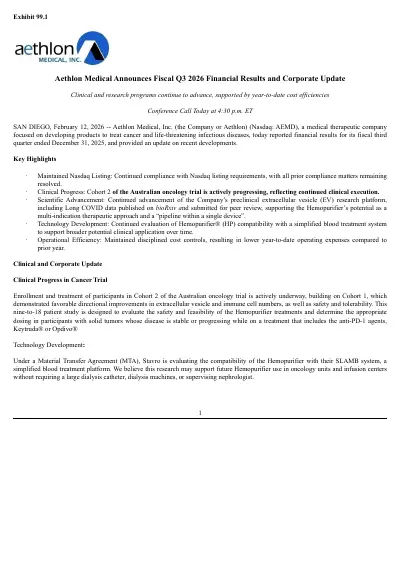
Now I would like to begin by highlighting progress during the December quarter and early calendar 2026, as we continue to execute against our strategy of advancing the Hemopurifier platform while maintaining disciplined cost control. Key developments include: continued enrollment and treatment progress in our Australian oncology trial, ongoing expansion of our extracellular vesicle, or EV, research platform, supporting the Hemopurifier as a potential multi-indication therapeutic, advancement of work evaluating Hemopurifier compatibility with a simplified blood treatment system that could expand future clinical and commercial flexibility, and sustained operating expense reductions on a year-to-date basis compared to the prior year.
Now I will turn the call over to Dr. LaRosa, who will cover updates on the Australian oncology trial and on our R&D efforts.
Steve?
Steven LaRosa
Thank you, Jim. Ongoing progress has been made in our Australian oncology trial of the Hemopurifier in participants with solid tumors not responding to a treatment regimen that includes immunotherapy with the anti-PD-1 agents pembrolizumab, known as Keytruda, or nivolumab, known as Opdivo.
We have previously reported the successful completion of the first cohort, where three participants received a single Hemopurifier treatment without any device-related serious adverse events or dose-limiting toxicities. Favorable directional improvement in EV numbers and immune cell numbers were observed in this cohort with the HP treatment.
We have now completed two HP treatments in two participants in the second cohort of the trial. We have also recently enrolled a third patient who has passed screening and is due to receive the two Hemopurifier treatments by the end of March, excuse me, by the end of February.
Once the three patients have completed treatment in Cohort 2, safety data will be presented to an independent Data Safety Monitoring Board. We are targeting late March for this meeting.
The DSMB will provide Aethlon Medical with a recommendation to either advance to the third and final cohort of the trial, where patients will get three Hemopurifier treatments in a given week, or they may require three additional patients in the current cohort. Aethlon has noted an uptick in the number of interested potential participants in this study since we contracted the groups Trialfacts and Dedicate.
Trialfacts performs online advertising of the trial, while Dedicate performs phone pre-screening of interested participants. Participants who pass this initial screening are then referred on to the three investigative sites for informed consent and more detailed screening.
This process has already resulted in HP-treated patients in the study and has provided a pool of potential future participants for Cohort 3 of the study. As a reminder, this 9- to 18-patient safety, feasibility, and dose-finding trial is in patients with solid tumors with stable or progressive disease while on a treatment regimen that includes either Keytruda or Opdivo.
Patients who meet all inclusion and no exclusion criteria are enrolled in sequential cohorts to receive one, two, or three Hemopurifier treatments during a treatment week. In addition to monitoring safety, the study is designed to examine the number of Hemopurifier treatments needed to decrease the concentration of extracellular vesicles, and if these changes in EV concentrations improves the body's own natural ability to attack tumor cells.
The scientific rationale and full design of this study have recently been published in the peer-reviewed journal BMJ Open, and the link to this article can be found on the Aethlon Medical website. I'll now change gears and talk about the R&D update.
Under a material transfer agreement, Stavro is studying the compatibility of the Hemopurifier with their SLAM system. This system utilizes a single small-lumen vascular catheter and a simplified blood pump compared to the large double-lumen vascular catheter and more complicated dialysis machines typically used for the treatment.
This research could lead to a simplified system for performing Hemopurifier treatments in oncology units and in infusion centers in the future, without the requirement to use a large double-lumen dialysis catheter, a bed in a dialysis unit, a dialysis machine, or a supervising nephrologist. The Aethlon Medical R&D team continues to attempt to build on our preclinical data in long COVID.
We have previously shown that the GNA affinity resin in the Hemopurifier binds EVs in long COVID patient samples and decreases microRNAs known to cause immune dysregulation. This data has been published in the preprint server bioRxiv and has been submitted for consideration in a peer-reviewed journal.
We are now exploring possibilities of investigating other cargo within the EVs, such as viral particles, with our technology. Extracellular vesicles, including platelet-derived EVs, have been implicated in the pathogenesis of a myriad of indications in addition to cancer, including, but not limited to, lupus, rheumatoid arthritis, systemic sclerosis, multiple sclerosis, cardiovascular diseases, sepsis, and ALS.
Aethlon previously published data on the removal of platelet-derived EVs from healthy plasma by the Hemopurifier in the preprint server bioRxiv. We plan to further this work by examining platelet-derived EV and microRNA removal by the Hemopurifier in patients with some of these indications, diseased plasma, to further this work.
This approach is in line with our thinking that the Aethlon Hemopurifier may provide a pipeline within a single device. With that, I'll turn the call back over to Jim for the financial discussion.
Jim Frakes
Thanks, Steve, and good afternoon again, everyone. Turning briefly to the financials, as of December 31, 2025, we had a cash balance of approximately $7 million.
Our consolidated operating expenses for the three months ended December 31, 2025, were approximately $2.06 million, up $250,000, or 13.6%, compared to the same period last year. This increase was primarily due to higher payroll and related costs, partially offset by lower clinical trial expenses and reduced professional fees, mainly from investor relations activities.
As a result, the operating loss for the quarter increased to $2.06 million compared to $1.81 million in the prior-year period. Other income, primarily interest income earned on cash balances, was $44,000, slightly lower than the $60,000 recorded in the same quarter last year.
Looking at the nine-month period, our operating expenses decreased significantly to $5.36 million, down $1.98 million, or 27%, from $7.34 million last year. This improvement reflects lower payroll, general and administrative costs, and professional fees, highlighting the impact of our ongoing cost management initiatives.
You can find more detail on these expense changes in our 10-Q, which breaks down specific drivers by category. We included these earnings results and related commentary in our press release issued this afternoon.
The release also included the balance sheet for December 31, 2025, and the statements of operations for the three- and nine-month periods ended December 31, 2025 and 2024. We will file our quarterly report on Form 10-Q following this call.
Our next earnings call, for the fiscal fourth quarter ending March 31, 2026, will coincide with the filing of our annual report on Form 10-K in June 2026. Now we would be happy to answer any questions that you may have.
Operator, please open the call for questions.
Operator
Thank you. We will now begin the question-and-answer session.
To ask a question, you may press star, then one on your touch-tone phone. If you are using a speakerphone, please pick up your handset before pressing the keys.
If at any time your question has been addressed and you would like to withdraw your question, please press star, then two. At this time, we will pause momentarily to assemble our roster.
The first question today comes from Marla Marin with Zacks. Please go ahead.
Marla Marin
Thank you. I just want to touch upon some of the things that you mentioned in the prepared remarks.
You moved on in the trial to Cohort 2. Given that the part of the trial's goal is to determine dosage, or the number of Hemopurifier treatments, and impact that they have on the trial participants.
Now you will be administering the treatment twice instead of with Cohort 1 the one-time treatment. The participants are involved in the trial for the same length of time.
Is that correct?
Steven LaRosa
It's the same follow-up period. The difference, as you correctly stated, was instead of getting one Hemopurifier treatment in Cohort 1, in Cohort 2 they get two.
They get it typically on a Monday or Monday and Friday, a number of days in between. We'll be able to see the kinetics of what the EV numbers do in between treatments.
Then we'll also see if the two treatments lead to more long-lasting decreases in EVs and more long-lasting effects on T cells compared to what we saw in the first cohort.
Marla Marin
Thank you for clarifying that. Then my next question is, if it turns out that the investigating the potential to connect the Hemopurifier to, I think you called it the SLAM system, can you give us some indication of what that would mean in terms of potentially opening new doors or facilitating your ability to get the Hemopurifier into different medical centers potentially down the road?
Steven LaRosa
Sure. Right now, Marla, you have to put in a dialysis catheter, which is a fairly we we call it kind of in medicine circles, we call it a garden hose.
It's a It's a large-bore catheter with two lumens, one that you take blood out, and then when you when you return the blood in. That's a pretty invasive device.
The SLAM system uses a a much smaller single-lumen catheter that wouldn't have to be put in in the neck. In hospitals where there are these things called PICC lines that are pretty much become ubiquitous, that are these small thin catheters that can be put in the crook of the arm.
That's what I would envision, so that would be a a big change in terms of the invasiveness of the catheter. Currently, for the Hemopurifier, we use a dialysis machine to run it.
We're We're solely using really the blood pump mechanism of the machine. We're not using all the other bells and whistles that a dialysis machine has, cuz we're not removing any fluids or or electrolytes.
We're at the mercy of a a dialysis machine, securing a bed in a dialysis unit, because that's the only place dialysis can be done in the hospital, and having a a treating nephrologist, because they're the ones who are skilled in using the dialysis machine. With this SLAM system, you'd have a single-lumen catheter with a simplified pump, which presumably would be much easier from an operator standpoint.
That opens the ability to do this potentially in a in oncology unit, where people get their chemotherapy infusions, or even in infusion centers, which most hospitals have in their ambulatory centers. It really opens the door to doing this, in oncology units as well as in say if it was an a patient with autoimmune disease that gets an infusion of whatever whatever immunosuppressive, those kind of units.
It really kind of removes you from the dialysis space, potentially.
Marla Marin
Just to make sure I understand, it removes you from that dialysis space and makes it much simpler for the hospital staff to administer the treatment, but also from the patient's perspective, it makes it less invasive and probably less daunting to receive the treatment. Is that the right way to think about it?
Steven LaRosa
Yeah. Cuz as I say, these PICC lines, they're typically put in what we call the antecubital fossa.
That's the space in between your forearm and your upper arm, right in front of your elbow. Getting a thin catheter there is a lot less daunting to a patient than getting a large catheter placed up in their neck.
They're also easier to take care of as well. They tend to have less complications.
I think that from a patient perspective, I'd much rather have one of these catheters than a dialysis catheter. I'd much rather be able to stay in my therapeutic home, meaning I'm going to an oncology unit to get my immunotherapy, I'd like to get my EV removal treatment in the same place and not have to go to a dialysis unit to have that done, which is what has to happen now.
It just makes it more integrated into care.
Marla Marin
Got it. Okay.
Thank you for that. Last question from me.
Jim, I know that you are extremely cost-conscious about just about everything that the company is doing and trying to make sure you maximize your R&D spend and optimize the operating costs. In the press release and in the prepared remarks, you did talk about building upon some of the preclinical research that you had done.
Can you just confirm that everything you're doing is consistent with that same very cost-effective approach you're taking generally, and how you're able to do some of what you're doing, like the long COVID, in a cost-effective manner?
Jim Frakes
Right. You're right.
I can't escape my Scottish heritage, I guess, on the cost containment front. We're trying to keep costs down as much as we can, yet still advance.
We're trying to obtain samples just for shipping costs, basically, to the extent we can. We're trying to do the work in-house with our small scientific staff, try to limit the work by outside labs.
Yet still advance. We're publishing articles, we are learning things.
We have to make trade-offs, but we do feel like we're advancing it, Marla.
Marla Marin
Okay. Thank you.
Steven LaRosa
While keeping the focus on the oncology trial, we're again delighted that we've treated two out of the likely three patients in the second cohort after finishing the first cohort last quarter. The progress is picking up on that front too.
Marla Marin
No, that is very apparent that things seem to really be moving forward at the pace that you are finally happy with or that is good to see, rather.
Steven LaRosa
Yes. That is true.
Marla Marin
Thank you.
Operator
Next question comes from Jeremy Pearlman with Maxim Group. Please go ahead.
Jeremy Pearlman
Thank you for taking my questions. Good afternoon.
First question related to the oncology trial, you said the third patient should be treated by the end of February, and then you'll present the safety data by late March. How long do you think the board will respond back whether you can move on to the third cohort or you have to, let's say, add additional patients into the second cohort?
What do you think the timeframe for that would be?
Steven LaRosa
Great question. I had misspoke, and so I'm glad you caught my correction, that third patient will be treated at the end of this month, February, and then the Data Safety Monitoring Board will occur likely in late March.
I can only go historically, last time, following the open session, on the day of the meeting, they had a closed session and they returned a signed document to me within a couple hours after. I would anticipate a decision same day or next business day.
Jeremy Pearlman
Great. Let's say just assuming they move you on to the third and final cohort, and you said also on your prepared remarks that you had a pool of applicants, you saw an uptick of interest of potential participants, how quick do you think you could turn those around to do the three Hemopurifier treatments and finalize the last cohort data and then push that through?
Steven LaRosa
That's a great question. This is what's really exciting.
Thanks to our controller, Michelle Bommarito, she got this Trialfacts and Dedicate, these groups that Aethlon contracted with. They have been able to supply the sites referrals.
We have a number of these folks aligned up. With the current protocol, you can't enroll or sign a consent for a new patient until you advance to that next cohort.
Once we do, those patients can then be approached. They're in the queue, to speak.
They can be approached for consent. There's then a screening period where they get some additional lab tests and review.
Then we have to line up the HP treatment around their next Hemopurifier treatment. The really exciting thing is, and again, we can't count our chickens, but there's a queue of potential participants waiting, which is really exciting for me.
Jeremy Pearlman
They can roll into the third cohort.
Steven LaRosa
They can roll into the third cohort. They'll sign consent and they'll just move on.
As opposed to saying now we got to go look, we at least have a pool to draw on.
Jeremy Pearlman
No, that's great. That's really good to have that pool to draw on.
Then this is just a hypothetical theoretical question related to how do you decide on the time gap between the first treatment, like you said earlier on a Monday and then you did the second treatment on a Friday, is there a specific reason why you chose the five days and is there a possibility where maybe extending the gap between the treatments would be more beneficial to the patient? Is this the optimal time, I'm just curious?
Steven LaRosa
Extracellular vesicles are produced by tumors, people with active tumors, continuously, the turnover's quite rapid. Going in again, this is a safety, feasibility, and our first time in oncology, we said we have to start with a single treatment and see how they do.
We knew it's unlikely that that's going to keep EV numbers down long term, right? We said, let's try two in a week, and let's also try three in a week, meaning Monday, Wednesday, Friday.
We thought anything more than that a patient won't tolerate because, for instance in dialysis, it's very hard for people to do more than three times a week. We thought that that was the most that somebody would be able to get during a week.
Then the other part of the story which I think you're getting at is, when we look, we'll say, how often do you have to repeat that whatever treatment regimen is? Do you have to do that every week?
Do you have to do that every two weeks? Do you have to do that once a month?
The way we have our sampling of labs, we'll be able to ascertain that. Is it once a week and then X number of time in between?
Is it twice a week with X number of time in, or is it three times a week? This was done with a little bit of background information from the plasma exchange trial at Mayo where they ultimately thought that you needed at least two to three times in a given week to keep EV numbers down.
The design was informed by what was in the literature in the plasma exchange space.
Jeremy Pearlman
Got it. Understood.
Thank you for that information. Then just last question related also to this potential incorporating it into the SLAM system, would there be any regulatory hurdles from your end or since that device is, I'm assuming it's already approved, if you could get the Hemopurifier compatible with it, it's ready to go?
Or you would have to do some sort of a safety test or something related to that before you could use it into that system?
Steven LaRosa
They're working on their submission for the FDA, it's not already approved. They'll have to do that, and then we would have to roll it in.
I'm sure we would be expected to do a certain number of treatments with the two in place.
Jeremy Pearlman
Understood. All right, thank you so much for taking my questions.
I'll hop back in.
Steven LaRosa
That's the plan.
Jeremy Pearlman
Got it.
Steven LaRosa
Yep.
Jeremy Pearlman
Understood. Thank you for taking my questions.
Steven LaRosa
Thank you.
Jeremy Pearlman
I'll hop back in to the queue.
Steven LaRosa
Sure.
Operator
Again, if you have a question, please press star, then one. The next question comes from RK with H.C.
Wainwright. Please go ahead.
Ramakanth Swayampakula
Thank you. Thanks, Jim, for doing this.
Couple of quick questions. With the Cohort 2, two out of three patients in, and if I understood it correctly, you are basically using the same patients who were in Cohort 1 into the Cohort 2.
If that is true—
Steven LaRosa
These aren't the same patients that were in Cohort 1. These are entirely new patients.
Ramakanth Swayampakula
They're entirely new. Fine.
You said the third patient is starting at the end of this month. Do you think, in a couple months down the line, we should be done with this Cohort 2?
The real question is, is there a real need to do Cohort 3, or do you think with Cohort 2, you would be able to judge if two treatments with Hemopurifier is enough to get the benefit that they could get? Or you still think you need to do Cohort 3?
Steven LaRosa
Okay. There's a bunch of questions there.
One is, yeah, you're right, the third patient is going to get their two HP treatments at the end of this month. Following that, the independent Data Safety Monitoring Board will decide if that's sufficient or whether, because it's a 3+3 safety study, they'll decide whether it's sufficient or whether we need to add three additional patients.
I can't nor would it be appropriate for me to speak for them. In the best possible scenario, by the time they meet at the end of March, we would have a directive to go ahead and begin in April with Cohort 3.
Cohort 3. To get to your next question about the need for Cohort 3, well, again, this was based on the Mayo Clinic data, which suggested that you needed two or three.
I think we would be really hamstringing ourselves to stop at two and not investigate three cuz I have every reason to believe three could potentially be superior to two in terms of EV removal or T cells. I think we would be selling ourselves short to stop at two.
I haven't seen any of the data from two to actually even prognosticate. It's way premature to call on the efficacy of two right now.
Jim Frakes
It was a good question, but without knowing the data
Steven LaRosa
it's tough,
Jim Frakes
right. It's purely hypothetical.
Steven LaRosa
Yeah.
Ramakanth Swayampakula
Okay. Then I have a couple of questions on the SLAM device integration.
As you were stating, when you go from the dialysis machine to this machine, the tubing itself, the catheters itself are smaller in size, which makes the patient feel not so cumbersome. On the other hand, the flow dynamics of the blood changes quite a bit, between the larger tubing and the smaller tubing.
Do you see that you might have to go through this rigmarole one more time with that machine because the flow dynamics are changed, the amount of capture of the EVs could be different because of the dynamics? What do you think?
Steven LaRosa
Yeah. Again, a lot of forward-looking questions there, but yeah, the first set of experiments is simply is their pump compatible with the device, meaning does our device function without triggering alarms and clotting off, etc.
They'll be doing this not on patients, but they'll be doing it in the lab with colored fluid and look at the pressures, etc. Then, you're right, there probably would have to be some ex vivo experiments looking to make sure the EV capture is similar.
Yes, the first step is seeing the compatibility of their pump with our device.
Ramakanth Swayampakula
Okay. Basically, that is not going to really help us move this trial any faster at this point.
It's something in the future, basically, correct?
Steven LaRosa
Not the current trial, and probably not even the next trial.
Ramakanth Swayampakula
Yeah.
Steven LaRosa
I don't think it would be done in time.
Ramakanth Swayampakula
Okay. Then the last question from me is at one point, you were talking about India, and then you kind of walked away from that idea.
Do you still see a possibility of having the Indian hospital get back into doing the clinical trial so you can kind of speed up the progress here, or is it first Australia and then we'll see what happens?
Jim Frakes
I think we're pretty highly focused on Australia, RK. While the PI is great there and the hospital's great, we're advancing at a very good pace right now in Australia and we just want to finish executing and get this trial done, and get the data out.
I think there'd be some expense and some distraction, the answer is no, we're not going to go back there.
Steven LaRosa
It'd be hard to advance to a PMA trial if you had another safety, feasibility trial going on in somewhere else in the world.
Jim Frakes
Right.
Ramakanth Swayampakula
Yeah.
Jim Frakes
If there's an emergency, if there's a pandemic breaking out in India, we know them, the PI is very comfortable with our device. We certainly could do an emergency use situation there, I wouldn't hesitate to consider that, but in terms of going back and doing a safety trial, no.
Ramakanth Swayampakula
Okay. Fair enough.
Thank you very much for taking my questions.
Operator
This concludes our question-and-answer session.
Jim Frakes
I would
Operator
like to turn the conference back over to Mr. Frakes for any closing remarks.
Jim Frakes
In closing, we remain focused on advancing the Hemopurifier platform through disciplined clinical execution and careful capital management. We appreciate your continued interest and support.
Have a good day. Goodbye.
Operator
The conference has now concluded. Thank you for attending today's presentation.
You may now disconnect.