AudioEye, Inc.
NNASDAQ:AEYEQ3 FY2026 · Earnings Call TranscriptOctober 26, 2026
Operator
Good afternoon, and welcome to AudioEye's third quarter 2026 earnings conference call. Joining us for today's call are AudioEye's Chief Executive Officer, Ms.
Kelly Georgevich, and Chief Financial Officer, Mr. Matthew Domeyer.
Following their remarks, we will open the call for questions from the company's publishing analysts. I would like to remind everyone that this call will be recorded and made available for replay via a link in the Investor Relations section of the company's website at www.audioeye.com.
Before I turn the call over to AudioEye's CEO, the company would like to remind all participants that statements made by AudioEye management during the course of this conference call that are not historical facts are considered to be forward-looking statements. The Private Securities Litigation Reform Act of 1995 provides a safe harbor for such forward-looking statements.
The words believe, expect, anticipate, estimate, confident, will, and other similar statements of expectation identify forward-looking statements. These statements are predictions, projections, or other statements about future events, and are based on current expectations and assumptions that are subject to risks and uncertainties.
Actual results could materially differ because of factors discussed in today's press release, in the comments made during this conference call, and in the Risk Factors section of the company's annual report on Form 10-K, its quarterly reports on Form 10-Q, and in its other reports and filings with the Securities and Exchange Commission. Participants on this call are cautioned not to place undue reliance on these forward-looking statements, which reflect management's belief only as of the date hereof.
AudioEye does not undertake any duty to update or correct any forward-looking statements. Further, management's remarks today will include certain non-GAAP financial measures.
A reconciliation of the most directly comparable GAAP financial measures to these non-GAAP financial measures is available in the company's earnings release or otherwise posted in the Investor Relations section of its website at www.audioeye.com. Now, I'd like to turn the call over to AudioEye's CEO, Ms.
Kelly Georgevich.
Kelly Georgevich
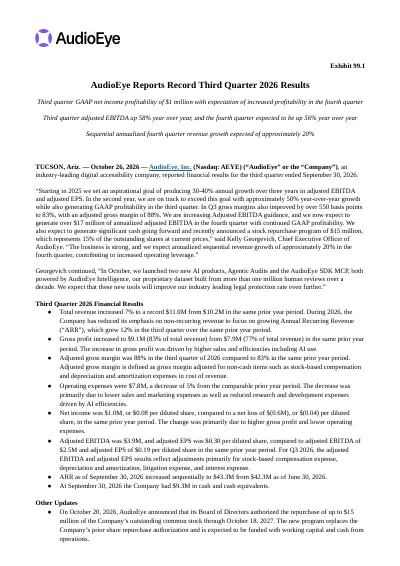
Thank you, operator. We had a great quarter, generating record revenue, record adjusted EBITDA, strong free cash flow, and positive GAAP net income, driven by efficiencies and increased AI use across the company.
We are also excited to discuss accelerating revenue growth in Q4, with continued operating leverage. In 2025, we introduced an aspirational goal of 30% to 40% growth in adjusted EBITDA and adjusted EPS per year over the following three years.
We are pleased to report that we continue to deliver against this aspirational target, and now expect approximately 50% growth in adjusted EBITDA in 2026. We also expect a Q4 adjusted EBITDA annualized run rate of over $17 million, up from previous expectations of $15 million.
This translates into an annualized run rate for adjusted EPS of around $1.30 in Q4. Gross margin improved over 550 basis points year-over-year, with adjusted gross margins of 88% in Q3, driven by efficiency and increased use of AI.
Adjusted EBITDA in Q3 was $3.9 million, up 58% year-over-year. The adjusted EBITDA margin was 35% in Q3.
As we anticipated, and as indicated last quarter, litigation expense decreased in Q3. We expect a further reduction in Q4, and believe litigation expense will continue to trend down.
We expect meaningful free cash flow generation in Q4 and into 2027, and we recently announced a $15 million stock repurchase program that runs through October 2027. This represents approximately 15% of the outstanding shares at current prices.
It's worth noting that our revenue has nearly doubled over the last five years, while our outstanding shares have increased by approximately 10% in this timeframe. We also had a strong quarter in terms of GAAP profitability.
In Q3, GAAP net income was $1 million, or 8 cents per share, compared to a net loss of $600,000 and 4 cents per share loss last year. Revenue was approximately $11 million, representing our 43rd consecutive quarter of record revenue.
ARR grew $1 million sequentially to $43.3 million as of September 30th, 2026, 12% over the prior year. On October 8th, we launched two new products: Agentic Audits and our SDK MCP.
Both are built on what we call AudioEye Intelligence, our proprietary dataset created from more than 1 million human accessibility reviews across more than 100,000 sites over 10 years. Our SDK MCP brings AudioEye Intelligence into AI coding tools developers already use, they can catch and fix issues while coding is being created.
Our Agentic Audits use an AI agent powered by our proprietary dataset to move through a site the way a real user would: opening menus, filling out forms, and going through checkout. They can find up to 50% more high-severity issues than automation alone, and most results come back within an hour.
Our solution already delivers three to four times the legal protection of others. These new products add to that protection, helping developers ship more compliant code from the start, and helping companies catch high-risk issues as their sites change.
These products represent exciting upsell opportunities. In September, we released a study on how well AI coding tools build accessible websites.
We asked AI agents to create 15 sites that comply with WCAG 2.2 AA standards. We found that even when explicitly instructed to make the site accessible, it could not.
The AI-generated sites averaged 55 issues per page compared to 62 on a typical site, and AI-generated e-commerce sites had three times as many issues as other e-commerce sites. Because AI models have been trained on an inaccessible web, they repeat the same accessibility failures.
Digital accessibility has become a critical part of AI readiness as well as compliance. As more agents complete tasks for humans, they increasingly rely on a web's accessibility tree to navigate the site.
To illustrate how important the accessibility tree has become, we've published research on how AI agents perform on inaccessible websites. We ran AI agents through everyday tasks on six sites, with and without AudioEye's fixes.
We found that on the least accessible site, AI agents completed only 31% of their tasks. With AudioEye's fixes, that rose to 96%.
AI agents navigate through a site's accessibility tree, when it's broken, they can't complete tasks like making a purchase or booking. This means an accessible site now serves two audiences: people with disabilities, and the AI agents acting on the behalf of customers.
On the regulatory side, in September, the European standards bodies published an updated accessibility standard that adopts WCAG 2.2, which raises the bar for companies covered by the European Accessibility Act. Stateside, Hawaii signed a new law in July, Act 257.
Act 257 is the first state law to require all private businesses to conform to WCAG 2.1 level A and AA through rules the state is now finalizing. This will have significant implications for the travel and hospitality industry.
We believe other states may follow Hawaii's lead. The new law took effect July 14th, 2026, with compliance deadlines 24 to 36 months after the rules are final.
Turning to guidance. For the fourth quarter of 2026, we expect revenue between $11.4 and $11.6 million, a sequential increase from the third quarter of 2026 of approximately $550,000 at the midpoint, and approximately 20% annualized sequential revenue growth.
For the full year 2026, we are narrowing the revenue range to be between $43.6 and $43.8 million. For the fourth quarter of 2026, we expect adjusted EBITDA of between $4.2 and $4.4 million, a 56% increase over the fourth quarter of 2025 at the midpoint, and an adjusted EBITDA margin of approximately 37%.
We expect adjusted EPS of between 32 and 33 cents per share for the fourth quarter of 2026. For the full year 2026, we are increasing adjusted EBITDA guidance from at least $12.7 million to be between $13.4 and $13.6 million, representing approximately 50% year-over-year growth.
As mentioned earlier, Q4 adjusted EBITDA guidance represents an annualized run rate of over $17 million, and we expect cash generation to ramp significantly in Q4 and 2027. In the fourth quarter, at the midpoint of guidance, an adjusted EBITDA of $4.3 million less around $400,000 of software development costs implies $3.9 million of adjusted free cash flow.
Litigation expenses decreased in Q3, down approximately 50% from the second quarter. Further decreases in litigation expense are expected in the fourth quarter, contributing to substantial cash generation.
With that, I'll hand it over to Matt to cover our financial results in more detail.
Matthew Domeyer
Thank you, Kelly. As Kelly mentioned, revenue for the third quarter was a record $11 million, representing our 43rd consecutive period of record revenue.
Annual recurring revenue was $43.3 million as of September 30th, 2026, up from $42.3 million as of June 30th, 2026. Year-over-year, ARR grew 12%, driven by double-digit growth in both our partner and marketplace and enterprise channels.
As of September 30th, 2026, AudioEye had approximately 130,000 customers, up 7,000, or 6%, from approximately 123,000 customers as of September 30th, 2025, and up approximately 1,000 from June 30th, 2026. The increase was driven primarily by our partner and marketplace channel, with enterprise customers also increasing.
Both of our two revenue channels continue to deliver strong results. AudioEye's enterprise channel consists of our larger customers and organizations that generally engage directly with AudioEye sales personnel for pricing and solutions.
As we have previously discussed, in 2026, we have reduced our emphasis on non-recurring revenue to focus on growing ARR. In the third quarter of 2026, enterprise revenue was relatively flat year-over-year, with lower non-recurring revenue being offset by increases in recurring revenue.
Our focus on enterprise ARR is showing results, and it increased 10% over the comparable prior year period as we continue to deliver some of our strongest new and expansion business to date. As of September 30th, 2026, enterprise ARR represented approximately 41% of total ARR.
Our partner and marketplace channel includes all revenue from our SMB-focused marketplace products, as well as from partners who deploy these products for their SMB customers. In the third quarter of 2026, the partner and marketplace channel revenue increased 14% year-over-year.
We again saw strong expansion from our state and local government partners in the quarter. Partner and marketplace ARR grew by 14% compared to the prior year quarter, and represented approximately 59% of total ARR as of September 30th, 2026.
Gross margin for the third quarter expanded over 550 basis points to 83%, compared to 77% in the third quarter of 2025. Gross profit grew 15% to $9.1 million, compared to $7.9 million in the prior year period.
While revenue grew 7%, cost of revenue declined 19%, resulting in 160% conversion of incremental revenue to gross profit. The reduction in cost of revenue came primarily from AI-driven efficiencies in engineering and service delivery.
Adjusted gross margin was 88% in Q3 2026, compared to 83% in the prior year comparable period. The increase in adjusted gross margin is consistent with the GAAP change.
In the third quarter of 2026, operating expenses decreased 5%, or $400,000, to $7.8 million. The decrease in operating expenses was driven primarily by lower R&D and sales and marketing expense.
Our total R&D spend in Q3 was approximately $1.3 million, including approximately $400,000 recorded as capitalized software development costs. Total R&D spend decreased 17% year-over-year, and was around 12% of Q3 2026 revenue, down from 15% in Q3 2025, driven by increased AI usage.
Net income in the third quarter of 2026 was $1 million, or 8 cents per diluted share, compared to a net loss of $0.6 million, or 4 cents per share, in the same year-ago period, driven by higher gross profit and lower operating expenses noted previously. In the third quarter of 2026, we achieved record adjusted EBITDA of approximately $3.9 million, or adjusted EPS of 30 cents per diluted share, and an adjusted EBITDA margin of 35%.
This compares to Q3 2025, which had an adjusted EBITDA of $2.5 million, or adjusted EPS of 19 cents per share, and an adjusted EBITDA margin of 24%. The $1.4 million, or 58%, increase in adjusted EBITDA over the comparable period of the prior year was primarily driven by increases in gross profit and AI efficiencies.
In the third quarter, we generated $3.5 million of free cash flow, calculated as adjusted EBITDA of $3.9 million less $400,000 of capitalized software development costs, an improvement of $1.5 million from the third quarter of 2025. Turning to the balance sheet, we ended the quarter with $9.3 million in cash, an increase of $600,000 from June 30th, 2026, and $3 million available under our revolving line of credit.
As of September 30th, 2026, our net debt, defined as total debt less cash, was $7.2 million. Net debt has declined approximately $1 million year-to-date, and our net debt to adjusted EBITDA ratio, using the midpoint of our updated 2026 adjusted EBITDA guidance, is approximately 0.5.
With that, I'll turn the call back to the operator to open the line for questions. Operator?
Operator
Thank you. We will now take questions from the company's publishing analysts.
If you would like to ask a question, please press star one on your telephone keypad. A confirmation tone will indicate your line is in the question queue.
You may press star two to remove yourself from the queue. For participants using speaker equipment, it may be necessary to pick up the handset before pressing the star keys.
Our first question comes from the line of Joshua Reilly with Needham & Company. Please proceed with your question.
Joshua Reilly
Great, thanks for taking my questions. Nice job on the quarter here.
I know it's early on the two new AI products released in October, but maybe you can share how much you're seeing in terms of the push-pull dynamics on AI features from customers, and are customers requesting more AI functionality, or are you seeing that you need to build awareness of what AI can do for them?
Kelly Georgevich
It's definitely still early days. We just released the products a couple weeks ago.
Far, feedback has been very positive, especially with the customers who've been in beta. I think I'd say both, but I'd say some of it has to be education on the customer side.
We think these are really powerful add-ons for customers, especially to do more in real time or between audits. We're pretty excited about what they can do, especially on the expansion side.
Joshua Reilly
Got it. Then as we think about the ARR growth going forward, how sustainable is this low double-digit growth rate for the balance of 2026 without giving any specific guidance?
What are the puts and takes investors should be considering for Q4 ARR growth that could maybe lead to outperformance? Then in 2027, once again, it seems the demand environment should be further improving given the tailwinds out there.
Is there anything we should be considering in terms of the macro or otherwise that may impact demand trends? Thanks, guys.
Kelly Georgevich
We had, what, 12% year-over-year ARR growth, which is good to see. I think we expect that to continue into Q4.
We're seeing really good momentum across the board, near-record new and expansion business, really solid growth from partners. All of that is just a positive for Q4 and expectations there on ARR.
I think we can expect something similar for 2027 with some additional accelerators or things that could move the needle, things like our new product offerings. I think as agents take over more tasks, the readability of sites and how accessibility plays into that could be really interesting.
Then, of course, enforcement of the EU could move the needle further.
Joshua Reilly
Thank you very much.
Operator
Thank you. Up next in the queue, we have George Sutton with Craig-Hallum Capital Group.
You may proceed with your question.
Logan Lillehaug
Hey guys, Logan on for George here. First one for me, I wonder if you could just unpack the step down in cost of goods sold this quarter a bit more, and maybe just talk in any more detail about where the AI efficiencies are coming into play.
I guess, is there more room for margin improvement here, or should we think about this as sort of a one-time step function improvement?
Matthew Domeyer
Logan, it's Matt. We saw 550 basis point increase in margin, which was a really great improvement, the gross profits helped by the growing ARR, and we're able to scale.
We got a long track record of lowering expenses and working to manage and scale, and so I think, where we're at right now, we expect to be able to maintain those rates, and we'll keep looking for room to expand the margins as we can going forward.
Logan Lillehaug
Got it. Then going back to the new AI products, and again, recognizing that it's early, can you give any sense for what kind of uplift in sort of revenue per customer those new products might have?
Kelly Georgevich
It's probably too early to quantify it, but I do think they are expansion opportunities for customers, kind of as in between their audits and additional current services that they already have.
Logan Lillehaug
I'll leave it there. Thanks.
Operator
Thank you. Up next in the queue, we have Richard Baldry with ROTH Capital Partners.
You may proceed with your question.
Richard Baldry
Thanks. I'm going to probably ask this a few times going forward, but people seem worried about AI sort of becoming a competitive threat in a lot of different verticals.
We've had these tools out for a little while, the large language models. Have you seen any actual new competitors enter the market trying to leverage those tools to create new businesses in competition with yourselves?
Kelly Georgevich
We haven't seen much in the market, no. I think that study we put out kind of emphasizes what we've been talking about for some time, which is, we have this proprietary dataset that no one else has of over a million human fixes over 100,000 websites over 10 years, no one can replicate that.
What the web has been trained on and what AI is trained on has been inaccessible sites. The idea of a new product coming in or a new competitor coming in that can just do what we've been doing for 10 years is just not possible.
That's part of the reason we put out the study over the last three months or so, was to prove that AI just can't do this. We found that AI essentially had no impact when you instructed it to create a site that was accessible, and our AI tools are powered with our proprietary dataset.
Richard Baldry
When you think about the new tools and the automation you're able to achieve with them, is there a way to think about how much of your prior workload you're able to automate, and how much you think you could incrementally automate over time, and how much sort of either now or long term remains probably manual because of complexity or other issues?
Kelly Georgevich
We definitely still find that you need the manual aspect of an audit. What we like about these new products and what they can do is they can find on the Agentic Audits significantly more issues than our automation, about 50% more of those high-severity issues, they're nice little fill-ins after a website redesign or between audits.
Same on the SDK MCP is while you're creating code, if you can solve a number of the issues that you would have to wait for an audit to find, I think that's pretty powerful.
Richard Baldry
You've had significant improvements in OpEx and on your cost of goods lines. How deep into the process of automating your own operating side of the table and your go-to-market COGS side do you think you're at?
How much incremental profitability do you think you could do even off the same revenue base with further automation?
Kelly Georgevich
We've been able to ramp revenue without ramping expenses for a number of years, and I think AI has just given us that extra kind of milestone where we've been able to implement AI and be very efficient across all departments. I think we expect to see that to continue, so as revenues increase, I don't think we'll need to ramp expenses significantly, but we're still focusing on finding further efficiencies as well.
Richard Baldry
Last for me, more sort of top-of-the-funnel, if you look at your sales overall, sort of the pipelines, can you talk about the degree to which they're expanding either in sort of geographies where the regulatory environment is pushing it outside of those, how you feel about those entering or heading toward fiscal '27?
Kelly Georgevich
I think we're seeing some of our best lead volume to date still, and as I mentioned, some of our best new business and expansion ARR to date. Litigation is still growing at record levels, so that's definitely a factor that we're continuing to see.
Regulation is helping, but I think demand overall is growing, and that private litigation is driving demand as well. As EU ramps enforcement, we expect to see additional demand, and I do think there's a possibility for additional demand with the AI readiness and linked to accessibility.
Richard Baldry
Maybe one last one to squeeze in. Your cash hit a multi-year high in the quarter.
I'm sort of curious, what do you think a comfortable level of cash for operations is now that your EBITDA is scaling the way it is? Sort of against a backdrop of how much you'd be willing to use the on-hand cash for buyback versus use it out of quarterly cash flow from ops?
Thanks.
Kelly Georgevich
Yeah. We have the $3 million line of credit, I think we're pretty comfortable at levels that we've been at over the last handful of quarters.
I do think that there's a key aspect of significant cash generation in Q4 and into 2027, which allows us to do a lot with that extra cash. I think we feel pretty comfortable with where it's at now.
Richard Baldry
Great, thanks. Congrats on the quarter.
Kelly Georgevich
Thanks, Rich.
Operator
Thank you. Our last question comes from the line of Scott Buck with Titan Partners.
You may proceed with your question. Hi,
Scott Buck
good afternoon, guys. Appreciate the time.
Kelly, on the new agentic products, how are they priced? Are they standalone SKUs, or are they bundled with kind of existing products?
Kelly Georgevich
You can purchase them as either. You can purchase them as standalone, and so like an add-on to your current line items on your contract, or certain products, one of the two you can buy as a standalone product.
Scott Buck
Perfect. Then, customer counts rose about 6%, ARR grew 12%.
Is ARR growing because of mix, pricing, upsells? Help kind of bridge me there.
Kelly Georgevich
Really across the board. We saw double-digit ARR growth in both our enterprise, which is kind of new and expansion business, both kind of approaching record numbers, and the partner sign as well, kind of operating and performing on all cylinders.
Scott Buck
Okay. Then last one on capital allocation and the announced buyback.
How quickly you expect to execute on the buyback, and is that constrained by the credit agreement?
Kelly Georgevich
Our stock is trading at 6 times adjusted EBITDA, and growing 50% year-over-year, we do think it's an attractive time to buy and a good way to deploy excess cash for shareholders. We have a good relationship with our debt provider and don't see any issues there.
Scott Buck
Perfect. I appreciate the added color.
Thank you.
Kelly Georgevich
Thanks, Scott.
Operator
Thank you. At this time, this concludes our question-and-answer session.
I'd now like to turn the call back over to Ms. Kelly Georgevich for her closing remarks.
Kelly Georgevich
I'd like to thank our employees, customers, and investors for their continued support, and we look forward to providing an update on the next call.
Operator
Before we conclude today's call, I would like to remind everyone that a recording of today's call will be available for replay via a link in the Investor Relations section of the company's website. Thank you for joining us today for AudioEye's third quarter 2026 earnings conference call.
You may now disconnect.