Albemarle Corporation
Q3 FY2026 · Earnings Call TranscriptNovember 5, 2026
Operator
Hello, and welcome to Albemarle Corporation's Q3 2026 earnings call. I will now hand it over to Meredith Bandy, Vice President of Investor Relations and Sustainability.
Meredith Bandy
Thank you, and welcome, everyone, to Albemarle's third quarter 2026 earnings conference call. Our earnings released after market close yesterday, and you'll find the press release and earnings presentation posted to our website under the Investors section at albemarle.com.
Joining me on the call today are Kent Masters, Chairman and Chief Executive Officer, and Neal Sheorey, Chief Financial Officer. Eric Norris, Chief Commercial Officer, will also be available for Q&A.
As a reminder, some of the statements made during this call, including our outlook, expected company performance, and strategic initiatives, may constitute forward-looking statements. Please note the cautionary language about forward-looking statements contained in our press release and earnings presentation.
That same language applies to this call. Please also note that some of our comments today refer to non-GAAP financial measures.
You'll find reconciliations in our earnings materials. Now, I'll turn the call over to Kent.
Kent Masters
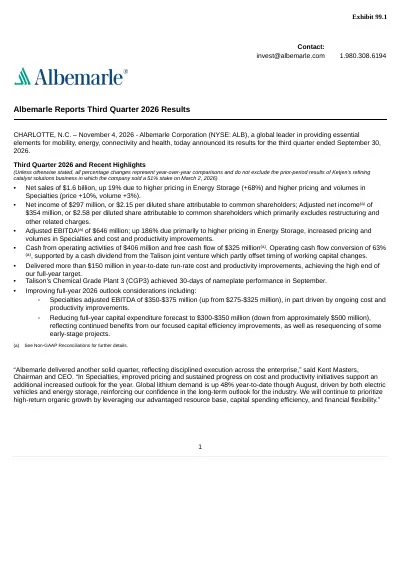
Thank you, Meredith. Albemarle delivered another solid quarter, supported by disciplined execution across the enterprise.
We reported third quarter net sales of $1.6 billion and adjusted EBITDA of $646 million. Energy Storage results were supported by higher lithium pricing year-over-year, and Specialties outperformed with both higher pricing and volumes.
Both segments are benefiting from ongoing cost and productivity efforts. Year-to-date, our teams have delivered more than $150 million in run-rate cost and productivity improvements, achieving the high end of our full-year target.
Importantly, we have converted those strong earnings into cash. Year-to-date, we've generated $1.5 billion of cash from operations and $1.2 billion of free cash flow.
Our year-to-date operating cash conversion rate of 67% is at the high end of our benchmarking range. We are also improving our 2026 outlook considerations.
We are increasing our adjusted EBITDA outlook for Specialties, based on strong year-to-date performance, steady market demand, and continued cost and productivity improvements. We are also reducing expected full-year capital expenditures through focused capital efficiency and the resequencing of some early-stage project spending.
End-market fundamentals remain strong for both our businesses. Global lithium consumption increased 48% year-to-date, led by continued strong demand for energy storage systems and rebounding demand for electric vehicles.
Lithium demand continues to outpace supply growth. Finally, at our world-class resources, the Greenbushes CGP3 expansion project achieved 30 days of nameplate performance in September.
We are also progressing near-term growth opportunities at Greenbushes, Wodgina, and the Salar de Atacama. Now, I'll turn it over to Neal to discuss our financial results and outlook.
Then I'll return to cover market trends, our resource position, and a few closing comments before opening the call for Q&A.
Neal Sheorey
Thank you, Kent, and good morning, everyone. I'll begin with our third quarter results on slide 5.
Net sales were $1.6 billion, up 19% year-over-year, driven primarily by higher pricing in Energy Storage and higher pricing and volumes in Specialties. Adjusted EBITDA was $646 million, up 186%, reflecting improved market conditions and continued cost and productivity improvements in both segments.
As a result, adjusted EBITDA margin expanded to 42%. Net income attributable to Albemarle was $297 million, or $2.15 per share.
Adjusted earnings per share, which primarily excluded restructuring and other related charges, were $2.58 per share. Turning to slide 6.
As usual, we provide the key drivers of our adjusted EBITDA growth year-over-year. Higher cost of goods sold primarily reflects the processing of higher-priced spodumene inventory and increased Chilean commission payments due to higher lithium pricing.
As you see here, increased equity income from our Talison joint venture offset the impact of the higher spodumene pricing running through COGS. By segment, Energy Storage adjusted EBITDA increased 351% due to higher lithium pricing.
Specialties adjusted EBITDA increased 31% on higher pricing and volumes, driven by increased demand for bromine products. In both segments, cost and productivity improvements helped offset increased fuel and raw material costs driven by the conflict in the Middle East.
Corporate and other declined primarily because the prior-year period included EBITDA from the Ketjen refining catalyst solutions business that was divested in the first quarter of 2026. Turning to slide 7.
Thanks to our disciplined execution, Albemarle's year-to-date results have trended toward the higher end of the $20 scenario. This is due to Specialties outperformance, higher volumes at Wodgina, and successful cost and productivity improvements.
Year-to-date, lithium market pricing has averaged approximately $20 per kilogram lithium carbonate equivalent, or LCE. Moving to slide 8.
In Specialties, geographic and end-market diversity has helped us manage through notable headwinds, such as the conflict in the Middle East. We are the only bromine producer with access to world-class reserves in both Jordan and the U.S., which has given us flexibility to meet dynamic customer needs.
As with most companies, we have seen higher costs related to the conflict, including select raw materials and logistics. At the same time, a tighter petrochemical supply chain has led to concerns around security of supply, supporting demand for our bromine products.
In spite of the geopolitical volatility in the region, our Jordan Bromine Company joint venture achieved record quarterly production in the third quarter, which further enabled our ability to capture market growth. For the full year, we are increasing the Specialties adjusted EBITDA outlook to $350 to $375 million, reflecting strong year-to-date performance, our expectation of steady demand in the fourth quarter, and further focus on cost and productivity actions.
Moving to Energy Storage on slide 9. Third quarter revenues and adjusted EBITDA were up significantly year-over-year, primarily due to higher pricing.
I'll note that last year's third quarter set a high bar for sales volumes, given the timing of spodumene shipments and inventory destocking. By comparison, third quarter 2026 shipments of 56,000 tonnes LCE were down year-over-year.
This is in line with our full-year volume expectations following the outage at CGP3 earlier this year. For the fourth quarter, we expect Energy Storage net sales and adjusted EBITDA to decrease sequentially, assuming today's lower market pricing persists for the remainder of the quarter, while volumes will be steady with the third quarter.
Margins are also expected to decrease sequentially, as higher-priced spodumene from our Talison JV flows through inventory and into production costs at a time when pricing is trending lower. Expected full-year sales volumes remain in the range of 225 to 235 thousand tonnes LCE, as the outage at CGP3 earlier this year is mostly offset by higher production and sales at Wodgina.
Our contract versus spot mix for 2026 is also unchanged. Slide 10 highlights our continued progress on cost and productivity improvements and cash management actions.
Year-to-date, we have achieved more than $150 million in run-rate cost and productivity improvements, reaching the high end of our full-year target. The improvements span manufacturing costs, incremental volume and yield gains, and supply chain and back-office initiatives.
Our focus on cash conversion and generation continues to show through. Year-to-date, we have generated $1.5 billion in cash from operations, representing an operating cash flow conversion of 67%.
Our conversion metric remains at the higher end of our benchmark target range of 60 to 70%. We continue to highlight our focus on cost, productivity, and cash, not only because we believe it's prudent, but also because it bolsters our competitiveness and continues to provide us with financial flexibility.
Turning to slide 11. We are reducing our expected 2026 total capital expenditures to $300 to $350 million, from approximately $500 million.
This is a meaningful reduction, and it is the result of purposeful analysis and focus that we have put on our capital spending for some time. We are capturing the benefits from our work to improve capital efficiency, including initiatives like best-cost country sourcing, third-party spend optimization, and streamlining our capital planning processes.
The reduction reflects a mix of two things: first, capital efficiency improvements that benefit both growth and sustaining capital projects; and second, resequencing early-stage project spending to better align with project timelines, which primarily impacts growth capex. To be clear, these improvements still prioritize the must-do capital for safety, critical maintenance, and regulatory purposes that our assets require.
As a result of our efforts, we are now targeting less than $300 million of sustaining capital spending in 2026. With that, I'll turn the call back to Kent to discuss demand and our resource position.
Kent Masters
Thanks, Neal. I'll start with an update on the lithium market.
We're maintaining our lithium demand forecast, which you can find in the appendix of these slides. We are encouraged that lithium demand continues to diversify across end markets and geographies, giving us greater confidence in the industry's long-term growth.
Starting on slide 12, stationary storage production nearly doubled year-over-year through September, maintaining the strong growth rate that we have seen throughout 2026. This significant demand growth is supported by global electricity demand, the need for grid reliability and energy security, storage project economics, and policy support in regions such as China, Europe, and Australia.
The broader driver is robust end-use demand for grid resilience and power generation, as renewables paired with storage are among the lowest-cost and fastest ways to add energy to the grid. Turning to slide 13 for additional perspective on the durability of the stationary storage outlook.
Lithium battery demand for stationary storage is expected to grow at a 25% CAGR through 2030. This high growth rate has made stationary storage as significant a demand driver as EVs in 2026.
At its core, this demand is driven by economics. Due to the reduced cost and increased global scale for lithium-ion batteries, stationary storage installations deliver attractive returns across most major end markets, such as China and Europe.
These returns are supported by multiple revenue streams, improving project bankability and access to financing. As a result, approximately 1,000 gigawatt-hours of stationary storage projects are in the pipeline for 2027.
This is in line with 2026 battery production, as the global average lead time between battery production and installation is more than one year. Current stationary storage inventories are needed to support significantly higher 2027 installations.
With our level of downstream visibility, we see battery producer order books remaining solid in the first half of 2027. We are still in the early stages of global stationary storage adoption.
The long-term need for storage is substantial, supporting a five-year lithium demand CAGR of approximately 25% for stationary storage. This growth is underpinned by growing electricity demand as renewables continue to increase in share of global energy production.
Most third-party forecasts expect 30 to 40 terawatts of storage are needed by 2050, 20 times what has been produced to date. Turning to slide 14, global electric vehicle sales increased 11% year-over-year through September, continuing the demand inflection that started in the second quarter.
This improvement is led by strong demand in Europe and rest of world. Europe remained strong, up 35%, supported by policy initiatives and higher oil costs.
In China, increased exports and larger battery sizes offset weaker domestic EV sales. Rest of world remained the fastest-growing region, up 94% year-over-year, as EV penetration continues to diversify globally.
Slide 15 shows this geographic diversification in more detail. Rest of the world EV sales have nearly doubled year-over-year and now represent 14% of global EV sales through September, up 8% in the prior-year period.
Recent shocks in oil pricing and availability have driven an increase in EV penetration. Oil-importing countries increasingly view EV adoption as an energy security measure.
This growth is broad-based across Southeast Asia, Japan and Korea, South America, and other markets like Australia and India. Chinese exports account for approximately 60% of rest of world sales, while policies in markets like Vietnam, Thailand, Indonesia, and Brazil are supporting domestic manufacturing.
Turning to slide 16, our world-class resource base provides multiple capital-efficient growth options. We've seen good improvements across our resources in the third quarter and promising development for both near- and long-term growth.
At Greenbushes, CGP3 achieved 30 days of nameplate performance in September. We are pleased CGP3 has resumed a successful ramp and expect to see the full benefit of that expansion in 2027.
The Greenbushes management team continues to progress optimization studies and has identified opportunities across the mine. The team is now working to incorporate these opportunities into life-of-mine planning as they are assessed and approved by the JV partners.
Wodgina continues to operate three trains successfully, with higher production and recoveries. The team at Wodgina is also progressing expansion studies.
Chile delivered solid operating progress, with lithium production up year-over-year at the Salar and La Negra through September. We also advanced the DLE project into feasibility stage and continue to progress permitting on schedule.
Together, these results demonstrate strong execution of current operations while advancing our high-return, brownfield growth opportunities. As previously announced, on February 1st, Rag Udd will join Albemarle as CEO, and at that time, I will move to Executive Chairman to ensure a smooth transition.
As this is my last earnings call as CEO, I want to take this opportunity to say what a privilege it has been to lead the Albemarle team. Over the past six years, we have accomplished a great deal together.
We've established Albemarle as a global leader in lithium and bromine, with expanded scale, even stronger financial flexibility, and global market leadership. We've delivered strong performance through the cycle by moving decisively as conditions changed to reposition the portfolio, reduce cost, and increase earnings power and cash flow generation.
Finally, and perhaps most importantly, we positioned Albemarle for even stronger performance and growth by putting in place a lower and more competitive cost structure, a simpler organization and portfolio, stronger capital discipline, and a world-class resource and asset base that can support disciplined, high-return growth. I'm excited for Albemarle's future, leveraging our strong position today, and looking forward to our next chapter under Rag's leadership.
With that, I'll turn the call over to the operator for Q&A.
Operator
We will now move into our Q&A portion. If you would like to ask a question, please press star five to raise your hand.
As a reminder, that is star five to raise your hand. Also, please bear in mind this Q&A session is limited to one question and one follow-up per person.
We'll take our first question from Patrick Cunningham with Citi. Your line is now open.
Patrick Cunningham
Hi, good morning. This is Alex Han for Patrick.
I guess it seems like there's an increasing, really strong focus on the cost discipline on the Specialties side. Can you maybe walk us through some of the actions you're taking there and how much incremental benefit we should expect in '27?
Kent Masters
I'll start with that. First comment would be it's across the whole organization, not just Specialties.
We're trying to get very focused, make us a kind of a leaner organization, and that's kind of across everything: operations, productions. I think you saw in the comments we had a record production quarter, third quarter, at JBC, in spite of kind of the disruptions happening in the region.
There's a lot of focus on operating costs, on productivity, on efficiency throughout the enterprise. It goes back office, supply chain, we're getting pretty focused and have been on that path for the last I would say three years and we're getting better at it.
You see doing the same thing on capital. That's a big program that we have of getting much more focused, particularly on sustaining capital, looking at benchmarks, trying to be best in class around how we maintain our assets, and looking significantly at different way between growth capital and sustaining capital.
A lot of focus on both, but looking at them different ways and benchmarking sustaining capital against other manufacturing organizations that we think are similar and world class. It's not just Specialties, but there is a focus on Specialties, but I think it goes across the enterprise.
Patrick Cunningham
Great. Then just for the follow-up, I think pricing was higher quarter-on-quarter, despite some declines in spot market.
I'm just curious, was there less spot volume or spodumene volume sold sequentially?
Neal Sheorey
Hi there, Alex. This is Neal.
I can take a little bit of this. Remember that our pricing in a particular quarter can be above the market for reasons actually different than what you mentioned with regards to mix.
Yes, mix is one part, but also remember that our contract volume has a three-month lag to it. Actually, for some of that contract volume that came through in the third quarter, what we actually saw was pricing that was more indicative of the second quarter.
There are things like that that also come through in our numbers, which would drive our pricing at times to be above the market.
Operator
Our next question comes from Josh Spector with UBS. Your line is now open.
Josh Spector
Hey, guys. This is James Cannon on for Josh.
Thanks for taking my question. I kind of wanted to dig in on lithium prices as well, just thinking about the price declines we're seeing in China against some of the commentary about consumption outpacing supply growth.
Can you just unpack a little for us what you're seeing that's potentially driving some of those price declines?
Kent Masters
Maybe I'll start on it. Eric can add some detail around that, but what you see in the trading markets is a little disconnected from the physical market.
Inventories are at a level that would typically indicate a fairly tight market. We see that in the numbers that we see in our own inventories as well, and then we see comments from customers that are asking us questions around the same thing.
As you said, the lithium demand's been higher than supply growth, and it seems strange with the market moving it is. It has to be people or the traders looking further out and assuming that that's going to shift in a year's time or so, but it's unusual to see that happening in the near term.
We're a little surprised by that as well. Eric, you want to—
Eric Norris
Yes. Kent, just to reiterate, demand this year has been very strong to date.
Supply has had challenge keeping up with that, the rate of supply growth lower than demand, and inventories are healthy. Getting underneath all of that, I think there is, as Kent said, it's a speculation on what might happen, but what is happening, what we're hearing from our customers, is strong demand continuing in the ESS sector.
Kent described during his prepared remarks that demand growth has been significant this year, about 840 gigawatt-hours of production, but that is forecasted against or is going to be applied against demand that's 12 months ahead, which are the up to a 1,000 gigawatt-hours of announced capacity in installations. That's not unusual.
I think there's been some speculation on inventory build. We don't see the inventory build unusual.
What's happening is this is planned production against future demand that feels very solid. That's what we're hearing from the market.
We're also seeing significant growth outside of China for electric vehicles, while the China market is gradually improving, and is still the workhorse of demand for the EV sector. Europe is up significantly.
The rest of the world is nearly double, and by rest of world, we mean everywhere but Europe, China, and the United States. As we've said many times, the U.S.
is a very small, almost not very relevant market to the EV picture. All of this is being driven by the affordability of EVs, coupled with high oil prices.
The demand side doesn't foot with what we're hearing on or what we're seeing in the speculation in futures markets for lithium. On the supply side, we have a similar disconnect.
On the supply side, as I said, the supply's had trouble keeping up. We've seen a lot of marginal cash-cost capacity announced to come on, largely Australian spodumene.
That was announced when pricing was significantly higher than it is today. At today's prices, that supply is going to be much less economic, if economic at all.
These are companies that have balance sheets that have to be focused on whether they can operate at that level successfully. We see that as being a challenge.
I think we also see challenges on the supply side of Africa. Africa is very important to supporting the growth and the appetite that China has for spodumene consumption.
Zimbabwe export ban has been reaffirmed, and we doubt that many producers are going to be able to comply with the downstream beneficiation requirement that the government wants there. Other projects throughout the region are challenged by inland and port logistics.
We see the supply is needed, but we see more challenges versus the face announcement of what would come on from a supply standpoint. Bottom line, you'll never hear us get out and try to predict price ourselves, but the fundamentals in the physical market don't support what we're seeing in the spot market now.
Josh Spector
Got it. Thank you very much.
Operator
Our next question comes from John Roberts with Mizuho. Your line is now open.
John Roberts
Thank you. At the end-customer level for stationary storage and EV sales, what would you guess the regional breakdown currently is?
Where the lithium finally ends up being installed or consumed in a car purchase?
Kent Masters
Those are going to be different answers between EV and the fixed storage market. The fixed storage market's becoming a bigger part.
You heard in our comments that the growth year on year was kind of the same with EV and fixed storage, and fixed storage is about 30% of the overall market now as well. I'm not sure if I can go around the world in each segment and tell you where the market is.
Eric, can you cover that?
Eric Norris
There's a lot of this might require several slides and may not be able to be addressed adequately in a Q&A session, John. I think the first thing you have to remember is that China is both a large market itself, I don't have the numbers in front of me, let's put it this way, most of the world's lithium is, at a cathode level, moving through China.
If you look at the EV sector, about half of the demand stays in China domestically, and the rest that gets processed is moving into other parts of the world, where Europe is about 27% or so. This is in one of our slides, by the way.
North America, as we've consistently said, is 10% or less of the market, and the rest of the world is 14%. What Kent commented upon in his remarks is that 14% was 8% last year, the rest of the world is the big growth driver for us at the moment.
When it comes to the grid demand, it's far more globally dispersed. China is the largest market at about 50%.
The U.S. in installations this year has actually been 7% or less.
That is, by the way, the market where you see a lot of the data center demand, or if there's going to be a lack of it there as well. That, I think, is appropriately what we should point out is a pretty small driver of what's going on in grid storage.
It's really the rest of the world, it's industrialization, growth of consumer demand, even in Europe, growth of transportation demand and storage thereof. The pairing of renewables with storage, grid reliability, those are the big drivers in this sector.
There, again, on one of our slides, I think it's slide 12, you can see that those pieces that I just referenced with Europe being 19% and the rest of the world being a very big contributor to grid storage demand, relatively speaking, it's about a quarter of global demand. You can reference those slides in the deck, John.
Hopefully, that gives you some commentary around them that's helpful.
John Roberts
Thank you.
Operator
Our next question comes from Ben Isaacson with Scotiabank. Your line is now open.
Ben Isaacson
Thank you very much, and good morning, everyone. Just one question for me.
I'd like to come back to Specialties. Your revised guide is about $350 to $375, which is almost exactly $100 million higher than your three-year average.
My question is, of that $100 million, can you parse out how much is productivity gains or removal of cost structure versus temporary pricing? Thank you.
Kent Masters
I think in the Specialties, so as you look out for the rest of the year, there is some pricing, there's volume, which we talked about, we've carried good performance, and there's some cost-out pieces associated with that. Specifically about which one's contributing both, I think it's a combination of everything.
I don't know if I can parse specifically which is which, but there is some productivity and cost around that. There's a little bit of pricing, and there is some volume as well.
Neal Sheorey
Maybe just to add, look, I don't think I can parse it out exactly as you're looking for it. A couple of things to think about that has benefited Specialties, and it's not the entire story around Specialties.
I agree with what Kent said, that we definitely have cost and productivity showing through. Just as a reminder, we started the year and we still believe that we have $70 to $90 million of unmitigated cost escalation that is coming through as a result of the situation in the Middle East.
You can see through our Specialties numbers that we are largely finding ways to mitigate that through our own ability to offset some of the logistics costs, as well as we have seen pricing move up in certain areas, particularly where we have spot business like in China, we have seen pricing move up. We've been able to pass some of those costs along.
Maybe the other thing that I would kind of highlight is the demand picture does continue to be quite robust. As we've gone through the year, we have definitely seen petrochemical chains nervous just about security of supply, and that's where for us, as a producer with locations in two major geographies, we can actually capture that demand, regardless from either geography as we need to to make sure that we have those stable supply chains for our customers.
Maybe I'll ask Eric if he wants to add anything else to that.
Eric Norris
Again, we can't give you what the question you're asking of the apportionment by driver, cost versus market. There are a couple of stories going on in Specialties.
The near-term story is the pressure on the market from the Middle East crisis and what that means for oil, as the oil end-market is an important market for us in oilfield. Then you add on top of that what Neal just talked about, which is we have the dual-source supply around the world, and that gives us opportunities to actually gain some share in a few cases with those customers for whom that risk diversification is important.
That's one part of the story. The longer-term part of this story is what we're doing on costs.
Kent answered to that already. On the commercial side, we have a broad mix of markets.
We have some that are more attractive and growing and profitable than others. Neal alluded to that.
Those might be markets such as semiconductor, pharmaceutical. Pivoting our mix to a higher value, those segments as they grow in the current market conditions, is also a part of both the top line and the margin expansion we expect going forward.
Ben Isaacson
That's helpful. Thanks so much.
Operator
Our next question comes from David Begleiter with Deutsche Bank. Your line is now open.
David Begleiter
Thank you. Good morning.
Kent and Eric, on lithium demand growth, looks like '26 will end up at the high end or above the 40% level you put out there. Do you think demand growth in '27 could approach that number, i.e., close to 40%?
Thank you.
Kent Masters
Look, you see in the forecast we've got a pretty wide range in that, and we were actually a bit below that this year. We feel pretty good about the long-term forecast, kind of spotting that year to year.
The drivers seem to be there. There's recovery in the EV market.
We talked about each one of those just a moment ago, so that looks like it's coming back, and the fixed storage market is strong. Now we don't expect it to grow it doubled this year.
We don't forecast that level of growth by any means, but we see it growing 25% over the next number of years, right? A CAGR through the end of the decade in that range, and it seems supported by the activity that we see.
I know there is conversation about is there inventory building up, but that's not how we see it. There's a year lag in the supply chain for that, the lithium made goes into batteries that are getting installed in one year, and all of that seems to be on track.
It looks, from our perspective, we can see about six months into that, and that looks on track. We think that growth is there, it should be strong in '27.
It's hard for us to say what a number is going to be, right? It's easier if we feel better about the long-term forecast and those CAGRs than we do specifically on a year-to-year.
Eric Norris
I think probably, David, what makes this most notable about this, the maturity of the market, is its breadth of demand by region and by application, and how that's developing. That means we have a range because there's uncertainty of how all these things play out.
I don't think anybody would have expected that a weak China EV market would lead to anything but significant oversupply in the market, and that has not happened. That's an important market, but its growth is being offset by other diversification in this market.
I think the bottom-line message is it's more about the development of this lithium market and its breadth and the sustainability of that growth in general than it is trying to pinpoint whether we're going to be at the high end or the low end. It's a healthy market in that regard.
Kent Masters
The diversification of our markets, right, both on application, fixed storage and EVs and other applications, and then geographically, that diversification we think's very healthy. We're not just riding one particular market in one geography.
David Begleiter
No, very helpful. Just similarly, lithium supply growth in '27, what are your updated thoughts, including the resumption of the CATL mine in China?
Thank you.
Kent Masters
The CATL mine, there's a lot of conversation about that. We talked about this in some of the detail around when we talk about supply-demand balance around that.
The CATL mine, when it was operating historically, is about 3% of '26 supply, it's not as big of a factor as it was a few years ago. It has a permit from an environmental perspective, but there's a number of permits they have to go through.
To our knowledge, it's not started back. This is opaque, we don't have perfect information on that, but I think there are some hurdles both around the CATL lepidolite mine, but other lepidolite mines as well, whether they come on as people anticipate in the next year.
I think, which is part of why there's a disconnect between the market and what you see in the traded market and the physical market today, is some of these mines may or may not come on. There's some challenges.
Eric talked about the challenges in Africa and Australia, as prices come down, the economics are not quite there. It's difficult to say exactly, but there are probably more questions in our mind on downside to supply than there are upside for '27.
Operator
Our next question comes from Aleksey Yefremov with Barclays. Your line is now open.
Aleksey Yefremov
Thanks, and good morning. This is Ryan Weis on for Aleksey.
First, I just kind of wanted to talk about the structure of volumes in Energy Storage heading into '27. Should we still be thinking about roughly a third of volumes kind of on LTAs, or is that changing?
I think you had a couple contracts rolling off, just want to get an update there.
Kent Masters
Yep. You want to answer, Kent?
I can start and then you can talk a little bit. I would say it's not really changed.
We do have a couple of contracts that need to be renewed kind of toward the end of this year. We're in conversations about that, we can't comment exactly how that will go, but our view on that is that we'll have a mix of kind of spot and longer-term contract volumes as we go forward.
There will always be a mix, and I guess the point we really want to make is we need value in those contracts. We have to see some value for us to do contracts because it ties our volume up, and we like having a mix of those volumes, but we need to see value for that.
Eric Norris
I think you couple that with some of the natural trends that are happening in the market, meaning that we have significant growth more in terms of ship-to location. I answered John Roberts's question earlier by talking about the diversity of where it lands ultimately in a battery, but the actual ship-to location is increasingly China location, which is a spot-type of market.
It's not a market that engages in long-term contracts, generally speaking. That's a factor that'll play into how '27 looks.
We'll give more guidance at the next call on exactly what we expect. In addition to these contracts that Kent said that are expiring, and the fact that to renew, roll over, or gain any new contracts, we need to see value in what we get for that contract, for the value we're providing in that contract of security of supply, Western supply, etc.
Aleksey Yefremov
Understood. That's all very helpful.
Then, I think there are some expansions being discussed, both at Greenbushes and Wodgina, just kind of curious what the scope of that might be and just, high-level speaking, what the direction of capex on a potential expansion could be relative to what it was in history? Thanks so much.
Kent Masters
The expansions, we call brownfield expansion, we've just done CGP3, and that doesn't show up in our capital, you wouldn't see that in our capital, but it's online now and it's operating pretty close to full rates. Normally you don't see that because it doesn't come through in our capital, but that's part of those brownfield investments.
Then we still have others we're looking at, at Wodgina as an example. We're not ready to tell you the capital or the exact scope of that.
We're still doing planning and engineering work around that, but we would expect to move that forward during '27. Then the next project at Wodgina, we need to line out CGP3, but we're doing studies around that, but we've not agreed on exactly the scope of the next project, but if you're thinking about sequencing, it's probably Wodgina, CGP3 now, Wodgina, another at Greenbushes in the future.
Then we have the project at the Salar de Atacama for DLE, which we are working on engineering at the moment, and then we've submitted for permitting, we're in that process. It's going according to plan, it's a longer-term permitting process, but the Kast administration has permitting reform as one of their big initiatives, and we've had conversations around that, we're optimistic we can shorten that permitting cycle.
Those are probably the next three investments, and we have Kings Mountain and Antofalla as well as more greenfield projects that we're progressing. We have a pretty big opportunity for organic growth on resources that we own, in jurisdictions that we know, and with partners that we're familiar with.
We feel pretty good about the prospects for growth within Albemarle.
Operator
Our next question comes from Joel Jackson with BMO. Your line is now open.
Joel Jackson
Hi, good morning. First question, just want to clarify that last question, Kent.
You said CGP3 a lot, but can you just clarify, would your next most likely brownfield be Wodgina or CGP4? As part of that question, you've done such a great job to lower your capital intensity, you're printing a lot of money here, doesn't seem to me you're anywhere close to spending real growth capital here.
What are you going to do with all that money?
Kent Masters
Since you brought it up, look, we're pretty proud of the fact that we've gotten our balance sheet's position where that it is. We do have growth projects, and I just went through kind of a pretty long list of those, which would be quite a bit of capital.
Now, it does take time to do that, but we've said we'll be thoughtful as we start back reinvesting in this. I don't want to sequence the projects, I kind of did in the last answer anymore, but we do have opportunities, three brownfield projects that I mentioned: Wodgina, Greenbushes, and the Salar de Atacama.
Those are probably the three that you'll see us moving forward with next from a brownfield standpoint, and then further out, you have Antofalla, and then Kings Mountain is closer in that. It's quite a bit of capital, it's not immediate, but we're going to be a little cautious.
If we hold a little bit on the balance sheet in the near term, we don't see that as a problem, but we do have good growth prospects and places for that capital, and we think that's the best place to invest that money.
Joel Jackson
Okay. Just following up on that, I guess the question is, what conviction do you have to do these brownfields?
Then, are you willing to maybe buy back stock in the short term if things drag out on the expansions? The second question I was actually going to ask was—so that, I want to ask that, too—but the second question I was going to ask was, you talk about ESS economics, they just work.
Did we learn something this year that as you get to about $25,000 a ton LCE or whatever price you want to use, that at that point, the IRRs on ESS are lower than what people would have thought maybe six or 12 months ago because of fixed charges, electricity costs, changing policies in China? Did we learn that $25,000, give or take, the IRRs don't look so attractive on ESS in China?
Kent Masters
You'll have to remind me the first part of the question, but on the energy storage, I don't think we've learned—
Joel Jackson
It's conviction. Yep.
The first question is, if you're not really going to spend growth capital for the next while, would you buy back stock or how are you going to use that money? Then the energy storage question.
Kent Masters
Yep. I'll do energy storage, cuz I was kind of starting on that.
I don't think we've learned anything about that. I think the point we were making in the prepared remarks is the economics on these in-use projects are good for a variety of reasons.
Part of it is because the efficiency of the cost of lithium-ion technology has come down through the technology curve. Lithium is some of that, but not the biggest piece of it.
I don't think it changes the economics at $25,000 versus $15,000. The learning curve, the experience curve, and the scale that automotive scale has given to lithium-ion technology is now being applied across fixed storage.
I think that's the benefit there. The other question, conviction, look, I think we can execute on these brownfield projects.
We feel pretty good about that. They're in, again, I've said it before, in jurisdictions we know, in resources that we know, and partners that we have been working with for quite some time.
We feel like we can execute those. We've done those projects already, right?
It's not the first time we've done projects at Wodgina, at Greenbushes, or the Salar de Atacama. It's probably as good as you get from a project execution perspective and our confidence and conviction.
I have strong confidence in executing projects like that. Then the question is really about how does that layer in, how does capital get spent, what's that profile, and what does price look like, right?
Look, buybacks are something that we look at. We will look at it on a regular basis, but we have these big projects.
We think that's better investment for us long term, but if the timing is not right, we will look at buybacks, and that's definitely part of our capital allocation strategy. Prices are moving down right now.
We want to see where we are in this particular cycle before we commit, but it's part of our thinking.
Operator
Our next question comes from Arun Viswanathan with RBC Capital Markets. Your line is now open.
Arun Viswanathan
Great. Thanks for taking my question.
Congrats on the strong results. I guess first question is just could you comment on maybe the Zimbabwe export, and apologies if this was asked before, but it seems like those restrictions will return again in '27, and that should add some tightness in the market, but it doesn't appear that pricing and customers are acting that way.
Maybe I can just get your thoughts on those dynamics. Thanks.
Kent Masters
Maybe Eric can come back. We talked about it a little bit already.
The ban's been reaffirmed. Now, they could change their mind, and there are people working to do sulfate projects and so they will be able to export within that ban.
Our understanding is that very few of those are ready to go on January 1. We think there's going to be a disconnect there.
The government could change that perspective and give them more time. We don't know, but it feels like, as I said before, there's more downside to upside on that supply, particularly coming from Africa.
Eric, you have more detail?
Eric Norris
No, I think that covers it. Arun, the second part of your question talks about what our customers think, and I think it's an important question to ask, and something I'm glad you did.
It goes back to Kent's earlier comments around physically, this is a strong market. Futures-wise, it's not showing that on price.
That is a reflection any conversation I have with a customer, they have the same confusion that you do and that we do as to why there'd be a disconnect. They see the market as strong, their order books are strong.
Yes, there are parts of the market that are stronger than others, but nonetheless, on the whole, it is perplexing to them, and of course to our customers, you might argue they always like low prices, of course, but what they hate more than anything is the volatility, and they don't understand this level of volatility. Bring that back to Africa, I think we have to be careful about taking every supply announcement, including which you see in Zimbabwe, on face value.
There are a host of things that are proven over time to make it harder than the announcement says it's going to be, and what Kent just described on Zimbabwe is one example of that.
Arun Viswanathan
Thanks a lot. Then if I could just ask one follow-up.
How has that impacted, or maybe even some of the other announcements, what you're seeing on the return side? Do you think that cost of capital is still relatively high for many of the producers, and they're still operating at a loss?
It's just doesn't really square with high levels of capital or kind of levels of cost of capital to bring on supply at $14,000 LCE. It's just a little unusual.
Do you be seeing, maybe reductions in the cost of capital, or are those producers operating at a loss? Thanks.
Kent Masters
Look, there's a wide range of different players in the space, and you see some are speculating, and they're willing to make investments around that. If you've got startups that have been funded, they're going to do their project as long as they have money to do it.
It's a big range, between how we think about it and how some of the other players in the market think about it. There's not one answer to that.
It is a wide range. I don't think the cost of capital is changing for any of these players, getting higher if anything, but doesn't seem to change their perspective on investments or restarting assets that would be marginal in this price structure, unless they're betting on the price going up, which a lot are.
Eric Norris
I think some of that might be people saw the price recovering, a little surprised by how quickly now it's come back down again. That's a catch-22 for anybody that's on the high end of the cost curve.
Kent Masters
You can't move on a dime on these projects. These are big big projects that take a lot of planning, and you just can't start and stop on a dime.
Operator
Our next question comes from Vincent Andrews with Morgan Stanley. Your line is now open.
Vincent Andrews
Thank you, and good morning, everyone. Congratulations, Kent, and best wishes going forward.
Neal, could I ask you on 2027, could you just give us the puts and takes that we should consider if we're using your existing 2026 scenario framework? I know there's already been some conversation about maybe the contract mix is going to shift.
It sounds like it might shift a little bit more toward spot, we can make our assumption there, and obviously we'll make our own price assumptions. Could you just talk about maybe, is there more productivity cost savings that you're carrying forward into 2027, what you think volume might be in Energy Storage?
We have to make our own assumption on what we think happens with the war and that $70 to $90 million of cost you've absorbed this year. What are the other puts and takes that we should think about if we're trying to use that framework to think about 2027?
Neal Sheorey
Thanks, Vincent. You actually kind of hit everything that was going through my head as you were asking that question.
Maybe I'll start with volumes, particularly in Energy Storage. As we've said this year, due to the CGP3 outage, that our LCE sales volume this year will be somewhere between 225 and 235 thousand tonnes.
We've already given you a guide for 2027 of between 240 and 260 thousand tonnes. There will be growth next year in terms of our LCEs, and we'll obviously, on the next call, we'll give you more kind of detail about how we're seeing that.
You should expect 2027 will be somewhere in that 240 to 260 kind of range. A lot of that is, of course, driven by CGP3 and having that fully up and running and having that contribution in the year.
I would be remiss if I didn't say we've got some other incremental production that we're squeezing out of our assets, like in the Salar, for example, that will continue to benefit from next year. The other piece is, you're right, the $150 million of cost and productivity, you should see that translate into next year as well.
Now, I wouldn't go so far as to say all of it's going to translate next year. Some of that is actually going to help us offset other cost escalations and things that we will see.
You brought up a very good point about the conflict in the Middle East, and we're going to have to take some kind of view, I guess, on the next call about how we're seeing that in 2027. If it continues, there will obviously continue to be we expect a cost push that we will have to offset in 2027.
Then, maybe a couple of other things that I would point you to is what Eric said, we're not yet ready to give you that spot versus contract mix in our Energy Storage book, but I will go back to what Eric said, is that increasingly, as more and more of the demand pull and the business is in China, there is a certain way that business is done in China, and that just naturally as our business grows, that will have some kind of influence on our spot versus contract mix. You've seen that over the last couple of years as China continues to be a larger and larger demand center in this market, our mix of, quote-unquote, spot business, the business that's done in China, has grown as a percentage of our overall business.
Maybe those are a few things I would give you on the, let's say, that would impact the EBITDA side of things. Just on the other side, just remember this year you had almost a quarter of Ketjen in our numbers that won't repeat, obviously, next year because Ketjen's no longer in the portfolio.
We also took out some debt earlier this year, we might have slightly less interest expense as well. Then, of course, as we have a share conversion event that's going to happen in March, always think about that as you're thinking about down to the EPS line.
Maybe I'll stop there. That gives you some puts and takes, and we'll obviously have a lot more to say on the next call.
Vincent Andrews
That's great. I really appreciate that.
Maybe just one follow-up on '27, just from a capex perspective. Obviously, we've all seen the good work you've done on getting that number down, but it is about 50% of depreciation and amortization.
Can you remind us why that is? Is that related to some of the assets that have been written down or sold, and does it need to move back over time to a D&A level?
If you have any initial thoughts on where it might be in '27, that would be helpful.
Neal Sheorey
Thank you, Vincent, for bringing that up, because I just realized I did forget to bring up the capex point. A couple of things.
Number one, that drives our capex a bit lower is, first of all, remember, we do have some brand-new assets, and so their requirement of capex at the moment is not very high. That's why from a sustaining capex level, it allows us to be very efficient with our sustaining capex across our entire network.
The other piece is that we obviously have some assets that are in care and maintenance right now, so that does flow through our D&A line, but you can imagine we're not spending a lot of capex on those kinds of assets as well, so that's another reason for the gap there. As you think about 2027, the way I would describe our capex outlook right now is you should expect our capex will go up, but go up modestly next year.
Not a spike in capex spending. As Kent kind of mentioned, we are still in the design phase of many of these brownfield growth opportunities, we're not really into the heavy capital spending, but we will keep progressing those projects.
We talked about resequencing some capex, that's really a shift of some of the spending from '26 to '27. For all those reasons, I'm not yet ready, Vincent, to give you a number, but you should expect that next year our capex will go up modestly.
Operator
Our next question comes from Kevin McCarthy with Vertical Research Partners. Your line is now open.
Kevin McCarthy
Hi, this is Matt Haworth on for Kevin McCarthy. I appreciate all the previous commentary you gave on different possible capacity expansion opportunities.
I was wondering if you could maybe just double-click on the Salar de Atacama and that efficiency improvements and the lithium extraction there. Could you size that opportunity for us, and maybe just what the timeline looks for that?
Thank you.
Kent Masters
Right, there's actually, when you talk about the efficiency, there's a couple of things that are happening there, right? We did the Salar yield project, and that project has gone well.
That's improved efficiency or lithium recovery out of the Salar without pumping more, which is a huge deal for us from an environmental perspective. That's trending, there's still work to be done on that to get it up even better than we had anticipated, but we continue to do work, and that's happening now.
Then the bigger project is DLE, and that's kind of at the feasibility stage. We've applied for permits, and so that's probably the gating factor, but still got to do work.
We're operating a pilot plant. We've run two different pilot plants on the technology now.
We're operating one at the moment, it's been running for quite some time, we're getting great results for that, and we get great recovery out of the DLE system. Just a reminder, the project that we're planning there is a combination of using the ponds and DLE, you don't get the full DLE recovery, which is pretty high rates compared to what we get in the Salar now, but it is a combination of a solar pond system with DLE.
We would start with one train, and then ultimately, we think we could do up to six trains. Now, that's a long project when you go through it.
When we talk about a new project, it would be the one particular train. We're at feasibility, we're not ready to size that for you, or even talk about exactly what we think the capital would be, but we're progressing on that.
The work we've done in the pilot plant gives us pretty good confidence around the project, but it would be one train first, ultimately could potentially be six trains, and we've talked about that in the permitting that we've asked for the government, and we're on track with permitting. There's a lot of hoops that you have to jump through around permits in Chile, and we've been through all of those so far, on schedule and on plan.
Kevin McCarthy
Thank you.
Operator
Thank you. That's all the time we have for questions.
I will now pass it back to Kent Masters for closing remarks.
Kent Masters
Thank you, operator, and thank you, everyone, for joining us today. In summary, Albemarle delivered another solid quarter, with year-over-year improvements in net sales, adjusted EBITDA, margins, and cash flow.
Our end markets remain strong, with year-to-date global lithium demand continuing to outpace supply. We are executing with discipline to advance growth options across our world-class resources, as we remain focused on operational excellence, balanced capital allocation, and durable value creation through the cycle.
Thank you for your continued support. We look forward to sharing our progress next quarter, when our new CEO, Rag Udd, will join the call.
Thank you.
Operator
This concludes today's conference call. Thank you for your participation.
You may now disconnect.