Ambiq Micro, Inc.
Q3 FY2026 · Earnings Call TranscriptNovember 10, 2026
Operator
Good morning, and welcome to the Ambiq Micro Third Quarter 2026 Earnings Conference Call. As a reminder, this conference call is being recorded.
After today's prepared remarks, we will host a question-and-answer session. If you would like to ask a question, please press star one on your telephone keypad.
To withdraw your question, please press star one again. I'd now like to turn the call over to Ms.
Charlene Wan, Ambiq's Vice President of Corporate Marketing and Investor Relations. Please go ahead.
Charlene Wan
On today's call, Ambiq CEO Fumihide Esaka will provide an overview of the company's performance and strategy. CFO Jeff Winzeler will then discuss the quarter's financial results and outlook.
Following their remarks, Scott Hanson, Ambiq's founder and CTO, will join Fumihide and Jeff for Q&A. Our earnings release is available on the Investor Relations page of our website at www.ambiq.com.
We have also posted our earnings presentation on the Investor Relations section of our website. Before I turn the call over to Fumihide, I'd like to remind our listeners that during the course of this conference call, management will discuss non-GAAP financial measures.
Reconciliations of these non-GAAP measures to their most directly comparable GAAP measures are included in our earnings release available on the company's Investor Relations website. In addition, today's call will contain forward-looking statements representing management's beliefs and assumptions only as of the date made.
Our most recent annual report on Form 10-K and other filings with the SEC provide more information on specific risks that may cause the actual results to differ materially from current expectations. Now, it's my pleasure to turn the call over to Ambiq's CEO, Fumihide Esaka.
Fumihide Esaka
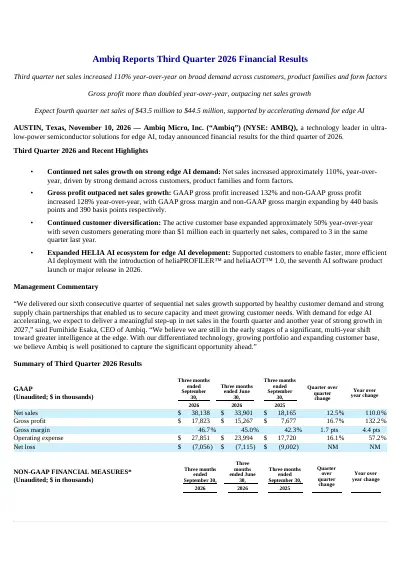
Good morning, everyone, and thank you for joining us. Third quarter results reflect the growing momentum in our business, with net sales up 110% year-over-year, marking our sixth consecutive quarter of sequential growth.
Based on the demand we are seeing today, we expect growth to accelerate in the fourth quarter and remain strong into next year. This momentum reflects a fundamental shift toward greater edge AI adoption and increasingly sophisticated AI capabilities, giving us confidence in the scale and durability of the opportunity ahead.
Net sales growth was broad-based across customers, product families, and form factors, with increases in both volume and ASP. Three factors drove this performance: First, healthy end-user demand supported continued growth from existing customer programs.
Second, we saw a strong response to our customers' new product launches, which incorporate more advanced edge AI capabilities across smartwatches, displayless bands, and rings. Third, we continued to add and scale new customers.
Seven customers generated more than $1 million each in net sales this quarter, up from three a year ago, and we grew our total active customer base by approximately 50% year-over-year. With lean inventory across channels and continued expedite requests, we are confident that the demand reflects underlying end-market consumption rather than inventory replenishment.
Importantly, our visibility into customer forecasts and strong supply chain relationships helped us secure the capacity needed to meet growing demand in a supply-constrained environment. Looking ahead, we see strong customer order activity and expect a meaningful step-up in fourth quarter net sales.
As a result, we expect to deliver approximately $140 million in net sales for the full year 2026, nearly doubling from 2025. We are positioned for another year of strong growth in 2027 and believe we are still in the early stages of a significant multiyear shift toward intelligence at the edge.
Advances in model efficiency are enabling more sophisticated AI on a growing range of devices, improving responsiveness and privacy while reducing reliance on connectivity and cloud compute. Unlike cloud AI, the edge AI opportunity builds on a vast existing infrastructure and edge device unit volume, with growth driven by more intelligent devices and increasing compute requirements per device.
As that shift accelerates, ultra-low power compute becomes increasingly critical, exactly what our SPOT platform was designed to enable. We are translating that opportunity into commercial momentum today while investing to expand our addressable opportunity over time.
On the hardware side, we continue to scale our newest platforms from design wins to commercial deployment. Apollo330+ and Apollo510 Lite are gaining traction across a broad range of applications, from wearables and smart glasses to hearing assist, medical monitoring, smart pens, and industrial remote monitoring.
We are encouraged by the breadth of customer engagement and remain on track for the first customer devices based on these platforms to reach the market in early 2027. On the software side, we have launched or significantly enhanced seven AI software products this year, strengthening our differentiation and helping customers accelerate development.
In addition to providing tools that enable customers to develop their own AI models, we are now developing our own AI models for customers' use. This quarter, a customer began deploying the first Ambiq-developed AI model for a voice-based use case.
We see this as an important validation of our AI capabilities and an opportunity to broaden our reach, particularly among customers without extensive in-house AI resources. Importantly, our hardware and software innovation is already translating into greater revenue diversification.
We remain on track to double revenue outside of wearables this year, with these customers expected to represent a mid-single-digit percentage of total revenue in 2026. Given the longer design cycles in these markets, we expect the revenue contribution to build over time.
Non-wearables are expected to remain in the mid-single digits as a percentage of revenue in 2027 before stepping up to low double digits in 2028. We also see additional upside from there as we secure new design wins across the Apollo3 and Apollo5 families, while the planned launch of Apollo340 in 2027 is expected to expand our addressable opportunity further.
Infrastructure monitoring is one emerging opportunity where we see a strong fit for our technology. These applications increasingly require always-on sensing and AI at the edge to monitor buildings and critical equipment.
They also operate with stringent power constraints, playing directly to Ambiq's strengths in ultra-low power compute and on-device AI. We recently secured a design win with a leading global provider of cloud-based physical security solutions for an AI-enabled glass break detection sensor.
The design uses both the Apollo hardware platform and the Helia AI software platform. Importantly, this customer has a broad portfolio across physical security, access, and building management, creating opportunities to expand into additional applications over time.
We have also partnered with an industrial AI company whose asset performance and predictive maintenance solutions are deployed with some of the largest U.S. energy operators.
These engagements are on track to begin contributing to revenue in 2027. Importantly, they provide early validation of the opportunity to bring intelligent, ultra-low power sensing to a much broader range of infrastructure assets.
Looking ahead, we expect Apollo340 to accelerate our diversification across medical, industrial, and smart building markets. Its combination of SPOT power efficiency and edge AI performance provides a lower cost, compact, and easier to deploy platform.
This expands the range of applications and customers we can address. By supporting reference designs, modules, and ecosystem partners, we can reach that broader customer base more efficiently.
Turning to our next-generation product roadmap, Atomic 110 remains on track for tape-out by year-end, with customer sampling expected in the first quarter of 2027. Customer engagement is already underway through early development platforms, allowing us to incorporate valuable feedback ahead of silicon.
Atomic 120 will build on the same architecture and 12-nanometer SPOT platform, extending the family to more compute-intensive applications, including vision. Apollo340 is also expected to begin customer sampling in 2027.
In closing, we delivered another strong quarter with accelerating demand across the business. Our customer base and design funnel continue to expand and diversify as growing AI adoption is increasing the need for ultra-low power compute.
With our differentiated technology and expanding portfolio, we believe Ambiq is well positioned to capture that opportunity. We remain focused on executing against the demand in front of us while investing to extend our leadership over the long term.
With that, I will turn it over to Jeff to cover the financials.
Jeff Winzeler
Thank you, Fumihide, and good morning, everyone. Our strong top-line performance translated into growth in gross profit, which more than doubled year-over-year and grew faster than net sales.
This reflects the impact capturing the increasing value we provide to our customers through our differentiated SPOT platform, an active focus on reducing product costs and scaling the business. Turning to the details of our third quarter financial results: Net sales were $38.1 million, increasing 110% year-over-year.
This was driven by strong volume growth along with a higher ASP as our product mix continued to shift toward more advanced solutions. During the quarter, we continued to see the benefits of customer diversification, with sales outside our major customers increasing more than 270% year-over-year.
Sales to end customers in China represented 17.3% of total net sales compared to 6.7% in the prior year period. This reflects continued expansion within our existing high-value customer base in China.
Non-GAAP gross profit increased 128% year-over-year to $18.6 million. Non-GAAP gross margin was 48.7%, up 390 basis points year-over-year.
While we continue to see higher input and supply chain costs during the quarter, our focus on manufacturing efficiencies is helping to offset these pressures. At the same time, we were realizing greater value from SPOT as we enable increasingly sophisticated AI capabilities.
Turning to operating expenses: Non-GAAP R&D was $13.1 million, up 90.1% year-over-year, reflecting investments necessary to support multiple product development programs currently underway. Non-GAAP SG&A was $9.6 million, up 53.8% year-over-year, driven by higher compensation-related and public company costs as we continued to scale the business.
Third quarter non-GAAP net loss was $1.2 million, a $2.8 million improvement year-over-year. Non-GAAP net loss per share was 5 cents, based on 24.3 million average shares outstanding.
Our balance sheet remains strong, with $363.5 million of cash and cash equivalents and no debt. Looking ahead, customer forecasts and order activity provide clear visibility into accelerating demand.
Despite tighter supply conditions, we remain confident in our ability to support customers and execute against the opportunities ahead. For the fourth quarter, we expect net sales in the range of $43.5 million to $44.5 million, positioning us for our seventh consecutive quarter of net sales growth.
Non-GAAP gross margin is expected to be roughly flat with 3Q as manufacturing efficiencies and product mix help to offset increased supply chain cost pressures. We expect fourth quarter non-GAAP operating expense of $25.5 million to $26.5 million, inclusive of half a million of IP spending, in addition to other variable costs associated with the Atomic 110 and Apollo340 tape-outs.
Finally, we expect a non-GAAP loss per share of 9 cents to 3 cents, based on a weighted average share count of 24.6 million shares outstanding. Stepping back, our performance this year has significantly exceeded the expectations we set at the beginning of 2026.
Based on our fourth quarter outlook, we now expect full-year net sales of approximately $140 million, compared to our initial expectation of more than $100 million. We also expect gross margin to expand by almost 300 basis points year-over-year, well ahead of our initial expectation for modest improvement.
With that, I'll turn the call back to Fumihide before we open the line for Q&A.
Fumihide Esaka
Thank you, Jeff. We have strong momentum across the business and remain focused on delivering for our customers, advancing our product roadmap, and delivering long-term growth.
With our differentiated technology and expanding portfolio, we believe Ambiq is well positioned to capture the significant opportunity ahead. With that, I will open the call to questions.
Operator, please go ahead.
Operator
We will now begin the question-and-answer session. If you would like to ask a question, please press star one on your telephone keypad.
To withdraw your question, please press star one again. Please pick up your handset when asking a question.
If you are muted locally, please remember to unmute your device. Please stand by while we compile the Q&A roster.
Your first question comes from the line of Liam Pharr from Bank of America. Your line is open.
Please go ahead.
Liam Pharr
Hi, thanks for taking my question. In August, you said supply would limit sales in both 3Q and 4Q, but 4Q guide is now up about $6 million.
Is 4Q still supply-limited, or has capacity caught up with demand? If it is still limited, roughly how much unfilled demand do you think carries into the first half of 2027?
Fumihide Esaka
We do still have certain demand that we couldn't completely fill. I believe that we will be able to support all the customers with a minimum quantity that we needed.
Our demand continued to be strong. Like I said in the last quarter, we can meet most of the demand as long as within a certain lead time.
In Q4, we had a little bit of short lead time upside in demand. Those are the things that we couldn't provide more, so that we believe that we have been able to work with our supply chain partners to provide product they need within a certain lead time range.
To answer your question, yes, we have to leave some demand unfilled because that upside came in with such a short lead time. Besides that, our supply chain partner has helped us to deliver as much as customer needs.
I hope that answers the question.
Scott Hanson
If I could just add one thing, in a couple cases we were able to use expedites to bring in some of the orders. That was a positive thing, but that's not always something that we can count on.
I would say that it's a very dynamic environment. Team has been working very closely with the various suppliers.
We've been working on reducing test times and increasing throughputs and so forth. I think we've done a lot.
Fumihide Esaka
Expedite, we do owe a lot to our supply chain partners, because usually they're sold out as well. They've done way beyond they need to do to help us out.
Liam Pharr
Amazing. Thank you.
For my follow-up, 3Q OpEx was a little bit below the initial guide. Did any tape-out or IP spending move from 3Q into 4Q?
How should we think about OpEx going into 2027 to support all of your different product ramps, especially thinking about Atomic in 2028? Thank you.
Jeff Winzeler
Yeah. The answer to your question is, yes, some of our spending has slipped into Q3 and Q4.
We saw some of that upside in Q3 in OpEx as we just reported, and our guide for Q4 shows that continuing to increase. Now, that said, the primary driver behind those things are variable costs like IP spending and tape-out costs associated with Atomic 110 and with Apollo340.
In terms of looking forward into 2027, I think it's too early to really guide in terms of what our run rate of spending is going to be for next year. We're in the process of doing our annual operating plan right now.
We'll come back to you at a future time and give you some insight in terms of what that looks like.
Liam Pharr
Thanks, Jeff.
Operator
Your next question comes from the line of Tore Svanberg from Stifel. Your line is open.
Please go ahead.
Tore Svanberg
Yes, thank you, and congratulations on the results. Fumihide, I was hoping you could talk a little bit more about the diversification.
I think you said outside of your larger customers, I think you grew almost 300%. Can you maybe highlight some potential applications there and use cases?
Thank you.
Scott Hanson
I can step in and talk about that, Tore. Actually there was one that I believe we highlighted already, which is a glass break sensor and security system.
This is what I think is kind of a bellwether opportunity within the broader infrastructure monitoring markets. Think of that being smart home related, industrial related, and we've got a number of different customers doing that.
In the past we've talked about one company doing machine health monitoring using anomaly detection and local AI models. We actually just had another win related to that recently.
If you look broadly at infrastructure monitoring, whether it's monitoring a smart grid or monitoring security in a home or security in a building, we see that as a really healthy and growing space. On the medical side, or let's call it the digital health side, we're seeing a lot of opportunities as well.
We've talked about this in the past, but our portfolio of wins keeps growing there. It's everything from EEG monitors to Parkinson's detection monitors to blood glucose monitors and heart monitors, Holter monitors, these sorts of things.
A lot of really interesting use cases there. Those are the two that I'll highlight right now, which I see as being nice contributors in the coming years.
Tore Svanberg
Very good. As my follow-up, I think you also gave us a number for non-wearables.
I think you said maybe double digits by calendar '28. Maybe a related question, what would that percentage look like if we assume customers that are buying both hardware and software, and also those customers that are buying hardware, software, and your AI models?
What percentage could that potentially be by 2028? Thank you.
Scott Hanson
What I'll say is that the percentage could go up. I think it's too early to quantify that, but maybe the key takeaway, I'm really glad you keyed in on the sale of the AI model to the customer that was mentioned, because that is a big moment for the company.
It's kind of, let's call it, immaterial right now in terms of contribution to revenue, but it has the potential to be significant. We see that as a proof point.
We're going to continue to pursue design ins and design wins. I would say I think your intuition is right that a lot of the big opportunities for that product lie outside of our main customers.
Our biggest customers are very capable of doing a lot of that development themselves. As we start looking at some of these non-wearables opportunities, that's the place where we can contribute value by building and selling AI models.
We'll report more on that in future quarters. I think you're right to think that that becomes additive to that 2028 non-wearables contribution.
Tore Svanberg
Sounds good. Congrats again.
Scott Hanson
Thank you.
Fumihide Esaka
Thank you.
Operator
As a reminder, if you would like to ask a question, please press star one on your telephone keypad. Your next question comes from the line of Kevin Garrigan from Jefferies.
Your line is open. Please go ahead.
Hi, this is Amrita for Kevin Garrigan. Congrats on the results.
Secondly, you're expecting another strong growth year in 2027. Can you give us a sense of what you're thinking in terms of contribution from unit growth versus higher ASPs and new products?
Fumihide Esaka
Our customer projection continued to be extremely strong even into 2027, from both quantity-wise and also now that a lot of customers moving towards Apollo5, ASP is going up. Mixture of quantity and a price are both being healthy.
However, it is too early for us to give you a really specific numbers. We will be giving you guys those forecast in 2027 Q1 earnings call.
What I can see right now is it was still very strong demand coming in from all the existing customer as well as a new customer that we just adopted. We're very optimistic that the 2027 is going to be another great year for us.
Got it. Then another question.
Last quarter, constraints existed across wafers, substrates, packaging, and test, and there still seems like there's a supply chain crunch today. For you guys, which part of the supply chain remains the bottleneck, and where have you secured meaningful incremental capacity?
Fumihide Esaka
Like I said, in the past, supply chain constraint comes in when customers give us such a really short lead time where sometimes it's not really easy for us to work with our supply chain partners. You see our growth from Q2, Q3, Q4, our supply chain partner has been helping us to meet most of the demand with reasonable lead time.
We believe that we will continue to do so in 2027.
Thank you.
Fumihide Esaka
Thanks.
Operator
We have reached the end of the question-and-answer session, and this concludes today's call. Thank you for attending.
You may now disconnect.