Amber International Holding Limited
NNASDAQ:AMBRQ1 FY2026 · Earnings Call TranscriptMay 28, 2026
Operator
Good morning. Welcome to Amber International first quarter 2026 financial results.
At this time, all participants are in a listen-only mode. A question and answer session will follow the formal presentation.
If you would like to ask a question, please press *1 on your telephone keypad. As a reminder, this conference is being recorded.
It is now my pleasure to introduce your host, Mia, Amber Premium's official AgentFi ambassador. Mia, you may begin.
MIA AI
Good morning, and welcome to Amber International Holding Limited's first quarter 2026 earnings call. I am Mia, Amber Premium's official AgentFi ambassador and your moderator today.
Before we begin, please note that today's discussion may contain forward-looking statements within the meaning of US federal securities laws. These statements involve risks and uncertainties that could cause actual results to differ materially.
For a more detailed description of these and other risks and uncertainties, please refer to our filings with the Securities and Exchange Commission. Joining us on today's call are Michael Wu, Chairman of the Board and CEO, who will share a first quarter overview, strategic vision, and AI initiatives; Vicky Wang, President, who will focus on our core business updates, client platform performance, and future focuses; Yi Bao, Chief Product Officer, who will update us on our regulatory update and platform evolution; Josephine Ngai, Chief Financial Officer, who will review our financial results and provide guidance; and Steve Zhang, Head of Capital Markets.
Following their remarks, we will open the line for Q&A. With that, let me now turn the call over to Michael Wu, our Chairman of the Board and CEO.
Michael Wu
Thank you, Mia. Thank you all for joining us today.
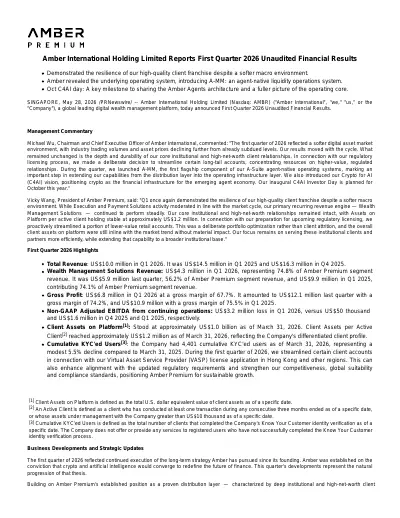
The first quarter of 2026 was another temperate period for the crypto industry, continuing the downtrend we saw in the fourth quarter of 2025. Our total revenue for the quarter was $10 million, compared to the $14.5 million in Q1 2025 and the $16.3 million last quarter.
Despite the challenging environment, we see this as an opportunity to strengthen our foundation with clients and continuing advancing our strategic priorities. Our focus remains on how we serve our clients more efficiently and how we scale that capability through our agentic fintech capabilities.
Through every cycle, what proves durable are Amber's most important assets: our ability to innovate and our ability to build scalable, future-proof infrastructure. To that point, this quarter marks another step forward in the strategy we have been building towards.
As part of our broader agentic transformation, we introduced A-Suite as an agent-native operating system that abstracts the complexity of digital asset financial services, enabling them to be automated and operated by AI agents. This is similar to how AWS two decades ago abstracted the complexity of servers and enabled a whole generation of web apps to simply build on top.
That is where finance is heading as the agentic economy arrives, and our vision is to be the foundational layer beneath it. We're moving from competing at the interface and the distribution layers to providing the rails for the agentic economy itself.
This is not an aspiration; it is already on the way. Amber Premium has already proven itself as a strong distribution layer with established institutional relationships, a regulatory licensing footprint, and demonstrated segment profitability as disclosed in our financial statements.
Building on that proven foundation, we are now creating the operating core beneath it. The greater efficiency and expanded addressable market unlocked by A-Suite are what will carry us toward the agentic future that I have always envisioned, spoken about, and built toward.
This also marks the next step in how we define AMBR, not just as Amber Premium the crypto platform anymore, but as Amber, a truly emergent agentic fintech. As I mentioned in previous earnings calls, Amber first began as Amber AI.
The conviction that crypto and AI would converge to define the future of finance was not a strategy we adopted later, but rather, it was the thesis we founded the company upon. What you are seeing today, this quarter, across both our business and our innovation, is that this thesis is arriving in practice.
We intend to keep building it deliberately, one proven layer at a time. Building on Amber Premium's proven success, we launched the first of our three flagship agentic fintech operating systems within the A-Suite at the end of March.
AMM, which stands for agentic market making, is an agent-native liquidity operating system for token projects and designated market-making infrastructure. AMM is designed to unify execution workflows, infrastructure, and transparency into a platform that can be orchestrated by agents with customized real-time performance and risk reporting and monitoring.
We expect AMM to begin contributing meaningful revenue in Q2 and to scale from there. It is the first of the three A-Suite products we plan to bring to market this year.
Yi will elaborate further on AMM and our A-Suite positioning later. Beyond A-Suite, we are also embedding AI agent capabilities directly into our existing operations across all of our businesses.
Within our iClick digital marketing business, we're transitioning toward an agent-first and agent-native operating model by integrating Mia, our first in-house AI agent, who is also our host today for the earnings call, into iClick's core workflows, decision-making processes, and service delivery. This goes way beyond just using AI as a tool.
We are making autonomous agentic workflows a central driver of how we operate, and that is already improving efficiency and scalability across the businesses. This is the practical execution of our broader AI agent-driven strategy.
As we continue building towards this vision, I'm also pleased to announce our crypto for AI vision. Crypto for AI, or C4AI as we call it, is our view that crypto will become the financial and economic infrastructure for the agentic economy.
To that end, our inaugural C4AI investor day, planned for October, will be an important milestone where we will share our progress and showcase a whole fleet of Amber agents with the market. One final point on capital allocation, because it reflects how we view our own valuation: we continue to repurchase shares opportunistically through Q1, and remain focused on returning capital to our shareholders.
Under our $50 million share repurchase program announced in November 2025, we repurchased approximately 2 million ADS during the period. As of March 31st, 2026, approximately $45.5 million remained available under the program.
We continue to have significant flexibility for opportunistic repurchases while investing for growth. Ultimately, Q1 reflected a deliberate strategic decision on our part.
Our strategy is advancing, and we are using this period to redefine the scope of AMBR and position the company for the next phase of the agentic economy. With that, I will now turn the call over to Yi, our Chief Product Officer, for a deeper look at our product roadmap and the launch of Amber's first agent-native operating system, AMM.
Yi Bao
Thank you, Michael. Our platform innovation is a natural continuation of how we have always built and delivered financial products.
From the start, Amber Premium operated primarily as a distribution layer, a UI-driven platform focused on user acquisition and onboarding. We are now evolving into a full-stack, agent-native organization, with a particular emphasis on building the service layer underneath that distribution layer.
This is a natural next step beyond traditional UI-centric thinking, where products were defined by features, buttons, and screens seen in apps, and by branches, licenses, and relationship managers in finance, to an operating system approach. In the agent economy, competition will no longer be about who has a better interface, but who can seamlessly convert client intents into execution, settlement, monitoring, compliance, and reporting through intelligent automated workflows.
A truly agent-native operating system can deliver personalized and optimized service at a scale no standalone platform, manual process, or single-purpose application can match. This quarter, we took a significant step towards with the launch of AMM, the first flagship component of our A-Suite.
AMM is an agent-native liquidity operations system and designated market-making infrastructure platform. Its core value lies in creating a unified platform layer that abstracts complex execution workflows, operational infrastructure, and transparency requirements into standardized modular components.
For token projects, liquidity is critical to price discovery, trading experience, exchange relationships, investor confidence, and ecosystem credibility. Yet, designated market making has historically been manual, bilateral, and trust-based.
AMM is designed to turn this process into an automated and structured operating workflow. Projects can define key requirements, such as target venues, service duration, spread, uptime, depth, settlement preference, and capital needs, while the platform supports RFQ submission, quote review, order management, contract administration, performance monitoring, and reporting.
This gives projects a clear way to express demand, market makers a standardized way to deliver, and Amber a controlled system of record for onboarding, KYC documentation, contracts, fees, and service data. This allows us to participate in the token liquidity value chain in a more scalable, infrastructure-driven, and asset-light way.
AMM is designed with a clear division of labor alongside traditional market makers. It is not a replacement, but an infrastructure layer that enables greater efficiency, transparency, and scalability.
In being able to offer different execution models, combined with real-time visibility via our performance dashboards, which is soon to be launched, we are already seeing strong early adoption and positive feedback from token projects in our soft launch phase. From a business perspective, AMM not only strengthens our own execution capabilities, but also creates a scalable revenue architecture.
Revenue can come from recurring service and platform fees, venue expansion as clients add more centralized or decentralized markets, market maker participation, and potentially premium data and analytics over time. We anticipate AMM will begin generating meaningful revenue in Q2 and over time, to serve as one of the A-Suite operating systems we plan to launch this year.
More importantly, AMM reflects the broader strategic direction of Amber: moving from distribution to service, from interface to infrastructure, and from manual financial workflows to agent-native operating systems. Complementing our product progress, we continue to strengthen our regulatory licensing footprint.
We have been granted the VARA license in Dubai, and are making steady progress on our virtual asset service provider application in Hong Kong. These efforts reflect our strategic allocation of resources to better serve growing institutional demand, supported by an increasingly visible regulatory framework, including Hong Kong's stablecoin regime and developments such as the US Clarity Act.
A stronger regulatory foundation is essential to building a sustainable, high-quality business in this evolving industry. This combination of technological innovation and regulatory advancements marks the natural continuation of our journey, extending Amber from a distribution-layer financial service platform into a fuller picture of agent-native operating systems for agentic crypto fintech.
Next, I will hand it over to Vicky for a detailed review of our Q1 business performance.
Vicky Wang
Thank you, Yi. Before deep diving into our AMBR platform business, I would like to first build on Michael and Yi's earlier comments around how we have successfully scaled Amber Premium over the years, and how we believe we are now entering the next phase of scalable growth.
As Michael mentioned, Amber Premium has evolved into a highly scalable institutional distribution platform, supported by long-standing client relationships, a regulatory operating footprint, and demonstrated segment profitability as reflected in our financial statements. Importantly, what we are building extends well beyond a single initiative.
This quarter, we announced AMM, which, as Michael mentioned earlier, we expect will contribute meaningfully in the coming quarters. More importantly, AMM represents only the first of the three A-Suite operational cores we plan to introduce this year, as we continue building the infrastructure layer for scalable institutional automation.
The same automation and infrastructure capabilities that power our market-making businesses can now be extended across a broader range of institutional financial products and services, creating a more scalable and higher-quality earnings profile over time. Turning back to our core business and Q1 performance, the first quarter of 2026 reflected a familiar market environment across digital assets, including softer trading activity, lower risk appetite, and more selective institutional capital deployment.
These broader market conditions were naturally reflected in our quarterly financial performance, particularly within our execution solutions and payment solutions businesses. However, what continues to evolve meaningfully is the expansion of the digital asset opportunity set.
We are no longer only seeing institutional interest around core crypto assets. Increasingly, we are seeing demand broaden towards tokenized financial products, on-chain yield strategies, tokenized real-world assets, and a wider range of digitally native financial products.
Alongside this trend, we are also seeing growing client appetite for more sophisticated and tailored structured products. Clients today are increasingly looking for customized yield opportunities, defined downside protection, and structure aligned with their specific risk-return objectives, rather than standardized off-the-shelf solutions.
Our ability to offer customized structured products across different underlying assets, tenor, and payoff profiles is a direct response to this evolving demand profile. Importantly, we believe this trend supports both deeper client engagement and a higher-quality revenue mix over time.
As asset universe expands, we believe distribution becomes increasingly valuable. Institutions are looking not only for access to products, but also for trusted platforms that can help clients access and manage these opportunities within regulatory framework.
This is where we believe Amber Premium is strategically well positioned. At the same time, we are seeing increasing demand for financial institutions and platforms seeking embedded digital asset capabilities, rather than building these capabilities internally.
We believe this creates meaningful long-term B2B2C opportunities for us. Against this backdrop, our primary recurring revenue engine, wealth management solutions, contributed $4.3 million in Q1, accounting for 74.8% of Amber Premium segment revenue.
This continues to reflect our intentional shift towards higher-margin and more predictable revenue streams. To further strengthen our regulatory positioning, we also took proactive steps this quarter to optimize our client account structure and align more closely with evolving regulatory requirements.
As part of this process, we streamlined a portion of low-engagement clients' accounts while continuing to deepen relationships with our core institutional and focused client base. Importantly, this optimization had minimal impact on overall asset on platform, while asset on platform per active client remains stable at $1.2 million.
We believe this strengthens the long-term quality of the platform as the industry becomes more institutional. Ultimately, while market cycles may continue to impact short-term activity, we believe the long-term value of this platform lies in our client relationships, regulatory infrastructure, and ability to scale customized financial services through automation.
In summary, Amber Premium is increasingly evolving from a client platform into an agent-native institutional layer for execution, coordination, and distribution of digital and tokenized assets. With that, I will hand it over to Josephine, our Chief Financial Officer, for our financial results.
Josephine Ngai
Thank you, Vicky, and good morning, everyone. I will now review our financial results for the first quarter of 2026 ended March 31st and provide our guidance for the second quarter.
Throughout my remarks, I will primarily reference the consolidated Amber International entity, providing additional context for the Amber Premium segment where relevant. Revenue for the first quarter was $10 million.
This compares to $14.5 million in Q1 of 2025 and $16.3 million in the sequential fourth quarter of 2025. Our Q1 performance was primarily influenced by a materially softer digital asset market environment, which leads to a moderation in transactions volumes across the entire industry.
Furthermore, our year-over-year comparisons was impacted by a non-recurring $2.9 million service fee that we recognized in the prior-year period. Looking closer at Amber Premium, performance across our core solutions was quite balanced.
The wealth management solutions delivered $4.3 million, the execution solutions brought in $0.9 million, payment solutions delivered $0.6 million, and iClick marketing and enterprise solutions contributed approximately $4.3 million. The gross profit for the quarter came in at $6.8 million, representing a 67.7% margin.
This is a step down from the $12.1 million with gross profit and 74.2% margins we recorded last quarter, reflecting shifts in our product mix as our dual products represent a higher share of revenue this quarter. Despite these near-term shifts, we remain firmly focused on driving long-term, high-margin growth across all product lines.
Moving down to the operating line, we recorded an operating loss of $3.2 million for Q1. However, our total operating expenses improved to approximately $10 million, down from $11 million in Q4 2025.
This reductions highlights our strategic efforts to streamline operational resources alongside early efficiency gains from our internal AI initiatives. I want to highlight an encouraging case here.
Within our iClick marketing and enterprise solutions business, we deployed our AI agent, Mia, into the operation. This integration helped reduce operating costs within that segment meaningfully this quarter alone, as we're transitioning the digital marketing business toward an AI-driven operating model.
The key takeaway for us is straightforward: AI is not just a forward-looking thesis for us; it is already actively absorbing operating expenses and improving the unit economics of our existing business. We expect this internal AI efficiency to continue compounding throughout 2026 as we extend Mia's capability to additional corporate functions.
The net loss from continuing operations was $3.7 million, compared to a net income of $0.8 million last quarter. Adjusted EBITDA for Q1 was a loss of $3.2 million, compared to a positive adjusted EBITDA of $50,000 in Q4 2025.
Turning to the balance sheet, our financial position remains strong and continues to improve. We closed the quarter with $36.5 million in cash and zero bank debt, giving us a highly resilient foundation.
Looking ahead to the second quarter of 2026, we are issuing preliminary revenue guidance for the Amber Premium segment of between $9 million to $10 million, representing a quarter-over-quarter increase of approximately 58.1% to 75.7% from our Q1 2026 Amber Premium segment revenue of $5.7 million. Our guidance currently covers the Amber Premium segment only and does not include revenue from our iClick marketing and enterprise solutions, to be consistent with previous guidance practice.
As we look to the rest of the year, alongside the external growth strategy we have previously outlined, internally, we are also enhancing our financial reporting system to provide transparent insights into our performance, and maintaining strong liquidity and balance sheet flexibility in order to support our global expansion and strategic partnerships. We believe that this disciplined approach will create sustainable and long-term value for our shareholders.
With that, I return the call back to Mia. Thank you.
MIA AI
Thank you, Josephine. That concludes our remarks for today.
We will now open the line for Q&A. Operator, please begin.
Operator
Thank you. If you would like to ask a question, please press *1 on your telephone keypad.
A confirmation tone will indicate your line is in the question queue. You may press *2 if you would like to remove your question from the queue.
For participants using speaker equipment, it may be necessary to pick up your handset before pressing the star keys. Our first question comes from Brian Dobson with Clear Street.
Please proceed.
Brian Dobson
Thanks very much. If we could just start with a big picture question.
I suppose, 2 years from now, what do you think the business looks like, and how do you think investors should be contemplating your growth outlook at this point?
Michael Wu
Thank you, Brian. This is actually a great question, because fundamentally, I think starting from this quarter, we want the investor to understand Amber is truly emerging from the platform, Amber Premium, which is by itself a very solid, profitable digital wealth management platform, to Amber, which I define as a crypto-enabled agentic fintech.
Two years from now on what the business should look like, I do think the agent-native operating systems we are launching today, the AMM and the remaining A-Suite, and the agents that are operating them as of today, they will become a financial infrastructure for a lot more companies. They will, hopefully, by that point, become the financial stack for the agentic economy.
How that will make our revenue model look like, I do think we have proven with our own platforms, with Amber Premium, that already automated, already agent-native operating system can enable businesses in a scalable way. Two years from now on, I think that scalability point should have been proven by that point.
There should be a lot of platforms other than Amber Premium, a lot of platforms either owned, invested by Amber, or completely unrelated to Amber on a ownership basis, that are operating on this shared stack that we are building today. I'm highly confident in the direction we are going.
I'm highly confident in delivering or accomplishing that in a 2-year framework. I do think the market will gradually understand Amber as an emerging crypto-enabled agentic fintech, as I mentioned.
Again, circling back to our crypto for AI vision, I do think being crypto-enabled as an agentic fintech gives us a unique edge if we look a bit further into the future. I do believe a lot of financial service today will move onto the crypto realm, especially as the agentic economy arrives, as more of the services, more of the operations, more of the economy is done by AI agents rather than human.
Hopefully, by that point, market will realize we not only have that vision way ahead of the curve, we are one of the first to actually deliver that vision.
Brian Dobson
Thanks, and I suppose just following up on that, do you think that leaning into that aspect of the business, right, makes the overall business model more scalable as you're driving more agent-native systems, and similar to more like a software company?
Michael Wu
There are similarities, I think, to software companies in the sense that most of the company, as I always mention today, are engineers at the core. Amber as a core, is a technology-driven company.
I do think the business model will look different from the software companies, or especially the SaaS companies, as we understand today. I don't think we are offering just a software, a tool, or an agentic tool even.
What we are building, and we are increasingly offering to our own platforms and externally, is really more of an agentic capabilities. Take iClick as the example, as we mentioned today.
iClick was a and maybe, at this point, still is a digital marketing business. What Mia does, and what our agentic stack does to iClick, is offer that ability to offer the same services, or even much better services, to their clients with a much more agent-native way, in terms of operation, most of the operations now are being automated.
The workflow they are streamlined is agent-first rather than human-first. That ability itself, again back to scalability point, is highly scalable.
A different company, or even a company with only similar business, or different client base or similar client base, can easily render that ability. Compared to the software example you mentioned, right, today if another company uses a software from a software company, they still need to use the tool themselves.
They still need to have staff trained to operate with their own workflow using that tool. The agentic abilities we are offering is different.
It's actually end-to-end. It's actually result-driven.
We do think companies will start to get used to paying for the actual results, rather than paying for the tools that can hopefully get them the results. I think that's fundamentally different.
I think the market will start to realize that. A lot of that understanding, I think, is becoming more talked about among the private investors, among the VC investors, but really, in the public market, I do think Amber is one of the first companies that through our results, through our accomplishments this year, hopefully will also educate the public market investors about this new business model.
Brian Dobson
Excellent. Thanks very much.
Michael Wu
Thank you.
Operator
Our next question is from Emily Wei with Symmetry Affluent. Please proceed.
Emily Wei
Hello, management. I have two questions.
Hello, management. Can you hear me?
Michael Wu
Yes. Hi, Emily.
Emily Wei
Hello. I actually have two questions.
Can you help us understand why we are pivoting towards an AI story? Secondly, on AMM, what has actually been delivered so far, and when do we expect the A-Suite to start making money?
Thank you.
Michael Wu
Great questions. This is Michael again.
First, I have to correct you. We are not pivoting to AI.
First, Amber started as Amber AI. It's actually always been our DNA.
Secondly, I've had this conviction, and I really think the company's putting that into reality as we speak, that crypto and AI are converging. These two technologies will together define what the agentic economy looks like, especially in what I call agentic finance.
Also, this is already happening, as I mentioned about the Mia inside iClick example. This is already transforming operating expenses through automation.
It is already changing workflows from humans using tools to agents leading towards direct results with humans in the loop. It's already making financial impact.
I think that's sort of related to your second question, which I will also get to. Also, if you look at Amber Premium itself, we really see Amber Premium as the proof case.
It is a proof case because it is successful, right? It has a very strong reputation among, I think, the most highly demanding, highly sophisticated, and high-valuable client base.
It is a profitable business. We are just reviewing within Amber what enables this success of Amber Premium, beyond, of course, our great sales team, our great relationship management team, and all the trust our clients putting into us.
It's actually this operating layer, which now we are reviewing as AMM, as A-Suite. It's actually this operating layer and this agent-native operating capability that makes Amber Premium, makes our platform successful, makes us able to deliver a very diverse priority of products and services within crypto.
The ability to deliver that not only to the highest standard, but deliver that with efficiency, with scalability. I really don't think we're talking about pivot.
AI and the crypto has been in Amber's DNA since day one. I do understand why you ask this question, or where does this confusion come from.
I think over the last year or so, we are a new public company, and throughout most of 2025, people are still trying to understand Amber Premium itself, which again is our first showcase, our first success. This year, of course, we are all on this call along with all the investors, with all the friends, trying to educate the market about the broader Amber, which hopefully, starting from this earnings call become more clear.
To the second of your question about when does AMM start to contribute revenues, it's actually already started, as we mentioned. AMM was launched at the end of March.
It's an agent-native liquidity provision OS, operating systems. As Yi explained about the product, right, we really abstracted a fairly complex business into a very streamlined protocol.
This product itself is agent-native, it's agent-operable, and it's highly automated. Along with the workflow agents that operate AMM, they've already been contributing revenue as we speak today.
I do think we will start to see these increasingly significant revenue contribution from AMM and other A-Suite as we launch them from this second quarter onwards.
Yi Bao
Yep. Thanks Emily for this.
I can add some points on Michael. Basically as Michael has mentioned, the AMM, actually it adds extra scalable revenue streams to our future developments.
Basically I just want to make a similar analysis. Once some like the token projects or MM, market makers onboarded to our agentic market making the platform, actually they will be very sticky.
Something like a middle-to-long-term agreement they will sign with us. Basically the revenue itself will be recurring and scalable as they adding more venues, or maybe they adding more parameters, or they require more digital service from our side.
Basically, we do think that this revenue stream will be extremely scalable, and start to contributing meaningful revenue from Q2 and onwards. Thank you.
Operator
There are no further phone questions. I would like to hand it back over to management for webcast questions.
Michael Wu
Okay. We have a few questions on the screen.
I will read one of them out first. The question is: how do you expect AI strategy to influence margins, cash flow, balance sheet efficiency over time?
Again, I think we touched upon some of that. The AI strategy is already influencing pretty much all of them, on cash flow, on expenses.
As we mentioned with the iClick example, Mia is already reducing OpEx of the iClick business segment as we speak. In terms of margin, AMM is another good example.
It turns a fairly bespoke kind of business model of liquidity provision in crypto, in digital assets into highly streamlined, agent-operable operating systems. That definitely increases not only the margin on the business, but also again how scalable the business can be.
In terms of balance sheet efficiency, I think that will also show the impact over time, as we, especially as we launch the other two products within A-Suite in the coming months.
Steve Zhang
Just to add to that point, I think, compared to current client margins, we do expect, obviously, higher capital efficiency coming out of the agentic AI services. Will have a positive impact on operating margins in the long run.
Given that this is a relatively scalable business, the balance sheet efficiency will also starting to improve in the coming quarters.
Michael Wu
We also have another question that's from Kelly. The question is: what LLM is being deployed to enable the AI solution for Amber?
Are there any proprietary components to your agentic infrastructure? This is very interesting to have a more technical question on this earnings call.
In short, the way we build what we call the intelligence layer of our agentic stack is we are very open to use whatever LLM model or whatever intelligence source that's actually helpful, that's productive, that actually enables our business and our clients' businesses to be better. We, of course, have integrated all the leading both the leading private models and the leading open-source models.
We have also in-house deployed our fine-tuned versions of open-source models where it's fit for. There are of course areas within our agentic workflows that are smaller, maybe less intelligent, but cheaper and more customizable open-source models are suitable.
We've done that. In a way, we have our own fine-tuned smaller models, I guess, in the workflow.
Are there proprietary components to the agentic infrastructure? This is also a very interesting question.
I think we touched upon, the models, the intelligence layer, right? I do think there are companies, there are gigantic AI labs that provide all these intelligence layers, and I don't think it's Amber's position today, at least, to compete on that front.
I do think, in terms of building more vertical agentic services or vertical agentic service stacks, that's where our edge lies, whether specifically in fintech or in financial services, especially digital assets financial services, which I think are actually more complex, but also more digitally native form of financial services. There's a lot of harness you need to build, there's a lot of sort of specified data sets that our agents need to be comfortable with or be trained with.
The short answer is yes. I do think there are a lot of proprietary components to our agentic infrastructure, even though that on the intelligence layer, we integrate most of the advanced, either private or open-source models.
MIA AI
Thank you all for joining us today. This quarter marks a defining moment as we continue to advance our agent-native operations system build-out while maintaining a resilient foundation in a challenging market.
We remain fully committed to delivering institutional-grade excellence and long-term value for our shareholders. We sincerely appreciate your continued trust and support, and we look forward to sharing further updates with you in the upcoming quarter.
This concludes today's call. Thank you, and have a great day.
Operator
Thank you. You may now disconnect.