Amplitude, Inc.
Q3 FY2026 · Earnings Call TranscriptNovember 4, 2026
Operator
With that, I'll hand the call over to Spencer.
Spencer
Thank you, John. Good afternoon, everyone.
Welcome to Amplitude's third quarter 2026 earnings call. Today, I'll cover three things.
First, our Q3 results. Second, how we've transformed Amplitude into an AI company and why every company I talk to now wants to learn how they can do the same.
Third, a look at our product and a spotlight on our customers. Let me start with the numbers.
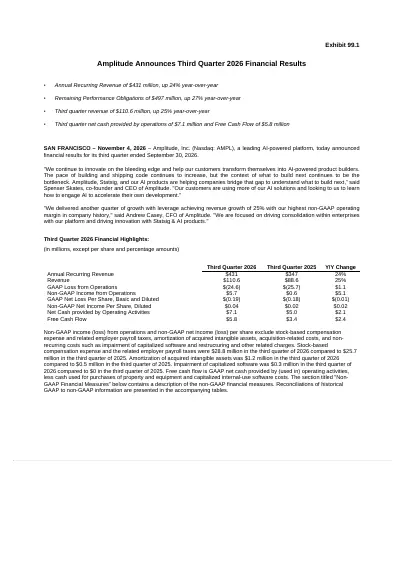
Q3 revenue was $111 million, up 25% year-over-year. Total annual recurring revenue was $431 million, up 24% year-over-year, and up $21 million from last quarter.
Non-GAAP operating income was $5.7 million, our highest quarter of non-GAAP profitability ever. Customers with more than $100K in ARR grew to 855, an increase of 31% year-over-year.
Enterprise customers are turning to us as a trusted partner in their AI transformation, and they're adopting a greater breadth of products from us. We are growing ARR at the fastest rate since 2023, while also achieving the highest profitability we've ever recorded.
Coding has changed dramatically over the last two years with the rise of long-running agents. Output is exploding, the amount of code being generated is growing six times per year, the length of tasks AI can handle is growing seven times per year.
We are on an incredible exponential. Every CIO I know wants the same thing, though.
They're saying that they're spending a fortune on tokens, but is that turning into something that they want? That is why Amplitude is essential as enterprises adopt AI.
The bottleneck is no longer producing more software. It's knowing what to build and whether it's working.
That's the core of what we do. We help our customers build better products.
When I talk with executives, they all want our help making AI transformation successful in their business. Every one of them is at a different point in that journey.
At the start, on the left here, are companies on legacy, disconnected point solutions. At the other end, on the right, are bleeding-edge companies using coding agents and context agents like Wave to enable self-improving products.
Most companies today sit on the left side in the first two categories. We have a massive opportunity to help companies change their tech stack from legacy players that were built through M&A over a decade ago.
We meet customers where they're at, help them take their businesses to the next step, and so are seeing wins across the life cycle. Our platform is designed to bring customers from wherever they are through an AI transformation.
Amplitude gives customers the deepest understanding of how users use their product. Our agents increasingly do that discovery for them.
Statsig gives customers feature flagging and experimentation, built on top of the world's most advanced stats engine with an engineering-first view. Our customers can now test and ship what features deliver the best outcome.
Wave is the future of product development, self-improving products where we automatically recommend what customers should build next based on signals from users. While we are early here, I'm very excited to show you a demo today.
Together, these three products close the product development loop: understand what's happening, measure what ships, and ship what matters. That loop is how AI-native businesses build, and it's where every enterprise wants to get their product development process to.
Let's start with Statsig. We are now six months into our journey with Statsig and our customers.
It is going better than I expected. We've accelerated our development on the platform and continue to release improvements to what is already a best-in-class experimentation platform.
Experimentation is important in this new age of building because it can prove what is working. It can close the loop on self-improving products when paired with best-in-class analytics.
This is the power of having the context for what is working and a platform for testing those results. We're working closely with data warehouses to unlock capabilities across experimentation and analytics.
I'm also thrilled to bring Statsig's founder and CEO, Vijaye Raji, to our board. Vijaye founded and led Statsig through its acquisition to OpenAI and is now CTO of Applications at OpenAI.
Statsig and Amplitude's history are deeply intertwined. Amplitude was initially inspired by Meta's growth team and their finding that making seven friends in 10 days was a strong predictor of long-term engagement for a new user.
We were convinced at the time that everyone would need the same type of insights, and so we started Amplitude in 2012. Vijaye saw firsthand the power of Meta's internal tools, including Deltoid, which helped teams measure the impact of their experiments.
Meta helped pioneer the modern data science and experimentation stack that is now standard practice across the industry. In 2021, Vijaye left Meta to bring those same capabilities to the rest of the world through Statsig.
For a number of years, we were competitors. We both had an engineering-led approach, working hands-on with customers and building around their needs.
Amplitude focused on its core of analytics, and Statsig focused on experimentation. We were both making sophisticated measurement tools accessible, and we pushed each other to get better.
Earlier this year, Vijaye was looking for the right home for Statsig's product, brand, and customers. We agreed that combining with Amplitude was the best way to continue Statsig's journey.
I'm excited to work with someone who has thought so deeply about the same mission. It's an honor to continue that work together with Vijaye joining our board of directors.
Now I want to talk about some of the newer products we've released. First, Agent Analytics.
Every company is trying to understand how they can deploy AI agents to serve their customers, but they are often stuck asking if those agents are working. Most observability tools can tell you whether an agent is running and how many tokens it's consuming.
They can't tell you whether the responses are any good or if they're improving customer outcomes. That's why we built Agent Analytics.
Every agent conversation is automatically scored: did it complete the task, was the response good, was the user frustrated? Then we connect those scores to everything else we know about the customer in Amplitude.
You measure your agents the same way you measure the rest of your product. Agent Analytics is about improving agents.
Product teams can define evals, identify the signals behind good and bad experiences, and see where their agents consistently succeeded or failed. It gives the people building AI products the kind of feedback loop AI engineers use to evaluate and improve their agents, connected to their users' behavior and to business outcomes.
Let's go ahead and take a look at how this works. This is a list of all agent sessions for a local car dealership called SF Bay Auto.
Their agent is their chatbot on the home page. I can click into individual sessions and see standard AI observability features like cost, token usage, and duration.
Agent Analytics also has out-of-the-box evals called signals that judge qualities like task completion, response helpfulness, and session safety. Customers can create bespoke evals based on the needs of their business.
Agent Analytics can also connect that agent behavior to business outcomes like conversion and retention. Here, we can see the conversion rate of people who visited the page, interacted with an agent, and went on to submit a price inquiry on a car.
We can compare people who interacted with an agent with those who didn't and see how that agent interaction impacted inquiry rates. We can also compare how using different models impacts rates of how many people submit an inquiry.
This understanding is crucial to deploying, maintaining, and improving agents as they become the future front door for customers. We launched Agent Analytics to all customers in August.
In just over a month, over 125 customers are using it. We helped Hybrid, an AI-driven fitness coach, connect its agent, Brain, to the rest of their customer journey data to understand if their Brain agent was helping their athletes.
Hybrid built an evaluator with Amplitude's global agent to flag conversations where someone had to ask twice for a tool to run and better understand where the agent was failing. They discovered that 25% of conversations in the prior week were resulting in frustrated users.
The Hybrid team was able to tweak the prompts to the Brain agent and ship a fix within a day, and the rate dropped significantly. They also discovered that athletes who engaged with the Brain agent retained four times higher than those who didn't.
They found this by connecting agent conversations with retention and adoption metrics in Amplitude. Now they're focusing their resources on building better onboarding to the Brain agent and building out more capabilities to keep athletes engaged.
This is the power of our platform combined with agent understanding that only Amplitude can do. We're now deploying Agent Analytics at scale.
One of our largest customers is currently running millions of agent conversations through it to help refine their own agents and improve their conversion funnels at scale. We use it ourselves too as well.
We use Agent Analytics to test an open-weight model in our own global agent. We found where it was failing, fixed it, and matched the quality of a leading frontier model at about a third of the cost.
Now let's go on to the highlight of the product section today. I'm really excited to show you Wave.
Wave is our agentic product team. It looks across everything that Amplitude knows about how customers use a product 24/7: analytics, session replays, experiments, feedback, agent conversations, and more.
It finds opportunities worth acting on, explains its evidence, and proposes a change. Then it hands that change to a person or to a coding agent to deploy, and then it measures whether that change worked.
Wave tells you what's worth building and whether it made an impact on the business because it has the full context from the rest of the user journey. This is the next level of what Amplitude has always done: help teams understand what users do and decide what to build next.
Wave makes that whole process proactive, using the behavioral data you've collected and product best practices to surface the right opportunities and actions automatically for product teams. Software factories are increasingly becoming a big part of software development.
Fleets of coding agents write and ship code continuously, but they don't have a context layer that can inform them what to build. Wave is that product behavior context layer.
Here's a real-world example of how we used Wave to improve Amplitude itself. Wave is constantly looking for improvements across all areas of Amplitude, including on our blog.
Here, it found a problem: our blog gets thousands and thousands of views a week, but the conversion rate to signing up from Amplitude after reading a blog post is artificially low. It realizes it should put in a topic-matched call to action in the text of the blog post that tells a user to sign up.
For example, if a blog post is about churn, it says, "Sign up with Amplitude to do a churn analysis now." Wave figured this out on its own, without any human intervention.
It created a visualization of the problem, it proposed a redesigned solution, and here's what it specifically directs us to do: add calls to action that matches the article's topic and give readers a useful next step. When we shipped it, it helped us write the PR and create the experiment as well.
After we shipped it, we saw an increase of 45 more user sign-ups per week. That's a huge deal for us.
Imagine hundreds of these improvements happening across a company's product and website all the time. I want to share with you an example from one of our customers, Mutant.
Mutant is an AI image generation platform. They deployed Wave, and it proposed that users who publish their artwork are much more likely to stick around, but publishing is left entirely to self-discovery.
There was also no tracking of users who published versus users who did not. Wave recommended a tool-tipped prompt to encourage publishing and created events to track those who did and those who did not publish.
The team shipped the simple change: engagement with the feature went up 76%, actual publish rate went up 10%, and then downstream Day 1 retention went up 3%. That is a massive impact from a very, very small change.
Now let's talk about some of our customers. We had a great quarter with both new lands and expansions.
We now have 855 customers paying us over $100K. We added or expanded our relationship with customers this quarter, including T-Mobile, Kalshi, Fireworks AI, a leading British airline, F5 Networks, SoFi, Hilton Resorts, Coursera, and Adidas.
We continue to consolidate point solutions and are gaining share from legacy incumbents. The companies on the bleeding edge today are choosing Amplitude.
We've transformed our organization, our product, and our business to be AI-native, and we are building the future of what can be done with data. We're launching Wave, our solution for self-improving products, next week.
Our pace of innovation continues to accelerate, and we're building in a way that can scale with leverage. I'm extraordinarily excited about what's ahead.
With that, I'll hand it over to Andrew to walk you through the financial results.
Andrew
Thank you, Spencer. Our fiscal third quarter was a continuation of the execution against our strategy of selling to the enterprise, expanding our platform reach, and bringing new products to market that drive extreme value for our customers.
We delivered 25% revenue growth, exceeding the high end of our expectations, and reached a 5% non-GAAP operating margin, our highest ever. This is the definition of growth with leverage.
We continue to invest ahead of our growth while seeing improving trends in the adoption of our platform. Our customers are increasingly accessing our platform through MCP and headless as well as our traditional UI.
We are seeing greater data ingestion, and our utilization rates are at an all-time high. We believe we are well-positioned to drive expansion and grow our base of customers.
This is showing up today as an increase in our cost to serve as demand occurs ahead of potential monetization. We are committed to growing with increasing our operating leverage.
Over the past two years, we have focused on reducing our costs, increasing our levels of efficiency, and driving greater accountability across our organization. We've done this by reducing the levels of management and aligning our teams to our customers' value proposition.
This resulted in reducing our costs as a percentage of revenue while continuing to invest in innovation. Looking ahead, we see opportunities to serve our current and new customers across their life cycle during becoming AI-native and how they serve their customers.
We have a path to growing our enterprise customer base and expanding our multi-product reach within our current customers. In addition, we are layering on new products that we can monetize, such as Agent Analytics, Wave, which attract new budgets and distribution channels.
I believe we are well-positioned to continue our growth with leverage strategy into 2027. Turning to our third quarter results, as a reminder, all financial results that I will be discussing, with the exception of revenue, are non-GAAP.
Our GAAP financial results, along with a reconciliation between GAAP and non-GAAP results, can be found in our earnings press release and supplemental financials on the Investor Relations page on our website. Third quarter revenue was $111 million, up 25% year-over-year and 10% quarter-over-quarter.
Total ARR increased to $431 million exiting the third quarter, an increase of 24% year-over-year and $21 million sequentially. We estimate that net new ARR of one of $21 million was the result of $15 million from Amplitude and $6 million from Statsig.
This segmentation will become increasingly difficult as we blend customer solutions and create derivative products from the Statsig intellectual property. Total remaining performance obligations grew 27% year-over-year to $497 million.
Current RPO is up 28% year-over-year, and long-term RPO was up 24% year-over-year. We had a strong quarter for both new and expansion deals in the enterprise, and platform sales were again particularly strong.
50% of our customers now have multiple products, with 81% of our ARR coming from that cohort. We have over 29% of our ARR from customers with five or more products.
In-period net dollar retention was 105% on a pro forma basis, led by cross-sell expansions across our customer base. This pro forma basis includes Statsig and Amplitude customers.
Gross margin was 70% for the third quarter, down approximately 6 points from the third quarter of last year and down 1 point sequentially. This was driven by continued growth in data ingestion into our platform, inference costs as customers adopt more of our AI tools, along with the integration of the Statsig business and its hosting environment.
Data ingestion rates remain strong and now represent over 90% versus contract entitlement, representing a strong position for our ability to drive expansion and upsells in future quarters. Sales and marketing expenses were 34% of revenue, down from 43% or 9 points in the third quarter last year, reflecting our ongoing efforts to drive efficiencies in sales productivity.
G&A was 11% of revenue, down 2 points from the third quarter of last year. R&D was 20% of revenue, up approximately 1 point from the third quarter of last year.
Total operating expenses were $71 million or 65% of revenue, compared to 75% in the third quarter last year. Operating income was $5.7 million or 5% of revenue.
This is our highest level of quarterly non-GAAP profitability in the company's history. Net income per share was 4 cents, based on 138.4 million diluted shares, compared to 2 cents a year ago.
Free cash flow in the quarter was $5.8 million or 5% of revenue, compared to $3.4 million or 4% of revenue during the same period last year. We ended the quarter with approximately $155 million in cash and investments.
We have conviction in the long-term value of our platform and have used and plan to use our cash to minimize the impacts of dilution when appropriate. Our balance sheet position remains strong and allows us the opportunity to be more aggressive in our M&A strategy to accelerate our R&D roadmap when opportunities arise.
Now turning to our outlook. As a reminder, the philosophy of how we set guidance is through the lens of execution.
We are pleased with our progress on consolidating point solutions to our core platform and the adoption of our different AI technologies. We've instrumented our business and selling process to make it easier to use more of our platform.
We see the opportunity to continue to drive growth in 2027, and we're investing ahead of that opportunity while maintaining our commitment to growth with leverage. For the fourth quarter of 2026, we expect revenue to be between $110.8 and $113.2 million, representing an annual growth rate of 23% at the midpoint.
We expect non-GAAP operating income to be between $7 million and $9 million. We expect non-GAAP net income per share to be between 5 cents and 6 cents, assuming a weighted average shares outstanding of approximately 142.5 million, as measured on a fully diluted basis.
For the full year of 2026, we are raising our expectation for full year revenue, based on the performance in the third quarter, to be between $415.8 and $418.2 million, an annual growth rate of 21% at the midpoint. We are also raising our expectation for full year non-GAAP operating income due to the performance in the third quarter and actions taken in the first half to be between $8.9 million and $10.9 million.
We expect non-GAAP net income per share to be between 7 cents and 9 cents, assuming weighted average shares outstanding of approximately 139 million, as measured on a fully diluted basis. In closing, we are accelerating our pace of innovation and we're growing the value that we can deliver to our customers.
We have confidence in our ability to scale a durable and growing business while also delivering non-GAAP profitability. With that, we'll open it up for Q&A.
Over to you, John.
Operator
Thank you, Andrew. We will now turn to Q&A.
For the sake of time, please limit yourself to one question and one follow-up. Our first question will come from the line of Scott Berg of Needham followed by Mark Cash.
Scott, your line is now open.
Scott Berg
Hey, Spencer and Andrew, really nice quarter. Thanks for taking my questions here.
Lots of them, but let's start with all the innovation. Spencer, the pace has been absolutely amazing.
You have several new products coming out, you mentioned Wave, Agent Analytics was just released. I guess as you hear from customers, how fast can they drink through this firehose, this product innovation track that you have?
Are they able to, kind of get through a product evaluation process at a reasonable timeframe, because there's so much coming down at them, and then actually adopt and drive the right value? It's amazing how quickly you're going, and just wanted to know if your customers are feeling kind of overwhelmed because you have a lot of new stuff to talk about.
Spencer
Scott, that is actually such a great question because you have identified the key bottleneck. To your point, we can build and come out with lots of stuff very aggressively, and that's awesome.
We're kind of building our lead versus point solutions and a bunch of the legacy incumbents all the time, it's great that that gap just keeps getting wider when someone compares us to some of the rest of the market. The bottleneck, though, is not that innovation anymore.
The bottleneck is how fast can a customer adopt. Now, I think there's a widespread belief that from the executives I talked to, the exciting part is they want to go as fast as possible, and the big question in their head is who is the right partner that's going to take me through that, because there's tons of AI innovation coming out in a lot of different places, and the question they're asking themselves is, okay, well, it's great that there's hundreds of companies that can sell me some AI software factory development platform.
Who is it can I partner with that can take my organization and go through that process successfully? That is what I think of as the critical bottleneck to the adoption of AI in the economy.
For us, we're spending a lot of time with how do we help customers kind of get through that maturity curve. That's why I kind of showed the maturity curve, because it's a process.
It's not like you go from stage 1 to 5 overnight, that takes many years, at the very least, if not longer. I think the good thing is, kind of no matter where you're at, there's always a next step to be done.
We have a large telecom last quarter that came off of a big legacy MarTech solution and was like, hey, we need to move off this year, help us do that. We sold them on the vision of, hey, we built Wave, we built self-improving products, we built Agent Analytics, and let's do the first step where you move analytics and experimentation over.
In contrast, we have customers we've been working with for many years that have already adopted a whole bunch of the platform, and they're very ready now for Wave or they're ready now for Agent Analytics. Yes, agreed, and I think that is the companies that figure out how to help the broader economy navigate that bottleneck are going to be the ones who win in the future.
I guess maybe just last little bit I'll put on it, Agent Analytics has been going very well. I think if someone already has an agent product experience on their website, that plugs in very, very easily, and they can get going right away, whereas something like Wave, that's a very advanced motion, so that requires a bunch more hands-on time and help.
I think there's a desire from these customers to move fast, and their question is, who can I trust to do that the most? We're talking stuff on the order of months or quarters, not years here.
Scott Berg
You're certainly moving fast. That's apparent.
Then, Andrew, from a follow-up question, you and I have had several conversations over the last six months about the kind of change in the company's go-to-market strategy and how you think the company can drive better efficiencies. My model says your sales and marketing as a percent of revenue is down, it looks like 12 points in two quarters.
It's kind of an amazing change that that's that quick. The question there is not, can you get to the 30% target, I think that you and I have kind of discussed.
It's more, do you have the right capacity to actually address the needs for all the new product you have out in a backdrop that seems where demand's actually accelerating right now?
Andrew
Good question, and it's one that's quite opportune, because right now we're going through our FY 27 planning, and as you suggested, the sales productivity has shown great resiliency as we've made big changes in structure and focus on enterprise clients. We've changed territory designs, we've changed pricing and packaging, and it's all working in the right direction.
This is the first time since I've been at Amplitude where we're seriously looking at, for planning purposes, adding capacity in key markets where we see that the current investment just isn't meeting the level of demand. That's a good problem to have when we've made the changes we have.
I still say that there's more to go. There's still things that we can do better, and we're constantly looking at changing how we can make productivity higher.
The classic way I look at our sales productivity and making investments is, are we getting closer and closer to that magic number, and if so, where are we seeing that, and is pipeline outstripping the ability for the salespeople to actually address it? If those two things are true, then it starts giving you indications you should be making capacity investments.
Scott Berg
Thanks for taking my questions. Really nice quarter.
Andrew
Mm-hm.
Operator
Thank you, Scott. Our next question will come from Mark Cash from Raymond James followed by Y.C.
Wang. Mark, your line is now open.
Mark Cash
All right, thanks, John. Spencer, I'd like to ask with Wave potentially moving Amplitude earlier in the development lifecycle with helping teams kind of what to build and appreciate it's quite early with the launch coming next week, as you just said, but I guess what milestones would signal it's ready for broader adoption?
Anything you've seen from the beta program so far, and could this be a meaningful commercial opportunity in '27, or think maybe it's beyond that, as organizations need to kind of rethink and need to trust this Wave product, right? It's kind of a new idea.
Appreciate your thoughts on that.
Spencer
Obviously it's early, I want to be careful in saying exactly what we expect out of it. I am very excited because it has taken something that customers have to do and does a lot of that process for them.
Monitors their data all the time, analyzes their website, spits out opportunities. I want to be clear, it's not fully automated yet.
There's still plenty of work to do to get it set up. We're actually focused on a little bit of a different motion with Wave.
Instead of just blasting it out to every single customer, we're looking to go deep and big with a few where we're very hands-on. Back to Scott's prior question about AI adoption, the bottleneck is not really some magic new piece of software technology.
The bottleneck is, how do I get integrated this into my organization with my processes and workflows and systems and train my people? Because Wave has the ability to do something very powerful, which is instead of we're just a data pipe where we spit out analytics charts or help you run experiments, we're now actually saying, hey, we think if you do these things, that will increase conversion, that will increase retention, that will increase sign-up.
The amount someone's willing to pay for that is 10 times more than just the data and the pipes and charts and dashboards. That's always been the aspiration for Amplitude.
I wrote up this white paper on self-improving products nine years ago that talked about this vision. The exciting part is it's now here, but to your point, this is a big change for a company adopting it, and the bottleneck isn't necessarily, does the software work well enough.
It's actually, how do you integrate that into their whole build process and way of working? We're taking a little bit of a different approach with Wave where we go big and deep with a few customers, and I'm excited that, over the next few quarters, we'll have some exciting results to share about it.
Mark Cash
Excellent. Thank you for that.
Andrew, if I could just follow up on that. Thinking about Wave and headless momentum, as you've seen, like MCP, active users, and just wondering how you're thinking about trajectory of product costs versus investing in innovation, make sure customers know about these new products and adopt it, like the different levers you have to get efficiencies?
Thank you.
Andrew
Sure, there's a number of them. First, it's very classic.
Got to get our sales team trained, make sure the marketing message is reaching the right customers who we think have the highest propensity to buy. It's really starting to showcase the value that customers get as they've implemented.
There's a lot of excitement with customers as they see the product in action. Just this morning I was talking with one of our customers about further adoption of our Statsig product, and it was a great discussion.
The moment we moved over to talking about Wave, their eyes lit up about the potential improvements that they could see just in their whole software development experimentation process where Wave is discovering the items that they could do to make improvements in their applications. We think it's something that's going to really differentiate our value proposition, and it's one that we're working to be very clear about what we think the rollout's going to look like and do our best to model what expenses and the requirements are to really get the message out.
Operator
Great. Thank you, Mark.
Our next question will come from Y.C. Wang from Citi followed by Billy Fitzsimmons from Piper Sandler.
Spencer
Oh wait, on the next one, sorry, we changed rooms on earnings calls, Andrew and I are in a little bit different heights, it's okay, I'm standing, he's sitting, it's all good, we'll get it sorted for next time. Good to see you, Y.C., go ahead.
Y.C. Wang
Hey, good to see you, Spencer and Andrew. Maybe just start with some of the security incident we have seen definitely quite a few over the past month or so with the PHP and also Node.js, including one that Amplitude talk about last week.
Are you seeing any influence like scrutiny around how your customer storing their data or usage in the platform or even buying behavior of Amplitude?
Spencer
For sure, it's a question that's coming up more. Customers in this era want to make sure they're working with a company that they can trust to be secure, that doesn't leak their data, that is running with all the best practices.
I think we're also seeing an increase on third-party attacks where you're kind of going through other libraries or other indirect mechanisms to hack a company versus the direct. I think it's just a wake-up call for all of us now that these models are sophisticated enough where you can have an individual that can run a bunch of rogue swarms of agents to attack a company.
We've been extraordinarily lucky in that we've never been hit in a big way, and so, I think what we're doing now is being very aggressive and proactive with our own stack and then also kind of communicating that with customers. They're much more confident that working with us, who's on the bleeding edge, not just on the bleeding edge of AI, but also on the bleeding edge of AI security, that they can trust us and all of that.
For sure, it's come up as a question, and I think customers are looking to us for education on it.
Y.C. Wang
Got it. No, that makes sense.
Definitely a big concern. Maybe just one quick follow-up for Andrew.
The Statsig acquisition, we know we talked about the breakout of ARR last quarter or even the impact of it. Can you give us an update whether Statsig outperform and how can we think about the outperformance, and what is Statsig impact in the quarter?
Thanks.
Andrew
We mentioned as the $21 million in net new ARR that came through, that was broken down between what you would generally think of as $15 million coming from Amplitude and $6 million coming from Statsig business. I also mentioned it's going to be very difficult for us to continue to make those breakouts because we're already seeing new solutions being developed on our roadmap from the combined teams, and we're taking those products and we're starting to create new products in Statsig's experimentation space.
We're very pleased with how well the Statsig business has come on to Amplitude and how we've been able to service clients. We've been able to renew contracts, and we're continuing to see great, great interest from both new clients and existing clients for the Statsig business.
We're quite bullish about the future. We're making big investments on continuing to drive growth and looking forward to kind of the next phases.
Y.C. Wang
Thanks. Congrats on the strong acceleration again.
Operator
Thank you, Y.C. Our next question will come from Billy Fitzsimmons from Piper Sandler followed by Rob Oliver from R.W.
Baird. Go ahead, Billy.
Billy Fitzsimmons
Hey guys, thanks for taking the questions here. A lot of exciting things in the business: Statsig, Wave, Agent Analytics.
I think what's kind of surprised us over the past couple quarters is just core demand, core utilization, better monetization at the base. What is it from?
Would you attribute that strength to better sales blocking and tackling that you've made over the last year or so and now kind of reaping the returns of that on the other side? Or would you attribute that to kind of the feature velocity and releasing more products and kind of being where customers want or need you to be?
Spencer
I think we had talked in 2022 and 2023 quite a bit about overselling during the 2021 COVID era. One of the numbers you can see that is in the utilization rates, where I think we're in the 70s on through a bunch of that time period.
I got to give I think go-to-market team a huge amount of credit by far. Nate as our Chief Commercial Officer, Jenna heading up post-sales, a lot of the individuals and leaders within go-to-market.
They've done a huge amount of work to make sure customers are enabled and onboarded and using everything they're entitled to. We're working through all the different blockers, like whether it's, hey, we don't have engineering resources, we've gotten delayed, that's why we've instrumented, or hey, we've started with a small use case, but we never graduated the big one.
It was just a lot of blocking and tackling over a bunch of years to get those utilization rates up. I got to give a huge credit to them.
The engineering, product, and design team have also done a lot of work to make it easier to use and onboard with Amplitude. It's just been a company focus for the last few years, so that we got past that overselling, we kind of get to a new regime where we're making sure all of our customers, from our largest to our smallest, are fully using Amplitude.
Billy Fitzsimmons
Then just a bigger-picture one that I want to get your thoughts on, Spencer. A lot's changed even since last quarter around consumer agents, right?
Now we have Meta Muese, now we have Dots, and different ways individuals are interacting with brands and many of your customers in many cases. Obviously, product velocity has accelerated.
Can you just frame, though, for a lot of investors where Amplitude kind of fits in that discussion and the potential opportunity for you around that?
Spencer
The big thing we're seeing is actually a lot of our customers are coming out with their own first-party agents. If you're a telecom or if you're in financial services or even if you're e-commerce, you'll have an agent on your site that helps support your customers, or helps find them the best deal for them, or helps search for a particular hard-to-find item.
All of those customers, they're not experts on building agents, and so they're coming to us to get help for how do we optimize and make this thing work really well in the context of the rest of the customer journey. That's kind of a huge opportunity.
In terms of some of the agents released by the labs, like Muese or Grokbot or Dots, it's still quite early for them in terms of adoption. I think my wife she's a consumer investor, she tracks the space closely and, haha, her joke is always just like, hey, most people don't want to do more work, and these represent ways to do more work efficiently, it makes it seem cool to tech people like us, but for the average person, they still have a ways to go for adoption.
I think we have opportunity to sell into many of those companies and some are our customers, and so that's exciting for us, too. The way to think about Amplitude in the macro is don't focus on any particular form factor, like is it a website, is it an app, is it VR, is it agents, is it something else, that doesn't matter as much.
We do Internet of Things. We have all those different surface areas where we have custom SDKs and all sorts of ways of tracking.
Amplitude as a company is a bet on the interaction between humans and technology going up over time. As long as humans are spending more time, whether it's with an agent, whether with an app, whether it's with voice or a new form factor, who knows what it's going to look 10, 20 years from now, but as long as that interaction is going up, then there's the desire of the people building those experiences to make them better, and that's what we do better than anyone else in the world.
Billy Fitzsimmons
Thank you.
Operator
Great. Thank you, Billy.
Our next question comes from the line of Rob Oliver from R.W. Baird followed by Koji Ikeda.
Rob, your line's open.
Rob Oliver
Great. Thanks, guys.
Thanks, John. Appreciate it.
Good evening, everyone. I guess first question for me is just on end markets and, Spencer, I saw you at the DigitalOcean event.
You guys are clearly doing incredibly well with AI natives and with AI companies. In reference to Billy's question, you did comment about how you guys had sort of reckoned with some of that overselling back in the old days.
I know, Andrew, part of your strategy has been to diversify and really improve getting into other verticals. I just want to get an update on color around non-tech verticals, traction there, and how the pipeline looks into '27, and then I had a quick follow-up as well.
Andrew
Sure. What I would tell you is we still see a quite broad variety of customers that are coming forward from various industries that are deploying Amplitude.
Spencer did a really good job just talking about some of the customers that are early on in their journey towards being AI-native, and they may just be replacing some legacy technology, but they still need our help and they still look for us for guidance. You see that showing up in our financial services clients, in our telecommunications clients, in our retail clients.
Each of those verticals is quite large. I think we've said in the past that software and technology is about 30% of our total, but each of those others is double-digit, and the financial services one is growing quite rapidly.
You see a broad array of customers that are coming forward, and it's not by error for us to show those different types of clients on our websites and in our scripts, because we want people to know that Amplitude isn't just for technology providers. It's really for any company who's trying to digitally engage with their client in an effective way and improve those experiences.
Rob Oliver
Great. Thanks, really helpful.
Then, Andrew, one follow-up for you, just on gross margins and you guys have been really clear about some of the Statsig impact and inference costs ahead of revenue and things like that. Just when we think about the trajectory of gross margins, are you satisfied with where you are today?
Maybe talk a little bit about what the activity levels around data ingestion are suggesting to you about where that could look and maybe how much of Statsig played a role in that gross margin for this quarter would be helpful. Thank you.
Andrew
Sure. First I'd say that the Statsig business, when we took it on, we took on a hosting environment which was not optimized.
It was one that we were rushing to make sure that the primary focus was ensuring that there's no disruption of service and that clients felt that Amplitude was absolutely the right place for them to continue to receive their experimentation services from. That was the paramount.
What we didn't do is we didn't look long-term at that point for do we have the best provider, partner for those hosting services, we didn't have a long-term contract in nature. If you look now in our Q, we actually disclose that we did extend a long-term contract with Google to provide the support services, the hosting services for the Statsig environment.
We're working towards improving gross margins in areas that we know historically that we can make improvements. We're also working on engineering optimizations both in our AWS and our Google environments.
All of those things you can count on that we're doing our best to try and make optimizations without sacrificing any level of quality of service. Now the other side of this is that you're indicating about the data ingestion rates and AI utilization.
Those are great predictors for us on future revenue. I'm very pleased that we're at this point now where utilization versus entitlement is so positive and because it starts giving you early signal where you can have the right types of discussions with our enterprise clients about broader expansions, whether that's upsell or it gives the opportunity for the sales rep to have a conversation about other products that they could get value as they're adding more surfaces to that data ingestion.
For us, it's a great leading indicator and we're quite pleased with the progress.
Rob Oliver
Great color. Thanks, Andrew, appreciate it.
Thanks, guys.
Operator
Thanks, Rob. Our next question comes from Koji Ikeda from Bank of America followed by Jackson Ader.
Go ahead, Koji.
Koji Ikeda
Hey guys. Hey, thanks for taking the question.
Of the $21 million in sequential ARR increase, $6 million came from Statsig, the remaining $15 million, could you talk a bit about which components across maybe logos, usage expansion, cross-sell, pricing, and contraction, which one of those components improved the most versus the second quarter?
Andrew
I think you're still seeing a very strong cross-sell motion, Koji, from our business, and we're seeing great responses from, believe it or not, our traditional experimentation, our analytics product. We talked about one of a really large telecommunication provider that we had done during the quarter.
That was a classic analytics sale. We are seeing contributions from upsell, which is great.
Historically, that was negative to flat in its contributions, but we're seeing upsells happen now, too, with that utilization rate getting higher and higher, in some cases customers exceeding their entitlement. I'd still tell you that the biggest contributor is cross-sell.
We're seeing great demand still for our session replay, our guides and surveys, products, and just the overall platforms sale is going very strong.
Koji Ikeda
Maybe the follow-up question here is on NRR then, and specifically that pro forma NRR 105. 105 this quarter, 105 last quarter, and so what's holding that back?
It sounds like cross-sell is good, but what else do we need to be thinking about within NRR?
Andrew
First things I would tell you is we added a base of customers from the Statsig business, and we didn't focus a lot on driving upsell, cross-sell. We focused more on getting the renewals in place.
What you see is there's a base of ARR that's now in there that kind of blunts, if you will, the other expansions from an impact perspective on net dollar retention. The other thing I'd mention, there's a number of good expansions in the quarter where customers had signed up as a new customer less than a year ago, and so that cohort hasn't caught up to really get the positives associated with the expansion.
In fact, one customer, they signed up close to six months ago and it was a just a few hundred thousand, or maybe it's just under 200,000, it's now well over $1 million in ARR. That expansion happened, and it won't have any impact on net dollar retention until we cross over that quarter when they became a new customer.
Those are some of the things that are impacting it.
Koji Ikeda
Got it. Thank you.
Sounds like it's better than reported. Awesome.
Thanks, guys. Thank you.
Operator
Thank you, Koji. Our next question will come from the line of Jackson Ader of KeyBanc followed by Clark Wright from D.A.
Davidson. Go ahead, Nate.
Nate
Great. Hey guys, this is Nate on for Jackson.
Thanks for taking our questions. Maybe this one's for Andrew.
It's been some time since the pricing model transition, just curious what typically happens to customer spend when they convert to the new pricing model and presumably there's less friction. Are you seeing an inflection in spend, whether that be higher volume, or cross-sell opportunities, just any color there would be great.
Andrew
Yeah. No, thank you for the question.
I'm very pleased with how well we've been executing against our new pricing and packaging rollout. Over 90% of transactions that were done within the quarter, both new business and renewals, were closed on the new pricing and packaging.
That now has created that 38% of our total ARR is on the new pricing and packaging, and by the end of the year, we're expecting it'll be over 50%. Now when we put this in place, we meant to do a couple of things.
First, we wanted to make sure it was simplified for our sellers to quote, that it was transparent for our customers to understand the costs as they expanded more into multi-product, and that we had an avenue through which to increase the overall ASP and contract duration for clients. I would tell you all of those things are positives.
We're seeing greater ASPs associated with customers who are renewing or initiating on new pricing and packaging, we're seeing more customers turn into multi-product customers because of pricing and packaging, and we're seeing contract duration increase. All those things are the result as we progress further and further on the rollout.
We've done it very methodically in how we're addressing customers, not forcing them to migrate, but incenting them to migrate as much as possible, and a lot of that comes from getting access to our AI products if they move to the new pricing and packaging. I personally am very, very pleased with how well the teams have executed on that, and there's still some road to go, obviously.
We're at 38%, we're not at 100. It'll take some time to get to that level, but we are making great progress.
Nate
That's helpful color. Then I guess one more for Spencer.
I know you noted that you're looking to target larger customers to start with Wave initially, but what's the typical customer profile that you expect to adopt Wave, and then what needs to happen for it to become a larger commercial opportunity?
Spencer
I think it is going to be a massive commercial opportunity. I wish I had a bunch of forecasts and spreadsheets where it was like, oh yeah, it's going to be a 33.333 repeating, of course, percentage uplift or whatever, but we don't, it's early.
I think it is going to be a massive opportunity in that the uplift could be 50% to 100% of the existing contract, the rest of the platform included, because we're now going from just driving a bunch of data pipelines and analytics and session replay and tools to we're actually improving someone's business. Companies willing to pay 10 or 100 times for that impact than they are just for the data tooling that goes upstream of it.
Anyway, I think it's a massive opportunity. I think going deep with a few customers first is the right way to do it.
I think if it takes, we'll see a lot of acceleration in the business.
Nate
Awesome, thanks, guys.
Operator
Great. Thanks, Nate.
Our next question comes from Clark Wright from D.A. Davidson followed by Arjun Bhatia.
Go ahead, Clark.
Clark Wright
Hi there, thank you. Last quarter, you talked about the 40 AI-native customers who are now working with Amplitude, and I thought that was a great stat to highlight.
How could you just maybe talk about this cohort and how it's behaving relative to traditional software customers in terms of data consumption, product adoption, and expansion? Then if possible, could you also just talk about if these customers are becoming larger accounts materially faster than what you've seen previously?
Spencer
It's 40 accounts. It's not like a huge sample set.
It's obviously great to be working with bleeding-edge companies. I think they're more of the flavor of, hey, make sure the tooling is good and leave us alone, haha, than they are with the hands-on help that we're doing with most of the rest of the customers.
They provide lots of great feedback all the time for us. I think Statsig has also been a great kind of foray into them.
We have Statsig, it's obviously the same tooling that OpenAI is running internally and then we have other labs and AI natives running Statsig as well. They're just more focused on, hey, is this the best product for or the most bleeding-edge piece of software for whatever my use case is, and they'll figure out how to assemble it among other Lego bricks they have, whereas I think a lot of the larger enterprises and most of the rest of the customer base is looking to us for a lot more hands-on help.
That's where we think that there's huge opportunity for us.
Clark Wright
Got it. Then, Andrew, in terms of you outlined data upselling, could you just talk about how that plays a role in the growth formula going forward and where you see event growth potentially trending versus the revenue growth flying going forward?
Andrew
I think that we're always going to see event volume growth exceed the revenue growth profile, and that's because we want to continue to incent customers to adopt more. We want them to have more surfaces that they're adding to the platform base.
We should be passing on marginal incremental reductions that we're seeing on to our customers. In fact, that shows up in our pricing strategy, that as customers adopt more volume, they get greater and greater discounts off of our list prices.
I think that some of the things we've been doing recently around expanding the services, adding more capabilities into our products, where customers are blending them with their own data warehouse capabilities, is leading to greater and greater outcomes, and that just incents more adoption. For us, it's as I think Spencer has mentioned earlier, it's really about think of Amplitude as being the application that provides the best outcomes given all the different surface areas and data that our businesses and their customers are interacting with.
We want that to be increasing. We want that to show greater and greater.
We want that to be something that our customers look at and feel that they're paying a fair value for the value they're getting for the Amplitude investment.
Clark Wright
Got it. Thank you.
Operator
Thank you, Clark. Our next question will come from the line of Arjun Bhatia of William Blair followed by Elizabeth Porter.
Willow Miller seems to be on for Arjun. Go ahead, Willow.
Willow Miller
Great. Hi team, I'm Willow on for Arjun.
Thanks for taking our question and sneaking us in. Great to hear the update on Statsig in the prepared remarks, but I'm curious to hear, what is the level of awareness of Statsig in your customer base?
Is there a need to spend more time educating and promoting Statsig to support cross-sell activity?
Spencer
Absolutely. Statsig's a huge opportunity.
I think when we tell customers they have it, they're like, oh, I didn't even know you had experimentation even before Statsig. Now it's like, oh, well, you have the bleeding-edge one.
That product has an incredible reputation and deservedly so. I think a lot of opportunity to cross-sell.
We've already done that here and there in the last six months, and we're going to be doing a lot more of that in Q4 and 2027.
Willow Miller
Sounds great. Thanks, Spencer.
Operator
Thank you, Willow. Our next question will come from the line of Elizabeth Porter from Morgan Stanley followed by Nick Altmann from BTIG.
Lucas on for Elizabeth, go ahead.
Lucas
Hey guys, thanks for taking my question. A lot of new products, demand continues to be really strong.
Would be curious to hear which products specifically you expect to drive the most paid expansion going forward, especially as customer pain points evolve with the next couple of months?
Andrew
I guess I would tell you that the ones that we're looking at for the greatest expansions are in terms of percentage would be like Agent Analytics and Wave. We see, even though it's very early, I would say those going to show great rates of improvement.
We're already seeing, as we're developing and demonstrating for clients, extreme interest in learning more, and that frankly opens us up to a lot more aspects of the platform as well. Of our existing products, I would tell you, look, core analytics, experimentation, the Statsig business, those are ones that are showing great growth as we continue to drive consolidation in the market and replace legacy players.
Lucas
Thanks, guys.
Operator
Great. Thanks, Lucas.
Our last question will come from Nick Dananowits on for Nick Altmann. Go ahead, Nick.
Nick Dananowits
Awesome, thanks, guys. We're hearing from some of other companies in our coverage about some of weakness down-market, like optimization and price sensitivity from customers, and then up-market, we're seeing some longer sales cycles as more decision-makers coming to the fold.
I guess with that being said, what are you seeing from your side on the demand perspective? I believe you guys said you have over 5,100 customers in the press release, and then if we look at last quarter, that looked like 52.
Any color on that would be helpful as well. Thank you.
Andrew
What I'd tell you is for me that to hear other peers in the market, I'm not sure who exactly you're referring to, but to hear them talk about softness in SMB or mid-market is not surprising to me, given we're entering a period of rising interest rates. I think that that's what you find in those core markets.
It's frankly one of the reasons why 2.5 years ago, we started focusing more and more on appealing to enterprises and really driving consolidation in the market. Everything is better with enterprise clients: their propensity to buy more, their ability to adopt multi-product, their gross retention, their net dollar retention, all of those things are better in the enterprise.
It's not surprising to me. I would tell you that the thing that we've looked at very closely is, how do we give the best information back to our investors based upon our focus?
That's why we've pivoted more towards focusing on the customers who have greater than $100,000, and we've focused less and less on smaller, plus customers and the packages for startups, including in our customer counts, because those aren't that indicative of what's generating the true ARR growth. That's where you see us pivoting over the last 2.5 years, just more and more enterprise focus.
Nick Dananowits
Got it. Thank you.
Operator
Thank you, Nick. That will conclude our third quarter earnings call.
Thank you for your time and interest, and we look forward to seeing you on the road this quarter as we attend conferences hosted by Needham, UBS, and Raymond James. Thanks, everyone.
Spencer
Thank you, guys.
Andrew
Thank you.