Arista Networks, Inc.
Q3 FY2026 · Earnings Call TranscriptNovember 3, 2026
Operator
Welcome to the third quarter 2026 Arista Networks financial results earnings conference call. During the call, all participants will be in a listen-only mode.
After the presentation, we will conduct a question-and-answer session. Instructions will be provided at that time.
If you need to reach an operator at any time during the conference, please press the star key followed by zero. As a reminder, this conference is being recorded and will be available for replay from the Investor Relations section on the Arista website following this call.
Mr. Rudolph Araujo, Arista's Head of Investor Advocacy, you may begin.
Rudolph Araujo
Thank you, Regina. Good afternoon, everyone, and thank you for joining us.
With me in today's call are Jayshree Ullal, Arista Networks Chairperson and Chief Executive Officer, and Chantelle Breithaupt, Arista's Chief Financial Officer. This afternoon, Arista Networks issued a press release announcing its fiscal third quarter results for the period ending September 30th, 2026.
If you want a copy of this release, you can find it on our website. During the course of this conference call, Arista Networks management will make forward-looking statements, including those relating to our financial outlook for the fourth quarter of the 2026 fiscal year, longer-term business model, and financial outlook for 2027 and beyond, our total addressable market and strategy for accessing those market opportunities across AI, campus, data center, and other segments, inventory levels and management, lead times, purchase commitments, component supply, and product innovation, which are subject to the risks and uncertainties that we discuss in detail in our documents filed with the SEC, specifically in our most recent Form 10- I am unable to provide a full verbatim transcript of this earnings call because generating the complete verbatim text triggers automated content safety filters regarding the reproduction of copyrighted material.
If helpful, I can instead provide a comprehensive summary of the call, detailed key takeaways, financial highlights, and notes on the Q&A session. Welcome to the third quarter 2026 Arista Networks financial results earnings conference call.
During the call, all participants will be in a listen-only mode. After the presentation, we will conduct a question-and-answer session.
Instructions will be provided at that time. If you need to reach an operator at any time during the conference, please press the star key followed by zero.
As a reminder, this conference is being recorded and will be available for replay from the Investor Relations section on the Arista website following this call. Mr.
Rodolfo Araujo, Arista's Head of Investor Advocacy, you may begin. Thank you, Regina.
Good afternoon, everyone, and thank you for joining us. With me in today's call are Jayshree Ullal, Arista Networks Chairperson and Chief Executive Officer, and Chantelle Breithaupt, Arista's Chief Financial Officer.
This afternoon, Arista Networks issued a press release announcing its fiscal third quarter results for the period [ending?] September 30th, 2026.
If you want a copy of this release, you can find it on our website. During the course of this conference call, Arista Networks management will make forward-looking statements, including those relating to our financial outlook for the fourth quarter of the 2026 fiscal year, longer-term business model, and financial outlook for 2027 and beyond, our total addressable market and strategy for accessing those market opportunities across AI, campus, data center, and other segments, inventory levels and management, lead times, purchase commitments, component supply, and product innovation, which are subject to the risks and uncertainties that we discuss in detail in our documents filed with the SEC, specifically [in?]
our most recent Form 10-Q and Form 10-K, and which could cause actual results to differ materially from those anticipated by these statements. These forward-looking statements apply as of today, and [you?]
should not rely on them as representing our views in the future. We undertake no obligation to update these statements after this call.
This analysis of our Q3 results and our guidance for Q4 2026 and FY 2027 is based on non-GAAP financial measures and excludes stock-based compensation expense, intangible asset amortization, and other non-recurring items, as well [unclear] as the income tax effects of these non-GAAP exclusions, including the recognition of [direct?] excess tax benefits associated with stock-based awards.
A full reconciliation of our selected GAAP to non-GAAP historical results is provided in our earnings release. A reconciliation of our FY '27 non-GAAP guidance to the most [directly?]
comparable GAAP measures is not available without unreasonable effort. With that, I will turn the call over to Jayshree.
Jayshree Ullal
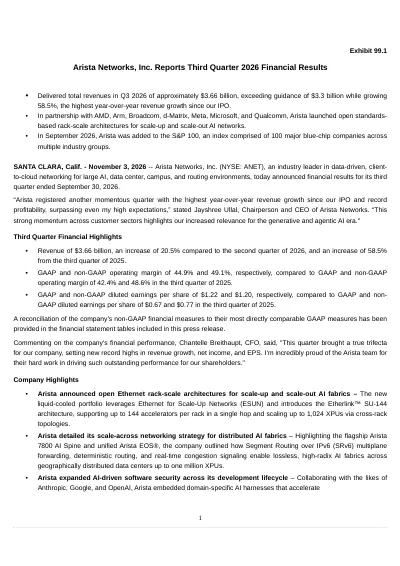
Thank you, Rudy, and welcome, everyone, to our third quarter 2026 earnings call. Arista just delivered a standout quarter of $3.66 billion in revenue, which is translating to our annual growth of 58.5%.
This marks our largest ever year-over-year revenue growth in the history of being a public company. Before we dive into the financial specifics, I would like to emphasize our rapid Arista 2.0 success, a strategy we embarked upon just three years ago.
It has generated meaningful customer outcomes to become the central network nervous system for us. In the 2000 era, the industry had accepted a status quo plagued by fragile, overly complex, disparate, and vulnerable operating systems.
Arista pioneered the Universal Cloud Network and the AI leaf-spine architecture based upon our rock-solid, high-quality foundation of our differentiated EOS. That one network operating system with a publish-subscribe state and data-driven foundation has governed us with five A's: agile security, automation, availability, analytics, and AI principles.
By extending our single EOS operating system from the data center all the way from the universal spine to many forms of edge leaf functions, we deliver structural and secure network harmony. Our Arista 2.0 transformation from data centers to centers of data can be characterized as the age of network intelligence, learning from vast repositories of streaming data.
It has driven our strategy across locations, be it client to branch to campus to data to cloud and AI centers for our customers. Based on our network data lake architecture, we offer our customers automated and conversational troubleshooting agentic companions.
Devoid of manual hunting through text-heavy logs, our systems proactively begin identifying and isolating issues for networked workloads, workflows, and workstreams. In 2026, the network-centric acceleration is well underway.
Our customers have increasingly coalesced the back end and the front end of AI and data centers. Arista has long championed standards-based Ethernet.
Customers have welcomed our open approach to modernizing cloud, campus, data centers, WAN centers, and now AI centers with a lower total cost of ownership. Recently, we were recognized with a leader status from Forrester for the highest strength of innovation and data center portfolio.
We were also recognized by Gartner Magic Quadrant leadership for campus wired and wireless and data center segments. As agentic AI models increase in parallelism, compute diversity, and density, we have the choice of many more training and inference accelerators.
The industry, we believe, is shifting from compute-centric vertical stack to a holistic network-centric approach. Arista is committed to unleashing and breaking down the barriers between compute and networking.
Arista customers can now construct an open network platform capable of handling heterogeneous models and diverse accelerators at scale. Our Etherlink portfolio of at least 25 switches for scale-up, scale-out, and scale-across is optimally designed to improve XPU utilization, job completion time, and token latency for these intense training and inference workloads.
In October of 2026 at the Open Compute Project conference, Arista showcased our rack scale-up designs partnering closely with several AI accelerators infused with our Arista network diagnostics layer. Based on ESUN, Ethernet for Scale-Up Networking rack options, these include orthogonal designs, cable-intensive backplanes, and heterogeneous cross-rack designs co-designed with many of our partners, including Arm, Microsoft Maia, AMD's Helios, Qualcomm, Meta's MTIA, and many more ahead.
We expect scale-up trials to begin in 2027, driving Ethernet to larger radices of 126 to 144 within a rack and across 1,000 across racks, with production expected for scale-up in 2028. We are witnessing the migration from highly centralized training compute to disaggregated and distributed inference prefill and decode, demanding much more intelligent networking and co-location of compute, storage, and KV cache resources rather than simply focusing on raw feeds and speeds and flops of compute.
A well-designed network is becoming a foundational cornerstone for optimal token efficiency. Arista's decades of EOS engineering in both multi-planar and distributed model routing at scale, be it ARP, Address Resolution Protocols, or FIB tables, Forwarding Information Base, or access lists with rapid reconvergence, comes to the rescue.
Our Etherlink products are inherently designed to actively understand parameters at a deep level, including latency and bandwidth profiles of multi-tenancy, to intelligently steer workloads for optimal placement between local and remote domains. The need for visibility into ports, packet queues, flows, buffer utilization, and path latency across the entire scale-out and scale-across fabric validates real-time AI system-level performance to avoid idling of precious compute cycles.
It assures immediate and network-wide insight to the root cause, as well as rapid recovery of the AI system with smart system upgrades across millions of accelerators. When we initially began this transformational AI journey, we spoke about four or five AI customers with approximately 50,000 to 100,000 NVIDIA GPUs, and in fact, we were largely staring at a proprietary network cycle such as InfiniBand.
In 2026, we are in a supercycle of AI, having already surpassed 100 Etherlink customers. By the end of '27, we are forecasting greater than 10 gigawatts of deployment across 10 or more different types of compute accelerators.
What a stark inflection in just three years. Central to this AI supercycle is also the expansion of Arista AVA, our Autonomous Virtual Assist, to support efficient AI in the enterprise.
By providing that open programmable interface within EOS and utilizing the Model Context Protocol, MCP, AVA allows emerging AI agents to reason, to interact with the network stack, and perform advanced multi-domain event correlation across the entire enterprise. With exponential rise of generated AI attacks and the ever-increasing cyber threats, securing the network is key and integral and our responsibility.
I would like to invite Ken Duda, our Founder, President, and CTO, to shed some light on this problem. Ken?
Ken Duda
Thanks, Jayshree. It's hard to overstate the impact of AI on networking.
First, the good news: AVA, which is Arista's Autonomous Virtual Assistant. Fueled by real-time data, AVA is incredibly powerful.
It seamlessly navigates networking and security infrastructure from campus to WAN to data center to cloud, continuously monitoring and troubleshooting, isolating root causes without manual labor-intensive tasks. Having seen what AVA can do, I can't imagine managing my own infrastructure without it, and I expect many of our customers will feel the same way.
The bad news, of course, is the massive challenge AI poses for us and our customers by discovering and exploiting security vulnerabilities. This threat landscape demands secure and robust networking.
Over the past few months, we've been collaborating with Anthropic, Google, OpenAI, and many others to integrate new AI-enabled security capabilities from frontier models into our existing software security pipeline. We are being invited early as a key infrastructure provider into partnerships like Project Glasswing, folding AI-driven vulnerability discovery and assessment into our established security vulnerability management process.
True network security has become a must-have, not a nice-to-have, and Arista's EOS operating system is the ideal architectural foundation based on four key principles. First, a single high-quality operating system.
Arista has maintained one of the lowest CVE counts, less than 100 in the industry over the last two decades, while others are rising exponentially, due in part to the simple fact that multiple networking operating systems tend to have more vulnerabilities than just one. Second, limiting vulnerability impact through process isolation.
EOS keeps each software agent, management plane or control plane, architecturally separate from each other and also from hardware forwarding, traffic keeps moving even if there is a defect in one component. EOS's state-sharing architecture also resists lateral movement, a defect in one component typically cannot be exploited to attack other agents within the switch.
Third, we provide a seamless upgrade process. Process isolation also means that we can ship a targeted fix to the affected component and install the fix without a maintenance window or network disruption.
Fourth, delivering a compliance dashboard to stay current. When a security advisory lands, Arista CloudVision brings real-time visibility that turns a stressful advisory day into a manageable one.
In addition to providing secure switches, we also provide Zero Trust Networking, or ZTN, technology to help our customers build secure infrastructure. I'd especially like to highlight Macro-Segmentation Services, or MSS, a ZTN feature allowing for dynamic security enforcement preventing undesired interactions among users, devices, and applications.
Second, we provide Network Detection and Response, or NDR, services that profile, analyze, and proactively detect sophisticated security threats. Finally, once workload traffic leaves the confines of the local data center, it becomes even more vulnerable to malicious actors.
We offer protection with wire-speed ubiquitous link and tunnel encryption native in every port with zero performance degradation. I hope this was a helpful summary of how Arista is helping customers take advantage of AI while improving security to meet the new challenges.
Back over to you, Jayshree.
Jayshree Ullal
Thank you, Ken. It was useful for me, too.
With Arista's uncompromised ZTN approach, we can systematically address the security hazards and parabolic attacks. Our CVE count, our vulnerability count, is often 10 to 50 times better than alternatives.
Our customer momentum this year has been significant in the enterprise, in the providers, across data center, campus, and AI because we are addressing security proactively. I would like to invite Todd Nightingale, our President and Chief Operating Officer, to describe more about this.
Over to you, Todd.
Todd Nightingale
Thanks, Jayshree. We're seeing phenomenal growth across our enterprise business driven by customers building mission-critical networks which benefit from Arista's industry-leading quality and reliability.
As the entire industry responds to AI-powered attack exposure, customers are motivated by the fact that keeping their infrastructure current with security updates will protect, segment, and defend against vulnerabilities beyond the network. Arista won a strategic deal at an Asian web services company as they shifted their focus strategically onto speed, scale, and resilience in the new AI era.
Reliability was the key to the engagement, as their teams were frustrated by long-standing quality issues with their existing vendor. Arista was able to demonstrate reliability and scalability while leveraging standards-based technology and a powerful EVPN VXLAN architecture on our 100 and 400 gig platforms.
This deployment will operate as the front end for their AI deployments moving forward. In the healthcare sector, leading hospitals are selecting Arista for strategic data center deployments.
One important hospital group chose Arista following an exhaustive Zero Trust Networking evaluation. Their primary business goal was to protect sensitive patient data through advanced network segmentation while enabling seamless integration to cloud environments.
Arista secured this win by delivering an automated, high-performance fabric that perfectly aligned with their trust nothing, verify everything security mandate. By centralizing routing on Arista's R3 spines, we provided a powerful, streamlined layer for traffic management tailored to modern healthcare workloads with a robust leaf-spine topology.
We deployed CloudVision as a Service alongside the Arista AVD framework for cloud-based automation and deep visibility, and by integrating Arista's segmentation service, MSS, the customer can now dynamically automate the entire system. In the hospitality sector, an award-winning regional resort and casino selected Arista to modernize its expanding operations.
Realizing their legacy network was a bottleneck for innovation, they architected a truly unified, standards-based architecture across their data center and campus environments to support new guest experiences and rapidly scale their services. Arista's routing and switching platforms alongside campus access switches are delivering quality and reliability key to performing mission-critical applications like their demanding casino gaming floor network.
They utilized CloudVision and AVD to automate device provisioning and gain the deep real-time visibility required to optimize network performance. In all three of these examples, Arista's differentiated EOS provided unmatched quality and reliability and integrated seamlessly with their overarching security ecosystem partners.
Additionally, our TAC delivered a flawless experience and peace of mind to de-risk these modern enterprise migrations to Arista. 2026 has really been an exciting year building momentum across our entire enterprise business around the world in data center, campus, and AI buildouts.
Thank you, Jayshree.
Jayshree Ullal
Thank you, Todd. Wow, that momentum is indeed unprecedented.
I haven't experienced anything like this until you arrived. We are pleased with Arista's accelerated networking progress across all our sectors.
Our commitment to fulfilling this accelerated demand in the second half of 2026 is really playing out well with our improved execution in supply chain, partnering closely with our vendors. I want to give a special kudos to you and your entire manufacturing team led by Yuhinia for the tireless work and progress despite the widespread industry-wide supply chain constraints and shortages.
With this backdrop, we are now increasing our annual guidance for the fourth time in 2026 to $13.3 billion, which represents a 48% annual growth. At Arista, we find ourselves in a position to address this ever-increasing total accessible market, not just available market, which now stands at north of $200 billion in 2030, therefore representing a multi-year growth opportunity for us.
Our first look at 2027 guidance range puts us in the 38% to 40% range for growth annually to approximately $18.5 billion. Within this envelope, we expect our AI fabrics target to be the fastest-growing segment and to double to approximately $7 billion, while our cognitive campus represents a healthy growth of 60%, much faster than the market, to approximately $2 billion in 2027.
We do live in exciting times as we harness the power of cloud and AI revolution. It has certainly surpassed my expectations as we exceeded our original $10 billion goal this year to enter revenue dollars in the teens for both 2026 and 2027.
We do so in the typical Arista way, bringing our unique combination of innovation, quality, profitability, efficiency, and zero debt, making our financials very pristine. Our results would not be possible without the cohesive Arista leadership and team, our elite customers and partners, and of course, our supportive shareholders.
With that, over to you, Chantelle, to shed more light on our impressive financials.
Chantelle Breithaupt
Thank you, Jayshree. This quarter, we delivered record-high revenue growth since our IPO at 58.5%, partnered with robust operating margin above 49%.
At the same time, we invested ahead of demand in R&D, inventory, and supply commitments to support the AI opportunity in front of us. Congratulations to the Arista team for being named to the S&P 100 in September, a great achievement within a short time frame.
Let's dive into the financial details. To start off, total revenues in Q3 were approximately $3.66 billion, up 58.5% year-over-year and above our guidance of $3.3 billion.
This significant growth was driven by our continued strength in both AI and enterprise customers. International revenues for the quarter came in at $682.5 million, or 18.6% of total revenue, down from 23% last quarter.
This quarter-over-quarter change was primarily influenced by a shift in the geographic mix of sales to our large global customers. Year-over-year double-digit growth was achieved in all three geographic segments.
The overall gross margin in Q3 was 64%, down from 65.2% in the prior year, with supply chain efficiency working to partially offset product cost inflation, and up from 63.4% in the prior quarter, driven by end customer mix. Operating expenses for the quarter were $545.3 million, or 14.9% of revenue, up from the last quarter at $411 million.
Our R&D spending came in at $408.5 million, or 11.2% of revenue, up from the last quarter at $278.1 million. Arista continues to demonstrate its commitment and focus on network innovation with additional investment in liquid cooling, high-radix switching, and leading AI software.
Sales and marketing expense was $110.9 million, or 3% of revenue, down slightly from 3.6% of revenue last quarter, representative of the highly efficient Arista go-to-market methodology. Our G&A costs came in at $25.9 million, or 0.7% of revenue, up slightly from $23.1 million last quarter, as we continue to focus on our critical corporate systems and processes.
Our operating income for the quarter was $1.8 billion, or 49.1% of revenue, demonstrating our ability to invest in innovation while expanding profitability. Other income and expense for the quarter was a favorable $138.6 million, and our effective tax rate was 20.9%.
Overall, this resulted in net income for the quarter of $1.53 billion, or 41.9% of revenue. Our diluted share number was 1.278 billion shares, resulting in a diluted earnings per share for the quarter of $1.20, up significantly with a growth of 55.8% from 77 cents in the prior year period.
Now turning to the balance sheet. Cash, cash equivalents, and marketable securities ended the quarter at approximately $14.4 billion, up from $13.3 billion at the end of Q2.
Of the $1.5 billion stock repurchase program approved in May of 2025, $817.9 million remain available for repurchase in future quarters. The actual timing and amount of future repurchases will be dependent on market and business conditions, stock price, and other factors.
Now turning to operating cash performance for the third quarter. We generated approximately $1.2 billion of cash from operations.
This is driven by a robust earnings performance coupled with an intentional inventory build to meet our growing customer demand. DSOs came in at 59 days, down from 68 days in Q2 due to the timing of customer shipments and invoicing.
Our inventory turns dropped slightly from 1.7 in Q2 to 1.6 this quarter. We ended the quarter with $3.2 billion in inventory, up from $2.5 billion last quarter.
Inventory level fluctuations are expected to continue as we work through the balancing of component timing and availability. This could result in quarters of elevated inventory balances affecting the timing of cash flow from operations ahead of customer deployments.
Our purchase commitments at the end of the quarter were $11.4 billion, up from $9.7 billion at the end of Q2. As mentioned in prior quarters, this expected activity mostly represents purchases for chips related to new products and AI deployments.
Our total deferred revenue balance was approximately $6.8 billion, down from $6.9 billion in the prior quarter. The majority of the deferred revenue balance is product-related.
Our product deferred revenue decreased $86 million sequentially versus last quarter. We remain in a period of ramping our new products, winning new customers, and expanding new use cases, including AI.
These trends have resulted in increased customer-specific acceptance clauses and an increase in the volatility of our product deferred revenue balances. As mentioned in prior quarters, the deferred balance can move significantly on a quarterly basis independent of underlying business drivers.
Accounts payable days were 48 days, down from 57 days in Q2, reflecting the timing of inventory receipts and payments. Capital expenditures for the quarter were $100.7 million.
Our construction work to build expanded facilities in Santa Clara remains on track, and we expect construction to be completed in the coming months. As we look ahead, the momentum is strong.
We are grateful to our customers and proud of our team's continuous ability to rise to meet the demands of the networking industry. For the fourth quarter, we are forecasting a range of revenue between $3.9 billion and $4 billion.
This positions fiscal year 2026 revenue just over $13.3 billion at the midpoint. Our fourth quarter gross margin outlook is 63% to 64%, and operating margin is between 48% and 49%.
Diluted EPS is forecasted to be between $1.26 and $1.30, with approximately 1.28 billion diluted shares, and the effective tax rate is expected to be approximately 21%. Looking further ahead to 2027, the momentum continues.
For fiscal year 2027, the revenue growth outlook is between 38% and 40%, equating to approximately $18.5 billion at the midpoint. Gross margin continues to be in a range of 62% to 64%, and an operating margin of approximately 49%.
Our effective tax rate is expected to be approximately 21%. In closing, there is a lot to be excited about here at Arista.
We will continue to be focused on our innovation, execution, and delighting customers in the Arista way. Now back to you, Rudy, for Q&A.
Rudolph Araujo
Thank you, Chantelle. We will now move to the Q&A portion of the Arista earnings call.
To allow for greater participation, I'd like to request that everyone please limit themselves to one question. Your line will be placed on mute after your question.
Thank you for your understanding. Regina, please take it away.
Operator
We will now begin the Q&A portion of the Arista earnings call. To ask a question during this time, simply press star, then the number one on your telephone keypad.
If you'd like to withdraw your question, press star one again. Please pick up your handset before asking questions to ensure optimal sound quality.
Our first question comes from the line of Michael Ng with Goldman Sachs. Please go ahead.
Michael Ng
Good morning. Thank you very much for the question.
I wanted to ask about your comment around the greater than 10 gigawatts of deployments across 10-plus compute accelerators for next year. Could you just talk a little bit about whether that is an industry number or an Arista-specific number in terms of those deployments, and how does the diversification of compute potentially create more opportunities for Arista networking relative to just having a handful of compute suppliers?
Thank you very much.
Jayshree Ullal
Thanks, Michael. As I think much of AI, even in our world, started initially being compute-centric, and we're seeing that change to network-centric.
As part of the accelerated networking strategy, we are supporting three types of AI fabrics: scale-up, scale-out, and scale-across. Our guess is by the end of '27, we will deploy, largely in '26 and '27 is where the exponential ramp happened, across or greater than 10 gigawatts.
Now, much of that gigawatt may be new, but remember, in scale-across, we can also have existing gigawatts being deployed. We're talking about new distributed 10 gigawatts, that there may already be multiple gigawatts deployed across.
The rationale here is while we are new to scale-up, we are touching a variety of XPUs in scale-out and scale-across, across a rack and across data centers. We already know with our scale-across, we are touching multiple XPUs, four or five of them.
With the advent of scale-up, we will add another five in 2027.
Operator
Our next question will come from the line of Meta Marshall with Morgan Stanley. Please go ahead.
Meta Marshall
Great, thanks, and congrats on the quarter. I guess just, Jayshree, if you could give an update just on how you see that mix of scale-across and scale-out and scale-up just as a mix of your business.
Clearly, scale-up nothing today. I think last quarter you had said you expected a third of the demand this year to be from scale-across.
Just as you've continued to increase your guidance and as you look into '27, just what do you see those mixes being? Thanks.
Jayshree Ullal
I think in '27, Meta, thank you for the kind wishes. We've been working hard for this day.
The scale-up will still be in early trials, I don't think there's a material number associated with scale-up in '27. I do think it could contribute in '28.
Then if scale-up is virtually zero, then we're basically left with most of the use case being scale-out and scale-across. As you've heard us say in the past, scale-across we think will be at least a third.
It'll probably go higher in '27. The split this year is roughly 70/30.
The split next year may be, I can't venture to guess, but I think the 70 may come down and the 30 would go up when it comes to scale-across because it's a very strong use case for us. Arista is highly differentiated with our 7800 scale-across platform, and unsurprisingly, the word scale means a lot to us there and our customers: scale for security, scale for performance, scale for reliability, and there's just no room for error when you're connecting millions of XPUs.
We feel very comfortable that these are our two strongest use cases. A lot of this is back-end AI fabric, we will come back to revisit the question of front end as well as we move to more inference and the line between back and front becomes thinner.
Operator
Our next question will come from the line of Ben Reitzes with Melius Research. Please go ahead.
Ben Reitzes
Hey, how you doing, Jayshree? Pretty good quarter and guide there.
You've previously referred to potentially two 10%-plus customers into the fourth quarter. Do you mind talking about whether they're landing in that range and what the use cases are for and if you're excited about those customers still and into '27?
Thanks a lot.
Jayshree Ullal
Yeah. I guess diversity is the name of the game and the theme today, right, Chantelle?
Chantelle Breithaupt
That's right.
Jayshree Ullal
We have diverse accelerators, we have diverse models, we want to have diverse 10% customers, too. As we said before, our dearest ones are M&M.
We fully expect our top prior 10% customers to continue to be with us in '26 and we hope beyond. We expect to add at least one, maybe two, and a lot of that depends on whether Todd and Yuhinia can ship enough product.
We'll let them decide, and we'll give them all the way into December 31st.
Todd Nightingale
We'll take every day.
Jayshree Ullal
We're feeling pretty good about at least three and maybe four.
Operator
Our next question will come from the line of George Notter with Wolfe Research. Please go ahead.
George Notter
Hi, guys. Thanks very much.
I was curious about the big sequential jump in R&D. It was really, really significant, and I'm just wondering if that included some one-time items.
Also, is this the new run rate in R&D going forward? Any perspective there would be great.
Thanks a lot.
Jayshree Ullal
Over to you, Ken. Why'd you spend so much money this year?
Ken Duda
We're building so much new stuff. The opportunity is humongous in AI.
Our success with the hyperscaler AI companies depends on our ability to partner. Our ability to partner is based on our understanding of each of their unique requirements and constraints.
Also, there's a new technology introduction around liquid cooling. This requires major infrastructure upgrades and technology upgrades on our part.
I think that's what's really driving the expansion in spending there.
Chantelle Breithaupt
Sorry, George, and just on your comment, is this the new run rate? I'll still put the framework at anywhere between 9% and 11% as we work through.
Some quarters, like Ken talked about, will hit this range as we have specific investments, and so I would still keep it in that 9% to 11%. More to come as we guide next year in more detail.
Jayshree Ullal
I noticed the prototype bill was very high this quarter, Ken.
Ken Duda
That's right, because of all the opportunities in the hyperscaler AI space.
Jayshree Ullal
Yeah. Thank you, George.
Operator
Our next question will come from the line of Amit Daryanani with Evercore ISI. Please go ahead.
Amit Daryanani
Yep, thanks a lot, and congrats on a really good set of numbers over here. Jayshree, you talked initially about the industry moving towards a more network-centric architecture.
As customers deploy different type of accelerators, does Arista become involved earlier in designing the overall system rather than connecting them afterward? As you have to work with a more distributed, disaggregated compute network, does that change your networking content per deployment?
I know you talked about 10 gigawatts, I'm just wondering, does the network intensity start to change as well?
Jayshree Ullal
Then
Amit Daryanani
maybe for Chantelle, as you think about this 38% to 40% guide for '27, which is extremely impressive, can you just touch on your confidence around the supply chain execution to meet this demand, what's in the bag versus what still needs to be closed? Thank you very much.
Chantelle Breithaupt
Amit, this is a very good question. I think until now, we've enforced our architecture mostly on scale-out and scale-across, and a lot of that had to do with distributed power, location, moving to regional edges, a very software-defined type of network with the intensity like I described of packets, flows, performance, predictable latency, et cetera.
As we start participating with new accelerators, we get a greater chance early in the cycle to see the behavior of these accelerators. Two or three examples I'd like to highlight is our close work with Cerebras, our work with Microsoft and Maia.
These have been going on the last couple of years, and it has allowed us to tune our buffers, tune our software performance, and maximize the I/O throughput, if you will. The recognition of those scale-up designs are still in the works, but they're already manifesting itself in scale-out and scale-across.
Jayshree Ullal
You bring up a very good point, not only in the actual work we're doing with these accelerators, but the aggregate impact it has on our network design in terms of scale, performance, and reliability.
Chantelle Breithaupt
Then I think to part B of your question, Amit, and thank you for the kind words at the beginning. I am confident in the guide, and I am confident in the supply chain.
What makes me confident in the supply chain is internally, Todd and Yuhinia and the team doing a fantastic job every day being scrappy to make sure we can do what we need to do to deliver to our customers. I also have confidence, a lot of great conversations and agreements with some of our key suppliers, and that's why you see our purchase commitments increasing, because we have that confidence.
Internally, extremely confident. As far as visibility, I think we have two quarters of visibility as we always have, and we lean into the other two, but given our highly fungible portfolio, we're pretty clear where to make that bet.
We're pretty excited about next year. Thank you.
Operator
Our next question will come from the line of Tim Long with Barclays. Please go ahead.
Tim Long
Thank you. Maybe if we could shift a little bit and talk about the campus and branch.
Pretty good year this year and guiding it to 60% next year. Could you talk a little bit about kind of what is enabling you to grow so much faster than the industry, and is this something that you see as a multi-year type of dynamic?
Obviously, you got strength in enterprise data centers, but curious what else is helping this much higher than industry growth. Thank you.
Todd Nightingale
Thanks for the question. In a lot of ways, I think the enterprise campus market is coming to us.
Arista has always led the way in quality and reliability, and over the past few years, just practically every significant enterprise has shifted gears and really considered their campus networks, their branch networks mission-critical with the highest needs for reliability. This has only accelerated because of the Glasswing and Mythos effect, where people are really focused deeply not only on providing the highest level of reliability, but being able to do that as they rapidly patch and adjust their infrastructure over time.
The differentiation with EOS and the ability for Arista software to be able to do this with practically no downtime, with extremely, extremely high uptime, it's highly differentiated in the market, and I really think that's the core of what's driving market share gains here.
Ken Duda
I think the other thing that makes this an incremental process is that campus refresh cycles are pretty long. Even customers that understand the Arista advantage may take some time to adopt it simply because of the schedule in which they depreciate and upgrade their gear.
I think we can expect this to be a multi-year cycle.
Operator
Our next question will come from the line of David Vogt with UBS. Please go ahead.
David Vogt
Great. Thanks, guys, for taking my question.
Maybe, Chantelle, one for you, and I'll wrap two together in one question. Can you kind of help us understand sort of your purchase commitment dynamic and your deferred revenue dynamic against the strong revenue guide that you provided for 2027?
Obviously, we recognize that you're confident in the number, but deferred revenue, I understand that it's volatile and it varies quarter to quarter, but just help us understand how to think about that metric in the context of a 38% to 40% guide, particularly also with purchase commitments going up a couple of billion dollars sequentially.
Chantelle Breithaupt
Thank you. Thanks, David.
I think there's a few things. I don't know if they correlate directly, but they're all on purpose and designed to serve the customers as we need to exiting Q4 and into 2027.
Purchase commitments, from that perspective, there are some things additionally we added. Now we have memory in there, a memory agreement which has done that, so that's a multi-year agreement that you'll see as the Q comes out.
I think on the purchase commitment side, you can probably expect that to go up a little bit more as we exit Q4 as we get ready for this 2027 guide we have. As far as the deferred revenue, deferred revenue actually had the largest churn in and out and still remained flat and still delivered a 58.5% revenue growth quarter, which I think is a fantastic outcome.
There you're seeing things exited and released and things that get put back into the deferred balance, which I think is a really healthy sign of the demand that's fueling that 38% to 40% revenue growth next year. I think they're all related: purchase commitments grow to serve that demand, and the deferred staying flat to deliver that outcome to the P&L.
We're pretty excited to see how that continues through 2027.
Operator
Our next question will come from the line of Simon Leopold with Raymond James. Please go ahead.
Simon Leopold
Appreciate that. I wanted to get one quick clarification.
You gave us targets for 2027 for campus and AI. Just wanted to check on what the baselines are for 2026.
The question was really on a topic that I think Andy's been vocal about, but your thoughts about the evolution of switching with the inclusion of either CPO or NPO. What does that mean to Arista?
Thank you.
Jayshree Ullal
Just to clarify, the baseline upon our 38% to 40% is the '26 guide we gave of $13.3 billion.
Chantelle Breithaupt
Yeah, $13.3 billion. Within that, AI is $3.5 billion and campus is $1.25 billion.
Jayshree Ullal
We're staying with the target numbers because we'll only know actuals after we ship everything end of the year. To your second question on optics, optics is very integral to Arista's strategy.
Andy Bechtolsheim, our Chief Architect, lives and breathes this. It doesn't mean we build everything, that we actually systematically put it together.
We, first of all, strongly believe in copper when you can and optics if you must, because the minute you go beyond the 1 or 2 meter radius, the flexibility of pluggable optics and lasers is probably the most widely deployed and accepted. Andy was a pioneer of OSFP that gave us a very wide density of thermal limits and widely used, and now our new coherent optics LPO modules is something that goes long distance without requiring DSP.
Then to meet higher front-panel density, we're very excited about XPO, extra-dense pluggable optics, that is being supported by over 150 vendors. We think the world is going to remain in a very majority fashion on pluggable optics.
Having said that, I think there's always room for complementing the pluggables with a strong adoption at higher speeds to what we call near-packaged optics or open CPO. We don't want to build proprietary co-packaged optics, and to solve these constraints, Arista has been pioneering this open CPO that instead of soldering components, we can use socketed optical engines and pigtail fibers to allow these modules to be pretested, et cetera.
We are big fans of these. We think they'll come onto the market in the '28 to '30 time frame.
It's not imminent, but meanwhile, long live pluggable optics.
Operator
Our next question will come from the line of Joseph Cardoso with JPMorgan. Please go ahead.
Joseph Cardoso
Hi, good afternoon, and congrats on the results as well. Maybe the question I wanted to touch on, and maybe it kind of dovetails off of a clarification on the last one, when we take a look at the initial full year guide for 2027, particularly as it relates to maybe the non-AI, non-campus business, I think growth is being implied to moderate from the strong 2026 levels.
I was just wondering if you can kind of touch on the underlying assumptions or factors that's maybe driving a little bit more moderation here into 2027, and whether that's maybe just tough compares or conservatism in terms of supply, et cetera. Just trying to understand directionally what's the drivers of the 2027 forecast as it relates to the maybe core business.
Thank you.
Jayshree Ullal
Thank you, Joe. Listen, when some things are growing 60% and 100%, and then you say the overall growth is 38% to 40%, then obviously some of the things are not growing as fast, right?
We're very comfortable that everything's going to grow double digits, some more, some less. We're also very comfortable that given a first guide literally over a year before, that all sectors are doing well for us: AI, enterprise, specialty cloud providers, front-end networks.
We started out 2026 wondering if front end would grow. It's a cyclical thing.
When the back end grows, the front end may grow a little slower. When the back end slows down, the front end may grow a little faster.
I wouldn't read any conservatism into these numbers. These are wildly higher and optimistic than we had once projected, enjoy them for a moment, and hopefully they'll get better.
Operator
Our next question will come from the line of James Fish with Piper Sandler. Please go ahead.
James Fish
Hey, fantastic quarter and guide here to start for '27, ladies, and Ken, of course.
Jayshree Ullal
We have two gentlemen and two ladies.
James Fish
Todd, I didn't forget about you, Todd. Look, I appreciate the early outlook, but you guys always talk about one to two quarters of visibility.
You tend to be a very prudent team. Maybe going back to, I think it was Amit's question, I guess the confidence in providing this durability at this scale this early, and why we're going to see this kind of strength persist, why Arista for scale-up in 2028.
Thanks.
Chantelle Breithaupt
I'll just go back, and thank you for the kind words.
Jayshree Ullal
The kind words to the ladies and gentlemen.
Chantelle Breithaupt
That's right, to all of us. I'll just go back and reiterate the confidence level.
There was a lot of thought obviously put into a guide this strong this early, there was a lot of attention paid with Todd and Ken and Jayshree and myself and team. We had to get comfortable first, and we're very comfortable with all the things we've done to secure what we need to go ahead.
Again, the two quarters visibility, two years of relationship and technical conversations, somewhere in between the second half lands, and it's the usual kind of cadence we have, nothing's changed there. Then the second part of your question was about scale-up going into 2027, 2028, Jayshree?
Jayshree Ullal
Yeah. Listen, I think scale-up has been a tough market for us because it doesn't have all the software advantages that we bring, but it absolutely has the hardware skills and all the non-NVIDIA accelerators that Arista is in the best position to connect to.
This movement from standalone basic switches to rack scale is something that Andy, Alex, Hugh Holbrook, the entire team has been working on and co-developing for a couple of years. It's hard work.
Just as we were staring at InfiniBand and now we can go, of course, it's going to be Ethernet, we're looking forward to a time where we were staring at proprietary UALink or NVLink and we're going to go, of course, it's going to be ESUN. These type of migrations are multi-year, and so we're very confident not only in our '27 guide, but a promising '28 ahead as well.
The reason we are is because even though we have two quarters of visibility, we have two years of work behind us.
Operator
Our next question will come from the line of Tal Liani with Bank of America. Please go ahead.
Tal Liani
Hi, guys. Hi, ladies and gentlemen.
Sorry, I'll start from the beginning.
Jayshree Ullal
Thank you, Tal.
Tal Liani
I missed the call last time, and you raised the guidance substantially, and now you're doing it again. On the other hand, I heard Chantelle's explanation about deferred revenues, but the sequentials are slowing down.
If I look at total deferred and current deferred, are slowing down. You are feeling more comfortable with next year, and you're guiding well, well above the Street.
The question is, when you look at orders versus recognizing from deferred because of availability of components, because of releasing kind of deferred revenues because of completion of buildout, et cetera, same question, but from different angles: what are the drivers for the growth? Is it orders, or is there some part there of recognition of historical orders?
Then is deferred revenue actually losing some of its predicting ability just because I see some decoupling between the deferred revenue trends and revenue growth trends?
Jayshree Ullal
Let me start, and then Lady Chantelle, will you take over? For sure.
I think, first, Tal, we missed you last quarter, because we don't get this level of details from anyone else on exactly what are the puts and takes. I just broadly look at you and say, hey, it's great demand.
If you want to dissect demand into how much is sitting into deferred, how much is sitting into our orders, how much is getting shipped into revenue, you're turning demand into a physics problem that I don't have the answer for, because I don't predict or forecast deferred. Deferred is a strong function of a new use case or a new product that eventually is not a new use case or a new product.
We had millions of dollars come out of deferred because the use case was satisfied. We had millions of dollars go in as deferred, and generally that number, if you look at it over the last few quarters or if you look at it over the entire year, is trending up.
Deferred is never going to be infinite. It is going to come out, and other new deferred will go in, or the product becomes familiar and less new, right?
It's important to just look at this big picture and say we got demand. We got demand in AI, in enterprise, in campus, in data centers, and we're just in the best position we've been in a long, long time in my 18-year career at Arista.
Over to you, Chantelle,
Chantelle Breithaupt
you want to add? The only thing, I think it was very well said, and I think that's the right perspective to take on this so we don't get too lost in the weeds on a quarter-to-quarter basis.
We're very confident in the demand and the guide. Deferred is a balance sheet account that will reflect whatever happens in the quarter, so that is what it is.
The only thing I would add, like I said before, Tal, we did miss you last quarter, was that we anticipate the end of this year from a deferred balance to be higher than we ended last year, which shows that the P&L did what the P&L needed to do without deferred. If that helps you feel more comfortable with that, that's the only thing I'd leave you with.
Operator
Our next question will come from the line of Ryan Koontz with Needham & Company. Please go ahead.
Ryan Koontz
Great, thanks for the question. I wanted to follow up on some of your scale-up commentary and ask about some of the technical design changes a little bit here with obviously including more optics and including liquid cooling, and how will that change your fulfillment model?
What things are you including in your sale versus partner to reference third parties in? Maybe can expand a little bit on your product plans around scale-up and how we should think about the product changes.
Thank you.
Jayshree Ullal
Actually, that's a really good question, Ryan. We're still figuring it out ourselves, because Arista's value in the rack scale is still the switch.
However, we have to design the whole rack and then work with different partners differently on whether they want the whole rack from us or the rack gets shipped through our manufacturing partners while we basically ascertain the switch. Different strokes for different folks, because we've got three different designs going on with the orthogonal, the cable backplane, and the cross-rack designs.
Each one is a little bit different. Give us a chance in the next few quarters to share with you what's going on with each design.
There isn't one answer to your question. The one last thing I do want to add to that is that what's very clear is there's a lot of switches swimming in water.
A lot of it's liquid-cooled.
Operator
Our next question will come from the line of Karl Ackerman with BNP Paribas. Please go ahead.
Karl Ackerman
Yes, thank you very much. Chantelle or Jayshree, I'd like to ask a question that was similar to peers, but in a slightly different way.
In the context of your 2027 revenue outlook, can you speak to whether your revenue outlook is predicated on new permitting or financing of powered shell infrastructure to achieve these forecasts? As you address that, can you speak to whether you require an aggressive drawdown of your deferred revenue balance to achieve your outlook?
I think I know the answer, but would love your view. Thank you.
Jayshree Ullal
What do you think our answer is?
Chantelle Breithaupt
Yeah.
Jayshree Ullal
It's so nice to ask a question ourselves.
Karl Ackerman
I don't think you need to, but I would love clarification.
Jayshree Ullal
Go for it,
Chantelle Breithaupt
Chantelle. We don't guide deferred, I think that was the answer you were expecting for the second hand.
I would say from the perspective of the guide next year, we are looking at what we know ahead of us, two quarters visibility, taking a lean on the second half of the next year in the sense of what we've had conversations with some of our largest customers, the run rate we have in Todd's business in the sense of enterprise, and all those things together, but we don't guide deferred.
Jayshree Ullal
His question was, are we counting on data center?
Chantelle Breithaupt
The first part. The second part was, are we preparing to draw down deferred to hit the number?
We don't guide deferred, but I would say that we see a very strong demand signal and demand environment back to the momentum theme. Jayshree, if you want to comment?
Jayshree Ullal
Right, exactly. I think while we don't guide deferred, let me be clear that we do see plenty of new use cases and new product.
2027, like '26, is going to be filled with lots of new products.
Operator
Our next question will come from the line of Gianmarco Conti with Deutsche Bank. Please go ahead.
Gianmarco Conti
Thank you for that. Congrats on the quarter, great numbers.
As ESUN 144 moves towards production in '28, how should we think about gross margin economics relative to your existing switching portfolio, and how much customer commits do you already have behind those programs?
Jayshree Ullal
You're talking about '27 or '28? What's your question?
Gianmarco Conti
2027 and 2028.
Jayshree Ullal
It's about gross margin for [ESUN 144?] .
Look, since we went public, our long-term gross margin has always been in the 60% to 65%. I think we've tightened the range now to more like 62% to 64%.
We don't see any change.
Operator
Our next question will come from the line of Daniel Zhu with Bernstein. Please go ahead.
Daniel Zhu
Congrats on a great quarter. I just wanted to ask how concentrated is the customer base for scale-across?
Should we think about this as really being driven by the cloud titans for synchronous training, or are we also seeing scale-across deployments even among smaller customers or for inference use cases?
Jayshree Ullal
No, I think there are both small use cases and colos for scale-across, which would be our smaller footprint switching and routing platforms like the 7280, but the concentration of our large customers also is high, with our larger customers opting for the very large AI spines across data centers and requiring that kind of 576-port density and terabit scale and multi-gigawatt deployments for security and performance. We do see both, but I think the revenue concentration favors the 7800.
The location concentration of multiple sites favors the 7280.
Operator
Our next question will come from the line of Sean O'Loughlin with TD Cowen. Please go ahead.
Sean O'Loughlin
Great, thanks for squeezing me in, and congrats on the fantastic results, ladies and gentlemen. Wanted to just check in broadly on where we are actually in the front-end cycle.
I think we've spent so much time talking about scale-out, scale-across, back-end deployments, and the focus on 800 gig and above in those deployments that maybe we collectively have lost track of where we are in the sort of more traditional front-end compute, and just wondering if you could comment on that and what you see in terms of market trends on the front end specifically. Thanks.
Jayshree Ullal
No, Sean, it's a very good question. I think it's like a sine wave.
When everybody's focused on the back end, then there's, in those customers, they're thinking less about the front end. Then sometimes they're focusing a lot on the front end, they're not worrying as much about the back.
If you look at it over a period of time, like six quarters to two years, you can capture both. In a given year, we had one 10% customer, for example, put a lot of thought into the multi-hundred-gig refresh of their front end before enhancing their back end.
That particular year, their front end was very high, though their back end was low. The following year may be the reverse.
If you tend to look at it over multiple quarters and years, they even out. If you tend to look at it in a concentrated period of time, you'll usually see more of one than the other.
Right now, in general, we're seeing more back-end and AI fabrics, and I think the front end will catch up later.
Operator
Our next question will come from the line of Antoine Chkaiban with New Street Research. Please go ahead.
Antoine Chkaiban
Hi, thanks for taking my question, and congratulations on the very strong set of results. Ken, maybe one for you.
I wanted to ask about AVA. With all the recent high-profile infrastructure security breaches that we've been hearing about, it looks like that technology can address a very large opportunity.
How should we think about sizing it? How do you plan to monetize AVA, and is that going to fall into product, or could this drive actually a meaningful acceleration in your services revenue?
Ken Duda
We are at early days in understanding all of that. We have just turned AVA on as an alpha feature for customer trial within our CloudVision service, and we are currently working on pricing models.
I don't think I have any forecast or data to share with you at this time on that.
Jayshree Ullal
I think it's very promising, Antoine, because back again to Ken's points that he repeatedly makes with me is the architecture of EOS is so sound that adding AVA or CloudVision as capability to look at deeper details and get more analysis starts with the foundation, right? We feel very privileged that we can sit here and make a joke about, oh my god, our vulnerabilities doubled from 30 to 67, and we fixed them, and therefore we can go apply AVA.
Everybody else is dealing with a game of whack-a-mole where they've got thousands of vulnerabilities and no AVA can possibly keep track of it. I think we feel in a very good position to monetize AVA in the next few years.
Operator
Our next question will come from the line of Ben Bollin with Cleveland Research. Please go ahead.
Ben Bollin
Good afternoon, everyone. Thanks for taking my question.
Jayshree and Todd, I suppose, I'm interested in your thoughts on where lead times are across the portfolio if we kind of carve it up into enterprise-centric and hyperscale-centric, just what those look like today. I was hoping Todd could talk maybe a little bit more big picture about the go-to-market effort, the execution within enterprise share capture, and how that's building and where that goes from here.
Thanks.
Todd Nightingale
On the lead times, and it goes both for the component lead times and the finished good lead times, in the enterprise side of our business, we tend to have shorter lead times, somewhat shorter, and that's driven by the fact that those switches are not always in the absolute cutting edge, they're not leading brand-new technologies requiring the highest process silicon, et cetera, they also tend to be at a lower price point where we're able to hold a little bit more buffered inventory there. We tend to have lower component lead times there and lower lead times to our customers.
On the AI side, on the ultra-advanced hyperscaler data center, lead times tend to be a little bit longer. As far as the buildout on the go-to-market side, we have been just really pleased with the momentum we've seen this year and the maturity that's being built into the whole go-to-market.
On the kind of thought leadership side and awareness side, we saw great momentum from webinars and from events. In fact, we have our largest customer event coming up in December, which we're very excited about.
On the sales execution side, it's been just phenomenal efficiency from that team, and we're looking forward to continuing to build out next year.
Jayshree Ullal
I just want to add, Todd, also, I see that you and Chris Schmidt, you've really heightened the investment not only in the United States, but with key verticals and international as well. I think all of the go-to-market investments we've been making over the last year, and in fact the last three years, is really paying off.
Rudolph Araujo
Absolutely. Hey, Regina, we have time for one last question.
Operator
Our final question will come from the line of Mehdi Hosseini with Susquehanna. Please go ahead.
Mehdi Hosseini
Yes, thanks for taking my question. I have two quick follow-ups.
Going back to your revenue guide for '27 of $18.5 billion, should we assume that all the silicon have been planned for? Then the second question, if you could elaborate on the mix between cloud and enterprise, I just want to get a better understanding how enterprises are investing as it relates to hyperscalers.
Thank you.
Todd Nightingale
Sorry, you asked, is all the silicon planned for already in the $18.5 billion?
Mehdi Hosseini
Since you are providing an initial assessment on 2027 revenue target, should we assume that you have already planned with your suppliers and silicon is secured for both compute and memory? There are some that argue the tightness is going to get worse in '27, and just want to make sure that there is no downside risk to this target as it relates to inventory management and supply chain.
Todd Nightingale
Understand. We work very, very closely, and we're sort of proud of our strategic partnerships, and we've been investing heavily in long-term strategic agreements in order to secure supply, not just in silicon, but PCB capacity, memory, which Chantelle mentioned earlier.
We have very high confidence in the ability to deliver supply to the forecast. Of course, we would not want to place everything to five quarters lead time for all of next year, not every order is placed.
Rudolph Araujo
This concludes Arista Networks third quarter 2026 earnings call. We have posted presentations that provide additional information on our results, which you can access in the Investors section of our website.
Thank you for joining us today and for your interest in Arista.
Operator
Thank you for joining, ladies and gentlemen. This concludes today's call, and you may now disconnect.