Air Products and Chemicals, Inc.
Q4 FY2026 · Earnings Call TranscriptNovember 5, 2026
Operator
Good morning, and welcome to Air Products' fourth quarter earnings release conference call. Today's call is being recorded at the request of Air Products.
Please note that this presentation and the comments made on behalf of Air Products are subject to copyright by Air Products, and all rights are reserved. Beginning today's call is Megan Britt.
Please go ahead.
Megan Britt
Hello, and welcome to the fourth quarter and full-year fiscal 2026 earnings conference call for Air Products. Our prepared remarks today will be led by Eduardo Menezes, Chief Executive Officer, and Melissa Schaeffer, Chief Financial Officer.
We have prepared presentation slides to supplement our remarks during the call, which are posted on the Investor Relations section of the Air Products website. During this call, we will make forward-looking statements, which are our expectations about the future.
These statements are based on current expectations and assumptions that are subject to various risks and uncertainties. Our actual results could materially differ from these statements due to these risks and uncertainties, including, but not limited to, those discussed on this call and in the forward-looking statements and risk factors sections of our reports filed with or furnished to the SEC.
We do not undertake any duty to update any forward-looking statements. Please note in today's presentation we will refer to various financial measures, including earnings per share, capital expenditures, operating income, operating margin, the effective tax rate, ROC, net cash flow, and net debt to EBITDA on a total company basis.
Unless we specifically state otherwise, statements regarding these measures refer to our adjusted non-GAAP financial measures. Reconciliations of these measures to our most directly comparable GAAP financial measures can be found on our investor website in the relevant earnings release section.
It's now my pleasure to turn the call over to Eduardo.
Eduardo Menezes
Thank you, Megan. Hello, and thank you for joining our call today.
Please turn to slide 3. Early today, we reported our fourth quarter and full-year fiscal 2026 results.
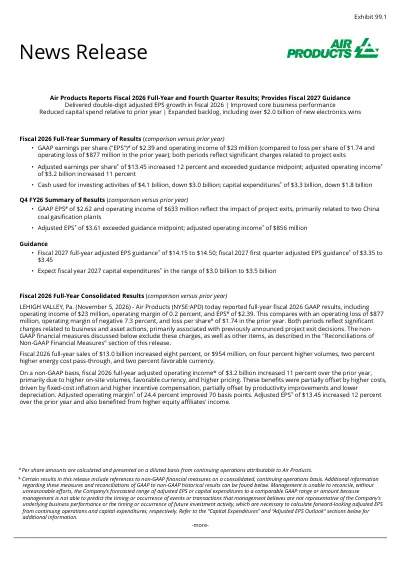
These results demonstrate the progress we made to drive earnings growth while adjusting our portfolio of legacy energy transition projects and increasing the investment in our core industrial gas business. Our adjusted financial results were strong.
We delivered 8% year-on-year sales growth and adjusted earnings per share of $13.45, which represents a 12% increase compared to the prior year. EPS growth was comprised of operating income growth of 11% and equity affiliate income growth of 14%.
Our operating income margin was 24.4%, a 70 basis point improvement relative to prior year. Return on capital was 11.9%, a 100 basis point improvement relative to prior year.
Our total capital expenditure was reduced by $1.8 billion compared to fiscal year 2025, and we achieved net cash flow neutrality. All that while significantly expanding our investment and backlog of industrial gases projects, primarily in the electronics and space sectors, and maintaining our historical track record of dividend increases, with $1.6 billion paid to shareholders in fiscal 2026.
Overall, our results for fiscal year 2026 demonstrate the benefit of focusing on our core industrial gas business, setting meaningful targets, and executing with resilience to ensure that we deliver on the targets we set. I want to express my appreciation to the entire Air Products team for their dedication to safety, reliably serving our customers, and supporting our projects.
Moving to slide 4, we show our progress relative to our mid-term targets. In early 2025, we provided a roadmap on this slide, and we have made meaningful progress in 2026 on several of these targets.
We delivered double-digit adjusted earnings per share in fiscal year 2026, above our original guidance for the year, and as you see on this slide, we also made progress relative to each of our mid-term targets. For example, we demonstrated progress on our commitment to return to excellence in execution through a right-sized organization.
We achieved $95 million in savings from cost reductions in the year and have completed approximately 93% of our previously announced workforce reduction. These actions are critical to offset inflation and adapt the organization to a lower level of capex spending.
We'll continue to pursue further productivity gains using tools like AI and taking meaningful productivity actions that keep us on track to deliver our multi-year commitments. Moving to slide 5, we have our key priorities for 2027 to continue our performance momentum and our progress to reach our medium-term targets.
We have an objective to improve our operating income margin and achieve best-in-class margins among our primary peer group. We expect to deliver a step-up in margin improvement this year using a combination of pricing, productivity actions, and portfolio optimization.
Also, we expect to continue to win high-quality industrial gases projects, particularly in the electronics end market. Last quarter, we highlighted that our industrial gas backlog was approximately $3 billion.
With another group of project wins in the fourth quarter, which we plan to announce during the next few months, our IG backlog now stands at $3.3 billion, and we are still evaluating a healthy pipeline of opportunities. I will share more detail on the backlog in a moment.
Finally, we expect to strengthen our balance sheet in fiscal 2027 as improved operating cash flow relative to capital expenditure is expected to generate positive net cash flow. We also anticipate the opportunity for proceeds related to several asset transactions to improve our overall balance sheet and support improved return on capital.
Please turn to slide 6 for a summary of our current project backlog and our update to our capital expenditure forecast. We currently have a traditional industrial gas backlog of approximately $3.3 billion in projects.
A significant portion of the capital projected for the backlog will support electronic customers, including over $2 billion in project wins for Air Products during the last 12 months. Translating our backlog into a view of capital expenditures, on the right-hand side of this slide, we are targeting to invest approximately $3 to $3.5 billion in capex in fiscal 2027, with over $1 billion currently forecasted to go toward traditional industrial gas growth projects.
As a reminder, there are new projects being added and completed projects being removed from the list every quarter. As we have previously disclosed, we are also moving forward with several underperforming projects, giving our commercial obligations and project status.
Although these projects are not expected to contribute materially to our future operating income, we continue to work to improve their results through commercial negotiations, operational improvements, and productivity. Overall, I would say 2026 was the year we demonstrated we can turn the ship and return Air Products to its long-term mission of being a high-performance pure-play industrial gases company.
I look forward to maintaining our momentum in 2027 and continue our progress on delivering our commitments. Now, I will turn the call over to Melissa to discuss our results in greater depth and review our 2027 outlook.
Melissa?
Melissa Schaeffer
Thank you, Eduardo. Please move to slide 7 for a high-level summary of our fiscal year financial results.
Sales were up 8%, while operating income improved 11%, and earnings per share improved 12% on strong underlying business performance. Even with headwinds from higher energy pass-through, operating margin expanded 70 basis points compared to the prior year.
Return on capital of nearly 12% also improved from last year on strong base business performance and large project optimization. Please turn to slide 8.
Our fiscal year earnings per share of $13.45 increased 12% on improved base business performance, led by strong onsite volume from our existing assets and new start-ups. We also saw benefits from portfolio optimization, pricing actions, and our equity affiliates.
Despite overall higher costs from inflation and incentive compensation, we recognized approximately $95 million in savings in fiscal 2026 from our head count reduction plan and have reduced head count 15% since the FY '24 peak. These results also reflect a 3% headwind from helium.
Against a challenging supply chain environment, we were able to navigate the disruption while narrowing the pricing headwinds through positive volume momentum from reliably supplying our customers. Moving now to slide 9, I'll provide an overview of our results by segment for the fiscal year.
You can find additional details on the fourth quarter results by segment in the appendix. Americas operating income increased 8%, primarily driven by onsite volume, including higher production from US refinery assets, as well as new assets, which began contributing in the second half.
The volume and pricing improvement was partially offset by higher costs. Americas equity affiliate income was elevated during the fiscal year due to higher volumes from a short-term contract in our Mexico joint venture.
Asia's operating income grew 15% due to benefits from the gasification assets held for sale, new electronics assets starting up, and lower costs driven by productivity, partially offset by weaker pricing, particularly in China. Asia also saw improvement from helium volumes driven by reliably supplying our electronics customers.
Currency improved results 3%. Europe's operating income improved 7%, including 4% from favorable currency.
The remaining growth was primarily driven by onsite volume and pricing actions, which were partially offset by higher costs. Europe's equity affiliate income was up due to the performance in our Italy joint venture.
In our Middle East and India segment, operating income improved on lower costs, while equity affiliate income increased 6%, primarily due to lower costs in an affiliate in Saudi Arabia. Lastly, the Corporate and other segment experienced lower sale of equipment activity, which was partially offset by productivity improvements that drove a 10% reduction in corporate SG&A.
We also recognized lower changes to cost estimates associated to our sale of equipment projects. Please turn to slide 10.
For the fourth quarter, earnings per share increased 6%, which was primarily driven by higher volumes from new assets and a strategic asset sale associated with an early contract termination in the Americas. Additionally, we were able to implement timely pricing actions to recover higher power costs.
This improvement was partially offset by higher costs, which included higher incentive compensation and fixed cost inflation, partially offset by productivity. While we continued to experience a helium price headwind in the quarter, we were able to partially offset the impact through positive momentum in electronics volume.
Moving now to slide 11, we will review our outlook for fiscal 2027. For the full year, we expect earnings per share to be within the range of $14.15 to $14.50, which is an improvement of 5 to 8% from the prior year.
In terms of key drivers, we expect to more than offset inflation with pricing actions and productivity. This includes realizing an approximate $50 million of benefit associated with our existing cost reduction plan.
For new assets, we expect a continuation of the benefit recognized in the prior year from the ramp-up of new start-ups in the Americas and Asia. As a reminder, we do not anticipate a material financial impact from NEOM in fiscal 2027.
In our outlook, we have assumed modest market volume growth in line with current industrial production growth rates. We also do not expect the prior-year sale of equipment cost adjustments in our corporate segment to repeat.
As a reminder, last fiscal year, we benefited from collections related to the China gasification assets that were held for sale that will not repeat, as we are now exiting both assets. We expect a 2% headwind from non-operating items, including higher interest expense due to the canceled projects, a higher tax rate of 19%, primarily due to lower tax credits.
We anticipate contributions from our equity affiliates to be flat, primarily due to the contractually lower interest income in our Jazan joint venture, largely offset by modest improvement in our other affiliates. Lastly, we have not anticipated share buybacks within this outlook.
In the first quarter, we expect earnings per share to be within the range of $3.35 to $3.45, up 6 to 9% from the prior year. Although we expect helium to stabilize for the full fiscal year, we anticipate a headwind in the first quarter due to lower pricing from a contract renewal with a strategic customer.
For capital expenditures, as Eduardo noted earlier, we expect to spend within the range of $3 to $3.5 billion. From cash perspective, we expect to be net cash flow positive, as improvements in our operating cash flow and anticipated asset proceeds are expected to offset anticipated capital expenditures and dividends paid to our shareholders.
We will now open the call up for questions. Operator?
Operator
Thank you. If you would like to ask a question, please signal by pressing star-one on your telephone keypad.
If you are using a speakerphone, please make sure the mute function is turned off to allow the signal to reach our equipment. In the interest of time, we ask that you please limit yourself to one question.
Again, press star-one to ask a question. We'll pause for just a moment to assemble the queue.
We will take our first question from David Begleiter with Deutsche Bank.
David Begleiter
Hi, good morning. This is Emily Fusco on for Dave.
Could you maybe quantify or give some color on where US HyCO volumes ended for 26 and if you're expecting maybe similar levels for 27, and if so, whatever the outlook is there, what gives you confidence in the sustainability of refineries? Just any color there would be helpful.
Thank you.
Eduardo Menezes
I believe it's fair to say that we basically sold out in 26 our volume increase, probably in the mid-single-digit percentage. We are trying to squeeze more molecules and try to find way to continue to grow the volume, but the demand is very strong, and it's going to be more a function of us optimizing our production than the market, which is very, very strong, as you can imagine, with all the demand from the refineries.
David Begleiter
Got it. Thank you.
Operator
We will take our next question from Vincent Andrews with Morgan Stanley.
Vincent Andrews
Hey, good morning. This is Steve Haynes on for Vincent.
Just want to ask a couple questions on NEOM. I guess you kind of indicated that there's not much of a financial impact in 27, but just wanted to confirm that that also applies on the cash side of things.
Then secondly, on the NEOM project financing, who exactly is paying interest expense, and when does the principal start getting repaid? Thank you.
Eduardo Menezes
We can confirm again that we do not expect any impact on 2027. We do not disclose exactly on the cash flow of this project, but I can tell you that on this category of projects that we talked about, our energy transition projects, including the project in Canada, the multiple projects in the Netherlands, and in our portion of the NEOM project, we have a little over $2 billion in capex to go to finish all these projects together.
We expect that the majority of this money will be spent in 2027. I think we indicated in the prepared remarks that something around $1.5 billion.
The vast majority will be in 27, the balance in 28, and zero in 29. With that, we will close the expenditures on these energy transition projects.
That's the forecast. We have a project financed for this project, but we do not disclose the terms and conditions that we have with the banks and with our partners there.
Vincent Andrews
Okay. Thank you.
Operator
We will take our next question from Jeff Zekauskas with J.P. Morgan.
Jeff Zekauskas
Thanks very much. I think Linde's average prices were up 3%, and maybe yours were less than that.
What they argued was that there are all kinds of inflationary costs that need to be captured. Do you feel you're capturing them?
Do you feel that you're pricing up with your competitors?
Eduardo Menezes
Good morning, Jeff. I believe so.
I think we're very close. At the end, as there is a difference in portfolio in the packaged gas side that we do not have a presence in US in hardgoods and so forth.
The numbers always are going to be a little different from one company to the other. I believe on the products and the markets we serve, I think our numbers are similar to our competitors.
I think in 2026, it was a little bit of a battle to pass this cost. At the end of the year, as there was a extreme inflation, especially in Europe, that natural gas prices it jumped close to $30 per million BTU, we've seen power prices over €200 a megawatt.
We passed those prices, as always, to our onsite customers, basically as part of normal price increases we have in our agreements. On the merchant side, there is a little bit of a lag always, and that's a normal activity.
You may end with a little less recovered than you would like at the closing of a year when the price increases at the end like we have, but we expect that we're going to be able to recover that in the first few months of our fiscal year 2027.
Jeff Zekauskas
Yep.
Operator
We will take our next question from Chris Parkinson with Wolfe Research.
Chris Parkinson
Great. Thank you so much.
In your guidance, it indicates that helium's neutral for the year, following a slight headwind for the first fiscal quarter, and I guess that kind of aligns with what we saw in the fourth fiscal quarter. Could you just give us a little insight on how you're underpinning your assumptions in terms of cadence for the balance of the year, how you'd apply current, let's say, spot trends, albeit so small, to, let's say, contracts that are rolling over, and whether or not you've seen any propensity from customers to adapt, let's say, longer-term contracts with floors, ceilings?
Is there any difference in how everything's evolving in due course? Thank you so much.
Eduardo Menezes
Thank you, Chris. Yes, helium, as that we had a lot of changes in the market in the last year.
Most of the changes, they started with the war, after the first quarter. We have a little bit of a lap effect between the first quarter of last year to this year, and some of price renegotiations that will affect this year.
In addition to that, we are working on the direction of changing a little bit how we value our inventory, and that will have also a negative effect for the year that is part of our estimate. When we say that our guidance is to be neutral, we have to overcome this change in inventory cost, and also we have to overcome several renegotiations that we had started in 25 and the beginning of 26 that will have a negative effect for us in 27.
Put that aside, I would say that our volumes, they continue to grow. We continue to use our storage, our cavern.
We have many, many quarters that we can continue to supply about 40, 50% of our needs with product that comes from the cavern, and that is giving our customers the confidence to sign long-term agreements and work with us in a different way to contract helium in the future. Some of agreements that we are signing, especially with our new onsite plants in oxygen and nitrogen space, they are combined with agreements for helium that sometimes can go for the entire life of the air separation plant.
So 15-year contracts for helium, which was not something that we've seen before. I know the next question will be about price on helium.
Of course, we understand the dynamics, our customers understand the dynamics. These contracts, the long-term contracts, they have instruments that can make both parties feel comfortable that they can work during these 15 years.
It is a change, and I think the resilience that we show in our system is really paying off and is really positioning us to start recovering our helium volumes. I know I talked about that in the past that our products, by 22, 23, we had a significant reduction in volumes when the prices were very high in the marketplace, but we are on our way to recover a significant part of that volumes and be the most reliable supplier in this market.
Since I mentioned this inventory thing, I'll ask Melissa to provide a little more color on that.
Melissa Schaeffer
Sure, absolutely. We are changing our inventory accounting method starting in FY '27 for helium.
This is really to align with the industry standards. This is going to an average cost accounting.
Now, this will create a modest headwind in FY '27, which are, as Eduardo mentioned, currently considered in our range for the guidance.
Eduardo Menezes
That's not a cash headwind.
Melissa Schaeffer
Not a cash headwind, purely in accounting.
Chris Parkinson
Okay. Thank you.
Eduardo Menezes
Thank you.
Operator
We will take our next question from John McNulty with BMO Capital Markets.
John McNulty
Good morning. Thanks for taking my question.
Eduardo, I think you spoke early on around an early contract termination and asset sale. I guess, can you give us a little bit more color on that?
Maybe how much of a benefit it gave you in 4Q on the sales and operating income side? Also, should we be thinking about that, okay, if it's a contract that's now ended and you sold off the asset, is there any drag going forward with the absence of that business?
Then I guess, finally in that, how would you characterize, excluding this termination and asset sale, the overall Americas volumes, just so we can kind of get a picture of kind of what you're seeing in the market?
Eduardo Menezes
Okay. Let me divide the question in two here.
I'll take the first part, and I'll ask Melissa to answer the second part. In related to that transaction, right, this is part of a collection of hydrogen plants that Air Products bought, I would say during COVID, and this specific facility, it's probably 60 years old.
A very old reformer that sits in the middle of the refinery, and with time, I think both Air Products and the customer, they understood that the customer is probably the best owner for that asset as they can provide O&M services for a cost that is lower than our cost, right? I think we both understood that.
We were able to get to a resolution of the case where they are buying back the facility. They believe they can have a reduction in costs, and we believe we can have a reduction in, let's say, the difference between what we're actually spending and what we're charging them for O&M.
I think it was a win-win approach for both sides. In going to 27, I would say that we do not expect an impact from our deal or the performance of that specific asset because it's true that we made some money this year with that sale, but it's also true that we're going to save O&M going forward.
There will be no impact year-over-year in 27, and I'll ask Melissa to answer the question specifically on 26 with the caveat that this transaction was part of our guidance and was part of what we expected. As in this business, you're always going to have some events like that.
Last year, we have this one that was positive. We have the loss in the equipment sale that we had in the first half of the year that was negative.
These things, they tend to balance each other at the end, and I expect that we're going to have more in 27, but that's the nature of the business. Melissa, in the 26?
Melissa Schaeffer
Sure, absolutely. Thank you, Eduardo.
From a volume perspective in the Americas to answer your question, it was a good portion of the volumes, but I will remind you we had very strong HyCO volumes in the Americas, and we also had the contributions of new assets as well. Now, one thing I want to note as we lead into '27, this will be recognized as a financing agreement.
At closing, we did remove the net book value on the balance sheet and established a financing receivable at the present value of the six payments. What we will see next year, as Eduardo mentioned, will be neutral, and the customer will pay us a monthly fee for the purchase of the asset over the remaining 9 years.
John McNulty
Got it. Thanks very much for the color.
Appreciate it.
Operator
We will take our next question from Duffy Fischer with Goldman Sachs.
Duffy Fischer
Good morning. I was hoping, maybe just walk through where your coal gasification business in China is today, particularly the three plants with Lu'an, Debang, and Juitai, two held not for sale.
There's a bigger chemistry business around that. I would assume that just like your HyCO business, that's doing very well given the stuff in the Middle East.
Just year-over-year, what does coal gasification do from 26 to 27? Kind of what were the results of the held-for-sale assets?
Eduardo Menezes
Yeah. As we had three assets in China.
We took two of these assets, and we announced that they were set aside for a sale, that were Juitai and Debang. Juitai was closed.
We sold the asset at the end of the fiscal year, beginning of this fiscal year 27. I believe we collected something a little over $250 million for that, and that will be out of our numbers going forward.
Debang is an asset that we also put for sale. We still expect to conclude that sale, but that is also has some issues there with the customer, some legal procedures that are going forward.
Because of limitations on how much time we can keep an asset held for sale in our books, we decided to take an adjustment, a write-down of this asset this quarter. This is also out of our books at this point.
Again, we expect that as soon as the arbitration is concluded, that we're going to be able to proceed and close the sale of that asset as well. Those two assets, as you said, the coal gasification is going very strong in China right now.
The issue that we had in these both assets were the quality of the counterparts that we had, and a history of very complicated relationship and payments. The third asset that we have, which is the largest asset, which is Lu'an, is running basically above nameplate capacity, doing very well, and we do not expect any changes on that.
That's, in a nutshell, the story of our three products in China.
Duffy Fischer
Thank you, guys.
Eduardo Menezes
Thank you.
Operator
We will take our next question from Matthew DeYoe with Bank of America.
Matthew DeYoe
Good morning. Hakeem on for Matthew.
EBIT growth for 2027 seems strong, with interest and tax being a more headwind to EPS growth. Can you provide some context into why they're rising, and does that pressure kind of skew toward any quarter?
Eduardo Menezes
I'm sorry, I don't know if I
Melissa Schaeffer
No, yeah, absolutely. I think I can handle that one.
I think, Hakeem, what you were asking about is the non-operating items as we head into fiscal 2027. The non-operating items are a headwind.
As we are aware, because of the canceled projects, we have higher interest expense that was previously capitalized. That is providing a headwind as we enter into next year.
Additionally, we have a higher tax rate, and this is driven by the absence of US tax credits and a decrease in foreign incentives associated to some of our foreign investments. As we've mentioned, it's going to be about a 2% headwind versus '26.
Matthew DeYoe
Got it. Thank you so much.
Operator
We will take our next question from John Roberts with Mizuho.
John Roberts
Thank you. Does your 2027 capex include anything for ammonia cracking, or maybe give us an update on your plans there?
Eduardo Menezes
Morning, John. No, we do not have anything specifically for that.
We have one project we are still developing, a smaller project we're still developing in Rotterdam that we'll see how that goes. We did not include anything material for 2027 in our guidance.
I would say that the effort that we did as a company to reduce our capex was one of the things that I'm most proud of our performance in 26. As you see, we had 3 years, consecutive years that we were having a capex of $5 billion.
We're able to reduce this year to 3.3. Our estimate for next year, it's still in this range of 3 to $3.5 billion.
That includes some of these legacy projects that we will finish by 27, 28. At the same time, we're being able to raise our backlog and raise our expenditure in our traditional industrial gas projects.
Our goal long term is to have a backlog for regular industrial gas projects in the range of 4 to $4.5 billion that allow us to start every year 1.5 to $2 billion in projects, which is our goal at this point as a company. So 26 was also a very important year that we proved to ourselves that we can win in the marketplace, that we can bring these new projects on traditional air separation projects.
We got $2 billion more in capex. The direction of our capex is going to be more in the direction of this traditional air separation HyCO projects and less on these energy transition projects, which include the ammonia dissociation.
We're still pursuing some of these projects in Europe. The regulation keeps being a little fluid.
At this point, there is an expectation that there will be a demand, a greater demand for RFNBO hydrogen by 2030, 2031, and we still have time to do that starting in 2028 if it makes sense. We'll only going to move after we understand exactly what the regulations are and we have firm commitments from customers that justify these projects.
John Roberts
Thank you.
Operator
We will take our next question from Josh Spector with UBS.
Josh Spector
Hi, good morning. It's Chris Perrella on for Josh.
Could you just talk through, I guess, the puts and takes of the corporate line in the quarter and the outlook for 27? I think corporate costs are supposed to roll off with the start-up of GCA and just how that's going to compare, how you guys are penciling that in with the equipment sales and all the moving parts there?
Melissa Schaeffer
No, thanks for the question, Chris. You are right.
Corporate was down versus prior year for this quarter. We saw really very strong corporate functional productivity, but that was largely offset by the sale of equipment cost increases that we saw largely in the beginning of the first two quarters, but we did see some trail into the fourth quarter.
Yes, again, strong functional productivity, but it was offset by the sale of equipment cost increases. That will not repeat in FY '27.
Josh Spector
All right. What would be, I guess, the step-up or the step-down in corporate that you guys are expecting next year with the increased cost savings and the less SOE drag?
Melissa Schaeffer
As you are aware, we had around a $70 million cost increase that will not repeat associated to the GCA project throughout the year. We do anticipate that to not repeat, and so that will be a tailwind for us in the corporate segment going into '27.
Josh Spector
Thank you.
Operator
We will take our next question from Alex Yefremov with Barclays.
Alex Yefremov
Thank you. Good morning, everyone.
In your $4 billion pipeline in electronics and space, what's the relative timeline for awards? Is it something inside of 12 months or something longer-term?
If this is a shorter-term number, how do you see the total TAM for electronics pipeline over say, next 2 to 3 years?
Eduardo Menezes
Good morning, Alex. A good question.
We ask this question ourselves because these projects, they're moving very fast, as you can imagine. We expect that the decision for some of these projects to come very soon.
I would say that the main hurdles that our customers are facing now are both in the side of regulatory and a little bit on labor availability, even in countries where they didn't have that before. With the numbers that they have been publishing in terms of capex, you see that in Taiwan, you see that a little bit in Korea, in US, and so forth.
I think the customers are trying to push as hard as they can to make these decisions. We are trying to be responsive and be there.
I would expect that you're going to see probably some major definitions being done in the next 12 months. I don't think they have a good visibility much, much after that, but we'll see.
In terms of the total market, we still believe that the semiconductor industry, with all the capex we see, all the projects, they're still, let's say, behind the expected demand, especially when you see what people talk about data centers and so forth. I think if a fraction of this data centers that people talking about, if they go forward, it's still going to see a significant increase in semiconductors demand for the next 5 to 6 years.
At this point, the things are moving so fast and furious that our main objective is really to stay close to these projects that are going to be decided in the next 12 months and try to get our fair share or more than our fair share on those.
Operator
We will take our next question from Abigail Eybers with Wells Fargo.
Abigail Eybers
Thanks for taking my question. I'm curious about what your assumptions are regarding the conflict in the Middle East.
It seems like the market is expecting, given election results, that it might conclude sooner than originally expected. Asking specifically as this pertains to what you called out on slide 20 regarding your expectation for elevated US refinery rates for the full-year 27.
Thanks.
Eduardo Menezes
If I knew the answer for that one, Abigail, I would be selling that. As you imagined, it's very important for us.
We have very large facilities, we have a very large project we're building there. The impact of the Middle East crisis in the oil side, we see that in Europe in the form of higher prices.
We see that in US in the form of higher demand for hydrogen, for refineries. We see that in China in the form of higher demand for oxygen for gasification.
On top of that, we have the impact on helium that the 1/3 of the global capacity was basically put to the side by the conflict. I follow this very closely.
We try not to be moved by this short-term events, like if the election goes this way, what will be the impact tomorrow or the day after tomorrow? I think at this point, we do not expect any meaningful resolution that will affect the helium market for at least 6 months.
That's our assumption. I would say for the demand of refined products in US, I would say that that will continue to be very strong, not because only the US, I think there is a shortage of refining capacity globally, and I think that will take several years to be resolved.
We expect that to continue to be very strong in the next 12 months. Those are the main impacts that we see and the assumptions we're making.
Again, things can change very quickly, and the strait may be open in a month, and things can go back to normal. That's not the base assumption that we use today.
Abigail Eybers
Got it. Thank you for the color.
Operator
We will take our next question from Salvatore Tiano with KeyBanc Capital Markets.
Salvatore Tiano
Yes, thank you very much. Just want to check firstly on the Alberta project, what's kind of the expectation at this point for start-up and contribution, as well as where do you stand on contracting the volumes?
On the same front, on contracted volumes on NEOM, I don't think there's been any new developments or agreements. At the same time, there's been actually a pretty steep pickup in activity for green ammonia by other suppliers in Asia.
I wonder, is there any reason, for example, why you haven't participated in these agreements? Is it a matter of price, for example, and the margins you could get?
Eduardo Menezes
Two very different questions. On Edmonton, we are working hard to finish the facility by the end of 27.
We do not expect any impact on that on our fiscal year 27. We are working on how to improve this project.
We already made it clear that the project, as it was expected to start, would not contribute to our operating income. Of course, we're trying to see how we can improve that.
I would say that the changes in Canada in the direction of the prices of renewable diesel and credits and so forth, they gave us some hope that we can improve our position on that. Again, these are also part of all this geopolitical and tariff situations, and these things can change very quickly.
We understand the ins and outs, but we see some light there on trying to be able to commercialize the balance of the volume. We'll keep you informed, and again, we still have more than a year to be able to get to the point that we need to do something there.
On NEOM, again, everyone can read all these announcements. A lot of those are MOUs and LOIs and from projects that do not exist today.
Again, I tell people that doesn't matter where you're making green ammonia, if it's in Saudi Arabia or in Japan or in India or in the US, it will take 10, 11 megawatts to make a ton of ammonia. When I see people doing LOIs with prices that do not make a lot of sense versus the cost of the power plus all the capex you need to invest, I'm always very suspicious of that.
Our project is basically construction completed. We're going to go through commissioning.
It is a very complex commissioning. I mentioned that before.
We're working on that. We expect to have the plant completed, up and running at 100%, by the second half of 27.
In the meantime, we're probably going to start making some product that we're going to test the market, but will be very different because it's going to be real product and not LOIs or MOUs and promises from things that are not being even in the construction stage. That's my take.
We'll see how that develops. I mentioned before that I believe we're going to be the lowest-cost producer of green ammonia for forever, and we'll see how that position us in the marketplace to sell the product.
Operator
We will take our next question from Patrick Cunningham with Citi.
Patrick Cunningham
Hi, good morning. Just in terms of your line of sight into positive free cash flow, it seems like most of the legacy clean energy projects will be near completion at year-end.
Are your base assumptions cash flow neutrality this year, and if you do expect to achieve more meaningful positive free cash flow in 2028, are you considering commencing a buyback program?
Eduardo Menezes
Patrick, I think we'll probably going to get to that point. Of course, when we get there, we need to go to our board first, get authorization for all that, and we're going to let you guys know.
Yes, we expect that with these projects, as I said, we have a little over $2 billion to finish these projects. The majority of that will be spent in 27.
We'll have a tail in 28, and assuming that everything goes as expected, even as we grow our capex and backlog for traditional industrial gas projects, we should have enough room on our cash flow to do that. At that point, we'll discuss with our board, and we'll make a decision how to allocate the capital.
Operator
We will take our next question from James Hooper with Bernstein.
James Hooper
Hi, good morning. Thank you for taking my question.
Can I follow up on your portfolio optimization comments you made, Eduardo, please? I know you've already talked about the gasification assets, but if you could give us a bit more color on what that means and how you're thinking about what assets in the portfolio and how you test them for returns, please?
Eduardo Menezes
Good morning, James. It's not anything major.
I think we talked about these gasification projects. We talked about the transaction we did in US for that reformer.
I would say that the next one which became public a few months ago was the work that we're doing, trying to understand if we're going to go forward with the IPO of our subsidiary in India. It is a fantastic business that we have, probably our fastest-growing JV.
The market in India is at very high multiples at this point, and our partner wants to go for that IPO. The disclosure obligations that you have in India with the local regulation, SEBI, they're very, very specific.
We published an IPO prospectus of more than 500 pages, and we cannot say more than what is there. We had to say a lot of things, and then we cannot say more than what absolutely is there, I cannot make more comments on that.
The only thing I would say is that if you read the prospectus, you see that the sponsors, which is Air Products and our partner, we are proposing to or considering to sell between 10 and 15% of the company, and we, by the Indian regulations, if we go forward, we will have an obligation to do 25% in between 3 to 5 years. Of course, this is a question of opportunity, how you see the valuation, and we expect this decision for the initial tranche that will also make us basically liable to do the entire 25%.
We should take this decision during the first calendar quarter of 27. If we make that decision, it will be a function of what we think the proceeds will be, and we'll inform the market about that.
I've seen several numbers around. I think sometimes people miss the point that this is 15% what we have in the prospectus, and the total obligation to sell is 25%.
This is the largest one, and other than that, we always had some small things here and there, but they are not material to our overall results.
James Hooper
Thank you.
Operator
We will take our next question from Kevin McCarthy with Vertical Research Partners.
Kevin McCarthy
Yes, thank you very much and good morning. Curious to hear your thoughts on volume trajectory moving forward, maybe a two-part question on that subject.
First, what are you baking into your fiscal 2027 EPS guide related to volume specifically? Then second, maybe more broadly, Eduardo, as you look across the portfolio, where would you expect volumes to accelerate sitting here today in 27 versus 26, and where would you expect a deceleration, either from an end-market perspective or regionally?
Eduardo Menezes
Our 27 numbers, guidance, I would say that you guys probably got that from the presentation, the remarks that in 26, we had a very strong performance on our business, and we had a very strong performance on our affiliates. Our equity affiliate income in 26 increased around 14%, and that's a very significant number for Air Products.
So 20% of our operating income comes from that equity affiliate income, not operating income, but our EPS comes from that. 80% comes from our operating income from the business we consolidate.
Both had strong performances in 26, with the EAI growing faster than our business. For 27, for several different reasons, we expect the equity affiliate income to be flat year-over-year.
When you have 20% of our EPS being flat, you imagine the pressure that is putting on the rest of the operating income. Our volumes that are embedded in our total number is around 2%, with another 3% coming from new assets that are coming on stream.
That is on the overall company, I would say, for the business we consolidate is even a little higher than that. That's what we expect.
On that math, there is a lot of components. We expect the hydrogen business in US to continue to be very strong and grow a little bit.
We continue to expect the volumes in electronics to grow, and, frankly, the rest of the economy, we see the same things that everybody sees, very negative scenario in Europe, tough scenario in the US, and a tough scenario in China. Overall, our assumption is around 2%.
Kevin McCarthy
Thank you very much.
Operator
We will take our final question from Laurence Alexander with Jefferies.
Laurence Alexander
Hi, good morning. This is Kevin on for Laurence.
Thank you for taking my question. Most of my questions have been asked, but just on maybe margin expansion, just wanted to get a sense of, after the first quarter, what the sort of cadence of margin expansion would be, maybe from Q2 to Q4?
Melissa Schaeffer
Sure, absolutely. Thanks for the question.
As we look into our guidance for FY '27 and our margin forecast, we are expecting a sizable improvement. This is driven by new asset contributions and base volume driving a good portion of that improvement.
We are looking for also strong price over recovery as we continue to see those cost inflations that we talked about previously. The headwinds that we will be seeing are obviously the assets held for sale in the gasification space that we have sold down, those will not continue, and the other significant headwinds from cost inflation.
Again, improvement through '27, largely driven on new asset contributions and base volume.
Laurence Alexander
Okay. Thank you.
Operator
That concludes today's question-and-answer session. I will now turn the call back to Mr.
Menezes for any additional or closing remarks.
Eduardo Menezes
Oh, thank you all for joining our call today. We appreciate your interest in Air Products, and we look forward to discuss our results in the next quarter.
Have a safe day. Thank you.
Bye.
Operator
This concludes today's call. Thank you for your participation.
You may now disconnect.