Arrive AI Inc.
NNASDAQ:ARAIQ1 FY2026 · Earnings Call TranscriptMay 15, 2026
Operator
Good day, and welcome to the Arrive AI, Inc. Q1 2026 earnings call.
At this time, all participants are in listen-only mode. After the speakers' presentation, there will be a question-and-answer session.
To ask a question, you will need to press *11 on your touch-tone telephone. Please note this call is being recorded.
I would like to turn the call over to Kylie Conway, Arrive AI Senior Communications. Please go ahead.
Kylie Conway
Thank you, Michelle. Before we go any further, our CEO, Dan O'Toole, has somebody he'd like to recognize this morning.
Dan O'Toole
Hey, thanks, Kylie. Hey, everybody, thanks for being here and listening in.
This is an exciting day for us. A year ago today, we actually made our public debut on the Nasdaq, ticker ARAI.
It was the culmination of a huge journey that took us through a lot of twists and turns, and then something that I'll never forget my whole life. I appreciate everyone that helped make that happen.
I ordered a chicken and egg a little bit earlier, and I'm going to let you know which one comes first, but go ahead, Kylie, take it back.
Kylie Conway
Dan, thank you. Good morning, everyone.
Thank you for joining us today. With me on the call, of course, you just heard from him, Dan O'Toole, Arrive AI Chairman, CEO and Founder, and Todd Pepmeier, Chief Financial Officer.
The rest of our leadership team is also here in the room to answer questions later in the call. The earnings press release issued this morning is available in the Investor Relations section of the company's website at arriveai.com.
Before we begin, please note that today's remarks may include forward-looking statements regarding future financial results, operations, and performance. These statements are not guarantees of future results and are subject to risks and uncertainties that could cause actual outcomes to differ materially.
We encourage investors to review the risk factors detailed in Arrive AI's SEC filings, which are also available on the company's website. Now, I'll turn the call over to Arrive AI CEO Dan O'Toole.
Dan O'Toole
Hey, everyone, Dan O'Toole here. Thank you for joining us today.
As always, we appreciate you taking the time to be with us and follow our progress. Building Arrive AI continues to be an incredible journey.
Like any company creating entirely new infrastructure, the path is not always linear. Our vision remains clear, and we continue executing against that vision with discipline and focus.
One thing I want to emphasize before we begin is how we think about our progress as we continue to build the infrastructure and processes that will help us begin to ramp our commercial activities beginning later this year. The same way an early-stage pharmaceutical company's progress is evaluated by milestones they achieve along their way to commercialization, development progress, validation points, regulatory steps, manufacturing readiness, and commercialization preparation is the way we view the consistent progress we are making.
What matters most right now for the company is whether we are continuing to hit our operational milestones that move us closer to scalable deployment and recurring revenue. Over the last 30 days, we believe we've made measurable progress in several important areas.
Before we get into those updates, I also want to mention that we're continuing to experiment with innovative formats for our earnings calls. The prepared remarks you're about to hear will be delivered using AI-generated versions of my voice and Todd Pepmeier, Chief Financial Officer at Arrive AI.
For us, this is more than a novelty. It reflects how we think about artificial intelligence as a practical tool that can improve efficiency, scalability, and communication, the same philosophy that drives our broader platform and autonomous logistics network.
After the prepared remarks conclude, Todd and I will return live to answer questions that were submitted ahead of this call. I'll also be joined by the rest of our leadership team, Chief Strategy Officer Neerav Shah, Chief Operating Officer Mark Hamm, and Chief Legal Counsel John Ritchison.
Also, Todd will rejoin. With that, let's begin the prepared remarks.
Thanks, everyone. Given it has only been about 30 days since our last update, today's call will focus primarily on our execution progress and operational milestones.
As I noted earlier on this call, we believe we've made meaningful progress in this short period of time. As I've said before, building a category-defining company is not linear, but we continue executing deliberately, and we're seeing those efforts translate into stronger operational fundamentals across the business.
At Arrive AI, we believe our most meaningful metric of progress right now is not financial, such as revenue or EPS, it is MPQ, or milestones per quarter. At this phase, our focus is on building the right infrastructure, validating deployments, strengthening our technology, expanding partnerships, and preparing for scalable, recurring revenue opportunities.
These milestones matter because they are what ultimately create the foundation for long-term shareholder value. When we look back since becoming a public company in May of 2025, we believe we've accomplished a significant amount in a relatively short period of time.
Since going public, we have strengthened and reorganized our leadership team, advanced our AP3 platform, optimized our supply chain, brought software development in-house, expanded development of our proprietary operating system, ArriveOS, advanced deployment and demonstration initiatives, added experienced leadership to our board, expanded strategic conversations across logistics and infrastructure sectors, and continued positioning Arrive AI as a foundational platform for autonomous logistics and intelligent delivery infrastructure. We have also strengthened our patent portfolio to now 10 US utility patents.
While we recognize we are still early in the commercialization cycle, we believe these operational milestones continue moving the company meaningfully forward. I'll walk through several recent, important updates before turning it over to Todd.
One of the most important developments since our last call has been progress within our supply chain and manufacturing operations. We've taken significant steps to optimize and stabilize AP3 production through a new manufacturing partnership in India.
This has improved both our supply chain reliability and cost structure, giving us a more scalable and predictable manufacturing base moving forward, while also speeding up unit delivery. This configuration represents what we believe is the finalized supply chain structure for the current AP3 platform as we prepare for our transition toward next-generation hardware.
Importantly, we remain on track for an improved AP3 release in July, with broader availability expected beginning in October. We believe this increased availability is important because, until now, deployment capacity has naturally limited the pace at which we could onboard new customers and expand deployments.
The July release is not a complete platform redesign, it is a meaningful refinement and enhancement of the existing AP3 platform focused on reliability, deployment readiness, and customer scalability. As availability expands later this year, we believe it positions us to accelerate customer deployments and move closer toward consistent and growing recurring revenue generation.
At the same time, we continue progressing toward our next-generation platform, internally referred to as APX. We expect to receive early APX prototypes in the coming development cycle, and this platform represents a major step forward in functionality, manufacturability, and long-term scalability.
While AP3 establishes the operational network foundation, APX is designed to support larger-scale commercialization and broader deployment opportunities across autonomous logistics, healthcare, enterprise delivery, and smart infrastructure applications. Another important development is the advancement of ArriveOS, the software layer that will help unify deployment management, monitoring, integrations, and future network functionality across the Arrive ecosystem.
Much of this foundational work was completed during Q1, and we expect phased rollout activity to begin during Q3. This is an important strategic initiative as it creates a more scalable and cohesive operating environment across our intelligent delivery network.
In addition, following our recent internal reorganization, we have now brought software development fully in-house, which has already created meaningful operational efficiencies. We have stripped out portions of our legacy software stack and replaced them with internally developed systems that are already improving performance and iteration speed on our current AP3 units.
Owning more of our software stack internally improves our ability to move faster, deploy updates more efficiently, and build a stronger long-term technology foundation. To sum this up, we own and control all of our software that is being built in-house.
It's saving us money and time while keeping us in control of our success. This is exactly where we want to be.
We've also continued advancing plans for a digital demonstration initiative, with a realistic target of conducting that demonstration in Texas later this year. This important milestone will provide customers, enterprise partners, municipalities, and logistics stakeholders with the opportunity to evaluate our platform operating in more realistic deployment conditions.
These demonstrations are critical because autonomous logistics infrastructure requires trust, validation, and operational proof points. As we continue demonstrating real-world functionality, it strengthens both customer confidence and future deployment opportunities.
From a governance standpoint, we recently held our first board meeting with Mike Fitz as a member of our board. Mike is a member of T-Mobile's leadership team and brings invaluable experience in networks, connectivity, and large-scale infrastructure operations to Arrive AI.
His addition further strengthens what we believe is an experienced and highly engaged leadership group, and we are already benefiting from his strategic perspective and operational insight. We continue to believe strong governance and experienced leadership will play an important role as we scale the business.
While we remain careful about discussing initiatives prior to execution, we are encouraged by the level of engagement and interest we continue to see. Given the progress I've just highlighted, I am confident you will agree with me that the foundation we are building continues getting stronger quarter by quarter.
With that, I'll turn it over to Todd Pepmeier, Chief Financial Officer of Arrive AI.
Todd Pepmeier
Thanks, Dan. Given the short period since our last update, there are few major changes to report from a financial standpoint today.
Our priorities remain consistent: disciplined capital allocation, infrastructure investment, deployment readiness, and operational scalability. As we've said previously, Arrive AI is building a network-driven business model.
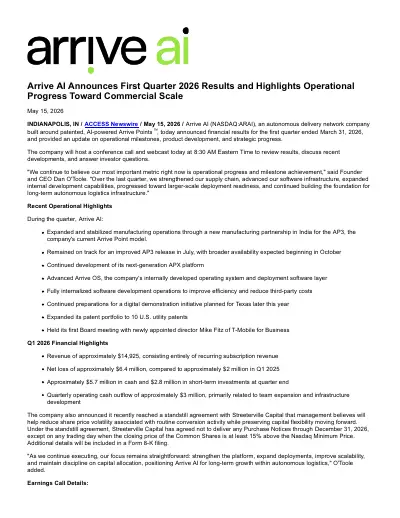
For the first quarter, our total revenue was $14,925, all of which was recurring subscription revenue from our deployed Arrive points. Our net loss for the first quarter was $6.4 million, compared to a loss of about $2 million in the same quarter of 2025.
The increase was primarily due to higher operating expenses and non-cash items related to our convertible note facility. We ended the quarter with $5.7 million in cash and $2.8 million in short-term investments on the balance sheet, primarily as a result of the January 2026 $10 million draw from our existing credit facility.
This significantly strengthens our balance sheet and provides a meaningful runway to continue executing our business plan and funding our growth initiatives. Our quarterly cash burn rate of approximately $3 million has been mostly driven by salary costs and R&D expenses as we've built out the team to support growth.
We expect expenses to remain at or near this level in the short term, before increasing modestly in the fourth quarter. We continue managing capital carefully while maintaining a focus on long-term scalability.
On a housekeeping note related to capital markets activity, in the days immediately following this call, we expect to file a shelf registration statement with the SEC as we are now eligible to do so. This filing is standard corporate practice for public companies and does not reflect any immediate financing plans.
What it does reflect is the optionality that benefits the company. When the opportunity arises to capitalize Arrive AI on our own terms and at the lowest cost of capital, the shelf filing will position us to take advantage of that opportunity in the most efficient manner.
Our capital strategy has not changed, our operating framework has not changed, and we remain focused on disciplined execution moving forward. As an example of this discipline, earlier this week we reached a standstill agreement with Streeterville Capital through the end of the year, which we believe represents an important step forward in strengthening Arrive AI's capital markets position.
The standstill substantially reduces the volatility which resulted from the previous routine conversion activity by the investor. This should provide the conditions for more natural price discovery and thus reduce a significant source of market uncertainty.
Importantly, we accomplished this from a position of operational and balance sheet strength. We believe we have sufficient capital available to support our business plan through the standstill period under ordinary market conditions.
At the same time, the structure of this recent agreement preserves flexibility for the orderly reduction of the remaining Streeterville balance during periods of significant market liquidity, which could further improve our capital structure over time. Overall, we view this as a positive alignment between shareholder interests, market stability, and long-term value creation for Arrive AI.
Additional details for this standstill agreement will be noted in a Form 8-K we plan to file later today. Additional financial commentary and detailed results will be included in our filed earnings materials.
With that, I'll turn it back to Dan.
Dan O'Toole
Thanks, Todd. To wrap up, we believe the last 30 days have demonstrated meaningful operational progress across several important areas of the business.
We strengthened our supply chain, we improved execution internally, we advanced software infrastructure, we continued progressing deployment demonstrations, and we further positioned the company for future scalability. We strengthened our first-position patent portfolio, we added significant bandwidth to our world-class team, and most importantly, we continued building the foundation required to support long-term autonomous logistics infrastructure.
Our focus remains straightforward: execute the roadmap, expand deployments, and continue positioning Arrive AI to capture what we believe is a significant long-term market opportunity. We appreciate your continued support and engagement.
With that, Todd and I will now return live for Q&A, along with the rest of our team.
Operator
Thank you. As a reminder, to ask a question, please press *11.
If your question has been answered and you'd like to remove yourself from the queue, please press *11 again. Our first question comes from James Kisner with Water Tower Research.
Your line is open.
James Kisner
Hi, thanks for taking my questions. Hancock Health has been a very encouraging proof point.
Can you talk about your confidence about healthcare in general, how repeatable a vertical for Arrive is that?
Dan O'Toole
Hey, thanks, James. Dan O'Toole here, CEO.
Appreciate that very much. We do highly value and appreciate the Hancock opportunity.
It's been a great showcase for us, not only within the hospital and how it's really helped their ROI as far as maintaining healthcare professionals dedicated to areas, keeping them in those areas and letting automation streamline a lot of things. It's also afforded us an opportunity to bring several other groups to Hancock to showcase what we're doing there, and I can say that that opportunity is growing.
We've newly identified additional opportunities within Hancock that we're going to be rolling out. Neerav Shah, Chief Strategy Officer, do you want to add to that anyway?
Go ahead.
Neerav Shah
Thanks, Dan. I just wanted to kind of hone in on one point Dan made, and that's about the labor.
Dan had said about saving time, and that pressure isn't going anywhere. Labor pressures are going to continue to grow, in fact, and nursing shortages will be there.
We're taking that basic burden off of the nurses is massive and cuts across the entire country, frankly.
Dan O'Toole
James, you have anything else, James, you want to ask?
James Kisner
Sure. Actually, I got a couple quick ones if I can sneak them in.
Can you just talk about kind of the near-term opportunity? Just kind of wondering how much that depends on kind of drone approvals versus workflows that can scale today with ground robots, couriers, and kind of internal campus logistics?
Dan O'Toole
Hey, Mark, you want to take that one? Mark Hamm, our COO.
Mark Hamm
Yeah. While there's still some hurdles on the drone front, there are areas of the country that are very active with drones, like Texas, for instance.
We are targeting them in time. With regard to kind of robots and traditional logistics couriers and now kind of DoorDash services, things like that, of course, that's all very active now.
You can see that on hundreds of campuses, and, yeah, we're actively pursuing that.
Dan O'Toole
James, what else you got?
James Kisner
All right. Great.
You guys have talked about kind of international opportunities. Just how are you kind of balancing pursuit of international versus the opportunity to go deeper in the US?
How are you prioritizing that?
Dan O'Toole
We, being a low to no-revenue company as we are, really building a brand-new platform and an emerging technology market, what's really important to us is deploying human resources as efficiently and cost-effectively as we can for support of those opportunities, and also just capital overall. We're kind of doing a home-first approach.
We're trying to iterate and develop as close to home just for all those reasons. Plus, all for us, the ROI right now is the learnings, we're able to have those learnings be very linear and pull them back and redeploy new things that we're learning and getting those into our next-gen product.
That's kind of our strategy. The reality is there's lesser restrictions in a lot of the parts of the world besides the US, and it would be easy to iterate in those areas.
When you put that against the backdrop of all the costs and human resource costs, it just really makes sense to iterate here at home as close as possible, and that's what we're really focused on.
James Kisner
That's helpful. Just last one for me, I apologize if you addressed this in the opening comments because I had to hop from another call, but just talk about the cash runway, how do you kind of think about that, especially given I assume that some of the stuff you're working on has some cash requirements at the AP3 availability and software dev and all that?
Dan O'Toole
Yep, I'm going to have Todd, our CFO, jump in on that, but I want to preface one thing that we're really excited about. Today, we announced the standstill agreement with Streeterville.
We feel like we're really well-positioned from a capital standpoint to not have that headwind of draws coming off of that line. I'm going to hand this over to Todd.
Todd Pepmeier
Thanks, Dan. James, as we noted earlier, our cash burn is about $3 million a quarter right now.
We expect it to remain at that level for the next couple of quarters. It may tick up modestly as we go into the fourth quarter and increase unit deliveries and things like that.
We ended the quarter with about $8.5 million of cash and short-term investments on the balance sheet, which is something like 8 months of runway at the end of the quarter if we do nothing else. As we said earlier, we are going to file a shelf registration statement and access capital at much lower cost of capital here, at the right opportunity.
We do have that available to us as well. Finally, with regard to the Streeterville, we did request the standstill agreement.
They complied. We think that will significantly reduce the volatility.
Their routine conversions were at their choosing, not ours. They've agreed to stand still, and vice versa.
We don't really need to take more cash in the very short term. We think we have runway to get much further out in the year, and I would say we do still have $19 million capital left on the facility with Streeterville if we choose to take it.
With all that said, we feel like we're in a pretty good place runway-wise to execute the business plan in front of us.
James Kisner
All right. It's great color.
Congratulations on getting that done. I'll pass the mic.
Dan O'Toole
Thank you.
Operator
Thank you. Our next question comes from Jack Vander Aarde with Maxim Group.
Your line is open.
Jack Roderick
Hi, how's it going? This is Jack Roderick in for Jack Vander Aarde.
Thanks for taking my questions. First kind of clarification question quick, on the revenue front, it was relatively small, but any revenue is positive.
Can you parse that out? Is that entirely Hancock Health?
Then, can you just give us kind of a general update on all of the different sort of pilot programs that are progressing, where do you expect to see kind of revenue start to build?
Dan O'Toole
Yeah. Hey, thanks, Jack, for being here.
Appreciate it. I'm going to hand this to Todd, but I'd just like to preface this by saying we are very early.
We are building the platform. We are building the technology.
We are not focused on some de minimis revenue that becomes the guidepost of our valuation. The value in what we're building is the product and all the software layers and all the proprietary AI items that we're engineering and developing right here in our building.
If you could contrast that against the small revenue, you'd be really shocked at where we are and how fast we're moving. We will flip the switch at some point, and you'll see this in a bigish way.
I want to hand that over to Todd, our CFO, and Todd can further answer that. Todd?
Todd Pepmeier
Thanks for the question, Jack. More than 90% of the reported revenue was from the deployment at Hancock Health, not unlike what we reported in Q4 as well.
They remain the vast preponderance of our revenue stream at the moment. We did have one other small revenue deployment that was active in the quarter, but de minimis compared to the Hancock opportunity.
Right. One other thing I want to come back with just to kind of put a bow on this is, yeah, being an early company in an early emerging market, what's important is not nickel-and-diming opportunities to the point where you extinguish them.
For us, the ROI is the opportunity more than the capital display or the revenue. We're focused on that.
We're not trying to extinguish opportunity by being very giddy about how can we nickel-and-dime this thing. To us, the cost of doing business is being in these opportunities, and I can say that we are having a very robust cycle of inbound contacts wanting to explore how to work together, doing deployments, scheduling opportunities, doing presentations.
It's a very frothy environment for us right now as the market starts to realize that scalability of autonomous delivery and pick up cannot happen without the infrastructure, and that's us.
Jack Roderick
That's helpful. Then I have another question, kind of in that same ilk.
What do you think catalyzes that kind of commercialization progress? Is it just time through these pilots where people realize how useful it is?
You mentioned kind of the opex is expected to stay roughly flat to near this level, but given that headcount increased, do you expect the headcount to drive things forward, or do you have any plans to kind of scale sales and marketing? How should we think about that?
Dan O'Toole
I want to throw this over to Mark, but I do want to say one thing. There's a lot of alignment happening, drone delivery, robotic delivery, Arrive AI, all these things are converging, it's really coming to a boiling point, which is going to be huge for everybody.
I can say this, on the deployment at Hancock that we have, we've had dozens of groups come in and see that, and that is what's creating excitement and people becoming aware of this. As that continues to happen, we continue to roll out.
We see a day when the biggest challenge we have is fulfilling opportunities and not getting ahead of ourselves in that regard. I'm going to let Mark finish that thought there.
Go ahead, Mark.
Mark Hamm
What I would add is our intention is to continue learning in the present mode at the present levels, and then, as we stated, by end of next year, we're pursuing deploying the next generation. As we build up to that, you also heard that we've announced a digital demo that we're exposing strategic partners to, that we believe is the foundation for engaging them in preparing for that next gen.
It's really that next gen where we're targeting larger deployments with larger customers, and that, I believe, is the step function that kind of you're referring to. I think that's the real trigger point.
Jack Roderick
That's super helpful. I'll hop back into queue.
Thanks, guys.
Dan O'Toole
Thank you.
Operator
Thank you. That concludes our analyst questions.
Now, I'll pass the call back over to Kylie.
Kylie Conway
Thank you, Michelle. We did receive a number of thoughtful pre-submitted investor questions ahead of today's call.
Many centered around similar themes, we've grouped them into broader topics to make the discussion as efficient and informative as possible. We'd like to thank Benjamin, Early, Calian, John, Rahul, Betty, Donghyun, Christopher, Matthew, Ryan, Shelley, Tim, and also thanks to James and Jack for dialing in.
First, kind of piggybacking off of some of James's questions, we received several regarding Arrive AI's international initiatives, including updates on Antigua and SkyAir pilot programs, the expected path toward monetization from those deployments, broader international expansion opportunities, including healthcare markets overseas, and the company's global intellectual property position and patent protection.
Dan O'Toole
That's a lot. Thanks for asking your questions, and for future calls, just so you guys know, we do have a proprietary questionnaire that we put out to all of our shareholders, and you're welcome and encouraged to submit your questions so we can get to all of them.
I'm going to let Neerav start on that one, and I think John
Neerav Shah
might chime
Dan O'Toole
in on that, too. That's right.
Yeah.
Neerav Shah
Thanks, Dan. I'll start with Antigua.
Right now, the unit economics of BVLOS operations are just not there because of the regulations. For an example, in the US with Part 107, you need to have visual observers, and that just drives up the cost of drone operations.
With Part 108, we see that dropping, and that would reduce the cost internationally of beyond-visual-line-of-sight type operations and autonomy. Once that happens, I think the unit economics in places like Antigua will make a lot more sense.
Stay tuned on that, we're monitoring that very closely. The second question was around SkyAir.
Stay tuned, there's a lot happening there. The CEO of SkyAir was in Indianapolis about 2 weeks ago for some critical conversations and discussions.
Stay tuned, like I said, we'll be announcing something hopefully here in the not-too-distant future. I'll turn it over to John around the international patents.
John Ritchison
Thanks, Neerav. Before we started commercially here in the US, we secured our position.
Dan mentioned already that we've got 10 issued patents. We've actually, now with our influx of some excellent engineering staff, we've got over 14 in the pipeline.
IP in the US continues where it's been, and it's growing very rapidly with the new personnel. Similar to that, we have prepared ourselves internationally, and you say, okay, how do you do that?
Where do you go from here? We looked around and used the World Bank GNP, took the top countries from that, and looked at their GNP, and looked at other things, if we had contacts there, if we had interest from marketeers, potential licensers, also contacts with drone and robotic people.
All those places that we've got, and that's over 20 We've got 23 countries now around the world, and in those places, we've got or now got 77 international patents in pending stage. Of those 77, we've had over 10 issued or allowed, and the rest of them are still in the pending stage going through examination.
The important part I'd say is with the commercialization, we're prepared with our protection ahead of time.
Kylie Conway
All right. John, thanks.
Thanks, Neerav. We also received a number of questions related to commercialization progress and operational scale, including current deployments, recurring revenue expectations, production timelines, commercialization milestones investors should be watching over the next 12 to 18 months, and the broader path toward scaling operations and achieving cash flow break-even.
Dan O'Toole
I'll ask Mark to handle this one.
Mark Hamm
Thanks, Dan. Yes, we know everybody wants revenue, and we want it, too.
Towards that end, we're executing a milestone-based process framework to innovate and produce more revenue. The way we think of it is innovation equals invention plus realization plus commercialization.
Right now, we're kind of in that realization phase where we're building next-gen, AI-enabled product. We're building an AP network and a new Arrive Point platform to go with all of that.
Last quarter, we actually slowed down to incorporate some of the latest learnings from the AP3 in the field from Hancock and others, and also to improve the supply chain of the AP3, as well as to pull forward some next-gen technologies we've already developed for what was referred to earlier as APX. All of that is improving what we plan to release in July as our AP3, which is a significant set of improvements and will allow us to do some further deployments and learning.
The AP3 will also be available in higher quantities in Q4 with the supply chain improvements. Beyond that, as stated earlier, we're looking in the second half of this year to be employing our digital demo with some strategics as we build towards larger next-gen deployments and delivering next-gen Arrive Points by the end of next year.
Those are the major milestones I'd say for the next 18 months.
Kylie Conway
Thanks, Mark. Another topic investors asked about was residential adoption, including opportunities with homebuilders, integrating Arrive AI technology into new housing developments, and the company's long-term vision for residential delivery infrastructure.
Dan O'Toole
Thanks, Kylie. This is Dan.
I'm going to answer that. We're looking at every aspect of delivery and deployment for Arrive Points.
The total addressable market in the US is 170 million addresses. The cool thing is that number grows by 4,000 new addresses every day.
When you talk about rolling out into new subdivisions and things like that, that is something that is on our radar. Studying infrastructure in for new developments is a great and easy way to do it.
We see that as a great growth opportunity. Also, 80% of the market is residential, 20% is commercial.
The residential aspect is probably the largest opportunity ultimately for us. We are looking at all these areas.
We're developing some really optically and aesthetically really modern, yeah, I would say Apple-esque looking products that are going to really modernize the streets of America and the world. Stay tuned for that.
Obviously, we're looking at all these opportunities. It's an exciting moment, I can tell you that.
Kylie Conway
Thanks, Dan. We also saw several questions around strategic partnerships and infrastructure opportunities, including potential licensing arrangements with major logistics providers, collaboration opportunities with biotech and medical device companies, and how the platform could support medication and grocery delivery for elderly or disabled populations.
Dan O'Toole
Mark, why don't you take that one?
Mark Hamm
We're excited, and our investors are thinking along the same lines we are about the future of all those opportunities. I think I guess it was right around the time we were going public, we did talk about some of the assisted living and those types of opportunities.
Of course, in due course, down the road, we will definitely be looking at international and licensing. Again, when you're delivering next-gen products, a network, a platform, the AI, and then all the associated certifications and compliance that goes with that, we believe the big opportunity here is here for quite a while, and we will not be limited on opportunity, and so we'll get to those items as it makes sense to continue the momentum.
Kylie Conway
Thank you, Mark. Finally, we received questions related to capital strategy, including the company's cash runway, approach to dilution, and future financing, as well as questions surrounding treasury management activities referenced on previous calls.
Dan O'Toole
Todd, CFO.
Todd Pepmeier
Thanks, Dan. As we noted earlier, I think it was Jack's question, at the end of the quarter, we had liquidity on hand, including the cash and the liquid investments, to fund us for the next 8 months or so.
We're also putting in place an at-the-market facility, which will give us the opportunity to raise additional capital at a much lower overall cost of capital. Together, we believe that gives us enough dry powder to execute our plan into 2027 and beyond.
You have to remember, we're developing and deploying a whole new technology platform in an emerging market, and this business plan will require new capital over the next several years to achieve the scale we're talking about. My job is to make sure we do that in the most efficient way for the shareholders.
In the meantime, we do have a treasury management program that puts a portion of our idle cash to work to earn favorable returns until we need it. We evaluate that risk tolerance periodically to ensure we're being good stewards of our assets, and we may adjust that treasury allocation from time to time.
Kylie Conway
Todd, thank you. I will turn it to Dan for final closing remarks.
Dan O'Toole
Thanks, Kylie. Thanks, everyone, for being here.
Thanks to my team, everyone that invested in this company or is considering that. This is all of our company.
I just want to reiterate that today marks a huge milestone in this company's evolution. We are marking our 1-year anniversary to the day of us going public on the Nasdaq.
That was a North Star goal that we had for a long time, and we accomplished it. If you loved us as we went through that journey, you should really love us now because as we move forward, we've never been more well-positioned than we are at this moment.
With the acceleration in the market around us, with the announcement of the Streeterville standstill agreement today, I see that as a big breathing opportunity for our stock to breathe, and I think that's important. We are moving fast.
We're up to nearly 50 employees at this point. We're well-capitalized, and we've got cutting-edge technology that the market is going to be anxious to take receipt of.
Thanks for being with us, thanks for all of your questions, and I'll hand it back to you, our operator, Michelle.
Operator
Thank you for your participation. This does conclude the program.
You may now disconnect. Everyone, have a great day.