Alexandria Real Estate Equities, Inc.
Q3 FY2026 · Earnings Call TranscriptOctober 27, 2026
Operator
Good day, everyone, and welcome to the Alexandria Real Estate Equities Third Quarter 2026 Conference Call. All participants will be in a listen-only mode.
Should you need assistance, please signal a conference specialist by pressing the star key followed by zero. After today's presentation, there will be an opportunity to ask questions.
To ask a question, you may press star and then one using a touch-tone telephone. To withdraw your question, you may press star and two.
Please also note, today's event is being recorded. At this time, I'd like to turn the floor over to Paula Schwartz with Investor Relations.
Please go ahead.
Paula Schwartz
Thank you, and good afternoon, everyone. This conference call contains forward-looking statements within the meaning of the federal securities laws.
The company's actual results might differ materially from those projected in the forward-looking statements. Additional information concerning factors that could cause results to differ materially from those in the forward-looking statements is contained in the company's periodic reports filed with the Securities and Exchange Commission.
I now would like to turn the call over to Joel Marcus, Executive Chairman and Founder. Please go ahead, Joel.
Joel Marcus
Thank you, Paula, and good day, everybody, and welcome to Alexandria's third quarter earnings call. Want to thank each and every member individually and collectively of the Alexandria team for a very solid third quarter 2026.
As a family team, we've impacted the lives of countless patients here in the United States and around the world, and thank you for your commitment to the life science sector through real estate venture capital that has really transformed the impact on the growth and success of this amazing industry. With that, I'd like to highlight a couple of key thoughts before turning it over to Marc Binda, our Chief Financial Officer, to recap the quarter.
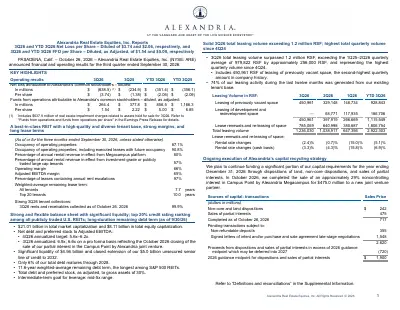
Under the category of demand and leasing, we had a solid third quarter leasing over 1.2 million square feet. Notably, we had a weighted average lease term of about 11 years, which is pretty great, and we had the second-highest filling of vacant space in the company's history.
74% of our leasing was existing tenants. We do have the largest life science tenant base in the industry, and it was quite well balanced except for public biotech, but we expect that to contribute importantly to fourth quarter projected leasing of about 1.25 million square feet.
Helpful was the defeat of the cap on indirect costs, a issue that we have talked about a many times, and that circuit court essentially beating off that cap helped drive institutional demand and leasing this quarter. One interesting indicator, people always wonder about the potential for public biotech health.
Rather than the XBI, I think people should look at what's called the BBC ETF, about 129 stocks, 93% of which are clinical stage, which I think reflect the public biotech sector probably more realistically. Clinical stage biotech valuations still remain well below historical averages.
There's been a good contribution this quarter from advanced technology companies as they're very attracted to our mega campuses for their recruitment and retention, as well as our wonderful infrastructure that is quite well-suited to their businesses. For 2027, we have, I think, a very strong 60+ percent of the 1.37 million square feet of lease rolls with expected downtime we're engaged with specific tenants, and that's very good at this stage.
Moving on to the capital plan, and Marc will have a lot to say about that, we had very successful or very solid progress in the third quarter and through this earnings call, including the hybrid notes, raising $1 billion in a very unique and very timely REIT debut for this instrument, and it's useful to note that over $160 billion of hybrid notes in the US trade and get 50% equity credit from the rating agencies. We just recently closed a $475 million joint venture at Campus Point with our continuing control of that core mega campus.
Our ownership will grow to over back over 50% as we fund our Novartis build-to-suit. On the Bristol Myers space that's coming back to us on that campus, about 250+ thousand square feet rolling next year, 2027, I'm pleased to say we're in advanced negotiations and expect to resolve on very favorable terms almost 200,000 square feet of that.
Moving on to the balance sheet and leverage, importantly, we expect to hit our year-end guidance of 5.6 to 6.2 times. We closed and extended our $5 billion credit line.
We have the longest weighted average remaining debt term of all S&P 500 REITs at over 11 and a half years. We have just $350 million of debt maturities next year.
Then I'd like to refer everybody to pages XV and XVI of the supplement, showing our very significant progress in reducing cap interest as we transition from a decade life science bull run and COVID rocket ship era when our leasing went up 4x overnight and that was led by a historic development growth. That transition is never simple, and takes a fair amount of time, but we're well into it.
Significant reductions are also noted on those pages in non-income-producing assets as a percentage of gross assets, which is very, very good. Our ARR from non-core assets versus a percentage of total ARR overall, especially from the mega campuses continuing to climb.
On the path forward, which we'll have more to say at our December 2nd Investor Day, we'll talk about 2027 and beyond. In the interim, we're laser-focused on a many items, but including most importantly, moving leased vacant space into operations as rapidly as possible, leasing currently vacant space, future rollovers, and development, redevelopment space as rapidly as possible, and focusing our CapEx on releasing with the path to NOI.
We're also heavily focused on continuing dispositions of land and non-core assets, especially focused on those without a reasonable path to NOI, and we've certainly culled our asset base considerably at this point. Then finally, execution of our capital plan to ensure we continue to achieve our leverage targets.
With that, let me turn it over to Marc for a highlight of this third quarter. Marc?
Marc Binda
Thank you, Joel. This is Marc Binda.
Good afternoon, everyone. Congratulations to the entire Alexandria team for continued solid execution during the quarter, including the five key accomplishments.
First, great progress on the funding plan with $1.7 billion of capital completed since June 30th, including $234 million of dispositions of land and non-core assets completed, a $475 million joint venture completed in October, and $1 billion of junior subordinated notes, which received 50% equity credit from key rating agencies. Second, completed and pending dispositions and sales of partial interest aggregate $2.6 billion and exceed the midpoint of our $1.9 billion target by $720 million, which gives us the opportunity to defer some proceeds into 2027.
Third, we had solid leasing volume for the quarter of 1.2 million square feet, which was the highest total volume in the last seven quarters and included 451,000 square feet of leasing from previously vacant space, which was the second-largest quarterly total in company history. Fourth, we continue to monetize the pipeline through deliveries of development and redevelopment space of 529,000 square feet during the quarter, providing $40 million of incremental annual net operating income, and through successful resolution of projects under evaluation, including 421 Park, which is under contract to sell, and our 311 Arsenal project, which has around half of the building leased or under negotiation, primarily with advanced technology tenants.
Fifth, we continue to manage general and administrative expenses prudently, as our G&A expenses as a percentage of net operating income are almost half the S&P 500 REIT average. FFO per share diluted, as adjusted, was $1.54 for 3Q 2026, and we reaffirmed the midpoint of our guidance for 2026 FFO per share diluted, as adjusted, at $6.40, while tightening the range to plus or minus $0.02.
Leasing volume for the quarter was solid at 1,236,000 square feet and represented the largest total volume in the last seven quarters. Five key items to highlight on leasing activity: First, leasing of previously vacant space of 451,000 square feet was up significantly over the last several quarters and represented the second-largest quarterly amount in company history.
Second, leasing with public biotech remained muted, representing only 1.1% of total leasing volume for the quarter, and remains a future potential catalyst. Third, we expect continued positive leasing momentum into the fourth quarter with an early estimate of 1.25 million square feet.
Fourth, we continue to outperform the broader markets on leasing. For our three largest markets, our share of the leasing represented 1.7 times our total share of the lab market over the last four quarters, driven by our high-quality assets, mega campus model, operational excellence, and brand.
Fifth, with respect to life science tenants in the market, after two consecutive quarters of high growth, we observed a modest 5% decline in the list of total tenants in the market across all our markets. Greater Boston and San Francisco had moderate gains, and San Diego had a moderate decline.
Declines are typically caused by the demand converting to leases without an equal number of new tenants to backfill the list. Initial free rent concessions remained elevated at two months per year of term for the trailing 12 months ended 3Q 2026, really driven by one large non-life-science lease signed in Research Triangle.
Excluding this lease, free rent concessions would have been significantly lower at 1.1 months per annum. Tenant improvements and leasing commissions on renewed and releasing space were modest during the quarter.
In fact, as a percentage of total rent, they were 7.4%, which is the lowest percentage over the last 10 quarters. Occupancy at the end of 3Q 2026 was 87.1%, up 20 basis points from the prior quarter and in line with our guidance for year-end 2026 occupancy, which remained unchanged.
We continue to significantly outperform on occupancy in our largest three markets, ranging from 6% to 12% higher than those broader markets. Bolstered by solid new leasing during the past few quarters, we have leases aggregating 1.3 million square feet, which will add 3.7% to occupancy over time and are expected to commence in June 2027 on average, with expected annual rental revenue of $52 million.
We did not make any changes to our guidance for occupancy, rental rate changes on lease renewals, or releasing of space, or same-property performance. Same-property net operating income was down 6.7% and 2.8% on a cash basis for the quarter.
The overall decline for 3Q 2026 same-property performance was primarily driven by lower occupancy in 2026. The recent quarter represented an improvement compared to the prior-quarter performance of 3.9% and 5.8% on a cash basis, primarily related to slightly better occupancy dynamics in the comparative same-property pool and changes to the same-property pool driven by certain properties that were designated for held for sale during the quarter.
Despite current challenges in the life science real estate market, we continue to benefit from a high-quality tenant base, with 57% of our annual rental revenue coming from investment-grade or publicly traded large-cap tenants, long remaining lease terms of 7.7 years, average rent steps approaching 3% on 97% of our leases, and strong adjusted EBITDA margins of 65% for the quarter. We continue to focus on the successful reduction and management of general and administrative expenses.
We remain on track with our guidance range of $134 million to $154 million for 2026 for all S&P 500 REITs over the last few years of 14.3%. Realized gains included in FFO per share diluted, as adjusted, from our venture investments were $16 million for 3Q 2026 and $44.5 million for the first three quarters of 2026.
We lowered our guidance range for realized investment gains by $10 million at the midpoint, from $75 million to $65 million, due to certain transactions being pushed out into 2027. We expect average real estate basis capitalized to reach a bottom for 2026 in the fourth quarter, ranging from $3.4 billion to $4.9 billion, which is a 40% to 60% decline from the basis that was capitalized for all of 2025.
This is generally consistent with the significant 40% reduction in non-income-producing assets as a percentage of gross assets, which has declined from 20% at the end of 2024 to 12% as of 3Q 2026. Capitalized interest for 3Q 2026 was $62.9 million, was down $11 million from the prior quarter, primarily driven by significant deliveries from the pipeline, coupled redevelopment projects that reached milestones and were paused.
We expect a further decline in capitalized interest in the fourth quarter driven by two large projects designated as held for sale at September 30th, coupled with significant deliveries from the pipeline in 3Q 2026, including the 199,000 square foot delivery to Novo Nordisk for its R&D center at 60 Sylvan on our Waltham mega campus. We continue to execute and favorably resolve our development and redevelopment pipeline.
From 4Q 2025 to 3Q 2026, the pipeline has shrunk by more than 50% from 3.6 million square feet to 1.6 million square feet. This included three major accomplishments during 3Q 2026, including the following: First, we delivered 529,000 square feet of development and redevelopment space that was 84% occupied and will generate $40 million of annual net operating income.
Second, we entered into a contract to sell most of our remaining investment in our development project at 421 Park Drive in the Fenway, with a 4Q 2026 anticipated closing date. Third, with respect to our 311 Arsenal Street project in Watertown, we've executed leases of 67,000 square feet, and 101,000 square feet of leases are under negotiation, primarily with advanced technology tenants, which has allowed us to pivot to a lower-cost, advanced technology execution and will reduce future construction needs by approximately $220 million over the next few years.
As of 3Q 2026, we have 906,000 square feet of development and redevelopment projects under construction, expected to stabilize through 2028, which are 77% leased or negotiating. In addition, we have 667,000 square feet primarily related to two projects, for which we are evaluating the business and financial strategy.
The first is 40 Sylvan Road, which is located in our Waltham mega campus. We continue to believe this project will be attractive to advanced technology tenants that may find the campus, as well as certain elements of the building, attractive, and may not require a conversion to lab.
The second is 3000 Minuteman Road, which is located in our Andover mega campus. The campus is very attractive to advanced technology tenants, as evidenced by the 160,000 square foot lease we executed for an adjacent building on this campus in 2Q 2026.
If we complete significant advanced technology leases, we may place all or some of these spaces into the operating pool, which may reduce operating occupancy in the near term, but, more importantly, will reduce our future capital needs and generate near-term revenue upon delivery. We continue to make very good progress in raising capital, with $1.7 billion completed since June 30th, including the $1 billion junior subordinated notes offering completed in August.
The 7.25% junior subordinated notes offering had several important benefits, including the following four key features: First, the rating agencies ascribed 50% equity credit to the notes, which will help us achieve our 2026 leverage goal. Second, it provided an implied cost of equity capital superior to the cost of issuing common equity, as well as non-core stabilized operating asset sales.
Third, it reduces our 2026 target for asset sales and near-term reliance on joint ventures. Fourth, it represents a fixed cost of capital for at least five years, with significant flexibility to refinance thereafter.
We are highly focused on and expect to meet our $1.9 billion midpoint for dispositions and sales of partial interest. Our team is making good progress, with $717 million completed, including $242 million of non-core and land dispositions and a $475 million sale of a partial interest related to our Campus Point mega campus.
In addition, we have $355 million under contract and subject to nonrefundable deposits, and additional $1.5 billion of dispositions and sales of partial interest with signed letters of intent or in late-stage negotiations. Included in the $1.5 billion of pending transactions is one large joint venture, for which we are actively engaged.
The aggregate sum of the completed and pending transactions is $2.6 billion, which exceeds the midpoint of our 2026 guidance by approximately $720 million, which may provide us the opportunity to potentially close certain transactions in '26, but defer the capital into 2027. There are three key points on the Campus Point joint venture transaction I'd like to highlight.
First, Alexandria will control and consolidate the joint venture. Second, the joint venture contains a waterfall distribution model that shifts distributions over time, but at a minimum, we expect the joint venture to make distributions to our new partner equivalent to at least 5.5% of their initial $475 million contribution in year one and beyond.
Third, our partner has a put right exercisable after seven years, and we may settle that amount in cash or shares of common stock at our election. In connection with our disposition program, we did recognize impairments of real estate of $638 million during the quarter, of which substantially all of this amount is related to developments in process, land, or properties that were laboratory conversion opportunities.
The two largest impairments made up 75% of the total balance and included the following: First, we are under contract to sell to an institutional user substantially all our remaining space at our 421 Park Drive development project, located in the Fenway. This project was acquired in January 2021 and was under construction.
As a result of the expected sale, this removes the overhang on lease-up of this project, and the buyer will take on the cost to complete the interior lab improvements, which we estimate to be approximately $136 million. Second, this relates to a four-building office project located in our Palo Alto submarket, which was acquired in January 2022 with a business plan to convert the buildings for laboratory use.
This market has subsequently had limited demand for life science tenants, and we now expect to sell these assets rather than go forward with the redevelopment. Looking forward, we have real estate assets under consideration for potential disposition in 2027 that may have estimated market values below their respective carrying values.
These assets remain as held-for-use assets as of 3Q 2026 and remain recoverable under probability-weighted recovery analysis, and, accordingly, have not been impaired due to a variety of factors necessary to designate them as held for sale, including the lack of a final decision to proceed, as well as our current estimation that it is unlikely that we will complete these sales within the next 12 months. We could have impairments over the next couple of quarters if these types of assets subsequently meet the accounting requirements for held-for-sale designation as we refine our approach, make final decisions to proceed, obtain the necessary approvals, and commence the disposition marketing process.
We continue to have a strong and flexible balance sheet. Our corporate credit ratings rank in the top 20% of all publicly traded US REITs.
We have tremendous liquidity of $4.6 billion as of 3Q 2026, and we recently extended our $5 billion unsecured senior line of credit to 2032, providing additional significant flexibility. We continue to have the longest average remaining debt maturity among all S&P 500 REITs, with an average term of 11.6 years, and we remain committed to meeting our leverage goal for 4Q 2026 of 5.6 to 6.2 times on a net-debt-to-annualized-adjusted-EBITDA basis.
Over the intermediate term, beyond 2026, we would like to be around five, mid-five times for leverage. We tightened the range of our guidance for 2026 FFO per share diluted, as adjusted, with no changes to the midpoint of $6.40.
Key moving pieces underlying our 20 2026 guidance included a reduction of $10 million in realized investment gains and slightly later timing on expected dispositions and sales of partial interest. Our earnings release contains several key considerations that could have an impact on our results beyond 2026, which are highlighted on pages 6 and 7.
Three key important takeaways from those pages to highlight: First, we expect temporary pressure on occupancy in the first half of 2027, which includes the impact of the 1.4 million square feet of key lease expirations, which are expected to have downtime ranging from 9 to 24 months on average, with expiring rent of $101 million, and the potential for tenant wind-downs. Based upon our current outlook and considering typical lag times between lease execution and delivery, we expect to see average occupancy growth in 2028.
Second, we expect same-property performance to improve from both 2026 to 2027 and from 2027 to 2028, although we still expect '27 to be negative, driven by occupancy. Then third, we continue to prioritize capital spending with high incremental returns, including costs to meet the market and lease up vacant space, and, accordingly, we expect construction spending related to our operating assets to comprise a significant component of next year's construction forecast.
We continue to refine our capital funding plan for 2027, and we expect to have access to the same funding tools used in 2026, including non-core and land dispositions, sales of partial interest, and other cost-effective capital. We also expect to continue to manage our leverage and other credit metrics carefully.
We continue to focus on the execution of the steps for our path forward that we established at our Investor Day. Our seasoned and best-in-class team remains disciplined and committed to making forward progress, including maintaining our strong balance sheet, solid lease volumes, reducing capital needs where it makes sense, procuring cost-efficient sources of capital, effectively managing G&A, and focusing on our highly differentiated mega campus strategy.
We believe these steps put us in a great position to be highly successful. Now, I'll turn it back to Joel.
Joel Marcus
Thanks, Marc. Operator, please open it up for questions.
Operator
At this time, we will begin the question-and-answer session. To ask a question, you may press star and one on your touch-tone phones.
If you are using a speakerphone, we do ask that you please pick up the handset before pressing the keys. To withdraw your question, you may press star and two.
Again, that is star and then one to join the question queue. Our first question today comes from Jim Kammert from Evercore.
Please go ahead with your question.
Jim Kammert
Good afternoon. Thank you.
Marc or team, as regards the new joint venture, when that waterfall, is there any particular fixed cadence to the shift of the cash flows over time or is it more elective, just trying to think of how they get to their IRR and how that impacts kind of what ARE gets to hold on to in the interim?
Marc Binda
Yeah. Hi, Jim, it's Marc.
There's a 5.5% that's in place for at least the first several years. There are steps in that over time.
As I said, there is a put mechanism that's intended that, if exercised, would allow the investor to get to a certain IRR that they're targeting.
Jim Kammert
Jim, a second question kind of related, as regards the other joint ventures you're working on hoping to close or negotiate by the end of the year, will that have a similar structure, do you imagine, a put and some sort of minimum? I'm just curious how the structuring of that is looking at this point.
Marc Binda
That is a structure that we're looking to potentially replicate, but the other joint venture that I did mention that we're actively engaged on right now is different than the Campus Point structure.
Jim Kammert
Okay. Thank you.
Operator
Our next question comes from Farrell Granath from Bank of America. Please go ahead with your question.
Farrell Granath
My first question is around the tenant wind-downs. First for 2026, obviously we had a little step-up in the tenant wind-downs in guidance, and then the commentary around expecting similar for 2027.
I was curious if that is outlined just given or a conservative number just from what you saw in 2026, or you already have known move-outs or wind-downs expected in '27.
Marc Binda
Hi, Farrell. That is an estimate at this point.
These situations are generally really hard to predict. We do go through and diligently underwrite each and every tenant.
A lot of these tenants have milestones coming up, which will dictate whether or not they're able to raise capital. Certainly once we know that a tenant is vacating, the deferred rent gets written off, gets written off when they move out, they hit the occupancy roll.
This is really our best guess at this point as to what happens next year. The other thing I would mention here is, the run rate for 2026 has a similar number in there, $30 million to $35 million.
This shouldn't necessarily result in incremental dilution to next year, because we're really just saying we think we'll have a similar type of hit to the economics next year as we've had this year. Yeah.
Joel Marcus
Farrell, this Joel. One other thing that, or a couple things, keep in mind.
Since the kind of bear market which followed the historic bull run in the COVID run-up, more and more funders of companies, certainly on the private side and sometimes on the public side, have sought to combine or merge companies, which historically they did, but the pace at which they've done it over the past handful of years has been much more pronounced, and I think we've had one case where a tenant, after we underwrote them, ended up taking on venture debt and they were essentially almost put out of business or were put out of business, this goes back a handful of years, by the debt being called by a lender who was kind of not a traditional venture debt provider and just felt that the matters would going on with a company were such that they triggered the debt without even breaching the covenants. We've seen things in this I don't know if you call it cycle or just episodic period that are different than past practice, we're trying to be conservative here.
Thank you.
Farrell Granath
I just also wanted to ask about the progress that you've made in your 2027 key expirations now with the 22% under negotiation, which was essentially at zero in the last quarter. Definitely making progress there.
If you could give a little bit more on the profile of that leasing, is this any of this renewal or net new leasing, and any economics or expected downtime relative to your underwriting as you're going through those negotiations? Yeah.
Joel Marcus
I think I mentioned in my kind of prepared remarks, if you look at the 1.377 million square feet that's rolling that are move-outs with downtime, a bunch of that like, for example, in San Diego is Bristol Myers leaving space to go into their new building. That amount, the 1.37, is fully move-out, and we now have over 60% in active tenant, some in late-stage and some in early-stage, but with specific tenants.
I think that's a really good sign for us at this stage to have that many specific situations under discussion or negotiation, I should say.
Operator
Our next question comes from Ronald Kamdem from Morgan Stanley. Please go ahead with your question.
Ronald Kamdem
Great. Two quick ones.
I think last quarter, you talked about $1.15 billion to $1.65 billion of development spending in '27. Just curious if we can get an update on the current thinking and sources and uses and leverage impact on that spending in '27.
Thanks.
Marc Binda
Hey, Ronald. You're right.
That was the estimate that we had given off of our 2Q earnings call, $1.15 billion to $1.65 billion. We expect to be able to refine that number over the next five weeks here as we get prepared here for Investor Day.
I would say stay tuned, we'll have a better number in early December. The one thing I can certainly tell you is we expect a big chunk of that to be targeted towards the operating portfolio, and a lot of that is stuff that's either leased or under negotiation, but we'll, again, we'll have a better number here soon.
Ronald Kamdem
There's no sneak peek if that's going to be lower or higher, or?
Marc Binda
I don't think I can say at this point, Ronald.
Ronald Kamdem
Got it. My second question, just going back to the JV, just trying to get my arms around it.
Is the returns are guaranteed? Is this being treated as equity or debt?
How does the value of the JV change, given sort of that put option? Just high level, how is that going to work?
Thanks.
Marc Binda
Sure. No, the joint venture is treated as permanent equity, Ronald.
There is a put mechanism, there is a call option that Alexandria will hold, which really strategically is important to us, because it allows us to control our destiny there long-term on a campus that we really like, but in the meantime, get a very effective or efficient cost of capital, particularly in the near term at the 5.5%.
Peter Moglia
Hey, this is Peter. Sorry, I'm a little under the weather, my voice is bad.
There is no guarantee, just to be clear. You had stated that it was guaranteed.
That is not true. Thank you.
Ronald Kamdem
Got it. Thank you so much.
Operator
Our next question comes from Seth Bergey from Citi. Please go ahead with your question.
Seth Bergey
Thanks for taking my question. I just kind of wanted to go back to kind of your updated views on kind of pricing for assets.
You obviously came up with this creative structure for the joint venture and are contemplating it sounds like another one, but just where do you think kind of core assets price in today's market, especially given the macroeconomic uncertainty?
Peter Moglia
Hey, this is Peter. I'll take this one.
In past conferences, I've been talking about I thought our Tier 1 core assets would still have a 5 handle. I think that's getting pressured by rates, but I would say that things like Campus Point and other high quality would still have that threshold.
I would say that our better assets would trade with a 6 cap handle on it. Then we've got some good workhorse assets that could trade anywhere between 7 and 1/2 and 8 and 1/2.
The market is specifically tied to markets. The big three markets tend to have lower cap rates, and markets like Seattle tend to have lower cap rates.
Those markets are typically looked at by institutional investors as favorable markets. Historically, we've done well there, but there are other markets that are more suburban that typically have a 100 to 150 basis points spread not because of the quality of the assets or the tenancy, but just because of location.
Hopefully, that's helpful.
Seth Bergey
Thanks. Then maybe just for a second one, just going back to your comments on kind of the mid-5s leverage target and as we think about sources and uses for next year.
How do kind of the JVs go into this computations? You get the benefit of the cash, but then since you still have controlled the EBITDA is still consolidated, is that the right way to think about how that structure kind of factors into that calculation?
Marc Binda
That's correct, Seth. We would continue to consolidate the Campus Point joint venture, and the EBITDA would stay on the income statement and included in the leverage computation.
Seth Bergey
Great, thank you.
Operator
Our next question comes from John Kim from BMO Capital Markets. Please go ahead with your question.
John Kim
Thank you. I know you don't want to give out 2028 guidance at this point, but you did mention that you've seen improvements in same-store NOI from 2027.
I'm just wondering how you anticipate getting there, just given known move-outs that you provided and the tenant wind-downs on our numbers is a 10% headwind to occupancy over the next couple of years. I just want to clarify, do you expect occupancy to improve by 2028 to drive that same-store performance?
Marc Binda
Hi, John. Clearly, in order to have occupancy growth in 2028, we're going to have to continue at a very healthy pace of leasing, particularly leasing of vacant space.
This quarter was a really strong quarter in that regard. We had 450,000 square feet leased that was previously vacant, second-highest in company history, we're going to need to continue the focus there, and we're working hard every day to continue that, so that's going to be key.
John Kim
Okay. Then as a follow-up, I just wanted to ask about embracing advanced technology as a leasing opportunity going forward, given it does have a lower rents than life sciences, but also a lower CapEx.
I'm wondering, how you view this tenant base in your leasing.
Joel Marcus
I think it's fair to say, John, much like our early tenants, Google and then during the heydays of the last technology boom, companies like Stripe and Pinterest, those folks came to us because of our ability to put creative spaces together that allowed them to retain or recruit great talent and having the infrastructure for what they needed, and we're finding the same thing with a whole range of advanced technology clients. There've been a whole series of articles about those coming to our campuses for both the infrastructure and what's offered on the campus.
Kind of speaks for itself.
Peter Moglia
This is Peter. If I could add, it's not only a benefit to Alexandria as a wider tenant base to lease from, but it is also going to take a lot of the current supply that was built and marketed as lab, but probably shouldn't have been.
We're definitely seeing that, it's been serendipitous for that segment to really start to have a bunch of funding coming into it and a lot of companies being created because lab buildings are perfect for what they need, and we're definitely seeing that as a source to chew up some of the supply.
Joel Marcus
Yeah. Now, one footnote to what Peter said, which I think is generally true, is some of those buildings are really true zombie buildings built in locations that people just don't want to go to, there's got to be some other adaptive reuse, but in general, if well-located, they would be recipients of that demand.
John Kim
Thank you.
Operator
Our next question comes from Anthony Paolone from JPMorgan. Please go ahead with your question.
Anthony Paolone
Great. Thank you.
First question is on the $1.9 billion of pending dispositions, I think it's the $1.5 billion and the $350 or so under contract. What are the GAAP and cash type cap rates we should be thinking about for that grouping?
Marc Binda
Tony, maybe I'll talk about it in the context of I would say non-core and land. There's definitely a combination of both of those in the 355.
A big chunk of that, as an example, is the 421 Park, so that will have basically no cap rate. The bigger chunk, we'll call it $1.5 billion of pending, a big chunk of that is a joint venture that we're working on, and I have to ask you to stay tuned on the economics, since we are currently in advanced discussions on that deal.
Anthony Paolone
Got it. Then, going back to the discussion on the construction spending for next year, if I look at the remaining spend on the few developments that you have underway, I think it's about a half a billion dollars.
Whether it's the $1.4 billion prior midpoint or some new number that you'll give us at Investor Day, am I missing anything to assume that anything above the $500 million would be like CapEx, or am I missing a different type of bucket?
Marc Binda
No, there'll definitely be some capitalized costs for the portfolio, right, capped interest, capitalized operating expenses, as an example. In this year's construction forecast, we've got $210 million of the $1.75 billion is future, call it land.
Almost all of that is capitalization, there will be some of that as well. TBD what that amount ends up being, but you're right, Tony, in that it suggests that there is a large amount that is going to be tied into the operating portfolio for leasing of vacant space, so that will definitely be the majority.
Anthony Paolone
Okay. Thank you.
Operator
Our next question comes from Rich Anderson from Cantor Fitzgerald. Please go ahead with your question.
Rich Anderson
Hey, good morning still out there. Marc, you mentioned the tenant market number down 5% in the third quarter.
If I remember correctly, that number was sequentially up 30% in the first quarter, so that perhaps was tied to the removal of that overhead cap situation, maybe that created activity. My question is the 30% in the first quarter in terms of its sort of one-timeishness sort of likewise one-timeishness when you talk about this down 5% in the third quarter?
I'm curious where does this asymptote to, to use a cool word, in terms of ongoing tenant market activity in 2027, if you were to guess today? Thanks.
Peter Moglia
Hey, Rich, it's Peter. Congratulations on expanding your vocabulary.
Look, the 30% quarter-over-quarter from 4Q to 1Q was definitely an anomaly. I had never seen it jump like that.
Then last quarter, you may recall, went up another 10%.
Rich Anderson
Another 10%.
Peter Moglia
That is something that we would see. A 5% move down is really kind of normal.
It usually goes from flat to plus or minus 7 or so percent. I think at least for now, there was probably some pent-up demand that came out, boosted from 4Q to 1Q, a little bit more leaked out after that, and I think we're probably in a stable situation at this point.
That's my best guess.
Rich Anderson
Fair enough. Good stuff.
Thanks for that, Peter. Second question for me is just broadly on the component of dispositions related to partial interest of core assets.
What is your appetite for that in terms of the three buckets, Marc, that, or anyone can respond to this, non-core assets, land, and partial interest sales. Is that number three in the totem pole or do you think it could be an equal player in 2027 just because you get better pricing there?
Thanks.
Marc Binda
Hi, Rich. It will certainly be on the menu.
I think what we've done and what we expect to do this year is a little unique. We did one on a mega campus, as we've talked about.
I think the other JV that we're working on will be a little different than that, likely something having to do with multiple assets, multiple types of assets, it could be core and non-core. Certainly, as you mentioned, future JVs would be on the menu for next year as well as some land and some non-core assets that we weren't able to get done this year will certainly be on the menu for next year to resolve a big chunk of the capital plan.
Rich Anderson
Related to that answer, thank you, what's the efficient frontier on percentage of the total represented by mega campuses? I know it's 80%, I think it's up from 74% to start the year.
Could that be 100% someday or will there always be a need for some sort of non-mega-campus sort of assets in and around the portfolio?
Joel Marcus
I think there'll always be a need, Rich. This is Joel.
Remember too, we have a variety of core but non-mega-campus assets. Good example is the Lilly building in the Seaport, we will continue to have a balance.
I think you may see it move up to 85%, maybe at a height 90, but I wouldn't expect it would be 95 or 100 at any point.
Rich Anderson
Great. Thanks, everybody.
Joel Marcus
Yep. Thanks, Rich.
Operator
Our next question comes from Michael Carroll from RBC Capital Markets. Please go ahead with your question.
Michael Carroll
Thanks. Joel, in your prepared remarks, you still seemed to be pretty cautious on the macro outlook for the space, but Alexandria did see some better leasing trends in 3Q and expected in 4Q.
Can you kind of explain the difference there? Is that just more leasing activity from the advanced tech tenants versus core life science tenants?
Joel Marcus
I think you have to remember and go to the pie chart in our supplement, remember, this niche, and it is a niche, and life science sector is made up of a whole bunch of sectors, subsectors if you will, and Hallie on past calls have gone through the health of each. Each kind of are different for different reasons.
Obviously, public biotech with marketed products or approved products is one that would be normally pretty steady. It's the public biotech in the clinic, but without immediate data as value inflection milestone is where the pinch point has been.
Private has been historically pretty stable. It's gone through ups and downs, but it's pretty stable.
Institutional has come roaring back in an important way. Life science products, services, tools, etc., has been continually strong.
I think, don't get lost in public biotech as the entire sector. Pharma is obviously chunky, but steady.
That's what I would say. We are expecting to see, based on the best we can tell from our discussions, negotiations, fourth quarter should see an upswing in public biotech for the first time in quite a number of quarters, and I think that's, irrespective of Alexandria, I think that's healthy for the industry.
Michael Carroll
Great. Then on the new disclosure that Alexandria expects about downtime at 1700 718,000 square feet on the 2028 lease expirations, does this largely reflect the above-average move-outs that year or are there still some large leases that are TBD?
I'm just trying to get a handle on the remaining 3 million square feet. Should we just assume that that's normal tenant retention, or is that still kind of up in the air and you can see that have lower tenant retention kind of similar to 2027?
Joel Marcus
It's a combination. We do have one large move-out in Tech Square, which is coming to the end of a lease, actually, a big pharma that has consolidated elsewhere years before, and that's an example of a backfill.
We are seeing activity, here we are, what, a year and a half away, or a year and a quarter, whatever it may be, and we're starting to see some activity there. Our thoughts are maybe more positive than they were, say, 3, 6, 9, 12 months ago.
Michael Carroll
Then just one clarification. Could that known tenant move-out number increase significantly off of that 718, or should we think about that 718 as the big known move-outs and then
Joel Marcus
Yeah, that's the big one, yeah. Or the big combination, yes.
Yep.
Michael Carroll
Thanks.
Joel Marcus
Yep.
Operator
Our next question comes from Wes Golladay from Baird. Please go ahead with your question.
Wes Golladay
Hey, everyone. Looking at the 2027, '28 expirations with downtime, are you open to having advanced technology tenants look at that space for all the locations, or are you going to hold some back for life science tenants?
Joel Marcus
You can't kind of make a judgment like that, because each space is so unique, and where you have built-out lab space, obviously, that's not necessarily a target for advanced technology. Where you may have office space, or you have shell space in a building that has robust infrastructure and it's on a campus, that certainly could be 311 Arsenal, which Marc alluded to, on our Watertown Arsenal on the Charles campus, is a good example of that.
They're not interchangeable one-for-one by any means.
Wes Golladay
Okay. Then, a quick follow-up on that.
If you did pursue the advanced technology tenants, would the downtime be less?
Joel Marcus
Again, it's space-by-space, but generally, yes, because oftentimes, these are extremely well-capitalized companies that are prepared to put in significant tenant improvements on their own. They a little bit like pharma.
Pharma generally puts in a huge amount of CapEx on their own. We would expect, yes, less downtime.
Thanks. Thank you.
Operator
Our final question this afternoon comes from Dylan Burzinski from Green Street. Please go ahead with your question.
Dylan Burzinski
Hi, guys. Thanks for taking the question.
Just maybe touching on the outlook for partial interest sales on sort of you guys' core assets. Should we be expecting most of that capital to be coming from or derived from more structured transactions like you guys did at Campus Point, or will there potentially be just outright partial interest sales included in that?
Marc Binda
Hi, Dylan. For the balance of this year, we got the Campus Point joint venture done.
The other joint venture we're working on for 2026 is not that, I mentioned earlier. It'll probably be a combination of multiple assets, core and non-core, not necessarily mega campus driven.
Next year's a little bit of a TBD. Certainly, as I said at the outset of the call, the structure we used for the Campus Point joint venture would be something that we would consider doing again.
It's a little too early to kind of comment on what the mix of partial interest sales might look like. I would say we're certainly open to both, but we're also very focused on finding the most cost-efficient capital in this environment.
Dylan Burzinski
That's helpful. Then, maybe, something you touched on earlier in Q&A about '28 and new leasing needing to continue to be strong.
As we sort of think about some of the commentary you guys outlined, right, an increase in occupancy, an improvement in same-store NOI growth versus '27. Is the idea that you need new leasing activity to pick up from what you guys saw in Q3, or would it be a continuation of that?
Just sort of curious what's sort of baked into some of that commentary.
Marc Binda
Certainly, this quarter was a strong number. Last quarter was actually a pretty strong number as well in terms of new leasing.
We have really seen that the last two quarters. I think, combined over the last two quarters, we've leased over or almost 800,000 square feet of that type of leasing.
We've started to accumulate a large amount of space that's been leased that hasn't yet hit the occupancy rolls, and we're seeing that there can be a significant delay between when those leases get executed and when they get delivered, right? If you look today, we've got 1.3 million square feet.
On average, that stuff's not delivering until June of next year. Our commentary for '28 was really based upon market conditions today and what we think we can get done, understanding that in many cases, a lot of these spaces will have a fair amount of a lag between when we lease and when we deliver.
Dylan Burzinski
Great. Appreciate that commentary, Marc.
Operator
With that, we'll be concluding today's question-and-answer session. I'd like to turn the floor back over to Joel Marcus for closing remarks.
Joel Marcus
Thank you very much, everybody, and look forward to meeting everybody on Investor Day. Thanks so much.
Operator
With that, ladies and gentlemen, we'll conclude today's conference call and presentation. We thank you for joining.
You may now disconnect your lines.