ARN Media Limited
AASX:A1NQ2 FY2026 · Earnings Call TranscriptAugust 20, 2026
Michael Stephenson
Good morning and welcome to ARN Media's FY 26 first half results presentation. My name is Michael Stephenson, I'm the Chief Executive Officer of ARN Media, and this morning I'm joined by Alexis Poole, our Chief Financial Officer.
Today we're once again streaming from our North Sydney studios. Today I'm going to share with you our company highlights and summarize our first half results before handing over to Alexis to walk through the financial results in detail.
I'll then take the opportunity to reiterate our vision for the future of our company and provide a trading outlook before opening for questions. There are three key things that I'd like you to take away from today's presentation.
Firstly, we have stabilized the core business. Secondly, we're on track to deliver $55 million of cost savings by the end of 2027.
Finally, our underlying audience performance is strong, but our metro radio revenue share is below our audience share and below our expectations. Our immediate focus is on regaining the revenue share that we have lost over the past 18 months, primarily because of brand safety issues in KIIS breakfast.
If we could turn to slide five. At our full year results, we said that we would be focused on stabilizing the core radio business and the divestment of non-core assets.
I'm pleased to say that in the half, we've done this. We have entered into an agreement to sell Cody Hong Kong to DFI Retail Group.
This simplifies our portfolio, provides greater financial flexibility, and creates certainty for our shareholders. Subject to final approvals, we expect this transaction to complete shortly.
During the half, we also finalized a settlement with KwaiZar Media. This settlement also provides certainty for our shareholders.
Most importantly, it gives us the freedom to execute our plan and regain lost revenue free from the brand safety and regulatory issues that have existed previously. The Henderson Media case continues to be a matter before the courts, and of course we won't comment on that today.
Last year we made a commitment to transform our business, to create a leaner, fitter, and increasingly more digital organization, and we're making excellent progress. We have an unrelenting focus on disciplined cost and capital management.
In the half, we've reduced costs by $12 million and have a clear line of sight to deliver $55 million of cost out by the end of '27. The metro radio business is ready for growth.
We've spent the last six months developing new breakfast shows and selecting fresh new talent. I'm pleased to say that we're close to finalizing talent agreements for our new shows in both Sydney and in Melbourne, and I can announce today that both shows will launch this year and both will be live and free.
Our regional performance has been excellent with strong audience, revenue, and EBITDA contribution. We've made a strategic investment in digital capability.
We've developed a clear digital strategy, and we've moved away from unprofitable podcast partnerships, and now digital revenue and EBITDA is growing. iHeart is at the very center of our long-term strategy, and in the half we've created more iHeart original content.
We've delivered eight iHeart Live events, and in June we officially launched video on the iHeart platform. This is going to be an absolute game-changer for ARN.
At the same time, through the half we've continued to build our next generation data infrastructure. We've further developed our data partnerships, and we've launched new data products.
It has been a very, very busy period, but I'm proud of our team and I'm pleased with what we've achieved. Of course, there is still a lot more for us to do.
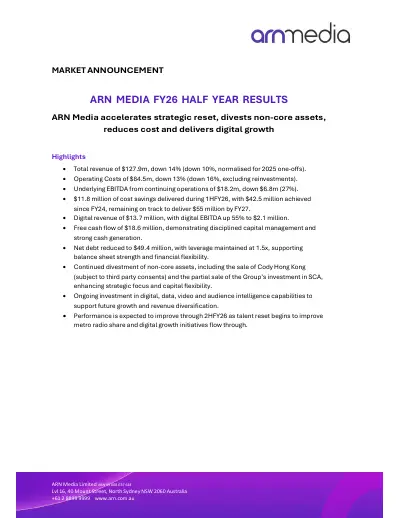
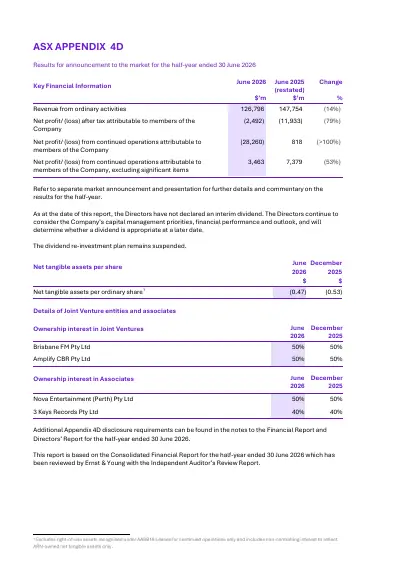
Turning to our results. Revenue for the half was $128 million, down 14% on the prior period, impacted largely by brand safety issues in KIIS breakfast and the federal election in the prior year.
EBITDA was $18 million for the half, down $6.8 million versus the prior period. Digital EBITDA was $2 million.
Net debt reduced by $28 million to $49 million, driven by strong cash conversion and disciplined working capital management, and Alexis will share a lot more detail later in our presentation. We have a very clear plan to transition to a more digital business.
However, in the short term, we must continue to stabilize the core radio business and regain the revenue share that we've lost over the past 18 months because of issues surrounding brand safety. I'd like to take just a moment to explain why this is so important.
Right through the cycle, radio markets will decline by 2% to 3% per year and digital markets will grow by 12% to 13%, 14%. We've passed the point of inflection.
Any declines in radio markets will now be offset by the growth in digital markets. We're operating in a growth market.
ARN is Australia's number two radio network. We have a 28 share of audience, we reach 12 million people every month, and we reach 7 million Australians on the iHeart network.
Our audience performance is strong. However, our metro radio share is well below our audience share.
This is our single biggest opportunity. You can see on this chart, we're a 25% share of audience in the metro markets, yet we're only an 18.5% share of revenue.
Our revenue share has decreased by more than six points over the last two years, largely because of concerns around brand safety. The good news is, of course, the brand safety issues that we've had are now over.
Every share point is worth $6 million. That means there's $38 million worth of revenue upside for ARN if metro radio share can improve and we can regain what we've lost.
80% of this falls straight to the bottom line, and this is not an unrealistic expectation. We were 25 share of revenue less than two years ago.
Whilst we continue to transform our business and enter new markets, and this is critically important, regaining lost radio share is the lowest hanging fruit and it's our single biggest growth lever in the short term. At our full year results, I shared our vision for the future of our company: to transition from a radio business to an entertainment company.
A little later, I'm going to reiterate our strategy, the importance of iHeart to our business, and the huge opportunity for growth that comes as we diversify our revenue and into the $5 billion digital video market. Right now, I'll hand to Alexis to walk you through our financial results in detail.
Alexis Poole
Thank you, Stevo, and good morning, everyone. I'll take you through the financial performance for the first half of 2026, and more importantly, the progress we've made strengthening the fundamentals of the business.
Against a challenging backdrop, ARN is now more resilient, disciplined, and financially stronger than it was 12 months ago. We have strengthened the balance sheet, reduced debt, divested non-core assets, reset the cost base, generated strong cash flows, and accelerated our shift to digital and data-led revenue.
We have been super busy resetting our business. Now to the numbers.
Revenue was $128 million, down 14%. Adjusting for last year's federal election and ATN contract negotiations, it was down 10%.
Despite these headwinds, EBITDA was $18 million and free cash flow was $19 million. We delivered a further $12 million of cost savings, bringing total savings since 2024 to $43 million.
Net debt reduced to $49 million, and digital revenue now represents 11% of group revenue, and digital EBITDA increased 55% to $2 million. ARN is leaner, financially stronger, and more digitally focused than it was a year ago.
Now to revenue on slide 14. The prior period includes $7 million of one-off revenue items relating to the federal election and ATN contract negotiations.
On a like-for-like basis, revenue declined by 10. The regional revenue was down just 1% with local regional revenue growing by 3%, reflecting the strength of our local market positions and the continued value that advertisers place on ARN's regional presence.
Digital revenue grew by 2%, driven by growth in streaming revenue of 16%, demonstrating that our strategy to grow audience and monetize across digital platforms continues to gain traction. Metro revenue declined 20%, reflecting the ongoing impact of brand safety issues carried over from 2025 and into the first half.
As Stevo noted earlier, our biggest opportunity is to leverage our strong metro audience positions and rebuild revenue share and continue to diversify the business. Turning to slide 15.
This EBITDA walk demonstrates the benefit of the hard work done on the cost base and how those savings have helped offset revenue headwinds. EBITDA was $25 million in the prior period.
Our productivity program delivered $12 million of savings, increasing EBITDA to almost $37 million on a like-for-like basis. We deliberately reinvested part of these savings back into the business, including $3 million in data, tech, and digital capability.
We also absorbed inflationary pressures while benefiting from $5 million of lower talent costs following the departure of Kyle and Jackie O. Post revenue decline, EBITDA for the half was $18 million.
Turning to digital on slide 16. Digital revenue increased to $14 million in the first half, up 2% on the prior period, while digital EBITDA rose 55% to $2 million.
Digital EBITDA growth materially outpaced revenue growth, reflecting the improved earnings quality of our digital business. This was achieved despite lower podcast revenue following our deliberate exit from low-margin third-party agreements.
We prioritized higher quality earnings reinvestment in ARN-owned products and deeper integration in the iHeart ecosystem. ARN's disciplined cost management continues to deliver a meaningful reset of the cost base while creating capacity to invest in future growth.
As this slide shows, operating costs reduced from $97 million to $85 million, a reduction of $12 million, 13% year-on-year. Importantly, this reduction was achieved while continuing to invest in the business.
We are removing structural costs while we're investing in the capabilities needed to support future growth. Stepping out our multi-year cost-out program on slide 18.
In 2025, we embedded a stronger productivity mindset, enabling us to increase our total cost savings target to $55 million over the '24 to '27 period, well above the original ambition. As this slide demonstrates, our productivity program continues to deliver ahead of expectations.
In the first half of FY 26, we delivered a further $12 million of savings, bringing cumulative savings to $43 million. Importantly, we have already actioned a further $7 million of initiatives for the second half of '26, and our productivity program will deliver a further $5 million in '27, giving us clear visibility to approximately $55 million of cumulative cost savings by '27.
The key takeaway is that we are strengthening operating leverage and creating capacity to invest into future growth. Turning to slide 19.
As mentioned previously, strong cash generation remains a defining feature of ARN's financial performance. Operating cash flow was $13 million, representing an operating cash conversion rate of 145%, reflecting disciplined capital management.
Free cash flow was supported by $10 million of proceeds from non-core asset sales, primarily reflecting the partial sale of our SCA shareholding and the continued execution of our regional property monetization program. These initiatives support our disciplined approach to capital management and balance sheet optimization.
As a result, ARN generated free cash flow of $19 million, representing a free cash flow conversion rate of 202%. Turning to the balance sheet on slide 20.
Despite the challenging operating environment, we closed the half with a significantly stronger balance sheet and greater financial flexibility. Cash increased 72% to $18 million, supported by strong cash generation, proceeds from asset optimization, and disciplined capital management.
We continued to deleverage the business with net debt reduced to $49 million. Reported net assets were $239 million, down $36 million on the prior period, primarily due to non-cash impairment charges of $25 million and litigation-related items.
Excluding these items, net assets actually moved in a positive direction. Importantly, the impairment has no impact on cash flow, debt facilities, or covenant headroom.
As we prove out our strategy, we get to write back that value onto our balance sheet. We also continued to simplify the group with Cody Hong Kong sale agreement recognizing a net asset position of $4 million, a significant improvement on the prior year.
ARN remains committed to returning capital to shareholders through dividends. As the group continues to divest non-core assets and progresses the resolution of litigation matters, the board will continue to assess dividend payments in the context of earnings, cash flow, and capital requirements.
The key takeaway is that ARN exits the half with a stronger, more flexible balance sheet supported by higher cash, lower debt, and improved liquidity. You can see that ARN's leverage on a continuing operations basis has reduced materially over the past two years and remains comfortably below our target range.
Net debt has reduced by $39 million from $88 million in June '24. Net leverage was approximately 1.5 times EBITDA, well below our target of less than 3 times.
The group has $140 million of debt facilities, and as at 30 June, $73 million of undrawn capacity. As we head to the completion of the sale of Cody Hong Kong, proceeds of which will be applied to net debt, but more significantly, it will release $30 million of Australian bank guarantees and also parent guarantees.
Before I hand back to Stevo, let me recap the first half's financial performance. Despite a challenging backdrop, ARN has continued to reset its cost base, continued to strengthen its cash generation, continued to materially simplify and de-risk the balance sheet, continued to accelerate the shift to higher quality digital earnings and revenue, and most importantly, we continued to build stronger operating leverage, creating a clearer pathway to long-term shareholder value as we regain revenue share and continue to diversify the business.
Thank you, I'll hand back to Stevo now.
Michael Stephenson
Thanks, Alexis. In February, I shared our vision for the future of our company: to transition from a traditional radio business to an entertainment company, a company focused on the creation, the distribution, and the monetization of content.
We have a very, very clear strategy: create great content, distribute it across all platforms, amplify that content on social to engage our audiences and our advertisers. That's our plan.
Our focus is on maximizing the return on our existing content and talent investment by using our leading radio brands, our number one radio shows, and our new stars to create content for every other platform: content for radio, content for podcasts, increasingly content for video, and of course social platforms. Radio remains the foundation of this business, but what we're building around it is something bigger, a platform that brings together audio, video, social, and in-real-life experiences to create one connected entertainment ecosystem.
Now, the very, very center of our digital strategy is iHeart, the world's largest free streaming platform. Our partnership creates long-term competitive advantage for ARN.
It gives us access to global development and product teams via a long-term license agreement. Critical to our long-term plan is the ongoing development of our next generation data platform.
Over the half, we've continued with our data partnerships with Westpac, with Experian, and with Azira to enrich our audience segments with banking, consumer lifestyle, and location-based data. We now have over 800 audience segments that advertisers can use for targeting.
We are building a first-party data asset at ARN that dramatically improves the monetization of our growing digital audiences. It's my view that the convergence of audio and video is a clear medium-term opportunity for ARN.
We launched short-form and vertical video on the iHeart platform in June, and next year we will start live streaming long-form content. Video advertising in video content arrives in September.
It's this strategy that I expect will help us to grow and diversify our revenues whilst improving the long-term monetization of the core audio assets we already have. The implementation of our strategy will fundamentally change the shape of our revenue.
Today, 45% of our audience is delivered on a digital platform, but it's only 11% of our revenue. Over time, any decline in radio revenues will be more than offset by the growth in digital revenues, and this growth will come from audio and video podcasts and video live streaming, both of which attract a CPM that is three to time three to five times higher than the traditional radio yields that we receive.
The creation of video content using our existing talent and the monetization of short-form video on social is going to allow us to participate in the $5 billion digital video market and the $2 billion social video market. It's this clear gap between our audience share, revenue contribution, and margin that highlights the significant runway ahead for monetization and of course supports the digital transformation program that we're undertaking.
Now turning to page 30. As we've said previously, our plan will be executed in three phases over five years.
Our immediate priority is to regain the revenue share that we have lost. In the mid-term, we'll be focusing on accelerating our digital transformation, leveraging our investment in data, our investment in video, and our investment in digital capability to enter new and emerging markets.
Right through the cycle, we'll develop new products, new services, and we'll develop digital adjacencies that will allow us to enter high-growth digital markets and further diversify revenue and earnings over time. Turning to page 31, to our outlook.
We expect the total audio market to be flat in FY 26, excluding the election revenues from the prior period, with low single digit declines in radio markets being offset by the growth in digital revenue. We expect our metro radio share to improve throughout the year, regional radio share to be flat, and digital revenues to grow in the mid-teens.
We will of course continue to be focused on executing our cost-out plan. As I mentioned earlier, there are three key things that we'd like you to take away from today's presentation.
Firstly, we have stabilized the core business. Secondly, we're on track to deliver $55 million of cost out by the end of '27.
Finally, our metro radio revenue share is behind our audience share, and number one priority is regaining the revenue share that we have lost over the past 18 months. Thank you for your time, and we will now open for questions.
Fiona Ellis-Jones
Good morning, I'm Fiona Ellis-Jones, Head of News and Information at ARN. I'll be moderating today's live Q&A.
If you have any questions for Stevo and Alexis, please do put them in the chat and we'll endeavor to get to as many as we can. Analysts will have the chance to ask questions verbally, and we do have a few questions already, let's go to them now.
Stevo, first to you, and the question, if you were sitting in our seat, what would you need to see before becoming more positive on ARN?
Michael Stephenson
Thanks, Fi. Oh first I think there's a I think there's a number of things to consider.
The first is, I reflected a little bit of this in our presentation. The first is that we should feel confident that we're in a growth market.
Right the way through the cycle, I believe any or any declines in metro radio markets will be more than offset by the growth in in digital. We've got a very strong audience.
Through the half we we obviously we entered into an into into an agreement with DFI Retail to divest the Hong Kong business. We've also made a settlement with KwaiZar Media.
We've reduced our cost base, we've reduced our net net debt. Th- the fundamentals of this business are are very, very strong.
Of course the big challenge, and what I see as a as a significant opportunity, is to regain the six points of revenue share that we've lost over the last couple of years for all of the obvious, obvious reasons. I think there's, there's a there's a lot for us to to feel confident about in our ability to do that.
It was only two years ago that we were at 25 share of share of revenues, and I have every expectation that that's where we'll return.
Fiona Ellis-Jones
I see we do have a question on Cody Hong Kong, and we'll get to that in just a moment, Stevo. First, how does the iHeart partnership translate into actual revenue growth in Australia?
Michael Stephenson
Again in the presentation I highlighted that we have 5 million signed-in users on the platform. We've got a monthly reach of 7 million Australians accessing content on the iHeart network.
We have launched video in June on the platform. We invested heavily in data in terms of time and resource to develop data products over the course of the last six months.
We've now got over 800 audience segments, and we're starting to see the revenues that that is generating. I think we should feel very confident that our ability to monetize the audiences that we have will continue to grow over time.
We've spoken about the fact that 45% of the consumption of our content happens on a digital platform, but today it's only 11% of our revenues. The opportunity to continue to build momentum on the digital revenue line is real and is happening.
Fiona Ellis-Jones
Thanks, Stevo. Alexis, on Cody, does the Cody Hong Kong sale create capacity for dividends?
Is it debt reduction, reinvestment, or is it actually all three?
Alexis Poole
It's actually all of the above, but I'd just probably want to start with we haven't changed our dividend policy. We still believe that returning capital to shareholders is what we want to do via dividends.
As we progress through the completion of the sale of Cody Hong Kong and also resolving outstanding legal matters, yeah, we'll turn our hand to looking at paying dividends, but of course looking at cash flows, performance, and other capital requirements.
Fiona Ellis-Jones
Seems like a question here from UBS. Elise from UBS.
Hi, team. We have a question from Annie on audio and this question is for Stevo.
Annie from Barrenjoey, go ahead.
Hi. Good morning, guys.
Thanks for taking my question. Nice.
First I had a couple of questions. First one is just on the improved radio outlook sort of from the update you provided in May.
How it's been improved a bit and in line with the guidance you had prior to that. Can you talk about what you're seeing that's driven that change?
Fiona Ellis-Jones
We've got a pretty dodgy line to Annie. It's just on the improved radio market, Stevo.
What was the question, Annie?
Can you hear me okay?
Fiona Ellis-Jones
Yes.
Just on the improved radio outlook. Can you talk about what you are seeing that has driven that change in the outlook comment?
Has that been an improvement at the end of the first half, or what you've seen in the second half so far? Also just related to that, can you talk about what you've seen in the trading the second half so far?
Your peer noted a
Fiona Ellis-Jones
Stevo, the question is what you put down the improved outlook in the radio market to the end of H1?
Michael Stephenson
Yeah, [coughs] excuse me. I don't use the word improved radio market.
I think the realities are the first half of the year, the metro radio market did decline by 6.6%. You strip out the effect of the election through that period, the underlying market is more like 3%, and I suspect that probably continues all the way through until the end of the year.
If you think about right the way through the cycle, if the metro radio markets decline by 2% to 3% through that period and digital markets are growing at 12% or 13%, 14%, you get a market position, a total audio market that's growing at about 1% all the way through the cycle out till 2030. I expect that's what happens.
The inflection point that we're seeing in radio and audio has happened far quicker than it happened obviously in television. Hence why I think we should have confidence in the market that we operate in.
Of course if you think about our strategy and our ability to diversify revenue and earnings by entering into new growth markets means we can also be in video markets and other high-growth digital markets, which is certainly a part of our plan. I don't want us only to be leveraged to a traditional marketplace.
Fiona Ellis-Jones
Stevo, the second half of Annie's question here is can you comment on second half trading to date? Your peer had a good July.
Did you see the same?
Michael Stephenson
We've given an outlook for the half we've given the market conditions obviously, as I just highlighted. We've also spoken about our share in the second half improving from the first half, which is what I'm currently seeing.
I can't underestimate the impact that the brand safety issues have had on our business. Whilst that all ended in March, there is a lag between our ability to recover some of that market share that we've lost.
I say the words lost because that's what I fundamentally believe. With all respect to my traditional competitors, I don't think they've won that share, I think we've lost it, and it's our opportunity now to regain that.
I think you'll see that happening increasingly as we progress through the half and into next year.
Fiona Ellis-Jones
Alexis, can I ask a follow-on to that question? Should investors expect working capital to normalize in H2?
Alexis Poole
Yes, they should. Yep.
Fiona Ellis-Jones
Stevo, final question unless there are any more coming through in the chat or on audio. What's the strongest evidence that ARN can transition from a radio business to a broader entertainment company in your view?
Michael Stephenson
I've spoke a lot about our strategy. At the very, very core of what we do, we're a content business.
Of course, to grow and to monetize audiences across multiple platforms, to diversify our earnings over time, we must operate in different markets. The ability to create content once, distribute it across multiple platforms, and monetize it multiple times is obviously fundamental to that strategy.
At the same time, and something I'm getting increasingly more excited about, is our ability to produce content that not always begins in radio and is amplified on other platforms, but potentially is developed for another platform and we use radio to amplify that content. I think a recent example of that would be The Failed Footballer podcast with Ollie and Tekkers that we stood up for the World Cup.
It's a video podcast distributed across all video platforms. We use our radio network to promote Ollie as a talent and the content via updates and driving our audiences back to experience that content on YouTube or any other digital platform, including now iHeart.
That, I think, is very, very exciting for us.
Fiona Ellis-Jones
Alexis, did you have anything to add today? I
Alexis Poole
just like to go back to the normalization of working capital. In the balance to go, we will have a quite public kind of settlement that will start to pay out.
When I said normalize, it was more about our DPO and DSO, excluding settlements.
Fiona Ellis-Jones
Excellent. That brings us to the end of our presentation.
There are no more questions, Stevo.
Michael Stephenson
Thanks, Fi. Thank you to everybody.
This is the end of our first half FY 26 results presentation. Thank you very much for your time this morning, and I look forward to seeing you all at our full year results early next year.
Thanks a lot.