Adore Beauty Group Ltd.
AASX:ABYQ4 FY2026 · Earnings Call TranscriptAugust 24, 2026
Operator
I now like to hand the conference over to Mr. Sacha Laing.
Please go ahead.
Sacha Laing
Good morning everybody. My name is Sacha Laing, CEO of Adore Beauty Group, and I'm joined by our interim CFO, Kylie Archer.
Thank you for joining us today as we present Adore Beauty's results for the 2026 financial year. FY 2026 was a significant year of investment and transformation for Adore Beauty Group.
We delivered record revenue while materially expanding our retail network and completing the major infrastructure investments required to support our growing omnichannel operations. At the same time, challenging retail conditions and the upfront investment associated with our still-maturing store network impacted earnings.
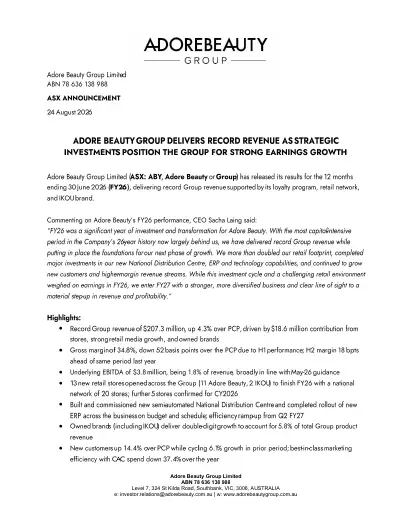
Our FY 2026 result highlights include: record revenues of $207.3 million, up 4.3% over the prior year; in-store revenue of almost $19 million, reflecting the expansion of our national retail network and omnichannel customer momentum. New customers increased over 14% to almost 419,000, while active customers grew 2.6% to nearly 500—860,000 customers.
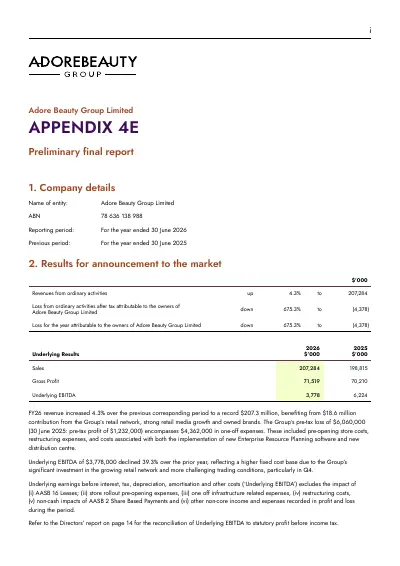
Gross margins at 34.8% were down 52 basis points over the prior year; pleasingly, up 134 basis points on FY 2024, in line with our long-term strategic plan. An underlying EBITDA of $3.8 million was at a margin of 1.8%.
Turning to our key achievements on slide 3. FY 2026 marked the largest period of growth investment in the group's 26-year history.
We opened 13 new retail stores across Adore Beauty and ikoo, taking our national network to 20 stores. We also secured locations for a further 5 stores opening in the first half of FY 2027, in line with our strategic plan set out in November '24 to have 25 stores across the group by the end of FY 2027.
Alongside the store roll-out, we built and commissioned our new semi-automated National Distribution Centre and completed the rollout of our new ERP platform. Both projects were delivered on budget and on schedule, with the efficiency benefits expected to begin flowing through FY 2027.
We also delivered strong new customer growth while significantly reducing customer acquisition costs. While the expected earnings benefit from our omnichannel growth strategy is not evident in our FY 2026 result, we are very pleased with our progress to date, with key positive indicators including store-led contributions from new customer growth up 14.4% and a 37.4% decline in customer acquisition costs to $35 per customer.
With omnichannel customers generating a lifetime value 2.5 times greater than online-only customers, and with a further 5 stores planned to open in FY 2027, we remain confident that our omnichannel growth strategy will translate into improved earnings as our store network continues to mature over the next 18 to 24 months. High-margin own brands continue to grow, contributing 5.8% of group product revenue, and retail media delivered another strong performance.
We materially strengthened the foundations of our ikoo business with investment in the brand, in infrastructure, customer experience, and data analytics. The successful execution of our strategic plans in FY 2026 provides a solid foundation from which to grow revenue and profitability as our store network and operating infrastructure mature.
On slide 4, slide 4 demonstrates the changing composition of our revenue and earnings as we progress our strategic pivot to omnichannel retailing. We delivered record revenue of $207.3 million despite challenging retail conditions, and we're particularly pleased with the composition of this growth, with strong performance from our expanding retail network and strong contributions from our high-margin own brands and retail media.
Gross profit margin was 34.8%, down 52 basis points over the prior year, primarily reflecting increased promotional activity in the first half. Pleasingly, we saw margin stabilize in the second half, finishing 18 basis points ahead of the prior year corresponding period, benefiting from increased contributions from our high-margin own brands, growth in retail media, and of course, our growing store network.
Of note, gross profit margin lifted significantly against FY 2024, up 134 basis points, in line with our long-term strategic goal. Underlying EBITDA declined 39% to $3.8 million, and this reflects the higher fixed cost base associated with our still-maturing store network and investment in capabilities required to support our omnichannel strategy.
With most of our retail network still in its early maturity curve, we expect a greater financial contribution from retail stores in FY 2027 and beyond. I will now hand over to Kylie to take you through our key financial results.
Kylie Archer
Thank you, Sacha, and good morning, everyone. Turning to slide 6, being the group financial statement, the first thing I do just want to quickly touch on here is the change in how we're reporting profit compared to FY 2025.
Consistent with our approach at the half year, and due to our growing retail footprint and the requirements of AASB 16, from FY 2026, we've commenced reporting EBITDA on an underlying and pre-AASB 16 basis. This measure takes account of rental costs, and we feel it best reflects the underlying performance of the business.
Moving now onto the financial results, and whilst Sacha has already touched on the key aspects of the headline results for the year, it's worth calling out the substantial improvement in marketing efficiencies. We see for FY 2026 a significant reduction in marketing and advertising costs, declining 22.8% over the prior year, to finish at 8.8% of sales.
This is 316 basis points lower than the prior corresponding period. This was achieved despite continued investments in brand awareness and customer acquisitions, and reflects both ongoing refinements to our data-driven customer acquisition strategies and our strategic pivot to omnichannel retailing.
In parallel with these targeted marketing efficiencies, we also remained focused on operational costs more generally, having completed throughout FY 2026 a head office restructure, an ERP system rollout, commissioning of our new semi-automated National Distribution Centre, as well as AI implementation across the business and a new freight partnership with Team Global Express. Together, these initiatives are expected to deliver significant cost and productivity benefits over the year ahead.
Turning now to our balance sheet on slide 7. FY 2026 has represented the most significant investment cycle in Adore's 26-year history, with investment across our growing store network, new National Distribution Centre, and supporting operational infrastructure.
The group closed the year with cash balance of $0.7 million and net debt of $9.3 million. In June, we successfully refinanced our debt facilities with our long-standing banking partner CBA under a new three-year agreement, increasing our working capital facility and establishing an asset-backed facility supporting the new distribution centre.
At 30th of June, we had $14.4 million of undrawn facilities available, providing a significant level of liquidity headroom as we enter FY 2027. Inventories remained tightly managed at $23.2 million, despite the addition of 13 new stores carrying close to $5.3 million of stock at year-end.
We're now nearing the end of this major investment cycle, with the infrastructure and funding capacity in place to support the group going forward. I'm happy to take questions at the end of the presentation, but for now, I'll hand back to Sacha.
Sacha Laing
Thanks, Kylie, and great to have you with us here today.
Kylie Archer
Turning
Sacha Laing
now in detail to Adore Beauty business specifically. Expanding Adore Beauty retail network is supporting a more cost-effective customer growth, while helping us deliver a more engaged and valuable customer base.
Stores accounted for 26% of total new customers in FY 2026, compared to just 3% in the prior year, helping us to offset our deliberate reduction in lower-value customer cohorts. Our loyalty program is also increasing customer value.
Loyalty revenue increased 18.7% to $151.8 million, with loyalty members accounting for 81% of total product revenue, up from 70% in the prior year. Together, stores and loyalty are helping us acquire customers more efficiently, strengthen engagement, and improve the quality of group revenue.
Moving to slide 10. Our national Adore Beauty network now comprises 14 stores and remains in its infancy, with more than half of our network less than a year old and only 5 stores trading for the full 12 months.
Adore Beauty store revenue increased 40% from the first half to the second half to $8.8 million, and attracted 1.4 million customer visits during the year, with strong in-store conversion at 15%. Importantly, omnichannel customers have a lifetime value 2.5 times higher than customers shopping through a single channel.
Omnichannel revenue increased from 5.1% of product revenue in the first half to 11.9% in the second half, making up almost 10% of total revenue for the year. We've secured leases for a further 5 Adore Beauty stores opening in the first half of FY 2027, including, most excitingly, a national flagship store in Melbourne's CBD.
Slide 11 demonstrates the improvement in our store performance as the network and our retail capability mature. In-store conversion increased from 13.1% in the first half to 17.4% in the second half, a 420 basis points improvement and comfortably above our 13% success benchmark.
We are also seeing emerging online halo across new store catchments, particularly in markets where the Adore Beauty customer base had previously had very low penetration. Omnichannel customers spent 52% more than online-only customers during FY 2026, reinforcing the opportunity to increase share of wallet as more customers shop across both channels.
Broadway in the State of New South Wales is currently our best performing store, while Western Australia, Queensland, and South Australia are outperforming our Victorian stores, which obviously has a much higher penetration of existing Adore customers. The Adore Beauty retail channel delivered an underlying EBITDA loss of $1.1 million in FY 2026, with more than half of that network less than a year old.
However, as stores move towards operational maturity over the next 18 to 24 months, we expect a higher contribution from stores to group earnings. Importantly, we do not expect the store network to represent a material impact on group profitability in FY 2027.
Moving to slide 12. While our retail network is gaining momentum, continuing to grow and enhance the online business remains an absolute priority.
Active Adore Society members increased 22% to 538,000, supporting average order frequency and value growth. Customer acquisition costs declined to $37 compared to $57 in FY 2025, demonstrating the increasing efficiency of our acquisition strategy.
Mobile app revenue increased 21% and now represents 36% of all online sales and 34% of product sales. We continued to refine our brand portfolio, launching 16 new brands, including Dolce & Gabbana Beauty, KILIAN Paris, Prada, and Miu Miu, alongside a significant expansion of our Korean beauty range, with now over 20 K-beauty brands in our portfolio.
We also deployed proprietary AI across customer-facing and internal channels: Ask Aura, our online AI agent, is improving product recommendations and customer engagement on-site; Abbie, our customer service AI agent, is supporting customer service and answering over 40% of total customer queries today; and Dora, our internal AI platform, is enhancing internal analytics and reporting. Through our partnership with Google, as a launch partner for the ANZ region, Adore launched agentic retail in Australia, enabling customers to purchase directly from Adore Beauty within Google Search, including AI Mode and the Gemini app.
Turning to a new National Distribution Centre in Broadmeadows in Victoria. The transition to a semi-automated 6,000 square—6,300-square-meter facility is now complete, with the efficiency ramp-up commencing from the second quarter of FY 2027.
The NDC combines leading-edge robotics and technology and provides more than seven years of capacity to support our future growth ambitions. With its automated picking and replenishment capabilities, we are anticipating approximately $2 million in labor efficiencies while materially increasing our dispatch capability and speed.
The $8 million investment is split across both FY 2026 and the early part of FY 2027, and is largely funded through a project-backed facility from the CBA, and we expect to achieve a payback within four years of the centre being operational. Slide 14 brings together Adore's broader efficiency initiatives delivered across marketing, inventory, and operations.
A more targeted customer acquisition strategy supported growth in new customers, despite an almost 30% reduction in marketing spend and continued investment in brand marketing. Marketing return on ad spend increased to 14 times compared to 9 times in the prior corresponding period.
Inventory closed at $23 million, including approximately $5 million held across the 13 new stores that we opened during the year. On a like-for-like basis, excluding these new stores, inventory was back 11.3% on the prior period, as the team diligently manage our inventory levels, and we saw stockturn increase up to 6.9 times, from 5.9 times last year.
Operationally, the new ERP is improving planning and productivity, while the reshaped head office team is expected to deliver more than $2 million—$2.5 million in annualized cost efficiencies, along with greater, broader omnichannel organizational capability. These benefits will be complemented by our new freight partnership, revised shipping revenue thresholds, and the broader use of AI across the entire organization, all playing a significant role in keeping the cost of doing business under control as we scale.
Moving to the Blue Mountains and our ikoo business. ikoo delivered double-digit revenue growth in FY 2026, with stores, online, and wholesale all contributing to growth during the year.
During the year, we opened new stores in Berry and Sorrento. The Berry store is particularly significant as it includes ikoo's first in-house day spa treatment facility, building on our legacy in wellness and to capture greater share of wallet from existing customers.
The retail network now comprises 6 stores across New South Wales and Victoria, with a seventh store currently under construction in Hobart and scheduled to open in September this year. Active customers increased 49% to 35,000 customers, reflecting both the expansion of the store network and improved brand awareness.
Stores accounted for 45% of new customers, up from 20% in the prior year, highlighting the growing role of physical retail in customer acquisition. Over the year ahead, ikoo will launch its first loyalty program just now in September, and a new digital wholesale platform in Q2, supporting customer engagement and further growth across its retail, online, and wholesale channels.
Slide 17 highlights the investments made during the year to strengthen ikoo's operating capability and to support its next phase of growth. In FY 2026, completed the rollout of a new e-commerce and point-of-sale platform in both of those two channels, launched a customer-facing AI shopping agent on-site, and fully integrated ikoo into Adore Beauty's data and analytics infrastructure.
We also strengthened the leadership team with the appointment of a dedicated managing director, established a formal customer service capability, and completed a full packaging refresh, which will be progressively rolled out through FY 2027. Taken together, these initiatives have significantly strengthened the ikoo brand, customer, and operational foundations, and position us well to scale in the years ahead.
On to group outlook. We expect revenue growth and the benefits of investments completed this year to drive significant improvement in underlying profitability over the years ahead.
Revenue and margin growth will be supported by continued momentum in our online business, an increasing contribution from higher-value omnichannel customers, and the maturation of our existing 20 stores. Finally, on slide 20, we summarize our step from this year's $3.8 million to our current target of $9 to $13 million in EBITDA, with revenue growth of at least 10%.
Omnichannel customers expected to drive online revenue growth as the contribution from this higher-value cohort continues to increase. 4 new Adore Beauty stores and 1 new ikoo store will open in the first half, taking our national network to 25 stores across both brands.
The completed infrastructure investments are expected to deliver significant operational efficiencies across the business. FY 2026 was a year of significant investment and operational progress.
With our omnichannel strategy gaining momentum and the key infrastructure required to support growth now in place, we enter FY 2027 with confidence in our ability to deliver a material step-up in revenue and profitability. I'll now hand back to the operator to open the call for questions.
Operator
Thank you. If you would like to ask a question via the phone, you need to press the star key followed by the number 1 on your telephone keypad.
If you would like to cancel your request, please press star 2. If you are using a speakerphone, please pick up the handset to ask your question.
If you would like to ask a question via the webcast, please type your question into the Ask a Question box and click Submit. Your first question from the phone today comes from Leo Armati from Bell Potter Securities.
Please go ahead.
Leo Armati
Good morning, Sacha and Kylie. Just wanted to start just on that record revenue for you guys, just with the retail store network only partially contributing, about $18.6 million of that print.
Can you just give us an idea of how much of that is ikoo versus the Adore banner?
Sacha Laing
We break that down in the Adore section of the presentation, Leo. The Adore stores made up around $15 million of that 18.
Leo Armati
Great. Then just on private label, you just spoke to ikoo, but that double-digit growth and the seventh store that's going to open outside of New South Wales, Victoria shows pretty good momentum.
I just want to know what the long-term vision of the brand is, maybe in terms of footprint, if it can rival Adore, and considering that you flagged that partnership for an entrance into Asia in FY 2027.
Sacha Laing
Two very different businesses from a customer perspective. ikoo, very much based in wellness and the ikoo brand translates to rest, restore, and relax by origin.
We'll continue to look for locations, and we have several targeted in locations where customers do go to holiday. If you look at the locations that we're in today, like Byron Bay, like Berry, like Sorrento, like Leura in the Blue Mountains, where people go and spend their weekends relaxing, restoring.
We will continue to seek out locations very much in the same vein as those existing stores, hence why we're opening our next store in Hobart, which is obviously a key tourist destination where customers do go to spend some time away and to restore. The ikoo brand is very much anchored in wellness, with skincare being a primary part of that and the rituals of skincare, how they lean into the rituals of relaxing with our home fragrance and bath products.
Very much a different proposition to Adore, which finds its stores located in high-traffic shopping centre locations around the country. We absolutely have aspirations for the ikoo business beyond the ANZ region, and this year we will continue to develop and explore partnerships into Asia, and we'll talk a little bit more about that at the half-year results.
Leo Armati
Great, great. Just on customer acquisition cost, obviously, a 37% reduction is quite good when you're growing new customers at the same time.
Just give us an idea of the change in marketing mix or the targeted approach. I presume stores are quite a large part of that, but any color would be great.
Sacha Laing
If we look at both businesses, and I'll just talk about Adore given that's the material component of that marketing spend, 26% of new customer acquisition came through the store network. We're seeing a significant and meaningful portion of those customers now shopping online and then shopping back in stores again, truly becoming omni in the way that they're engaging with the brand.
Pleasingly, the only way we know who those customers are is because they've joined our loyalty program. As we start to see them benefit from the rewards of that loyalty program and redeeming the benefits of that program both in-store and online, their frequency continues to improve.
What that enables us to do is obviously focus on acquisition both through stores and online and lower those acquisition costs online. Historically, the only channel that the business had to acquire new customers was obviously digitally, and digital acquisition at the top of the marketing funnel can be quite expensive as you seek quite broad audiences, and clearly when a customer's in-store, you can describe them as a customer with intent or interest in beauty, and therefore we find those customers immediately become more valuable.
As they shop from stores into online, particularly, we see their increasing mix of skincare being a much higher proportion of their basket, and that's a key focus for us as skincare is what sets us apart in market.
Leo Armati
Great, thanks for the color. That's all from me, Sacha.
Sacha Laing
Thanks, Leo.
Operator
Thank you. Once again, if you would like to ask a question via the phone, please press star 1 and wait for your name to be announced.
There are no other phone questions at this time. We will now pause a moment before addressing webcast questions.
Your first webcast question today reads: "Can you talk about the individual stores that have worked really well, and why, and some that haven't worked so well?"
Sacha Laing
Thanks for the question, Mark. I think what I'll what I'll talk to there is the journey that we've had since opening our first store in in Southland in February last year through to today, as we opened our 15th store just recently in Hurstville here in New South Wales.
When we opened our first store in Southland, Victoria, we opened with 60 brands in that store. We didn't have a treatment space, and and maturity operationally was obviously at the very early stages.
As we opened our most recent store in Hurstville in New South Wales, in the Westfield Centre there, close to 140 brands in that in that store, almost more than double the number of brands that we introduced initially in Southland, a dedicated treatment space, dermal therapists permanently on staff. That's now the case in in 14 of our 15 stores outside of Southland, where our typical product assortment is is around 120 to 140 brands, a treatment space, dedicated private treatment space in every store, dermal therapists on staff, a very strong skincare and pro-hair, professional hair mix from a product perspective.
When when I'm answering that question around what's worked individually or not, it's more been about the progression as we've gone through the store rollout, and we've provided customers with, a greater elevation, particularly in skincare and pro-hair. That's really where our learnings have been, and what customers are looking for when they're coming into store has been advice, service, and consultation.
We've significantly invested energy in in improving our experience in store for customers in that area. Individually, I won't comment on stores that have out-traded or under-traded.
I think we've talked to our non-traditional markets outside of Victoria seeing significantly higher acquisition of new customers. That's not surprising; that's been pleasing, and that was certainly what we hoped to achieve by opening stores in those markets.
We're continuing to consider other store opportunities as we move forward. There was a a further question there on, is 25 stores, the extent to which we will we will cap the network or will we continue to open more stores?
We're very much still in the in the early stages of our store strategy, and with 4 more Adore stores opening in this quarter—sorry, in this half, one of those already being opened, as I mentioned, in in New South Wales. We will continue to consider the the opportunity for more stores as we move forward, but we've certainly got a long runway of benefit to come from the the 15 stores that we've already opened and the 4 stores that we're we're soon to open—sorry, the 3 further stores that we're soon to open in this half.
Operator
Thank you. Your next question reads: "What was LFL online sales and retail sales respectively?"
Sacha Laing
We haven't broken those out specifically, and we won't be breaking them out specifically. Our view is that we're creating an omnichannel ecosystem where customers are shopping both the online channel and the store channel, and conversely and inversely.
What we will continue to share with you is the growth of that omnichannel customer as a contribution to total revenue, how those customers are adding value on a lifetime basis across all of our channels. Certainly wouldn't consider them as individual businesses, as they are very much integrated in the way that our customer transacts through the two channels.
Operator
Thank you. Your next question asks: "You mention a return on ad spend of 14 times.
How much of that is online, or is that number elevated because of an increasing share of sales offline? Doesn't that number and its magnitude point to operating leverage from the pure online model?
With an EBITDA of under 2%, where does the board actually see operating leverage? Where is the return on invested capital coming from in the next 12 months?"
Sacha Laing
Thanks, Nick. I'll start just on that first question around the ROAS of 14 times, and that is online only.
We don't attribute any of the revenue in the store network against marketing spend from a return on investment in the digital channel. I hope that answers that.
Hope that answers that question. The question's just disappeared off my screen, if the moderator wouldn't mind just bring that question back up, please, I can answer the other components.
Otherwise, we might move on to another question and just come back to your question, Nick, once I can see the rest of that. Oh, there it is there now.
In terms of the operating leverage across the business more broadly, again, a little like what I touched on from the earlier question, what we're looking to achieve with our omnichannel model is to create an omnichannel ecosystem where customers are shopping across both channels. They're doing that on a frequency basis that's improving as a consequence of our loyalty program.
We're seeing all of the positive trends and signs that that's working across the network. Again, we're not looking at individual channels and assessing the performance of those channels on their own; we're understanding how our customer is engaging with us across both channels and how those channels are interacting.
In terms of operating leverage, really it's about scaling the business, and scale comes from both the fixed cost base obviously that we've now seen lift as a consequence of our investments over the last 18 months, an increased store network, the National Distribution Centre. We continue to look for revenue growth in the way that our customers are engaging with us across multiple channels, hence our revenue targets for FY 2027 of greater than 10%.
That's really where the operating leverage comes from as the business scales.
Operator
Thank you. Your next question asks: "How does your FY 2027 EBITDA translate to free cash flow and NPAT?"
Sacha Laing
Kylie, would you like to comment on that? I'm happy to jump in.
Kylie Archer
Yeah. I guess it's quite a broad question.
Obviously the underlying results was 3.8. In terms of how that relates to cash flows, obviously been significant investment in capital spend through the year, being our biggest year of investment across the business.
Sacha, sorry, feel free to add to that.
Sacha Laing
No, the only thing I'd add to that, because obviously EBITDA does translate to free cash flow and NPAT just by the very nature of its definition. I think a further question from Ron Sharma just commented on "When do you expect net debt to peak?"
As we've suggested, net debt will peak in the first half of FY 2027 as we complete that sort of final phase of the current investment cycle in stores and the NDC in this particular quarter, and then we will see net debt step back as we move into half two.
Operator
Thank you. Your next question asks: "At the current share price, do you consider yourself vulnerable to a takeover by someone with deeper pockets to continue in the group's expansion?"
Sacha Laing
I'll probably answer that question not so much in the context of a takeover, because that's a question for shareholders and existing investors. What I would comment on is that our current working capital relationship with the CBA, the asset-backed facility that we put in place to support the NDC, and the current future stores that we've already got planned to open, our expansion isn't being limited by, as the question sort of indicates, deeper pockets.
We'd certainly like to see the share price move materially in the context of what we think is a very solid plan moving forward. I won't comment on the next price around historic offers against the business.
Operator
Thank you. Your next question then says: "Cash closed the year at $0.7 million, and the accounts include an ongoing concern note."
Pardon me, that question just disappeared.
Sacha Laing
I saw that too.
Kylie Archer
I don't think there's a going concern note. I think the going concern is always something that we assess each year as part of the accounting process.
I wouldn't say there's a going concern over the business.
Sacha Laing
I'd probably just summarize that question from that particular person just in terms of the forward confidence. We have today reaffirmed that we believe our assumptions leaning into our FY 2027 targets of revenue growth greater than 10% and EBITDA guidance of 9 to 13% remain sound.
We've commented on those targets being set in the context of a backdrop of what is a more challenging retail climate at the moment, but certainly a number of the initiatives that underpin our FY 2027 targets were put in place through FY 2026 and, might I say, successfully put in place. We're feeling really confident about the foundations that we've established in terms of omnichannel capability, in terms of operational leverage and scale through the efficiencies of the NDC, the head office team, and the ERP platform that we now have live across the business.
I'd probably summarize those last few questions just in the interest of time around what has been a very strong year of delivery in terms of foundational investment in the group. We're seeing very strong lead indicators from the way that customers are behaving across the omnichannel network, and we've commented on omnichannel revenue making up 11.9% of total revenue in the second half, and a 2.5 times more larger LTV from that customer cohort that will continue with momentum.
We're seeing that already into FY 2027. The board remains confident in our targets as set out, and we believe that we've done so with the appropriate consideration for the backdrop of what's happening more broadly economically.
Operator
Thank you. As there are no further questions at this time, I'll now hand back to Mr.
Laing for any closing remarks.
Sacha Laing
Thanks very much. I'd like to thank everybody for joining us today.
The FY 2026 year was the most significant year in Adore Beauty's 26-year history from an investment perspective. We've reshaped the business as an omnichannel retailer.
It gives us great confidence going into FY 2027 that we've got the right operating indicators showing strong trends through customer acquisition, store conversion, omnichannel penetration, marketing efficiency, gross margin gains, and our large major infrastructure investments are now complete. That combination gives us a clear line of sight to a material improvement in revenue and profitability in FY 2027, and I thank everybody for joining the call today.
Operator
That does conclude our conference for today. Thank you for participating.
You may now disconnect.