Macquarie Group, Ltd.
Q2 FY2027 · Earnings Call TranscriptNovember 5, 2026
Sam Dobson
Good morning everyone and welcome to Macquarie's first half 2027 results. Before we begin, I would like to acknowledge the traditional custodians of this land, the Gadigal of the Eora Nation, and pay our respects to elders past, present, and emerging.
For everyone present in the room, I would ask that you turn your phones to silent, please. Today, as is customary, you'll hear from our CEO Shemara Wikramanayake, our CEO designate Greg Ward, and our CFO Frank Kwok.
Before I do hand over to Shemara, given that it is her last day as CEO, I would like to, on behalf of our shareholders, thank and congratulate Shemara on her tenure as CEO, and obviously her tenure at Macquarie, culminating in today's record first half result. With that, I'll hand over to you, Shemara.
Thank you.
Shemara Wikramanayake
Okay. Thanks very much, Sam, and welcome to everyone from me as well.
As usual, we'll start by just reflecting on the mix of businesses and central service areas we have. You can see there the four businesses that we have that give us very good diversification and resilience across them and are structurally well positioned for medium-term growth.
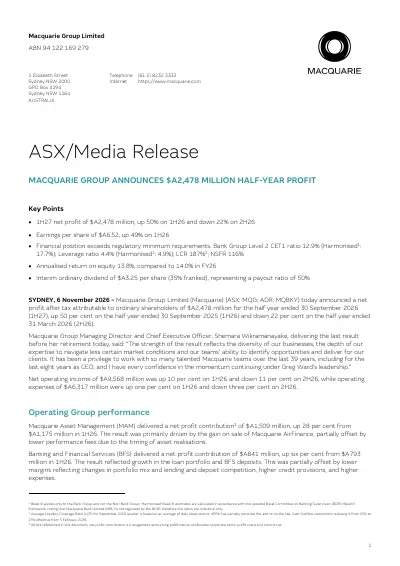
We show you the mix of annuity style and market-facing income, and in this half, we have had a slightly bigger weighting to the market-facing because of the Macquarie AirFinance realization in Macquarie Asset Management. With that, turning to this half result, you'll have seen we announced a result of $2.478 billion.
That was up 50% on the first half last year, the PCP. That was because of some one-offs that happened in this half plus things in the previous half.
We had good revenue growth with costs fairly flat and delivered an ROE of 13.8%. The only other thing I'd note on this page is our tax rate was lower than our typical range at 22.5%, and that was because of the composition and the nature of income with some realizations we had.
Now looking at the contribution by each of our businesses, the net profit contribution from the operating groups was up 23%, and three of the groups were up on the prior comparable period and one down. Macquarie Asset Management had an increase in the previous result, principally through that Macquarie AirFinance realization that I mentioned, and we had lower performance fees, but that's really the lumpiness and timing of realizations.
Banking and Financial Services continued its ongoing steady growth across all aspects of its business. We had some margin pressure from the mix in our portfolio and changing.
Also a couple of other things I'd note is that we kept investing, our expenses stepped up because of that, and our credit provisions as well. Frank will take you through in more detail the ECL went up because of our modeled adjustments.
Macquarie Capital was down on the prior comparable period, and we did have a really strong first half last year. I think it was our strongest since '07 or '08, Michael, but the big factor there is the timing of realizations of the equity investments, which again are lumpy, and last year we had a few plus a lot of market activity.
This year, less on this front, weighted to the second half the result. CGM, a good result in that we had good contribution from all three divisions in CGM, so that was up quite a bit.
Looking at the geographic diversification, as you see, we still have good diversification across all regions, with outside of Australia the contribution still being over 60% of our income. The Americas was down a bit this year, and that was because of the exit of our public investments in Macquarie Asset Management.
Turning then to the operating groups, starting with Macquarie Asset Management, and as usual, all the leaders of our operating groups and our central service groups are here in the front row with us, together with Stuart Green, CEO of Macquarie Bank, and Glenn Stevens, our chair. Macquarie Asset Management, as you can see, the result of $1.509 billion was up 28% on the prior comparable period.
Big driver there was the Macquarie AirFinance realization. Now we're showing our assets under management here by the four sectors that they're in, and you can see the assets under management are up 3% to just over $742 billion.
We're also following market practice now and in the private markets showing the fee-paying assets under management, which at just on $530 billion are up 6%. Some things to note in this result is it was a very good period of raising at $15.3 billion.
We also had over $19 billion of capital returned to investors, a strong period of realization while the sector environment is more challenging. We had some targeted investments of just over $17 billion.
The public investments also had net inflows of over $16 billion, and that was helped by the Spire acquisition, the CLO business. Turning then to Banking and Financial Services, up 6% at $840 million, and this is the business that under Greg's leadership has continued every year to deliver solid growth in results and will continue no doubt under Ben Perham, who's just taking over at midnight tonight, a minute after midnight, he's corrected, but has been with BFS a long time through this steady, strong delivery.
As I said, up across everything, I saw in the APRA stats that we had grown at five times system in terms of home loan portfolio and three times system in deposits. You can see a good pickup there in our home loans, where we're at I think now 7.6%, up 1% in terms of market share, but also growth in our business banking book, our funds on platform, and our deposits, where we raised about another $23 billion of deposits this year.
All of this helped a lot by our very high Net Promoter Score, and I think our client numbers are up 300,000 over this year. Ongoing continuation of the trajectory of BFS with a very long runway to keep going.
Commodities and Global Markets at just over $2 billion there, $2.034 billion, up 83%. Now we did have quite a weak prior comparable first half.
Simon, I think Liberation Day and things had impacts on the prior comparable period, but still a very strong result from CGM and pleasingly spread really well across all three divisions. For the first time, commodities, which had a good step-up, is only 49% of CGM's income.
That has been helped by the fact that in financial markets, we had strong performance and good increase in contribution from activity in financing, in FX, in futures, and in equities, and also in the asset finance business, we had a very strong period, where we particularly had gains from asset sales in technology and energy investments there. The book grew if you take out the Onstream meters, which went out in this quarter, by 30%.
Again, investment in technology and shipping drove that. A great contribution from CGM in the first half.
Then Macquarie Capital, the result of $278 million, it was down 61% on the prior comparable half, but that was because, as I was just noting with Michael, a very strong first half M&A activity, strong, and realizations. This half, the private credit book continued to grow, we're just over $28 billion, but we didn't have the level of prepayments that we had in the first half last year, so that's made a difference half on half.
Also the M&A activity, while global peers have had a very strong first half in markets like the Americas, Europe, we're much more focused in the Australasian market, where activity wasn't as buoyant. The main contributor is the timing of realizations of our equity positions, where we realize at the best time to get best return for the investment.
In the periods where we're not having big realizations, we have the funding costs and the equity accounted losses, etc. We've guided that this would be a year of second half realizations principally.
With that, let me just turn to capital and funding. We on funding continue to have our term funding comfortably exceeding our term assets, and Frank will give you more detail on this.
Our deposits are at $244 billion, just over, with $23 billion raised in this period, which is impressive, and our term funding that we've raised, similar to the prior comparable period, is about $16 billion. On capital, the main thing to note there is our Basel III Level 2 CET1 ratio is at 12.9%, which is a very solid level, and in terms of capital movements, we've had this earnings of roughly $2.5 billion, as I said, a record in the first half, offset by the dividend for the full year last year of a billion and some investment in our businesses.
The main areas where we invested, if you look to the right-hand side of that chart, is BFS continued to absorb capital as it grew its business. Also, in Macquarie Capital, we continue to make small, $300 million, investment in what we think are very attractive digital opportunities principally.
In CGM, the net number is flat. We did grow our credit books, but that was offset by the capital released in the first quarter from the Onstream meters.
Our regulatory ratios sit well above the Basel III minimums. The last thing I was going to do is just mention the board for this half has declared a dividend of $3.25, 35% franked.
That represents a 50% payout ratio. I'll be handing over now to Frank to take you through the results in more detail, and then Greg will cover the outlook.
Before I hand over, I just wanted to note, because as Sam said, this will be my last set of results, that I wanted to say a thank you to analysts and investors who are with us today, but also have been following us for many years, even going before my 8 years as CEO. We have, as you see, a diverse and unique mix of businesses, which we think gives us very good resilience across the businesses and really good opportunity to respond to a whole lot of circumstances, but it makes us more complex for all of you to look at.
We really appreciate the support and the commitment you've given in terms of getting across this in so much detail, the insights, the challenges you've provided over the years. Our team have done a great job sending me out on a record first half result, but having worked here for more than the 8 years and more than many of your lifetimes, I have to say I know it's hard work delivering this stuff.
Nothing is a given. It's great.
The external world keeps changing, our people respond, their culture is amazing. I'm not taking for granted what needs to be done from here, but I am going to say that I do think not just our amazing businesses, but our team should position us well to deliver.
As part of that, Greg stepping up to be our CEO, the seventh, I think, Greg, that we've ever had. We had two joint CEOs, and then Greg will become the fifth of us after that.
I think Greg is bringing a whole lot of things that we need for the next chapter in terms of his experience with technology, operating platforms across our business, dealing with stakeholders like regulators, governance bodies, etc., but also having been CFO for a long time before he with the team built our BFS business, really understands what we're doing in the world and not just funding capital, but the entrepreneurialism and the businesses. I am excited to see what the team can deliver.
I have been right there with you all for 39 years, never sold a share, very much believe in the business, and confident I'll continue to see great returns. With that, I'll hand over to you, Frank.
Frank Kwok
Thanks, Shemara. Before I start, I'd like to take the opportunity to thank you for being an extraordinary leader of our business.
From a personal note, we've worked together ever since I started 30 years ago from within the Macquarie Capital days, Macquarie Asset Management, and to the role I have today. Thank you for that amazing support and guidance you've given me throughout my career.
I could not have asked for a better mentor. Now just moving to our first half results in a bit more detail, we're going to start with the consolidated income statement.
As Shemara said, the group delivered a net profit after tax of $2.478 billion, up 50% on the first half last year. As outlined by Shemara, this equates to a 13.8% return on equity.
Group net operating income increased 10% to $9.6 billion, and you can see the drivers of this increase on the slide. Net interest and trading income is up 26% to 7 to $5.7 billion.
What we've seen is in CGM, we've seen higher income across all three business divisions with strong client activity in risk management, growth in the financing volumes, and higher inventory management and trading income driven by oil trading. In BFS, we've continued to see growth in the loan and deposits portfolio.
Fee and commissions income decreased 29% to $2.8 billion. This reflects lower base fees in MAM following the sale of our public investments business in North America and Europe, lower performance fees, which was really due to the timing of asset divestments, and lower M&A fees in Macquarie Capital, which had a strong first half last year.
These were partially offset by stronger fees and brokerage income from increased equities and futures activity. Net investment and other income increased substantially to $1.2 billion, comprising primarily of the gain on the previously announced sale of Macquarie AirFinance, higher gains on sales in assets in CGM, asset finance in the first quarter, and lower impairments and expenditure on green investments in corporate.
We've taken net and other credit impairment charges of $220 million in the first half, reflecting a small number of specific credits in CGM, together with the impact of movements in our modeled credit provisions, particularly in BFS, which has been driven by a change in the macro outlook for the Australian market. Our actual credit performance continues to be very resilient, but given the uncertainty in the current environment, we think our credit charge, which follows the $461 million charge we took in the second half last year, to be appropriate.
Turning to costs, operating expenses increased marginally by 1% to $6.3 billion. This was primarily a function of higher profit share due to the operating performance of the group.
We continue to see the impact of cost management discipline, while we proactively invest in our technology platforms and people. Income tax expense is $730 million, resulting in an effective tax rate of 22.5%.
This rate's a consequence of the composition and geographical makeup of our operating income. Now turning to the operating groups and starting with Macquarie Asset Management, MAM delivered a net profit contribution of $1.51 billion, up 28%.
The principal driver was higher investment income, primarily from the sales of Macquarie AirFinance and Aligned Data Centers, which both closed this half. Performance fees decreased on the PCP, primarily due to the timing of asset realizations.
Current period performance fees included contributions from MIP III, MIP IV, and MEIF 2. Excluding FX movements, base fees increased, reflecting investments and positive inflows and the acquisition of Spire Partners, a European-based CLO manager.
As you're aware, we closed the sale of our North American and European public investments business last year, you'll see the impact on net profit contribution on the slide. In terms of assets under management, it increased 3% during the half to $743 billion, comprising $347 billion in real assets, $248 billion in credit and insurance, $120 billion in solutions, and $27 billion in real estate.
Over the period, we saw good inflows, investments, and positive valuation movements, which were partly offset by the capital return to investors, which Shemara referred to, and also adverse FX movements. Now turning to BFS, where we continue to see strong growth across our core portfolios, noting the more challenging backdrop we have here in Australia.
Net profit contribution increased to $841 million, up 6%. Personal banking profit contribution increased by $154 million.
This increase has been driven by growth in average home loan volumes of 26% in the last 12 months and average deposit growth of 27%, which has been partially offset by margin compression. Business banking income increased by $40 million on the PCP, supported by 8% growth in average lending volumes and 7% growth in deposit volumes.
As we touched on earlier, BFS saw adverse movements in modeled credit provisions, which was driven by changes in our outlook for the Australian economy. BFS operating expenses are slightly higher, reflecting wage inflation, increased headcount, and our continued investment in technology.
This investment is critical to the ongoing success of our digital banking platform, allowing us to support business growth. Importantly, the cost to income ratio in BFS continues to decline.
It's now at 50.1% compared to 51% at the full year. We continue to see strong volume growth across all of our core products in BFS.
Home loan balances have now reached $198 billion, representing 7.6% of market share, with growth in the half at five times system. Similarly, deposits increased to $236 billion, representing 6.9% market share and three times system growth.
You can also see that business banking loans increased by over a billion to $19.2 billion. Now turning to CGM, CGM delivered a strong, broad-based result of $2.03 billion with increased contributions from all three divisions.
Commodities income increased by $420 million to $1.8 billion. This increase has been driven by higher client-led risk management activity, especially in global gas and power and resources, and increased lending and financing activity across all of our energy sectors.
These results were supported by higher inventory management and trading income, primarily due to the elevated volatility in oil driven by the ongoing conflict in the Middle East. Financial markets continue to grow with its net profit contribution up by $169 million, reflecting increased contribution from financing origination with the book increasing by just over $2 billion over the half, as well as strong client and trading activity in equities products.
Asset finance delivered growth with increased volumes in the shipping sector in particular, which is now at approximately $4 billion, offsetting the decrease in operating lease income following the sale of our Onstream meters business. Asset finance also delivered gains from asset sales in technology and energy sectors, which is reflected in a significant increase in investment and other income that you can see on the waterfall.
It's also worth noting that CGM's operating expenses, excluding brokerage costs, have decreased compared to the first half last year, primarily due to the non-recurrence of transaction-related expenses. CGM continues to demonstrate its resilience and diversification with underlying client growth across both commodities and financial markets.
These businesses remain client-led, and our teams have been focused on expanding our offering to attract new clients while strengthening existing client relationships. As we've previously noted, we're continuing to see strong repeat client business with over 80% of client revenue generated from existing relationships.
This growth in client activity is the main driver of the increasing regulatory capital requirement for CGM. This is reflected in the graph on the bottom right, where you can see that credit risk capital is driving our capital usage.
Our market risk capital remains in line with historical levels. Finally, turning to Macquarie Capital, Macquarie Capital delivered a net profit contribution of $278 million, down significantly on a strong first half last year.
Investment-related income decreased $344 million due to reduced realizations across the equity portfolio, which really reflects their timing, and lower prepayment income from our private credit portfolio. Excluding that prepayment income, net interest income from our private credit portfolio increased, reflecting growth in the book.
Fee and commissions income decreased by about $100 million, driven by a decrease in M&A activity following a strong first half last year, and this was partially offset by stronger brokerage performance, especially in Asia, where revenues increased 20%, benefiting from stronger inflows and elevated market volatility. Our capital usage in Macquarie Capital was $6.5 billion for the half, a slight increase from the full year.
Just under a half of that capital is to our $28 billion private credit book. The book remains highly diversified with just under 200 positions across industry sectors characterized by strong operating cash flows and defensive or structurally attractive risk profiles.
The portfolio continues to perform well, delivering margins of over 400 bps. As you can see on the pie chart, approximately a quarter of our exposure by capital is in software.
Over the period, there continues to be no visible impact on portfolio quality from AI disruption or uncertainty in the macroeconomic environment. Turning to the broader platform, you can see on this slide our regulatory compliance and technology spend.
We continue to invest significantly in regulatory compliance with over $600 million of spend in the half. This was slightly lower than PCP, reflecting a reduction in project and change expenditure as several major initiatives near completion following sustained investment to evolve our operating platform and deliver more scalable compliance capabilities.
Our technology investment of $1.17 billion remains a significant component of our cost base and is a key strategic focus area across the group. We will continue to invest to support our scalable growth, strengthen risk management and controls, and enhance client service and operating efficiency.
In terms of our funding profile, we continue to diversify across product, currency, and tenor, with a weighted average life of term funding at 4.1 years. The growth in our deposit book continues to be very strong, allowing us to grow our BFS business.
Deposits grew by 10% in the last 6 months to $244 billion, with 87% of the deposit base from savings, transactions, and offset accounts. Deposits are a key high-quality funding source for the bank and now represent over 50% of the funded balance sheet.
Our loan portfolio is now at $273 billion, which is up 8% from the full year, primarily driven by growth in that home loan book. In terms of our equity investments, they're now at $11.6 billion, down $1.4 billion from the full year.
This reflects the sale of the Macquarie AirFinance business and a significant reduction in our green energy exposure in corporate, which is now at approximately $200 million following the sale of our European solar platform, Cero. We've provided on this slide an outline of our key regulatory matters.
I note that we reported a breach of our prudential obligations related to the capital treatment of MGL's structural interest rate risk hedging. The capital treatment has now been corrected and we've applied a $100 million overlay.
These have been incorporated in the numbers presented today. Our capital position remains strong with our CET1 ratio at Level 2 at 12.9% and a harmonized rate of 17.7%.
Our liquidity position remains strong. We remain comfortable maintaining LCR above regulatory requirements, especially in the current environment.
Finally, to capital management, our businesses continue to find opportunities to generate good returns and we supported this by allocating additional capital. With the current uncertainty in the macroeconomic environment, it's important that we continue to have the balance sheet to withstand this uncertainty, but also to support our businesses to pursue opportunities that the current environment with heightened volatility may provide.
With this context, as Shemara has outlined, the board has declared a dividend of $3.25 for the half with 35% franking and has resolved to continue the dividend reinvestment plan with a discount of 1.5% with shares being issued to satisfy that DRP. Also, as we previously noted, APRA has released changes to prudential standards to phase out hybrid instruments as eligible capital, which is effective 1 January next year.
Given the requirement to hold additional CET1 capital with respect to the Macquarie Bank Capital Notes 2, or BCN2s, we intend to resell all these notes at par to a nominated purchaser, followed by the proposed exchange of all or some of those notes for Macquarie Group shares. On that note, I'll hand over to Greg to take you through the short and medium-term outlook for the group.
Greg Ward
Thanks very much, Frank. It's been a really good pleasure working with you over the last couple of months as it has with our leadership team.
We've got an incredible leadership team, as Shemara said, at Macquarie, and we're very, very lucky. I'm really appreciative of this role and the opportunity that the board and Glenn Stevens, our chair, has given me, and the support from Shemara.
I want to congratulate Shemara on yet another amazing result, and every one of your results has been amazing, and it's going to be a tough act to follow, and a tremendous tenure as CEO and a wonderful career. We'll have lots of opportunities later today to celebrate I will continue the celebrations.
We've had lots of celebrations overseas. My job today is a really small one, just to present the outlook, and I'll have an opportunity to talk to you in a lot more detail in February next year at our operational briefing.
Just see if I can get this working. There it is.
As usual, I'll start with the factors impacting our short-term outlook for each group. In MAM, our base fees are expected to be broadly in line, excluding the '26 contribution from the public investments business in North America and Europe, and we continue to expect net operating income to be up, with the outcome subject to the timing of asset realizations.
In BFS, we're continuing to see good growth across loans, deposits, and platforms, subject of course to market conditions and customer activity, and that continues the trend we've seen over the last decade. Market dynamics and portfolio mix are expected to continue to drive slightly lower margins there.
In Macquarie Capital, you can see, subject to market conditions, we're expecting transaction activity and investment-related income to be down compared to last year. In CGM, again subject to market conditions, we're expecting net operating income to be slightly up, excluding the impact of Onstream meters divestment, which was in 2026, and so, in other words, you can't just double the result for the first half.
We also note volatility may create opportunities across the platform. At the corporate level, we're expecting the compensation ratio and the effective tax rate to be broadly in line with historic trends.
At the group level, there are a normal range of factors that can influence the short-term outlook, and these include the global economic conditions, inflation, and interest rates, significant volatility, and geopolitical events, as well as the completion of period-end reviews and transactions. Of course, our results can be affected by the geographic mix of income, foreign exchange movements, and potential tax or regulatory changes and uncertainties.
As a result of all that, we continue to maintain a cautious stance and a conservative approach to capital, funding, liquidity, as you heard from Frank. Our medium-term factors, they are consistent with previous periods, and probably have been unchanged for a long, long time.
If we look across our businesses over the medium term, they are as well placed as they've ever been to capitalize on all the trends we see across the world. I'll hand back to you now.
Thanks, Sam.
Sam Dobson
Great. Thanks, Greg.
We'll start in the room, and then we'll go to the line. I'll start with John.
Just at the front here. Thanks.
Jon Mott
Thank you. Jon Mott from Barrenjoey and on behalf of myself and I think pretty much all the analysts in the room, congratulations on a great career.
You've been very supportive of us as well and the whole team, well done. My question could be on commodities.
It was a very good Commodities and Global Markets, I should say. It's been a very good result and very diverse, more so than we've seen in a long time.
We usually hear about the gas business, but it looks like oil in particular has had a good time, other commodities, probably resources have had a good time as well, as well as the markets and across the board. Can you give us more flavor on is it just clients more active given the volatility that's going through the system at the moment, people want to hedge given the commodities exposure, or are you thinking you're winning share, especially in oil, given just the size of that market?
Shemara Wikramanayake
Frank Frank, I'll comment first and hand over to you or Simon if you have anything to add. Basically there was a lot of activity in this first half and particularly not just in energy, but in technology.
The asset finance business had a very strong half. We had realizations and gains on sale of assets, and I think in that page 25 of the pack, Frank, you showed how much the gain on investments, etc., was, and you can see that's a material hundreds of millions number.
Then we did also because of the activity, and you mentioned there oil particularly, but we did have far more activity. Last first half, as I said, we had the Liberation Day impacts, but underlying, CGM is all about growing franchise, to your question.
We are happily growing customer numbers in all of our business lines. We grew our asset finance book, we've grown customers in financial markets and in commodities.
We are managing to gradually grow our share, but we've benefited in this half from one-off benefits both through the tech, digital sector in asset finance and across the business, and then in the energy sector in CGM. I don't know if I should comment, but I was going to say as we look forward, we've just had the midterms, Brent crude's off a lot, the market is hoping for a more subdued environment both in the digital space and in the energy space, and if data center rollouts slow, that will not just impact technology, but also energy and metals as well.
We'll have to see what happens, but really our focus is on that underlying franchise growth. As we've given guidance for the second half, we're expecting standard, ongoing growth in franchise.
Sam Dobson
I'll just go to Matt behind you. Thanks, John.
Matthew Dunger
Thank you very much for your ongoing engagement and very thoughtful messaging, Shemara. If I could ask on the regulatory side, APRA's review of non-operating holding companies, we saw the very small capital penalty today, but just wondering if you could make any comments around if this signals the direction of travel for capital, what reversal of the NOHC could cost you, and if there's any costs associated with the latest small capital penalty?
Shemara Wikramanayake
I'll let Frank elaborate, but basically we had self-imposed that penalty and APRA will work with us in reviewing the work we do in terms of that coming off. As you say, it was a small penalty and tiny compared to our capital levels, but we are working constructively with APRA.
I think the AT1 changes will probably be more material for all of us in terms of capital, but we will work constructively with the regulator and continue to target appropriate returns for all our business, having regard to the amount of capital required for them. Frank, do you want to give more detail on that?
Frank Kwok
In relation to NOHC review, that's been planned for a number of years and so that will happen as outlined by APRA, it's something that we will work constructively with APRA on. As in relation to the capital overlay, that was self-imposed in relation to governance and specifically in relation to the Macquarie Group, nothing to do with the bank, it's actually with respect to the group, and how we treated our interest rate structural hedging there.
As I said, it's $100 million over a capital base on the bank side of over $12 billion, not much, but is obviously something which APRA today endorsed.
Matthew Dunger
Right, can I just follow up on the cost of regulatory programs? You'd noted, Frank, that some of those are starting to wind up, and can that continue to come down given recent scrutiny?
Frank Kwok
Look, we have uplift programs across the organization, and we've shown a lot of progress, for example, on our liquidity uplift, where APRA in the last 12 months reduced NCO overlay from 25% to 15%. We obviously would like to see that go to zero, and so there's ongoing work there.
Specifically on capital as well, we're going through the capital uplift program, working very collaboratively with APRA to ensure that we've got the systems to ensure that we can report appropriately, and hopefully, over time, we can reduce that. Would expect spend to continue, but it's obviously important not just for the regulatory outcomes, but also for the operating efficiency across the platform.
Shemara Wikramanayake
Briefly without dropping Greg in it, I think the background Greg brings in terms of technology, efficient operating platforms will benefit us across the business, not just in terms of the regulatory processes we're going through, CGM's costs you saw slightly down. We're on a program that's been going for multiple years of updating with technology, data, etc., to drive more efficiency in our operating platform.
That's got time to go, and Greg, don't want to drop you in it, but that'll be an area of focus.
Greg Ward
No, look, that's right. I think you've overseen for many years now a lot of foundational work in and our data and platforms, and this is incredibly important because I think the requirements of APRA are extensive and not going down.
We've seen a lot of deregulation overseas that hasn't been the case in Australia. In fact, it's probably been the opposite.
Lots of businesses have talked about the regulatory burden and the compliance burden and so forth, and that's what we see. It's very important that we get things right, of course, as a regulated NOHC and bank, and this particular case was obviously unintentional and the rules are complicated and nuanced, and this was something that was an interpretation that had been there for some time and not visible to us and not visible to the regulator.
We think it's an isolated matter and a small matter, but it just does highlight to us the importance of continuing investment to make sure that we get everything right.
Sam Dobson
Thanks, we'll go to Andrew Triggs first in the second row. Thanks.
Andrew Triggs
Andrew Triggs from J.P. Morgan.
Just adding my congratulations, Shemara, for a fantastic career at Macquarie. If I'm just looking at guidance, perhaps for Greg or members of the ExCo, there is a reasonable amount of step-up required or in performance fees and MacCap realization activity in the second half to achieve guidance.
Perhaps provide a little bit of color on market conditions in those two markets and the degree of confidence in achieving that?
Greg Ward
Yeah. Look, I think in Macquarie Capital, I think the first half was a very quiet period in terms of realizations.
In fact, there was no significant realizations, and that's not from failed transactions or things that didn't happen that we were disappointed by. It was just the timing of when to take things to market.
Things are taking longer, and we hadn't really taken things to market. Now that the North American summer period is over, there's a number of transactions in market and we're getting good feedback on a number of these assets, and these are very good assets, and we feel a reasonable degree of confidence about material gains there in line with expectations.
I just would highlight that, of course, it's a very uncertain environment, particularly well, here it's uncertain, but certainly uncertain in America and other parts of the world, and so transaction timing is hard to forecast. Having regard to that, that's why we've sort of made our forecast.
The underlying business in terms of our M&A franchise is tremendously busy. We've just been around the world and met with the teams and a number of clients as we have in Australia, and I think if anything, we don't have enough staff.
We're that busy, but of course transaction completion is the thing that we can't control there. The franchise even in the US is extraordinary.
The level of M&A income in the 6 months is as big as Australia in the 6 months. There's reason for great optimism there, and of course the private credit portfolio is in tremendous shape.
We've deployed more capital there over the last 6 months. As we look at the credit watch list, it's the lowest it's ever been, looking at Andrew, the lowest certainly in the dataset that I've seen.
I think lots of optimism in terms of that, but the transactions are lumpy, it will depend on completion. We're optimistic that a lot of those will complete in this 6 months, but that's subject to risk.
I think in terms of MAM, I don't know whether, Frank, you want to add to In asset management,
Frank Kwok
obviously it's the same environment, but I'd note that this half we continue to book performance fees for MIP III, MIP IV, and MEIF 2. They have assets which are still to be realized.
Obviously, still subject to the timing of those. Because they're already in performance fee territory, we'd expect them to generate performance fees, as we've obviously made guidance in terms of the timing, but if asset realizations do move around, that might change some of the timing.
We're obviously confident in the portfolio that we have, and the teams will realize the assets when they think it's going to be the best for the LPs in those funds, and so we'll obviously have to see where that occurs in the half, but those funds are obviously already in performance fee territory.
Shemara Wikramanayake
I'd reinforce what you were saying, Frank, is we realize those assets at the time when we can get the best return for the investment. We'd always said for Macquarie Capital it would be second half weighted.
We've got processes underway, they're quite advanced, aren't they, Michael? We'll see if the market's not conducive, we can hold on for a while because across the whole business it's not make or break.
Then in MAM, then we've got limited realizations which are well advanced as well, and MAM I think is not as second half weighted. It's a bit more BAU.
Sam Dobson
Richard?
Richard Wiles
Good morning. Just like to ask a question about BFS.
You talked about the cost to income ratio at 50%. How long do you think it'll be till you have a lower cost to income ratio than any of the major banks?
What sort of market share do you think you need to achieve that lower cost to income ratio? You also mentioned technology spend continuing within the group.
Does that mean the cost growth is going to go up in BFS or this is just a continuation of the path that you've been on?
Shemara Wikramanayake
I'll hand over to either Greg and/or Ben to respond to that, but I don't think, Greg, CTI is the biggest focus for us. It's continuing to grow the franchises at good returns and invest to do that.
Greg Ward
That's right. I think the overall cost to income is probably a little misleading compared to the major banks because it has a very large platform business, which is not normally the case, well, not the case at all with the big banks other than the investment that CBA has, and I'm sure they don't consolidate it, it wouldn't appear in their cost to income.
That's the highest cost to revenue business, and in that part of the business, because we have such scale already at that sort of 21% market share, we're very focused on lowering the cost to revenue in that part of the business. As Shemara says, in the personal bank and the business bank, we are in growth mode, and so we're investing for growth.
That's a good place to be because it's working, and we can see in those parts of the businesses, particularly in the personal bank, our cost to revenue keeps coming down and we think it's really competitive compared to the major banks, and we'll only get even better as we get even more scale. I think that's a pretty wonderful place to be.
Richard Wiles
The spending, the cost growth, is that just a continuation of the trend you've been on or do you actually think cost growth in BFS goes up from here?
Greg Ward
I think what we'll see overall is the cost to revenue go down, I think that's what you're seeing now. You'll see the cost to revenue go down as the work in the platform on the actual in tech side of the platform continues.
You'll see that cost to revenue go down, and I think with scale and the other investments we're making, you'll see the cost to revenue go down in the personal bank and the business bank. If the costs are going up, that means the revenue is going up even more, and I think we'd be happy with that.
Sam Dobson
We've got Ed behind you. Thanks, Richard.
Ed Henning
Thanks. Ed Henning from CLSA.
Just pass on my congratulations as well. Just a couple on CGM.
Can you just clarify a little bit about the guidance first off? You talked about standard growth in the franchise.
You also talked about a weakening outlook. Are you assuming weakening volatility into the second half and no cold snap with El Niño as the first one?
Second part of it is, can you just touch on the asset finance business and you're willing to continue to invest capital into that business and continue the really strong growth there? Then the last one, just on the costs in CGM was flat in the half.
Can you just talk about the cost outlook for CGM for the existing business and how we should think about that as well, please?
Shemara Wikramanayake
We don't make assumptions on volatility, the guidance that we've given, which is slightly up, is assuming ongoing franchise growth from where we are. We have said here that volatility may create opportunities and that's always the case, but at this point, none of us are in a position to call whether cold snaps in Europe that you refer to will cause TTF surges and give us opportunity, etc.
We're just assuming underlying franchise growth for now. We are seeing an environment where the markets were off last night, they think tech activity could come off, as well as energy markets with the Iran war.
We're ultimately growing franchise and will respond if the markets do anything like that. That impacts the asset finance business as well.
They, as I mentioned, had material gains in this first half from investment, principally in digital assets, data centers. Their book is down a lot at the moment, we've realized a lot of the positions we've got.
We're not positioned to respond as much if the environment picks up, but also quite resilient if there's issues there. Then in terms of costs, as Greg mentioned as well, we are investing in that platform, but are actually getting cost efficiency.
You saw it was really in MAM, where Ben and the team are really growing into new channels and products, and in BFS, where we've invested in expenses, but in CGM and Macquarie Capital, we've been getting some efficiencies.
Frank Kwok
I think just on costs for CGM, in the first half last year, we had some transaction-related costs,
Shemara Wikramanayake
and so
Frank Kwok
obviously that hasn't repeated, which is why the cost base for CGM slightly decreased. That was the main driver.
Effectively, costs have remained flat, and to Shemara's point, we're continuing to invest in the platform, especially across CGM.
Sam Dobson
Right, we'll go to Brian. Yep, and then I'll go to you, Andrei, next.
Brian Johnson
Congratulations, Shemara. Just like to come back to something, I suppose, that is a little bit of a surprise.
If we look at slide 37, you're talking about the BCN2 note?
Shemara Wikramanayake
Right, yeah.
Brian Johnson
Macquarie always says that you've got surplus capital, there's been a lot of perhaps scurrilous debate in some of the media about whether you do or not, but I'd just like, Frank, can we get a little bit more detail on this conversion into ordinary shares? How big is it?
What dollar value are we talking? Are we talking about fresh ordinary shares on issue that dilute long-suffering shareholders' returns?
Frank Kwok
Sure. As I noted, APRA has changed the rules in relation to CET1 by removing AT1, we actually have to increase our CET1 by 25 bps in the bank.
Based on our risk-weighted assets, that's about $450 million. Our BCN2 has a face value of just over $600 million, and that has a call date at the end of December.
In response to the requirement to hold additional CET1 capital in the bank, we have a bank note out there which could be converted. What effectively happens is that those noteholders will still receive their $100 and we'll have a nominated purchaser who will take those shares and put them into the market.
Really it is just a reaction, a response to the increased capital requirements which APRA has imposed on the entire industry given the removal of AT1s. It's just over $600 million.
Brian Johnson
Frank, can I just go back, I suppose, to the messaging, you've got what, $10 billion in surplus capital, which you would think would be more than enough to actually satisfy that requirement. Could we just get issuing DRP stock today again, and we see you converting this, it seems a little bit of a contradictory signal.
Frank Kwok
No, I think broadly, we have surplus capital above regulatory minimums, as you said, just over $9 billion, and so that's relatively consistent where we've been. I think from a capital position, we want to make sure that we continue to support our businesses in their growth, and you continue to see growth across the businesses, BFS in particular, Macquarie Capital, and CGM, once you take out the realizations as well.
We want to make sure we've got the capital to do so. I think given the regulatory change which has been imposed on us and the industry, we thought it was appropriate with respect to the BCN2s, which happen to have a call date before the end of the year.
On 1 January, we have to actually have that additional capital requirement, actually it was quite good symmetry in relation to kind of using that as the basis to effectively have the capital to meet that regulatory requirement.
Brian Johnson
Thank you.
Sam Dobson
We can go to Andrei in the back corner, please.
Andrei Stadnik
Good morning. Andrei Stadnik from Royal Bank of Canada.
Congratulations, Shemara, on a terrific run. Can I ask one question?
Can I ask around private credit? Just in terms of the appetite to grow private credit in all sorts of forms and vehicles across the group, because it seems Macquarie Capital has been growing that, but just curious about your appetite to continue to grow that, whereas in MAM, it seems like private credit assets under management have been a little bit stagnant.
How are you thinking about that and how is the collaboration between Macquarie Asset Management and MacCap going in terms of delivering more private credit solutions?
Shemara Wikramanayake
Yeah. Our first foray into private credit has been in Macquarie Capital with the team there going back a dozen years at least.
We've had really solid track record there. Our loss ratio is 0.3%.
It's a very diversified book, as you've seen, and we've been growing that gradually. The main constraint there is concentration in terms of our overall portfolio and our overall balance sheet, we've been slowing the rate of growth more recently.
They're $28 billion now in an almost $3 trillion market today, they're able really to pick the eyes out of very, very good credits in sectors where they see opportunity, pivoting a bit more to Europe now, Michael, I think, as we see much greater competition in the Americas, in the US particularly. We have appetite to grow that book with the balance sheet and as they find good risk return.
The bigger growth, as you said, is Ben and the team in MAM have started working now with the private credit team to take that senior secured, mid-market direct lending to investors as well. Ben, we're having very good success in terms of raising funds.
Initially, it's a long period. Even though their track record is phenomenal, they're seen as a first fund as we go out to fiduciary market.
The first fund's now pretty much hitting their requirements, Ben, in North America and Europe. Gradually after that, we'll do seconds and thirds.
Certainly MAM is committed to growing in the private credit space, and this is one of the important strings to the bow where we have capability. Equally, the asset finance capabilities that are inside CGM, etc., we'll look to bring to fiduciary investors, as well as the strategies MAM has in MAM itself.
Does that cover it, Andrei? Okay.
Thanks.
Sam Dobson
All right, we'll go to the lines. We've got a couple of questions online, but before we do, for those joining online, if you haven't already joined the live audio queue, please do so now by pressing Request to Speak at the top of the broadcast, and if you're asking a question via phone, please use the dial-in number and access PIN provided followed by the hash.
We can go to the lines, please.
Operator
Thank you. Our first question today comes from Matthew Wilson from Jarden.
Matthew, please go ahead.
Matthew Wilson
Good morning, Matthew Wilson, Jarden. Also echo the market's congratulations today, Shemara, on a superb tenure at Macquarie Bank, fantastic innings.
Two questions, if I may. Firstly, in BFS, $77 million uplift in provisions, mainly coming from an uplift of about 30% in the ECL provisions for home loans, which is a tad surprising given the nature of your book.
Can you sort of give us more color on how you see the macro outlook changing? You seem more consistent with what we saw at NAB and very different to what was sort of projected by Westpac on Monday.
That's the first question. Then secondly, if we could tease out a little bit more the review of the NOHC structure.
Obviously, there's been a major bank out there that's been particularly public. Does this end their concerns, or does this confirm them?
Shemara Wikramanayake
Frank, do you want to go first on the first question on the ECL?
Frank Kwok
Sure. I can't speak for others in terms of what their concerns are.
All I can say is that with respect to how we measure our capital, as we've talked about before, in the period, we reported a breach in relation to what we had done for the capital treatment in relation to our structural interest rate hedging in the non-bank, and we put a self-imposed $100 million governance overlay and that seems to have been accepted by APRA. I really can't
Shemara Wikramanayake
I think he's talking about the ECL modeled in terms of the outlook for the home loans, where our economist Ricky is here with us, and we have views on the Australian economy that may be different to other banks.
Frank Kwok
On the first question in relation to ECL, yes, we have taken an additional charge, really reflecting our view of the Australian macroeconomic environment and potential impact on house prices. Obviously, the quality of our book remains very strong, especially when compared to our peers, we're comfortable with the level that we've taken, but we think we're being prudent, given things that we're seeing across the broader market at the moment.
Operator
Thank you. Our next question comes from Brendan Sproules from Goldman Sachs.
Brendan, please go ahead.
Brendan Sproules
Hi, good morning. Brendan Sproules from Goldman Sachs and again I'd like to congratulate Shemara on what I thought is a fantastic career and particularly the support you provided to us analysts over the journey.
Look, my question relates to BFS. We've seen quite an increase in net interest income relative to the last half, in fact it looks like that it grew faster than spot lending.
Could you maybe contrast the NIM change that you saw in this half relative to maybe the March period?
Shemara Wikramanayake
Greg, do you want to? NIM change.
I
Greg Ward
think yeah, I can handle that one. I thought my CFO might have the NIM one covered, but anyway.
Luckily I'm a former CFO, I know how NIMs work.
Shemara Wikramanayake
Sorry, you're not moving out of your job until midnight tonight, you're BFS, still in the hot seat.
Greg Ward
Yeah. No, we've been really pleased with the NIM performance half on half, and I think that's because we've done well in the business bank, which has a slightly higher NIM, and so we had good growth in the business bank.
I think also on the deposit side, we made a couple of little tweaks to our deposit pricing, which helped with the deposit NIM. Obviously also there's been some rises in interest rates, and we have sadly only a small amount of non-interest-bearing deposits, but we obviously benefit from that as well.
We don't get the big benefit that the larger banks get on the deposit side with a very large portfolios of non-interest-bearing deposits.
Brendan Sproules
A second question just around CGM, and just the outlook for what is the Northern Hemisphere winter. Last winter, you had a very strong contribution from North America power and gas.
Obviously, we've seen a lot more volatility in gas prices in Europe. I was wondering if you can give us a view of how you see the differences in this coming winter versus what we saw 12 months ago.
Shemara Wikramanayake
I think as I said before, it's sadly very difficult to call. We can't sit here and say a weather event is going to happen.
We're in an El Niño year. Does that mean we have cold snaps in Europe?
The expectation is it's going to be a warm winter. All we can do when we give you our guidance is call how we see the franchise growing in each of the three divisions in CGM, and then say that volatility can create opportunities.
We've had certainly in my time as CEO, very, very varied winters every year. Some of them quite subdued, a couple of them really active, because we had one where North America had a lot of issues and we had the Russia-Ukraine, and then we've had much, much more subdued winters.
We're just assuming a normal second half with a little bit of franchise growth at this stage in our guidance. I'm not going to crystal ball weather.
Sadly, got no expertise.
Sam Dobson
Thanks Brendan, thanks Matt. Another one from Brian just in the middle there.
Thank you.
Brian Johnson
Greg, could I trouble you to put on that hat again? The intangible assets in the second half have gapped up quite a bit.
Is that the capitalized software in BFS? Then the second one, with that same hat on, if we look at the deposit changes that you put through, you put those through kind of halfway through the half, I think, from memory, I think it was late June.
Does that actually suggest that slowing housing business lending, perhaps slowing, but still stronger than housing, but you've got the full-period impact of the deposit pricing to come through? Is that kind of signaling that the NIM could actually now start to expand?
Shemara Wikramanayake
Sorry, just on the first one, it's not poor Greg's hat because it's the acquisition that we've done in MAM really that's driving intangible, we expense all our software and I'll let you talk to that.
Greg Ward
Expense all the software. Again, a difference to the major banks, we expense all the software.
It's what you said. We might get a bit more depending on how things go in the second half.
We might get a little bit more benefit from those deposit rate changes. The other thing, of course, is the credit growth is slowed appreciably, and so the need for deposit raising has slowed for us.
We're not pushing deposit growth much at all because we're so well funded, and so you see us hardly participate in the term deposit market, for example, and so we can turn more to deposit margin, I think, management going forward.
Sam Dobson
Okay. If there's no further questions, thank you all for your interest, and we look forward to catching up over the next few weeks.
Thank you very much.