AltaGas Ltd.
Q3 FY2026 · Earnings Call TranscriptOctober 29, 2026
Operator
Good morning, ladies and gentlemen. Thank you for standing by.
Welcome to the AltaGas third quarter 2026 financial results conference call. My name is Joanna, and I will be your operator for today's call.
All lines have been placed on mute to prevent any background noise. If you have any difficulties hearing the conference, please press star then zero for operator assistance at any time.
After the speakers' remarks, there will be a question-and-answer session. As a reminder, this conference call is being broadcast live on the internet and recorded.
I would now like to turn the conference call over to Aaron Swanson, Vice President, Investor Relations. Please go ahead, Mr.
Swanson.
Aaron Swanson
Good morning, and thank you for joining AltaGas' third quarter 2026 results conference call. This call is being webcast, and we encourage following along with the supporting slides that can be found on our website.
Speaking this morning will be Vern Yu, President and Chief Executive Officer, and Sean Brown, Executive Vice President and Chief Financial Officer. We're also joined by Randy Toone, President of Midstream; Corine Bushfield, President of Utilities; and Jon Morrison, Senior Vice President of Corporate Development and Investor Relations.
We will refer to forward-looking information on today's call. This information is subject to certain risks and uncertainties as outlined in the forward-looking information disclosure on slide 2 in the presentation.
Prepared remarks will be followed by a question-and-answer session. I'll now turn the call over to Vern.
Vern Yu
Thanks, Aaron, and good morning, everyone. I'll start by reviewing our Q3 results, provide an update on our construction progress at REEF and our other growth projects.
After that, we'll review the current state of global LPG markets. I'll then review recent regulatory outcomes at our utilities and wrap up by reviewing our 2026 strategic priorities.
Sean will cover our quarterly results, discuss our 2026 guidance, and close with an update on our leverage and capital plans. Let's start on slide 4.
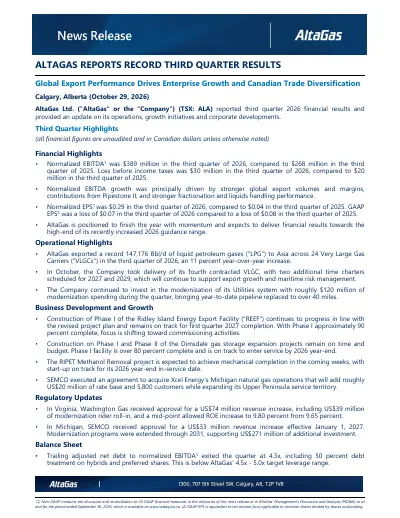
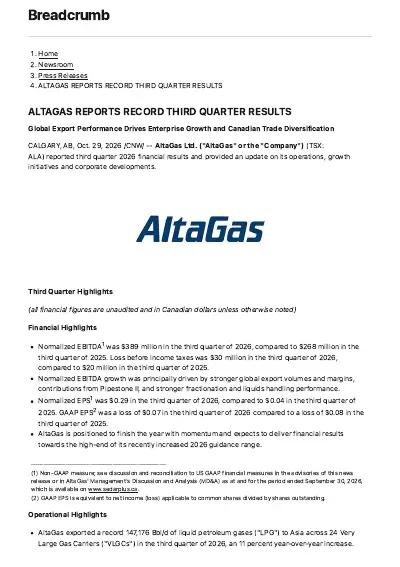
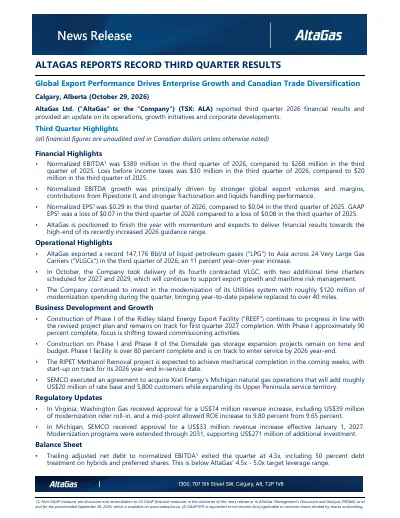
In Q3, we generated normalized EBITDA of $389 million, which is 45% higher than Q3 2025. In Q3, normalized EPS came in at 29 cents compared to 4 cents last year.
Our record third quarter results were driven by our midstream segment, which continues to benefit from strong operational performance and global LPG tailwinds. Based on our year-to-date performance and our outlook for Q4, we expect to be towards the high end of our recently increased 2026 guidance range for both EBITDA and EPS.
We exported a record 147,000 barrels per day of LPGs to Asia off the West Coast, loading 24 VLGCs. Midstream throughput continues to grow, with Montney processing up over 20% year-over-year, driven by the addition of Pipestone II and higher throughput at our Townsend facility.
We recently took delivery of our fourth VLGC time charter in Japan and have executed agreements for two more vessels, with deliveries anticipated in 2027 and 2029. These additional vessels mitigate us from uncertainties with global shipping rates.
In utilities, we finalized rate case settlements in Michigan and Virginia, which will add $68 million U.S. in revenues.
We're also expanding our footprint with an agreement to acquire roughly $20 million U.S. of rate base in Michigan's Upper Peninsula.
Let's turn to slide 5. In Prince Rupert, REEF continues to progress, with the highest-risk work now complete.
I'm happy to share that the project is now 90% complete and moving into commissioning. We remain on track for an in-service date in the first quarter of next year.
REEF Optimization I remains on schedule for an in-service date in the second half of 2027. We continue to advance the 60,000-barrel-a-day REEF Optimization II project, which we expect to FID before the end of this year.
Slide 6 highlights progress on the jetty. All of the piles and platforms have now been installed.
This means the most complex phase of the in-water construction has been completed. In September, we completed installation of the main loading platform and loading arms.
REEF's last major work stream is the installation of the VLGC mooring system. The suction anchors will be installed this quarter, with the balance of the mooring system scheduled to be completed in early 2027.
Mechanical completion of our Ridley methanol removal project is only weeks away, and commissioning is now 25% complete. The project will enhance our propane specs, and it'll all be done by year-end.
We continue to make good progress on our Dimsdale storage expansions. Once complete, these expansions will add 36 Bcf of natural gas storage in the Alberta Montney.
The pipeline for Phase 1 expansion has now been finished, and the Phase 1 facilities are more than 80% complete, which puts us on track for a Q4 2026 in-service date. For Phase 2, the facility is 40% complete, and the drilling program is now over 50% complete, with the wells expected to be done in early 2027.
Turning to slide 8, I want to provide an update on the conflict in the Middle East and its impact on the global LPG market. LPG export volumes through the Strait of Hormuz remain more than 70% below pre-conflict levels, with less than one ship exiting the strait each day.
Since the disruption began, we estimate that more than 240 million barrels of LPG supply has been lost. This has resulted in very high Asian LPG prices, with recent pricing approaching peak pricing.
As the situation drags on, we've seen a significant increase in long-term export spreads. For the second half of 2027, export spreads have increased by more than $5 per barrel compared to three months ago.
The conflict has also driven spot shipping rates to triple since early 2026. While shipping rates are expected to stabilize in 2027, subject to Middle East supply returning to normal, our tolling contracts and our time charters isolate AltaGas from these abnormally high shipping rates.
Finally, the disruption in Middle Eastern supply has highlighted the value of Canadian LPG exports, with global buyers placing a premium on security and reliability. Slide 9 highlights why we are bullish on LPG supply growth in Western Canada.
As Canada expands its access to global energy markets, we're seeing major LNG and crude oil pipeline projects advancing. Driven by LNG projects and growing in-basin demand, Canadian gas supply is positioned to grow over 35%, or 8 Bcf a day, by 2035.
We anticipate much of this growth will be in the liquids-rich Montney. This, in turn, will drive higher LPG supply.
We estimate that 8 Bcf per day of gas will add about 280,000 barrels per day of propane and butane, and all of these barrels will need to be exported to premium markets in Asia. In addition to natural gas egress, nearly 1 million barrels a day of sanctioned crude oil expansion projects are slated to come online by 2029.
The crude oil outlook is even stronger if we include unsanctioned projects, which would add a further 2.4 million barrels per day of crude oil egress. This growth will be filled by oil sands production, increasing domestic demand for both gas and condensate, further supporting LPG supply growth in the basin.
Slide 10 shows how we plan to connect this growing LPG supply to global markets. When REEF comes online, it will add 56,000 barrels a day of export capacity.
The dock, the rail loop, and utility corridor have been pre-built to accommodate REEF's ultimate capacity of 500,000 barrels per day. When REEF and Opti I and II are online, our global export capacity will grow by over 185,000 barrels a day to over 300,000 barrels per day by the end of this decade.
Additional crude and natural gas egress will drive even more LPG supply growth, creating additional phases of REEF expansion, which REEF can accommodate well into the 2030s. We are also excited about the long-term potential of ethane exports.
Here, we have the opportunity to connect the oversupplied Canadian ethane market with strong petrochemical demand in Asia. This capacity can be added to REEF, and we are currently targeting to have an initial 60,000 barrels per day of ethane export capacity online in the early 2030s.
Let's move over to our utilities. We've been very active with our regulatory filings, and we have recently had some constructive rate case outcomes, which ensures that we will make the appropriate returns on our rate base investments.
Across DC, Maryland, Michigan, and Virginia, we have received approval for $115 million U.S. of incremental revenue, with an average allowed ROE of 9.67% across these jurisdictions.
We also have $1 billion U.S. of approved modernization rate riders that provide predictable rate recovery that allows us to continue to make investments that enhance the safety and reliability of our systems.
Our utilities will continue to focus on maintaining strong cost and capital discipline to support customer affordability. We will also continue to file regular rate cases to ensure inflation and non-modernization capital investments do not result in material ROE lag.
Finally, I'll close on slide 12 with the progress we've made on our 2026 priorities. We continue to deliver on our strategic priorities by growing, de-risking, and strengthening the enterprise.
We're optimizing our assets by delivering record global export volumes, seeing higher throughputs across our midstream assets, and regularly filing rate cases in our utilities. At the same time, we're making great progress on our growth projects.
We've been very disciplined in how we allocate capital and we're only investing in the best projects. Taken together, we've extended our competitive advantages, improved the quality and visibility of our cash flows, while creating a long runway for industry-leading shareholder returns.
I'll now turn it over to Sean to walk through our results and outlook.
Sean Brown
Thanks, Vern, and good morning, everyone. As Vern noted, we are very pleased with our record third quarter performance, delivering normalized EBITDA of $389 million, a 45% increase over the third quarter of last year.
For today's call, I'll focus on our segmented financial results, discuss our balance sheet strength, 2026 outlook, and finish with our investment proposition. Turning to slide 13, our midstream business continues to exceed expectations, delivering $337 million of normalized EBITDA, an increase of 65% year-over-year.
Midstream performance was driven by the global exports platform, which delivered record export volumes and strong margins. From an operational perspective, we exported a record 147,000 barrels a day of LPGs across 24 VLGCs.
During the quarter, we shipped an average of 89,000 barrels a day at Ridley across 14 ships and 58,000 barrels a day across 10 ships at Ferndale. In total, export volume grew 11% year-over-year.
We also saw continued strength across the balance of our asset portfolio, with total volume growth of 12% led by our Montney assets. Plant utilizations remain strong, with notable year-over-year throughput increases of 11% in the gathering and processing segment and 40% within extraction, while the fractionation and liquids handling segment benefited from strong margins during the quarter.
Our strategic footprint in the liquids-rich Montney continues to drive performance, supported by strong producer activity and basin growth. In the Alberta Montney, extraction volumes at our Pipestone complex increased by nearly three times year-over-year, owing largely to the addition of Pipestone II.
The Pipestone complex had 94% utilization during the quarter as producers fill or exceed their take-or-pay commitments. In northeast BC, North Pine continues to operate near its 25,000-barrel-a-day frac capacity.
Across our system, underlying basin growth and constructive egress dynamics continue to reinforce the value of our midstream platform, while our expansion projects position us to support further growth. In terms of risk management, 91% of AltaGas' remaining 2026 global export volumes are either tolled or financially hedged, with an average FEI-to-North America spread of approximately US$23 per barrel on non-tolled volumes.
We've also substantially hedged all our 2026 Baltic freight exposure through a combination of time charters, financial instruments, and tolling arrangements, which has been positive on the back of the spike in freight costs. We continue to manage frac spread exposure and have 86% of expected volumes hedged at an average price of approximately US$24 per barrel.
Separately, we are managing through a labor strike at Trigon Pacific Terminals, which began on October 2nd. Trigon provides rail logistics and berthing services for Ridley.
To date, we have seen no material impact to our operations. Following a Canada Industrial Relations Board ruling over the past 48 hours, we now expect some impact in the coming period.
We are actively mitigating that impact and continue to expect results towards the upper end of our recently increased guidance ranges, including any potential financial impacts. Turning to utilities on slide 14, the segment delivered results consistent with expectations, typical of summer seasonality.
Normalized EBITDA of $66 million was relatively in line with the same quarter last year. A stronger contribution from asset modernization and asset optimization activity was largely offset by increased O&M and G&A costs, including the impact of a rising stock price on incentive plans.
During the quarter, we deployed approximately $370 million in the segment, including $120 million towards modernization programs, $30 million on new growth initiatives, and $220 million on system betterment programs. These investments are focused on delivering long-term safety and reliability while extending our network to serve our expanding customer base.
Additionally, the team continues to progress construction of the Keweenaw Connector pipeline, which now sits 85% complete and remains on budget and schedule for completion by year-end 2026. The pipeline will increase reliability for 14,000 SEMCO customers in Michigan's Upper Peninsula.
We also recently announced the acquisition of 5,800 customers and approximately US$20 million of rate base in Michigan's Upper Peninsula. This transaction marks an important milestone for SEMCO, expanding its service territory while reinforcing its commitment to delivering safe, reliable service to customers, with the transaction expected to close in the second half of 2027.
Lastly, on the regulatory front, the team was pleased to receive final orders for rate cases in Virginia and Michigan. In Virginia, WGL received approval for a total annual revenue increase of $74 million, including $39 million previously recovered through a rate rider and a 15-basis-point increase to the midpoint of the allowed ROE to 9.8%.
In Michigan, SEMCO received approval for an annual revenue increase of $33 million and an allowed ROE of 9.85%. The Michigan modernization programs were also extended through 2031, supporting $271 million of additional capital over the next five years.
We view these outcomes constructively. They will add $68 million to revenue next year and reflect the continued execution of our regulatory strategy.
For clarity, for the discussion around the rate case outcomes, all figures I noted are in U.S. dollars.
Looking ahead in utilities, our growth outlook remains strong. We continue to prioritize capital towards our accelerated pipe replacement programs and new customer connections, while we advance data centers and large-load industrial opportunities.
Finally, results in our corporate and other segment declined year-over-year, primarily reflecting higher employee incentive costs due to strong performance across the business and share price strength, while financial performance at Blythe was consistent with the same quarter last year. Turning to slide 15, we are pleased to be tracking towards the upper end of our recently increased 2026 guidance ranges of $2 to $2.1 billion in normalized EBITDA and $2.35 to $2.60 in normalized EPS, primarily reflecting sustained strength in the LPG export market.
Looking forward, we expect LPG spreads and margins to remain supportive. That being said, we are mindful of a few potential headwinds, including the potential impact from lower throughput volumes due to the Trigon strike, the impact an El Niño weather pattern could have at our utilities, and higher incentive costs linked to share price strength.
With that said, reflective of these factors, we still expect to land towards the upper end of our guidance ranges. From a capital perspective, there are no major changes to our outlook.
As shown on slide 16, we continue to expect capital investment of approximately $1.8 billion, with roughly a 60% allocation to utilities and the remainder to the midstream and corporate segments. As shown on slide 17, we exited the quarter with a trailing 12-month adjusted net debt-to-normalized EBITDA ratio of 4.3 times, including 50% debt treatment for preferred shares and hybrids, which is down meaningfully from year-end 2025 and modestly below our 4.5 to 5 times target leverage range.
On slide 18, we highlight AltaGas' established track record of delivering growth in EBITDA, earnings, and dividends, while driving meaningful per-share value creation, including an average annual TSR of 26% over the past five years. I want to conclude with our investment proposition, which is shown on slide 19.
AltaGas has a resilient, low-risk infrastructure platform that underpins stable and growing cash flows. The diversification of our business provides strong earnings visibility and capital allocation flexibility.
Our visible organic growth opportunities position us to grow earnings and cash flow per share, while maintaining financial flexibility and supporting sustainable dividend growth. With that, I'll turn the call back to the operator to begin the Q&A.
Operator
Thank you. Ladies and gentlemen, we will now conduct the analyst question-and-answer session.
If you would like to ask a question, press star then the number one on your telephone keypad. If you would like to withdraw your question, please press star then the number two.
There will be a brief pause while we compile the Q&A roster. First question comes from Rob Hope with Scotiabank.
Please go ahead.
Rob Hope
Morning, everyone. Can we maybe dive a little bit deeper into the Trigon impact, just given the recent ruling?
Is the expectation that you'll still be able to load ships during the work stoppage, or does the guidance assume that the strike continues for an extended period of time with limited volumes there?
Vern Yu
Hi, Rob. It's Vern here.
The strike at Trigon started October 2, and it's been ongoing for almost a month. We've been working very collaboratively with Trigon, where contingency plans were put into place that allowed us to effectively operate at planned throughputs.
About 48 hours ago, we got a ruling from the Canadian Industrial Relations Board that our mitigation actions needed to change. We're obviously very disappointed about this ruling because we don't believe that the ruling takes into account all case law in Canada.
We're going to vigorously take all legal actions we can to reverse its decision. In the interim, we're going to operate under modified mitigation plans, which will slow down our ability to load vessels at planned throughputs.
At this time, it's a little unclear on how much that's going to impact throughputs, but I think we've taken a relatively conservative view on that, and we'll have to see how that plays out. This gets to a bigger issue I think that the federal government's trying to deal with in its proposed Bill C-39, where labor actions are creating choke points for the Canadian economy, and we need to have a better method of how the government can help labor and companies deal with these actions.
Obviously, we're extremely disappointed about how a third-party service provider's labor disputes are impacting our throughput. We'll do everything we can to maximize the volumes that we can move through the system.
I think we've put in a fairly healthy contingency in our outlook.
Rob Hope
All right, appreciate that. Maybe taking a look still on global exports, but a little bit longer, can you maybe provide a little bit of incremental thought on how you're thinking about hedging 2027, just given the Trigon outage, the potential or the planned in-service of a couple facilities, as well as kind of where you're seeing what we'll characterize as attractive spreads, both on the LPG side as well as the transit side as well?
Vern Yu
Maybe I'll make one quick comment. These labor disputes have historically, they're relatively short-lived.
When you get to a one-month disruption, you're approaching the median. I think the worst-case scenario we've ever seen is a couple months.
We don't expect that this is going to impact 2027, but I'll pass it over to Sean to give you more color on how we're thinking about it in '27.
Sean Brown
Thanks, Vern, and thanks, Rob. Our approach to '27 hasn't really changed to what historically we have done.
At a very high level, we are about 60% tolled. As we get through the NGL bid season, our target is to be 80% tolled or financially hedged for the remainder of the year, and that won't change as we move into '27.
We think that is fundamental to the investment proposition here. If you start to think about '27, we actually have started to hedge some of that Q1 exposure in advance of that.
Curve remains heavily backwardated, but we are seeing liquidity into that Q1. As we sit here today, we're actually about 75% hedged and/or tolled for that Q1 period at what we would view as being relatively attractive rates.
In all, really no change in how we're going to approach our sort of tolling/hedging philosophy or practice as we move into '27 here.
Rob Hope
That's great. Thank you.
Operator
Thank you. Next question comes from Patrick Kenny with National Bank Capital Markets.
Please go ahead.
Patrick Kenny
Thank you. Good morning, guys.
Vern, wanted to get your thoughts on the change in government in BC, what this could mean for potentially flexing your capital plan in the province going forward, and any specific projects that you might be able to either rekindle or bring forward based on the new Premier's platform?
Vern Yu
Obviously, there's been a massive change in the political environment in BC, and we believe that's extremely constructive. I think the Premier designate has indicated that his government wants to double LNG by 2032, I think, and then triple it by 2035.
That's in line with kind of our house view on how we see natural gas ramping up, and obviously that provides a lot more liquids for us to export. Obviously, we talked about in the call script about how we expect more phases of REEF to follow Opti II.
This is also helpful towards our ethane project. Then finally, I think as we see more and more LNG demand, we might see an acceleration of our investments in northeast BC, both at North Pine and Townsend and our ability just to continue to add a phase of REEF every couple years post-Opti II.
It's extremely exciting.
Patrick Kenny
That's great. Then, I guess specific to LNG Canada 2, now officially on its way, but still a few years out, of course, in terms of coming online.
Can you just update us on how you're thinking about the cadence of adding that extra or incremental G&P capacity, frac capacity, storage, and other opportunities to support what you see in terms of both gas and NGL supply growth?
Vern Yu
We FID'd a Townsend debottlenecking earlier this year that will unlock a bunch of liquids at that facility. The LNG Canada producers are big customers for us up there, and I think that will accelerate the timing for when we see a North Pine expansion.
As you recall, we have the ability to effectively double our fractionation capacity up there given we have permits from both the First Nations and the BC provincial government. We're extremely excited about those prospects.
Patrick Kenny
Thanks for that. I'll turn it back.
Operator
Thank you. Next question from Sam Burwell with Jefferies.
Please go ahead.
Sam Burwell
Hey, guys. Just to follow up on the Trigon-related labor dispute, is there any ability for you guys to reroute LPG volumes down to Ferndale and kind of maintain the overall export cadence or help ameliorate the problem?
Randy Toone
Hi, Sam. It's Randy Toone here.
We are looking at potentially redirecting some of the rail and some of the VLGCs to Ferndale, but Ferndale is limited on how much capacity it can push out, it doesn't fully offset. We believe with a lower rate to Ridley, we'll still be able to get cargoes out there plus redirecting to Ferndale.
It's already reflected in our outlook.
Sam Burwell
Understood. Then maybe switching gears a little bit.
Saw the small acquisition that SEMCO made from Xcel. Could we anticipate more material acquisitions within Utes going forward or maybe even more broadly than that?
How would you guys characterize the M&A opportunity set across the whole business?
Vern Yu
I think we're excited to be able to acquire those customers from Xcel. We were able to do that on extremely attractive financial terms.
Generally, that's not something we're able to do in the utility space where assets are trading at high multiples to rate base, it was kind of an opportunistic situation. If we're able to acquire additional gas utility assets at a reasonable multiple to rate base, that's something we'll definitely pursue.
Then on the midstream side, we're always looking at opportunities, but anything we do needs to be on strategy, needs to be financially accretive, needs to be accretive to our long-term growth profile, and neutral to our credit ratings. Those opportunities are going to be difficult to execute, but we for sure look at everything that comes our way.
Sam Burwell
All righty, sounds good. Thank you.
Operator
Thank you. Next question from Maurice Choy with RBC Capital Markets.
Please go ahead.
Maurice Choy
Thank you, and good morning, everyone. Just wanted to start by continuing the discussion on the labor strikes at Trigon.
If this is not a short-lived event, are there actually force majeure clauses or other clauses that protect you and your ability to meet your contractual obligations?
Randy Toone
Hi, Maurice. It's Randy Toone here.
As Vern talked about, labor disruptions don't usually last for an extended period of time, we believe that's the case. Obviously, we're looking at all options to make sure it doesn't impact Ridley long term, and we don't believe it will be.
That includes looking at potentially force majeure clauses in the agreements, though.
Vern Yu
I think it's very important, as we talk to customers and governments and everyone interested in this, the reality of the global situation is the world is extremely short LPGs right now. Obviously, Canada has been a growing supplier of these global LPGs, and we've seen extremely strong demand from our Asian customers for these LPGs.
The feedback we've already seen from these customers is they're highly disappointed in Canada's ability to provide these LPGs because of this labor unrest. This is something I believe the government's going to have to keep a keen eye on as I mentioned earlier, and this is one of the things I think the federal government is trying to deal with with their proposed Bill C-39.
Maurice Choy
Understood. Maybe just as a quick follow-up on the guidance for the labor strikes as well as the super El Niño effects, is there a way that you can quantify what contingencies you've reflected in these outlooks, or put differently, what would guidance have been if it wasn't for these two elements?
Sean Brown
I'll take that, Maurice. We're not going to give specific numbers.
As you think about the labor dispute, I think we've answered it in a couple questions here. We do think that we've been somewhat conservative.
Vern walked through sort of a typical timeline for a dispute like this with more typical being a couple weeks, as Vern said, probably the median in around close to a month, and sort of an outside case being closer to two months. I think the way you should look at the way we've approached guidance is basically the worst case, based on historical precedent or the outside case, which would be closer to a two-month outage, which would be, or not outage, sorry, two months with the next month having reduced volumes through the facility.
As Randy touched upon, we're doing everything we can really to try and mitigate that, to make sure we can continue to get volume through. As we approached guidance, I think we would have viewed it as being relatively conservative.
From an El Niño perspective, I wouldn't say there is really a big impact there. We've just highlighted that as something that there's potential.
Maurice Choy
Understood. If I could finish off with a discussion on freight rates, I wonder if you could elaborate a little bit more about the landscape for these rates, comparing what you see in Prince Rupert versus say what you hear in the Gulf Coast.
Given your two time charters that you are expecting in 2027, 2029, between now and then, what is your exposure to spot rates?
Randy Toone
I think we had some of that in our disclosure. We feel fairly protected from the current high freight rates.
The time charter investment has been good to us, and that's why we're looking at getting more time charters. When you look at our time charters, our tolling, and our hedges in place, we're fairly protected from rates.
When you look at our West Coast export platform, we are the closest distance to Asia, and so, compared to other supply sources, we have the cheapest rates, even at higher rates. We feel fairly comfortable going forward.
Vern Yu
I think, Maurice, what higher shipping rates means is our arbitrage over the U.S. Gulf Coast actually just goes up.
Maurice Choy
I recall that earlier in the year, you've been quite fixed on your Baltic freight exposure for the whole of 2026, again, pretty early in the year. Is that a similar strategy you'll take for 2027 as well, or is that not possible right now given the disruptions?
Randy Toone
No, it's the same approach for 2027. Obviously, we do have REEF coming on, and so we have that ramping up, we have to have some flexibility there, but we do feel comfortable for 2027.
Sean Brown
We did just add a time charter. If you think about the time charter basically mitigating that, it's going up.
We feel very comfortable.
Randy Toone
Yeah.
Sean Brown
Then we're adding another one in 2027 as well.
Maurice Choy
That's great. Thank you very much.
Operator
Thank you. Next question from Jeremy Tonet with J.P.
Morgan. Please go ahead.
Hey, good morning. This is Eli on for Jeremy.
Just starting with the midstream project backlog, obviously a lot of optionality on the unsanctioned projects. How should we think about project sequencing?
Is there a way to logically think about which projects make sense to bring on before others in the backlog? Thanks.
Vern Yu
Sorry, can you repeat that? I wasn't entirely following the question, Eli.
Sequencing the projects in your backlog, how should we think about that?
Vern Yu
There's a natural sequencing based on permitting, commercial agreements, and construction. If I understand the question correctly, you'll see within the utilities ratable investment coming from system modernization, ARP, and customer growth, along with investments in betterment, which will offset depreciation at the utility.
On the midstream side of things, I think the sequencing is really dependent on permitting, construction, and supply growth within Western Canada. Obviously, through our capital allocation process, we will FID the highest risk-adjusted returning projects each and every time and then move on to the next highest risk- adjusted returning project.
I think we're very disciplined in how we go about that. Hopefully, that answers your question.
Thanks. Then, maybe just moving to the LPG premiums you're seeing in Asian markets, can you just frame the physical-to-financial spreads right now and how they've kind of trended since the quarter close, just thinking about what it might look like in 4Q?
Thanks.
Sean Brown
The dynamic has been very similar as it has been sort of throughout the year. The curves still heavily backwardated, and so we see that.
I'd say the one observation I'd make, relative to earlier in the year, the curve has moved up somewhat, especially as you look into what we're seeing into next year. As a whole, I wouldn't say a real change in the dynamic that we've experienced throughout the year, other than the observation that it remains heavily backwardated, but as we look out into future months, the curve has moved up, certainly relative to sort of the shape we saw earlier.
Vern Yu
I think relative to 2026 at this point in time, the prompt is basically double what it would have been last year, and then Q1 and all of 2027 is materially higher as well.
Thanks, guys.
Operator
Thank you. Next question from Robert Catellier with CIBC Capital Markets.
Please go ahead.
Robert Catellier
Thank you. I just wanted to quickly go back to Trigon.
Maybe you can describe, what you're doing in terms of mitigation measures, and what costs those might attract?
Vern Yu
I think, Rob, we don't want to get too detailed on what we're actually doing. I think if you recall, we had a labor situation at Ridley last year, and, effectively, we were able to manage our way entirely through that situation where we saw a very, very minimal decline in throughputs.
We're working hand-in-glove with Trigon to see what we can do to minimize those impacts. Through October, we're extremely successful.
Obviously, this CIRB ruling impacts how we're actually going to do that going forward. We're working through with our service provider to see how we can maximize that.
We expect that there will be some volume loss, but we're doing everything we can to minimize the effects of
Randy Toone
it. Robert, it's Randy.
I would just add that, obviously, we do have storage. We do have rolling storage with rail, and so we are looking at all those options.
That has been put into our outlook, those additional costs.
Robert Catellier
Okay. Thanks for that.
Then, I just wanted to move to capital allocation for a minute here. I think it was slide 17, you show the balance sheet and the leverage coming down basically .4 multiple points per year.
I would characterize your operating environment as strong as it's ever been. What is the plan for capital allocation going forward here other than the normal annual dividend review, considering you're below your leverage target at this point?
Is there anything new we can expect on the capital side?
Vern Yu
As our investment capacity's been going up as we grow EBITDA. That gives us more opportunities to invest capital, and we'll pick the best place to put that capital.
You should expect that our dividend cadence isn't going to change much. That really allows us, if we choose, to invest more in organic growth projects.
Organic growth projects are the most attractive thing we have in front of us in our capital allocation process. The backdrop is hopefully going to accelerate more opportunities to make some investments both in midstream and utilities.
We're really excited about what we have in front of us and the tailwinds that we have. You should expect us to continue to deploy capital and deploy it perhaps even a little bit faster given our strong financial performance that we've seen.
Robert Catellier
Great. Then, last one for me, just a quick one on the data centers.
Can you quantify the scale of the two data center agreements, and also comment on the timing for cash flow generation?
Corine Bushfield
This is Corine speaking, Robert. Just on both of the deals, they're relatively small both in scale.
Think of this as under 15 megawatts per project, and that's what we're focused on. The cash flow generation at this point in time going out into 2027 isn't that significant on what we're doing.
For us, we're going to continue to look and target these projects and the growth that we see around our jurisdictions, and look for opportunities that we can invest in that both help our rate base growth and as well as on the unregulated side add to our portfolio, too. From a rate base perspective, we really want to make sure we're not over-burdening our current customers, so that's a focus for us as well.
Vern Yu
We still have lots of opportunities on the go, Rob, so, I think despite all the news you read about pushback in local counties and jurisdictions, there is still a lot of activity from the developers, but we need to be extremely careful on which ones we pick and choose.
Robert Catellier
That makes sense. Okay.
Thanks, everyone.
Operator
Thank you. The last question will be from Ben Pham with BMO.
Please go ahead.
Ben Pham
Hi, thanks. Good morning, everybody.
I want to start off with Opti II. Last quarter, you mentioned the finalization of the Class 3 estimates, incremental tolling arrangements that you wanted to finalize within a few months.
Could you update us where you're at on that, and specific what remains before FID? I'm also wondering the 2029 in-service date you've mentioned in the presentation, is that a bit of a slight tweak from what you've mentioned before?
Vern Yu
Hi, Ben. The good news is we have our permits.
We've had those for a while. We've finalized our Class 3.
It's a good number. We're just in the late stages of finalizing some commercial agreements, which, it's really a matter of dotting the i's and crossing the t's.
We're extremely excited about REEF Opti II. We're looking to bring that on, late '29, early 2030 depending on supply growth, there will be some flexibility there how we see the basin ramps up.
We'll give you more color when we have our Investor Day in a month about a month or so.
Ben Pham
Got it. Not that I want to get into your '27 guidance ahead of the Investor Day, but you've mentioned some trends to think about.
You have the hedges in Q1, you got new projects coming on, you don't expect the labor disruptions to persist into next year. Could you give maybe high-level other key trends or what's some takes you're thinking about as you head into 2027 versus '26?
Sean Brown
I'll start there, but, as you noted, Ben, we're not going to steal the thunder from our Investor Day, we'd encourage everybody to come and hear that. What are we seeing as we move into '27?
I think, as we talked about, we've invested quite a bit of capital, and that will come online. That's both at the utility through our accelerated replacement program, we'll see the benefits of that.
We'll see the benefits of recent rate cases. On the midstream side, we have been deploying capital and are very excited to see REEF come online, which will be a material contributor to EBITDA as well.
We talked about it a bit, but Dimsdale Phase 1 comes online to the year-end this year and Phase 2 mid-year, there is real benefits that we're going to see from the capital that we've deployed. Then from a commodity perspective, or an export perspective, as we talked about, we continue to see tailwinds as we move into the year.
We expect that to continue, but I think from a conservative perspective, there could be some normalization. At a high level, what we're most excited about is to see our investment capital earn a return, and that's on a take-or-pay, fee-for-service, utility basis.
I think I'd leave it at that.
Ben Pham
That's great. Thanks, team.
Operator
Thank you. This concludes the Q&A portion of today's call.
I will now turn the call back over to Mr. Swanson.
Aaron Swanson
Thanks again to everyone for joining the call this morning. The Investor Relations team is around if you have any further questions.
Have a great day. Thank you.
Ladies and gentlemen, this concludes today's call. You may now disconnect.