AudioCodes Ltd.
Q3 FY2026 · Earnings Call TranscriptNovember 4, 2026
Operator
Greetings, and welcome to the AudioCodes third quarter 2026 earnings conference call. At this time, all participants are in a listen-only mode, and a question-and-answer session will follow the formal presentation.
If anyone should require operator assistance during the conference, please press star zero on your telephone keypad. Please note, this conference is being recorded.
I will now turn the conference over to your host, Itamar Rosen, Chief Legal Officer at AudioCodes. Sir, please go ahead.
Itamar Rosen
Thank you, operator. Hosting the call today are Shabtai Adlersberg, President and Chief Executive Officer, and Niran Baruch, Vice President of Finance and Chief Financial Officer.
Before we begin, I'd like to remind you that the information provided during this call may contain forward-looking statements relating to AudioCodes' business outlook, future economic performance, product introductions, plans and objectives related thereto, and statements concerning assumptions made or expectations as to any future events, conditions, performance, or other matters are forward-looking statements as the term is defined under U.S. Federal Securities Laws.
Forward-looking statements are subject to various risks, uncertainties, and other factors that could cause actual results to differ materially from those stated in such statements. These risks, uncertainties, and factors include, but are not limited to, the following: the effect of global economic conditions in general and conditions in AudioCodes' industry and target markets in particular, including governmental undertakings to address such conditions, shifts in supply and demand, market acceptance of new products, and the demand for existing products; the impact of competitive products and pricing on AudioCodes' and its customers' products and markets; timely product and technology development, upgrades, the advent of artificial intelligence, and the ability to manage changes in market conditions and evolving regulatory regimes, as applicable; possible need for additional financing, the ability to satisfy covenants in AudioCodes' financing agreements; possible impacts and disruptions from AudioCodes' acquisitions, including the ability of AudioCodes to successfully integrate the products and operations of acquired companies into AudioCodes' business; possible adverse impacts attributable to any pandemic or other public health crisis on our business and results of operations; the effect of the current and any future hostilities involving Israel, including in the regions in which we or our counterparties operate, which may affect our operations and may limit our ability to produce and sell our solutions; any disruption in our operations by the obligations of our personnel to perform military service as a result of current or future military actions involving Israel; and any other factors as described in AudioCodes' filings made with the U.S.
Securities and Exchange Commission from time to time. AudioCodes assumes no obligation to update this information.
In addition, during the call, AudioCodes will refer to non-GAAP net income and net income per share. AudioCodes has provided a full reconciliation of the non-GAAP net income and net income per share to its net income and net income per share according to GAAP in the press release that is posted on its website.
Before I turn the call over to management, I would like to remind everyone that this call is being recorded. An archived webcast will be made available on the Investor Relations section of the company's website at the conclusion of the call.
With all that said, I would like to turn the call over to Shabtai. Shabtai, please go ahead.
Shabtai Adlersberg
Thank you, Itamar. Good morning and good afternoon, everybody.
I would like to welcome all to our third quarter 2026 conference call. With me this morning is Niran Baruch, Chief Financial Officer and Vice President of Finance of AudioCodes.
Niran will start off by presenting a financial overview of the quarter. I will then review the business highlights and summary for the quarter, and discuss trends and developments in our business and industry.
We will then turn it into the Q&A session. Niran?
Niran Baruch
Thank you, Shabtai. Before I start my formal remarks, I would like to remind everyone that in conjunction with our earnings release this morning, we will post shortly on our Investor Relations website an earnings supplemental deck.
On today's call, we will be referring to both GAAP and non-GAAP financial results. The earnings press release that we issued earlier this morning contains a reconciliation of the supplemental non-GAAP financial information that I will be discussing on this call.
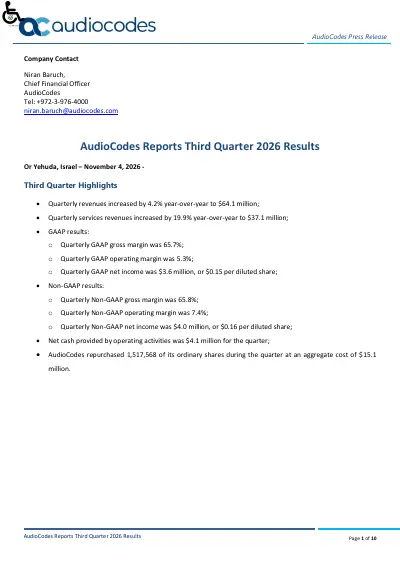
Revenues for the third quarter were 64.1 million, an increase of 4.2% over the 61.5 million reported in the third quarter of last year. Services revenues for the third quarter were 37.1 million, an increase of 19.9% over the year-ago period.
Services revenues in the third quarter accounted for 57.8% of total revenues. Revenue by geography was as follows: North America 47%, EMEA 34%, Asia Pacific 16%, and Central and Latin America 3%.
Our top 15 customers represented an aggregate of 56% of our revenues in the third quarter, of which 35% was attributed to our 10 largest distributors. GAAP results are as follows: gross margin for the quarter was 65.7% compared to 65.5% in Q3 2025.
Operating income for the third quarter was 3.4 million or 5.3% of revenues compared to operating income of 4.1 million or 6.6% of revenues in Q3 2025. Net income for the quarter was 3.6 million or 15 cents per diluted share compared to net income of 2.7 million or 10 cents per diluted share for Q3 2025.
Non-GAAP results are as follows: non-GAAP gross margin for the quarter was 65.8% compared to 65.9% in Q3 2025. Non-GAAP operating income for the third quarter was 4.8 million or 7.4% of revenues compared to 5.8 million or 9.5% of revenues in Q3 2025.
Non-GAAP net income for the third quarter was 4 million or 16 cents per diluted share compared to 4.9 million or 17 cents per diluted share in Q3 2025. At the end of September 2026, cash, cash equivalents, short-term bank deposit, short-term marketable securities, and long-term financial investments totaled 47.1 million.
Net cash provided by operating activities was 4.1 million for the third quarter of 2026. Day sales outstanding as of September 30, 2026, were 109 days.
On August 4, 2026, we declared a semi-annual cash dividend of 20 cents per share. The aggregate amount of the dividend was approximately 4.8 million.
In September 2026, we received court approval in Israel to purchase up to an aggregate amount of 30 million of our ordinary shares. The court approval also permits us to declare a dividend out of any part of this amount.
The approval is valid through March 9, 2027. During the quarter, we acquired 1.5 million of our ordinary shares for a total consideration of approximately 15.1 million.
Now to provide an update on our guidance. We reiterate our guidance for revenues for 2026 to be in the range of 251 million to 256 million and non-GAAP earning per share of 60 cents to 75 cents.
I will now turn the call over to Shabtai.
Shabtai Adlersberg
Thank you, Niran. Third quarter 2026 delivered solid financial results and healthy operating performance, with both core business areas moving forward.
Connectivity for UCaaS and CCaaS is an established, profitable, market-leading activity. Voice AI is a younger business started back in 2018, continues to expand, and is projected to become a major growth driver over the coming years.
Two primary growth engine continued to propel revenue: Live managed services and Voice AI applications aimed at the emerging intelligent voice enterprise. By the end of third quarter 2026, they jointly represented 87 million in annual recurring revenues, a 16% increase from the prior year, which highlights how much high-quality recurring revenue now contributes to the business model.
Over the last 3 years, annual recurring revenue has expanded by almost 90%, providing a solid base for further growth. Results from both primary business matched expectation.
Connectivity held its leading position in the UCaaS and CCaaS market, and Voice AI kept growing at 40% to 50% year-over-year. As a result, the company remains on course for its stated Voice AI revenue target of 25 million in 2026 and its goal of 50 million by 2028.
Now to some of the financial highlights of the quarter. Year-over-year revenue growth picked up to 4.2%.
Over 90% of revenue came from the enterprise segment, with the Microsoft Teams Phone business expanding 4% late. Connectivity, covering the SBC, gateways, and CPE business lines, has kept its revenue steady.
The SBC business line has had a good year so far. Revenue is up 8.2% year-to-date versus the three the first three quarters of 2025, and full-year revenue is on track to exceed 135 million, which would set a record above the prior high of 131 million back in 2024.
Among gateway sales, third quarter '26 was the best quarter of the year to date, and the full year is projected to roughly 50 million. 2026 will mark a second consecutive year of stability and modest growth, following the gateway revenue decline of 2023 and 2024.
Service revenue rose 19.8% year-over-year and now makes up for about 58% of total revenues. Headcount stood at 992 full-time employees at the close of third quarter, nine fewer positions than in the prior quarter.
Operating activities generated 4.1 million in net cash during the quarter. All those represents great financial performance in the third quarter.
To business strategy, what is driving our new growth story? What gives us the confidence that our strategy direction is the right one and that we are well positioned to capitalize on the opportunities ahead?
Several durable industry trends underpins growth strategy, reshaping enterprise communications through the adoption of new intelligent voice technologies. Central to this shift is the fast progress of GenAI, which is altering how people engage with computers, machines, and intelligent systems.
Voice is quickly becoming one of the most natural, intuitive, and capable interfaces linking people and machines. Advances in speech recognition, natural language processing and understanding, and real-time conversational AI make interactions with intelligent systems feel increasingly human.
These advances also carry Voice AI basic human-machine interaction. They open the way to intelligent automation of conversations, communications, and business workflows throughout the enterprise.
Taken together, these developments strengthen the view that intelligent voice for enterprise is a major growth opportunity, and they underline the decision to speed up investment in intelligent voice solutions for the enterprises. AudioCodes has invested in the UCaaS world for more than 25 years now, which places us in a strong position to pursue this opportunity.
A customer base that has grown over several decades in voice communication to thousands of accounts for both voice communication infrastructure, together with long-standing leadership in voice system and solution, supports the company's ability to lead this space. Now let's move to some of the actual business line.
Let's talk first about Microsoft. Microsoft is practically delivering about close to 66% of our overall business.
Third quarter 2026 revenue came to 43 million, up 4% year-over-year. Over the first nine months of 2026, revenue from the Microsoft business rose 5.2% year-over-year to 125 million, which keeps the company on course for its stated full-year revenue goal of above 170 million.
Newly created opportunities in the space reached 90 million, a 9.4% increase of the prior year, that points to a healthy demand environment ahead. Bookings of new contract value linked to Microsoft Teams Phone activity climbed 61% year-over-year to more than 20 million.
The quarter marked the second consecutive record quarter, which is a solid evidence of this segment potential and our leadership in the space. Momentum build in the third quarter on the opportunity that's above 10 million that we reported in the previous quarter.
After starting at a monthly recurring revenue of only tens of dollars in the second quarter, the forecast is now for an MRR of several hundred thousand by mid-2027. As reported earlier, the project is expected to contribute several million dollars of product revenue annually over the next 3 years, on top of the annual gateway sales.
The Microsoft Team voice ecosystem is healthy overall. Teams Phone represents only a small share of the more than 320 million monthly active Teams users, and with voice becoming more central to Microsoft enterprise strategy and for AI-driven Copilot workplace, the long-term outlook for this market looks favorable.
A key component of our sales in the Microsoft space is the Live platform for Live Teams. Sales of Live platform made good headway in the third quarter, as the platform serves the core underlying technology for the Live Teams solutions portfolio.
Enterprises, service providers, and partners use AudioCodes' Live platform, a cloud-based voice service delivery platform, to deploy, manage, and scale enterprise voice communications and AI-powered voice services, comprising of voice connectivity, centralized management, and automation. AudioCodes Live platform kept up its strong growth in third quarter.
September monthly recurring revenue came close to half a million, an increase of roughly 35% year-over-year. A new large customer in Asia Pacific signed in the third quarter of '26 help push Live platform services beyond 5.5 million in annualized recurring revenue.
This adds to the momentum behind the cloud-based intelligent voice services strategy. Now to the conversational AI business at AudioCodes.
The Voice AI growth strategy was carried out successfully in third quarter, adding one more quarter of growth. Voice AI revenue rose by nearly 50% year-over-year the first 9 months of 2025 -- compared to those three first three 9 months of 2025.
That results move the business nearer to its stated annual goal of 50% growth year-over-year and 25 million in revenue for the full year of 2026. Strength in Voice AI technologies, combined with the distinctive mix of expertise in telephony, networking, security, management, and orchestration for intelligent voice in business application across cloud and edge computing, underlines the success in the conversational AI segment.
The discussion now moves to business lines within that category in more detail. Let's begin with VoiceAI Connect.
The AudioCodes VoiceAI Connect technology and solution link enterprise telephony networks with the fast-growing ecosystem of Voice AI business applications. Drawing on AudioCodes' deep experience in voice communication and SBC technology, VoiceAI Connect lets enterprises and solution providers join existing telephony infrastructure, such as the PSTN, SIP trunk, PBXs, UCaaS, CCaaS, and the WebRTC, to advanced conversational AI solutions.
Large enterprise and service provider customers, among them Deutsche Telekom, Vodafone, Rabobank, and others, are planning to build tens of distinct Voice AI agent across their operations, all would be VoiceAI target market. Connectivity is only one part of the offering.
VoiceAI Connect also supplies a flexible orchestration layer that integrates and coordinates best-of-breed AI technologies, those including speech-to-text, text-to-speech, large language models, speaker identification and authentication, real-time translation, and voice analytics and recording. Above this layer sits enterprise applications, such as integration with CRMs, contact centers, databases, and business workflows.
Now VoiceAI Connect and Live Hub operations advanced significantly over the course of third quarter '26. An accelerating pipeline, steady flow of new logos, substantial expansion with the existing customer base made the momentum broad-based.
Invoicing revenues grew by close to 40% of the first 9 months of 2025. 60% increase in booking was recorded for the first 9 months of 2026 versus the prior-year period.
The number of new opportunities created was more than 40% higher than in the same period of 2025. Notable wins with large enterprises in North America and Europe are also worth mentioning, including a major multi-million-dollar and 24-month contract from a very large network operator in North America.
What was unique in this quarter that usually VoiceAI Connect opportunities wins are typically staying confidential, usually not allowed to be talked about. There was one unique announcement that was published in the third quarter.
Deutsche Telekom announced that they have selected AudioCodes VoiceAI Connect for their AI-powered mobile services. In October 2026, Deutsche Telekom announced the deployment of AudioCodes VoiceAI Connect to power its new mobile AI Notes mobile service for business customers, providing automatically recording, transcribing, and summarizations for mobile conversations.
VoiceAI Connect serves the connectivity and orchestration layer between Deutsche Telekom mobile network and Mistral AI, a French company, demonstrating its ability to enable scalable network-integrated Voice AI services. This deployment represents an important strategic validation of VoiceAI Connect's potential as an enabling platform for telecom operators seeking to introduce and monetize a broad-based range of AI-powered voice services.
Now to VocaCIC, our AI-first contact center solution for Microsoft Teams. VocaCIC kept up its strong operational momentum during the quarter, fueled by new customer wins in education, financial services, and large enterprises, along with growing adoption of AI capabilities.
Revenue in the third quarter grew according to plan. Let me dwell on some unique wins in that quarter.
We see deeper traction in education mainly. Another major U.S.
higher education institution chose VocaCIC this quarter as part of a project that also covers the AudioCodes Live Teams for Microsoft. The deal additionally covered the omnichannel capabilities with agent insights, the automated conversation summarization for agents supporting them.
Dozen of universities and colleges worldwide are now customers, reflecting both the depth and the potential of the education vertical for VocaCIC. Next let's talk about financial services.
After the Swiss and the Asian banking wins for VocaCIC noted in earlier quarters, a major German insurance company chose VocaCIC this quarter to replace its legacy contact center. That makes three quarters in a row in which major financial institution has selected VocaCIC.
Then let's talk about partner-driven wins. VocaCIC is bundled with AudioCodes Live Teams for Microsoft migration project, and the same approach applies with AT&T business and its AT&T Cloud Voice offering for Teams Phone.
In the third quarter, the partnership produced a win of a Fortune 500 global enterprise, which chose VocaCIC through AT&T.
Operator
Apologies for interrupting. Sorry.
Mr. Adlersberg, your line has just gone robotic for a moment, apologies.
Shabtai Adlersberg
Okay. Can I continue?
Operator
Yes, sir. If you keep talking, I'll let you know once it's cleared up.
Shabtai Adlersberg
Fine. Let's move on to the next Voice AI area of activity, which is Meeting Insights.
Talking about Meeting Insights cloud edition, strong momentum carried Meeting Insights cloud edition through the quarter as key operating metrics kept growing. Meeting volume climbed 90% year-over-year.
Monthly recurring revenue more than doubled, and active number of users set new records with 50% year-over-year growth. By the end of the third quarter 2026, Meeting Insights had become a mature, field-proven cloud platform shaped by years of innovation and customer deployments.
A significant rise in the use of Meeting Insights mobile client recording ranked among the main developments of third quarter. Beginning in third quarter '26, a shift in the go-to-market approach toward specific verticals has noticeably improved the success rate in winning new accounts.
Customized, tailored workflow solution for these verticals form the basis of the strategy, which keeps gaining traction and is producing meaningful commercial and operational momentum. Moving to the last business line in the Voice AI business, moving on to MIA Edge.
MIA Edge is our next-generation Meeting Insights on-prem solution, which provides secured meeting analysis and intelligent extraction. Interest in air-gapped solution, which operate without access to the internet and nor to cloud services, has been rising in recent years.
Secured meeting insights and intelligent extraction are what MIA Edge offers, with government and defense use cases as the main target. Growing worldwide emphasis on data sovereignty has produced comparable needs in the verticals such as healthcare and finance.
More than 25 accounts were active as of the second quarter, according to our previous reporting; 10 were in production and the rest in pilots and implementation. A new advanced solution launched in the third quarter brought in 11 new customers across defense, healthcare, security, infrastructure, and government in Israel.
The quarter saw the first development and deployment in Israel of a real-time translation application for asylum seekers. Adopted by the state Population and Immigration Authority, it provides live translation in tens of interview rooms daily.
It's now in full use. Evaluation of this solution is now underway at two comparable European authorities.
Other public organization, including such as police and further public service entities, are also evaluating the real-time translation application as a way to simplify the typically complex job of serving foreign citizens and visitors in a given country. With that, I've pretty much concluded my presentation.
Just to wrap up, operational momentum was good in the third quarter of 2026, driven especially by continued strong growth in two primary engines: the Live family of managed services and Voice AI business application. Steady gains in recurring revenue, operations, and services keep the company on track to meet its business target for the full year of 2026.
With that, I've concluded my presentation, and I'll open the session for question and answers.
Operator
Thank you, sir.
Shabtai Adlersberg
Operator?
Operator
Apologies. Thank you.
Ladies and gentlemen, at this time, we will be conducting our question-and-answer session. If you wish to ask a question, please press star one on your telephone keypad.
A confirmation tone will indicate your line is in the question queue, and you may press star two if you wish to remove your question from the queue. For participants using speaker equipment, it may be necessary to pick up your handset before pressing the star keys.
One moment, please, while we poll for questions. Thank you.
We have a question from Joshua Reilly with Needham. Your line is live.
Joshua Reilly
All right. Thanks for taking my questions.
Starting off on VoiceAI Connect. You've positioned it as a vendor-neutral orchestration layer that keeps enterprises from being tied to a single AI vendor.
At the same time, Microsoft, Zoom, NICE, and other cloud communication vendors are all bundling their own AI agents into their platforms. In your recent wins and pipeline, how often are customers choosing a best-of-breed multi-vendor approach versus just using the AI that comes with their phone or contact center platform, and what's typically driving that choice?
Shabtai Adlersberg
Thank you, Josh. As we all know, Voice AI is making advances in the very fast pace.
Actually we all know that large enterprises prefer a best-of-breed approach, meaning they would like to choose each a different LLM that's adapted to their specific need, a different speech-to-text, and few more. Yes, it's true that the traditional, I would say, UC providers such as Microsoft and others have a complete set of functionalities.
When we work with large enterprises, and talking to enterprises that has hundreds of employees, they prefer to work with some of the more advanced framework, some which are those from Google and or from others, and usually the flexibility just assume that you've been working with an LLM and there's a new one that came up, more accurate, cheaper. You would like to be able to switch to that new LLM in a matter of simple development.
That was the value that VoiceAI Connect offers as it providing full flexibility in moving and evolving their solution with different components that may appear in a very fast pace.
Joshua Reilly
Great. On MIA Edge, you've described strong interest from government, defense, healthcare, and finance customers that can't use AI on public clouds.
How eager are these regulated customers to adopt AI in closed or air-gapped environments today, and are they moving from pilots to production or still mostly evaluating?
Shabtai Adlersberg
Actually the need is very kind of urgent, especially when you're talking about defense applications, they need to move fast because we all understand that use of meeting intelligence and the ability to transcribe, generate summaries, and few more application is ramping very fast. Think about organization which are in a need to respond to new threats in very fast pace.
Yes, I think usually and substantially different than what we see in networking and telecom, the moves is pretty fast. They test the application fairly fast, respond on what needs to be fixed and or improve, and then they move very fast to production.
This is an increasing trend today in the world, big organization, enterprises, and governments feel the need to go completely off the public internet and or clouds. Therefore, talking about organization in Europe, we know that they are very anxious to be using their own technology and they do not want to go cloud.
It's a fast growing trend.
Joshua Reilly
Great. Thanks for taking my questions.
Shabtai Adlersberg
Sure, you're most welcome.
Operator
Thank you. If there will be any final questions, please indicate so now by pressing star one on your telephone keypad.
As we have no further questions on the lines at this time, I would like to turn the call back over to Mr. Adlersberg for any closing remarks.
Shabtai Adlersberg
Thank you, operator. I would like to thank everyone who attended our conference call today.
With continued solid performance in our UCaaS and CCaaS operations and wrapping growth in the Voice AI business, we believe we are on track to grow and expand our business in next coming years. We look forward to your participation in our next quarterly conference call.
Thank you all. Have a nice day.
Operator
Thank you. Ladies and gentlemen, this does conclude today's conference.
You may disconnect your lines at this time, and we thank you for your participation.