Audinate Group Ltd.
Q4 FY2026 · Earnings Call TranscriptAugust 16, 2026
Aidan Williams
Co-founder and CEO at Audinate. With me is Chris Rollinson, our Chief Financial Officer, and Nick Peace, our Chief Strategy Officer.
Today, in the first part of the call today we'll be talking through the investor presentation that accompanied our financial results, and both of those were lodged with the ASX earlier today. You can ask questions, as usual, at any time by typing them into the Q&A box.
At the end of the presentation, we'll collate those questions and answer as many as we can in the time that we have available. Before getting into the meat of the results part of the presentation, I would like to recognize that this year is the 20th anniversary of Audinate as a company.
It's been a year to look back and to reflect on how far we've come, and to remember the many people who've contributed to Audinate's success over the years. There are so many to thank, but I would like to particularly recognize the two prior CEOs, Lee Ellison and David Myers.
They took on responsibility for the company in those very early and challenging years. It's a hard thing to start something from scratch and to build something self-sustaining, and there were certainly many challenges on the way.
I am, and I think we should all be proud of how far we have come. The Dante networking technology itself has been successful, perhaps more successful than we had dared to hope when we started.
There are now over 8 million devices in the field using, and over 5,000 products that support it. Around the world, hundreds of thousands of AV professionals depend on Dante to deliver experience at the highest profile events, but Dante also underpins a wide range of bread-and-butter, day-to-day, behind-the-scenes AV systems that do their thing without people being aware.
In another way, our vision to pioneer the future of AV, and that's beyond just the Dante technology itself, is gaining traction in the industry, and our role in carrying that vision forward is becoming clearer. For me personally, I'm energized by the talent we have at Audinate and the platform investments that we are making.
The vision has stayed remarkably consistent throughout the last 20 years, and now is the time to capitalize on the success of the Dante ecosystem and deliver something new in the AV industry. We've built a strong foundation, and the opportunity ahead of us is the largest it has ever been.
Now on to our FY 26 results. Turning to slide 4, you can see the FY 26 highlights.
On the revenue side, FY 26 saw a return to growth, coming in at the upper end of our guidance range and with improved momentum across the whole product portfolio. Second-half revenue was strong and underpinned delivery of the FY 26 outlook.
Revenue growth from AVIO adapters was supported by the introduction of a new range of AVIO products targeted specifically for the AV installation and integration channel. Overall, the Dante ecosystem is healthy and continues to expand.
Over the full year, a record number of 555 new Dante-enabled products came to market. Each new Dante product hitting the market generates revenue in FY 27 and beyond in the form of chips, modules, or royalties each time an equipment manufacturer builds a new batch of those products for sale.
The product design pipeline is also healthy, with 137 design wins during FY 26, pointing to future revenue expansion as those products hit the market. 229 OEM brands are currently developing new Dante-enabled products.
During FY 26, our Dante certification and training programs were refreshed and relaunched. Training, as we continue to say, is key to supporting AV professionals as they design and deliver AV systems using Dante.
Over 375,000 AV professionals have completed certification or training around the world. On the product side, the portfolio has expanded.
We have expanded the AVIO product range with models specifically targeted at the AV installation market. The idea there really is to have a form factor that enables simplified installation under tables and inside cabinets.
Dante Director was enhanced with features required for enterprise usage and for additional control functions, and Iris was integrated following acquisition. Iris extends our product offerings with deep camera controls and into video production workflows.
Strategically, it has been a big year for Audinate. To briefly summarize, our long-term strategy remains to capitalize on the growing installed base of networked audio-visual devices and to provide the software platform used by the industry to deliver projects globally.
AV installations are generally understood to require three kinds of functions: audio, video, and control. Today, including Iris, there are more than 8 million audio and video devices available in our product system.
The time has come for us to invest further into the third leg of the stool, the control function. During the year, Audinate has made organizational changes to better align our cost base and R&D investment with our strategic objectives for the Dante platform.
These changes reflect the natural progression of the product investment cycle, with several major initiatives now complete. The full benefit of cost base realignment will be realized in FY 27 and beyond, and supports disciplined, profitable growth as revenue scales.
We retain a robust balance sheet with $65 million in cash and term deposits, and improved cash flow trajectory heading into FY 27 ensures we retain a strong financial and strategic position, enabling prudent investment to unlock future growth. Organizationally, we have realigned resources around three core categories of business during the year.
Those three categories are embedded components, so that's things sold to manufacturers like our Dante chips or software; installed products, these are things that go into AV installations like AVIO adapters; and the third category is software and services, audio-visual software and services, these are platform products like Iris and Dante Director. You will see this structure reflected throughout this presentation, in how we are reporting product revenue, in how we are generating future value and future growth at Audinate, and also in how we think about our strategic priorities.
New leadership roles have been established to ensure that each category has the appropriate focus and accountability to drive growth in FY 27 and beyond. The new structure recognizes the channel and go-to-market differences between products sold to manufacturers of audio-visual equipment and products that get sold into the installation itself, like AVIO adapters or platform software and services.
Turning to slide 6, you can see the key financial metrics for the full year. 15% revenue and gross profit growth was at the upper end of guidance, reflecting a return to growth as anticipated.
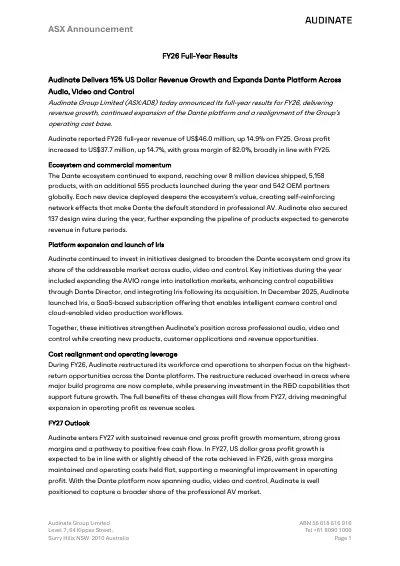
Revenue for the full year was $46 million U.S. dollars, and we retained a strong gross margin percentage of 82%.
Audinate continues to grow at a multiple of the underlying growth rate of the AV industry, which has slowed with the abatement of COVID and return-to-office tailwinds, and things like tariff uncertainty. The Australian dollar numbers reflect FX headwinds experienced during the year.
Keep in mind that Audinate's products are largely priced and sold in U.S. dollars, our COGS are largely in U.S.
dollars, and we have also got employment costs in U.S. dollars too, and that gives us a natural hedge against adverse exchange rate movements.
Overall, the full-year results is extremely pleasing. Slide 7 breaks down our product portfolio into the three categories described earlier: embedded components, installed products, and then AV system software and services.
Revenue growth in FY 27 was spread broadly across all three product categories, led by new product launches. Embedded components include what we historically have reported as chips, cards, and modules, and also includes embedded software products like Dante Embedded Platform, our Linux implementation, and Dante IP Core.
The embedded components business delivered a strong second half as first-half bookings translated into revenue. Installed products is our AVIO product range.
Growth in this category was driven by new product introductions specifically targeting AV installations like meeting rooms, boardrooms, and higher education applications. Software and services includes new products like DVS Pro, the early uptake of Iris, as well as other PC/Mac software and management software like Dante Director and Dante Domain Manager.
These products are typically used in audio-visual installations and get attached to those installations as AV professionals design and install projects. Slide 8 shows continued strength in the key operating metrics associated with the Dante ecosystem and the growth of the Dante ecosystem.
Each of these metrics are leading indicators of future revenue. Audinate's sales cycle to manufacturers involves an initial design win followed by a period of 12 to 24 months for product design to be completed, followed by repeat revenue derived from the ongoing purchase of chips or the payment of royalties as each new unit is manufactured over the sales lifetime of that AV product.
Design wins are the earliest indicator and represent manufacturers signing up to use Dante technology in their products. 137 design wins is an excellent full-year result and highlights the ongoing take-up of Dante technology by AV manufacturers.
In the middle column, the number of manufacturer brands with Dante products in the market, and importantly the number of manufacturers developing their first Dante product, continues to grow. There are now 771 AV equipment manufacturers signed up to use some form of Dante technology in their products, with 542 manufacturers shipping one or more Dante-enabled products today.
229 manufacturers are currently developing new Dante-enabled products, the largest it has ever been. The right-hand column contains a key indicator, that is the number of Dante-enabled products available on the market.
You can think of this as effectively the catalog of products that an audio-visual professional can choose from when they are designing and installing an AV system. Over the year, a record number of 555 new products came to market, making a total of 5,158 Dante-enabled products on the market.
Since the Dante networking technology provides interoperability between competitive brands, the growing product ecosystem continues to strengthen the economic network effect associated with the Dante technology and its competitive moat. Ultimately, these charts illustrate the continued health of Audinate's core Dante technology business.
Design wins, product development activity, and product launches are all leading indicators of future revenue for our embedded component business in FY 27 and beyond. I'll now hand over to Chris to talk through the financials.
Chris Rollinson
Thank you very much, Aidan. Just turning to page 10 and the income statement.
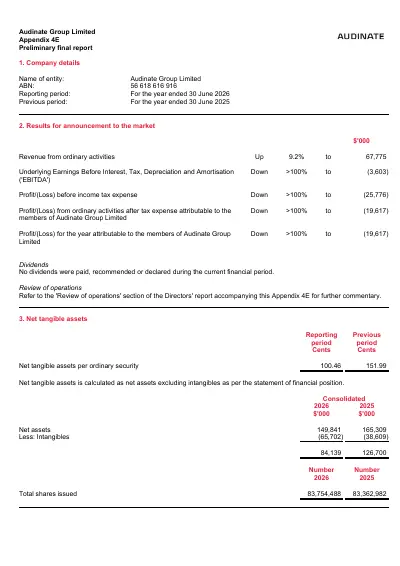
This is presented in Australian dollars. Starting with revenue, FY 26 revenue grew 9% to $68 million.
Now, this growth was lower than the increase we reported in U.S. dollars, reflecting the Australian dollar-U.S.
dollar exchange rate movements during the year, with the Australian dollar strengthening around 6% over the year compared to the U.S. dollar.
While revenue was 100% U.S. dollar denominated, the group has U.S.
dollar-denominated expenses covering approximately half of this revenue and provides a partial natural hedge against these exchange rate movements. Our gross margin was 81.9%, down slightly from 82.3% in FY 25, and this was driven by the strong performance of chips, cards, and modules revenue, in particular in the second half of the year.
We continue to maintain high margins overall and expect a similar margin result as we look forward in FY 27. Turning to costs, employee expenses increased 23% or $8.2 million.
Now, this was driven by a $2 million increase as a result of the employee costs from the Iris acquisition. There was $3.9 million as a result of stronger performance against short-term incentive targets, which drove higher variable incentive costs.
The remainder of this increase was from head count increases in the second half of FY 25. An operating restructure was undertaken during the year, resulting in a net reduction of 10% of roles across the broader group despite the additional head count from Iris that came into the year.
Sales and marketing expenses decreased by 15% following the completion of launch-related investment activities in control, in particular Dante Director, while we maintained targeted presence at key trade shows across major regions. Our other operating expenses increased 18%, reflecting the cost of running a geographically diverse listed business.
Putting this all together, underlying EBITDA was a loss of $3.6 [million], down from a positive $0.7 million in FY 25. Now, this reflects a deliberate choice, we invested ahead of revenue for Iris, Dante Director, and the broader platform because we believe the market opportunity in front of us justifies this.
We're broadening Dante's footprint across audio, video, and control, and each of these product launches solves a problem of a different kind for a different customer, and together they put Dante in front of a much wider set of buyers than audio could do alone. Now, at the same time, we didn't lose sight of cost discipline.
We restructured the business during the year to concentrate our cost base on the highest return parts of the platform and expect the full benefits to show up in FY 27 as stronger operating leverage and improved cash generation. Turning to the cash flow statement, operating cash flows were $1.2 million, down from $7.4 million in FY 25.
While this remains positive, the reduction reflects three factors: a $1.7 million reduction in interest income from a lower cash balance following the Iris acquisition, a $2.7 million increase in operating costs from Iris as the business scale subscribers, and also the $1.8 million cash outflow from the operating restructure that took place during the year. The largest driver of cash movement in the year was investing activities, there was the $31 million acquisition of Iris and then the $12.4 million invested in continued development in product lines across the group.
Altogether, the overall movement in cash during the year was $44.8 million. If we look to FY 27, we'll continue to invest in the business, but increasingly funded through improved operating cash flow rather than the balance sheet.
We expect an improvement in operating cash flow next year driven by our revenue outlook combined with the benefits of a leaner cost base, and this will be the foundation of our path to positive free cash flow in future years. If we now turn to the balance sheet, the cash movement flows directly through to the balance sheet.
Cash and term deposits together stood at $65 million at the end of the year. We remain in a robust financial position.
We carry no external debt, and our balance sheet gives us the flexibility to fund our strategic initiatives. The most significant movement on the balance sheet relates to intangible assets, which grew to $65 million, an increase of $27 million, which is made up of the continued investment in our platform, but the majority of that is through the recognition of goodwill through the Iris acquisition.
If we look at that combined across the P&L, cash flow, and balance sheet, FY 26 tells a very consistent story. Deliberate investment in the platform expansion were funded through a strong balance sheet and cash position, and we enter FY 27 with a positive revenue outlook and a leaner cost base, and together this will drive improved profitability and cash flow generation.
I'll now hand you back to Aidan.
Aidan Williams
Actually, I think it's over to Nick to talk through some of the strategy slides.
Nick Peace
Thanks, Aidan and Chris. As a starting point, it's worth reiterating why Dante is the de facto AV networking standard trusted by customers around the world, with more than 8 million devices in the field.
In summary, Dante is chosen by AV professionals because it enables them to distribute high-quality, low-latency digital signals across standard IP networks. Dante enables AV system designers, installers, and operators to build and operate more flexible AV networks with significantly reduced cabling and labor costs.
AV professionals choose Dante for five main reasons: ubiquity, which is underpinned by interoperability, any brand, any Dante device, and the confidence that Dante's large installed base and broad OEM adoption provides; scalability, from a single room to multi-site enterprise deployments running on standard off-the-shelf networking equipment and extending from audio into video, control, and software; reliability, this is a must-have when you're trusted with high-profile AV installations such as Premier League grounds, major concert tours, and Fortune 500 HQs; ease of use, which is supported by our extensive training program, is really one of our most important assets, as Aidan mentioned, over 375,000 trained professionals across 24 countries; and security, this matters more every year as AV moves onto enterprise IT networks. That's why customers choose Dante.
How then do we build on this to sustainably grow value? We think about our business as having three categories, it's best to talk about each of them in turn.
Slide 15 is about how we're going to do that in part to sustain value. The first two are aimed at expanding Dante's installed base across audio and video.
With OEMs, we're continuing to work with AV OEMs globally to embed Dante across their product ranges. 771 OEMs are either currently shipping or developing Dante-enabled products, utilizing either our hardware or our embedded software offerings.
This is the largest part of our business today, and it's our continuing priority to ensure that our products meet the needs of OEMs across the breadth of their product ranges. Beyond OEMs, we're developing Audinate-owned products that extend Dante into more AV installations.
Current examples of this include products such as AVIOs, which we sell primarily to AV integrators and installers. These extend the benefits of Dante AV networking to AV products which are not natively Dante-enabled.
In practice, this means that AV professionals can bring in more AV devices into Dante networks, even in existing brownfield installations. In each of these first two categories, we do generate revenue on a per-unit basis.
There's an additional dimension as well, though, which is to build products which help AV professionals manage, control, and operate Dante AV networks. Products like Dante Director and Iris enable us to deepen our engagement with our customers and to generate recurring revenue from our global user base.
We're aligning our business around these three categories, not just to guide us on what we build, but also to help us best engage with, to sell to, to train and support each segment of the AV industry. That's the model.
It's worth now turning to major priorities in each of these categories for FY 27. Firstly, our component business.
We continue to see opportunities to work with AV OEMs to further expand the adoption of Dante across their product ranges. One significant initiative this year is making Dante's embedded software solutions as easy as possible for OEMs to implement into their AV products.
A broader priority, though, is to continue to encourage the broadest possible adoption of Dante by AV specifiers, integrators, and end users. We're continuing to deepen the Dante ecosystem across AV specifiers, integrators, and installers in our major markets via Dante certification, training, and support.
Notwithstanding we've been in business for 20 years, digital AV networking is still in its early stages globally, and adoption does vary significantly by country and by region. Hence, we've been reviewing each of our major markets on a country-by-country basis to guide us on key local ecosystem initiatives for this year.
With our installed products category, we will be growing AVIO revenue through recently launched product offerings which target installed AV projects. In addition, we've recently restructured our sales organization to create a dedicated solution sales team which focuses on integrators and end-user customers.
This team is responsible for AVIO product sales, and together with products such as DDM, Dante Director, and DVS, which are also aimed at AV professionals and end users. Beyond our existing product range, though, we're continually to develop new products that set the benchmark for Dante-enabled installations.
In terms of monetizing the network, growing the Iris subscriber base is an important FY 27 priority, as is growing the uptake and the capability of our control solutions across enterprise end customers, integrators, and consultants. From a product perspective, we see significant opportunities to deliver products that help AV professionals better manage, control, and operate AV systems.
Accordingly, extending Dante and Iris into higher-value AV workflows and applications is going to be a significant focus for this year. Over to you, Aidan.
Aidan Williams
Thanks, Nick. On slide 17, given the potential for AI to disrupt a variety of software and seat-based SaaS businesses, I thought it would be helpful to again share how we think about the relationship between AI, Audinate, and the broader AV industry.
For Audinate, the bulk of our revenue is linked with hardware devices that are installed into physical locations. Here you should think microphones, amplifiers, cameras, and the like.
This revenue model is infrastructure-oriented rather than seat-based, and it is connected to the audio-visual equipment that's needed in physical environments. Another point to make is that the value of Audinate's key technology, Dante, is tied to the economic network effect created by interoperability between competing AV equipment brands.
There are currently 8 million devices in the field with an ecosystem of over 5,000 products from over 500 brands. As this ecosystem and the installed base grows, the moat deepens since replacing or reworking that whole portfolio of Dante products and the installed base is extremely expensive.
Ultimately, I see Dante and Iris technology, specifically the networking APIs and platform services components of those technologies, as enabling workflow automation and also AI applications. Both Dante and Iris put audio and video signals onto networks with APIs to control them, and this creates a natural foundation for AI work and workflow automation.
AI is broadly applicable in the AV industry. The AV industry is largely project-based and there's typically three phases: a design phase, an installation phase, and then an operation phase.
If we look at that in a little bit more detail, for example, in the design phase, converting customer requirements documents into detailed specifications can be accelerated using AI. For system programming, this is not unlike software programming that is a substantial application of AI tools today.
Also when we think about the operation of audio-visual systems, the ability to speak or use natural language instructions to control and change the operation of a running AV system, I think, is a significant opportunity. Furthermore, technologies like Dante are enabling change in the industry, with IT-style networking software and APIs really replacing old-school AV equipment and wiring.
If you think about it, the interface for AI in the AV industry is networking and APIs, because AI is essentially software that's running inside computers. Dante and Iris provide key networking and control technologies that ultimately end up enabling a broader adoption of AI throughout the industry.
Slide 18 summarizes the FY 27 outlook. Audinate enters FY 27 with sustained revenue and gross profit momentum, strong gross margins, and a pathway to positive free cash flow.
In FY 27, U.S. dollar gross profit growth is expected to be in line with or slightly ahead of the rate achieved in FY 26, with gross margins maintained and operating costs held flat, supporting a meaningful improvement in operating profit.
As I said earlier, our long-term strategy is to capitalize on the growing installed base of Dante devices and to provide the software platform the industry uses to deliver audio-visual projects and services globally. New product development, expansion into new geographic markets, and deeper customer engagement are accelerating growth.
Continued investment in the Dante platform is expected to support meaningful revenue growth over time. Audinate holds sufficient liquidity to fund its growth initiatives and strategic priorities.
We expect materially stronger operating cash flow in FY 27, driven by improved revenue and a leaner cost base. Finally, to wrap up on slide 19, where is Audinate today?
There have been various ups and downs over the last sort of 20-odd years of Audinate being in business. However, our core Dante networking business has remained strong and it continues to gain even more traction in the industry.
The leading indicators of design wins, products under development, and new products coming to market show ongoing momentum, and there is plenty of further runway ahead. We're expanding our product offerings into video and control, and have strategically realigned our business around those three activities that I was talking about further to create focus and growth: so that's our component business to manufacturers, our installed product business like AVIO adapters, and audio-visual system software and services.
The consistent, long-term effort over the last 20 years has created the installed base, the team, and the conditions to make our long-term vision a reality. Ultimately, Audinate has a proven core business model, a robust balance sheet position, and the discipline to succeed over the next few years.
With that, I will hand back to Chris to coordinate questions.
Chris Rollinson
Thank you very much. Thank you, Aidan.
We have a number of questions, I'll just read through them and we can look at how we answer that. The first question from Tom: "Can you give a little more color regarding the traction for AV and when we can expect break-even versus the cash outflow we've had in this results?"
Maybe I'll talk about the cash position and outlook, and Aidan, Nick, we can talk through then the traction that we're seeing across the AV products. In terms of cash flow, we have an operating restructure, as we've outlined, has taken place in FY 26, and those benefits will flow in FY 27.
In terms of our outlook, the expectation is revenue and gross profit growth in line with what we've had in FY 26, and we're maintaining a flat cost base. What we're seeing in FY 27 is certainly an improvement in our operating leverage and certainly an improvement in our operating cash flow.
For us, that is much more positive result from a cash outlook. In terms of cash flow break-even, the expectation is not that we'll be free cash flow break-even in FY 27, but certainly as we get to the end of FY 27, we should have much more clarity around what our cash position and free cash flow position looks like as we go into FY 28.
Aidan or Nick, did you want to talk about the traction in AV?
Nick Peace
I think, well, we've obviously touched across a number of dimensions in terms of what we see in terms of the OEM business. Uptake there continues to be steady.
In terms of monetizing the network, we're sort of continuing to attack that deliberately and really focus on getting the basics right, delivering value to customers, to end users, building products that stick within their workflow, and then expanding out from there. Like all recurring revenue models, you've got to grow with stickiness and gradually build out from there.
It's early days with both the Director and Iris, but increasingly it's going to be focused on ensuring steady attachment to our user base and growing account by account, segment by segment. Sort of early days, but we're sort of buoyed by what we're seeing at the moment.
Chris Rollinson
Next question is: "Can we get an update on your strategy for Iris? What is the likely revenue pathway for Iris?"
Aidan Williams
I think that was actually related to the first question as well. The acquisition of Iris actually represents a pretty significant strategic shift for Audinate in how we think about monetizing our networking technology and how we think about monetizing audio-visual installations as a whole.
I think in the past, maybe sort of 2 years ago, we would think about the success of the audio business that we have selling components to manufacturers, and then we would think, "Oh, we can just do that again with video," and that turns out to be a tougher proposition because of a variety of reasons, which I think we've covered in previous either results or conversations that we've had with investors. The nutshell really is that in video world, things like codecs, the need for compression technology creates quite a lot of friction in terms of interoperability, and that tends to dilute the value of an interoperable networking technology like we had with Dante audio.
When we thought about capturing the value from the audio-visual system that ultimately will become networked, we were thinking about different business models and different strategies to go and do that. One business model and strategy that was out there was the Iris business model.
The idea there is to provide the technology to manufacturers for free, but then monetize the end-user part of that. Iris really represents a vertical slice through a use case involving camera control and production, and Iris has been very successful in terms of getting adoption with camera manufacturers.
It's a different model. In the end, it achieves a similar result because if you remember my comments about audio-visual systems having audio, video, and control, Iris has video transport and it also has control functions.
It provides a complementary set of networking technologies that go with our audio solutions. Again, I think what I would point you towards is perhaps a shift in the way that we're thinking, a strategic shift in the way that we're thinking about capturing value from audio-visual installations and from the technology I guess ecosystem that we've created with Dante.
Instead of focusing on video as the next thing or how big's video going to be as a component business, we want to point investors towards thinking about there's a component business, but there's also a business selling products into installations, like our AVIO business that we have today, and there's a business involving the coordination, the software, the control, and management of those systems to create a lot of stickiness in those audio-visual installations. When we think about future growth of Audinate, I would be guiding investors to be thinking about how's our component business going to grow, how is our products that we sell into AV installations going to grow, and what does it look like for our long-term strategy in terms of being able to deliver products that enhance the management, control, and stickiness of Dante technologies in audio-visual installations globally?
Sorry for the long answer, but I think it's sort of a very significant shift in the way we're talking about future growth, and it really represents a fair bit of strategic thinking over the last 18 months, maybe more.
Chris Rollinson
Thanks, Aidan. Next question, Iris-related as well.
The question is: "Is Iris bringing in revenues now?" The second part: "Is there info on Iris revenues projections, including timing?"
I'll answer the first part, and maybe, Aidan, Nick, you can answer the second part just around outlook in terms of revenue for Iris. The first one, yes, Iris is bringing in revenue now.
Disclosed in the accounts, we've got $200,000 U.S. worth of revenue in FY 26.
Then in terms of Iris revenues and projections...
Nick Peace
Obviously, as I said before, we're sort of very much focused on getting the basics right in terms of building both the sales motion, the outreach motion, to ensure we can generate recurring revenue from our installed base. Very much focused on getting the basics for that right.
We're obviously not providing guidance at this stage, but we're very much focused on getting the basics right, ensuring that we can support as many of our sort of 20-odd Iris partner OEMs and go to market alongside them. We'll be saying more about this as we move forward, but at the moment, we're focused on early adoption, early roll-out, and getting the basics right.
Chris Rollinson
Thanks, Nick. A question from Lucas, just in relation to costs: "So FY 27 costs are guided as flat, excluding one-off restructuring and Iris acquisition payments.
What's the expected quantum of those one-off costs in FY 27?" The assumption is zero in terms of restructuring costs.
In Iris acquisition-related costs, it will be $1.8 [million], the expectation of a $1.8 million in FY 27. That's non-cash, that's just amortization of shares that were issued as part of the Iris acquisition that have been amortized over 3 years.
Next question from Ryan: "Given that the operating expenses are rising despite recent restructuring efforts, what inflection point in revenue or cost reductions is required to reach net profitability, and what's your targeted timeframe to achieve cash flow break-even?" I think we've outlined during the presentation around the restructure efforts that took place have been completed in FY 26.
Guidance in FY 27 is to have our revenues increasing and our costs remaining flat. Certainly as we head into FY 27, we're seeing a different outlook in terms of revenue growth and cost growth for Audinate.
I think in terms of the break-even mark, one of the key elements in achieving that break-even mark, Iris is still a business that is young and is still not cash flow positive, and we don't expect that to be the case in FY 27 as the business continues to scale subscribers. As we head into FY 28, the expectation is that business will turn around and certainly we'll continue to see more operating leverage in our core business outside of those investment initiatives.
Next question from Lucas: "With the major platform initiatives complete, why is FY 27 gross profit only in line or slightly ahead of FY 26 at 14 14.7% rather than accelerating?" We've guided the market to our gross revenue and gross profit growth expectations of in line with or slightly ahead of FY 26.
I think at this stage, that's our best estimate of what we believe the outlook looks like for Audinate in FY 27 in relation to gross profit and revenue.
Aidan Williams
But... I think the word "only" is interesting in this sentence, but I'd love it to be ahead of 15% for sure.
I think one of the reasons is really the world is not the same as it was, say, 3 years ago when there was a number of tailwinds in the AV industry. I think Audinate continues to perform at an underlying multiple of the growth rate of the industry, but the industry itself, the growth rate in the industry has gone from 6-point-something percent down to sort of high-3s, high-4s.
This 15% growth rate actually represents a multiple of 2 to 3 times the underlying growth rate of the industry, which is healthy. I would say it's consistent, continuing growth for Audinate driven largely by our core business.
I would also say that the changes we've made will enable us to do things like grow the AVIO products and the things being sold into AV installations, and also for that to be a channel which can actually better for Audinate to be structured more appropriately in order to go and have a go-to-market for those products that we've developed. That's how I would answer that question.
Chris Rollinson
Question from Tim: "So saw accelerating gross profit growth in the second half. First-half growth 12% versus second-half 17%.
Can you talk to exit or current gross profit run rate, and can we get an update on historical inventory destocking, please? Are the top 10 OEMs back to normal ordering?"
I'll answer the first part of the question in relation to growth rate. We certainly saw a positive second-half performance in revenue.
A lot of that was driven by chips, cards, and modules, embedded components growth in the second half of the year. That's certainly pleasing, and for us not necessarily unexpected because we're really at the end of the inventory destocking cycle.
As that looks into FY 27, we've made an estimate of what we believe our outlook will look like in FY 27, and that's been factored into the outlook.
Aidan Williams
I would jump in on the OEMs back to normal ordering. It's a question of what you mean by normal.
I think the OEMs are all through the inventory overstocking-type stuff that they had in terms of our components and parts. Their propensity to buy Dante technology is no longer gated by them sitting on a pile of chips, by and large.
I think that's true of our top 10 for sure. However, I would say that going forward there's always inventory issues.
There's RAM issues at the moment with all the shortages on things like RAM and costs are going up. I think those things have really replaced concerns around people sitting on big piles of Dante circuit boards or Dante chips.
It's a different challenge even if it is in that same supply chain-type area.
Chris Rollinson
Question from Chenny, just in relation to capex for FY 27: "So we expect somewhere around $13 million in capex for FY 27, which is in line with 26. A view on when Audinate can hit a cash break-even?"
Not in FY 27. I think we've sort of outlined this at length.
Certainly we'll see much stronger operating cash flow come through in FY 27. As we hit into FY 28, I think that's an area that we would be targeting a free cash flow break-even position.
Question from Chenny, just in relation to I guess the breakdown of where we see growth coming from across the product portfolio in FY 27.
Aidan Williams
Product portfolio growth. Yes.
I think we are not providing guidance at that sort of breakdown line-type number. I think this is the first time that we have broken down our products in that way.
I don't think I have a specific answer to that question. My expectation is that as we have put in place a go-to-market organization, and we have a bunch of new AVIO adapters that have hit the market, like the four-channel AVIO adapters right at the end of FY 26, my expectation is that there should be healthy growth on the AVIO adapters side of it, consistent growth around the Dante ecosystem, which is very much a law of large numbers thing, and I expect also to see consistent growth around the AV system software and services.
Things like Dante Virtual Soundcard tend to be pretty stable in terms of their attach rate to underlying AV installations, and I would like to think that things like Dante Director and Dante Domain Manager would benefit from the organizational changes that we have made as well. Overall, there's always a question of what you think the end of the whole financial year will look like.
We're not without our headwinds, I think I already mentioned things like RAM shortages, there are things like chip shortages potentially out there on things like FPGAs that we have to navigate. There are always pluses and minuses, but that's probably how I would answer that question.
Chris Rollinson
Related question, Aidan, from Chenny, which is: "Any impact from memory prices and availability?"
Aidan Williams
Absolutely. One of the things that our manufacturing team has been spending a lot of time on is getting redundancy in supply for things like RAM chips of various sorts.
We've been shaking the trees and finding parts all over the place. That does have an impact on our COGS, and we have recently put a price increase through to reflect that.
I think generally speaking the industry is as a whole dealing with the same thing, because our manufacturing customers have the same issues with their products. RAM, I think, is one of those things where it's just more expensive now than it was, but I think it's a tractable problem even though we have to be on it.
The next kind of cab off the rank is other chips where it's more the upstream manufacturing of things like FPGA parts, which are now in tighter supply than they were. That's the next thing that we have to manage.
This is one of these gifts that keeps on giving. It's not the same as in the middle of the pandemic or when we had that giant chip shortage, it's not the same as that, but it is still an ongoing issue because of the pressures associated with the desire to build out truckloads of data centers.
Chris Rollinson
Next question is just in relation to capitalized costs: "So we capitalized $12.4 million intangibles in '26, $12 [million] in '25. What's the guidance for '27?"
I think I've previously stated I think that's going to be around that $13 million mark in FY 27 is our expectation. Another question again just around achieving positive free cash outflow, which I think we've sufficiently answered.
Somewhat of a double-up here, Nick, but just: "How is Iris tracking relative to your expectations?"
Nick Peace
I think anytime you put a new product into the market, you always have to go in expecting a wide variety of outcomes. I'd say across a couple of buckets, we've been really pleasantly surprised by what we've seen in terms of great adoption by PTZ camera OEMs, it's been really positive, continuing engagement and partnering with camera OEMs.
In terms of prosumers and enterprise clients, there's really sort of good sort of engagement with the core proposition and sort of validation of the need and the opportunity to do things better. Where we're being very deliberate is ensuring that we take the time to get the alignment on product and market fit and how we sell it and how we scale it right.
We're deliberately moving forward fairly sort of deliberately here as you have to do with recurring revenue models. More customers are always better, but at this stage, we're making sure we get stickiness and fit right so that the recurring revenue will flow fairly naturally from there.
Chris Rollinson
Question from Michael, just in relation to: "What drove revenue growth in the second half of the year? What gives you confidence around your future increase in revenue, given your guidance for FY 27?"
I think Aidan answered that in terms of the components and certainly Nick has answered that in terms of where we're focused on FY 27 in terms of our areas of growth. The only comment to add to that is that pleasingly we've seen all of our categories of products growing in FY 26, which is positive, so that provides some diversity.
The other part there is that in terms of our markets, 40% of our markets 40% of our revenue is from the U.S., 35% from EMEA, 10% from other markets, and again, we've got diversity with our customers as well, top 15 customers accounts for around 40% to 50% of our revenue. Overall our guidance is based on what we can see, and based on the second-half growth, which was driven by chips, cards, and modules, we've outlined the guidance for FY 27.
Question from Owen, which we've answered, just in relation to the Iris launch and second-half key metrics and also revenue make-up as well. I think we've answered those questions in relation to Iris.
Question from Sinclair, which Nick is probably one for you to take on: "So can you please provide some more comments on the increased strategic focus on adapters? Is it a necessary step to enhance the competitive strength of Dante?"
Nick Peace
I think just to be clear, we've been in the adapter space for many years, but it's an aspect of the business where we still see a lot of potential to do more, particularly in the installed space. Obviously there are many thousands of Dante networks out in the world.
The opportunity for us, though, is to extend those networks into sort of AV equipment that our customers have that are non-Dante. Every time you extend the network, you make the Dante-enabled network more controllable in a more modern way, you increase interoperability, etc., etc., and we continue to see lots of ways we can do that better across segments and really as we think about the broader picture of how do you build up an overall platform.
The bottom line is yeah, we think we can do more both from getting products out into the market, but also in terms of new products that help us extend Dante networks into customers' AV networks.
Aidan Williams
I might just add one other piece. It's an interesting question: is it a necessary step to enhance the competitive strength of Dante?
I would say it's a necessary step for us to achieve our long-term vision, which is actually to deliver that software platform because we need to provide audio—great, we got that one solved [chuckles]—we need to provide video, we're on the way with things like Iris and the video ecosystem that we have, and we also need the control functions. Those are sort of three parts of the stool, and things like AVIO adapters, if we can create the right kind of AVIO adapters, then that allows us to provide all three legs of the stool and then to start to deliver more of our software and platform technologies.
They don't necessarily enhance the component business or the historical strength of Audinate with the Dante technology business, but I would say they actually are quite an important component for us to be able to deliver on our long-term strategy to be able to capture more of the value of the audio-visual installation, and particularly the platform software parts. Plus, as you can see in the numbers, they're actually pretty good from a sort of revenue point of view.
I think it's a win-win.
Chris Rollinson
Just from Sinclair as well: "So can you please provide some more commentary just around the overall AV market? Some commentary has suggested that corporate office installation market remains weak."
Aidan Williams
I think that's right. One of the things that has happened is that the organization that used to provide these kinds of statistics for the industry, AVIXA, has kind of downscaled its data in that area, it's once again a bit more diffuse to figure out what's going on.
However, I think from talking with people in the industry, things like trade show attendance, stuff like that, I think the AV industry generally speaking is not immune from the overall cost of living increases. When they're thinking about doing upgrades for things like offices and the corporate installation market, I think there was a big burst of activity with the post-COVID return to office, I think we're in a bit of a lull with respect to that particular segment.
That's probably also true of things like higher education, but on balance, Dante applies across a number of different segments, and so swings and roundabouts. I think we kind of take a law of large numbers kind of view of that with respect to the component business and with respect to the AV projects side of things.
I think there are projects out there; they're not necessarily in those corporate and office installation areas, there're fewer of those.
Chris Rollinson
I know we're getting to the end of time, I think we'll just go through some quick ones. Sinclair again, just: "Is it possible to provide an update on the launch of Dante Director professional?"
Aidan Williams
What happened during the financial year with that was that we invested in developing a number of features for the enterprise version of Dante Director. We had something like 20 enterprise customers going through an alpha trial process.
We built a bunch of features that connected with those customers and looked for their requirements. We did things like ISO 27001 certification during the year, we've ticked off a whole bunch of things.
That side of it went well. The realization ultimately of sort of building that product is that that product naturally wants to be sold through a channel into the audio-visual installation market.
The organizational changes that we've made to create a focus on selling audio-visual products like adapters and AV system and software and services into AV installations, Dante Director is going to benefit from that, and so we're expecting to see increased opportunities coming from our standing up of that organization and the focus on the go-to-market element of that product.
Chris Rollinson
Question from Reese for Nick: "Any more acquisitions are you looking at?"
Nick Peace
I think the short answer is I think we're really well placed in terms of what we have from a technology in terms of capability across the business. I think we've got really all the key elements from a product and tech perspective to be really successful to execute our strategy.
From that perspective, there's nothing obvious that we need, and there's nothing obvious on the horizon. It's probably the best answer I can give at this point.
Aidan Williams
I guess we're not shopping,
Nick Peace
but
Aidan Williams
potentially something interesting could come up.
Nick Peace
I'm always wary about saying never, never,
Aidan Williams
never,
Nick Peace
but there is nothing that we need to execute on the plan we have, and really the challenge for the next 24 months is just to get on and use the assets we do have to deliver on our strategy.
Chris Rollinson
Couple from Owen: "So what percentage of your guidance is from new revenue lines versus your core chips, cards, and modules, software sales?" The overwhelming growth is coming from our core business is the answer to the question.
Next one is that: "Can you quantify the cost out? Does flat opex include capitalized costs?"
In terms of quantifying the cost out, that's been factored into the guidance for FY 27, and we are expecting flat capex in FY 27 as well. Question from Reese: "What percentage of revenue are you expecting to expend on R&D in the next few years?"
Certainly R&D is important for a business like Audinate, but in terms of the percentage of revenue, we don't have a target in mind. It's more around the cost of developing the particular products, I think it's remained flat at around that sort of $12 million to $13 million mark over the last couple of years, but yeah, there's no fixed percentage.
It's more around what we're building and what we see as a return on those developmental costs as well. Question around: "Do you expect the group margin to tend higher with increase in embedded software and SaaS take-up?"
I think we've seen a step change in our gross margin percentage really from between '24 and '26, moving to the 82% mark now. I think at this stage, 82% we've guided next year feels like a reasonable margin.
The answer is it depends on the strength of our chips, cards, and modules business, which is still...
Aidan Williams
Probably adapter business.
Chris Rollinson
...and adapter business, which is an important part of our make-up, feels like it's a good balance at the moment in terms of a combination of both hardware and software products. "The Iris acquisition had an earn-out subject to achieving certain targets, are those on track?"
At this stage, the answer is not on track to hit the earn-out. The earn-out was between $10 million and $15 million in revenue after 3 years.
At this stage, no, but that will be reassessed every reporting period. Question from Tom, just in relation to: "What strategies does the company have to allay investor concerns regarding potential AV write-downs or the need for a capital raise?"
Aidan Williams
I think the answer to that is related to perhaps the longer statement I made earlier about strategic changes and thinking about Audinate's growth opportunities differently. In particular, I think you're referring to the change in terms of how we think about the video networking or video component part of our business.
What I would say is we have been working through over the last 18 months a number of strategic changes, both in terms of acquisition, different business model for how to monetize something like video, and we've been bringing into the company specific talent from people that have done control-related product developments. We've been making strategically moves both on the business model, video side of things, the talent side of things in terms of our long-term strategy to build out all of those three legs of the stool.
Again, I would say that the strategic shift is that the opportunity is not so much to build out a video component business, which is a rough approximation of our audio component business today, but really the opportunity for Audinate is: how do we take our existing ecosystem position, the brand, the interoperability, all those people we've trained in the AV industry, and how do we capitalize on that ecosystem and footprint to capture more of the audio-visual installation value? The way to do that in our view is not so much to try and figure out how to get a video component business up and running as an ingredient that goes into everybody's product, but to actually think about the overall audio-visual market and opportunity.
That means different business models for things like video like Iris, but also building out that third leg of the stool so that we have the audio, video, and control functions that ultimately we can monetize in the audio-visual installation itself. I hope that that answers that question.
I know it's been something that we've been talking about perhaps over the last couple of results series, and I imagine we'll come back to it again.
Chris Rollinson
I think we've got through all questions. The final two just relate to Iris, which I think have been covered off during the Q&A, so that's all for the questions.
Aidan Williams
Thank you very much for joining us on the call today. I think it's been a great result.
I think it's been a lot of hard work this year and a lot of thinking as we think about the implications of Iris. We've done the acquisition, we've done some organizational change, and I'd like to think that Audinate has been operating in a disciplined fashion and that as we head into FY 27, that really is going to set us up on a path to a return to free cash flow positivity as we move forward.
Thank you.