Avnet, Inc.
Q1 FY2027 · Earnings Call TranscriptNovember 4, 2026
Operator
Welcome to the Avnet first quarter fiscal year 2027 earnings call. I would like to turn the floor over to Lisa Mueller, Director of Investor Relations for Avnet.
Lisa Mueller
Thank you, operator. I'd like to welcome everyone to Avnet's first quarter fiscal year 2027 earnings conference call.
This morning Avnet released financial results for the first quarter of fiscal year 2027, and the release is available on the Investor Relations section of Avnet's website, along with a slide presentation, which you may access at your convenience. As a reminder, some of the information contained in the news release and on this conference call contain forward-looking statements that involve risks, uncertainties, and assumptions that are difficult to predict.
Such forward-looking statements are not a guarantee of performance, and the company's actual results could differ materially from those contained in such statements. Several factors that could cause or contribute to such differences are described in detail in Avnet's most recent Form 10-Q and 10-K and subsequent filings with the SEC.
These forward-looking statements speak only as of the date of this presentation, and the company undertakes no obligation to publicly update any forward-looking statements or supply new information regarding the circumstances after the date of this presentation. Please note, unless otherwise stated, all results provided will be non-GAAP measures.
The full non-GAAP to GAAP reconciliation can be found in the press release issued today, as well as in the appendix slides of today's presentation and posted on the Investor Relations website. Today's call will be led by Phil Gallagher, Avnet CEO, and Ken Jacobson, Avnet CFO.
With that, let me turn the call over to Phil Gallagher. Phil?
Phil Gallagher
Thank you, Lisa, and thank you everyone for joining us on our first quarter fiscal year 2027 earnings call. We are off to an outstanding start to the new fiscal year.
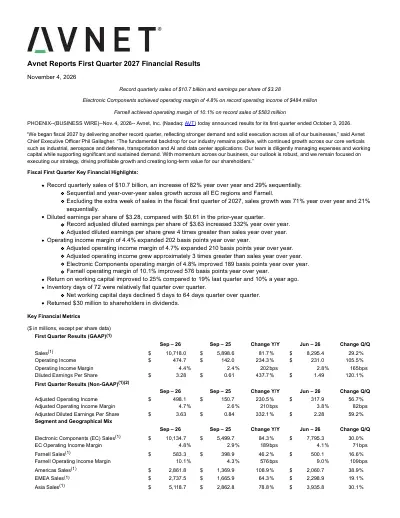
Our first quarter results came in well above our expectations, with record performance across all regions and both our Electronic Components and Farnell businesses. We achieved record sales of $10.7 billion, above the high end of our guidance, and record adjusted earnings per share of $3.63, also well above our expectations.
Importantly, the strength we saw at the top line translated into meaningful operating margin and earnings expansion, once again demonstrating the earnings power and operating leverage embedded in our business model as demand continues to strengthen. I'm extremely proud of how our team is executing in this dynamic business environment, and I want to thank them for their hard work and dedication.
Our results show the strength and resilience of Avnet's position at the center of the technology supply chain, supported by our global scale, broad component line card, diverse end markets, deep customer and supplier relationships, experienced and dedicated employees, and the differentiated capabilities we offer across the business. As we look across the market today, the environment continues to evolve in ways that play to those strengths.
Supply conditions continued to tighten during the quarter, with lead times extending across most semiconductor and IP&E, which is our interconnect, passive, electromechanical product categories, as demand broadened across all our end markets and applications. Pricing increases also began to extend beyond memory, with additional increases expected in the new calendar year.
Given these dynamics, there has been considerable discussion across the industry about what is driving the recent acceleration in growth. The question we frequently get is whether our growth is from true underlying demand or just inventory replenishment.
Let me take a few minutes to share our point of view on the question. From what we see in our business today, we believe underlying market conditions and demand are improving across all of our core end markets.
There may always be some replenishment or changes in customer ordering patterns as markets tighten, but the breadth of the demand across geographies, technologies, and end markets gives us confidence that what we are experiencing is much broader than any one factor like inventory replenishment. Our key demand indicators continue to support that view.
Book-to-bills remain solidly above parity in all regions, our backlog is healthy and growing, the amount of backlog due in [out-quarters?] continues to increase as lead times extend.
We are monitoring it closely. As investment in AI infrastructure increases, it drives demand for more than just processors.
Those solutions require a wide range of other semiconductors and IP&E technologies. As those investments move through the technology supply chain, they create opportunities across Avnet's world-class supplier line card and our diversified customer base.
While we are seeing accelerated growth in the data center market and are experiencing the ripple effects of that growth in our business, the opportunity for Avnet extends well beyond direct AI-related data center sales. This is demonstrated by the breadth and quality of the demand we are seeing outside of the data center.
That diversity continues to be one of Avnet's important strengths. We have a globally scaled electronic components line card.
We operate across a broad set of higher-growing end markets and maintain deep relationships across our customers and supplier base. Through Farnell, we engage with customers early in the product design process and support them from new product introduction through their journey to higher-volume production.
Now, with that, let me turn to the first quarter highlights for our businesses. Our Electronic Components business delivered another record quarter, with stronger than expected sequential and year-over-year growth across all three regions.
We saw profitable growth across all end markets, led by data center, aerospace and defense, and networking. In Asia, the region is entering its third consecutive year of growth, with another record quarter of sales reaching $5 billion.
Demand was higher across all end markets year-on-year, led by data center and industrial. As a reminder, Asia is regionally led by Taiwan, followed by China, Southeast Asia, and Japan.
In the Americas, sales more than doubled year-over-year, resulting in another record quarter for the region. Demand was broad-based and highest in data center, aerospace and defense, and networking.
One contributor to the Americas region's record performance was our Avnet Integrated Solutions business, which we discussed in our last earnings call. Integrated Solutions provides advanced systems integration and services for customers using purpose-built IT hardware.
We have long served industries such as industrial and healthcare, and we are seeing strong demand from our customers serving enterprise, hyperscale, and neocloud data centers. AI infrastructure build-out is a key contributor to that demand, and as we scale the business, it is contributing to greater operating leverage and profitability in the region.
In EMEA, sales grew both sequentially and year-on-year for the fourth consecutive quarter, reflecting continued improvement in the region. The region also achieved record sales during the quarter, which was led by demand across several verticals, including industrial and transportation.
Across EC, we also continue to see strong momentum in the capabilities that differentiate Avnet well beyond fulfillment component distribution. Our demand creation activity remains healthy, with new design registrations continuing to provide a strong pipeline of future opportunities.
Our higher-margin IP&E business also continues to perform well, nearing $1.7 billion in sales for the quarter, or more than $6 billion of sales when annualized. As we have said before, every semiconductor-based solution requires a complement of connectors, passives, sensors, power, and other technologies around it, and next-generation systems require ever-increasing connectivity.
The growth we are seeing in these complex systems plays directly into the full suite of solutions we provide our customers, combining both semiconductors and IP&E. Momentum in our Supply Chain Solutions business continues to also grow, as large OEMs increasingly rely on our capabilities to provide resiliency to complex and evolving supply chains.
Our supply chain services engagements are expanding across a growing set of customers, particularly in data center infrastructure, networking, and transportation, where demand trends remain favorable. Now, turning to Farnell.
Farnell delivered a record sales quarter and returned to a double-digit operating margin, benefiting from strong execution by the team and the broader market recovery. We are seeing improving demand across all regions, while our Power of One focus continues to create opportunities by combining Farnell's digital and high-service distribution capabilities and broad customer base with Avnet's global scale and customer and supplier relationships.
Farnell's growth for on-the-board components comprised of semiconductors and IP&E was similar to the growth we saw across the EC business. We were pleased with what the Farnell team delivered this quarter.
The results demonstrate the strength of the business and the operating leverage Farnell can achieve as it grows. Farnell also gives Avnet an important position early in the product life cycle, allowing us to engage engineers during the design phase and complementing our capabilities as customers move toward higher-volume production.
As I step back from the quarter, I think there are several points worth emphasizing. First, as we've been stating for some time now, we embrace our position at the center of the technology supply chain.
We are primed to benefit from robust growth in the traditional markets we serve, including the powerful, emerging megatrends driving electronic component demand, including drones, robotics, and edge intelligence, which are still in the early stages of growth. Second, our growth is broad-based, and we believe it is sustainable.
We are seeing improving market conditions and demand across all of our geographies and end markets, and our book-to-bill, backlog, and other leading indicators continue to support our confidence in the underlying demand environment and our current outlook. Finally, we also know that strong markets alone don't deliver results; execution matters.
The capabilities, scale, and infrastructure we have across Avnet allow us to support higher levels of revenue efficiency. The margin expansion, EPS growth, and return on working capital we delivered this quarter demonstrate the operating leverage and earnings power in our business model.
We will continue to stay close to our customers and suppliers, manage inventory and expenses with discipline, while still making investments to focus on delivering growth, profitability, and returns for all of our stakeholders. With that, I'll turn it over to Ken to dive deeper into our first quarter results.
Ken?
Ken Jacobson
Thank you, Phil, and good morning, everyone. We appreciate your interest in Avnet.
Our sales for the first quarter were $10.7 billion, up 82% year-over-year. On a sequential basis, sales were higher by 29%.
The first quarter had 14 weeks compared to a typical 13-week quarter. Normalizing the first quarter growth by excluding the impact of the extra week, sales grew 71% year-over-year and 21% sequentially.
Foreign currency did not have a meaningful impact on our sales growth this quarter. Regionally, on a year-over-year basis, sales increased 109% in the Americas, 79% in Asia, and 64% in EMEA.
On a sequential basis, sales increased 39% in the Americas, 30% in Asia, and 19% in EMEA. During the first quarter, sales from Asia represented 48% of total sales compared to 47% of sales last quarter and 49% of sales last year.
From an operating group perspective, Electronic Components had record sales during the quarter, increasing 84% year-over-year and 30% sequentially. Normalized for the impact of the extra week, EC sales grew 73% year-over-year and 22% sequentially.
Farnell also had record sales during the quarter, increasing 46% year-over-year and 17% sequentially. From a pricing perspective, memory prices increased during the quarter at similar levels to last quarter.
As a result, approximately 1/3 of both the sequential and year-over-year sales growth was attributable to pricing increases in the memory product category. We did not see a meaningful impact from pricing in other electronic component categories beyond memory during the quarter.
Gross profit margin of 10% decreased about 40 basis points year-over-year and sequentially, primarily due to product and customer mix in the quarter. Electronic Components gross profit margin was down about 30 basis points year-over-year and sequentially.
EC gross margin declined primarily due to the growth in our Avnet Integrated Solutions business, which had a lower gross margin than the EC average, but contributed meaningfully to the operating margin expansion. Farnell gross margin increased about 200 basis points year-over-year and declined about 60 basis points sequentially.
The year-over-year improvement in gross margin is primarily due to the growth of on-the-board components, which come with a higher gross margin. Farnell's gross margins at the product category level remained stable.
Turning to operating expenses, SG&A expenses were $576 million in the quarter, up $112 million year-over-year and $29 million sequentially. The sequential increase in SG&A is primarily due to a combination of higher sales, annual pay increases for employees that took effect in the new fiscal year, the impact of the extra week in the quarter, and from an increase in stock-based compensation expense.
As a percentage of gross profit dollars, operating expenses were 54%, exceeding our near-term target by approximately 600 basis points. We expect to continue to drive Avnet operating expense to gross profit dollar ratio to low 50s through the remainder of fiscal 2027.
Our EC business had a record low operating expense to gross profit dollar ratio of 46% for the quarter, compared to 69% last year and 56% last quarter. The Farnell operating expense to gross profit dollar ratio was 65% in the quarter, which is the lowest level since the first quarter of fiscal 2023.
As we move through fiscal 2027, we will continue to maintain a high level of cost discipline while still making the necessary investments in the business to enable profitable growth. For the first quarter, we reported adjusted operating income of nearly $500 million, and the Avnet adjusted operating margin was 4.7%, an increase of more than 200 basis points year-over-year and more than 80 basis points from last quarter.
This represents the fifth consecutive quarter of adjusted operating margin expansion and the highest Avnet operating margin since fiscal 2023. Adjusted operating income also grew approximately three times greater than sales compared to last year and approximately two times greater than sales compared to last quarter.
This is consistent with our continued expectation of driving operating income growth at least twice the rate of sales growth. By operating group, Electronic Components operating income was $484 million, and EC operating margin was 4.8% in the first quarter, a 71 basis points sequential increase.
Similar to last quarter, the sequential improvement in EC operating margin was led by the Americas, including both the core and Avnet Integrated Solutions businesses, with all regions increasing their operating margin over 45 basis points sequentially and even more year-over-year. We expect EC operating margin to reach our near-term goal of 5% in the second half of fiscal 2027.
Farnell operating income margin of 10.1% was its highest operating margin in more than three years. Farnell operating income margin grew by over 100 basis points sequentially, achieving our near-term target of returning the business to a double-digit operating margin.
We expect to continue to expand Farnell operating margin beyond 10% as they continue to grow and their product mix of on-the-board components improves. Turning to expenses below operating income, first quarter interest expense was $92 million, a sequential increase of $25 million, mainly due to higher debt levels to support working capital investments for stronger than expected sales growth.
The increase in interest expense negatively impacted adjusted diluted earnings per share by 23 cents quarter-over-quarter. Our adjusted effective income tax rate was 23%, consistent with expectations.
Adjusted diluted earnings per share of $3.63 was a quarterly record for Avnet and was well above the high end of our guidance. Adjusted diluted earnings per share grew 4.1 times greater than sales compared to last year and grew two times greater than sales compared to last quarter.
Turning to the balance sheet and liquidity, during the quarter, we invested $1.2 billion in working capital sequentially to support our profitable sales growth. Of this increase, approximately $2.1 billion came from inventories, substantially offset by a $1.8 billion increase in accounts payable.
Accounts receivable increased by approximately $900 million, which was the primary driver for the use of operating cash flow during the quarter. The increase in inventory was driven by a few factors.
Roughly 1/3 of the inventory increase was due to memory-related pricing. Another third was attributable to increases specific to supply chain services engagements.
The final third was primarily due to a combination of sales growth as well as the timing of inventory receipts near our quarter-end of October 3rd, which was later than the quarter-end of many of our suppliers. Inventory continues to be a key driver for our business and helped enable us to achieve record sales and earnings during the quarter.
We are positioning ourselves appropriately from an inventory perspective so that we can capitalize on the numerous opportunities we see in the markets we serve. Inventory days remained relatively flat sequentially.
Our accounts payable and accounts receivable days improved quarter-over-quarter. Overall, working capital days decreased five days quarter-over-quarter to 64 days.
We continue to focus on disciplined inventory and working capital management, which is contributing to the improvement in our return on working capital. Our return on working capital improved by approximately 600 basis points sequentially to 25%, which is the highest level of returns in the past 10 years.
The increase in working capital led to an increase in debt of approximately $950 million and an approximate $842 million use of cash from operations for the quarter. Because we expect strong sales growth in the coming quarter, we also anticipate using cash to support that growth.
As growth moderates, we expect cash generation to catch up, and we are currently expecting to generate positive cash flow by the end of fiscal 2027. During the quarter, we raised additional capital, primarily through various debt instruments and facilities, to support these increased working capital requirements.
We expect to continue to raise additional capital over the coming quarters as we support the anticipated growth through the remainder of fiscal 2027 and beyond. We ended the first quarter with a gross leverage of 3.1 times, down from 3.2 times in the fourth quarter, and approximately $1.2 billion of available committed borrowing capacity.
We anticipate reaching our target of three times leverage by the second half of fiscal 2027. Cash used for capital expenditures was $24 million during the quarter, as expected.
With regard to our capital allocation strategy, we continue to prioritize supporting our profitable growth while maintaining a strong and flexible balance sheet. We also increased our quarterly dividend by approximately 6% to 37 cents per share this quarter.
Over the past decade, we have more than doubled the dividend, with the average annual increase exceeding 10%. During that same time, we have also returned approximately $1 billion to shareholders through these dividends.
We also expect to continue to explore potential tuck-in M&A opportunities that equip us with the capabilities needed to further advance our strategic priorities and provide a strong risk-adjusted return on capital. Finally, as cash generation improves, we'd also expect to revisit our share buyback program, which still has $226 million of authorization remaining.
Turning to the second quarter guidance, we're guiding sales in the range of $11.1 billion to $11.4 billion and adjusted diluted earnings per share in the range of $3.90 to $4.10. Our second quarter guidance assumes current market conditions and electronic component availability, including in the memory product category, persist.
Our guidance implies a sequential sales increase of 5% at the midpoint. Adjusted for the extra week in Q1, Q2 sales are expected to increase 12% sequentially at the midpoint on a comparable basis.
This guidance also assumes similar interest expense compared to the first quarter, an effective tax rate of between 21% and 25%, and 87 million shares outstanding on a diluted basis. In closing, we're optimistic about the strong start to the fiscal year and the continued momentum we see in our leading indicators for fiscal 2027.
Our first quarter results and second quarter guidance demonstrate that our team continues to deliver profitable growth on the value proposition we bring to our customers and suppliers. With that, I will turn it over to the operator to open it up for questions.
Operator?
Operator
Thank you. Ladies and gentlemen, we will now be conducting a question-and-answer session.
If you would like to ask a question, please press star one on your telephone keypad. Confirmation tone will indicate that your line is in the question queue.
You may press star two if you would like to remove your question from the queue. For participants using speaker equipment, it may be necessary to pick up your handset before pressing the star keys.
One moment, please, while we poll for questions. Thank you.
Our first question is from Mr. William Stein with Truist Securities.
Please proceed with your question.
William Stein
Great. Thanks for taking my question.
Congrats on the great results and outlook. I'm hoping you can talk to us a bit about lead times.
We know they're stretching. You cited it in your prepared remarks.
I'm wondering if that's challenging your ability to deliver product and grow, and if so, maybe quantify any impact from that?
Phil Gallagher
Yeah. Hey, thanks, Will.
Thanks for the comments. Appreciate it.
This is Phil. We did comment on that, and we are seeing lead times start to go out more, I would say more broadly.
We know what's happening in memory and the likes. Starting now see it, power, well power's been out, starting to see it in passives, MLCCs, discretes, it's much more broad, controllers.
I can't say, and with that, as we also talked about, we're starting to see some additional inflation and pricings as well with ASPs starting to get impacted again, probably most at first starting in the new calendar year. To date, I can only say, Will, to date, we've not seen that directly inhibiting our growth currently through the quarter or in our guidance.
Tough to call into next year yet, as things tighten up. Right now, I would say not a lot.
Are some customers struggling, particularly if they're heavy concentration of memory in their BOM? They're having a tough time.
Yes, we have some customers that maybe aren't producing maybe as many tablets as they were before, things along those lines. That's tough to measure.
It's not like they're done, they're just slowed down. It's not really broad-based at this point.
Of course, we're watching it because we know what has happened in previous cycles where lead times go out, you start to have some challenges there. To date, again, we're not seeing that as an impact to the growth or the guidance.
William Stein
Great. I appreciate that.
As a follow-up, I'd like to ask about guidance and maybe going out a little bit further. You gave us a great December quarter guide, even considering the extra week that I think you just had in September.
The December guide is still, I think, six or seven points above typical seasonality. Understanding you're not guiding further than a quarter, when we look to March, I think normal seasonality is approximately down 1% or 2%.
Would that be an appropriate way to think about growth in this part of the cycle, or considering the strength that we're seeing, should we expect stability or sequential growth into March?
Phil Gallagher
Yeah. Let me take a shot at that, and I'll pass it over to KJ for some comments.
We don't guide out that far, you're right, thanks for saying that. As far as we look out, the March quarter is kind of a wild card the last several years if you look at it with the Lunar New Year.
Last year did not have much of an effect, the year before it did. You're right, typical, which is a word we don't use much anymore because nothing seems typical, March would be down more dramatically in Asia Pac due to Lunar New Year, and the West would come back up.
It was almost offset, but you're right, down 1% or 2%. Right now, as we look at it, again, we're not guiding, and the wild card being Lunar New Year, we feel the West is going to still be pretty strong into the March quarter.
Just looking at the backlog, which I'm looking at as we speak, the backlog looks good for March quarter overall. The book-to-bills, as we talked about, continue to be positive.
I'll just say we're optimistic about the March quarter, may even being a little bit better than what you called out as typical seasonality. Ken?
Ken Jacobson
Yeah. Will, I'd just add that I think at that kind of growth rate you described, let's say a typical seasonal, that would also imply, call it a 20 to 40 basis point uplift in gross margin because of the mix shift to the West?
I think the West is looking good. The wild card is the impact of Lunar New Year and Asia.
The counter to that would be if you have higher growth than that, above seasonal, that's likely because Asia isn't declining as much due to the Lunar New Year holiday, similar to the last couple of years.
William Stein
Great. Thank you.
Phil Gallagher
Thanks, Will.
Operator
Thank you. Our next question is from Melissa Fairbanks with Raymond James.
Please proceed with your question.
Melissa Fairbanks
Hey, guys. Thanks very much.
We heard from one of your suppliers earlier this morning. They noted that channel inventories are pretty tight across most geographies, which I think is pretty consistent with what you're seeing as well, but actually exceptionally low in Asia.
I know that Asia has been a very strong market for you for several quarters now, just wondering what you're seeing in terms of your ability to address upside demand in Asia and what your own inventories in Asia look like today?
Phil Gallagher
Thanks, Melissa. I think I know who you're referencing there.
Anyway, again, right now, again, as you saw, we grew inventories, I'm sure we'll give you a breakout on where that growth was and inventory. We're not comfortable, we're very confident with our inventory position now, but as lead times go out, we want to make sure we're replenishing appropriately.
I'm looking at our Asia inventory actually grew sequentially quarter-to-quarter in total dollars in Asia Pac, and the inventory days actually went up about a day, a day 1.5 days or so. Again, right now, we're feeling pretty good about the inventory position we have.
Again, can change quickly, based on the market and Will's previous questions, but right now we feel pretty good about it. Now, also need to qualify, it's a broad question, right?
Inventory, in certain areas in power and discretes and power caps and things like that, anything around power probably going to get a lot tighter than some other products. I give you a broad answer to a broad question.
You really need to break it down by commodity and see where we're appropriately pipelined and where we have the inventory positions we need. There could be some pockets that were shorter than we need to be, but in total, our inventory is in pretty good shape.
Melissa Fairbanks
That's great! I would be happy to break it down by component if you want to give me that data.
Look at those sheets. I want to zoom in.
You mentioned that demand creation activity remains healthy. With as much as your mix or just the market mix in general is pivoting to data center, aerospace and defense, networking, kind of some of these higher-touch areas, how much is that impacting your demand creation business?
Are you able to engage with customers, are they reaching out to you earlier in the design cycle?
Phil Gallagher
It's a really good question, cuz some of that obviously where we're dealing directly into the data center, some of that might be more just fulfillment. Wouldn't even have demand creation tied to it in many cases, particularly if it's a hyperscaler, cuz a lot of that's probably being done direct and we're doing the fulfillment and supply chain piece for that.
However, again, good question because you would think with the growth that we had, and fulfillment increasing in that space, and maybe it's not all demand creation, you would think the percentage of demand creation would come down as a percentage of our sales, and it's actually flat, which is really good news. Demand creation revenue, yeah, as a percentage of our total revenues actually stayed roughly flat.
Flat as a percentage, dollars were up. Obviously, it had to be up to keep pace to stay flat as a percentage of total sales.
We're really pleased with that, frankly, cuz it's critical to us, it's critical to our suppliers, and it helps the margin profile as well.
Melissa Fairbanks
Great. Thanks very much, guys.
Phil Gallagher
Thanks, Melissa.
Operator
Thank you. Our next question is from Mr.
Ruplu Bhattacharya with Bank of America. Please proceed with your question.
Ruplu Bhattacharya
Hi, thanks for taking my questions. First question is on inventory.
Ken, I think you said of this $2 billion sequential increase, 1/3 was due to supply chain services. How much revenue did supply chain services account for in the quarter?
How should we think about the impact of this going forward? What inventory days are you targeting?
I have a follow-up.
Ken Jacobson
Roughly a third of the inventory growth came from inventory build for supply chain services, and again, the revenue there is more of a services revenue, you're not going to see it a lot on the top line, but would see it in the gross margin. I don't think we'd expect it to build meaningfully in the next couple quarters from the supply chain services perspective.
That business is growing pretty well, Ruplu. I would say, the rest of the business is growing pretty hot as well, so, I think it's contributing overall.
I think from an overall inventory days, I think we'd expect things to continue to be flattish to down slightly. I think we feel pretty good about the days overall.
The returns for the quarter were really good, and the supply chain services business really helps on the returns side of things as well, we are continuing to ramp that business, especially in data center and automotive-type customers. We wouldn't expect the inventory to continue to build much from here, but be more stable from a supply chain services perspective.
Overall, I would say, we grew $2.4 billion from last quarter, you're going to need some more inventory, and, some of that was timing differences at the end of the quarter as well, and then the last piece that we referenced was, the pricing, that, some of the memory-related products, we had a pricing increase during the quarter, and the inventory we had at the end of the quarter reflects that price inflation.
Ruplu Bhattacharya
Got it. Thanks for the details there.
Can I ask a follow-up on operating margins? Obviously, great performance in both Farnell as well as the EC business.
EC, you're already at 4.8%, and I think on the call you said you can get to 5% in the second half of fiscal 2027. What drives the ceiling, or what is the ceiling in operating margins for that business?
How should we think about the puts and takes there? Same question, I guess, for Farnell.
You're already at double-digit margins. Is there a ceiling to this?
Can you get back to the 14, the mid-teens kind of operating margins over time? Should we continue to think 50, 100 basis points every quarter?
Can you just give us how we should think about where the ceiling is for these two businesses in terms of operating margin? Thank you.
Ken Jacobson
Maybe I'll comment this way. I think it's higher than 5% for EC and higher than 10% for Farnell.
We continue to drive steady progress there. I think the 50 to 100 basis points you mentioned was more of a Farnell commentary versus EC.
EC was a little bit more modest. Look, we're continuing to drive efficiency.
You can see the expenses didn't go up very much. This quarter, the guidance would imply further improvement.
From our OE to GP perspective, I think we're going to be in the low 50s, right, and we continue to drive that lower. That will help continue to drive the operating margin improvement.
I think we want to hit those near-term goals and then reset a little bit. Again, I think Farnell in the low teens over time, and then, EC trending towards 6% over time.
Part of it depends on the growth, part of it depends on regional mix, but, we're continuing to drive efficiency with the expense model and the working capital model to continue to drive the returns up 25% this quarter, but, continue to make traction there as well.
Phil Gallagher
Ruplu, this is Phil. Thanks for the comment, and, we're proud of the team thus far.
We're not planning on stopping that progression, okay? Farnell's listening on the call, and the plan is to get that to continue to increase quarter-on-quarter.
I'll go back to exactly what Ken just said, the regional mix. As Europe gets stronger, that helps all our businesses, frankly, is the higher margin profile, and then the commodity mix, as we expand on-the-board components with Farnell, that runs at a higher margin than the traditional test, measurement, and single-board computers.
Constantly driving that, and same thing on the core, okay? The key through all this upside, if you will, is to manage tightly our expenses while making the investments we need to make to drive the growth and efficiency, it's a maniacal focus on that.
Ruplu Bhattacharya
Can I just ask, going forward, do you think regional mix remains a bigger contributor to margins or a bigger factor for margins versus product mix or supplier programs or other investments?
Ken Jacobson
I think it goes back to the seasonality more so than, let's say, a fundamental mix shift. I think Asia's performed pretty well.
They're well-positioned. You can see the growth over the last three years, we don't see Asia slowing down, although, in the third quarter with Lunar New Year, they could have, a little bit lower sales just because of less shipping days, but, I think the mix where Asia's roughly high 40s to 50% of our mix kind of continues into the foreseeable future.
We're still going to continue to drive operating margin expansion in the West. I think it's hard to say, Ruplu, exactly where the regional mix lands, but I think for the time being, we should think about it being flattish absent seasonality trends.
Ruplu Bhattacharya
Great. Thank you so much.
Ken Jacobson
Thanks, Ruplu.
Operator
Thank you. Our next question is from Mr.
Joe Quatrochi with Wells Fargo & Company. Please proceed with your question.
Joe Quatrochi
Thanks. I guess maybe just following up on that line of thinking, if Asia is stronger than seasonal into the March quarter, do you think you can get EC margins back to that 5% in the second half?
Ken Jacobson
Yes. I don't look at that to be a constraint.
I think either way, we'll get it through growth or we'll get it through gross margin expansion from the mix.
Joe Quatrochi
Got it. As a follow-up, I think, Ken, I think I heard you say expect to raise capital over the coming quarters to fund growth.
Can you just kind of maybe share some more color on that? Are you expecting to raise some more debt?
Ken Jacobson
I think with the growth we've seen, $3.6 billion in the past six months, we've just needed to have more borrowing capacity to kind of fund those receivables and the inventory. We think it starts to normalize a little bit, but we've done notes, we've done term loans, we've done upsizing to our revolving line of credit, and we've done more securitization.
We'll continue to tackle those things, and we'll have some maturities coming due that we'll have to refinance. Interest rates aren't the most favorable right now, but, we'll be thoughtful about taking some of those notes out and extending them.
Joe Quatrochi
Maybe if I could sneak one more in. What's embedded in the guide from just a memory pricing perspective in terms of the benefit to revenue growth you've seen over the last few quarters?
Ken Jacobson
The guide would imply very modest improvements in pricing. It's just kind of flattish pricing.
I think Phil gave some commentary. We're seeing more announced in the new calendar year, we'd expect maybe a little bit more impact there.
We're still digesting that, but, we're kind of going on a guide of flattish pricing and consistent availability.
Joe Quatrochi
Thank you.
Ken Jacobson
Thanks, Joe.
Operator
Thank you. Gentlemen, there are no further questions at this time.
I will now turn it back to Phil Gallagher for closing remarks.
Phil Gallagher
Great. Thank you very much.
I want to thank everyone for attending today's earnings call. Look forward to speaking to you again at our second quarter fiscal year 2027 earnings report in early February.
Have a great rest of the day.
Operator
Ladies and gentlemen, this does conclude today's teleconference. You may disconnect your lines at this time.
Thank you for your participation.