Axalta Coating Systems Ltd.
Q3 FY2026 · Earnings Call TranscriptOctober 29, 2026
Operator
Ladies and gentlemen, thank you for standing by. Welcome to the Axalta Coating Systems Q3 2026 earnings call.
All participants will be in a listen-only mode. A question-and-answer session will follow the presentation by management.
Today's call is being recorded, and a replay will be available through November 5th. Those listening after today's call should please note that the information provided in the recording will not be updated and therefore may no longer be current.
It is now my pleasure to turn the call over to Colleen Lubic, Vice President of Investor Relations. Please go ahead.
Colleen Lubic
Good morning, everyone, and thank you for joining us to discuss Axalta's third quarter 2026 financial results. I'm Colleen Lubic, Vice President of Investor Relations.
Joining me today are Chris Villavarayan, our Chief Executive Officer, and Carl Anderson, our Chief Financial Officer. You can find today's presentation and supporting materials on the Investor Relations section of our website at axalta.com.
Before we begin, please turn to slide two for our forward-looking statements and non-GAAP disclosures. Our remarks today and the slide presentation may include forward-looking statements reflecting our current views of future events and their potential impact on Axalta's performance, and with respect to the proposed merger of equals between Axalta and AkzoNobel.
These statements involve risks and uncertainties, and actual results and outcomes may differ. We're under no obligation to update these statements.
Our remarks and the slide presentation also contain various non-GAAP financial measures. We have included reconciliations of these non-GAAP financial measures to the most directly comparable GAAP financial measures.
Please refer to our filings with the SEC for more information. With that, I will now turn the call over to Chris.
Chris Villavarayan
Thank you, Colleen, and good morning, everyone. Let's turn to slide three.
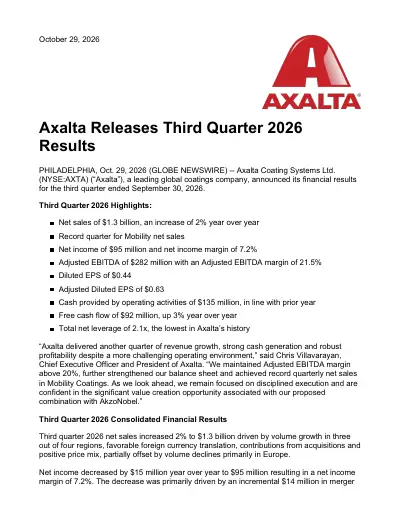
Net sales in the third quarter increased 2% year-over-year to $1.3 billion, with volume growth in three of our four end markets and three of our four regions. Mobility Coatings performed exceptionally well, delivering record quarterly net sales and record third quarter adjusted EBITDA.
Commercial Vehicle net sales grew 24%, Light Vehicle once again outperformed underlying global production trends, and Industrial showed modest growth. We delivered adjusted EBITDA of $282 million and adjusted EBITDA margin of 21.5%, marking our 11th consecutive quarter above 20%.
While our performance in the quarter remained strong, results were below our expectations, driven primarily by softer volumes in Europe refinish. Sales in the region were lower than anticipated following five consecutive quarters of record sales as a weakening macroeconomic environment led distributors to adopt more cautious ordering patterns during the quarter.
Importantly, our pricing actions this year continued to offset inflation, resulting in positive price-mix for the business. While the current operating environment is affected by sluggish end markets, geopolitical uncertainty, and rapidly increasing raw material and freight costs, we continue to strengthen our financial position.
Free cash flow was $92 million, up 3% year-over-year despite absorbing approximately $21 million of merger-related cash costs during the quarter. Year-to-date, free cash flow is up 25% compared to the prior year period, inclusive of approximately $42 million of M&A-related cash costs, while capital investment remained at record levels.
Total net leverage ended at a record low 2.1 times, and gross debt fell below $3 billion for the first time in company history, approximately $500 million lower than two years ago. We're gaining new business in attractive markets, generating strong margins, and converting earnings into cash at a high level.
Through September, we have won approximately 2,600 net new body shops and believe the pipeline remains strong. Additionally, Industrial sales in Asia Pacific grew again in the third quarter, marking seven straight quarters of net sales growth, and CTS grew double digits year-over-year to a quarterly net sales record.
Combined with the strength of our balance sheet, we're well positioned to navigate the current environment. Now to Carl for the results.
Carl Anderson
Thank you, Chris, and good morning, everyone. Turning to slide four.
Third quarter net sales increased $23 million versus the prior year period, coming in at $1,311 million. The year-over-year improvement was driven by significant growth in Commercial Vehicle, favorable foreign currency, contributions from refinish acquisitions, and favorable price-mix.
Net income was $95 million for the quarter, and adjusted EBITDA totaled $282 million, a decline of 4% compared to the prior year period. This decline was primarily driven by lower refinish volumes in Europe and higher freight rates due to the significant increase in diesel prices.
Overall, freight costs were up over 15% year-on-year. SG&A was up 2%, while operating expenses declined 3%, reflecting strong cost discipline across the organization.
As a result, adjusted EBITDA margin was 21.5%, a good outcome given the volatility in costs and demand experienced during the quarter. Adjusted diluted earnings per share was 63 cents, down 6% year-over-year as lower volumes, primarily in refinish Europe, and higher variable costs were partially offset by lower interest expense.
Cash provided by operating activities was $135 million, in line with the prior year period, and free cash flow increased 3% year-over-year to $92 million, inclusive of approximately $21 million of incremental merger-related cash costs incurred during the quarter. Let's turn to the segment results, beginning with Performance Coatings on slide five.
Performance Coatings net sales were $818 million in the third quarter, a decrease of 1% to the prior year. Refinish net sales were $504 million, a decrease of 2%.
Lower volumes in Europe were the primary headwind in the quarter, more than offsetting positive price-mix and contributions from acquisitions. Encouragingly, on a year-to-date basis, refinish net sales are modestly above prior year levels, supported by contributions from acquisitions, new body shop wins, and positive price-mix, demonstrating our ability to outperform the market.
Industrial net sales were $314 million, an increase of approximately 1% compared to the prior year, driven primarily by volume growth in Asia Pacific. Demand remains strong in energy solutions, Europe remained resilient, while demand in North America continues to be subdued.
Performance Coatings adjusted EBITDA was $188 million, a decrease of 11% versus the prior year period, and adjusted EBITDA margin was 23%. This decline reflects lower volumes, higher raw material and freight costs, and increased investments to accelerate conversion of our recent MSO wins that we were awarded during the quarter.
These headwinds were partially offset by positive price-mix and contributions from acquisitions. The velocity of body shop conversions are expected to increase in the fourth quarter, which speaks to the success of our team, however does create short-term margin compression as we finish out the year.
Turning to slide six. Mobility Coatings was a clear bright spot in the third quarter.
Net sales increased 7% year-over-year to a quarterly record of $493 million. Light Vehicle net sales were $374 million, an increase of 2%, driven primarily by favorable foreign currency translation.
Global auto production was down almost 2% in the third quarter, while our volumes were roughly flat year-over-year. Our Commercial Vehicle business delivered an outstanding quarter.
Net sales increased 24% year-over-year to $119 million, supported by volume growth across all four regions. Our Commercial Transportation Solutions business continues to perform at exceptionally high levels, and we are benefiting from increased Class 8 production in North America.
Momentum in the business has been building for several quarters, and with Class 8 production back above replacement demand levels, we believe the business is well positioned to benefit from the expected production ramp into 2027. Adjusted EBITDA was $94 million, up 13% year-over-year, with adjusted EBITDA margin expanding 100 basis points to 19%.
This improvement reflects strong operational execution, favorable volume leverage, and disciplined cost management. Turning to slide seven.
During the first nine months of the year, we reduced gross debt by $211 million, bringing total debt below $3 billion for the first time in the company's history. In fact, since September 2024, we have reduced debt by approximately $500 million, highlighting the consistent cash flow generation of our business model.
As a result, year-to-date interest expense declined by $22 million versus the prior year. Through the first nine months of the year, cash from operating activities increased 16% to $355 million.
Free cash flow increased 25% to $220 million, inclusive of more than $40 million of merger-related cash payments. Excluding these costs, underlying free cash flow is up nearly 50% year-over-year.
Total net leverage ended the quarter at 2.1 times, a record low for the company. This financial strength provides significant flexibility and positions us well as we prepare to close the merger with AkzoNobel in early 2027.
Turning to slide eight. Based on our third quarter results and revised expectations for the fourth quarter, we are adjusting our full year expectations for 2026.
There are two primary factors driving this change. First, third quarter results were lower than planned, driven primarily by lower refinish volumes in Europe.
Second, we are taking a more measured view of the fourth quarter given the recent increase in macroeconomic uncertainty in our end markets. We now expect fourth quarter net sales to be approximately flat year-over-year compared to being up 3% previously.
Additionally, we are accelerating investments to convert the strategic MSO wins announced in July, which sets us up for future growth, but does create some near-term margin pressure. In the fourth quarter, we now expect adjusted EBITDA of $254 million to $264 million and adjusted diluted earnings per share of approximately 55 cents.
For the full year, we now anticipate adjusted EBITDA of $1.1 billion to $1,110 million and adjusted diluted earnings per share of approximately $2.45. We also expect free cash flow of approximately $450 million, resulting from the reduction in EBITDA and higher merger-related costs as we get closer to deal closing.
Excluding deal costs, we are generating greater than $500 million of free cash flow, highlighting the strength of our operating model, which is delivering another year of strong cash generation. Turning to slide nine.
Let me update you on the progress we have made towards closing our proposed combination with AkzoNobel. We have now secured regulatory clearance in two-thirds of the required jurisdictions, and the divestitures of AkzoNobel's European refinish business and Axalta's North America building products business are underway.
These are important milestones that keep us on track for an expected close in early 2027. This combination will create a premier global coatings company, NYSE-listed, with unmatched scale, technology breadth, and a global customer platform that neither company could replicate independently.
The strategic and financial case has only strengthened since the initial announcement. We remain confident in approximately $600 million of annual run-rate cost synergies, with roughly 90% captured within the first three years following close, and also believe there are meaningful revenue synergy opportunities through cross-selling, technology sharing, and expanded customer access.
Integration planning is advancing, our teams are energized, and we are focused on delivering substantial value creation. Now, I'll turn the call back to Chris.
Chris Villavarayan
Earlier this month, we announced the name of the combined company: Axanzo. We believe this name unites the legacies of Axalta and AkzoNobel under a single identity and reflects what the combination stands for: honoring our heritage, the trusted brands, technology, and customer relationships both companies have built over generations; creating a global coatings leader, a diversified portfolio with scale, strength, and reach to accelerate sustainable growth; and engineering to outperform, a shared ambition to deliver breakthrough innovation and a new world performance.
After closing, Axanzo will trade on the New York Stock Exchange under the ticker AXZ. This is a pivotal moment, not only for the two companies, but also for the industry.
Axalta will enter this combination from a position of strength: 11 consecutive quarters of adjusted EBITDA margin above 20% and the strongest balance sheet in our history, while investing in future growth. As we work towards the next chapter, our focus remains unchanged: serving customers, supporting our employees, and creating long-term value for shareholders.
I believe more than ever that the combination with AkzoNobel offers a unique opportunity to bring together two highly complementary businesses and create a stronger, more competitive global coatings company. I want to thank our employees, customers, and shareholders for their continued support.
Operator, please open the line for questions.
Operator
Thank you. If you would like to ask a question, press *1 on your keypad.
To leave the queue at any time, press *2. Once again, that is *1 to ask a question.
We'll take our first question from John McNulty with BMO Capital Markets. Please go ahead.
Your line is now open.
Caleb Boehnlein
Hey, good morning. This is Caleb on for John.
I just had a quick question on refinish. With insurance premiums starting to show some signs of moderation, but loss rates looks like they're continuing to push higher.
Maybe just how do you think about these dynamics as they play out through '27, and then what that means for refinish for next year? Thank you.
Operator
I do apologize for the delay.
Chris Villavarayan
...slightly down, which is a good story in terms of where we were. The difference here was our expectations versus what ended up in Europe.
In Europe, we certainly have had five quarters of record-on-record performance, and here, insurance rates have not gone through the experience in North America, we were actually expecting growth, not stability, and that was the difference in our print in Q3.
Caleb Boehnlein
Got it. Thanks.
I don't know if it was just on my end, but I think you cut out halfway through the answer. I'll just try and follow up later [to?]
catch what I missed. Then maybe just in light vehicle, just kind of talk to your outperformance relative to global auto builds in Q3, and how you're thinking about Q4 with it looks like Chinese production expected to step down further?
Thank you.
Chris Villavarayan
Love to, Cale. That's been a really, really good story for us in Q3.
Here, actually, if you look at builds, builds are actually slightly down, but our sales were flat. Even on the light vehicle side, with our performance in Asia and our performance in Latin America, we were able to offset the weakness that we saw in North America and Europe, so that was a great story.
Additionally, a lot of the great news that we saw here was also what happened in CV. CV was up 24% in the quarter.
That certainly provided a tailwind. Additionally, all our wins on the CTS side just provided a great, great story for us and drove the margins that you saw.
As I think about, let's call it the future, or as I look at Q4, yeah, we're seeing softness in Asia, but what we're also seeing is growth of what our customers are doing shipping out of Asia into Southeast Asia, and that's actually driving a great amount of, let's call it growth, up from our expectations. In terms of that, we're coming in slightly above our expectations in Asia as well as the great wins in Latin America.
Caleb Boehnlein
Great. Thank you.
Chris Villavarayan
You're welcome, Cale.
Operator
Thank you. We'll take our next question from Kevin McCarthy with Vertical Research Partners.
Please go ahead. Your line is open.
Kevin McCarthy
Yes, thank you and good morning. Chris, within the Performance Coatings segment, appreciate your updated thoughts on price-mix trends there.
For example, can you comment on where pure price might be running versus the mix component? I know that can be quite volatile.
What is your outlook for that component in the fourth quarter and beyond, and maybe you can provide some color as to pricing trends on refinish versus the industrial lines within the segment? Thank you.
Chris Villavarayan
Sure. Absolutely, Kevin.
Pure price for refinish has been 4.8%, and as I look at consolidated for the company, pure price is running at 2%. To your question on what's happening with price-mix, price-mix for us is still positive through the year.
As you point out, as you think about our strategy, mix has a part in terms of our strategy for growth here. As you think about us entering adjacencies, as you think about us entering the economy segments, these come in at a lower margin than what we have in terms of refinish.
Overall to the Performance Coatings, or at least refinish margins, it's a little dilutive, but to Performance Coatings or to the entire company, I would say we're positive. The best way to look at this and probably see how we've performed here is if you go back three years ago, Kevin, our sales was about $2.1 billion.
If you look where we're going to close this year, in refinish, we're going to be around $2.1 billion. Margins in '24 and '25 were 24%, margins in Performance Coatings this year, even with some of the uncertainty we have seen, will be 23.5%.
It just shows the strength of what we were able to overcome by putting in or growing in other areas, and we were able to still maintain that margin.
Kevin McCarthy
Thank you very much.
Chris Villavarayan
You're welcome.
Operator
Thank you. We'll take our next question from David Begleiter with Deutsche Bank.
Please go ahead. Your line is now open.
David Begleiter
Thank you. Good morning.
Chris, just on Industrial, two of your peers this week reported pretty strong sales in their industrial businesses. Your sales were a little more modest.
How do you tie those trends together?
Chris Villavarayan
It's really mix. Thanks for that question, David.
It's a lot to do with mix and our channels, as well as the areas that we play in. If you think about it, and the best way to describe our business, is there's a portion in Asia, but the majority of our business is North America and is tied to retail, residential.
As with where interest rates are and what's happening with builds, that's the weakness we see. The bright spot for us is actually our Asia business.
Here, what we provide for everything that is in what we call our electrical space, impregnating resins for motors, as well as what we provide for battery coatings, has actually gone seven quarters where we've continued to grow quarter-over-quarter-over-quarter. That business, as it's tied to what we're doing in Asia, is growing, but the reality is the rest of it, which is tied to residential, has been weak, specific to North America.
I will point out, though, Europe has been resilient. Actually, in Q2, we saw volumes pick up.
Again, as as you look at our guide for Q3 and what we were expecting in the back half, David, we were actually expecting 2% to 3% up. Part of it was a pick-up in expectations also in industrial in Europe, but what we saw was more flat there, and that was what drove our results.
I think that just the expectations for us was we weren't expecting stability, especially coming out of Q2 and our strong performance. We were expecting Q2 to Q3 and Q4 to start be up 2% to 3%.
David Begleiter
Very helpful. Just in European refinish, it's been pretty weak there for a while.
What's causing the change in distributor behavior now? Thank you.
Chris Villavarayan
I wouldn't characterize it, at least for us, as being weak. Europe for us has grown 4% to 5% the last three years.
Actually, even to date, we're up 5% in Europe. It's been five quarters of record-on-record performance for us.
That was primarily why we thought Q3 would actually be a pick-up. Now, just, David, in terms of how we approach the market, we approach the market in Europe different than we do in North America.
We have three channels to market. We have our own retail shops, which is about 50, we have our own direct channel, where we have our own distributors, and then we have indirect, which is similar to North America, which is distributors that we partner with.
What we saw in, let's call it late August and in September, is that indirect channel really look at the inventory levels and, based on the macro and a bit of the political environment, decide to take a pause on filling inventory levels for Q4 as we normally expect, and that was primarily the driver here.
David Begleiter
Thank you.
Chris Villavarayan
You're welcome.
Colleen Lubic
Britney, I just want to interrupt real quick. Chris, we got a technical issue on the first question regarding refinish insurance inflation in North America.
Can you just comment on that? That was the first part of the question that you answered.
Chris Villavarayan
Love to. I think the best [unclear] is in as good news.
In fact, if I look at our performance in Q3, North America refinish volumes were actually down slightly, and it's been a very good quarter. We're starting to see stabilization in the marketplace, and especially with what we announced in Q2 with the 830 MSO wins, we do believe that, as I look at Q4 and far more importantly into 2027, we'll certainly start seeing an uplift, especially as the market starts stabilizing.
In terms of insurance premiums, certainly insurance premiums are starting to abate, miles driven is also growing slightly, and so as I look at all of the impacts, overall, I would say we're starting to offset the declines that the high declines we had seen for the last few years.
Colleen Lubic
Great, thanks, Chris. Britney, back to you.
Operator
Thank you. We'll take our next question from Ghansham Panjabi with Baird.
Please go ahead. Your line is open.
Josh Vesely
Hey, guys, good morning. This is Josh sitting in for Ghansham.
Maybe if I could just take a stab at a macro question. Just very high level.
Obviously, Carl, you talked about the full-year guide, kind of baking in some uncertainty on the macro front. Just given where interest rates are being higher, cost inflation continuing to ramp, just curious what your thoughts are about the demand trend line on a go-forward basis.
Just a high level across your end markets and geographies, especially in the context of you guys having exposure to interest rate-sensitive end markets and with costs inevitably flowing through to the consumer. Thanks.
Carl Anderson
Thanks for the question. I think very short-term, if you look at the Q4, we are guiding to about flat sales, and you should really think about it as refinish sales is expected to be flat on a year-over-year comparison, Industrial will also be roughly flat year-on-year.
Our Commercial Vehicle business, as Chris talked earlier, will be up year-on-year, but light vehicle's probably going to be down to flattish. That kind of walks through the very short-term demand picture for the fourth quarter as we finish out the year.
As we pivot into '27, we're not really kind of providing any views or guide yet, but I would look at commercial vehicle production is expected to take another increase in '27, I think that's a positive tailwind that will be coming in next year. I think, as Chris is answering a lot of questions on refinish, again, I think we're getting more and more bullish of what we're beginning to see here in North America, but also even with Europe, yes, even with what happened for us in the third quarter relative to expectations, we're still growing that business 4% to 5%.
I think our expectations, as we continue to grow, our acquisition strategies, especially in Europe and refinish with distribution, has worked extremely well, and as the team looks to evolve and drive more accessories in retail, all those are kind of positive trend lines as we get into next year. To your point on interest rates, that is something that, if you look specifically in the Industrial business, we are always betting on at some point there will be a change in construction.
I think that one is probably a little bit more tempered as we think about here in the near term, but overall, as we think what's in front of us, we're pretty excited about what '27 could look like down the road.
Josh Vesely
Perfect. Thank you.
Carl Anderson
Thank you.
Operator
Thank you. We'll take our next question from Christopher Parkinson with Wolfe Research.
Please go ahead. Your line is now open.
Harris Fein
Great, thanks. This is Harris Fein on for Chris.
Just wanted to maybe talk a little bit about the net body shop wins you're seeing. You mentioned some upfront costs to onboard those customers.
Just any color you can give on the timing of how those should flow in relative to when the business actually starts to flow in, and also what is the rough geographic breakdown of those body shop wins that you're seeing year-to-date? Thanks.
Chris Villavarayan
Sure. Good morning, Harris.
The cool part about I think our story, as I look through to Q3, is what we normally win in a year, we've been able to achieve by this quarter, which is around 2,600 body shops. The real story for us was what happened in Q2.
We won two very large body shops that are in the top 10. Most of that volume is in North America.
In terms of the launch of that, the velocity of, let's call it those implementations, are accelerating. A lot of that will start up in Q4 and then mostly in the front half of '27.
In terms of our investments, just to give you a perspective, our investments in Q4 is almost $8 million, so that will just give you a view of what it takes to be able to invest to get these up and running into next year.
Operator
Thank you. We'll take our next question from Matthew DeYoe with Bank of America.
Please go ahead. Your line is now open.
Matthew DeYoe
Thank you. I'd like to drill in a little bit on the refinish volume side.
Can you share how much volumes were down in Europe and refinish just on a consolidated basis? Specifically, I guess it feels like that one independent channel where you said pause, pause is probably more the right word than slow down, I'm guessing.
As we think about '27 given your comments on the 830 MSOs, obviously it's always a competitive environment, but what do you think the tailwind to volumes in '27 from market share wins is? Is it 50 bps, 100 bps?
Carl Anderson
Yeah. Thanks for the question.
In EMEA specifically, we were down year-on-year double-digit percent, and then overall for refinish volumes, we were down about mid-single digits percent volumes only on a consolidated basis. To your point on '27 and what that looks like as far as incremental opportunity, it's probably in the range you kind of quoted as far as potential.
Obviously it's going to be more dictated to where the market is evolving to, if there's any additional growth above and beyond that. Overall, I think it really highlights just the strength of the Axalta brand, of our technology, and really our customer service and what we're able to do day in and day out with our customers.
That is something that will continue, but I think as far as opportunities, it's just part of the overall strategy that we've been employing here in the last couple years as far as the body shop wins. Okay.
Matthew DeYoe
Thank you.
Operator
We'll take our next question from Duffy Fischer with Goldman Sachs. Please go ahead.
Your line is now open.
Duffy Fischer
Good morning, guys. I guess I'm just trying to understand a little bit more the decremental margins that we're seeing from that European business.
It seems like EBITDA's down $23 million year-over-year. Roughly how much of that is due to the lost volume versus other stuff?
Carl Anderson
I think if you look at the overall margin perspective, again, a year-over-year basis, we're down about $12 million, if I look at a consolidated basis. I think in the quarter, especially as we kind of got into September, we saw pretty significant increases in freight rates that we have not been able to recover yet.
That was probably at least about a $5 million to $6 million headwind that we had on that. Then you kind of coupled that with what happened just really in the quarter on European refinish, it is a relatively high-margin business, and that was the other impact that we had there for the quarter, along with what Chris has been talking about with our MSO wins, as we continue to invest and really begin to accelerate some of the body shop conversions.
Those were kind of the bridges on a year-over-year basis.
Duffy Fischer
Great. Thanks.
Then just a question on raw materials, with oil where it's at, if oil stays at this level, would you anticipate more inflation rolling through your key raw materials versus where they sit today, and how big of an impact do you think that will have early next year?
Carl Anderson
As we assess it, for the full year, we're probably still tracking year-on-year to be up about mid-single digits, but to your point, we are finishing out Q4 running more in high-single digits type inflation for the fourth quarter. Again, if it holds at those levels, that's kind of the run rate that we're exiting out of into next year.
I think we're assessing it further as far as there will be additional pricing activities and actions that we will be implementing, even if I think about what's happening on freight, the teams are actively pricing diesel surcharges and many of our businesses. I think the pricing will be very, very critical as we kind of get into next year as well, based off what we're seeing on raws today.
As it's a very volatile environment, and they can move around pretty quickly, but that's what we're preparing for at this moment.
Duffy Fischer
Thank you, guys.
Carl Anderson
Thank you. Welcome.
Operator
Thank you. We'll take our next question from Josh Spector with UBS.
Please go ahead. Your line is now open.
Josh Spector
Hi, good morning. I kind of want to put a finishing point here on refinish.
Just you gave a lot of details on Europe and the movements there. Do we need to annualize that?
It seems like you still have a pretty decent decline in refinish in fourth quarter. Should we assume some of that carries into first half if inventories were higher or purchasing was higher, or do you think that normalizes exiting this year?
Thanks.
Chris Villavarayan
I don't believe so, Josh. From my perspective, I think this is just inventory timing, and because especially when I look at our retail and in our direct channels, that's down slightly, and I think clearly the direct channel is just taking a pause based on the current environment, but in terms of demand, there's no need for destocking or there's no massive increase in insurance premiums.
Just to remind you, year-to-date, we're still up 5%, from my perspective, I certainly don't see that as I look at 2027. This business, one of the reasons we had such a bullish outlook in Q3 and for Q4, we expected this to go up 2% to 3%, was we've been going up for five straight quarters 2% to 3%.
Actually for the full year last year, we were up 4%, the front half of this year, we were up 5%, our expectations was this trend would continue. Additionally, I think and this is again purely looking at Europe, and additionally we've done about almost 20 acquisitions into distribution over the last three years, and we can see the pull, as I look at the pull there across northern and southern Europe, the strength still seems to exist.
This was just something that we noticed in the, let's call it late September, for what folks were doing to get inventory in place for Q4. Then we reached out and made sure as we looked at Q4, we adjusted accordingly, just this is from our perspective, we certainly don't want to miss or don't like missing, we want to make sure that we were at a very good spot as we looked at finishing off the year.
Josh Spector
Thank you.
Operator
Thank you. We'll take our next question from John Roberts with Mizuho.
Please go ahead. Your line is now open.
John Roberts
Thank you. Did the antitrust review focus on Europe market share overall, or did it focus on country-by-country market share?
Carl Anderson
I think, John, as we've assessed it, as you see what we've announced, that specifically for Europe, it is the Akzo refinish business that will be divested. I think you can kind of really see where that stands as far as from Europe and what we're doing.
Obviously, North America, we publicly said that we are in the process of divesting our building products business as well. Don't want to get into the specific details as relates to the exact question, but I would say those are the only two remedies that both companies are working on at this time.
John Roberts
Was Wood Coatings ever integrated into the portfolio, or will that be a relatively clean separation with minimal stranded costs, just corporate overhead?
Chris Villavarayan
It's pretty clean. Again, we did integrate it, but it is something that has its own manufacturing and, let's call it its own standout P&L.
It is something that we can split out quickly. It is a process that we started off a month ago.
The best part about it is it's a quality asset, certainly as quarter-over-quarter we've talked about this in terms of what we've done to improve the business coming out of COVID, and we've made a significant effort in investing at the site. We have quite a bit of interest in that business, and we're working through second-round bids right now.
John Roberts
Thank you.
Operator
Thank you. We'll take our next question from Abigail Eberts with Wells Fargo.
Please go ahead. Your line is now open.
Abigail Eberts
Thanks for taking my question. Just another one on price.
I thought you said that you achieved 2% pure price in the quarter. Just based on where raw materials are, it seems like there was opportunity to justify more.
Are you consciously not pushing price because of demand elasticity concerns, or is this a realization issue? Thanks.
Carl Anderson
I think, thanks for the question. Specifically for the third quarter, we had about 3% pure price in the quarter.
For the full year, when you kind of look at it, it's about 2%. It does vary by our end markets, in our businesses, refinish, as you would expect, is running higher.
We did closer to 5% in Q3, we're probably running in that 4% to 5% range. Some of the other businesses, you have a little bit lower as relates to overall price increases.
I think, again, as we assess it, especially where we are with the raw material environment, where we are with freight, as you said, there's probably some additional surcharges that I know that we're looking to execute. Then as we kind of get into next year, we're going to have another assessment, of course, about where pricing needs to go.
The reality is we're managing this holistically as well. If you look at kind of the overall cost as a company and how we're managing SG&A and operating expenses, we've also been able doing a very, very productive job on how we're handling that as well.
We do look at this on an aggregate basis as how we go to market.
Abigail Eberts
Got it. Thanks.
Carl Anderson
Thank you.
Operator
Thank you. We'll take our next question from Aleksey Yefremov from Barclays.
Please go ahead. Your line is now open.
Ryan Weiss
Thanks, and good morning. This is Ryan Weiss on for Aleksey.
I know Josh tried to put a bow on the refinish question a little while ago, I apologize to pile one more on you, but I just wanted to try and compare and contrast maybe your comments on European refinish versus what Akzo said. I think Akzo said European refinish got a little bit better in the third quarter.
Is this maybe differences in distribution models? Is it maybe just a comp issue?
Just any thoughts on that would be much appreciated.
Chris Villavarayan
Sure, Ryan. No issues.
As I look at it, I would say it is different because we do approach this through three different channels, and one of them is distribution, and specific to that, that's where we saw the delta. Don't forget, as I look at the full year, we're up 5%.
This is just, against our expectations, we weren't looking for stability or slightly up, we were expecting to be up 2% to 3%, and that's the delta difference that we see here. Then additionally, as I look at where Akzo and we play, obviously we play in the premium space, Akzo's more in the economy space, there's also a difference in what we each play in.
The reality of it is to where we are for the quarter, we're actually up through the full year. However, our expectations were higher.
Ryan Weiss
Understood. Very helpful.
Then maybe just on mobility, I guess pretty impressive quarter with margins being up year-on-year. I would figure maybe price-cost is upside down still just kind of on raw material indices, base pricing, and light vehicle not coming through.
Maybe can you give us an update where you are in price-cost there, when you expect pricing to kind of inflect better in light vehicle? Thanks.
Carl Anderson
I think, Ryan, if you look at the headwind, if you just look at the price-mix only in Mobility Coatings, it actually came a little bit more from CV than it did in our light vehicle business. A lot of that was just more mix that was driving that impact in the short term.
I think, as it relates to our raws and the pass-throughs and the timing of that, I do think you'll start seeing that catch up a little bit more as we get into Q1 of next year. Overall, I think that business and that team has done a phenomenal job, and how it's been managed in this environment, being up 100 basis points in margin is very, very strong execution.
The good news is we're positioned, in our opinion, very, very well, both on the light vehicle side of our business and on the CV side of our business as we get into next year as well.
Operator
Thank you. We'll take our next question from Laurent Favre with BNP.
Please go ahead. Your line is now open.
Laurent Favre
Yes, good morning. On the remedy packages that you've announced, I think they account for roughly half a billion of sales.
Wouldn't be crazy to assume that maybe you could have attached, I don't know, $50 million of synergies to those. The fact that you've kept the $600 million unchanged, I'm just wondering whether you had always assumed that those two assets would go into remedy, or did you use some of the headroom that maybe you had in mind to keep the $600 million flat?
Chris Villavarayan
Yes, good morning. It was the headroom that we had as we looked at this.
Obviously, as we consistently talked, from Greg, myself, Carl, Martin, we've always talked about 600 being floor, you know that we were consistently aiming for something better or higher than this. As we went through the process and started working with the regulators, and we came to the conclusion that, to your point, 500 million was coming out, we were able to find offsets, and that's why we still believe that 600 is the floor.
Laurent Favre
Thank you.
Operator
Thank you. We'll take our next question from Salvatore Tiano from KeyBanc Capital Markets.
Please go ahead. Your line is now open.
Salvatore Tiano
Yes, sir. Thank you very much.
Just want to go back a little bit to the European refinish situation. I understand, obviously, you said it's a 5% growth year-to-date so far.
First, can you clarify, are you talking net sales or is this volume? Secondly, always when there's this drastic destocking kind of, it seems to imply that one-third of your channel essentially destocked at a very, very high double-digit rate, right, throughout the quarter.
How confident are you that this was more of a destocking that will need to be recuperated in the next few quarters versus potentially some of the year-to-date growth just representing big restocking from the channel that may actually have more to play out?
Carl Anderson
Good morning, Sal. I think as we look at the numbers we've been quoting, it's a pure sales number.
Obviously, at the end of the day, that's how we're driving this business, is on revenue. All the percentages that we've been quoting is on that basis.
As we look forward, even in the fourth quarter and what the implicit guide is, we are calling for our European business to be roughly flat in refinish on a year-over-year basis. I think so we're not seeing any further destocking or any challenges, at least when you compare on a year-on-year basis, and in fact, when we look at October early, we're not done with the month now, but it's kind of tracking to at least our expectations here as we kind of are finishing out the year.
Not something that we're really that concerned about as far as what that means for the fourth quarter. As I said earlier, as we get into '27, again, I think the business just continues to be very well positioned as we move forward into next year.
Salvatore Tiano
Perfect. On the mobility side, now that commercial vehicles are growing much more, can you talk a little bit about what maybe the differences versus light vehicles in terms of pricing for the coatings or the incremental margins from differences in volume there?
Chris Villavarayan
I'll take that one. The best way to describe that is that our CV margins look more like our refinish margins, it's actually a great story.
However, the business is much smaller than, let's call it, the overall refinish business. For example, it's about $500 million is our CV business inside the mobility overall business.
As you think about this way, the best way to describe it is North American truck builds are around 270, the expectations for next year is 300,000. As Carl pointed out, the one thing that that team has done just an exceptional job is beyond just growing on the light vehicle side, we've focused on commercial transportation solutions.
Commercial transportation solutions is everything outside just Class 8 truck, it's what we have in terms of ambulances, off-highway, defense, and this business is also at a record level. The fact that we're growing here between winning new business as well as where this market is is also providing us a tailwind.
Salvatore Tiano
Thank you very much.
Chris Villavarayan
You're welcome.
Operator
Thank you. We'll take our next question from Patrick Cunningham with Citi.
Please go ahead. Your line is open.
Patrick Cunningham
Hi. Good morning.
Thanks for taking my question. I guess just on refinish, maybe more of a general question on sort of year-to-date and the outlook.
Are you seeing any divergences in premium versus mainstream versus economy within that business, and how should we think about mix going forward?
Chris Villavarayan
I think the best way to describe this at a high level is premium, we are the leader in premium. Axalta is number one.
We have about 40% of this market. As I look at that business, that business is growing less than our economy segment, and that's obviously has an impact on mix or margin.
If you think about our premium business, the good news again is the announcements we made in Q2, which will hit the P&L a bit in Q4, but certainly in 2027 with the 830 body shops we won. I know there's been a lot of questions on our refinish business, and I think the best way is I'd like to maybe take a moment and summarize this.
I said this earlier on the call, but I know this business, if you think about this business over the last three years has faced a lot of market challenges between high single-digit claims declines, insurance premium increases, destocking, tariffs, inflation. Again, folks, I want you to remember that three years ago our revenue was $2.1 billion.
We're going to finish this year at $2.1 billion, despite, let's call it, over $200 million of market impact, which just talks to you about what we were able to do with the business while maintaining those margins at that premium level that you have seen through the year. From my perspective, this is an incredibly resilient business.
It's a strong business, and volume is the main factor here. Certainly our performance in Q2, you can see when volume comes in, what happens to us, and my expectations is with the new wins and if the market stabilizes, we'll have a great news story to say in 2027.
Patrick Cunningham
Great. Then maybe just a quick one on industrial.
I guess you talked about some of the strength in Asia. What are the specific end markets or product areas where you're seeing strength, and what have you sort of seen year-to-date in terms of building products volumes, given some of the underperformance relative to peers?
Chris Villavarayan
Certainly, as I look at our performance in Asia, it's primarily in what we call our electrical segment, what we provide in terms of impregnating resins for motors. Motors that go into electric vehicles, and these, as you can imagine that market expanding with China being a strong provider of this, we certainly see growth there, as well as we provide coatings for battery enclosures, and so this is something that's certainly been driving our performance.
I would say Asia's continues to be up, even as we look at Q4, our volume expectations are up. As we look at '27, our volume expectations at this point are also up.
We've had seven quarters of success here. Europe, I would call somewhat stable.
We had again a good Q2. Q3 came in somewhat less or flat, but my expectations is this market has been stable.
Coming back to North America, obviously with all the weakness that we have seen, but whether it's interest rates, whether it's builds, that has continued to be weak for us.
Operator
Thank you. We'll take our next question from Arun Viswanathan with RBC Capital Markets.
Please go ahead. Your line is now open.
Arun Viswanathan
Great, thanks for taking my question. I guess I just wanted to follow up on refinish.
I know that volumes have been weak for a little while, and could you just maybe recount your thinking on when claims and collision rates could maybe normalize? Is that going to require some deflation?
I guess that's it. Thanks.
Carl Anderson
Thanks, Arun. I think we're actually beginning to see that market, especially and usually the questions we get is more about North America, typically in that market, we are beginning to see that stabilize.
The year-on-year declines are getting less and less as we think about where that business is from insurance claims. I think as it relates to overall kind of collision rates, we're kind of right in line with expectations.
I think as we look at that business, especially here, you get into Q4 and into early next year, we're in a pretty stable environment. I think that that's the first point, North America.
In Europe, as Chris said, that market actually did not have the same type of impact in North America in the last couple years, it's been a much more steady market, and we do expect that to continue as well. All of that speaks to where, again, as you get into next year and beyond, then we kind of get into the normal, we believe, algorithm of Axalta always being able to outperform the market, not only with market share wins, what we're doing with adjacencies, what we're doing with retail, what we're doing with overall distribution, all of that, and plus, obviously, what we could do on pricing.
I think it sets us up well as we kind of get into next year and beyond.
Arun Viswanathan
Thanks.
Operator
Thank you. We'll take our next question from Garth Alexander with Jefferies.
Please go ahead. Your line is now open.
Laurence Alexander
Hi. Just wanted to touch on a more structural question.
A lot of the narrative earlier in the year was this expectation that the inflation wave would crest. Not just from yourselves, but I think from a lot of companies.
Clearly, we're heading into next year with another surge. Are you getting feedback from your customers, I'm more curious on the industrial side about how they're going to react if this is the new normal?
Every year there's another shock, but the system just is tight enough that inflation persists. Just give a sense for how your customers are preparing you for how they're thinking about more structural changes in how they approach their value propositions to their customers.
Appreciate it.
Chris Villavarayan
Yeah. Good morning, Garth.
That's a very good question. I think, to your point, it feels like quarterly or at least at maximum it's six months where you're having a conversation on pricing.
As many of our customers are also pricing for obviously all the reasons beyond just us, those conversations as I get involved in them are becoming more straightforward and constructive. You would imagine the counter of that, but it is that because I think it's almost become where it's expected, it's data-driven, and these conversations have become more of a norm.
I think, in terms of, as you can see, in many cases, many of our customers are, as we are, passing that pricing through to the end consumer. At this point, I would say the conversations, from my perspective, across all our four end markets are very constructive and have become very data-driven and aligned with our customer expectations because they've gone through so much of it.
In terms of the consumer, look, I think the simple perspective there is we can see that markets in North America remain muted primarily because some of that is driving that, but beyond that, obviously, the interest rates also have an impact. Specific to what I would call the industrial and residential market, the end impact of that is, I would call it, the weakness that we're seeing in the marketplace.
Europe, we see more stability, as I mentioned, and again, demand being pulled in Asia, if we're staying consistent on, let's call it industrial, despite, let's call it, the pressures of inflation, which obviously also exist in Asia, and maybe it's at some points at a higher level, we're still able to see the demand primarily because of the high demand for the products that are, let's call it, either the EV vehicles or the battery enclosures we provide. In that sense, I would say the conversations continue to happen, the inflation continues to be smoother, or the pricing discussions seem to continue to be constructive, but at the end of the day, the consumer, depending on the region, is reacting differently.
Laurence Alexander
Thank you.
Chris Villavarayan
You're welcome.
Operator
Thank you. This brings us to the end of today's meeting.
We appreciate your time and participation. You may now disconnect.