AXT Inc
Q3 FY2026 · Earnings Call TranscriptOctober 29, 2026
Operator
Good afternoon, everyone, and welcome to AXTI's third quarter 2026 financial conference call. Leading the call today is Dr.
Morris Young, Chief Executive Officer, and Gary Fischer, Chief Financial Officer. In addition, Tim Bettles, VP of Business Development, will be participating in the Q&A portion of the call.
My name is Tracy, and I will be your coordinator today. I would like to now turn the call over to Leslie Green, Investor Relations for AXTI.
Leslie, please go ahead.
Leslie Green
Thank you, Tracy, and good afternoon, everyone. Before we begin, I would like to remind you that during the course of this conference call, including comments made in response to your questions, we will provide projections or make other forward-looking statements regarding, among other things, the future financial performance of the company, market conditions and trends, emerging applications using chips or devices fabricated on our substrates, our product mix, global economic and political conditions, including trade tariffs and import and export restrictions, ability to obtain China export permits, timing and receipt of export permits, our plan to list our subsidiary Tongmei in Hong Kong, the closing of the intended investment into Tongmei by a leading Asia-based asset manager, our ability to increase orders in succeeding quarters, to control costs and expenses, to improve manufacturing yields and efficiencies, or to utilize our manufacturing capacity.
We wish to caution you that such statements deal with future events, are based on management's current expectations, are subject to risks and uncertainties that could cause actual events or results to differ materially. In addition to the matters just listed, these uncertainties and risks include, but are not limited to, the financial performance of our partially owned supply chain companies and increased environmental regulations in China.
In addition to the factors just mentioned, or that may be discussed in this call, we refer you to the company's periodic reports filed with the Securities and Exchange Commission. These are available online by link from our website and contain additional information on risk factors that could cause actual results to differ materially from our current expectations.
This conference call will be available on our website at axt.com through October 29, 2028. I also want to note that shortly following the close of market today, we issued a press release reporting financial results for the third quarter of 2026.
This information is available on the Investor Relations portion of our website at axt.com. I would now like to turn the call over to Gary Fischer for a review of our third quarter results.
Gary?
Gary Fischer
Thank you, Leslie, and good afternoon to everyone. Our financial results highlight the continuing inflection in our business trajectory and the early stages of a multi-year growth phase for AXTI.
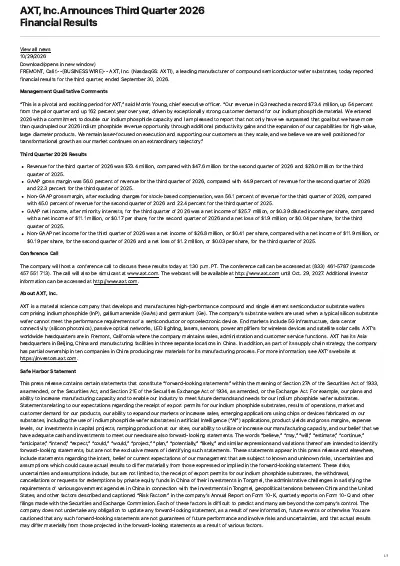
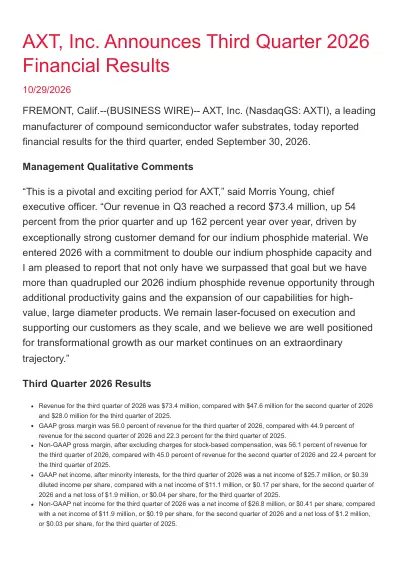
Revenue for the third quarter of 2026 was $73.4 million. This is an increase of 54% from $47.6 million in the second quarter of 2026, and an increase of 162% from $28.0 million in the third quarter of 2025.
To break down our Q3 2026 revenue for you by product category: indium phosphide was $54.3 million, primarily from data center applications; gallium arsenide was $9.1 million; germanium substrates were $344,000. Finally, revenue from our consolidated raw material companies in Q3 was $9.7 million.
The top five customers generated approximately 35% of total revenue, and one customer was over the 10% level. Gross margin showed continued gain in the third quarter, driven by an increase in total volume and a favorable product mix.
In addition, market prices for indium phosphide have increased, and a shift from 3-inch to 4-inch wafers has also contributed. Morris will give more color on this in a moment.
Non-GAAP gross margin was 56.1%, compared with 45.0% gross margin in Q2 and 22.4% gross margin in Q3 of 2025. For those who prefer to track results on a GAAP basis, gross margin in the third quarter was 56.0%, compared with 44.9% in Q2 and 22.3% in Q3 2025.
Moving to opex, our total non-GAAP operating expense in Q3 was $11.7 million, compared with $10.2 million in Q2 and $6.7 million in Q3 of 2025. On a GAAP basis, total opex in Q3 was $12.7 million, compared with $10.9 million in Q2 of 2026 and $7.3 million in Q3 of 2025.
Our non-GAAP operating profit for the third quarter of 2026 was $29.5 million, or 40.2% of revenue, compared with a non-GAAP operating percent in Q2 of 2026 of $11.2 million, and a non-GAAP operating loss of $384,000 in Q3 of 2025. For reference, our GAAP operating line for the third quarter of 2026 was a profit of $28.4 million, or 38.7% of revenue, compared with an operating profit of $10.4 million in Q2 and an operating loss of $1.1 million in Q3 of 2025.
Non-operating income and expense and other items below the line of the operating line for the third quarter of 2026 was a net loss of $2.7 million. The details can be seen in the P&L included in our press release today.
We are pleased to report non-GAAP net profit of $26.8 million, or 41 cents per diluted share. This compares with a non-GAAP net profit of $11.9 million, or 19 cents per share, in the second quarter of 2026.
Non-GAAP net loss in Q3 of '25 was $1.2 million, or 3 cents a share. On a GAAP basis, net profit in Q3 was $25.7 million, or 39 cents per diluted share.
By comparison, net profit was $11.1 million, or 17 cents per share, in the second quarter of 2026. GAAP net loss in Q3 of 2025 was $1.9 million, or 4 cents per share.
The weighted average diluted shares outstanding in Q3 was 65.9 million. Cash, cash equivalents and investments increased by $77 million to $825.9 million as of September 30th.
By comparison, at June 30th, it was $748.8 million. Accounts receivable increased by only $3 million.
In Q3, DSO improved to 49 days as a result of multiple customer prepayments. During Q3, we signed a long-term supply agreement with Lumentum.
Under the terms of the agreement, we received a prepayment for wafers of $43.5 million. This type of agreement with significant upfront cash is an additional signpost regarding the important use of indium phosphide for high-speed optical data transmission required in the AI data centers.
This prepayment is posted on our financial statements as a liability and will be converted to revenue as we ship products against the agreements. Depreciation and amortization in the third quarter was $2.6 million.
Total stock comp was $1.1 million. Net inventory was up by approximately $7.4 million in the third quarter.
This concludes the discussion of our financials. Before I turn the call over to Morris, I want to note that yesterday we announced that our majority-owned subsidiary, Tongmei, has entered into a definitive agreement for a private equity financing, selling its own shares, not AXTI shares, to provide RMB directly into its operations.
This is an exciting milestone for Tongmei, as it works towards a public offering on the Hong Kong Stock Exchange. Funds will be used to advance capacity expansion for indium phosphide wafers at a time when demand for these wafers is outpacing supply.
Proceeds will also be used to increase capacity at our raw material companies in China. Assuming the maximum amount of the investment at $545 million US dollars, AXTI will maintain control of Tongmei with approximately 73.4% ownership, down approximately 12.1% following the completion of the transaction.
This transaction turns the spotlight on Tongmei, reflecting its substance and generating momentum towards the future. Finally, as previously stated, Tongmei is proceeding with its efforts towards a listing on the Hong Kong Stock Exchange.
We continue to believe that an IPO in China is highly beneficial as expanding both the substrate and raw material capacity in China is the most efficient way to support the rapidly evolving AI infrastructure build-out. Thank you.
With that, now I'll turn the call over to Dr. Morris Young for a review of our business and markets.
Morris?
Morris Young
Thank you, Gary. This is a pivotal and exciting period for AXTI.
As Gary noted, our business has reached an inflection point, driven by exceptional strong customer demand for our indium phosphide material, which seems to increases with every review cycle. We entered 2026 with a commitment to double our indium phosphide capacity.
I'm pleased to report that we surpassed that goal in August and are continue our expansion as an ongoing effort. We are currently in the design phase of converting a newly acquired adjacent building for indium phosphide production, with work expected to begin within the next several months.
Even with more significant event, our revenue opportunity in indium phosphide has more than quadrupled in 2026 from where we were coming into the year. We are expecting substantial additional expansion also in 2027.
Three developments are fueling this progress. First, as I mentioned, we are aggressively adding capacity to address the massive market opportunity.
Second, new proprietary crystal growth furnace designs are delivering meaningful gains in manufacturing productivity and output. Third, customers are transitioning to large-diameter substrates and a higher-value products.
Together, these developments are creating a step change in our revenue potential. We have well surpassed our historical record levels for both indium phosphide revenues and corporate revenues.
We are in a brand-new territory, with backlog now above $500 million, including long-term multi-year agreements, short-term contracts of less than 12 months, and spot purchase orders. Demand remains ahead of supply, even as we accelerate the pace of our capacity addition.
According to AI data center markets, the need for optical connectivity is growing rapidly. As hyperscalers deploy increasing GPU-dense systems, they require faster, more powerful efficient photonics to move enormous volume of data.
Today, the transition to 800G and 1.6T transceiver modules is generating strong demand for indium phosphide-based lasers and detectors that enables these high-performance optical links. Looking further ahead, the industry is moving towards near-packaged and co-packaged optics, which should expand the role of our material even further.
Taken together, these developments support a sustained build-out of high-density optical infrastructure and a multi-year growth opportunities for our indium phosphide business. As many of you are aware, the competitive landscape for high-quality indium phosphide is limited to just a few players, due primarily to the very high technical barriers to entry and the ongoing difficulty and sensitivity of crystal growth and proprietary processes technologies.
Among our peers, we believe AXTI is in the strongest position to scale our business for massive industry growth, while continuing to meet the most stringent performance requirements for high-speed data center AI connectivity. Case in point, we continue to make great strides in development of our 6-inch indium phosphide capability.
Our 6-inch lines are now moving to pilot production line status, with productivity increasing steadily. We believe this further differentiates us from our field of competitors and puts us in a leadership position for next-generation devices.
I want to thank our customers who are partnering with us throughout this process. We're excited to support them as we move forward with our own capability.
Looking at demand by region, the large-scale build-out of AI infrastructure in the United States, as well as in the significant capital investment planned for cloud services and AI platform providers, is driving strong demand for EML and silicon photonics-based optical transceivers and high-speed photodetectors, with developing demand for CW lasers for scale-up applications. We believe our material are already deployed across multiple US hyperscalers, and we expect adoptions among the customers to continue to expand.
China is also emerging as a important growth market, as it accelerate investment across the AI supply chain. Our revenue into China indium phosphide-based laser market increased strongly again in Q3, and all of our customers there remain on allocation.
This momentum reflects China's growing role in building AI infrastructure for the global market and represent a compelling opportunity for AXTI, particularly because shipment within China do not require a export license. Turning to gallium arsenide, several of our key customers are now showcasing slow and wide VCSEL lasers for data center applications based on both 6- and 8-inch gallium arsenide.
We believe this can be exciting future market for AXTI, and we are in a pole position as the world leader in both 6- and 8-inch gallium arsenide substrates. In Q3, demand for both semi-insulating and semi-conducting material across wireless devices, industry robotics, and data center lasers applications grew sequentially from the prior quarter.
We do expect several of them to be seasonally down in Q4, but we continue to see opportunity for market share expansion in the continuing year for our gallium arsenide substrates. Finally, our raw material business continued to be highly strategic to our growth plan.
Our subsidiary, Jinmei, is now refining high-purity indium, which gives us direct control of a guaranteed supply of yet another critical material for our indium phosphide substrates. We're also investing to help Jinmei to expand the capacity, so that AXTI can depend on them on our growth.
Jinmei will continue to provide a meaningful portion of our raw material requirements. We'll continue to invest in our portfolio, as we believe it is a major competitive differentiator.
In summary, AXTI is operating from a position of growing strength at an important moment for our industry. Demand for indium phosphide continues to exceed supply, and we're moving quickly to expand our capacity, improve our productivity, and advance large-diameter substrates.
We always believed that indium phosphide would represent a big opportunity for AXTI, but I can honestly say we didn't expect it to be so big. We're happy to see it, and we are also humbled by it.
Through the years, we have created a great product to serve the market. As I have said, we're stepping up to embrace this massive opportunity.
We are off to a fantastic start and remain laser-focused on execution. We believe we are well positioned for transformational growth as our market continues on its extraordinary trajectory.
With that, I will turn the call back to Gary for our fourth quarter guidance. Gary?
Gary Fischer
Thank you, Morris. As of today, we have approximately $90 million in revenue that can be realized in Q4 across our substrate product lines and raw materials, for which we either already have a permit to ship or for which a permit is not required.
We have a high degree of confidence in recognizing this revenue in Q4. We have delivered strong gross margin improvement over the past several quarters and are very pleased with progress.
Further improvement depends on a number of factors, including total revenue as it relates to revenue mixed by product, absorption of fixed costs, and our ability to continue to drive better manufacturing efficiency. With regards to operating expense, we expect that it will be approximately $13 million in Q4 on a non-GAAP basis and approximately $14 million on a GAAP basis.
With these factors in mind, we believe our non-GAAP net income will be in the range of 57 to 59 cents, and GAAP net income will be in the range of 56 to 58 cents. We estimate the share count for Q4 will be approximately 66.1 million shares.
This concludes our prepared comments. We will be glad to answer your questions now.
Tracy?
Operator
We will now begin the question-and-answer session. If you would like to ask a question, please press star one on your telephone keypad now.
To withdraw your question, press star one again. Please pick up your handset when asking a question to allow for optimum sound quality.
If you're muted locally, please remember to unmute your device. Please stand by for a moment now while we compile the Q&A roster.
Your first question comes from the line of Richard Shannon with Craig-Hallum. Your line is open, please go ahead.
Richard Shannon
Oh, great. Thanks, Morris, Gary, and Tim, for taking my questions.
I'll congratulate you guys again on another very strong quarter, and keep up the great work here. My first question is on gross margins.
We've had discussion last few conference calls, particularly the last one, about how high they could go, and you were suggesting they could get above 50, and you cleared that significantly here. Gary, you gave us a little bit of language here how to think about it going forward, but I didn't have enough time to run through your guidance through my model to see where this might be aiming here.
I'd love for you to discuss gross margins, particularly in the context of what's built into your guidance, up, down, flat, as well as whether it can go up meaningfully from here. Maybe if you can maybe touch on some dynamics here about the things that you touched on the call here, like wafer diameter increases here to the degree to which you have customers who are on contracts versus spot pricing, ASP trends, etc.
If you could help us kind of delineate all that, that'd be great. Thank you.
Gary Fischer
We thought about this in advance, and I'm glad to make comments. Tim and Morris are prepared to add a little more depth and color.
As usual, the gross margin is hugely driven by volume, which we've always said, and it's hugely driven by mix. By that, we mean that since indium phosphide is a profitable product for us, the more indium phosphide we have, the happier we are in terms of gross margin prospects.
Those are the two baseline variables that are fundamental. Now, as we look at the recent developments, we're also looking at productivity improvements.
What I would say, and I have a manufacturing background, but good manufacturing companies should improve if volume goes up, because you get a larger database, you can use statistical process control from a larger database to modify your processes. Our business model is extremely intensive in terms of process technology and process steps.
These higher volumes are helping us become more efficient. That's a third element besides volume and mix.
A fourth element that you also listed is customers moving to higher-value, larger-diameter substrates. What's happening is that we have a history of migration.
When Morris started the company, the wafer size for gallium arsenide and indium phosphide was 2-inch, and over the decades, we've migrated to 3-inch, 4-inch, and in the case of indium phosphide, we're now moving to 6-inch. As we move up, because there's more real estate in a 4-inch than there is in a 3-inch, obviously the price goes up, but it just opens up a dynamic in which the customer expects the price to go up, they're not surprised.
Then it's easy to agree on a fair price. The larger-diameter substrates also have a higher ASP, which becomes another element.
So 6-inch right now is not impacting much, but next year it will. Let me have Tim and/or Morris fill in some of the blanks here.
Tim Bettles
I want to add a few points on productivity as well. Morris mentioned that we're moving to a new generation of crystal growth furnace.
This has been brought out really for the development and manufacturing of 6-inch indium phosphide. What we're seeing with this new technology is a significant increase in productivity as we move forward.
It not only enables us to move more efficiently from 2-inch to 3-inch, and then 3-inch to 4, and eventually 6, but as we do that, it gives us much greater productivity in doing so. That's going to help the gross margin significantly as we employ more and more of these new generation furnaces.
It's really going to set us apart from the competition and give us a massive lead in on this technology.
Morris Young
Let me add a point. I think we saw a significant customer yesterday and they were asking us, Tim, on the much better EPD requirement on their high-power laser.
That is music to our ears. In other words, low EPD is our forte.
If they have a higher requirement for lower EPD, then there's less competition and there's a premium to the price. That adds to our gross margin.
Okay? Also is the larger diameter, 6-inch, of course, when we first were to ramp, we do expect productivity or yield to be low.
As we add more furnaces, we expect that yield improvement to expand significantly going forward. Lastly, but perhaps not very significant, is the raw material price is going up significantly.
We're going to have some deduction on that side. I think as you sum up all the other things that we're gaining, our efficiency, productivity, low EPD, etc., etc., it overwhelms the increase in our raw material cost.
Gary Fischer
Richard, one more thing. I guess I would say, you and I've known each other for even longer than I've been in my 12 and a half years at AXTI, but you probably never would expect me to say something like this on an open call, but I do think our gross margin will go up some more.
I don't think we've peaked, and I think it's reasonable to expect that it could begin with a 6 in the next quarter, not a high 6, but all of these things that we just described in terms of efficiency and migration and sizes and things like that, it's a work in progress, and so it should have a natural effect.
Richard Shannon
Thanks for all that perspective. Let me ask one more question, and I will jump out of line here, and that's on capacity.
Sounds like you've had some great progress in expanding capacity faster than expected. You were asked a question on the last call about what your indium phosphide revenue potential would be exiting both this year and last year, and if I wrote down the numbers correctly, where did I put those things?
I forgot what they are, but I think they were maybe 60 and then 130 each of the next two years. Sounds like it's a lot higher than that.
Can you quote what your expected potential indium phosphide revenue capacity is exiting this year and next?
Tim Bettles
I can give some idea on that. It is a lot higher than we projected recently, of course.
That's in part because of this migration to larger wafer sizes, and it's also in part to an increase in ASPs. We've been building out an ASP plan as we move forward.
In Q3, we recorded an indium phosphide revenue of $54.3 million—
Richard Shannon
Yeah. —and
Tim Bettles
that's probably going to go up in Q4. Total projection of Q4 being around the $90 million mark, I would anticipate that all of the growth is going to be indium phosphide.
Richard Shannon
Yeah.
Tim Bettles
You should probably think about adding all of that additional onto indium phosphide. Then we'll just see continued growth into next year.
Richard Shannon
Okay. Appreciate that detail, guys.
I will jump out of line. Thank you.
Tim Bettles
Thank you.
Operator
Your next question comes from the line of Charles Shi with Needham. Your line is open, please go ahead.
Charles Shi
Hi, thanks for taking my question. Morris, Gary, and Tim, I think this is probably a higher-level question cuz from time to time, there are some chatters within the investment community.
They have a view on where things are going. The most recent thing seems to be that they are worried about AXTI adding a good amount of capacity, and that could lead to overcapacity for indium phosphide substrates next year.
I'm not sure if I buy that, because it kind of mimics what we heard about HBM overcapacity into late 2024. That's a high-growth market, and supply getting a little ahead.
I don't think that really is a big worry. You guys know the forecast, customer forecast.
You guys have intelligence into what your competitors are doing. You guys know what you are doing, how much capacity is going to be added.
Mind if you address this question here and provide us your insight on the whole supply-demand situation maybe next year into next year? Thank you.
Tim Bettles
Hello, Charles. As we stand right now, we are significantly overbooked.
All of our customers are on allocation, and the market out there, every month we see additional growth. As we look at our capacity moving into '27 and then beyond into '28, the opportunities for us here and the demand for us outstrips any capacity that we can put in place.
The demand is just growing faster than we can add capacity today. We're seeing this, as Morris has already pointed out, with long-term multi-year agreements, short-term contracts of 12 months or less, and then spot orders.
Again, every customer is on allocation right now. It is impossible to keep up with demand.
Even long-term supply agreements that we're having off of customers, we're being asked to increase 2x or 3x. The plans that we have to, again, quote, double our capacity in 2027, I'm not sure we'll even get our head above water with 2027.
As far as competition goes, I think I believe that we are still the leaders out there. We are certainly one of the fastest to grow capacity on indium phosphide.
Morris has just made an excellent point, and we've been saying this for years: our low EPD substrates give us a massive value proposition advantage against our competition. As product moves towards high-power CW lasers and UHP lasers for scale-out and scale-up, low EPD, low defect density, is absolutely essential for high laser bar yields and high reliability.
AXTI offers the world class in that marketplace. Customers are turning to us not only because we're the fastest to build out capacity, they're turning to us because our value proposition model is stronger than anyone else's.
Worries about adding capacity through next year? No, I don't have any.
Morris Young
Yeah. Let me add a few points.
Let me give you an angle from the Chinese competitor. Indium phosphide substrate is really hot.
Last I heard, there are a number of new entries in China market wants to get into indium phosphide substrates. Do I worry about them?
I really don't think I do. I tell you the reason: indium phosphide is not a easy material to work with.
We worked with it for 40 years, and we know how long it took us to grow from 2-inch to 3-inch, and that 3-inch graduate to 4, and we're moving to 6. The EPD level, although is highly technical, but when we first enter into a major laser maker in the US market, their requirement of EPD is less than 500.
Now we're delivering less than one-tenth of it. Okay?
I think those just takes times and real experience to advance, and we're not standing still, and we're advancing. I think to give you more assurances, I think HPT or [storage?]
device market, I believe, doesn't have as high entry barrier as indium phosphide is. Okay?
I think I'm reasonably confident about this, and at least for the next two years. Three years out, it's hard to say, but yesterday we were talking to a major customer of ours.
They were telling us instead of the market is to expand by 20x, they're telling me actually is a 1,000x. I don't know how it comes to that, but it started with scale across, scale out, and scale in, and scale up.
Every level is almost a 10x increase, and optical connectivity is at heart of it. My answer is, I don't think we're going to reach that point.
Ask me next year, perhaps, that we worry about it, and hopefully we still don't have to worry about it.
Gary Fischer
Let me summarize. We have a long look forward, and we pay attention to it.
It's visible all the way up to our board level. As CFO, I'm not at all worried about 2027 CapEx.
I know it's less than is going to be needed, and I feel the same about 2028. Those two years, what we're planning to spend I think is very reasonable, and I don't think it's going to be overspending.
When we get closer to 2029, we need to look at that. We're grown-ups on this stuff.
We're going to measure it and pay attention to it.
Charles Shi
Thank you. Maybe I ask a second question.
If I heard you correctly, I think you announced a second supply agreement with Lumentum, I forgot the exact amount, but going to Q2, you had another agreement. Is this a follow-on agreement, an expansion of the previous agreement, or something else?
Related to that, I think I heard you talking about backlog is now over 500 million. It was over 100 million, I think, a quarter ago, probably 4x-ish, maybe 5x expansion of the backlog over the course of last maybe 90 days.
Mind if you give a little bit color? Those are kind of related, a two-part question.
Thank you.
Tim Bettles
Got you, Charles. No, the Lumentum contract is the contract that we signed in Q3.
It's not a double-up, it's not a secondary. It is the one that was signed and announced earlier in Q3, we're just reiterating that for the course of this conference call.
As backlog goes, yeah, obviously we mentioned before that we're more than 100 million. We were a little bit vague on exactly how much more than 100 million that we were, but now we're happy to say that as we see growth, we've surpassed the $500 million barrier.
That's made up of a number of things in terms of long-term supply agreements, again, short-term 12 months or less supply agreements, and spot POs that go through 2027. Really, that just gives us more encouragement and gives us more confidence that we're seeing growth into the rest of 2026 and through into 2027 with some significant backlog there.
I'll make another noteworthy change here, and that's the demand from China is increasing in a significant way, right? Historically, we've built and shipped for China because we don't need permits.
Again, everybody is now on allocation. We're accepting backlog as we see this, but we're also seeing a longer lead time out nine-plus months on a lot of this stuff.
Of course, as we see longer lead times, we see more of these supply agreements, we see more demand coming this way. The backlog is just going to grow.
Charles Shi
All right, thank you.
Tim Bettles
Thank you, Charles.
Operator
Your next question comes from the line of Tim Savageaux with Northland Capital Markets. Your line is open, please go ahead.
Tim Savageaux
Hey, good afternoon, and congrats on the results and outlook, and especially on the backlog increase. First question, sort of taking the discussion back to gross margins and kind of where you can go there.
Doing that math, I think you're solidly into the 60s in terms of where you're guiding. Your incremental gross margins in Q3 were 77%, which is pretty significant.
Gary, I know you're hesitant to talk about where these margins can go over time, but to the extent we were talking about lower levels just a few quarters ago, is it fair to look at that 60% level as kind of a new baseline, and with upside potential, given what you're seeing on incremental gross margins, or how are you looking at that now?
Gary Fischer
It's hard to comment. It gets into a vocabulary that's so strange for me, you know?
We don't want the horse to run away with and get out of the race track and just be way ahead of us, but on our commentary. It's pretty obvious that we're going to cross over 60%.
I have to say, and I don't mean it in a dodging way, but it's fast-moving change. We're hesitant to predict because things are moving so fast.
Morris Young
Let me add perhaps to this point is the moving market. I tell you, this year, the fastest-growth segment in 2026 was 3-inch.
Next year, the high growth we expect could be 4-inch. That is more of a new territory, okay?
High-power laser require low EPD, and, again, that's a new territory. And 6-inch is going to be, although it's still going to be single digits for 2027, but it's going to grow, and that's going to command a good gross margin.
Yeah.
Tim Savageaux
Got it. Thanks.
Looking at the revenues, the results, and the guidance, I know it seems like you've incorporated a significant portion of the long-term agreements in your backlog. I guess if you look at Q3 and the guide for Q4, how significant a contributor are the initial ramps of those long-term agreements to what you saw in Q3 and are guiding for in Q4?
Tim Bettles
We're we're definitely starting to see some contributions coming from the long-term supply agreements in Q3, Q4, sorry. That'll continue to build as we as we go into into 2027.
I I want to make a point in that, we when we talk about the long-term supply agreements, we we don't have a whole lot of them at the moment. They're not a big part of our backlog.
Although some of them extend out for for several years, the the LTSAs are still a relatively small percentage of the multi-year LTSAs, still a relatively small part of our capacity as it goes forward. A lot of this is still being built up on spot purchase orders, annual annual contracts, that type of stuff, that as I said before, our our our lead time is increasing, it just adds, keeps on adding to that backlog as we accept orders.
Gary Fischer
Tim, I would say that our Tim and Morris and our VP of Asia, C.P. Fan, they've kind of pulled back on formal long-term agreements, and we don't want to lock up in that way.
We're maintaining flexibility. We are making commitments beyond 90 days or beyond 6 months, but we want to protect on price, and we also want to protect on our ability to, if we can do more or do less, we don't want to be locked in.
The point is we're not going to be announcing multiple long-term agreements. There may be some more, and plenty of customers want us to sign up for them, but it's not what we think is the right strategy for AXTI.
Tim Savageaux
Yeah. Understood.
That was going to be my next question, so that's good. Tim, you're saying backlog is up $300 or $400 million sequentially, that is not majority or even materially driven by LTSAs?
That's just kind of run-rate business?
Tim Bettles
That's correct. That's run-rate business.
Yeah.
Tim Savageaux
Yeah. That's extraordinary.
Okay. I'll pass along.
Tim Bettles
Thanks, Tim.
Operator
Your next question comes from the line of Matt Bryson with Wedbush Securities. Your line is open, please go ahead.
Matt Bryson
Hey, thanks for letting me ask a question, and congrats on a great quarter. I have one longer one and one quick one.
For the longer one, it seems like low EPD and your ability to deliver larger substrates is a substantial advantage. Is there any more color you can give us around what portion of shipments might be 4-inch and above, or if there's rule of thumb that we can think about in terms of either pricing or gross margin benefit you get from shifting from 3-inch to 4-inch to 6-inch?
Then I guess also part of that, what portion of your competitors are able to deliver 4-inch or 6-inch substrates at this point? Thanks.
Tim Bettles
Thanks, Matt. The majority, if you're looking at pure wafer volumes, the majority of the business has transitioned to 3-inch.
Now, a lot of the non-China business has been on 3-inch for a long time, and we're seeing a lot of the Chinese business move up into the 3-inch wafer size. We saw a couple of years ago that we started to see a transition.
We made an announcement that we were seeing a 4-inch substrate going into AI-type data centers, and this was predominantly for detector material, photodetector material. Obviously we continue to see that.
That's been the market driver for 4-inch so far, and a lot of the photodetector material, especially the high-speed photodetector material, is now firmly based on 4-inch. What we're going to see next year, and we're starting to see that transition in Q3 and Q4 this year, is a lot of the laser material is now going to also transition to 4-inch.
In 2023, sorry, 2023, in 2026, a lot of the business is running on 3-inch for lasers, 4-inch for detectors. In 2027, we're going to see a big shift as we go through the year.
I think towards the end of the year, we could be looking, if you're looking at wafer volumes, just single wafer volumes, you could be looking at something equal in 3-inch and 4-inch by the end of the year. This does give us a significant ASP boost.
It also gives us a significant gross margin opportunity here as well. What can our competitors deliver?
It's variable, right? A lot of them still are stuck predominantly on 3-inch.
The move to 4 is, especially on the laser material and especially keeping the high-quality, low-defect material, is incredibly challenging. Morris said we've spent decades on building this up, and the move to 4 in itself is a huge challenge, let alone the move to 6.
I mentioned earlier that we've got this new crystal growth furnace. This gives us massive productivity improvements, not just on 6-inch, it's not just there for 6, gives us massive productivity improvements for 4-inch laser-type material as well.
As we build out new furnaces, we're going to be really heavily focused on putting the new design furnace in there with a real commitment on scaling from 3-inch to 4-inch, and then to 6-inch beyond 2027. I think as you look into '27, we're going to see a meaningful number coming from 4-inch, and you're going to start to see 6-inch come on board.
I think we're leading the game there.
Morris Young
I think one of Matt's question we have not answered is how many competitor can provide 4-inch and 6-inch. I think 4-inch is a bit harder to answer, but I think 6-inch, so far, actually, I think we're climbing very fast, right?
I think other than us, there's a company called S, and they are probably now equal to us, and the third is a very distant third.
Tim Bettles
Yes. Yes, there's two main players at 6-inch.
Morris Young
The point for us is we're adding a huge number of capacity all based upon 6-inch. We're glad that it is going into pilot production now.
Go ahead, Matt.
Matt Bryson
Awesome. Thanks for all the color.
Then I just have one other quick one. Going back to Richard's kind of question around capacity, I know initially I think you guys had talked about being able to double indium phosphide capacity in 2027.
Is that still roughly how we should be thinking about things, that from Q4 '26 to Q4 '27, we should
Morris Young
be looking at those
Matt Bryson
numbers roughly doubling?
Morris Young
The challenge is this. I think we're going to be more than double in Q 2026.
If you take end of 2025 as one, we're probably going to be at 2.75 or 3 at end of 2026, right? I think right now our goal is to double again in 2027.
Hopefully, by mid-year we can tell you we're still ahead of the planning.
Matt Bryson
Awesome. That's really helpful, Morris.
Thank you so much.
Operator
There are no further questions at this time. I will now turn the call back to Leslie Green for closing remarks.
Leslie Green
Thanks, Tracy. Thank you all for participating in our conference call.
We will be participating in the UBS Global Technology and AI Conference and the Northland Growth Conference in December, as well as the Needham Growth Conference in January. We hope to see many of you there.
As always, please feel free to contact us if you'd like to set up a call. We look forward to speaking with you in the near future.
Operator
This concludes today's call. Thank you for attending.
You may now disconnect.