Ball Corporation
Q3 FY2026 · Earnings Call TranscriptNovember 3, 2026
Operator
Greetings, and welcome to the Ball Corporation's third quarter 2026 earnings conference call. At this time, all participants are in a listen-only mode.
A brief question-and-answer session will follow the formal presentation. If anyone should require operator assistance during the conference, please press star, zero on your telephone keypad.
As a reminder, this conference is being recorded. It is now my pleasure to introduce your host, Brandon Potthoff, Head of Investor Relations.
Thank you, sir. You may begin.
Brandon Potthoff
Good morning, everyone. This is Ball Corporation's conference call regarding the company's third quarter 2026 results.
During this call, we will reference our third quarter 2026 earnings presentation available through this webcast and our website at investors.ball.com. The information provided during this call will contain forward-looking statements.
Actual results or outcomes may differ materially from those that may be expressed or implied. We assume no obligation to update any forward-looking statements made today.
Some factors that could cause the results or outcomes to differ are described in the company's latest Form 10-K, other SEC filings, and in today's earnings release and earnings presentation. If you do not already have our earnings release, it is available on our website at ball.com.
Information regarding the use of non-GAAP financial measures may also be found in the note section of today's earnings release. In addition, this presentation and the release include a summary of non-comparable items, as well as reconciliation of comparable net earnings and diluted earnings per share calculations.
I would now like to turn the call over to our CEO, Ron Lewis.
Ron Lewis
Thank you, Brandon. Today, I'm joined on our call by Dan Rabbitt, Senior Vice President and Chief Financial Officer.
I will provide some brief introductory remarks and discuss third quarter and year-to-date 2026 financial performance and our outlook for the remainder of 2026. Dan will touch on key metrics, and then we will finish up with closing comments and Q&A.
We continue to make progress toward our long-term value creation goals. The fundamentals supporting our current performance and long-term opportunities remain strong.
Packaged liquid volumes continue to grow, and aluminum cans continue to gain share as customers and consumers increasingly value convenience, performance, and sustainability. These trends continue to support beverage can growth across each of our regions.
Ball remains well positioned to benefit from our long-term customer partnerships, a well-contracted portfolio, EVA mindset, and unmatched global footprint. Together, these advantages have supported high utilization and volume growth above our long-term global target of 2 to 3%.
We continue to see attractive opportunities to grow volumes and create value through disciplined, EVA accretive investments. Our recently announced facilities in India and Germany are part of that strategy, and will position us to support customer growth and drive continued volume and EVA growth through the end of the decade.
Our financial discipline will continue to be front and center as we focus on driving shareholder value. A healthy balance sheet and capital expenditures averaging depreciation and amortization over time give us the opportunity to continue returning value to shareholders through dividends and share buybacks.
Operationally, we remain focused on steady progress. Standardization, cost discipline, and the Ball Business System are helping us to reduce complexity, improve productivity, and build a more repeatable operating model as volumes grow.
With attractive industry fundamentals, strong customer relationships, disciplined execution, financial strength, and an operating system built for continuous improvement, Ball remains well positioned to deliver on our 2026 objectives and drive long-term value for shareholders. Our performance reflects the strength of our business and the disciplined execution underway across Ball.
The strategy we have discussed in prior quarters remains clear and grounded in four strategic pillars. First, we remain focused on executing in our core business.
Second, we stay close to our customers and maximize the strength of our global network. Third, we continue to accelerate the substrate shift to aluminum and expand into targeted categories.
Fourth, we manage complexity to our advantage. We also recently announced leadership changes in two of our beverage businesses, with Carrie Cauzy taking leadership of our North and Central America, and Scott Biale taking leadership of our EMEA businesses.
Both bring significant commercial and operational experience, and I'm confident they'll continue strengthening our customer partnerships while driving disciplined execution across these businesses. Again this quarter, our people connected to our strategic pillars through the Ball Business System.
They have done an excellent job supporting our customers and managing strong growth through the summer selling season in North America and EMEA, while preparing for the upcoming summer selling season in South America. The combination of continued demand growth for aluminum packaging, our strategy, and the Ball Business System is designed to drive EVA dollar growth and support comparable diluted EPS growth of 10+% over the long term.
These outcomes align how we are compensated with how we create value for shareholders. Our long-term financial framework remains clear.
We are focused on growing comparable operating earnings 4 to 6% through volume growth and operating leverage, while consistently returning capital to shareholders through share repurchases. Together, those actions support our long-term target of delivering 10+% comparable diluted EPS growth.
Growing EVA dollars requires disciplined investments that generate returns above our cost of capital. This approach has been central to our long-term value creation and should provide additional opportunities as volumes grow across our geographic footprint.
With that context, I would like to provide more detail on our investments in India and Germany. Starting with Germany, we continue to see strong growth in Europe, including demand associated with a strategic energy drink customer.
Our long-term partnership, contractual commitments, and attractive EVA returns support our investment in a multi-line facility in Bayreuth, Germany. We expect the facility to be ramping up in late 2028.
As we announced via a press release last month, we will also be investing in a multi-line facility in Uttar Pradesh, India. The plant will further expand our manufacturing footprint in India and is expected to be operational in 2029.
India continues to be one of Ball's most exciting growth markets, and this investment reflects our confidence in the country's long-term economic potential and the continued growth of aluminum packaging. Turning to our third quarter results, we continued to build on the strong performance we discussed last quarter.
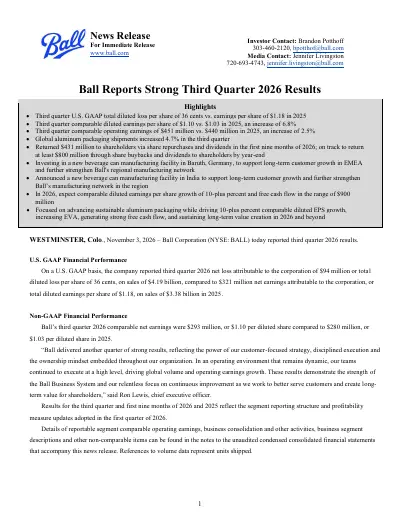
Global volumes improved 4.7% year-over-year, with growth in each region reflecting continued momentum across our portfolio and keeping us on track to exceed the full year volume outlook we outlined earlier this year. Comparable operating earnings grew 2.5% year-over-year, supported by disciplined cost management, commercial performance, and continued progress through the Ball Business System, including record comparable operating earnings for both Ball as a whole and our EMEA business, even as we absorbed the previously discussed North American startup costs.
Comparable diluted EPS increased 6.8%, reflecting comparable operating earnings performance and disciplined capital allocation. Our first nine-month performance reinforces our confidence in delivering 10+% comparable diluted EPS growth for the full year.
We remain focused on shareholder returns and are on track to return at least $800 million to shareholders in 2026. Operationally, we continue to advance our priorities, including integrating the two plants we purchased in Hungary and Belgium to expand EMEA capacity, and continuing to make progress on our Millersburg facility ramp-up, which remains on track towards full capacity in 2027.
Overall, this was a strong third quarter and first nine months, reinforcing the resilience of our business and our confidence in the 2026 framework. With that context, I'll let Dan walk you through the details of our third quarter financial performance and provide more color on our expectations for the remainder of 2026.
Over to you, Dan.
Dan Rabbitt
Thanks, Ron. I'll start by walking through our third quarter 2026 financial performance and provide additional context on the first nine months of the year and our expectations for the balance of the year.
The business continues to perform well. In the third quarter, global aluminum shipments increased 4.7%, and year-to-date we have grown our volumes 3.4%.
Our performance is supported by growth across each business unit and, as Ron mentioned, puts us ahead of our 2 to 3% global volume expectations. As Ron also noted, third quarter comparable operating earnings increased 2.5% year-over-year, and comparable diluted EPS increased 6.8%.
On a year-to-date basis, comparable operating earnings increased 6.4%, and comparable diluted EPS increased 14%. The quarterly and year-to-date performance remains consistent with the financial framework we laid out for 2026.
In North and Central America, volumes increased low single digits year-over-year, consistent with our expectation for full year growth at the low end of our long-term 1 to 3% range. Demand remained constructive in energy drinks and non-alcoholic beverages.
Segment comparable operating earnings declined 2.3% year-over-year as higher costs, including approximately $10 million of costs related to starting up Millersburg, were partially offset by favorable volume and price mix, primarily from metal pass-through timing. We now expect full year costs related to starting up Millersburg to total approximately $25 million.
Adding further color on the fourth quarter, we expect the metal pass-through timing that we experienced in the third quarter to reverse in the fourth quarter, impacted by metal price declines and timing with our large customers who procure their own metal. In EMEA, volumes increased mid-single digits year-over-year, supported by underlying demand and the contribution from the two plants we acquired in Hungary and Belgium, partially offset by last year's sale of our Saudi Arabian business.
Third quarter segment comparable operating earnings increased 3.7% and have increased 9.1% year-to-date. Third quarter results reflect higher volumes and favorable price mix, partially offset by higher costs.
We also continue to make progress integrating the Hungary and Belgium facilities. For 2026, with the inclusion of these newly acquired plants, we continue to expect volume growth above the top end of our long-term 3 to 5% range.
I also want to congratulate our EMEA team for delivering record high quarterly comparable operating earnings. Their consistent performance over many years set the foundation for this record quarter.
I look forward to many more record quarters and years to come for this part of our business. In South America, volumes increased low double digits year-over-year as the business continues to see strong volume growth across the region.
Third quarter segment comparable operating earnings increased 19.5% and year-to-date have increased by 24.2%. Third quarter results reflect higher volumes and favorable price mix.
Looking ahead, we expect volume growth in the middle of our long-term 4 to 6% range in 2026. Focusing on modeling details for 2026, as Ron noted, the resilience of our business and stability provided by our contractual pass-through mechanisms gives us confidence that we remain on track to deliver 10+% comparable diluted EPS growth in 2026.
CapEx is now expected to be $650 million, in line with GAAP D&A in 2026. With the higher CapEx expectations, we anticipate free cash flow in the range of $900 million.
Our 2026 full year effective tax rate on comparable earnings is expected to be slightly above 23%. Interest expense is expected to be in the range of $310 million.
Reported adjusted corporate undistributed costs recorded in other non-reportable are expected to be in the range of $165 million. We anticipate year-end 2026 net debt to comparable EBITDA to be 2.7 times, and we will repurchase at least $600 million of shares, which will bring our total capital returned to shareholders to approximately $800 million.
Last week, Ball's board declared its quarterly cash dividend. With that, I'll turn it back to Ron.
Ron Lewis
Thanks, Dan. To close, Ball is well positioned to win.
Packaged liquid volumes continue to grow, aluminum cans continue to gain share, and our strong customer partnerships and unmatched global footprint position us to capture that growth and deliver value to our customers and shareholders. We are focused on disciplined execution across our business.
Through volume growth, operating leverage, and the Ball Business System, our long-term objective is to grow comparable operating earnings 4 to 6% annually. At the same time, our EVA mindset guides how we invest in our business and return capital to shareholders through consistent share repurchases.
Together, these drivers support our long-term target of delivering 10+% comparable diluted EPS growth. Our investments in Germany and India are examples of that approach.
They are supported by long-term customer demand and attractive returns, and will position us to drive continued volume and EVA growth through the end of the decade. We have attractive industry fundamentals, strong customer relationships, a healthy balance sheet, and meaningful opportunities to improve how we operate.
We remain confident in our 2026 outlook and in our ability to create value for our shareholders over the long term. Before we open the call for questions, I want to thank our employees around the world.
Their disciplined execution, commitment to our customers, and focus on continuous improvement are what make this performance possible. With that, Dan and I will be happy to take your questions.
Operator
Thank you. We will now be conducting a question-and-answer session.
If you would like to ask a question, please press star, one on your telephone keypad. A confirmation tone will indicate your line is in the question queue.
You may press star, two if you would like to remove your question from the queue. For participants using speaker equipment, it may be necessary to pick up your handset before pressing the star keys.
One moment, please, while we poll for questions. Thank you.
Our first question comes from the line of Ghansham Panjabi with Baird. Please proceed with your question.
Ghansham Panjabi
Thank you, operator. Good morning, everybody.
Ron, just first off on the higher inflation dynamic impacting your customers, from a operating cost standpoint, obviously everyone in the supply chain including you, how do you think that evolves as relates to volumes and their focus on volumes versus price? Obviously, it hasn't impacted you so far this year, but certainly costs are up quite a bit sequentially in context of the consumer already struggling with affordability.
How do you see that netting out?
Ron Lewis
Hi, Ghansham. Thanks for the question.
Hope you're well. What I would say is we're not macroeconomists here.
The can is winning. It wins in all of our geographies, as evidenced by really strong volume growth again this quarter and this year, on top of a really strong quarter last year and a strong year last year.
The can has a number of attributes. It's incredibly robust in the supply chain, it sells well as a single package, and it delivers great value to consumers on behalf of our customers in a multipack format.
Again, it continues to win, and it continues to deliver great value to consumers. We think really positively about the opportunity for the can to continue to win regardless of the sort of macroeconomic backdrop.
Ghansham Panjabi
Okay. On that, it seems like every major liquid company seems to be focusing on introducing ready-to-drink cocktails and so on and so forth.
Can you just share your thoughts on whether you think that category could be a needle mover for the industry, and also how are you positioning to capitalize on that? Thank you.
Ron Lewis
Thanks, Ghansham. I would say we love all of our customers the same.
We love when they sell their products in our cans. I think, regardless of the category, innovation is a key to growth for them, and we help them innovate by delivering the broadest array of different sizes and shapes of cans in our industry.
That category you're speaking of specifically appeals more towards the 12-ounce or 330-ml or 355-ml sleek package, and that's how we aim to deliver that innovation for them. Can it be a needle mover?
I think all consumers are looking for innovation. They're looking for an opportunity to try something new.
I believe, in the long term, our customers are going to find ways to innovate and deliver great-tasting products to the consumer.
Ghansham Panjabi
Okay. Just to clarify, how big is RTDs as a percentage of the industry at this point volumetrically?
Ron Lewis
It's less than 5%. It's single digits.
It's not huge at the moment, but it is gaining share.
Ghansham Panjabi
Perfect. Thank you.
Operator
Our next
Ron Lewis
Thanks, Ghansham.
Operator
Our next question comes from the line of Anthony Pettinari with Citi. Please proceed with your question.
Anthony Pettinari
Good morning.
Ron Lewis
Hi, good morning. Ron,
Anthony Pettinari
hey, you had really good double-digit growth in South America in 3Q, and I'm just wondering, as we kind of move into the high season, if you can talk about what you're seeing and expectations for fourth quarter, and maybe what you're seeing between sort of the Brazil and non-Brazil regions.
Ron Lewis
Sure thing. Gives me a chance to say how pleased we are and how proud we are of our South America team and the business that they're delivering for us this year.
We're really proud of where they've come from. That team and our business there is really well positioned to navigate the ups and downs that we see sometimes in South America.
We're super confident in their ability to deliver going forward. Our strong volumes, I think, this year could be attributed to our customer portfolio, which I think is unrivaled and envied by everyone else.
We're really pleased that we get to serve our customers. It's an incredibly broad business in South America, not just Brazil, but all the other markets that we have in South America, especially the Southern Cone.
Basically, if you take Brazil and the rest of our markets, they all grew in total double digits, and they were more or less in line with one another. If you take the balance of the countries outside of Brazil and Brazil, we grew double digits.
How do we feel about the balance of the year coming into the summer selling season? We think we'll be much more back in line.
Instead of double digits, we'll be within our 4 to 6% long-term outlook for volume growth, and that's the way the quarter is starting. It's starting quite well there, right in line with what we expect.
Anthony Pettinari
Got it. That's very helpful.
Then just thinking about the broader business, understand you're not giving guidance, but is there any kind of early thoughts on '27 and whether you have any particularly higher or lower level of contract renewals in any region or you obviously had very strong, above-target volume growth this year? We had a World Cup is next year, maybe a tougher comp, or just kind of any early thoughts or any kind of things we should keep in mind as we look to '27?
Ron Lewis
Sure. Thanks, Anthony.
I would say if we go back, number one, we have grown volumes the last seven quarters in a row. 2025, we grew 4+%, which is well above our 2 to 3% long-term outlook.
On top of that relatively challenging volume growth, we will deliver above our long-term outlook again this year. Really strong volume growth across all of our businesses.
Q4 is shaping up the exact same way. As we think about 2027, we are well contracted.
There's nothing significant up for renewal, and everything that we see from our customers is that we'll see certainly in line with our 2 to 3% volume growth. We're confident in that long-term outlook will be delivered in 2027 as well across our business.
Anthony Pettinari
Okay. That's very helpful.
I'll turn it over.
Operator
Our next question comes from the line of George Staphos with Bank of America. Please proceed with your question.
George Staphos
Hi, everyone. Good morning.
Thanks for taking my question, and thanks for all the details. I wanted to spend the first question on cash flow.
Ron, if you could talk to us, and Dan, talk to us about the outlook as much as possible for CapEx next year, with Germany now coming on. Would you expect that CapEx can be kept in line with D&A, or will it necessarily be higher?
You said CapEx in line with D&A over the course of a cycle, so that doesn't mean quarter-to-quarter, year-to-year. Want to see what thoughts you could share there.
Relatedly to cash flow, maybe it's just timing, but working capital seems to be a bit more of a headwind thus far in the year. Now, the free cash flow guide, the trim is associated with the CapEx, it implies that working capital will be normalized by the fourth quarter.
Want to see what you have to say there. Thanks.
I had a couple follow-ons.
Ron Lewis
Great. Thanks, George.
Why don't we let Dan tackle those first two?
Dan Rabbitt
I think the first question was about cash flow and CapEx, and the second one was about working capital. When we start with free cash flow, obviously we have higher capital spending this year, as you noted.
We made a point of calling out not $650 million of CapEx this year, which is at the depreciation and amortization rate. With that, we felt good about being around the $900 million free cash flow.
I think the second part of that question was about working capital in particular, and I think you answered a little bit of how I will answer it is that we do expect it to start to normalize a little more in the fourth quarter. We've had higher inventories throughout the year, really to support the growth, and there was some challenges in our supply chain when the year started.
We do think we'll bring it back in line by the end of the year.
George Staphos
Hey, Dan, part of the question was also next year on CapEx, with Germany and India. Where would you peg it relative to depreciation?
Dan Rabbitt
The 20 the '27 outlook, we're doing our budgets still right now, but we've been operating kind of with this targeting depreciation and amortization spending over time. That kind of puts us in a 80 to 120% band in reality on how it'll flow through.
I think you can expect it to come in somewhere midpoint to a little above next year in that range.
George Staphos
That's fair. Then last one for me and I'll turn it over.
Look, in aggregate, the performance was in line/better. Just curious, in Europe, margins were a little bit weaker than we were looking for.
How did European margin trend versus your expectation? If you can just quickly, Ron, touch on the management transitions that you'd mentioned with Carrie gaining a little bit of additional responsibility, that'd be helpful.
Thanks and good luck in the quarter.
Ron Lewis
Thanks, George. From a European perspective, we are growing above our long-term growth outlook, just like we did last year.
Again, we are very tight, just like we were in North America. We're above that 3 to 5%.
When we say mid-single digits for this quarter and the year, we're above the 5% growth. That's why we were really pleased to be able to acquire these two plants in Hungary and Belgium, but the fact of the matter is they are not fully operational running 24/7 delivering all of the cans that they have the ability to deliver right now.
That growth has created operational friction, just like it has in North America. That's primarily where we see the challenge.
Does that answer your question, George, on that topic?
George Staphos
It does very well. On the management transitions?
Ron Lewis
Yeah. Look, our culture, the culture of Ball, is a culture of ownership.
Our businesses own their results. That's the first thing I would say.
Both Carrie Cauzy and Scott Biale are proven operational and commercial leaders with really strong experience within Ball. I'm really confident in both of them and I think, more importantly, the teams that they lead and the ownership that they have of their businesses serving our customers.
Again, what I'd want you to take away from anything we do in this company relative to our leaders is driving this culture of ownership.
George Staphos
Thanks. I'll turn it over.
Ron Lewis
Thanks, George.
Operator
Our next question comes from the line of Edlain Rodriguez with Mizuho. Please proceed with your question.
Edlain Rodriguez
Thank you. Good morning, everyone.
Just one quick one on EMEA, like Europe. Volume clearly is strong, but everyone seems to be adding capacity to meet that demand.
Any concerns that if demand slows down a little bit, there might be excess capacity down the line?
Ron Lewis
Thanks for the question. Let me start by saying what I say most times, which is Europe is a land of opportunity.
It's a land of opportunity because can penetration is relatively low in that geography versus other geographies that we operate in. Our customers are making significant can filling investments.
There's real physical evidence of the demand that's required in order to build these plants. Sustainability, as opposed to perhaps other geographies in the world, is a real tailwind there, and it continues unabated.
That's the backdrop. It's a very positive market dynamic that favors growth.
For us, I can just say that in the long run, we invest when our customers ask us to invest on their behalf for their growth. The way they ask us to do that is through long-term offtake agreements that allow us to deliver an EVA accretive project on behalf of our shareholders.
That's what I would say about that. The other thing I would say in Europe is these projects take time to build.
There is a natural governor on building in a geography like Europe where there's lots of permitting and requirements to overcome. I feel very confident in our growth and the growth of the can in Europe.
Thank you very much for the question.
Edlain Rodriguez
That makes sense. Another quick one.
In terms of the regional volumes, how did you do compared to the respective markets? Did you do better or worse than the markets?
Ron Lewis
You mean this past quarter, are you asking about?
Edlain Rodriguez
This past quarter, yes. Yes, this past quarter.
Ron Lewis
Sure. Yeah.
Let me just start by saying the can is winning, and so are we. We've had seven quarters of consecutive growth, and we expect growth in the fourth quarter kind of in line with where we are for 2026, and that's the way the year has started, and we expect similar growth for 2027 and beyond.
Um, 2025, again, we grew 4+%, well above our our long-term outlook. 2026, we'll grow above our 2 to 3% volume outlook, and I think we have, in the long run, an unrivaled customer portfolio and an advantaged network that allows us to win in the long run vis-à-vis the industry.
As it relates to the quarter itself, let me just take a quick spin around the quarter around our regions. In North America, as we've said, we are capacity-constrained.
It's why we're building a plant in in Millersburg, which I'm really proud to say is up and running now, we're excited about that. We probably grew right at right at our range, which is 1 to 3%.
I think you can check the data yourself, but the market in North America actually grew stronger than that. In Europe, we were again above our long-term outlook and above our long-term outlook for the for the industry.
We grew at least in line and maybe a little stronger than the industry. In South America, we clearly outperformed, again, due to our unrivaled customer portfolio and the team that drove great operational efficiency and success in that market.
Overall, I think we were representative of the industry across the across the the geographies. Again, 2026 will be above our long-term outlook cycling a really strong 2025, and in the long term, we will win because of our customer portfolio and our unrivaled network of of plants and the people that run them.
Edlain Rodriguez
Great. Thank you.
Ron Lewis
Thank you.
Operator
Our next question comes from the line of Phil Ng with Jefferies. Please proceed with your question.
Philip Ng
Hey, guys. Congrats on a solid quarter.
I guess to kind of kick things off, you talked about some friction this year, whether it's in Europe and US. Encouragingly, Millersburg is up and running.
Any update on Benepack as well? I think my focus is really how are you guys set up heading into 2027 to start the year?
Are you kind of in a good spot operationally where we're going to see the type of operating leverage we're accustomed to seeing in North America and Europe based on where you are positioned heading into next year from a operation standpoint?
Dan Rabbitt
Hey, Phil. It's Dan.
Going to take this question. Hey, thank you for the congratulatory note.
You mentioned friction costs, and we mentioned friction costs, and you repeated that. What we have there is really the tightness is causing inefficiency in how we operate, right?
Those are the friction costs. We're seeing that in both North America and EMEA.
I think the Millersburg comes with some ramp-up costs, as you may recall. We've been talking about the starting-up costs this year.
We've been calling out $35 million. We think that number's actually going to come in a little lower, around $25 million.
We had $10 million in the quarter, so that implies another $10 million to go or so in the fourth quarter. I also would like to call out that we specifically experienced around a $20 million metal gain.
You may recall that we saw commodity prices really run up quickly when the Iran war started, and now we're seeing them drop. What you have there is what we will call a timing gain in the quarter that is looking like it's going to reverse out in the fourth quarter.
Is there any other points that you'd like me to address?
Philip Ng
Just really more so 2027, Dan. Are you positioned to have these friction costs be behind you, I guess, whether it's to the North America and Europe where we would see the type of operating leverage you have delivered in the past to start 2027?
Dan Rabbitt
I think it's safe to say it's really still too early to tell on that point specifically. I think, with the guidance Ron did talk about volumes looking good for next year, capacity will still remain tight, but it is definitely still too early to make any call on that.
Philip Ng
Okay. Then from a backdrop where inflation is obviously heavy, you've managed reasonably well.
Margins have been pretty solid. When we look out to next year, remind us how your PPI resets kind of kick in in 2027.
I know it's been a mismatch of sorts where you're on a one-year lookback. Is that an opportunity for North America and similarly in Europe?
Remind us how you're set up there from a pricing standpoint. Are you in a position to stay in front of inflation when we look out to next year?
Dan Rabbitt
Again for 2027, it's still really hard to call what the PPI will be for next year. What I can tell you, in 2026, we're operating pretty well, though, with the good inflation pass-throughs in our customer contracts.
I feel like we're navigating this year very well.
Philip Ng
Okay. All right, appreciate the color.
Thank you.
Dan Rabbitt
Thanks, Phil.
Operator
Our next question comes from the line of Josh Spector with UBS. Please proceed with your question.
Anojja Shah
Hi, good morning. It's Anojja Shah sitting in for Josh.
First question is just kind of a modeling question. I think corporate was a bit higher than we modeled in 3Q, but you also reduced the full year guide for corporate.
Was there something one-time going on in 3Q? What drove that?
Dan Rabbitt
Nothing really to point out. It's where we make accruals for some of our incentive comp plans.
Really from our perspective, we look at everything's in line with our expectations when we put our budget together for 2026.
Anojja Shah
Thank you. Then, is there any way you can give us a sense of the market growth that we're seeing in Germany right now?
It sounds like a new plant there is related to a particular customer, but I think, if I recall correctly, growth in Germany was a little behind other countries just because of their historical deposit law. Where is market growth now?
Then also, did you think about maybe adding new lines at existing plants versus a greenfield, and why did you come out at a new greenfield? Thanks.
Ron Lewis
Hi, Anojja. It's Ron.
Thanks for the question. We're really excited to build this plant in collaboration with one of our largest and certainly most strategic customers.
This plant is really not for market growth or has anything to do with the general market. It has to do with the long-term partnership we have with a customer who continues to experience incredibly strong growth across all of Europe and all of the world.
This plant won't serve Germany necessarily; it will serve broader Europe. I can't tell you how excited we are to build this plant on their behalf.
We have a model in place where we've done this a number of times throughout the world. This will be I think our fourth kind of through-the-wall plant for that customer.
Anojja Shah
All right. Read you loud and clear.
Thank you very much. I'll turn it over.
Ron Lewis
Thank you, Anojja.
Operator
Our next question comes from the line of Chris Parkinson with Wolfe Research. Please proceed with your question.
Chris Parkinson
Thank you. Just an extension on the German facility, just kind of two questions.
It seems like there could be two anchor customers, or is it just one? Then understanding that it's not a play on the German market, once again loud and clear on that, but at the same time, there have been, let's say, a decent amount of pressures across the glass industries.
You've seen rationalizations, closures due to demand, overcapacity, carbon costs. You name it.
Is there a preliminary kind of assessment where there could be an intermediate to longer-term opportunity, and that perhaps if it's not just one anchor customer, if it's two, that you could see other market dynamics evolving favorably? Is there anything else there, or is it just, hey, we should think about it as one anchor customer and then that's it?
Ron Lewis
Thanks, Chris. Let me comment on Anoja's question as well.
The German market is actually the largest it's ever been, so that's good news. They've grown back to a level of demand that is greater than it's ever been even before the deposit legislation, which came into effect decades ago.
It is a growing market, to your point as well in your second comment. At the moment, this is one anchor tenant in this current plant, but we have a number of other facilities where we can add capacity.
It's one of the exciting things about the two plants that we bought. There are opportunities for us to expand those facilities and other new plants that we've built in Europe.
We built a plant in the UK, as in Kettering, and a plant in the Czech Republic in Pilsen, and those plants continue to grow into the capacity that we planned for them. Lots of opportunity, I think, in Europe, not only in this new greenfield plant, but also in the plants that we have in our network.
Chris Parkinson
Got it. Just as an extension of, once again, a prior question on the India side of it, once again, understanding that capacity is being built with anchor customers.
Just in terms of per capita aluminum consumption, in terms of the market dynamics there, longer-term growth rates, and the way that market has been perceived, let's say historically of saying, hey, it's difficult based on domestic and other competition, what's been changing there that gets you so exciting? Is it just the fact that you have high-end anchor customers?
Is it that their per capita consumption changes evolving favorably? Just any more insights there will be particularly helpful.
Thank you.
Ron Lewis
Thanks, Chris. Nothing has changed recently.
India is growing mid-teens and has been growing that way from a volume perspective for the can for several years. That's exciting for us.
Second thing that's exciting for us is this plant is anchored not only by one, but multiple long-term, large, global strategic customers of ours that are excited for us to build there. Maybe another element is it helps us build out our network.
We have a plant in the southeast, we have a plant in the southwest, and we now will have a plant in the north of the country supporting our global customers and our large customers in India with the opportunity to hit them from a number of different locations wherever their filling locations are. Super exciting for us in India, and overall, there's a real growth there.
The aluminum industry is investing as well as the can making industry, thanks for the question.
Chris Parkinson
Thank you.
Operator
Our next question comes from the line of Mike Roxland with Truist. Please proceed with your question.
Mike Roxland
Thank you, Ron, Dan, Brandon, for taking my questions. First one, not to belabor the point on volumes in North America, Ron, but I think you said in one of the prior calls that 90% of your volumes are committed for 2027.
Is that still the case? Really what it comes down to is you're seeing announcements from CPGs, and this relates to Ghansham's question, some of the other questions that were asked previously, you're seeing a shift in the CPG mindset back to price over volume.
One of the leading CSD companies announced that about a month ago. I think maybe some of your customers may also be pursuing that.
There are obviously some concerns out there about the volume trajectory given this change in CPG mindset.
Ron Lewis
Thanks, Mike. What I can say is we are effectively contracted for 2027.
We have an incredibly strong contracted position, and at the end of the day, the can continues to win. It wins this year in the current macroeconomic environment that we have.
The can continues to win because of the value it offers the consumer, again, from a single-serve, but also from a multipack perspective. We're effectively contracted for all of our volume for next year across all of our geographies, as you would expect us to be.
Mike Roxland
Got it. There's been no shift, there's been no change, no one has clawed back their commitments for '27 over the last month or two?
Ron Lewis
I would say the exact opposite. I would say our customers are making sure that we have the capacity that they expect from us to ensure that they can fulfill the growth that they hope to deliver in 2027.
Mike Roxland
Got it. Then one quick follow-up.
In terms of the competitive backdrop, given the fact that supply and demand are particularly tight in North America and Europe, are the operating conditions such in these two markets where a new entrance could potentially come to market, particularly given tight supply/demand, given good economics? Just your thoughts around potential entrance that could emerge in the next year or so?
Thank you.
Ron Lewis
Thanks, Mike. We're very excited when we get to chance to serve our customers and they call us and ask us how we can help them to grow.
We're not seeing the kind of growth that we would have seen during the midst of the pandemic where there was an importation in the US, for example, of 15 billion cans. That's not happening.
I think it's measured, good, strong growth that when our customers call, we believe we can handle. It's why we built a plant in Millersburg, and it's why we'll continue to serve our customers from the assets we have throughout North America.
I don't really spend too much time worrying about new entrants into this market. We have a healthy supply and demand balance with the current set of conditions.
Mike Roxland
Thanks very much, Ron.
Ron Lewis
Thanks, Mike.
Operator
Our next question comes from the line of Arun Viswanathan with RBC. Please proceed with your question.
Arun Viswanathan
Great. Thanks for taking my question.
Hope you guys are well. Congrats on the strong Q3 results.
I guess I just had two questions. More along the lines of the last question, I know that you'd have a very favorable, solid contracted position for '27, but in prior cycles, we had seen inflation result in some of the customers opting to take minimums on those contracts.
Are those min/max provisions still in place? I guess this is related to the complexity issue.
I know, reference to friction costs, I think in the past similarly, when conditions were really tight, there was complexity, and then when conditions loosened up a little bit, and we did see customers opt for those lower levels of contracting, some of those complexity issues resolved. As you move into '27, I guess I'm just curious, do you expect minimums on the contracts and because of the inflationary impacts and would that alleviate some of the friction costs or should we expect actually larger friction costs in '27 given the tightness?
Thanks. All right.
Ron Lewis
Thanks, Arun, for the question. What I can say is, in 2025, we sold our total volume in North America, what we're talking about specifically, was 5% volume growth when in a market where we expect to grow 1 to 3%.
We were double our expected growth rates. This year, as I said, we're on the bottom end of our 1 to 3% range because we soaked up all of our excess capacity.
The market's growing still in this 2 to 3% range. I think the market has soaked up almost all of the industry excess capacity.
There isn't a lot of excess capacity out there, in my mind. That's sort of the backdrop.
What we're hearing from our customers is they're asking for us to be ensured that we can supply them, not pulling back. I don't feel or see or hear any hesitation on our customers' behalf, and our job is to serve them.
Our contracts I can just say they give us great comfort that we will be able to meet that volume growth in the 2027 timeframe.
Arun Viswanathan
Thanks for that. Then, I guess, just on Brazil, I know you've seen some very strong growth there.
The perception is that it's driven by your customer, and some of the other customers down there are struggling a little bit more. I guess is that an accurate characterization, and do you expect your customer to continue to outperform that market, or at least perform at the upper end of Brazil growth?
Thanks.
Ron Lewis
Thanks, Arun. Again, there is strong growth in the market in Brazil.
In Q3, there was really strong growth. The promotional excitement around World Cup was even greater there.
It was not the summer selling season. The industry and the can industry generally had really strong growth in Q3.
While we think we won the quarter and are winning the year, we're seeing the market come back pretty strongly. Again, our business is not just a Brazil market.
We have a number of countries where we're the sole can maker in those markets, and we get to enjoy the growth in those markets as well. Again, they've been accretive over time, and this year the volume that we've seen in those markets in aggregate is in line with what we're seeing in Brazil.
Arun Viswanathan
Thanks.
Ron Lewis
Thank you, Arun.
Operator
Our next question comes from the line of Silke Kueck with JPMorgan. Please proceed with your question.
Silke Kueck
Hi, good morning. I'm asking for Jeff Zekauskas.
In terms of your EBIT for the fourth quarter, the headwinds you're facing is $30 million. There's the $20 million metal cost benefit reversing and there's a $10 million startup costs.
Last year I think you earned $165. Is your base expectation that your EBIT in the fourth quarter is something like $135 million, or can you do better than that?
Ron Lewis
Let me start and just say, and then I'll turn it over to Dan, but we expect volume growth in the fourth quarter in line with our year-to-date experience, which has been strong, and that's cycling a really challenging comp of 6% volume growth in the fourth quarter last year. We come into the quarter with strong expectations around growth, even though we're cycling a really strong growth.
From an operating perspective, that strong growth in a sold-out position does create operational friction, and we know we're going to continue to observe these startup costs that we've talked about and Dan has outlined, and we do see a reversal of these metal benefits that we experienced in Q3. As you think about Q4, you should think strong volume growth, modest EPS growth, and reinforcement of our ability to deliver our full year 10+% EPS growth.
That's what we will deliver. Dan, what would you like to add, anything?
Dan Rabbitt
No, I think you covered it well, Ron.
Ron Lewis
Thank you.
Operator
Does that complete your question?
Silke Kueck
My follow-up question was, with your CapEx running high in the fourth quarter, are there any debottlenecking activities that you are undertaking in North America, other than Millersburg ramping up? Are there any debottlenecking opportunities that you have that are ongoing that might require some capital?
Ron Lewis
Thanks for the question. We don't spend a lot of time detailing all the debottlenecking projects we do in our plants all the time.
Yes, we absolutely are. You can add a bodymaker, you can add another decorator, you can speed up your necker, all of those sorts of things we do in all of our plants, and we choose which are the best projects based upon the returns from an EVA perspective.
Yes, we are absolutely doing that.
Silke Kueck
That's the majority of the higher CapEx spend in the fourth quarter, you think, when we're lifting the CapEx guide for the year, those debottlenecking activities?
Ron Lewis
Our CapEx spend that we've guided up to $650 million versus the $600 for the year is strictly a matter of timing and our ability to pull forward some of those investments and projects because we're having what we believe is a really strong and great year.
Silke Kueck
Thanks.
Operator
Our next question comes from the line of Hillary Cacanando with Deutsche Bank. Please proceed with your question.
Hillary Cacanando
Hi, thanks for taking my question. Outside of beverage, could you talk about what you're seeing in personal care and household products, and whether you see those categories becoming a more meaningful growth opportunity over time?
Ron Lewis
Thank you very much for that question, because it gives me a chance to say how proud we are of our personal and home care team and the business that they own and drive on our behalf and lead for us. Thank you for asking.
The first thing I think you should know about our personal and home care business is they deliver volume growth that is accretive to our overall volume growth at Ball. The better that business does, the better Ball does.
The second thing you should know is they deliver operating earnings on a per unit basis that's accretive to Ball. The more they grow, the more we grow our operating earnings.
It's a great business, and we're really really pleased with it. What I can say about this year and this quarter is our personal home care business had a good quarter, and they've had a good year, and demand is in line with what we expect from that business in broad terms.
Hillary Cacanando
Got it. Great.
Thank you so much. Then just high level, we've seen increased M&A activity across packaging recently.
There was a deal announced recently a few weeks ago in metal cans. There's a beverage company out there up for sale.
Just wanted to get your thoughts on, do you think the packaging industry in general is consolidating further? How do you think about M&A versus continuing to deploy capital organically?
Thank you.
Ron Lewis
Thanks for the question. I'll just say a sentence or two and then let Dan cover it.
We are always looking for opportunities, and we've been able to pursue a few of those in recent years. In general, you should be looking us to pursue opportunities in the space that's core to our business, aluminum packaging.
Dan, what would you like to add?
Dan Rabbitt
I think we look at M&As that make sense for us, and that's in aluminum packaging, and also that will increase our EVA, which is really our North Star for how we think about creating value to our shareholders. Just to point out, obviously, we made two we acquired two plants at the beginning of the year in Hungary and Belgium.
Last year, we made an acquisition in Florida, and year before that, we made a couple of PHC or aerosol plants in Europe. We're always looking, and when we see good value, we like to move forward.
Hillary Cacanando
Got it. Thank you so much.
Ron Lewis
Thank you, Hillary.
Operator
Our next question comes from the line of Matt Roberts with Raymond James. Please proceed with your question.
Matt Roberts
Hey, Ron, Dan, Brandon, good morning. A couple quick ones for me.
That the $25 million for Millersburg startup costs coming in better. Is that due to just better efficiency on the asset ramp, or any spillover we should consider into '27?
In Europe, to some of the earlier questions on the friction there, any additional color you can give on the status of Benepack as that ramps, whether it's utilization of those assets, how many lines are running now, or when we should expect those assets to be fully ramped and in line on an EBIT basis per can versus the legacy assets in Europe? Thank you for taking the questions.
Dan Rabbitt
I think with Millersburg, let's start with that. Our team has done a good job of getting that plant started up, pretty close to being on schedule, maybe a little better, and we're just seeing less costs associated with that startup.
You don't need to think that there's more coming into next year. We will continue to ramp up all of these assets that you noted, though, as we get our workforce operating to our standards and how we like to run the plants.
You can expect, as we look at next year, that all of these three plants we're talking about with the Benepack acquisition, we're talking about Hungary and Belgium, for them to produce better next year is how I would say that, and there's probably some upside on all of them beyond that as they get more proficient.
Matt Roberts
Yep, thank you, Dan.
Operator
We have reached the end of the question-and-answer session. I would now like to turn the floor back over to management for closing comments.
Ron Lewis
Thank you, Christine. Let me end by saying thank you.
I'm grateful for our colleagues for the dedication and commitment they've shown this quarter, and we're really thankful for our customers for the trust they place in us, and thankful for each of you who's asked a question, our analysts who help tell our story. Thank you for that.
Also, most importantly, on this call, to our investors for their ownership in us. I am excited, I'm proud, I'm pleased with our performance for the first nine months of this year.
The can is winning, we are winning, and when you couple this growth with the resilience we've displayed yet again this quarter, we have an incredibly strong business. We look forward to talking with you again in the very near future and sharing our future successes with you like we've had the chance to do today.
Thanks, everyone, and have a great day.
Operator
Ladies and gentlemen, this does conclude today's teleconference. You may disconnect your lines at this time.
Thank you for your participation, and have a wonderful day.