Burberry Group plc
Q2 FY2027 · Earnings Call TranscriptNovember 12, 2026
Josh Schulman
Good morning, and welcome to our interim results for the 2027 financial year. I'm Josh Schulman, Chief Executive Officer of Burberry, and with me is Kate Ferry, our Chief Financial Officer.
Two years ago, we launched Burberry Forward to stabilize our business and lay the foundation for growth. Today, our business is stronger, and our brand is healthier.
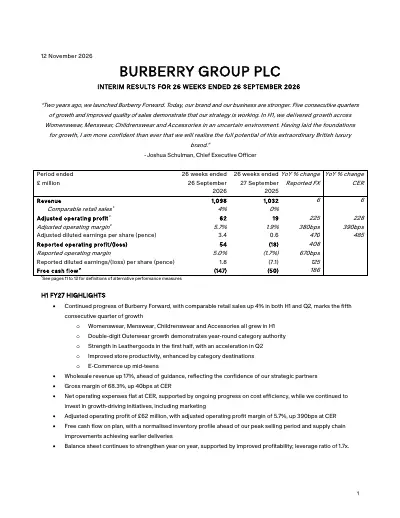
We have delivered five consecutive quarters of positive retail comps with an improved quality of sales. We picked up 480 basis points in gross margin, and we've delivered £62 million in adjusted operating profit, an increase of £104 million, while reducing our net debt leverage to 1.7 times.
While there is much more to do, our progress thus far gives us confidence in the opportunity ahead. Our Burberry Forward strategy is working.
In addition to delivering comparable retail sales growth and an improved quality of sales, we have strengthened our brand momentum and cultural relevance. The momentum stretches across product categories, channels, and geographies, which is translated into improved gross margin and increased profitability.
My conviction that the Burberry Forward strategy is the right path to brand relevance and value creation is stronger than ever. I will now hand it over to Kate to take you through our financial results, and then I will share further updates on our strategy.
Kate?
Kate Ferry
Thank you, Josh, and good morning, everyone. Let me start with a few key highlights.
Firstly, comparable retail sales grew 4% in the first half, with growth across both quarters. Total revenue increased by 6% at both constant and reported exchange rates to £1.1 billion, supported by strong performance from wholesale.
Secondly, we continued to improve the quality of our sales, supporting gross margin. Thirdly, our disciplined approach to cost has maintained opex flat while still growing the top line.
As a result, adjusted operating profit increased significantly to £62 million from £19 million last year. Adjusted operating margin expanded by 390 basis points at constant exchange rates to 5.7%.
Finally, we're continuing to strengthen our balance sheet while investing in ROI-accretive growth. Leverage is progressing in line with our plans, and profitability continues to improve.
I'm really pleased to see the continued progress we've made with Burberry Forward reflected in our financial performance for the first half. I'll now take you through a more detailed review of financial performance.
I'll start with revenue by channel and refer to changes at constant exchange rates. Comparable retail sales grew 4% in the first half, with growth of 5% in the first quarter and 4% in the second quarter.
There was no impact from space, resulting in retail revenue growth of 4% at constant exchange rates. We've continued to see good product momentum in all four divisions growing in the first half.
Wholesale revenue grew 17%, ahead of our guidance. This reflects wholesale partners continuing to reorder through the season, and it's encouraging to see their confidence in our brand.
Licensing revenue declined by 5%, in line with our expectations. As a result, total revenue for the first half increased by 6%.
Turning now to regional performance. Three of our four regions delivered comparable retail sales growth in both the first half and the second quarter.
The Americas continued to deliver the strongest performance with comparable retail sales growth of 12% in the first half and 11% in the second quarter. This was supported by customer engagement through local activation programs and strong conversion in our stores.
Greater China grew by 7% in the first half and 5% in the second quarter, driven by local spend and intra-regional tourism. We outperformed in a more challenging market, supported by our strong British brand heritage with broad luxury appeal, our products' enduring value, and our prominent store locations.
Asia Pacific grew by 3% in both the first half and the second quarter. South Korea grew by 12%, supported by local demand.
Japan declined by 1% in the second quarter, an improvement from Q1, but still impacted by continued weakness in Chinese tourism. EMEIA declined by 2% in both the first half and the second quarter.
This reflected the continued impact of reduced tourist activity and weak traffic trends, particularly in outlet. Excluding the Middle East, the region declined by 1%.
Moving on to the income statement and staying with changes at constant exchange rates. As mentioned, revenue increased by 6%.
Our gross margin improved by 40 basis points, supported by strong full-price performance. I'll walk you through the key moving parts in just a moment.
Adjusted net operating expenses were flat, supported by ongoing cost discipline. As a result, adjusted operating profit was £62 million, with adjusted operating margin up 390 basis points to 5.7%.
Reported operating profit was £54 million after £8 million of adjusting items. Our adjusted effective tax rate was 55%.
The overall level remains elevated given the phasing of pretax profit through the year, but is converging towards our guidance range as profitability improves. Finally, EPS improved significantly as profitability increased.
Turning now to gross margin expansion. Let me give you a little more detail on the drivers here.
Encouragingly, this performance was again driven by an improvement in our quality of sales as a result of strong full-price growth. We also benefited from a one-off supply chain rebate, partly offset by provisioning attached to the planned inventory build ahead of peak trading and mix impact from outperformance in our wholesale business.
Excluding the one-off item, underlying gross margin was 67.8%, a decline of approximately 10 basis points, which is consistent with the guidance that we gave at Q1. We continue to expect gross margin expansion in H2 and for the full year.
We've made strong progress on our cost base. Our cost efficiency program will deliver 100 million of annualized savings in line with the target we set for full year '27.
In the first half, these savings offset inflation and the phasing of marketing expenditure into the first half, while we continued to invest for growth. With revenue up 6% and adjusted net operating expenses flat at constant exchange rates, we're driving positive operating leverage as we rebuild margins.
We're also being highly disciplined in where we invest, focusing on marketing and consumer-facing investment on the highest return opportunities. Our focus on cost discipline and savings to reinvest continues as we're committed to keeping opex flat in FY '27.
Turning now to cash flow. We generated 50 million of cash from operating activities in the half, with a free cash outflow of £147 million.
This reflects a working capital outflow as we build inventory ahead of our peak selling period in the second half, very much as expected and as guided to at Q1. Our supply chain is also working more efficiently, meaning that winter '26 deliveries were earlier than last year.
Capital expenditure of 32 million was slightly below the prior-year period, reflecting some phasing of investment and our disciplined approach to selective, high-return investments. Leverage improved to 1.7 times compared to the prior year at 2.2 times.
Turning now to the outlook. As usual, we're providing technical guidance to support modeling, which can be seen on the slide and in the announcement this morning.
Let me just call out two of the changes since Q1. Firstly, the reduced capex guidance, which reflects the phasing of spend in stores into next year, and also the tax rate, where the higher rate reflects the resolution of historical tax audits.
We continue to expect our effective tax rate to converge towards our blended statutory rate in time. As we look to the rest of the year, we're encouraged by the progress of Burberry Forward and will build on it to drive performance and to deliver sustainable, long-term value.
While mindful of the continued uncertain environment, we expect to make further progress on our financial ambitions, including delivering revenue growth and margin expansion. I'll now hand over to Josh to share an update on our strategic progress and future opportunities.
Josh Schulman
Josh? Thank you, Kate.
When we launched our strategy in November 2024, we set a clear plan to reignite brand desire, improve performance, and drive long-term value creation. Two years on, Burberry Forward has reset our trajectory.
We have returned to growth while building stronger foundations for sustainable, profitable growth over the long term. As a luxury brand with broad universal appeal, there has never been a better time to be Burberry.
At a time when the luxury market has lost many customers largely due to price fatigue, Burberry has a unique opportunity to win. As a brand with broad appeal, we attract all five of the luxury customer archetypes, from the opinionated fashionista to the aspiring customer.
In the first half, we saw our customer base grow, with customers returning to the Burberry they love, and we're also attracting a new generation to the brand, with a continued increase in Gen Z customers throughout the first half. Let me update you on our progress across our four pillars, starting with brand.
Our strategy is to celebrate timeless British luxury through immersive storytelling, combining heritage and innovation. Our winter runway campaign captured the energy of London after dark with an all-star cast, including Romeo Beckham and FKA twigs.
Our winter wardrobing campaign carried that same energy and styling across our offer. More recently, our 170th anniversary portraits campaign celebrated our iconic outerwear on 170 personalities across London, New York, Shanghai, and Seoul.
Each look highlighted that your coat or outerwear is a canvas for personal style as well as protection from the elements. We continue to see some of the world's most accomplished talent wear Burberry, making our iconic brand codes their own.
From Jack Draper in a Burberry Check Harrington to Cardi B in an outstanding shearling right off the runway, Burberry continues to build cultural relevance globally. Last week, we launched our festive campaign with a playful take on the traditional British Christmas.
Actors Fiona Shaw and Pierce Brosnan welcomed an all-star cast, including Cara Delevingne, Dwyane Wade, and Wu Lei, for a joyous festive gathering in a beautiful English country house. This year, we're celebrating 170 years of British creativity, craft, and innovation through a series of activations designed to engage and inspire.
Our V&A exhibit, The Burberry Trench: Crafting an Icon, reinforces the enduring relevance of our most iconic product, from the invention of gabardine to its place in British culture today. The exhibit runs until January, and I hope many of you will have a chance to visit.
In two of the world's most important luxury markets, the Americas and Greater China, we are harnessing the power of our brand to drive growth. In the Americas, we delivered double-digit growth in the first half, supported by strong customer engagement, including activations in the Hamptons and other luxury destinations across the region.
We are also building cultural relevance through authentic relationships, including OG Anunoby, the star player from the New York Knicks who was featured in our outerwear campaign, and he's also British. Looking ahead, we will be taking residence at the iconic Mark Hotel in New York City to kick off the festive season.
In October, our board and executive committee gathered in Shanghai, reflecting China's strategic importance to our business and our confidence in the long-term opportunity ahead. We continue to invest in China with locally relevant activations that are attracting customers to our brand.
Earlier this year, we launched our Burberry expedition series with Chinese National Geography, and for the winter season, we are showcasing our outerwear on the slopes of Songli with an immersive pop-up experience. We will be bringing our 170th anniversary celebrations to Shanghai with a large-scale brand exhibition celebrating Burberry's heritage and relevance for today.
Looking forward, we will continue to build on this through our Lunar New Year campaign launching at the end of December. Moving to product.
Our fashion shows are the pinnacle of our creative expression. For summer '27, Daniel delivered a runway that sparkled with a joyous celebration of Burberry codes, juxtaposed with the artistry of Celia Birtwell, the iconic British print designer.
A balance of heritage and modernity, rainwear with a sense of lightness, a vibrant color palette, and a youthful energy, these were sophisticated and wearable silhouettes. The collection was positively received by the press and our wholesale partners.
As you can see here, we continue to channel the spirit of our runway across our broader commercial offer. With our design and merchandising teams working closely together, we are creating a more powerful and cohesive expression of Burberry, building desire across the full collection.
Our product stories remain timeless whilst disrupting expectations. We are embracing culturally relevant collaborations to reach new audiences.
In addition to the upcoming Celia Birtwell collaboration in the summer show, just last week, we launched an exclusive capsule with Palace Skateboards, the authentic British skateboarding brand. It put a fresh spin on Burberry icons, including the Camden car coat and signature check scarves, that sold out within hours at the opening of the new Palace flagship store in London's Soho.
Outerwear continues to outperform, up double digit in both Q1 and the first half, demonstrating our four-season outerwear authority. We have broadened our offer in lightweight jackets, a key category for us during the warmer months.
Alongside heritage, our Lakefield trench has been a particular standout in women's, bringing together our two most important brand codes, the trench and Burberry Check. As we move into the cooler months, we will be amplifying our quilts and downs over the festive period.
Burberry is the ultimate destination for outerwear, whatever the weather. For festive, we are building on our authority in scarves and expanding our cashmere offer across categories, spanning women's, men's, and children's, from outerwear and ready-to-wear to scarves, hats, and mittens, and even our Thomas Bear.
We are already seeing a strong response to our Kensington cashmere coats. We believe there is significant potential in cashmere, and I am particularly excited about the rollout of cashmere shops globally.
We are seeing this strength extend beyond our core as we build a more complete wardrobe for our customers. Women's wear, men's wear, accessories, and children's wear delivered growth in the first half.
That growth now includes leather goods, which is led by our women's House check and Cotswolds handbag families. Our progress across categories, and particularly our growth in leather goods, gives us confidence in the opportunity to broaden the Burberry wardrobe.
As I alluded earlier, we have a unique opportunity to win in this current luxury environment by providing enduring value at every price tier, whether it's an entry to the brand with a cashmere scarf at £450, or our heritage trench at £1,900, or a cashmere coat just over £3,200. Within each category, we have a range of products at good, better, and best price points within a luxury context.
Behind the scenes, we have been scaling our engine for growth with supply chain improvements that are strengthening our speed to market, improving our product availability, and supporting margin expansion. We saw a step change in the first half, with twice as much winter '26 runway product delivered by early August compared to the prior year.
In addition, our new AI-enabled demand tool and greater supply chain agility are enabling us to respond faster to demand signals throughout our business. Through this, we have significantly improved our availability of core styles, supporting our performance.
Our engine for growth will enable us to drive sustainable, profitable growth in the years ahead. Moving to distribution.
In our stores, we are creating more warmth and desire with richer product displays that showcase the breadth of the Burberry wardrobe and encourage cross-category selling. Our first trench destinations opened at the end of the first half and are off to a strong start, building on the 214 scarf bars and 118 polo galleries now installed across our store network.
Just in the last month, we have begun to introduce pop-up cashmere shops across our stores. These dedicated spaces bring together the breadth of the cashmere offer, from lightweight trench coats and knitwear to iconic check scarves.
We recently announced exciting plans to restore and reimagine our iconic Regent Street flagship as Burberry House. Our restoration will see the return of the historic Burberrys clock, which was displayed outside our Haymarket headquarters and store for decades.
Burberry House will offer an immersive experience with experiential, archival, and hospitality elements. We're introducing Burberry's tea and coffee, which will offer an inviting place for guests to come together and stop by for a tea and a scone.
I can't wait to welcome our customers and all of you to meet under the clock, discover Burberry House, and enjoy a truly one-of-a-kind experience. Here, you can see a first look at our Via Monte Napoleone flagship in Milan opening next year, with its archival staircase and beautiful outdoor courtyard.
We will be rolling out elements of the Regent concept to selected stores around the world. Our e-commerce business continued to accelerate throughout H1 with double-digit growth.
We are making great progress in our digital ecosystem as we continue to develop and embed inspirational content with 360 3D views and richer product storytelling. We're making aftercare a more visible part of the customer journey, reinforcing the lasting value of our iconic products.
Wholesale performance was outstanding in H1, with strong demand driving reorders. Our partners' confidence is translating into greater visibility at our wholesale and concessions.
Here, you can see some of our online activations with Bergdorf Goodman and Net-a-Porter, and our pop-up at Harrods. We will continue to build these partnerships as they attract new customers to the brand.
All of this is underpinned by a high-performance culture. This year, we brought back our Icon Awards, a beloved Burberry tradition which recognizes the exceptional colleagues and teams driving Burberry Forward around the world.
We continue to maintain our commitment to social and environmental responsibility. This remains an important part of who we are and matters to our colleagues and customers.
Throughout the half, we have made significant progress, guided by our Burberry Forward strategy. Today, our brand is stronger, and our business is healthier.
Going forward, we are focused on delivering sustainable, profitable growth. We are operating with greater cost discipline across the organization, driven by the mindset of saving to reinvest and fuel growth.
I am more confident than ever that we will realize the full potential of this British luxury brand. Just before we move to questions, I would like to invite all of you to our Capital Markets Day, which we will hold in March of next year, and we hope to see you there.
In the meantime, I will hand it to Jo, and Kate and I are happy to take your questions. Oh, we have a lot of hands.
Jo Kennedy
Great, thank you, Josh. We will now take questions from the sell-side analysts in the room.
If I could ask you to limit yourself to two questions so we can get through as many of you as possible, and to state your name and firm name before we start. Perhaps I could start with Zuzanna...
Zuzanna Pusz
Thank you so much. Zuzanna Pusz from UBS.
Thank you for taking my questions, and congratulations on the results today. I'll stick to two.
Maybe first of all, on the gross margin, it's pretty impressive, especially considering that even if we remove the tariff refund, and we adjust for the channel mix, you still managed to sort of improve it underlying. Can you tell us when you talk about the improving quality of sales, can you provide a little bit more detail?
Is it product mix? Is it full-price sales, maybe the outperformance of your mainline stores?
That's my first question. Secondly, maybe I know it's a tricky one, but kind of not asking about the exit rate, but obviously everyone is worried about what's happening in the world now.
You seem quite confident. I would imagine you're probably not seeing any slowdown, I would hope, but maybe if you can tell us a little bit about the cadence of growth throughout the quarter.
Now I appreciate that the coming quarter is very skewed to the festive season, but just to give us an idea of what you're seeing right now, that would be very helpful. Thank you.
Josh Schulman
Okay. Why don't I let Kate take the gross margin, and then I'll speak to quality of sales and give a little bit of an idea of what we're seeing.
Kate Ferry
Perfect. Okay.
Based on your question, I think you're kind of quite clear on the gross margin itself. As you say, we did have this one-off tariff impact.
If you exclude that, the gross margin was exactly as we expected, and most importantly, given that the kind of quality of sales piece coming through, we will expect further progress in both the second half and, of course, for the full year. Gross margin, really pleased with our performance there.
Did you want to comment on the quality of sales bit?
Josh Schulman
Yeah. In terms of the quality of sales, we don't typically disaggregate between the full-price channel and the outlet channel, but what we can say is that full price has been outperforming outlet, and we have traffic challenges, particularly in outlet, and particularly in EMEIA outlet at this time.
This is about the quality of sales, and we're very pleased that we continue to make progress on our full-price growth. In terms of the current environment, which I think was your next question, it's clear, no one is immune to what is happening in the current environment.
We see the traffic changes, and stock markets in some regions are rocky, and so forth. I think what this quarter shows us is it shows our ability to outperform a challenging market.
If there's one takeaway that I have from the quarter, it's that the Burberry Forward strategy and the positioning that we have been working on for two years now is resonating with our customers, and is giving us the momentum and the ability to outperform what is a challenging luxury market.
Jo Kennedy
Thanks. Can we go with Thomas and Luca please?
Thank you.
Thomas Chauvet
Good morning, Thomas Chauvet from Citi. Two questions please.
The first one on your operating expenses, you've managed to grow retail mid-single digit, in the half wholesale double-digit without incremental spend. Opex was flat constant FX, was even down given the adverse marketing phasing.
That's quite an achievement. That helps, I guess, rebuild the profitability of the business.
That was one of your target two years ago. At what point do you think you need to reinvest a bit more, perhaps at the expense of big swings in EBIT margin, especially as the 100 million of cost savings are now coming to an end?
My second question is on wholesale. We saw the great performance there.
I was curious to hear perhaps about one of your wholesale partners in Europe, Frasers Group. They're building a growing luxury and premium brands and retail presence as a strategy.
They have also disclosed a 6% stake in your company through derivatives. Has the dialogue with them changed in any way?
Are you looking to deepen the relationship with them beyond the existing wholesale arrangement? Thank you.
Jo Kennedy
Thank you.
Josh Schulman
Kate, why don't you take the first half, and then I'll come back on wholesale? Yes,
Kate Ferry
on the opex, we're obviously pleased given that revenue up 6% and opex flat, we really are now starting to see that leverage coming through. What I would say is that we will continue this real focus on cost discipline, but don't imagine that we're not investing behind growth either.
We're very much managing to protect the investment behind growth. It's actually much more about moving forward, empowering all of our leaders to make the right decisions, and internally you'll hear us talking a lot about saving to reinvest.
I think you start every year with the basis that opex will be flat, and there'll be some things that you decide you want to really get behind, and not others. I think, back to Josh's points around Burberry Forward, here we are two years in, we really know what's working, where we need to spend.
We're incredibly returns focused, and that goes obviously very important within opex. Obviously, you've seen it within capex as well.
I think we are able to deliver what we need to deliver, but within a tight, kind of disciplined envelope.
Josh Schulman
In terms of your next question, in general, in the quarter, we were really pleased with our wholesale growth. Just having spent time with a lot of our wholesale partners around the world, having just come back from New York, hearing their confidence in our brand is really gratifying.
The same impact that we are having in our stores of being a brand with broad luxury appeal, they're also seeing in their stores as well. The work we've done in terms of building a good, better, best in a luxury context is especially important for our global wholesale customers.
Of course, among our wholesale customers, we have a longstanding valued relationship with the Frasers Group. They are an important customer of ours, particularly here in the UK, and now they are also an investor.
We will be meeting with the Frasers team as we do with all of our investors, and we are pleased that they see value in Burberry. Yes.
Luca Solca
Good morning, Luca Solca from Bernstein. I have two questions.
The first one on retail space productivity. Where do you stand on that front relative to your ambition?
How much do you think you could potentially gain, on the one side, from stronger brand growth and brand appeal, and on the other side, from right-sizing the average store size? If you are planning to do that, where do you stand on that process?
My second question, again on stores, is whether you think that you could potentially be doing more when it comes to windows and how engaging they could be? I'm just thinking about another outerwear peer of yours who is using windows very effectively to try and attract attention.
You have now significantly more compelling product assortment, you could make maybe a bit more noise, I wonder.
Josh Schulman
In terms of store productivity, we are pleased that our strategic investments in scarf bars, polo galleries—I don't know if you've seen any of our new trench destinations—those are all driving an increase in productivity. Behind the scenes too, we are looking for ways to do so in a smaller footprint.
For instance, Regent Street is one of our largest stores, it is our largest store globally, and we used to have the Thomas's Cafe next door, and we gave back the Thomas's Cafe space and some back of house to the landlord, we will be reimagining that in a somewhat smaller square footage. That is playing out in different places around the world.
We do see that as another lever to drive productivity. Finally, in terms of windows, your timing is perfect with that question because we have a new hire on Paul Price's team who is over all of our global windows and visual experience, and I have to say, I'm very excited about what is in the pipeline.
Jo Kennedy
A few more questions. Could we go with Poomie please, Natasha, and...
Hi, Josh and Kate, it's Poomie from HSBC. I just wanted to zoom in on leather goods and what specifically drove the performance there in terms of price points or particular bag families, or was it more conversion or new customers?
Then, similarly, what is the mix now between new and existing customers, and how has that evolved in the last couple of years? Then, finally, given the EBIT beat, what are your thoughts on full-year consensus and the upside there?
Thank you. Okay.
I will
Josh Schulman
I will start off with leather goods and speak about the customers, and then turn it over to Kate regarding the EBIT beat and consensus. In terms of in terms of leather goods, I have, resisted talking about this for a while, because obviously, several of my predecessors have had bold strategies for leather goods that haven't necessarily planned panned out.
However, one of our big initiatives in Burberry Forward was to align our our pricing with our category authority and to infuse our products with our brand codes in innovative ways. Over the last two years, we have had a a several introductions that have done that.
First there was the B-Clip bag, and then more recently the Cotswolds group and the reintroduction of House check and the reimagination of the House check range. We have a sweet spot around £2,000, and and and that is and that is doing very well for us.
What, it's also interesting, because you you you you you speak about conversion and attracting new customers, and two years ago, we only had one category that was attracting new customers, and and that category was rainwear. Now what we see is we see accessories are attracting new customers, and accessories including handbags are attracting new customers, and and shoes are attracting new customers.
This gives us this gives us confidence. It's early days here, but it gives us confidence, both in the in the revenue generated from wardrobing, but also from having anchor anchor families of of of leather goods that will attract people into Burberry.
I was particularly excited by Daniel's summer show, where we had a strong impact of a new bag, the Derby bag, which will will be at a best price point. We'll have good, better, and best, but all all within all within, our range where we know we can have success.
The Derby will pick up, sort of where the B-Clip was, at at at the top of the pyramid. We are we are increasingly confident that we have a we will never we will never be a leather goods driven brand.
We will always lead with with outerwear, but we ha- there is an important role for for leather goods to to play in our mix. In in the quarter in in the half, in in terms of existing and and new customers, we had total customer growth, and that was driven by existing customers, and and we have we have a large database.
We have been able to really tap into that database and improve our clienteling, and we have a lot of customers who were welcoming back to the brand, that we may have not been in their consideration set, and, we are obsessed with Burberry 24/7, but, customers, may not know that we realigned the products around timeless British luxury, and so we are re- we are still re-engaging with people and bringing them back to the brand. The other highlight I would say is the growth that we have in Gen Z customers, and so we are really attracting a new generation of customers to the brand.
That is encouraging. I'll turn it over to Kate on the consensus.
Kate Ferry
On the consensus, clearly we're really pleased with our performance in the first half. As you've heard, we are outperforming the market.
At the same time, we're mindful of the uncertain backdrop. Wrapping all of that up, we are comfortable with consensus, happy with the range, happy with the consensus at the midpoint of that.
As ever, as you'd expect me to say, we're just a few weeks into H2. We've got our festive period ahead, but, as you've heard, I think we're well set for that.
Natasha Bonnet
Hi, good morning, this is Natasha Bonnet from Morgan Stanley. Thank you for taking my questions, and congrats again on the great set of results.
The first will just be on the new versus existing customers that you're seeing. Are you seeing any differences by regions, and could you maybe outline whether that's maybe due to local activations that might be more successful in one region versus another?
Then the second would just be a follow-up on the question on stores. Could you provide some more granularity on your store optimization plans, maybe second half or next year, and how we should be thinking about opex growth for fiscal year '28 at this stage?
Thank you.
Josh Schulman
I'll let Kate take the stores and opex, and I'll speak about the customers. The exciting thing is really Gen Z, which are up double-digit, and we're seeing Gen Z growth in general on a global basis, but particularly in China.
Again, this gives us great confidence to be introducing the brand to a new generation of customers in China. Of course, right now, we all read and we all see the challenges in the China luxury market, but we are being very deliberate in investing in a tough climate, and cementing our deep relationship with the Chinese customer.
I've been doing this a very long time in different contexts. Erwan is smiling, because he's known me a long time, but I think we should never underestimate the resilience of the Chinese customer.
Kate Ferry
I think on the opex point, really just to reiterate the comments that I made earlier. We remain incredibly focused on our cost discipline, keeping opex flat, but within that, we absolutely have the investment required to continue to optimize our stores and indeed to drive productivity.
If you're referring to the store program that Josh spoke about, obviously, some of that's in opex, some of that is in capex, but again, likewise on capex, very focused on where we can really drive returns. I think the beauty of that concept, actually, that you've seen outlined is that you can just take, some stores get the full piece like Regent Street, but we can take elements of that concept to stores over the next few years, which means that capex may increase a little bit, but we'll keep within that 5% of sales.
Jo Kennedy
Erwan, and Anthony, and then I think we'll go with Daria as well.
Erwan Rambourg
Thank you. Can you hear me?
Josh Schulman
Yes.
Erwan Rambourg
Yeah. I can't hear myself.
Erwan Rambourg from Goldman Sachs. Thanks for all the positive messages, it's quite rare and quite refreshing for a luxury company.
Two questions. I wanted to come back to retail.
You've spent two years reviving brand equity, nurturing brand desirability. You've talked about the Burberry House, you've talked about Montenapoleone, I was actually there yesterday and I see the location in the space.
I'm just wondering, you were operating with sort of stable space over the last two years roughly, possibly because the brand equity was not right, or desirability, or financial means, or a combination of the above. How should we think about the longer term?
Will you roll out stores with a different concept, or do you have what you need and you'll more focus on like-for-like and efficiencies and refurbs and relocations? Then the second question maybe a bit more philosophical on China.
There seems to be a pretty phenomenal dichotomy between premium European brands that are mostly declining double digits, and so-called contemporary brands that some of them reported last week up, very strong double digits. You're outperforming overall.
Can you explain what your view is on how this is stretched between different brands? Is it linked to what you mentioned, Josh, around price fatigue, or what you just mentioned about resonating with Gen Z?
It seems that the US performance of brands is slightly more uniform, but China seems to be all over the place, just wondering what your thoughts are on that. Thank you.
Josh Schulman
Yeah. In terms of your first question—I'm sorry, could you repeat part of your first question?
It's about the brand and the space?
Erwan Rambourg
The first question is you've had no space movement basically for the past,
Josh Schulman
and
Erwan Rambourg
now that the brand desirability is where it should be and now that you have financial means, and now that you're opening a Burberry House and Montenapoleone, will you ramp up space or will you just relocate? Right.
Okay. Yes.
Got it. Okay.
Josh Schulman
I think we see the space as broadly flat. There will be some openings, some closures, but broadly flat.
I think what is exciting about Burberry House, and you should take this as a signal of our confidence. Having five consecutive quarters of positive comps and laying the foundation for growth, people keep saying, what's next for Burberry.
We see the opportunity to add a further level of inspiration to the product, to the brand, the windows, the marketing. Having laid those foundations, our opportunity is how we inspire our customers around the world and ignite our brand and our business.
You'll be hearing a lot more about that at Capital Markets Day. Burberry House, Montenapoleone, those are hints of what to come.
In some of the questions about windows and inspiration and all of that, I think this is an amuse-bouche of what we will serve up for Capital Markets Day. In terms of our success in China, I try never to reference other peer brands, but I am going to reference two two brands that I have enormous admiration for, and one of which is Ralph Lauren, and one of which is Hermès.
I often reference these two internally, because in some ways, I see Burberry right in the middle of those two brands. On the one hand, Ralph Lauren has over 200, I think 250 outlet stores around the world, and we will never have 200 or 250 outlet stores around the world.
On the other hand, Hermès has £25,000 handbags. We will never have £25,000 handbags.
At least as long as I'm here. We've been here 170 years, I can't talk about 170 years from now.
We have a unique space in the luxury market, because we are a luxury brand with beautiful product, with cashmere coats and bags made in Italy, trench coats made in Castleford, England, and a true provenance, and beautiful luxury locations, and now we have the elements to fully wardrobe the customer. We have a unique space in this market, because we've always been a little more democratic than our European counterparts in terms of our pricing strategy.
This isn't a knee-jerk reaction to a market trend. This was an important element of Burberry Forward, was to go back and align our pricing with our category authority and look at when Burberry had its peak era of cultural relevance and its peak era of value creation.
We had the sweet spot, and so we're recapturing a spot in the market that was always ours, and the customer is coming back. That is why, yes, it's a tough market out there, but that's why, quarter after quarter, my confidence is building.
Right.
Jo Kennedy
Sorry, I think we had Anthony and Daria.
Anthony Charchafji
Yep, thank you very much for taking my question. It's Anthony Charchafji from BNP Paribas.
I have just two questions. The first one is on inventories.
Last year, you've been a bit cautious on the buying. This year, you're a bit more I would say aggressive in term of product availability.
We've seen inventory going up a bit in H1. I'm just curious to know if you're happy with the composition of inventories, and if you think that you still need to build up a bit more also next year, or are you happy with the current level?
The second question is more on Europe and the European locals. They're a bit lagging behind Americans and Chinese cluster that are still growing.
I'm just curious to know why we're still seeing European locals down a bit at Burberry, and if you have any color by country, UK versus continental Europe, that would be very helpful. Thank you.
Josh Schulman
Yeah. In terms of the inventory, you're right.
Last year, we were deliberately very tight on inventory as we were testing and learning about the new Burberry Forward strategy, and there are two things that have happened this year. One, we've been buying with more confidence, and the second is we've had supply chain improvements.
We actually had more of the product for the festive season ready by the end of the quarter, all of that is strong. In terms of the complexion of inventory, this is a different company than what existed two years ago.
Two years ago, we had very, very specific, very difficult product, and so we're very happy with the complexion of inventory. In terms of EMEIA, actually our locals are up.
Where we are challenged is in tourist spend. We're in a cycle where people are shopping locally more, particularly the Chinese customers.
In the Middle East, our sales to Middle Eastern customers are up, because they're not traveling to London and Paris and all of the places in Europe where they typically traveled. The Americans are still traveling a bit, but when business is really robust in Europe, you have a consistent local customer and you have some mix of Americans, Middle Eastern, and Chinese customers in the market.
Jo Kennedy
Great. I think we had Daria, and then we have one from Piral, and I think we'll have to call it.
Thanks.
Hi, this is Daria from Bank of America, and thank you for taking my questions. I have two.
Can I first ask a question on China again? How sustainable do you believe your outperformance versus the market to be?
Would you say this gap, especially in this very challenging quarter, was driven by any particular activations through the period that you can attribute it to, or we can just stop looking at comps in a way and just say that this is a lot more sustainable than many people might think? My second question is on wholesale.
Could you please split this wholesale strength into reorders, in-season replenishment, new season excitement versus any new doors? Did you resume shipping to Saks as part of this number, and how should we be thinking about wholesale growth after this year?
Obviously, as comps also get tougher.
Josh Schulman
Yeah. On China, obviously, it's a challenging market, and obviously, there are traffic challenges in the luxury malls in China.
We're not immune to what's happening in the headlines. As you saw, there was a step down from Q1 to Q2, but an outperformance.
This outperformance and what we see of the customer's reaction to our positioning, our product, our teams, they're telling us, you have the right positioning and the right product. I'm not going to be able to sit here with a crystal ball and predict the China macro, but we have been outperforming, and we continue to invest.
We're not retreating, and in fact, we're getting sharper with our localization and our marketing. What I can share with you is what we've achieved in the last few quarters and our confidence going forward, but we don't know what is going to happen with the overall macro.
In terms of wholesale, if I go back to last year, which seems like a lifetime ago in this business, we continued to ship Saks Global until around Thanksgiving time in November, and we stopped shipping them in November, and so I think that maybe somewhat different than some of our peers, and then we resumed shipping them in the following calendar year. The complexion of doors continues to change, and actually, we continue to reduce doors in Europe, and that has been somewhat offset with some growth in America, where, as I said, we're now strengthening our partnership with the Exemplar Luxury Group with Bloomingdale's and Nordstrom, and all of which are benefiting from the Burberry Forward strategy.
Jo Kennedy
We just have one more from Piral. Thank you.
Piral Dadhania
Thank you. Piral from RBC.
Two questions. The first is on the outlet network.
Historically, this has been an area where some analysts have been a bit less than positive. Given the challenges you're facing from a traffic and revenue perspective in the outlet business, is now a good time to potentially reduce the footprint there?
Following on from that, as you build the momentum and the rebuilding of the brand equity of Burberry, we were wondering how much of the VIC opportunity is still in front of you. Is that something that you are already addressing, or is that something that we can expect to intensify as the business continues to rebuild?
Thank you.
Josh Schulman
Yeah. In terms of outlets, they do play an important role in our ecosystem, particularly as a clearance mechanism for, at the end of the cycle.
There may be some adjustments down the road in terms of the numbers, but we also don't see the channel as an inhibitor to our overall growth. The question on VIC is very interesting and very timely, in fact, because here we have really gone after this, particularly we've done it globally, but I have to say, our Americas team is deeply focused on this, and unlocking the VIC opportunity.
Just next week, we will be taking over The Mark Hotel, right off of Madison Avenue, which is an iconic New York hotel, and will be bringing that to life from the facade to the inside with a series of activities and a private shopping suite in the penthouse. We're bringing in customers not just from the United States, but from all of the Americas, from Brazil and so forth.
I'm very excited about that activation, and we are doing that also in versions of that also in China, where we will be bringing in customers from around the region for our Ever Forward exhibit as well. We do have an important top of the pyramid, and we have a lot of different tiers of customer activities, and so we're really excited to have that one-on-one relationship build between our client advisors and our customers.
Jo Kennedy
Thank you very much. I think that concludes the Q&A, and I'll hand back to Josh.
Josh Schulman
Thank you, everyone, for your questions. It's always good to do this and to see all of you.
I do want to take a moment to thank Gerry Murphy, who formally steps down as chair today, and to welcome William Jackson into the new role. As always, I'd like to thank all of our colleagues around the world who are responsible for the progress we are making on our strategy.
We look forward to updating you in January, wish you happy holidays in the meantime, and we will see you at our Capital Markets Day in March. Thank you.