Brinks Company (The)
Q3 FY2026 · Earnings Call TranscriptNovember 4, 2026
Operator
Good morning, and welcome to The Brink's third quarter 2026 earnings conference call. All participants will be in listen-only mode.
Should you need assistance, please signal a conference specialist by pressing the star key followed by zero. After today's presentation, there will be an opportunity to ask questions.
To ask a question, you may press star then one on your telephone keypad. To withdraw your question, please press star then two.
This call and the Q&A session will contain forward-looking statements. Actual results could differ materially from projected or estimated results.
Information regarding factors that could cause such differences is available on today's press release and presentation, and in the company's SEC filings. The information presented and discussed on this call is representative of today only.
Brink's assumes no obligation to update any forward-looking statements. The call is copyrighted and may not be used without written permission from Brink's.
Please note this event is being recorded. I would now like to turn the conference over to your host, Jesse Jenkins, Senior Vice President of Financial Planning and Analysis and Investor Relations.
Mr. Jenkins, you may begin.
Jesse Jenkins (Senior Vice President of Financial Planning and Analysis and Investor Relations):
Jesse Jenkins
Thanks, and good morning. Joining me today are CEO Mark Eubanks and CFO Kurt McMaken.
Brink's reported third quarter results on a GAAP, non-GAAP, and constant currency basis this morning. Most of our commentary today will be focused on our non-GAAP results.
These non-GAAP financial measures are intended to provide investors with a supplemental comparison of our operating results and trends for the periods presented. We believe these measures allow investors to better compare performance over time and to evaluate our performance using the same metrics as management.
Reconciliations of non-GAAP results to their most comparable GAAP results are provided in today's earnings release and the presentation appendix, both available on our website. We will also have commentary on the status of our pending acquisition of NCR Atleos.
As a reminder, this transaction remains subject to the completion of customary closing conditions and additional regulatory approvals. Other details, including factors related to risk of the transaction, can be found in the pertinent SEC filings.
I will now turn the call over to Brink's CEO Mark Eubanks.
Mark Eubanks
Thanks, Jesse. Good morning, everyone.
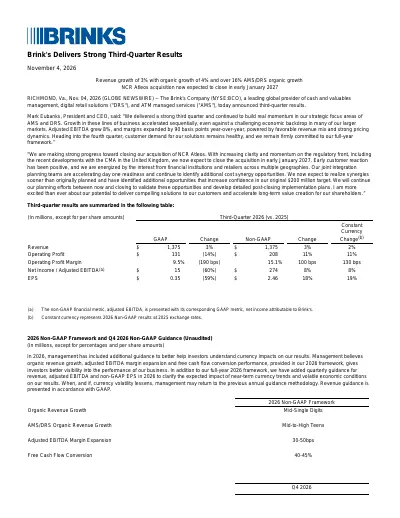
I'll begin on slide three with a quick overview of the quarter before updating progress on the NCR Atleos acquisition. In the third quarter, we delivered 4% organic growth, with organic growth in ATM managed services and digital retail solutions, or AMS/DRS, accelerating sequentially to over 16%.
Our AMS/DRS growth strategy continues to drive growth and profitability across the business in this, our 15th consecutive quarter of at least mid-teens organic revenue growth. AMS/DRS now represents 30% of our trailing 12-month revenue mix after reaching a record 32% in the third quarter.
Strong momentum is continuing in the AMS/DRS markets, and we expect to continue this acceleration into the fourth quarter. Cash and valuables management, or CVM, was highlighted by good pricing discipline and continued growth in our Global Services business.
Supported by record AMS/DRS revenue mix and good productivity, we delivered a third quarter with adjusted EBITDA margins above the midpoint of our previous guidance. Adjusted EBITDA margins were 19.9% in the quarter, up 90 basis points year on year, while operating profit margins expanded by 100 basis points.
Record Q3 total company margin performance was highlighted by the continued expansion in North America, Europe, and Rest of World. As you'll see later, North America hit 20% adjusted EBITDA margins on a trailing 12-month basis, and our European segment expanded by over 400 basis points year on year.
Trailing 12-month free cash flow was $413 million, with conversion of 40%, reflecting the adjusted EBITDA growth that I previously mentioned and continued CapEx leverage as we shift our business to a less capital-intensive customer offering. The year-to-date free cash flow and adjusted EBITDA growth drove an expected leverage reduction to 2.6 times in the quarter.
Year to date, our results remain in line with our full-year framework, and we expect to deliver on mid-single-digit organic revenue growth, 30 to 50 basis points of adjusted EBITDA margin expansion, with free cash flow conversion between 40% and 45%. I am confident in our team's ability to continue our growth trajectory in AMS/DRS, improve our profit margins, and expand these results into higher free cash flow for the years to come.
Turning to slide four, I'd like to take a moment to revisit the strategic rationale of the NCR Atleos acquisition. The deeper we progress with integration planning, the more excited I become about the potential of the combination.
While both companies are performing well independently, we expect our complementary customer offerings to create simplified solutions for customers. On the ATM managed services side, we have the potential to bring together a complete vertical stack of capabilities that touches every aspect of the value chain, from hardware and cash logistics through to software and processing capabilities.
Over the last few months, we've had many conversations with financial institutions about the possibility of what this combination unlocks. Together, we will have a compelling, best-in-class offer to present banks as they allocate capital towards other priorities and simplify ATM ownership in a managed services or full outsource model.
On the retail side, we are already seeing the potential of the combination. As I discussed last quarter, we recently signed an agreement with a large retail customer in North America to service approximately 5,500 locations with our DRS solution, each already containing an Allpoint ATM within the store.
After deal completion, we will have the ability to combine services of both DRS devices and AMS into a single trip, improving service quality and eliminating inefficiency as we support the entire cash ecosystem. The efficiency gained will help lower our operating costs while helping customers optimize the cash ecosystem within their stores, creating a true win-win solution.
As we continue to densify our service network across existing and new customers and drive significant back-office synergies, our cost structure will continue to improve, creating a flywheel that will position us to capture new customers and expand our share of wallet with existing customers. The opportunity in front of us is so compelling.
As we continue to drive more ATM outsourcing and penetrate deeper into the broad retail customer base, we believe the combination could expand our addressable opportunity to two to three times the current $36 billion global addressable market. As I've said many times, this was a strategy-first acquisition, and the more we explore the possibilities with the NCR team, the clearer it becomes that the growth potential is just as compelling as the value captured from the cost synergies.
Turning to slide five, we've made considerable progress validating cost synergies and are optimistic there's a potential for more as we progress with integration planning. As we announced this morning, we're pulling forward our expected closing date again and now expect to close the transaction in early January of 2027.
This would allow us to execute our synergy capture activities almost a full quarter faster than was originally contemplated. The chart in the middle of the page shows the impact of the improvement of the timeline, where we will ultimately reach our full $200 million run-rate synergy projection by the end of 2029.
Beyond the timing improvement, we've also preliminarily identified the potential for additional synergies across each of our focus cost categories. Within SG&A, we've identified opportunities to further streamline management functions and simplify the organizational structure of the combined business.
We also see the potential to leverage existing Atleos back-office and customer support centers of excellence in the combined business as we shift costs to lower-cost locations and drive standardization and simplification during integration. In the service network, our early estimates suggest additional opportunities around route density, operational footprint rationalization, and service network consolidation beyond the original simplifying assumptions around insourcing cash logistics and second-line maintenance.
Finally, procurement appears to be a significant opportunity as we assess potential savings involving common vendors and similar spend across categories like fleet, information technologies, and parts and supplies. While we still have work to do to solidify and quantify this potential upside after we close the transaction, it's clear from the work we've done so far that we expect to capture more value and capture that value sooner than our original expectations.
On to slide six. I'll provide a quick update on the significant progress we've made on the regulatory front.
There are three areas of regulatory clearance that must be addressed before closing. I'm happy to report that all closing conditions have been met in two of those, in both the foreign direct investment and money transmitter licensing.
We've also made considerable progress in antitrust reviews, reaching resolution in 12 major jurisdictions. The remaining reviews, including those in the UK and EU, are progressing as expected.
As we announced today, we expect the remaining regulatory approvals and other customary closing conditions to conclude within the next two months, allowing us to target closing in early January of next year. On to slide seven.
You can see here our full timeline. Over the coming months, each company will remain focused on its standalone commitments while we accelerate integration planning and day-one readiness.
Our joint integration planning teams have developed a list of quick wins, which we can distill into day-one action plans to optimize and accelerate value capture post-closing. We're also making progress designing the combined leadership team and organizational structure, with plans to finalize it within the coming weeks for implementation following closing.
Shifting back to the quarter on slide eight, I'll provide some commentary on the performance by line of business, starting with CVM. Organic growth was down 1.5%, reflecting faster conversion to AMS/DRS than in previous quarters.
Underlying growth reflects strong pricing ahead of inflation and continued strong growth in our Global Services volumes. Sequentially, Global Services continued to moderate towards its historic norms, especially in North America.
We expect these AMS/DRS conversion and Global Services moderation dynamics to continue into the fourth quarter. Moving to AMS/DRS, revenue growth accelerated sequentially to over 16%, our 15th consecutive quarter of at least mid to high teens organic growth.
The acceleration was widespread, with growth advancing in all segments. In the AMS business, we saw good growth from customer wins in Mexico and continued to roll out the Mandiri bank network in Indonesia.
In DRS, we continue to see stable, strong growth in all markets. Our value proposition is resonating with customers of all sizes and across diverse customer end markets.
Pipelines and backlogs remain robust as we head into the close of the year and prepare for growth in 2027. This includes the large retail enterprise customer we announced last quarter in North America that is now expected to begin deployment early next year.
As we look at the fourth quarter, we expect to see revenue accelerate in AMS/DRS again, despite the lapping impact of a large equipment sale in the prior year in North America. Supported by strong backlogs and pipelines in DRS and a solid schedule of conversions, including a new customer rollout in Luxembourg in AMS that I'll discuss in a few slides, we remain confident that we're on track to deliver our full-year framework of mid to high teens organic growth.
Moving to slide nine. I want to highlight a financial institution contract award that we recently won in Canada that will support growth and improve density in this important market starting in 2027.
This deal is with a top bank in Canada that has a large commercial presence across the major metropolitan areas in the country. As part of the competitive process, our commercial teams were able to secure the relationship, supporting traditional cash management services across the country.
This key win in the Canadian banking sector establishes a foundation for long-term growth with one of Canada's premier financial institutions. The additional volume provided by these locations will give us a better foundation as we continue to penetrate a large and growing addressable market with DRS.
On slide 10, you can see the details of an exciting new AMS win in Luxembourg. This deal continues a broader trend we're seeing across Europe, where major banks joined together to build a consortium and create a shared ATM network.
These situations often create a unique entry point for Brink's as they initiate a general review of operations, including the consideration of a full outsourcing of the new estate. In this specific situation, the participating banks have built a shared network under the brand name Bancomat that places devices at strategic locations spanning across the country.
Their goal is to ensure consistent and reliable access to cash for their customers, and Brink's will provide a holistic end-to-end solution to facilitate this objective. Once fully deployed, our turnkey solution, including services from cash logistics and real-time monitoring through transaction acquiring and processing, aims to simplify the customer experience, allowing these banks to shift focus to other value-creating customer services like loans and account growth.
Once we complete our pending acquisition, we will explore leveraging the capabilities of NCR Atleos in hardware, second-line maintenance, and software that could enable us to add new transaction types to these machines as we scale our relationship. This is a big win for our European teams and illustrates the outsourcing capabilities we have today and the potential to build on these capabilities post-closing.
We're having similar discussions with major potential customers across a range of geographic markets. We continue to see our offering is solving a diverse set of customer problems, and by continuing to win in the marketplace, we're developing more proof points for additional potential future customers.
I'm confident our AMS strategy remains in the early stages of development, and we are poised to capture significant future growth as this market continues to mature in the coming years. On slide 11, and before I turn it over to Kurt for more details on the financials, I want to recognize an important strategic milestone.
I'm happy to report on a trailing 12-month basis, we reached 20% adjusted EBITDA margins in our North America segment in the third quarter. Our progress has been impressive over the last several years, with revenue mix aggressively shifting to higher-margin services, and supported by strong productivity enhancements across the cost base, we've expanded margins by more than 500 basis points since 2022.
While reaching this milestone is certainly worth celebrating, I'm encouraged because I know that we are just getting started. With a solid AMS/DRS pipeline reaching well into 2027, significant synergy potential from the NCR Atleos deal, and ongoing efficiency initiatives across both Canada and the US, there remains significant potential to continue to expand margins over the coming years.
With that, I'll turn it over to Kurt to walk through the financials and fourth quarter guidance before I return for some closing comments and Q&A. Kurt?
Kurt McMaken
Thanks, Mark. I'll begin on slide 13 with a look at the quarter.
Revenue increased by 3%, with 4% organic growth, a 1% foreign currency tailwind, and a 2% revenue decline from the previously disclosed deconsolidation of our Malaysian business, which will continue at a similar level over the next three quarters. Adjusted EBITDA was up 8% to $274 million, and operating profit was up 11% to $208 million.
We continue to demonstrate strong operating leverage in the business, with profit growth rates more than double revenue growth rates again this quarter. EBITDA margins were up 90 basis points to 19.9%, and operating profit margins were up 100 basis points, pacing ahead of our third quarter guidance.
EPS of $2.46 per share reflects growth of 18%. Trailing 12-month free cash flow was $413 million, with conversion of 40%.
As I will cover in a few slides, we remain on track for full-year free cash flow conversion between 40% and 45%. On slide 14, total organic revenue growth was $48 million, including $62 million from our higher-margin, subscription-based, strategic focus areas of AMS and DRS.
As Mark mentioned earlier, growth in AMS/DRS reflects an increase in conversion from CVM, which more than offset growth in Global Services and good pricing realization. FX contributed $15 million, or 1%.
In the last few months of the quarter, the dollar strengthened considerably against most currencies, impacting our growth in Q3, and as you will see in a few slides, our expectations for the fourth quarter. Moving to the right side of the slide, you can see that $48 million of organic revenue growth converted to $24 million of adjusted EBITDA growth, for an incremental flow-through to profit of approximately 50%.
Our 19.9% EBITDA margin was driven by record margin performance across many of our segments as we continue to shift our revenue mix and drive operating leverage. Moving to slide 15, starting on the left, operating profit was up $20 million to $208 million, with a margin of 15.1% on productivity, pricing, and revenue mix.
Interest expense was $66 million in the quarter, up $3 million sequentially and year over year on higher interest rates and higher levels of provisional credit from DRS growth. Tax expense was $39 million in the quarter, representing an effective tax rate of 27.2%, slightly better than the prior year.
Income from continuing operations was $102 million on 41.5 million diluted shares, for an EPS of $2.46. Depreciation and amortization was $61 million in the quarter, and is expected to be slightly below $250 million for the full year.
Stock-based compensation was $5 million in Q3, and is expected to be approximately $30 million for the full year, roughly in line with the prior year. Let's move to slide 16 to discuss our capital allocation framework.
Our capital allocation framework remains unchanged despite the pending NCR Atleos acquisition. We reduced our leverage at the end of the second quarter to 2.6 times net debt to adjusted EBITDA.
With the pending acquisition set to temporarily move us over three turns at closure, we continue to expect the primary use of capital during 2027 to be aggressive debt paydown. As we have mentioned previously, we plan to rapidly delever after closing and are targeting net leverage below three times by the end of 2027.
Once we return to our targeted leverage level of two to three times, we expect to resume our prior capital allocation model, with at least 50% of free cash flow focused on shareholder returns. Given the expected adjusted EBITDA growth after closing, both organically and through synergies, we expect to continue net debt leverage reduction during 2028.
With a line of sight to $1 billion of free cash flow, we expect to have flexibility to capitalize on accretive uses of capital that can compound cash generation and improve return on invested capital as we move forward. Moving to the guidance on slide 17.
Our framework for 2026 is unchanged. We expect to deliver mid-single-digit total organic growth, supported by mid to high teens organic growth for AMS/DRS.
Adjusted EBITDA margins are expected to expand between 30 and 50 basis points, with conversion of adjusted EBITDA to free cash flow between 40% and 45%. In the fourth quarter, we expect revenue between $1.365 and $1.415 billion, reflecting between 3% and 4.5% organic growth.
Organic growth reflects continued moderation in Global Services and the lapping of a large DRS equipment sale in the prior year. FX is expected to be a little more than 1% headwind in the quarter, and impact from the Malaysia deconsolidation is expected to continue into the fourth quarter and the first half of next year.
Adjusted EBITDA is expected to be between $275 and $295 million, reflecting adjusted EBITDA margin expansion of approximately 40 basis points to 20.5% at the midpoint. EPS is expected to be between $2.45 and $2.80.
With that, I'll turn it back over to Mark for some closing comments.
Mark Eubanks
Thanks, Kurt. Before we take questions, I want to return to our preparations for post-closing integration.
As I detailed earlier, we have increasing confidence in the significant synergy potential above our original estimates. We see upside across the service network, within SG&A, and also in procurement.
With the accelerated close timeline, we have the ability to capture these synergies sooner than our original estimates. Our joint integration planning management office has been busy deep diving these opportunity areas and developing robust day-one action plans to deliver against our synergy commitments.
Externally, customers are excited about the possibilities that this combination can provide. Interest is high, and while we are still two separate entities until closing, customers increasingly want to understand what the future will look like.
Conversations have been very positive, and include potential customers of all sizes and across all of the countries where we operate. Just as we saw with the Bancomat win this quarter, we'll be able to deliver bespoke solutions that can solve a broad range of customer needs by leveraging our combined best-in-class service offerings.
Go-to-market planning is accelerating as we approach day one. We're developing playbooks for our commercial leaders and targeting specific customer opportunities to pursue post-close for quick commercial wins.
The outlook remains attractive. The marketplace is evolving rapidly, and post-closing, we'll be even better positioned to capitalize on the opportunities in front of us.
I look forward to closing a strong 2026 as standalone Brink's, and am energized for the potential of the combined companies to drive higher levels of growth and profitability for our shareholders in 2027. With that, we'll open the line up for questions.
Operator?
Operator
Thank you. We will now begin the question and answer session.
To ask a question, you may press star then one on your touchtone phone. If you are using a speakerphone, please pick up your handset before pressing the keys.
To withdraw your question, please press star then two. At this time, we will pause momentarily to assemble a roster.
Our first question comes from George Tong from Goldman Sachs. Please go ahead.
George Tong
Hi, thanks. Good morning.
You've publicly agreed to divest your NoteMachine and TestLink businesses in the UK to address the CMA's concerns. Can you quantify the revenue and EBITDA associated with those businesses and what you expect in terms of sale proceeds and any other remedies that might be required to satisfy regulatory clearance for the Atleos transaction?
Kurt McMaken
Hey, George, it's Kurt. Let me just give you kind of roughly size the business.
The business runs about $120 million, $130 million in revenues, and then EBITDA margins kind of in the mid to high 20s on that. You're looking at about a $30 million EBITDA kind of impact of the NoteMachine business.
We really can't talk about sales proceeds because we don't really know yet. It's an active process.
We'll have to see just kind of where that sorts out, but we should know, obviously as the process progresses, we'll get much better feel here in the coming weeks.
Mark Eubanks
I think importantly, George, this is Mark, and morning. We had none of our $200 million worth of cost synergies contemplated that benefits from the NoteMachine business just because we knew this was a potential remedy that we might have to undertake during the process and during the modeling.
Kurt McMaken
I would say, all the returns that we talked about with regards to the deals are still intact the way we talked about them, because this was contemplated that we might have to do this.
George Tong
Got it. That's helpful.
Then switching gears to discuss the AMS/DRS pieces, they've both now delivered at least mid-teens organic growth for multiple consecutive quarters, and you're looking for another sequential acceleration in growth in 4Q. As you look into 2027, do signed contracts and scheduled deployments and the backlog support sustaining mid to high teens growth, or would you anticipate a moderation in growth as the revenue base becomes bigger?
Mark Eubanks
Yeah. No, George, really really really happy with how the backlog has been developing and orders entered.
I think, if you just take one of our biggest markets in North America, our DRS backlog alone is up 80% versus prior year this time, prior year 2025. We're excited about that.
I think the other thing that we've seen, even with the growth that we're continuing to deliver, are some delays in long-term dealmaking around AMS and ATM as a service. In fact, I know the NCR guys released this morning and mentioned this as well, and I think others had mentioned some of this.
What we've heard from customers directly, because we're still operating as separate companies, is they're delaying some decisions based on waiting for what the combined offer looks like and what that new value proposition could be. Maybe it's a couple of months out.
Even with that, we're still seeing really good progress. I think you saw the growth rates here in Q3 on revenue for AMS/DRS continue.
What we did see was more acceleration of conversions. We've been running about 1% to 2% headwind to CVM in prior quarters on the organic side for AMS and DRS conversions.
We were running about 2x that rate here in Q3. Really glad the team was able to pivot in the quarter as we saw a little bit of that new customer decision-making happening to really pivoting more to conversions with our customers.
I think the other thing you can see is the ramp of progress on growth in Latin America from a AMS/DRS revenue perspective, which was really strong in the quarter. We had a good quarter in Rest of World again, on a big V, and we expect that to accelerate again here into Q4.
We're feeling really good about kind of where things are laid out. Of course, the Europe business, we announced the Bancomat network, which is basically the big bank network for the country of Luxembourg, and now are in process of deploying that network, and will go into a little bit of next year.
Again, all of that continues to add to positive growth momentum in the quarter. Really proud of all of our teams around the world on continuing to stay focused on executing the most important thing right now, which is run the business and grow the business in the strategic areas that we want to grow of AMS/DRS, while you let the corporate team and our lawyers and bankers work on getting the deal across the line.
Really really good focus by our teams as well as if you look across at the NCR teams.
George Tong
Very helpful. Thank you.
Mark Eubanks
Thanks, George.
Operator
The next question comes from Tim Mulrooney from William Blair. Please go ahead.
Tim Mulrooney
Yeah. Good morning.
Thanks for taking my questions. Mark, I just want to pick up on a couple of things you said there on DRS backlog up 80% year-over-year in the United States.
That's a big number. I wasn't expecting you to say something like that.
Can you talk about how broad-based that is? Is that a couple of large retail customers that you won this year that you're planning to roll out next year, or would you qualify it as pretty pretty broad-based and fragmented?
Mark Eubanks
I'd start, Tim, we announced a big retailer last quarter, about 5,500 locations. That's largely going to be deployed in '27.
That's part of the backlog, but that's not that didn't make up 80%, as you know. We have a pretty broad-based backlog right now that has some tens and 20 locations, some hundreds of locations, a couple that are thousands of locations, but it really is more broad-based, more of that mid-market retail.
I think that that's in North America. We're seeing similar progression in Latin America as well, particularly our Brazilian team and as well as in Mexico.
We really are optimistic about how we're continuing to build. Of course, that's outside of the 80% I mentioned.
Tim Mulrooney
Understood. Mark, are you finding of these new wins, are they smaller in terms of the amount of cash usage?
Are you seeing the aperture open with these new customer wins, that they don't necessarily need to be the heavy cash users of the past?
Mark Eubanks
We certainly are, Tim. Part of that is just as we continue to build more density of our existing business, a more flexible network with our DRS and AMS offerings, it just allows us to continue to deliver a very strong value proposition from the highest cash users moving down, continuing to push the envelope on the lower cash users that still value the service, value the transparency, and the visibility of their cash transactions.
Tim Mulrooney
Okay. That's interesting, especially the Latin America comment.
I wanted to ask about Latin America just lastly here. I saw organic growth was 2%, a little bit below our estimate.
We're expecting maybe more mid-single-digit range. I'm just curious, Mark, if you're seeing any incremental headwinds these days.
Particularly, I'm thinking about the South American countries as some of them seem to be transitioning quickly towards digital payment infrastructure. I'm curious if you're seeing that too, or in the business, or if I'm just getting sucked into the headlines.
Thank you.
Mark Eubanks
No, good question, Tim. Where we've seen the most digital payment adoption that could be impactful is actually in Brazil.
That really started almost two, almost two years ago now with the Pix network. That being said, we have seen and continue to see very good organic AMS and DRS particular growth across that region, across the country.
Part of that is that the economy is doing well relative to the others in Latin America. The other is that we've got a strong [team?]
, they're doing a great job on really targeting the right kinds of customers with the right value proposition for DRS and AMS, and really again unlocking a lot of unvended customers that were always in the TAM kind of opportunity, but maybe weren't in our previous aperture, as you said. I think that we are seeing some economic headwinds in Argentina.
We talked about that last few quarters. Consumption really is down as they're working through their austerity measurements and getting their fiscal house in order.
Again, still a really good business for us, and it does impact our business because it's a very profitable business as well. I'd say the same thing, we're starting to see some retail weakness in Mexico, that I think Walmex is kind of highly publicized cause their retail sales and growth, which has been kind of low single-digit.
We think that's cyclical, of course, but what we're certainly seeing that, again, regardless of the sort of macro pressure on the economic environment, there's still a ton of unvended opportunities. Our team doesn't view that as necessarily or use that as an excuse, even, as a headwind when there's so many unvended customers for us to go tackle, and they're doing a good job doing it.
Tim Mulrooney
Got it. Thank you, Mark.
Mark Eubanks
Sure.
Operator
Our next question comes from Tobey Sommer from Truist. Please go ahead.
Tobey Sommer
Thank you. I was hoping you could elaborate on your customer conversations about what the combination with NCR Atleos could mean to them, sort of what happens if they and you dream the dream of what it could unlock for your customers?
Mark Eubanks
Great question. Good morning, Tobey.
We're super excited about the combined offering. As I think we've talked about this previously, but this idea of integrating the entire value chain and orchestrating all of the activities as a priority one, which is all of the field maintenance, the break-fix, the cash logistics, the reconciliation, scene, the forecasting across the value chain, it's just going to allow us to squeeze out inefficiencies and in cost as well as cash that's tied up in their system, that they're having to deploy to keep their networks full.
We think that that will continue to be a big opportunity. I think our customers are also aware or are becoming more aware of what this could mean.
In fact, that's kind of where the conversations go is, or have been going, let's say, here in Q3 and I'm sure will be more in Q4, around, yeah, we probably could put these two together in some virtual way. We know you're going to be a combined company later.
Wouldn't it be great if we just sort of waited to get the full value proposition and understand kind of what all that looks like, frankly they could also take out inefficiencies in their system, and whether that is around forecasting or reconciliation and all the operational infrastructure they have to run their networks? We think that there's a really good opportunity.
I think the way those conversations are going to evolve, Tobey, is less about a brochure that has a specific price and scope of work or menu of options, but more like a whiteboard session with the customers and their operations team and their technology teams and their IT teams, and of course our counterparts and professional services teams, to orchestrate and architect the best offering for them that's going to extract the most value in what becomes a more trusted relationship as you enter into these kind of agreements. We've seen that.
We've seen that with other customers that we've already deployed with, and those are the best outcomes not only for us, but also for the customers. I think that's where we're headed, and where we're excited to get in the room and talk with those customers about that as we close this deal here in early Q1.
Tobey Sommer
Thanks. With respect to the flexible versus fixed nature of the network, how do you think of the percent of the network that's flexible now with AMS/DRS growing so much over the years?
Then if we fast forward, 3, 5 years from now, how would that percentage of flexible, what would that look like and how would it compare to a snapshot today?
Mark Eubanks
Boy, I'd like for it to be that way and be dynamic everywhere. That the amount of flexibility and efficiency and improved service we're able to deliver by being flexible is a win-win for us and customers.
If you think about today, about a third of our revenue is coming from AMS/DRS. That's probably on a location count, it's probably a little less of locations, because we're able to do more on that flexible network.
We're able to serve more locations than we are on the fixed. Listen, I think we're continuing to progress that, Tobey, and would like to continue to march that up as fast as we can.
If we're in the future in some way, you think about the ability to move, let's say, 50% of our business to AMS/DRS, there's no reason why we wouldn't think the cash logistics piece would follow that. If you look at what already happens with NCR from an FLM/SLM perspective, most of that is already a flexible network anyway.
It is about the dynamic capability of deploying their field engineers to the right field engineer to the right location for the right problem with the right spare part already. We think leveraging that algorithm and that optimization already, combined with the optimization we've done with our control towers, is going to continue to just compound to let us serve more customers with the same network or the same amount of customers with fewer resources.
For us, it's a really good productivity and mix impact by being able to drive that. I think you're seeing that in the numbers all over the past few years.
We talked about it on the call, on the prepared remarks there with North America. It's a clear lever that's driving productivity and driving profit improvements across the business.
You're seeing the same thing in Europe, almost four, over 400 basis points here in Q3. That's really on the backs of AMS/DRS penetration and getting after the cost structure that's there, and matching our infrastructure to the revenue volumes and new business model that we have with DRS and AMS.
Tobey Sommer
Thank you very much.
Mark Eubanks
Great. Thanks, Tobey.
Operator
Again, if you have a question, please press star then one. Our next question comes from Chris Senyek from Wolfe Research.
Please go ahead.
Chris Senyek
Good morning. Great quarter.
Question, and thanks for providing additional information on the synergy opportunities. If we could unpack that a bit, as you look out to 2030 and have identified those additional opportunities, are those more on the revenue side or the cost side?
Then any high-level additional color you can provide in terms of where those are coming from and what they might look like would be super helpful.
Mark Eubanks
Great. Good morning, Chris.
I'd say what we were referencing on the increased synergies that we have, obviously, from two areas. One is timing.
We're basically sliding everything to the left a little bit, one quarter earlier. You're going to see realization sooner.
That's based on just the timing close improvement. What we referenced in the additional synergies that we've identified and have a marker on, and we're working through validation, those are largely cost synergies.
If you think about areas like sourcing, like corporate real estate, like our network density, we had previously just been kind of far away from each other, the two companies, and we were only able to really talk about what are we going to insource of their field services, what were they going to insource for our cash logistics. I think there's more to do in that service network and infrastructure that we've identified around optimization and utilizing cross-trained people to deliver services more efficiently.
Then lastly, I think SG&A, we've been working through the kind of the operating model, the company and the leadership team there, and how we think about making sure that we've got the efficiency of both, and particularly in the corporate functions, as we continue to streamline and move work to the best-cost country and be able to utilize larger centers of excellence to deliver sort of back-office services. I think what we want to also highlight, and where we're working, and this kind of leads to the revenue synergies, though, is we really are not looking to take out sales infrastructure.
In fact, we view this duplicative sales organization as an opportunity to go deeper and wider with more customers. Whether that's expansion and share of wallet or whether that's moving over to new customers that one or the other two didn't serve in the respective market, but we think there's a lot of opportunity.
We're still quantifying those costs that I mentioned, and we'll have more specifics as we get through close, as we're able to work, sort of unmitigated relative to antitrust and kind of anything we wouldn't want to do legally. We're really excited about it, and we'll be able to update everyone after we close, likely in February with our Q4 results.
Rest assured, we feel positive about that and, again, just got to go validate it and to get after it. I'd say on the revenue side, we haven't quantified that yet, although we are clearly mapping the opportunities and on our side and trying to think about where we've got customer opportunities.
We know where there are opportunities coming in, whether that's equipment cycle refreshes on the ATM side or customers that are looking to make a new decision or an expansion of their existing networks. Those are clearly areas we'll be focusing on and being ready to present that to customers.
I'd say that the largest part, and I've talked about this in the past, of customers that we've spoken to have been positive on the opportunity and are intrigued by what the new offering could be and how they can participate, and again drive kind of better CapEx efficiency on their side as well as ultimately a better outcome for their customers. I think that that's the important thing that we want to make sure that our value proposition lays out, is not only is it better cost, not only is it going to be better availability and reliability, but we're going to give customers a blank palette or canvas to still control their customer experience.
I think that's something that's key. This is not an outsourcing of their customers, this is really an outsourcing of the infrastructure and the work that happens behind the scenes around hardware, software, technology, and field service, versus outsourcing the sort of customer experience to Brink's or NCR.
We've seen really good conversations with customers about how we do that and how we enable them to focus on the things they want to focus on, and let us handle the things that we know we can streamline and provide better efficiency.
Chris Senyek
Super helpful. Then another question.
Do you have any sense for the combined business's exposure to memory costs? I know we saw on the cost side some competitors talking about that recently, and wanted to get a sense, if you can, for how you're thinking about that for the combined companies.
Mark Eubanks
Sure. I know on the Brink's side, no real impact other than we're thinking about in the future could there be cost pass-through on hardware, whether that is ATMs or whether that's DRS devices, but we haven't seen anything meaningful yet.
I know that the NCR guys had seen this as well and had bought through and bought forward to protect their '27 I'm sorry, '26 inflation, and I think also into '27. We don't see any of that.
I think anything we would expect longer term, we would expect just like we do with all other input costs, is pass that through in pricing to the marketplace.
Kurt McMaken
This is Kurt. The only thing to add is that we saw in the Atleos release today that there wasn't really any mention of memory costs as impacting negatively, and in fact they performed pretty well from a EBITDA margin perspective, so.
Chris Senyek
Great. Super helpful.
Thanks, guys.
Mark Eubanks
Great. Thanks, Chris.
Operator
That concludes today's call. You may now hang up.