Bio-Rad Laboratories, Inc.
Q3 FY2026 · Earnings Call TranscriptNovember 4, 2026
Operator
Ladies and gentlemen, thank you for standing by. My name is Krista, and I will be your operator today.
At this time, I would like to welcome everyone to Bio-Rad's third quarter 2026 results conference call and webcast. All lines have been placed on mute to prevent any background noise.
After the speakers' remarks, there will be a question and answer session. I would now like to turn the conference over to Ruben Argueta, Bio-Rad's Head of Investor Relations.
You may begin.
Ruben Argueta
Thank you, operator. Good afternoon, everyone, and thank you for joining us.
Today, we will review the financial results for the third quarter ended September 30, 2026, and provide an update on key business trends for Bio-Rad. With me on the call today are Norman Schwartz, our Chief Executive Officer; Jon DiVincenzo, President and Chief Operating Officer; and Roop Lakkaraju, Executive Vice President and Chief Financial Officer.
Before we begin our review, I would like to remind everyone that we will be making forward-looking statements about management's goals, plans, and expectations, our future financial performance, and other matters. These statements are based on assumptions and expectations of future events that are subject to risks and uncertainties.
Our actual results may differ materially from these plans, goals, and expectations. You should not place undue reliance on these forward-looking statements, and I encourage you to review our filings with the SEC, where we can discuss in detail the risk factors in our business.
The company does not intend to update any forward-looking statements made during the call today. Finally, our remarks today will include references to non-GAAP financials, including net income and diluted earnings per share, which are financial measures that are not defined under generally accepted accounting principles.
In addition to excluding certain atypical and non-recurring items, our non-GAAP financial measures exclude changes in the equity value of our stake in Sartorius AG in order to provide investors with a better understanding of Bio-Rad's underlying operational performance. Investors should review the reconciliation of these non-GAAP measures to the comparable GAAP results contained in our earnings release.
We have also posted a supplemental earnings presentation in the Investor Relations section of our website for your reference. With that, I will now turn the call over to our Chief Operating Officer, Jon DiVincenzo.
Jon DiVincenzo
Thanks, Ruben. Good afternoon, everyone, and thank you for joining us.
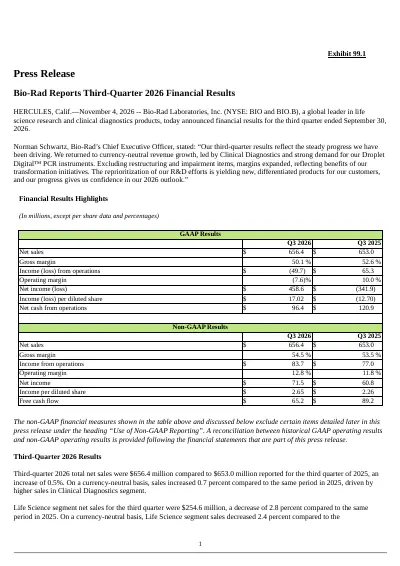
The third quarter represented another step forward in our efforts to improve Bio-Rad's operating and financial performance. Total company revenue in the third quarter was approximately $656 million, an increase of 0.5% on a reported basis and 0.7% on a currency-neutral basis compared with the prior year.
This marks our first quarter of currency-neutral growth this year. Gross margin expanded to 54.5% on a non-GAAP basis.
While the pace of revenue growth remains modest, we are encouraged by the progress across several areas of the business. Clinical Diagnostics returned to growth, supported by quality systems and diabetes products.
In Life Science, excluding process chromatography, revenue increased 2.5% year over year. This represents the third consecutive quarter of sequential improvement in the growth rate and was driven by our genomics portfolio, including our droplet digital PCR business led by the QX700 portfolio.
ddPCR instrument revenue increased more than 20% for the third consecutive quarter, supported by both conversions from traditional qPCR and competitive wins. We believe these wins are attributable to our expanded portfolio, market-leading assay library, and a simplified workflow.
While consumable performance continues to improve, pull-through has not yet normalized, and that could continue into 2027. The pace of our placements over the past year gives us confidence that as those systems ramp to full utilization, pull-through will normalize with them.
Longer term, we remain very excited about the opportunity in ddPCR. There are numerous applications for our technology ranging from biopharma R&D to clinical diagnostics to applied testing, and the penetration remains low.
We are confident ddPCR will remain a durable growth driver for Bio-Rad for many years to come. These results demonstrate progress in our business.
Turning to some of our key end markets, conditions remain mixed with encouraging developments in some areas and continued pressure in others. In biopharma, we are seeing signs of improving customer activity.
While the recovery remains gradual, we view these trends as constructive for demand over the coming years. Within process chromatography, revenue has improved sequentially throughout 2026.
While we expect a sequential decline in the fourth quarter, 2026 revenue should improve year over year. In the US, funding conditions in the academic and government markets remain challenging.
NIH outlays declined approximately 15% in the third quarter compared with the prior year and finished the federal fiscal year roughly $6 billion below congressional appropriations. Consistent with this environment, our fourth-quarter outlook does not assume a recovery in academic and government end markets.
In the United States, we are closely watching the Protecting Access to Medicare Act, or PAMA, which governs Medicare reimbursement rates for certain clinical laboratory tests. Preliminary revised rates were published in September and final rates expected in November.
While Bio-Rad is not directly reimbursed under these rates, changes in laboratory reimbursement can influence our customers' economics and purchasing decisions. We have not observed a meaningful change in customer purchasing behavior attributable to the proposed rates to date, and expect any indirect impact on our business in 2027 to be limited.
We will continue to evaluate the implications as the final rates become available. Within our APAC region, we saw a return to growth in China in the third quarter.
This performance was largely driven by orders that shifted from the second quarter, together with a favorable prior-year comparison. The operating environment here remains challenging, with continued preferences for domestic suppliers and pricing pressure affecting the competitive landscape.
The National Healthcare Security Administration's updated guidelines continue to create pricing pressure across China's in vitro diagnostics market. Based on our current assessment, we estimate a revenue impact in the middle-single-digit millions of dollars in 2027.
We are addressing this environment through commercial execution, portfolio management, and cost discipline while maintaining a measured view of the near-term market outlook. Within EMEA, in the Middle East, our local teams continue to work closely with our customers and supply chain partners to maintain product availability.
Logistics costs remain elevated, and our current planning assumptions contemplate continued disruption into 2027. We believe maintaining a realistic set of assumptions is important as we manage through these external challenges.
Now turning to our operational priorities, we remain focused on three interconnected objectives: strengthening execution, improving our cost structure, and increasing the productivity across our enterprise. Within our global supply chain, we continue to advance initiatives focused on operational efficiency, procurement, inventory management, and optimization of our manufacturing footprint.
These initiatives are important components of our efforts to improve gross margin and build a more efficient operating model. Another important enabler is artificial intelligence.
We are approaching AI with two practical objectives: improving how we operate the company and enhancing the products we deliver to our customers. As discussed on the Q2 call, we're applying AI to processes where we believe it can improve productivity, decision-making, and execution.
Our focus on applications that deliver measurable business value over time, we expect these efforts, together with a broader organizational improvements, to continue to contribute to productivity. The second opportunity: incorporating AI into our products to improve their capabilities and the value they deliver to our customers.
That brings me to innovation. We continue to make progress in strengthening our product development pipeline and improving the pace at which we bring new solutions to market.
During the third quarter, we launched the ChemiDoc Pro Imaging System, our new flagship platform for Western blot imaging. This launch is a tangible example of the benefits of our R&D portfolio prioritization initiated in late 2025.
For example, by concentrating resources on selected development programs and improving execution, we were able to accelerate the ChemiDoc Pro launch by approximately two quarters. Its analytical algorithm was developed using AI trained on thousands of Western blot images with the objective of improving the consistency and reliability of image analysis and image interpretation.
For customers, these capabilities are designed to enhance confidence in their results and support research productivity. For Bio-Rad, the launch expands our opportunity to serve both existing customers considering system upgrades and new customers seeking advanced imaging capabilities.
We also expanded our Foresight Pro pre-packed chromatography column portfolio during the quarter to include our Nuvia resins. This extension broadens the formats available to customers and reflects closer collaboration amongst our product development, marketing, and field application teams.
While individual product launches will contribute to growth over time, our broader objective is to establish a more consistent and predictable cadence of innovation across our portfolio. As part of our ongoing portfolio evaluation, we also recorded a non-cash impairment of certain intangible assets during the quarter.
We are taking a disciplined approach to evaluating technologies and product programs, including making decisions about where continued investment offers the greatest potential return. Our objective is to improve the return on R&D investments to support revenue growth.
In closing, the third quarter provided encouraging evidence of progress. We returned to modest currency-neutral revenue growth, delivered another quarter of strong ddPCR instrument performance, and continued to improve our non-GAAP gross margin and advanced important organizational and innovation initiatives.
Recognizing that our end markets remain uneven, our priorities remain clear: consistent organic growth, improved profitability, and strengthening the execution capabilities of the company. There is more work ahead, but we are encouraged by the progress we are making and remain focused on delivering measurable, sustainable improvements in performance.
With that, I will turn the call over to Roop.
Roop Lakkaraju
Thank you, John, and good afternoon. I'd like to start with a review of the third quarter 2026 results, then move to guidance.
Overall, net sales for the third quarter of 2026 were approximately $656 million on a reported basis versus $653 million in Q3 of 2025, a year-over-year increase of 0.5%. On a currency-neutral basis, this represents 0.7% year-over-year increase.
Life Science sales in the third quarter of 2026 were $255 million, a decrease of 2.8% compared to Q3 of 2025 on a reported basis and a 2.4% decrease on a currency-neutral basis. This was primarily driven by lower process chromatography sales and ongoing challenges in the academic research market, partially offset by increased ddPCR instrument sales.
Excluding process chromatography, Life Science currency-neutral sales increased 2.5%. Currency-neutral sales decreased in the Americas, partially offset by increased sales in EMEA and Asia-Pacific and Greater China.
Our ddPCR portfolio posted 7% currency-neutral growth in the quarter with instrument revenue growing more than 20% year over year. Clinical Diagnostics sales in the third quarter of 2026 were approximately $402 million compared to $391 million in Q3 of 2025, an increase of 2.7% on a reported basis and 2.8% on a currency-neutral basis.
Growth was driven by timing of orders in quality systems and diabetes products. Regionally, growth came from Americas and Asia-Pacific.
Turning to gross margin, consolidated gross margin was 50.1% for the third quarter of '26 compared to 52.6% in Q3 of '25. The year-over-year decline primarily reflects charges associated with our restructuring program.
On a non-GAAP basis, third-quarter gross margin was 54.5% versus 53.5% in the year-ago period and improved sequentially from 53.9% in the second quarter. SG&A expense for the third quarter of 2026 was $257 million or 39.2% of sales compared to $207 million or 31.7% of sales in Q3 of '25.
The increase in SG&A expense was primarily due to higher restructuring costs. Third-quarter non-GAAP SG&A expense was $214 million or 32.6% of sales versus $202 million or 31% of sales in the year-ago period.
Research and development expense for the third quarter of 2026 was $71 million or 10.9% of sales, equal to the third quarter of the prior year. Third-quarter non-GAAP R&D expense was $60 million versus $70 million in the year-ago period.
The decrease in R&D largely reflects focused management of R&D programs and a prior-year milestone payment that did not repeat. During the quarter, we also recorded a non-cash impairment of approximately $50 million related to purchased intangible assets in the Life Science segment.
The charge reflects the portfolio decisions we are making to prioritize our return on investments. Q3 GAAP operating loss was approximately $50 million compared to operating income of approximately $65 million in Q3 of 2025.
On a non-GAAP basis, third-quarter operating margin was 12.8% compared to 11.8% in Q3 of 2025, and this represents a sequential improvement from 12.5% in the second quarter of '26. Third-quarter 2026 non-GAAP net income, which excludes the impact of the change in equity values of Sartorius shares, was $72 million or $2.65 diluted earnings per share versus $61 million or $2.26 diluted earnings per share for Q3 of 2025.
For full details on the balance sheet, cash flow, tax, and Sartorius valuation, please refer to our earnings presentation, press release, and 10-Q filed today, all available on our Investor Relations website. Moving on to our non-GAAP guidance for 2026, we are reaffirming our guidance of full-year '26 currency-neutral revenue growth between -3% and +0.5%.
We expect full-year growth to be approximately at the midpoint of this range. We expect Life Science segment currency-neutral revenue growth to be between -3% and -1% and the Clinical Diagnostics segment currency-neutral revenue growth to be between -3% and +1%.
We expect a sequential revenue ramp from Q3 to Q4 of 5% to 6% on a reported basis, in line with our typical seasonality. Included in this guide is continued softness in the academic and government markets and a favorable comparison for process chromatography.
We expect full-year non-GAAP gross margin to be in the upper half of the guidance range of between 53% and 54%. We expect a sequential decline in the fourth quarter due to product mix shifting more toward instruments, the expected sequential decline in process chromatography revenue, and higher fuel prices, which are expected to continue into '27.
In the fourth quarter, we expect SG&A to be flat to Q3 and a $3 million sequential step-up in R&D to support continued innovation. We are also modeling approximately $40 million of depreciation and amortization in the quarter.
We expect full-year non-GAAP operating margin to be in the upper half of the guidance range of between 10% and 12%. We are reaffirming our 2026 full-year free cash flow estimate to be in the range of approximately $290 to $340 million.
Through 9 months, we have generated $210 million, and the fourth quarter is seasonally our strongest. Our third-quarter results do not include any benefit from tariff refunds.
In our year-end results, we expect to recognize any tariff refunds that we receive. As a reminder, we did not pass any tariff-related surcharges to our customers, instead absorbing them in our cost of goods sold.
As a result, we will not need to pass any of the refunded amounts to our customers. Finally, any tariff refunds will be recognized on a GAAP basis only and, as such, will be excluded from our non-GAAP results.
We continue to firmly believe that Bio-Rad is capable of delivering operating margins above 20%, and we are not satisfied with the gap between our current performance and that potential. We are committed to delivering stronger profitability while investing in innovation and sustainable growth, and we look forward to sharing further updates as that work progresses.
I'll now turn the call over to Norman.
Norman Schwartz
Thank you, Roop. Just maybe a few comments as we wrap up.
On products, in 2024, as you may remember, we began refocusing our product development efforts on market segments where we're best positioned to compete. Innovation has always been fundamental to Bio-Rad, and I think the products that John mentioned are good examples of that work to date.
In today's challenging markets, delivering differentiated products that meet customer needs, I think is certainly more important than ever. Next, over the past 12 months, our board has been evaluating its composition and the mix of experience that will really best support Bio-Rad's future.
We believe we would benefit from additional perspectives and broader operational experience in both Life Science tools and in diagnostics. With that in mind, we have been actively evaluating candidates to expand our board.
We would expect to be able to share updates with you in the near future on this project. Maybe finally, with regard to Elliott Management, I guess I would say our dialogue continues to be active and productive, and we believe we're broadly aligned on the objectives.
As we move forward, I'm certainly encouraged by the progress we're making and excited about what's ahead. Maybe with that, operator, we'll open up the line for questions.
Operator
Thank you. We will now begin the question and answer session.
If you would like to ask a question, please press star one on your telephone keypad to raise your hand and join the queue. If you would like to withdraw your question, again, press star one.
Your first question comes from Dan Leonard with RBC Capital Markets. Please go ahead.
Dan Leonard
Thank you very much, and good afternoon.
Roop Lakkaraju
Hey, Dan.
Dan Leonard
To start off, I'm just trying to get a better sense of where your head's at in framing 2027. I think there were, I counted them, three or four discrete lingering headwinds you reminded that could drag into 2027, but I'm not really sure how to interpret what your thinking is for the appropriate starting point in aggregate on revenue to clarify.
Roop Lakkaraju
Okay. This is Roop.
Hey, Dan. Great to have you on the call.
From a revenue standpoint, I think one of the things we're trying to balance here is to give a perspective of the end markets that we're dealing with and how we're navigating through that with the understanding that ultimately, as we continue to drive innovation and some of the portfolio management that we've been doing is to get back to growth. We think that 2027, and obviously it's a little bit early right now, with this third-quarter call, we'll lay out '27's guidance at the year-end call, but we would be focused on driving towards positive growth rate in '27, and as part of that, obviously driving further margin expansion in '27, as we move forward.
Hopefully that helps you. The breadcrumbs that we put into the script to give you a sense of the end-market dynamics we're dealing with is simply to help frame our understanding and what we're dealing with with our portfolio and our customer set.
Dan Leonard
Okay. The message is growth, but not fully normalized given the breadcrumbs that you have to contend with?
Roop Lakkaraju
That's right.
Dan Leonard
Okay. Then just specifically on droplet digital, you've had a number of quarters in a row with really strong instrumentation growth.
What's your degree of conviction that that can continue, as opposed to any caution that you're going to start cycling up against more challenging comparisons?
Jon DiVincenzo
Hey, Dan. Jon DiVincenzo.
Thanks for the question. As we model this out, first of all, we reflect on the last year that the new portfolio's been in the marketplace and it's very positive to see a number of new customers.
We're expanding kind of the available market that we're serving. There's a lot of positivity there.
We're going to continue to have these wins. Can't project that it's going to be 20% continued here, as you say we come up against some more difficult comps, but even in the challenging academic environment, customers are still choosing to invest in the platform.
They might not be at full utilization of the platform yet, but it'll be an important part of their research moving forward. We continue to believe it's going to be an important part of our growth in the near to mid term.
Dan Leonard
Thank you very much.
Roop Lakkaraju
Thanks, Dan.
Operator
Your next question comes from the line of Jack Meehan with Nephron Research. Please go ahead.
Jack Meehan
Good afternoon, guys.
Roop Lakkaraju
Hey, Jack.
Jack Meehan
Wanted to talk about the Diagnostics business a little bit more. You mentioned some of the expectations around the China region.
I was wondering if you could just talk about how the region performed in the quarter and how exactly is that impacting the business or ability to compete in the market?
Roop Lakkaraju
Jack, maybe I'll start out. This is Roop.
First in terms of the dynamics, we've had some in China was a little bit stronger for us in the quarter as a discrete quarter for the third quarter, largely driven by order timing around quality control, some process chromatography, these sort of things, which is obviously positive to see. I think from an overall China dynamic, when you speak about the guidelines that have just come out, we think overall and we kind of said this within the prepared remarks, there's some single-digit millions of impact into '27 we think.
Obviously we're doing the final assessments, those guidelines are getting rolled out, there's a little bit yet to come potentially. Overall, we don't think it's overly material, but there is some impact.
I think from an overall China DX perspective, quality controls continues to be strong there, and we continue to execute within the market overall.
Jack Meehan
Great. Okay.
Then on the Life Science side, kind of ex-digital PCR, ex-process chromatography, the core remainder of the Life Science business, was wondering if you could just talk about how you see demand trends across academic and pharma at the moment, and building off that, just whether you're seeing any indications of demand related to AI-related instruments,
Jon DiVincenzo
drug development? Jack.
Jon DiVincenzo. Good questions there.
Although we have some optimism around academic, it still is not where you normally would think the academic spending would go on a kind of run rate basis and all the activity in the labs. We'll see what happens with the midterm election, if that is any positive tailwind into '27 and '28.
In biopharma, we see kind of an improved environment. Initially it was kind of the later stages of the large pharma and biotech customers, but it's seeming moving over to more discovery role.
I think when it comes to AI, overall we believe that's a positive for demand for our portfolio. We are very close to our customers, for particularly customers that are deploying AI, transitioning from in silico modeling to the wet lab work and how do we ensure that we're supporting that transition.
Overall, we just think it's going to be meaning more productive testing in the lab, more utilization of reagents and our products, and are quite optimistic about the impact on the market for both academic as well as drug discovery.
Jack Meehan
Great. One last question is just on capital deployment.
It looks like the buyback was a little muted in the quarter. Can you just talk about how you think about allocating capital and then would be remiss not to ask about just any of your latest thoughts on the Sartorius strategy monetizing that?
Thank you.
Roop Lakkaraju
Hey, Jack. You trailed off at the end there.
Would you mind just kind of restating the tail end of yours? I heard the capital allocation and the buyback piece.
Was there an incremental piece you mentioned as well?
Jack Meehan
Yes, sorry. Just latest thoughts on the Sartorius stake and ability to monetize that.
Thank you.
Roop Lakkaraju
Got it. Maybe I'll start with the Sartorius stake.
Our point of view on that hasn't changed. It's a monetizable asset, and if there's a potential scenario in which we think it would make sense to monetize it, we would do so and that's within our own rights to do so.
That's kind of Sartorius. Same as before, no change in comments there.
As it relates to capital allocation, obviously, we talk about kind of three significant areas of capital allocation. One is investing back in the business from a CapEx standpoint.
We continue to do that, especially around innovation capability. The second is share repurchases, which we have done, but we've also indicated that we'd be opportunistic with those share repurchases and therefore, not necessarily systemic in every quarter.
With all that said, we still feel like we're undervalued and from an intrinsic value standpoint, there's opportunity for value creation from a share price standpoint. We will continue to look at it more opportunistically versus systemic, if you will.
The final piece is M&A, and as we've stated very clearly, we're not seeking to do transformative deals. However, we are focused on finding deals of some scale and size, and as we've said in prior earnings calls, anywhere from $100 to $500 million of revenue, whether it's in the DX space or the Life Sciences tool space, would be interesting to us.
What's critical is it provides value differentiation for our customers, gives us the ability to drive top-line growth, as Stella has done, and allows us to expand margins and drive working capital efficiency. We'll continue to have that kind of balanced capital allocation outlook.
Any discrete lack of share repurchases in a quarter or not shouldn't be read in any direction other than we'll continue to balance these different areas quarter to quarter.
Operator
Again, if you would like to ask a question, please press star one on your telephone keypad. Your next question comes from Tycho Peterson with Jefferies.
Please go ahead.
Hi. Thanks.
This is Jack on for Tycho. Could you give us an update on where you are against the $80 to $90 million restructuring program, and if the $30 to $35 million net realized savings is still the right ballpark for 2027?
Roop Lakkaraju
Hey, Jack. This is Roop.
I'll jump into that. We are executing on the restructuring plan that we announced in the Q2 call.
That is proceeding. The $30 to $35 million is still intact in terms of savings that we expect to see.
Just as a reminder to you and the market, that really is into 2028. The actions will take hold throughout the latter part of '26 in and throughout '27, and as such, the full realization of that $30 to $35 will really be in full effect starting in '28.
Got it. Then
on Diagnostics, you called out upside in quality control and diabetes. Can you just give us a refreshed sense of how big and material these businesses are, and kind of the latest trends you're seeing, and how sustainable you think they are?
Thanks.
Roop Lakkaraju
Yeah. From a China standpoint, and Jack, I think you're referring to China, specifically, or?
Quality control and diabetes within Diagnostics.
Roop Lakkaraju
Okay. We haven't actually quantified those specific areas.
With that said, we have said, and obviously Diagnostics is about 61% of our total revenue, roughly, at the enterprise level. Quality controls is the largest franchise that we have within Diagnostics.
We're a market leader there, and we continue to see strength on a global basis across all regions. From a diabetes standpoint, we've seen strength, as we've gone throughout 2026.
We're very pleased with that, and that's broad-based across various regions around the world. We continue to focus on identifying those growth opportunities both in QC, diabetes, but other parts of our Diagnostics portfolio as well.
Okay. Thank you.
Roop Lakkaraju
Thanks.
Operator
There are no further questions at this time. I would like to turn the call back over to Ruben Argueta for any closing remarks.
Ruben Argueta
Thank you again for joining us today. Also, a quick reminder that we will be attending the UBS Global Healthcare Conference next week and hope to connect with many of you there.
Goodbye.
Operator
Ladies and gentlemen, that concludes today's call. Thank you all for joining, and you may now disconnect.