Novanta Inc.
Q3 FY2026 · Earnings Call TranscriptNovember 10, 2026
Operator
Good morning, my name is Jamie and I will be your conference operator today. At this time, I would like to welcome everyone to Novanta Incorporated's third quarter 2026 earnings call.
All lines have been placed on mute to prevent any background noise. After the speakers' remarks, there will be a question-and-answer session.
To ask a question, you may press star and then one on your touchtone phones. To withdraw your question, you may press star and two.
Please also note, today's event is being recorded. At this time, I'd like to turn the floor over to Marcy Meditz, Corporate Finance Leader for Novanta.
Please go ahead.
Marcy Meditz
Thank you very much. Good morning, and welcome to Novanta's third quarter 2026 earnings conference call.
This is Marcy Meditz, Corporate Finance Leader for Novanta. With me on today's call is our Chair and Chief Executive Officer, Matthijs Glastra, our Chief Financial Officer, Robert Buckley, and our Co-Chief Operating Officers, Chuck Ravetto and John Lesica.
If you have not received a copy of our earnings press release issued last night, you may obtain it from our Investor Relations section of our website at www.novanta.com. Please note, this call is being webcast live and will be archived on our website shortly after the call.
Before we begin, we need to remind everyone of the safe harbor for forward-looking statements that we've outlined in our earnings press release issued last night and also those in our SEC filings. We may make some comments today, both in our prepared remarks and in our responses to questions, that may include forward-looking statements.
These involve inherent assumptions with known and unknown risks and other factors that could cause our future results to differ materially from our current expectations. Any forward-looking statements made today represent our views only as of this time.
We disclaim any obligation to update forward-looking statements in the future, even if our estimates change. You should not rely on any of these forward-looking statements as representing our views as of any time after this call.
During this call, we will be referring to certain non-GAAP financial measures. A reconciliation of such non-GAAP financial measures to the most directly comparable GAAP measures is available as an attachment to our earnings press release.
To the extent that we use non-GAAP financial measures during this call that are not reconciled to GAAP measures in the earnings press release, we will provide reconciliations promptly on the Investor Relations section of our website after this call. I am now pleased to introduce the Chair and Chief Executive Officer of Novanta, Matthijs Glastra.
Matthijs Glastra
Thank you, Marcy. Good morning, everybody, and thanks for joining our call.
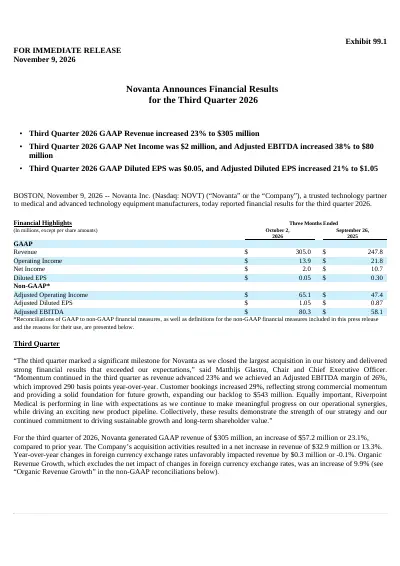
The third quarter was a milestone quarter for Novanta. We closed the largest acquisition in our history, Riverpoint Medical, and at the same time delivered results ahead of expectations on revenue, adjusted EBITDA, and adjusted EPS.
Revenue grew 23% on a reported basis to $305 million, with organic growth of nearly 10%, our strongest organic growth in more than 3 years. Adjusted EBITDA grew 38% to $80 million, or 26% EBITDA margin, the highest in Novanta's history and an expansion of 290 basis points year over year.
Adjusted EPS grew 21% to $1.05. Customer bookings grew 29%, resulting in a book-to-bill of 1.08 and a backlog of $543 million, with core backlog up 14% year over year.
Year-to-date operating cash flow of $156 million is nearly 3 times what we generated in the same period last year. Riverpoint Medical performed in line with our expectations in the first 2 months as part of Novanta, with an exciting innovation pipeline ahead.
Before I turn to our 2026 priorities, a word on our long-term direction and on how our proprietary competencies in high-growth markets reinforce each other. This quarter is evidence of both.
Our direction has been consistent and deliberate: more medical, more recurring, and less cyclical. It drives our capital allocation, with Riverpoint the most recent example.
Medical end markets are now 53% of revenue, approaching 60% on a full-year basis with Riverpoint. We win in high-growth end markets with durable secular tailwinds by solving our customers' most complex needs with proprietary platform technologies built on competencies honed over decades.
Let me touch on 3 of them. First, precision motion and robotics.
Servo drives, force torque sensors, and position sensors let a surgical robot position its arm with micron precision and sense force and torque, giving the surgeon a sense of feel while keeping the system safe. The same technology sits inside warehouse and humanoid robotics and advanced surgical equipment.
These capabilities are one of the core drivers of our Robotics & Automation revenue growth: 17% in the quarter and 13% year-to-date, with sustained momentum into 2027. Second, precision fluid and flow management for minimally invasive surgery.
The same precision control competency underpins our surgical insufflators and pumps, which control fluid and CO2 gas, where any loss of control puts patient safety at risk. We have leveraged this position to expand into consumables for the same endoscopic workflows.
Recurring consumables across sports medicine, minimally invasive surgery, and surgical robotics now represent roughly 25% of Novanta's revenue and have become a durable growth engine for the company. Third, laser beam steering and conditioning: shaping and controlling light with extreme precision.
In ophthalmology, it supports retinal imaging and refractive eye surgery; in life sciences, it enables cellular and genetic analysis; in manufacturing, it guides the systems that build medical implants layer by layer; and in semiconductors, it sits inside the lithography systems that pattern the most advanced chips and the tools that inspect them. Our precision manufacturing business covers all these applications and grew 14% in the third quarter, with a strong innovation pipeline ramping in 2027.
Running through all these 3 competencies is embedded software. It powers our intelligent subsystems, which now represent roughly 25% of our revenue and about 75% of our new product launches.
Embedded software lives inside the hardware, controlling it in real time and turning physical measurements into data that applications can use. Our differentiation lies in the software with proprietary control algorithms, closed-loop control, safety certification, and real-time data processing.
That position makes us the source of the data. The same competencies span the fastest-growing parts of medical and advanced industrial markets.
They grow because they solve real problems: healthcare productivity through early disease detection and less invasive surgery; labor shortages through robotics in factories and warehouses; and the technologies behind the manufacturing of next-generation semiconductors, medical implants, and aerospace components. Our breadth matters commercially as well.
Our largest OEM customers span multiple businesses, and we manage them as one Novanta, a design win in one business becomes the invitation into the next. Against this backdrop, we remain focused on our 3 priorities for 2026.
First, organic growth. Our innovation engine continues to deliver, and it is what underwrites our long-term algorithm of mid to high single-digit organic growth.
New product revenue grew 23% in the quarter and is up 47% year-to-date, lifting our vitality index to approximately 27% of sales year-to-date. Bookings grew 29% in the quarter, or 18% excluding Riverpoint Medical, and are up 22% year-to-date.
Incremental design wins increased 63% in the quarter and are up 19% year-to-date, driven by our Novanta Growth System Commercial Excellence Playbook. Three of our 4 business units grew organically in the quarter, led by double-digit organic growth in our Automation & Enabling Technologies segment.
John and Chuck will elaborate on examples of recent product launches and customer wins. Second, acquisitions.
We closed Riverpoint Medical in July. It is integrating well and performing in line with our expectations, with an exciting new product pipeline ahead.
John will cover Riverpoint and our new business unit structure in more detail. Our near-term capital deployment priority is to delever, and our strong cash flow generation positions us to do that quickly to take advantage of follow-on opportunities in an active market.
Our third priority for 2026 is completing our manufacturing foundation through our regional manufacturing Centers of Excellence for 2 reasons. First, greater scale, lower complexity, and lower cost.
Second, full in-region for-region capability. Our customers take ownership at our factory gates, building closer to where they sell minimizes their tariff and logistics exposure.
The strategy is making strong progress. In the second quarter, we consolidated 2 factories, and in the third quarter launched the closure effect of 2 more.
This puts us on track for 18 factories by the end of the first quarter of 2027, down from 21 a year ago. We also implemented our new SAP MRP system without disruption at 2 of our lighthouse centers.
Even so, our third quarter gross margin and fourth quarter outlook are below where we want them to be, and we own that. Much of the pressure is at our Stockport facility in the UK, where temporary dynamics are coming together, resulting in a production slowdown in our factory for the remainder of the year.
Fortunately, given the robust customer demand across Novanta, we were able to shift resources to ensure our revenue commitments are achieved regardless. We now expect production in this facility to resume in the first quarter, allowing us to expand our gross margins another 100 basis points for the full year of 2027.
John and Chuck will say more about each. The macro remains complex, and we're watching it closely.
We have strong demand, a $543 million backlog, continued new product momentum, and the strongest team Novanta has ever had. As we look to 2027, we expect a full year of Riverpoint, Stockport behind us, and our new product momentum to drive gross margin expansion and strong earnings growth.
Chuck Ravetto and John Lesica will walk you through their segments, new product launches, design wins, and customer momentum behind these results. John, over to you.
John Lesica
Thanks, Matthijs. Before I walk through the quarter, a quick word on how we'll discuss the Medical Solutions segment going forward.
With the addition of Riverpoint Medical, we've expanded our Advanced Surgery business unit into Advanced Surgical Technologies, which brings together our integrated insufflation and smoke evacuation, arthroscopy fluid management, and medical consumables franchises with Riverpoint's fiber-based sutures and implantable materials. Medical Solutions will now be reported through 2 business units: Advanced Surgical Technologies and Precision Medicine.
Our reportable segments are not changing. Riverpoint's results are included from the date of acquisition and will be excluded from organic growth until the anniversary of the close in August of 2027.
In the third quarter, revenue in the Medical Solutions segment grew 30% on a reported basis and approximately 3% organically, in line with our outlook of 2% to 4% organic growth. Riverpoint Medical contributed approximately $33 million of revenue in the quarter.
The segment saw a book-to-bill of 1.04, with Precision Medicine at 1.19 and our legacy Advanced Surgery business at 1.04. New product sales grew 19% year over year, and the vitality index in the segment was 30% of sales.
Our Advanced Surgical Technologies business grew 66% on a reported basis and 12% organically year over year, ahead of the approximately 10% we expected. Organic growth was driven by new product launches, including the continued ramp of our second-generation insufflators and our medical consumables business.
Our pump platform is at an important point. Building on the arthroscopic development platforms we described last quarter, our first multi-indication fluid management system is completing regulatory submission and shipping clinical evaluation units, and the platform is progressing toward introduction with a leading surgical OEM in early 2027, with 4 other OEM programs in development.
The playbook is the one that worked for insufflation: reduce procedure complexity, improve safety and workflow, lower the cost to own and serve, and build a recurring disposable stream behind every placement. Our Riverpoint Medical business performed in line with our expectations in the quarter, contributing approximately $33 million of revenue, with margins in line with what we outlined when we announced the acquisition.
Integration is progressing well. Riverpoint moves recurring medical consumables to roughly 25% of Novanta's revenue, and we currently address only about 10% of the minimally invasive surgical consumables market, we have a long runway to build on this platform.
Riverpoint's newest knotless sutures, launched with 3 of the leading sports medicine OEMs, are a good example of its innovation engine, and over a third of Riverpoint's revenue comes from recently launched products. They are sold to the same surgeons and the same OEM customers we serve with our arthroscopy fluid management systems and pumps, giving us more content in the same procedures.
We're excited about the opportunities ahead for these teams. In our Precision Medicine business, sales declined 5% year over year, as we expected and discussed on prior earnings calls, although bookings were strong, with a book-to-bill of 1.19.
The revenue decline is from our life sciences exposure, which is now less than 10% of Novanta's total revenue, and was the result of a strategic decision to not pursue lower-margin business for a next-generation product from a customer whose instrument has been negatively impacted by cuts in research spending and an overall maturing of the technology. We expect Precision Medicine to return to growth in late 2027 as we anniversary this impact and benefit from new customer wins as we continue to aggressively lean in and add new sockets in areas where precision and performance decide the outcome, such as proteomics, flow cytometry, advanced diagnostics, and ophthalmology.
In RFID, Keonn continues to win new customers and the base is broadening. In the first half, Keonn added or expanded relationships with retailers across Europe, Latin America, and North America.
Retailers choose Keonn for one key reason: Keonn has solved the signal noise and interference problems that have long limited real-time locating in busy, crowded stores. Inventory accuracy in a typical store is often only 65% to 75%; with Keonn, it's in the high 90s.
Combined with our AdvanCloud solution, retailers get a reliable picture of what they have and where it is. They improve the customer experience, employee productivity, reduce shrinkage, keep the right product on the shelf, and convert more sales.
We're now bringing the same technology and value into healthcare, with pre-production solutions in beta testing at hospitals in Spain. Real-time tracking lets staff ensure they have the right equipment and consumables in the room, accurately billing patients for the products used in the procedure, and helps to gain insights to optimize inventory and prep time for procedures.
Keonn's AdvanCloud software, which delivers real-time tracking and data insights in retail, brings the same value to the hospital floor while overcoming the same signal noise and interference challenges seen in retail. To bring it together, this was a strong quarter of execution and momentum for Medical Solutions.
We delivered organic growth in line with our outlook, our innovation pipeline and product vitality are strong, and Riverpoint is integrating well. Chuck will now cover the Automation & Enabling Technologies segment.
Chuck Ravetto
Thanks, John. In the third quarter, the Automation & Enabling Technologies segment revenue grew 16% year over year, ahead of our outlook of 12% to 14% growth, and another sequential acceleration.
The book-to-bill in the segment was 1.11, with both business units above 1. New product revenue for the segment grew 28% year over year in the quarter.
Incremental customer design wins grew by 33%, and the vitality index was 20%. Before I get into the 2 businesses, I want to step back and talk about what is driving demand across the segment, because the same things show up in both.
Three end markets are doing most of the work: semiconductor, robotics, and advanced manufacturing. Together, they represent roughly 40% of Novanta's revenue on a full-year pro forma basis.
In semiconductor, we are seeing strength in advanced packaging, substrate production, and front-end wafer fab equipment, which is driving demand for circuit boards and packaging substrates our customers produce. In advanced manufacturing, the driver is the automation and digitization of production lines, with ever-increasing demands for throughput, productivity, smaller form factors, and tighter tolerances, helped by a broad, positive manufacturing capital spending sentiment, as seen in the PMIs, which continue to improve.
In robotics, demand is strong across surgical, industrial, warehouse automation, and humanoids. Robotics is a roughly $2 billion addressable market growing about 10% a year, and it already represents about a quarter of Novanta's sales, including medical robotics.
What lets us capture that demand is our new product pipeline, and it is showing up in exactly those applications. On the laser beam steering side, demand for our Lightning II platform was a highlight in the quarter, led by laser additive manufacturing and electronics.
In laser additive manufacturing, our new 3D scan head delivered industry-leading speed and accuracy. Our performance on a leading additive manufacturer's current machines has earned us a significant share of its next-generation platform, and we won a second additive OEM in the quarter.
In electronics, the same subsystems are winning in via hole drilling for next-generation advanced packaging substrates, in probe card production, and in next-generation lithography. We expect Lightning II bookings and revenue to keep increasing from here.
On the precision motion side, we launched a new family of servo drives in the quarter, and we are introducing Vulcano, our new integrated servo drive and encoder module, which combines our drive and position sensing technology in one compact unit and simplifies integration for customers in surgical robotics, humanoids, and warehouse automation. In medical robotics, our sensing and motion technology won new content on a major orthopedic robotics platform.
In humanoids, we have a strategic partnership with one leading developer to supply servo drives across their robot portfolio, and we continue to progress development programs with others. This is still early on a long development path, but the momentum is real.
Whether it's a scan head in a 3D printer, a servo drive in a humanoid, or a motion subsystem in a surgical robot, it is the same pattern Matthijs described: proprietary technology, designed in early with leading OEMs in markets with durable growth. Let me now turn to how that played out in each business.
Our precision manufacturing business, which mainly serves the industrial segment and semiconductor markets, in addition to some medical exposure, saw a year-over-year revenue growth of 14%, with strong growth across the portfolio on the back of new products and improving PMIs. Book-to-bill was 1.06.
As Matthijs referenced in discussing Stockport, we expect growth to temporarily moderate in the fourth quarter due to a delay in shipments for certain lithography products caused by an end-user test finding. We expect shipments to resume in the first quarter.
In our Robotics & Automation business, revenue was up 17% year over year, with a book-to-bill of 1.14. Our air bearing spindles business, which serves the mechanical drilling of electronics, is sold out for the next 2 years, and we expect to double the business over that period.
The expansion of our Celina facility, partially funded by customers to support that growth, is on track for completion at the end of this year, with plans to be fully ramped by April of 2027. I also want to announce we just hired a new president of our Robotics & Automation business, Julie Eaton.
Julie joins Novanta most recently from Halma, where she served as a divisional chief executive officer overseeing 9 separate companies, including leading the acquisition of 3 of them. I'm thrilled to have her join us leading one of the fastest-growing and most profitable businesses in the company.
With that, I'll turn the call over to Robert to provide more details on our operations and financial performance. Robert?
Robert Buckley
Thank you, Chuck. The company's organic growth was nearly 10% in Q3, with strong growth across 3 of our 4 businesses.
Our sales in the medical end markets represent 53% of total sales, while sales into advanced industrial markets was 47%. Our third quarter 2026 non-GAAP adjusted gross profit was $143 million, or a 47% adjusted gross margin, compared to $115 million, or 46.5% gross margin, in the third quarter of last year.
Adjusted gross margins were up 50 basis points year over year, roughly flat sequentially. The addition of the Riverpoint Medical acquisition and positive contribution from our industrial businesses offset the incremental headwind from redundant manufacturing costs associated with our manufacturing site moves.
Medical Solutions adjusted gross margin was approximately 44%, down 140 basis points year over year and up approximately 280 basis points sequentially. The sequential improvement reflects accretion from the Riverpoint Medical acquisition, while the year over year was largely product mix and highly redundant factory costs.
The overall Automation & Enabling Technologies segment adjusted gross margins was approximately 51%, which is up 250 basis points year over year and down approximately 250 basis points sequentially, driven by factory redundant costs and transfer costs and higher material costs. As evident in our year-over-year performance, our teams continue to drive significant productivity and stronger product mix from new products.
Moving on, GAAP R&D expenses were $26 million, or approximately 9% of sales, which was down approximately 110 basis points versus the prior year. Third quarter SG&A expenses were $58 million, or approximately 19% of sales, which was down approximately 180 basis points year over year.
Our GAAP results also included $19 million in acquisition-related costs, roughly $4 million in costs related to the planning and design phase of our manufacturing SAP implementation, and $21 million in amortization of intangible assets, all of which are excluded from our non-GAAP results. Non-GAAP operating expenses were $78 million, or approximately 25.6% of sales.
Adjusted EBITDA was $80 million, or 38% growth year over year, or mid-teens excluding Riverpoint, and a 26% adjusted EBITDA margin, the highest in our history. That was up 290 basis points versus the prior year.
Stock compensation expense was $10 million in the quarter, above our expectation of nearly $9 million, driven by adjustment of performance-based stock awards from better-than-expected financial performance. Net interest expense was just over $8 million, reflecting a partial quarter of Riverpoint Medical financing.
On the tax front, our non-GAAP tax rate in the third quarter of 2026 was 21%, compared to 24% in the third quarter of last year. Our non-GAAP adjusted earnings per share were $1.05 in the third quarter, up 21% year over year and above our expectations.
Diluted shares outstanding in the quarter were 42.7 million, reflecting the $300 million equity raise completed to support the Riverpoint Medical acquisition. Operating cash flow for the third quarter was $39 million, compared to $8 million in the prior year, and free cash flow was $32 million.
Year-to-date operating cash flow was $156 million, compared to $55 million in the prior year. As expected, cash conversion stepped down sequentially, driven by the timing of the Riverpoint acquisition and from investments in inventory to support our manufacturing moves and ensure supply continuity.
Supply of rare earth materials and electronic components remains tight across our industry, and in some cases is tightening further, but our teams did an excellent job shielding customers from the impact by building safety stock earlier in the year before the conditions worsened. It is also a clear example of why we are building a regional manufacturing footprint.
Operating in-region for-region with a supply base close to our factories and our customers is proving to be a real advantage. In the quarter, we funded the $1.2 billion upfront purchase price of Riverpoint with $616 million of borrowings under our revolving credit facility, the proceeds of the equity raise, and cash on hand.
We ended the third quarter with gross debt of $839 million, with a gross leverage ratio of 2.7 times. Our third quarter cash balance was $149 million, and so our net debt was $689 million, giving us a net leverage ratio of 2.2 times, slightly better than we communicated this summer.
Now turning to guidance. Novanta's third quarter came in ahead of our expectations on revenue, on adjusted EBITDA, on adjusted EPS, and bookings.
We ended the quarter with $543 million in backlog, reflecting strong demand. For the fourth quarter 2026, we expect GAAP revenue to be approximately $306 million to $312 million, which represents year-over-year reported growth of 18% to 21% and organic revenue growth of 5% to 7%.
This outlook includes approximately $35 million of revenue from the Riverpoint Medical acquisition. For adjusted EBITDA for the fourth quarter 2026, we expect it to be between $76 million and $79 million, representing growth of 25% to 30% year over year and an approximately 25% EBITDA margin, which is approximately 150 basis points higher than the prior year.
For the fourth quarter, we expect adjusted diluted earnings per share to be in the range of 91 cents to 96 cents. Turning to the full year of 2026, we expect GAAP revenue to be approximately $1,135,000,000 to $1,140,000,000, raising the low end of our prior range.
This represents reported growth of approximately 16% and organic growth of approximately 7%. For adjusted gross margins, we now expect full-year gross margins of approximately 46.5%, reflecting the temporary headwind of the lost factory absorption in Stockport.
Full-year non-GAAP operating expenses are approximately 27% of sales, excluding costs associated with restructuring and our SAP MRP implementations. Depreciation expense for the full year will be approximately $19 million, and stock compensation expense will be approximately $38 million.
Interest expense will be approximately $23 million for the full year, reflecting a full quarter of acquisition financing. We expect our full-year non-GAAP tax rate to be approximately 21%, and full-year diluted weighted average shares outstanding of approximately 42 million.
For the full year, we expect adjusted EBITDA to be between $274 million and $277 million, which represents year-over-year growth of 24% to 25%, and adjusted diluted earnings per share in the range of $3.66 to $3.71, representing year-over-year growth of 11% to 13%. The update to our EPS range reflects the updated gross margin outlook and the higher stock compensation expense.
The latter was approximately 3 cents for the true-up of the performance stock unit performance in the third quarter. From an operating cash flow perspective, we expect to generate approximately $200 million for the full year of 2026, a record for the company and more than 3 times what we generated in 2025, despite completing the largest acquisition in the company's history.
Gross debt at year-end is expected to be approximately $818 million, with a gross leverage ratio of 2.6 times and net leverage of approximately 2.1 times. We remain on track with the deleveraging path we outlined when we announced the acquisition.
In summary, we delivered nearly 10% organic growth in the third quarter, along with 38% adjusted EBITDA growth and 21% adjusted EPS growth, while closing the largest acquisition in the company's history. Bookings grew 29%, backlog stands at $543 million, and we remain on track to delivering approximately 7% organic growth and 16% reported growth, and a record cash flow for the full year.
We also implemented SAP MRPs at 2 of our factories without disruption, while relocating 2 manufacturing factories into new regional manufacturing factory footprints, and while mitigating significant industry supply chain shortages. Our teams have shown remarkable resolve and skill navigating shifty macroeconomic and geopolitical conditions and supply constraints while integrating Riverpoint, executing further manufacturing moves, and upgrading our IT systems.
In doing so, they have further strengthened Novanta's operating foundation. Novanta is in the strongest strategic and financial position in more than a decade, with 3 of the 4 business units seeing strong, positive growth.
We have leading positions in high-growth end markets, exciting new customer wins, and continued momentum from our new product launches. This gives us confidence in delivering on our 2026 commitments.
Looking ahead, we currently expect to see a 2027 outlook of more than 15% reported growth and more than 20% adjusted EBITDA growth. We will provide more specific guidance when we report our year-end results.
This concludes the prepared remarks. We'll now open the call up for questions.
Operator
At this time, we'll begin the question-and-answer session. To ask a question, you may press star and then one on your touchtone phones.
If you are using a speakerphone, we do ask that you please pick up your handset before pressing the keys. To withdraw your questions, you may press star and two.
Once again, that is star and then one to join the question queue. Our first question today comes from Lee Jagoda from CJS Securities.
Please go ahead with your question.
Lee Jagoda
Hi, good morning, guys.
Robert Buckley
Morning, Lee.
Matthijs Glastra
Good morning, Lee.
Lee Jagoda
Could we just start with Stockport and maybe give us a little more detail around what exactly happened there, the magnitude of the gross margin headwind both in Q3 and in Q4, and then just your confidence around this really being isolated to 2026 and not leaking into the first part of 2027?
Matthijs Glastra
I'll take the first part and then Robert will comment on the margin. Basically, this is a result and this is not uncommon, we're designing to really sophisticated systems which include really sophisticated tests that are done by our customers and their customers.
Let's say a major end user found an issue, which is not uncommon, which we are correcting. We're confident about that correction, but as a result, we basically are not shipping, right?
While we're correcting the situation, we expect to restart shipment in the first quarter as we're working through this issue. The program is not in jeopardy, the customer wants this product, and so while this is a disappointment obviously and it impacts our fourth quarter, particularly the margins, it's a temporary headwind, right?
That's how you need to see. The exact timing, of course, when it turns back on, we're working on, but we expect that to be in the first quarter.
On the margin side, Robert will further comment on it.
Robert Buckley
Let me just add to that that you have somewhat of a perfect storm happening there. You have redundant costs because we are moving two factories into that location, and so we have redundant factory costs, overhead costs, labors sitting there.
Then we've taken out the revenue in the quarter as we deal with this one topic, and we've scaled down our life science customers. It's a sort of a perfect storm at all happening at the same time quarter, none of which has any legs to it and goes into 2027.
There's roughly a 200 basis point impact as a consequence of this, we're reporting something closer to 46% in the fourth quarter, it should be 48%. We'll start to bounce back as we get into the first quarter and begin those shipments back up, and then as we scale down the redundant costs from those factory moves, we'll have the gross margin pop probably by the second quarter again.
We'll be back on track, that's just a temporary impact for the fourth quarter.
Matthijs Glastra
Let me add, Lee, is that, yeah, obviously you see a dip in the precision manufacturing business as a result in the fourth quarter, but we're very confident that that will reaccelerate in the first quarter and in 2027 on the basis of all the dynamics that Chuck and myself discussed. We're really bullish on the outlook, we just have to work through that temporary blip in the fourth quarter.
Lee Jagoda
Got it. Then, I guess I was going to say you don't want to give guidance for 2027, but you've already kind of given us the at least 15% top line and at least 20% EBITDA growth.
Yep. Obviously, the Riverpoint business mixes the gross margin higher as we look out to 2027, even without all the noise we just went through.
What are the other puts and takes around the legacy Novanta business that we should be thinking about as we're looking at the 100 basis points of margin improvement in total including Riverpoint year
Robert Buckley
over year? The other big impact would be the redundant factory costs and then resolving this issue.
We'll quickly bounce back to something closer to a 48% gross margin, probably somewhere around the second quarter. Then how that unfolds for the full year, there should be more tailwinds than anything.
Obviously it's possible you could a little bit better than that back half, but I don't want to get into specific guidance at this point. I would just say that we feel extremely confident that we'll expand gross margins at least 100 basis points next year.
Lee Jagoda
On the
Matthijs Glastra
on Yeah, sorry, go ahead. Go ahead.
No,
Lee Jagoda
no. Go ahead.
Matthijs Glastra
No, and I was just to say, yeah, we just said that the long-term organic growth algorithm is intact. For the core business there for 2027 as well, you can probably do the math, but that is looking solid.
Lee Jagoda
Then just one more for me. You gave us a whole bunch of different data points on the spindles business, including you're building out capacity to double capacity, you're sold out for the next 2 years.
I think you said that the capacity will be online Q2 of 2027. Is that to say that capacity is going to get filled in Q2 or very shortly thereafter, and is the doubling of revenue more likely to happen in 2027 or is it kind of a ramp towards doubling in sometime in 2028?
Robert Buckley
Consider it like a linear ramp, right? We expect to double by 2028 is really.
We've expanded the facility to double capacity, we'll fill that capacity by 2028. There'll be a little bit of a linear path there that comes up.
You're right in that obviously the impacts are more muted in the first quarter because you're not fully ramped up on production, and then you quickly start shipping product out in the second quarter, which therefore helps your organic growth profile from the second quarter onward. Then it acts as that tailwind throughout 2028.
We don't mean to imply, oh, and then after that, there's some unforeseen risk to the business. We're actually seeing continued demand come into the business and optimism.
We just don't want to get too far over the edge of our skis until we get better visibility into commitments given the customer base.
Lee Jagoda
Is that business actually big enough so that when that capacity comes online and it's not fully ramped yet, is that actually a temporary headwind to the gross margin in Q1, Q2 of next year ahead of filling that, or is it negligible and we won't really notice it?
Robert Buckley
No, it's a great question, Lee, because we seem to always have a little bit of a headwind from redundant manufacturing costs, but in their specific case, the gross margin profile is better than the company average. As a consequence, it doesn't have an impact on the total company.
Lee Jagoda
Sounds good. I'll hop back in.
Robert Buckley
Great.
Operator
Once again, if you would like to ask a question, please press star and one. To withdraw your questions, you may press star and two.
Our next question comes from Brian Drab from William Blair. Please go ahead with your question.
Brian Drab
Hi, good morning. Congrats on the results.
Matthijs Glastra
Morning, Brian.
Brian Drab
Morning. On operating expense, I was a little low modeling that in the third quarter.
It seemed like maybe it would step up a little bit as you incorporate Riverpoint into the numbers. Can you just talk about some of the dynamics affecting SG&A in the quarter and how to model SG&A in the fourth quarter, if you could?
Robert Buckley
I think the reason we had a little bit of higher SG&A in the second quarter as a consequence of truing up bonuses. Obviously, with the company's better financial performance, the variable compensation will pay out at a higher rate and therefore we trued that up in the second quarter.
That doesn't repeat in the third quarter. If you carried forward the second quarter operating expenses into the third quarter, you'd be overstating the run rate.
It would be coming in a lot less than that. As you look at the fourth quarter, the SG&A expenses should largely be in line, a little bit higher than the Q3, is sort of the guide that I provided.
Not a lot of variability in terms of your pure SG&A. There'll be a little bit of an uptick in R&D expenses, but on the margin, I would say that the expenses should be just a little bit higher than where they were in the third quarter.
Brian Drab
Got it. Here's a small one for you.
Is there a headwind from fewer selling days in the fourth quarter?
Robert Buckley
We have the same number of selling days, but if you're referring to how most people close their factories at the end of the year
Brian Drab
That, or just how the calendar works and how you report. It was looking like possibly you're going to have maybe 4 or 5 fewer selling days, which would impact organic revenue growth by maybe almost a point.
I was just curious if you had any comment on that.
Matthijs Glastra
Maybe modestly, but quite frankly, the main drivers we discussed, right? It's the temporary production hold and that lapping we need to do on the precision medicine side and that precision manufacturing will bounce back, right, and will accelerate further in 2027 based on what we discussed.
See it more as kind of a dip we've got to work through there temporarily, and then it will accelerate from there in Q2 next year onwards.
Brian Drab
Got it. Then thanks for the detail on what's happening in the UK facility.
It seems clear that you have the root cause of the issue and are in the phase of the Yep. Just you're in the corrective action phase.
Is that how to think about it?
Matthijs Glastra
Yeah. That's a good way of thinking about it.
Listen, we've got to be careful getting in too much detail here, but you can imagine they're large players involved and they're up and to the right. It's really about getting the right test slots and getting everybody comfortable with extensive testing.
It's really more the testing and that is really now what we're going to work through, right? That's really it.
The customer wants the product, we're solving a real problem. We're really disappointed about this, obviously, but it is what it is.
We work through it, and the precision manufacturing business will bounce back in the first quarter, and so will margins shortly after.
Brian Drab
Okay. Then just the last one.
Robert, I think you said full-year gross margin for 2026 around 46.5%.
Robert Buckley
Right.
Brian Drab
Thanks. Then you said, expect the typical 100 bps of gross margin expansion at least in 2027.
That gets you 47.5%. It does feel Right.
It does feel like there should be upside to that if you're doing 48% in the second quarter and there's upside from the 48 as you move through the year. Is that fair?
Robert Buckley
No, that's a fair assessment. I don't want to get ahead.
We had a accidental stop shipment in a facility at the wrong time just as we were moving stuff in. I don't want to kind of get overly optimistic after just going through that event.
I think it's fair to say that with everything kind of clicking on at the pace in which we click on, the redundant costs coming out of the P&L, the better mix of product coming out, the higher growth coming out, the better mix from the Riverpoint transaction, you would be running at a better rate than that in 2027. You could also be running at a better organic growth in 2027.
I think we're obviously optimistic on the outlook, but we're also conservative at this point just to make sure that we get this behind us.
Brian Drab
I got it. Thanks very much.
Robert Buckley
Yep. Thanks, Brian.
Operator
With that, we'll be concluding today's question-and-answer session. I'd like to turn the conference call back over to Matthijs Glastra for closing remarks.
Matthijs Glastra
Thank you, operator, and thank you, everyone, for your questions. To wrap up, the third quarter delivered ahead of what we set we would do: organic growth of nearly 10%, adjusted EBITDA up 38% with margins up 290 basis points, adjusted EPS up 21%, bookings up 29% and a $543 million backlog.
The largest acquisition in our history closed, integrating and performing in line with our expectations. What I would most want you to take away is the direction: more medical, more recurring, more embedded software, less cyclical.
Novanta's competencies are anchored in healthcare and leveraged into the advanced industrial markets through the same technology and the same customers. That's what makes us makes our growth more predictable with a mid to high single-digit long-term organic growth algorithm.
In closing, as always, I would like to thank our customers, our shareholders, and especially our dedicated employees for their ongoing support. We appreciate your interest in the company and your participation in today's call.
I look forward to joining all of you soon at our fourth quarter and full-year 2026 earnings call. Thank you very much.
Operator
With that, ladies and gentlemen, the conference has now concluded. We thank you for attending today's presentation.
You may now disconnect your lines.