Black Hills Corporation
Q3 FY2026 · Earnings Call TranscriptNovember 5, 2026
Operator
Good day, and thank you for standing by. Welcome to the Q3 2026 Black Hills Corporation Earnings Conference Call.
At this time, all participants are in a listen-only mode. Please be advised that today's conference is being recorded.
After the speakers' presentation, there will be a question-and-answer session. To ask a question, please press *11 on your telephone and wait for your name to be announced.
To withdraw your question, please press *11 again. I would now like to hand the conference over to your speaker today, Sal Diaz, Director, Investor Relations.
Sal Diaz
Thank you, operator. Good morning, and welcome to Black Hills Corporation's third quarter 2026 earnings conference call.
You can find our earnings release and materials for our call this morning on our website at blackhillscorp.com. Leading our earnings call are Linn Evans, President and Chief Executive Officer; Kimberly Nooney, Senior Vice President and Chief Financial Officer; and Marne Jones, Senior Vice President and Chief Utility Officer.
During today's earnings discussion, comments we make may contain forward-looking statements, as defined by the Securities and Exchange Commission, and there are a number of uncertainties inherent in such comments. Although we believe that our expectations are based on reasonable assumptions, actual results may differ materially.
We direct you to our earnings release, slide 2 of the investor presentation on our website, and our most recent Form 10-K and Form 10-Q filed with the Securities and Exchange Commission, for a list of some of the factors that could cause future results to differ materially from our expectations. With that, I will now turn the call over to Linn Evans.
Linn?
Linn Evans
Thank you, Sal. Good morning, and thank you all for joining us today.
I'll provide a summary of our strategic progress, including our success with large load customers and our pending merger with NorthWestern Energy. Kimberly will provide our financial update, and Marne will provide our business update.
I'll start my comments on slide 3. I continue to be quite pleased that our team and our business are firing on all cylinders.
We delivered excellent operational and financial results as we successfully advanced our strategic initiatives through the third quarter. We remain relentlessly focused on our primary purpose: serving our customers safely and reliably, while delivering on our mission of improving life with energy.
To accomplish that purpose, we delivered strong earnings and remained on track to achieve our 2026 earnings guidance. We maintained our solid financial position and credit ratings, while executing our capital plan to serve the energy needs of our customers.
This includes our 99-megawatt Lange 2 generation project in South Dakota, which is scheduled to be successfully placed in service, on time, in the fourth quarter. Our team continues to advance our regulatory initiatives.
We completed our rate review for Arkansas Gas, and we reached constructive settlements for two rate reviews for our South Dakota electric utility in both South Dakota and Wyoming. We made clear progress serving the needs of our customers, including our large load customers.
After more than a year of active and constructive negotiations, we are thrilled to have successfully executed definitive agreements to serve Google's planned data center in Wyoming, which is outlined in some detail on slide 4. The project is planned to begin taking service by late 2027 and reach peak load in 2030.
Leveraging our innovative Wyoming Large Power Contract Service, or LPCS, tariff, the agreements we executed with Google include our generation investment and our role in coordinating the delivery of energy from a total resource mix of 2.7 gigawatts to serve the project. Achieving this key milestone for the company reflects a decade of strategic execution, innovation, and a major growth opportunity that will benefit our customers, the state of Wyoming, the Cheyenne region, and our shareholders.
I'm very proud of our team's hard work over more than a year to ensure the executed agreements include critical protections and opportunities for our customers and shareholders. Moving to slide 5, we are working to serve significant additional large load growth.
Again, driven by our unique large load LPCS tariff in Wyoming, our retail customers and shareholders benefit from our flexibility to serve large load customers with resources beyond traditional rate base capital investments. For market energy or contracted resources, we earn a negotiated microgrid management fee.
Interconnecting these resources to serve our large load customers provides important benefits of speed to market for growth, and resource optionality and diversity, all while maintaining our right and obligation to serve our customers as the franchised utility provider. This unique tariff supports strong large load demand in Wyoming.
We included 600 megawatts of data center load in our current plan, driven largely by Microsoft's ongoing expansion and Meta's new AI data center, which we now expect to begin taking service in early 2027. In addition to our current plan, the planned Google data center represents significant upside to be added to our 2027 to 2031 plan.
Moreover, we are actively negotiating 600 megawatts of other opportunities, which would be additive to our plan upon reaching definitive agreements. Beyond these, there are a variety of other emerging opportunities within our Wyoming footprint that could represent 2.5 gigawatts or more of future large load expansion.
As an example, we are assessing other opportunities, including Microsoft's recently announced purchase of more than 3,200 acres of land in Wyoming for future expansion, among other potential customer projects we are witnessing that are in exploratory stages within our service territory. We are also investing nearly $700 million in transmission to support current and future large load growth, unlocking additional opportunities.
Marne will provide more detail about our large load progress in her update. Moving to slide 6 for an update on our merger with NorthWestern Energy.
We are awaiting a decision in Montana as the last approval required for closing. We reached constructive settlements with many key intervenors in Montana and completed a four-day hearing before the Montana Commission in May.
I note that the Montana Commission recently exercised the option to extend their decision 30 days, resulting in a deadline for a written decision by November 12. With that, I'll turn the call over to Kimberly for our financial update.
Kimberly Nooney
Thank you, Linn, and good morning, everyone. I'm pleased to report strong third quarter earnings, the result of our team's continued focus on execution of our strategic initiatives as we deliver on our financial commitments.
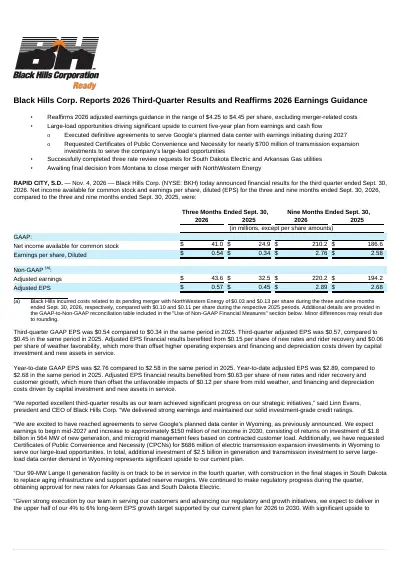
On slide 8, we provide a bridge for EPS from Q3 2025 to Q3 2026. We reported GAAP EPS of 54 cents, which included 3 cents of merger-related transaction costs in Q3 2026.
Adjusting for these costs, we delivered 57 cents of adjusted EPS for the quarter, compared to 45 cents in Q3 2025. We recorded 28 cents per share of increased margins, primarily driven by new rates and rider recovery and weather favorability compared to Q3 2025, which more than offset higher O&M, financing, and depreciation costs.
Slide 9 provides our year-to-date bridge. GAAP EPS was $2.76 through September 2026, which included 13 cents of merger-related transaction costs.
Adjusting for these costs, we delivered $2.89 of adjusted EPS, compared to $2.68 during the same period in 2025. Comparing EPS as adjusted, we recorded strong margins driven by new rates and rider recovery and customer growth, which more than offset higher financing and depreciation costs and unfavorable weather compared to last year.
We also benefited from cost management and tax planning compared to last year. We remain on track to achieve our earnings guidance for the year.
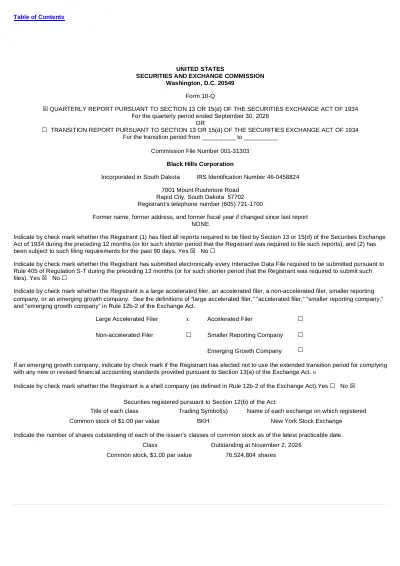
Further details on year-over-year changes can be found in our earnings release and our 10-Q to be filed with the SEC later today. Slide 10 presents our solid financial position through the lens of credit quality, capital structure, and liquidity.
We remain focused on maintaining a healthy balance sheet and our stated credit metric targets of 14% to 15% FFO-to-debt and at or better than 55% net debt-to-total capitalization. Year-to-date, we issued approximately $70 million of equity under our ATM program to support our over $900 million capital investment plan for the year, excluding recently announced generation and transmission to support growing data center load in Wyoming.
We maintain strong liquidity with $685 million of availability under our revolving credit facility at quarter end. Our next debt maturity is in January 2027 with $400 million of 3.15% notes to be refinanced.
We are evaluating both the public and bank markets as refinancing alternatives. Our financial outlook is listed on slide 11.
We reaffirmed our earnings guidance range of $4.25 to $4.40 of adjusted EPS for 2026, which represents 6% growth at the midpoint over 2025. Strong execution, planned large load growth, and our solid financial position give us confidence in delivering in the upper half of our 4% to 6% long-term EPS growth rate.
Slide 12 highlights the significant upside potential to our current five-year financial plan from large load growth opportunities, driven by new capital investment and contracted microgrid management fees. We have recently announced approximately $2.5 billion of new generation and transmission investment to serve data center growth in Wyoming.
This includes $1.8 billion of new generation investment through Black Hills' non-regulated affiliate contracted to our utility to serve Google's planned data center. Our agreements with Google include contracted cost pass-through mechanisms, including debt costs, and allow us to begin earning a cash return on our generation investment during construction, which is expected to start in mid-2027.
When construction is complete and as the assets are placed in service between 2028 and 2029, we will continue to earn a return on this investment with a declining book value to be fully depreciated by 2048. In addition to returns from our company-owned generation investments, we will manage the output of approximately 2.1 gigawatts of additional resources to serve Google and anticipate earning a microgrid management fee beginning in late 2027, which will increase based upon a contractually defined load ramp schedule peaking in 2030, with fees continuing through 2048, the end of the contracted term.
Taken together, these earning streams will ramp up and deliver approximately $150 million of net income in 2030. We further expect the planned Google data center to deliver an estimated $2.4 billion of unlevered free cash flows through 2048 after netting out our $1.8 billion of generation investment.
We also expect approximately $700 million in transmission expansion by 2029 to serve large load opportunities, including Google's planned data center. The investment is expected to be recovered directly from large load customers through our proposed large load transmission tariff.
The returns on these investments and contracted cash flows will meaningfully strengthen our financial profile, allowing us to fund these investments with a combination of strong cash flows and a mix of debt and equity instruments, while maintaining focus on earnings accretion and solid investment-grade credit ratings. In February, we look forward to sharing our updated 2027 through 2031 financial plan and capital forecast, incorporating our large load growth opportunities and other growth across our business.
Slide 13 illustrates our industry-leading dividend track record. In January, we increased our dividend, extending our track record of increases to 56 consecutive years in 2026, based on our current annualized dividend.
A dependable and increasing dividend is an important component of our strategy to deliver long-term value for our shareholders. I will now turn the call over to Marne for a business update.
Marne Jones
Thank you, Kimberly, and good morning, everyone. I will provide an update on our regulatory progress and current capital projects, and finish with an update on serving our large load opportunities.
Before I dive in, I want to recognize the commitment behind something our customers count on every day: safe and reliable energy. Our team brings that commitment to life day in and day out.
Done, team. Supporting our commitment, our industry-leading reliability is illustrated on slide 15.
We achieved another year of excellent reliability, with our combined electric utility in the first quartile of the recently published 2025 EEI SAIDI results. This outstanding service to our customers does not happen by chance.
It takes a dedicated team effort and our aligned deployment of capital projects to reliably support our customers' energy needs. We also continue to make strong progress on our regulatory agenda, as outlined on slide 16.
We continue to execute on our cadence of three to four rate reviews per year across our eight-state service territory. In October, we received approval from the Arkansas Public Service Commission for new annual revenues of $17.9 million based upon an ROE of 9.8%.
New rates were effective October 12th. We are also happy to have received approval of settlements for new rates for South Dakota Electric, which serves customers in both South Dakota and northeastern Wyoming.
In South Dakota, the settlement provides $27.4 million of new annual revenue based upon a WACC of 7.58%, subject to a four-year base rate moratorium. Final rates will be effective December 1st.
In Wyoming, the commission-approved settlement provides $4 million of new annual revenues based upon a 9.6% return on equity and a 53% equity structure, with new customer rates also effective December 1st. In Colorado, we continue the regulatory process for our Colorado electric rate review, requesting recovery of $184 million of investments since our last rate review in 2024.
As you can see on this slide, our team has made remarkable progress this year on several key regulatory initiatives, including wildfire liability protections, long-term electric resource plans, and continued development of large load opportunities, which I'll cover later in my remarks. Moving to slide 17, our 99-megawatt Lange 2 generation project, which will serve our customers in western South Dakota and northeastern Wyoming, is in the final stages of construction and is expected to be placed in service during the fourth quarter.
Recovery of the South Dakota portion has been requested through a generation rider, and the Wyoming portion of the project was included in our recently approved Wyoming rate review settlement. Turning to our large load opportunities on slide 18.
Cheyenne continues to be a prime location for large load customers, given its climate, connectivity, railroads, and interstates. Our unique large load tariff also gives us the flexibility to serve the individual needs of our customers and deliver speed to market.
We are excited to have executed agreements to serve Google's planned data center in southern Wyoming, delivering on our goals to serve this large-scale customer while protecting our other customers and shareholders. Kim has already touched on the key financial aspects of the project, I'll provide some color regarding the opportunity, the timeline, and customer protections.
This slide lays out the private microgrid structure that will serve the planned site. To deliver up to 590 megawatts of grid service, we expect to construct and own, through our non-regulated affiliate, 564 megawatts of new natural gas generation at our existing Cheyenne Prairie Generating Station.
This investment is expected to earn a risk-adjusted, utility-like return on a rate-base model, which is separate from our base retail customers and billed directly to Google. We are contracted to serve the remaining 26 megawatts through our industrial service tariff and market energy purchases.
In addition to investment returns starting in 2027, we expect to earn microgrid management fees related to 2.1 gigawatts of third-party collocated resources. This energy is contracted through PPAs and will be managed through a private microgrid, with total fees based on the contracted minimum peak load expected to begin with initial service in 2027 and increase throughout the project's ramp period.
I will note that the 2.7 gigawatts of total resources that are expected to serve the planned Google data center include reserve margins, and the contracted peak load and load ramp are confidential, as set forth in the agreements. Our approach is designed to provide large load customers with a flexible energy solution while protecting our franchise, our existing customers, and maintaining a utility-like risk profile for the company.
This structure combines 564 megawatts of company-owned generation supplied by our non-regulated affiliate to our regulated utility under a PPA, with 2.1 gigawatts of third-party generation supplied under long-term PPAs with our regulated utility and Google. These resources are interconnected through a private microgrid managed by us to serve the customer.
Together with our innovative LPCS tariff, this allows us to tailor the mix of resources to the customer's individual energy needs and is designed to provide predictable, risk-adjusted, utility-like returns and strong cash flows. We believe this flexible and disciplined approach is a unique advantage as we pursue and deliver additional large load opportunities in Wyoming.
Slide 19 lays out the planned timeline for the project. The planned Google data center is expected to begin taking service in late 2027 and is targeting a full ramp in late 2030.
To date, we have already achieved strong progress on a variety of requirements to support this project, with our team and project partners diligently focused on completing required permits, regulatory approvals, and additional contracts. As we have previously shared, we have reserved long-lead-time equipment for our 564 megawatts of planned generation additions, which are targeted for construction beginning in 2027 and planned to be placed in service in multiple phases through the latter half of 2029.
Additionally, long-term third-party PPAs provide capacity and energy to support the data center's ramp and ongoing operations, complementing our company-owned generation and grid service. The terms of the agreements require phased delivery and ongoing availability standards.
Beyond the energy and capacity needs, we are also planning to invest in expanding our transmission system to serve this project and our other large load demand in Cheyenne. These transmission projects are also expected to be placed in service in 2028 through 2029, including several new lines, substations, and other equipment upgrades.
Slide 20 provides an update on our large load customer opportunities. Looking at the stage of development of these opportunities, approximately 600 megawatts are included in our current financial plans through 2030, driven primarily by Microsoft and Meta, both of which continue to require minimal capital investment, as we've previously disclosed.
Layered on top of the 600 megawatts is the Google data center I just talked about, which is upside to the current plan and will be added to our financial plan when we share our 2027 through 2031 plan in February. Although, once again, the peak load for the Google data center is confidential.
In addition to our current plan and the planned Google project, we continue to negotiate to serve an additional 600 megawatts of load. This quarter, we are also highlighting additional opportunities that are early or exploratory stage projects with existing and potential new customers that we are still assessing and are not yet in active negotiations.
As an example is the potential data center expansion from Microsoft, based on their recent land purchase in the Cheyenne area. We currently estimate these exploratory stage opportunities to be at least 2.5 gigawatts and growing.
We will continue to provide updates as we progress. Slide 21 lays out the transmission side of serving large load opportunities.
To support recovery of our transmission investment, we requested a Large Customer Transmission Cost Adjustment mechanism, or LCT-CAM. The tariff is designed to directly recover transmission-related investments and expenses solely from the large load customers benefiting from those facilities.
We have recently requested CPCNs for two new projects. Just this week, we filed for a $606 million Aeolus transmission project, which is slated to add two new 230 kV lines spanning approximately 125 miles.
Importantly, these lines will be engineered to have capabilities to upgrade to 345 kV to support future growth. In September, we requested a CPCN for our $80 million South Cheyenne transmission project, which adds approximately 15 miles of lines in two new segments, along with other substation and equipment upgrades.
Before I finish my remarks, I'd like to underscore the key provisions in our agreements with Google to protect our customers and shareholders, as listed on slide 22. These protections include cost pass-throughs, strong collateral and financial assurances, stranded asset risk protection, and favorable early termination provisions.
We believe these are industry-leading safeguards, vital to delivering future large load growth in Wyoming. It was another busy and successful quarter, and I'm pleased with our progress.
With that, I will now turn the call back to Linn.
Linn Evans
Thank you, Marne. As I believe you can tell by our comments, we made excellent strategic progress for the first three quarters of 2026 on our customer-focused strategy.
We delivered solid earnings, continued to advance our regulatory plan and growth initiatives, and achieved a key milestone with our large load customer opportunities. Black Hills offers a compelling, long-term value proposition driven by our customer-focused growth, competitive yield, and the significant upside opportunities we described this morning.
Additionally, we have received six of seven approvals required to complete our planned merger with NorthWestern Energy. We look forward to delivering an even brighter energy future to all our stakeholders, with the potential advantages and opportunities as a larger, regional electric and natural gas utility company.
Thank you for your interest and your trust in the Black Hills team as we partner to grow long-term value for our customers and you, our shareholders. This concludes our prepared remarks, and we're happy to answer your questions.
Operator
Thank you. As a reminder, to ask a question, please press *11 on your telephone and wait for your name to be announced.
To withdraw your question, please press *11 again. One moment for questions.
Our first question comes from Julien Dumoulin-Smith with Jefferies. You may proceed.
Paul Zimbardo
Good morning. It's actually Paul Zimbardo on for Julien.
Thanks for taking the time.
Linn Evans
Good morning, Paul.
Paul Zimbardo
Good morning. Thank you.
I know you don't want to disclose a lot on the Google, but what are the terms, the rates, the economics? Is that kind of a fair proxy on a unit basis that investors should be thinking about on prospective data center deals?
Kimberly Nooney
Hi, Paul. It's Kimberly.
As we think about this project, we really focused on the contractual protections and the recovery mechanism. One of the things obviously we get asked a lot is around load.
When you think about how we've described this, the material elements of this contract really are predicated, they're not predicated upon load. It's really the fact that we've contracted many of the economic components within this contract with Google.
Maybe if I could ask the investors to start thinking differently about this opportunity compared to some of the other opportunities that we've discussed in the past, that really a lot of these factors are contracted-based.
Paul Zimbardo
Okay. The other one I was going to ask, just to make sure I understand right, it looks like the pipeline of opportunities is kind of effectively unchanged despite securing Google, because that you're incorporating, it sounds like that Microsoft new opportunity.
Just want to understand. It seems like you basically replenished that pipeline while converting Google, if I understand it right.
Thank you.
Marne Jones
Hi, Paul. Good morning.
This is Marne. I'll talk a little bit about it.
We continue to focus on the 3-gigawatt pipeline as we've previously discussed. Google has always been part of that pipeline, and I think we're continuing to make some meaningful progress on delivering that 3-gigawatt pipeline and turning that into active load on our system.
That's certainly been our priority. Additionally, we're looking at beyond the pipeline and assessing broader opportunities as we see emerging things happening in the Cheyenne area.
Based upon our high-level view, we think that there's certainly some credible opportunities to at least another 2.5 gigawatts and potentially growing demand. We look at this through the lens of how do we continue to move and progress that 3 gigawatts, and look at other opportunities that are up-and-coming that we could potentially move into that pipeline in the future.
Paul Zimbardo
Okay. Great.
Then if I could sneak in one quick one that the $150 million in net income disclosure, is that net of financing costs or that's more at the project level for Google?
Kimberly Nooney
Think about financing costs as a pass-through, it would be net of financing costs.
Paul Zimbardo
Okay. Great.
Thank you very much. See you soon.
Marne Jones
Thanks, Paul. Paul.
Operator
Thank you. Our next question comes from Nicholas Woods with Bank of America.
You may proceed.
Nicholas Woods
Good morning, and thanks for taking the questions. Just following up to what Paul was talking about, on the $150 million of the Google-related net income in 2030, could you kind of separate, if possible, the returns from generation and those that are driven by the microgrid management fee?
Kimberly Nooney
Those factors are confidential. What we can say is, as you think about the microgrid management fee revenue, it's really based on a contractually negotiated pricing and ramp schedule.
As you think about the generation specifically for that project, as Marne mentioned, we start earning a cash return on that investment during construction, and then it's placed in service, think about that utility-like, risk-adjusted return. If you take those factors into consideration, that's how you can think about the $150 million of net income in 2030.
Nicholas Woods
Got it. That was helpful.
Then just a clarification real quick. I know before you guys have highlighted the Related Digital site being a potential customer to serve the load, and I don't know if that has been mentioned on the slide deck, I couldn't find it.
I'm wondering if that's still in the pipeline?
Marne Jones
This is Marne again. The 700 or the 75 megawatt, let's start there, 75-megawatt project, we continue to work closely with our customer and expect to have an LPCSA by year end, and begin to serving that customer in early 2027.
I'll also note, Related Digital today is taking service at that site under a different tariff. We would certainly follow the LPCSA and grow that load in the future, but really that starts in January.
Nicholas Woods
Got it. Those are all the questions I had.
Thank you.
Linn Evans
Thank you, Nicholas.
Kimberly Nooney
Thank you.
Operator
Thank you. Our next question comes from Andrew Weisel with Scotiabank.
You may proceed.
Andrew Weisel
Hey, good morning, everyone. Congrats on getting the big deal done.
Linn Evans
Thank you,
Marne Jones
Andrew.
Linn Evans
Good morning.
Andrew Weisel
My first question is on the Google deal, the ramp pace. I know you said the load is confidential and that's not what we should be focused on, but help me understand the earnings contribution in '27, '28, and '29 before the $150 million in 2030.
I don't need the exact numbers, but is it kind of linear? Does it ramp up hyperbolic?
Then beyond 2030, should we think of that $150 million as sort of a flat line in perpetuity to 2048, or how should we think about it in that regard?
Kimberly Nooney
Great question, Andrew. As we noted, the microgrid management fee begins in late 2027, and it ramps between '27 and 2030 over that period of time.
That's a negotiated schedule, I can't disclose that, but just know between '27 and '30 that it's ramping. Then for the generation facilities, we start earning that return on invested capital beginning in mid-2027.
As Marne noted, those assets begin to be placed in service in 2028 and 2029, and then will be fully in service for the year of 2030. Then in 2030, those assets begin to depreciate over the next 20 years through 2048.
When you think about it from that lens, it's ramping up to 2030, and then we start depreciating those assets. I think another key point that it's really important to call out is the unlevered free cash flow that comes from this opportunity.
As we've disclosed, we have $2.4 billion of unlevered free cash flow, but that's after netting out the $1.8 billion of generation. Obviously there's a lot of cash benefit that will be ramping after we get through the spend period for the $1.8 billion related specifically to the generation that we're talking about here for the $150 million.
Andrew Weisel
Great. Very helpful.
Next question, given the size and scale of this Google project, how ready are you for more? You're talking some very big numbers here.
Do you feel like you might need to take a pause? If so, what would be the limiting factors?
Is it supply chain, land, labor, regulatory, or anything else?
Marne Jones
Andrew, I think it's a fair question. One of the benefits that we have in Wyoming, I think, is the flexibility with our tariff and our opportunity to rely not only on our sources and investments, but also those of others, as we've done through PPAs and collocated generation and things like that.
We certainly see continued opportunity to grow. As you saw, we added the 2.5 for emerging opportunities.
We know that there's likely more beyond that. However, up to date, we've done a lot of things through market purchases.
We've talked about pivoting and continuing to look at collocated PPAs, as well as investments. I expect those to continue.
We'll be looking at that through the lens of transmission, which we just filed the CPCNs for, there's potentially additional investment beyond that. I don't think there's a limit right now because we have the opportunity to use that flexible service that we have through the LPCS tariff.
Linn Evans
Andrew, this is Linn. I think another important point of our 2.5 gigawatts of potential upside is many of those customers come to us with generation reservations, things of that nature, which will take some risk off the table as well.
Andrew Weisel
Okay. Very good.
One more if I could, please. On the merger front, there was some questions in the Montana's last meeting about NorthWestern's Colstrip plant and how a portion might be dedicated to serve large load customers versus the general ratepayer population.
I know that's not your asset, but how willing might Bright Horizons be to allow those 370 megawatts to go to ratepayers as opposed to being dedicated to data centers? Or do you think that might not ultimately be needed as a condition for the merger approval?
Linn Evans
Andrew, thank you for that question. We're obviously very aware of what's happening with Montana and the commission, the discussion around Colstrip, and frankly, the open docket that NorthWestern Energy already has with respect to Colstrip.
We should be cautious about speaking about what Bright Horizons will do with their go-forward leadership, etc. I think there's opportunity for us to serve customers in as best way possible, and I think Colstrip may be part of that someday.
All options will be on the table, if you will. Again, I think a key focus will be what's best for customers.
We will focus on that.
Andrew Weisel
I'll leave it there. Thank you so much.
Linn Evans
Thank you, Andrew. Thank you.
Operator
Thank you. I would now like to turn the call back over to Linn Evans for any closing remarks.
Linn Evans
Thank you very much for your attendance this morning, your interest in Black Hills. I wanted to pause for one more moment, like Marne did, to thank our team.
It's been an incredible three quarters of 2026, and we're well into the fourth quarter. Thank you to the team for your relentless focus on serving customers as excellently as you do.
Ask all of you to please have a Black Hills Energy safe day. Thank you.
Operator
Thank you. This concludes the conference.
Thank you for your participation. You may now disconnect.