Blend Labs, Inc.
NNYSE:BLNDQ3 FY2026 · Earnings Call TranscriptNovember 5, 2026
Meg Nunnally
Good afternoon, and welcome to Blend's financial results conference call for the third quarter of 2026. I'm Meg Nunnally, Blend's Head of Investor Relations.
Joining me today is Nima Ghamsari, our Co-Founder and Head of Blend, and Jason Ream, our Head of Finance and Administration. Before we start today's call, I'd like to note that we will refer to certain non-GAAP measures, which are reconciled to GAAP measures in today's earnings release and in the appendix of our supplemental slides.
Non-GAAP measures are not intended to be a substitute for GAAP results. Unless otherwise stated, all financial measures we'll discuss today, including our profitability, refer to non-GAAP.
Also, certain statements made during today's conference call regarding Blend and its operations, in particular our guidance for the fourth quarter of 2026, other commentary regarding 2026 and 2027, and our expectations about markets, our strategic investments, product development plans, operational targets, and the macroeconomic environment, may be considered forward-looking statements under federal securities laws. We caution you that forward-looking statements involve substantial risks and uncertainties, and a number of factors, many of which are beyond the company's control, could cause actual results or events or circumstances to differ materially from those described in these statements.
Please see the risk factors we've identified in our most recent 10-Qs, our 10-K for fiscal year 2025, and our other SEC filings. We are not undertaking any commitment to update these statements if conditions change, except as required by law.
The financial information presented on this call is based on continuing operations, and prior periods have been recast to exclude operations that are now discontinued. Lastly, we will be providing a copy of our prepared remarks on our website by the conclusion of today's call, and an audio replay will also be available soon after the call.
I'll now turn the call over to Nima.
Nima Ghamsari
Thank you, Meg, and welcome, everyone. I'll start with the simple version of the quarter: the market got harder, but we're moving faster than ever.
Revenue was in the top half of our guidance range, and non-GAAP operating income came in above the high end. Three takeaways for today: one, we had our best sales quarter in more than three years; two, Autopilot went from six customers to 10, and the pipeline behind it is now big enough to size and growing; and three, next year, the market may not help us.
Converting Autopilot pipeline is how we're going to grow. Let's start with sales.
In Q3, we signed 26 new deals and expansions. In dollar terms, that's more than two times the first two quarters combined.
Back in August, I told you we had a late-stage pipeline that we expected to turn into signed deals in the coming quarter, and that's exactly what happened. A few of these are worth calling out.
We signed a new logo with a top 10 bank for mortgage and rapid home equity. We cross-sold rapid home equity into another top 10 bank and into a top 20 mortgage originator.
Five of the 26 deals were Autopilot deals. Two things are driving this.
Rapid mortgage and rapid home equity is what lenders want to buy right now because it makes it easier for their customers to work with them and lowers their cost to originate in a market where every basis point counts. Autopilot has changed how the largest lenders see us.
We're not just a point of sale to them anymore; we're a system that processes and moves the loan in real time. Which brings me to my second thing: Autopilot and the pipeline behind it.
Our Autopilot pipeline today includes three of the largest 20 banks, two of the largest credit unions in the country, and one of the 20 largest retail mortgage lenders. The deals we're working to close in the fourth quarter alone could contribute $5 million in incremental revenue to 2027, and the pipeline extends well into 2027.
For current customers, Autopilot runs inside the customer's existing Blend environment; there's no integration project. When a customer signs, we turn it on, and the revenue starts and the value starts almost right away.
Compare that to maybe our rapid deals or new logos, which can take multiple quarters to integrate before they show up in our results. This is a very different motion for us.
If we execute against this Autopilot pipeline, we believe there is a very real upside scenario for 2027 despite the macro. That pipeline does not exist in a vacuum; it's there because of the adoption and the customer outcomes underneath it.
Let's talk about adoption, which is the simplest measure of whether this is working. In August, I told you Autopilot had worked on more than 40,000 loan applications since it launched.
Today, that number is more than 90,000; it has doubled since our last call. 10 customers are now under contract for Autopilot, up from six in early August.
That list runs from one of the largest mortgage servicers in the country to community banks and credit unions. While the larger banks are working with us to get this signed, they have AI governance to go through, and so we are expecting some of those to come through here in this quarter.
Customers are signing with us because they can see the results. These are the same preliminary figures I shared in August: a 10% to 15% improvement in pull-through rates, two to four days cycle time improvement in loans, and about four and a half hours of fulfillment time automated in every loan.
For a loan officer or processor or underwriter, that's the difference between chasing documents and talking personally to your customer, the borrowers. Customers are also excited about Autopilot because of what we're building around it, and the biggest new piece of that is Navigator.
Navigator puts Autopilot in front of the loan officer as an assistant. It's an assistant that's built into Blend so a loan officer can ask, 'Which loans in my pipeline need attention today?
How do I get a pre-approval letter for Nima?' Navigator does all the work that they used to have to click into multiple systems and take tens of minutes or hours doing.
Similar to the things that you might use in your personal life like Mews or Claude Duet, but inside the lender's own products with their permissions, their guidelines that they've already configured, the integrations they've already set up. All the consequential work that they can do today can now be done via Navigator.
Anything that is important that needs the loan officer's attention waits for their approval, they stay in control and it is still a permissioned architecture. We launched on desktop first, and in October at the MBA annual convention, we unveiled Navigator Mobile, which is the same assistant, but in your pocket for people on the go.
A lot of loan officers are in the car between appointments working with realtors, and we launched that earlier this week for our customers. I want to play a short video of that for you here now.
The reception has been fantastic. At MBA, a day before the event, we put together a preview lunch on short notice, and 17 lenders showed up at that lunch in a small room with me showing this alongside the Autopilot team at Blend.
It was really an amazing experience to see them come and get excited about something new that could help make their lives and their teams' lives easier. It automates the work behind the loan with Autopilot, and Navigator gives the loan officer back the time to work with their customers.
That's a second reason for lenders to adopt Autopilot. If a loan officer runs their day through Navigator, they're still running it through Blend, but they're doing it in a 10-- 10 times better way that's faster and simpler and easier to consume, which drives utilization, drives retention, and it's a good lever for us to continue to grow with our customers and create value, which ultimately it's the value that's going to drive retention for us and our customers.
Back in August, I also laid out four advantages that we believe give Blend the right to win in agentic lending: where we sit with the data, 15 years of data; where we sit in the front end of the process when data and documents are coming in; the harness that Autopilot runs inside, which is all of the integrations and all of the compliance that's built into our platform; and on top of that, amazing relationships with lenders who really want a system that can drive outcomes for them. We have done that for them historically.
None of that's changed, I won't repeat all of that, but I do want to reemphasize one point because we have new evidence for it this quarter: Autopilot gets stickier and more future-proof as customers build on top of it. In August, I told you we had opened up our infrastructure through Autopilot MCP so customers and partners could build on us rather than around us.
Here's what that looks like three months later. Two large lenders have built voice agents on top of Autopilot MCP.
A large fintech lender is building inside its own mobile app and website things built into Autopilot MCP with Blend's integrations and intelligence underneath. Historically, that was a big tradeoff for them: do we use Blend's UI or do we use our UI?
Now that tradeoff goes away. A community lender is working with a lead generation partner to take a pre-application through a chatbot and open a file directly in Blend.
Four lenders, three very different use cases, and every one of them is going to run faster and better and in a more connected way through Blend. That's the point.
This makes Blend, and Autopilot makes Blend, an engine and not just an interface. The models underneath will keep getting better and faster and cheaper, and that's true for everyone, but what doesn't commoditize is the layer that knows how to manage the context of the loan and holds the integrations and applies the guidelines and then still keeps people in control for the regulated decisions that matter.
Durable value on building a harness like that accrues, and every time a customer builds on top of it, it gets more valuable to them. That makes them want to keep it longer and use it longer.
That's a different company almost than the one we were a few years ago. Speaking of the speed of Autopilot, one reason we can move this fast, and since March, we've launched Autopilot, Autopilot MCP, Navigator, and Navigator Mobile, and we have more things coming down the pipe towards the end of this year, is our efforts towards Blend 3.0.
It's in our effort to be an agent-first company. It went from idea to generally available on desktop in September and to a mobile app that we demoed in October and now generally available in the App Store for our customers in a matter of weeks and months because we have this amazing platform and amazing harness that has all these capabilities already, and it's about building the agent layer around it.
Doing that with agents as well to make our team be able to do these things faster than maybe ever before. I think speed is a compounding advantage.
Over time, we expect it to show up in operating leverage, and you're going to hear more about that as we plan and share our plans for 2027. Now let me close with some final thoughts on the overall growth trajectory.
When we spoke in August, mortgage rates were about 6.8%. After the Fed raised rates in September, they hit a high of north of 7.5%, and as you can expect, applications dropped with them, purchase and refinance both.
Refinance applications are now down roughly 60% from earlier this year. With more than 75% of outstanding mortgages sitting below 6%, there isn't a lot of refinance demand at these levels.
It's arguably the toughest origination backdrop we've seen at least since 2023, and maybe that we've ever seen. I'm not going to pretend that it doesn't matter.
It does, and that's why we had to update our Q4 numbers. The macro is the one thing in this business that we've never controlled, and we've spent the last four years making sure that our company doesn't depend on it.
We're building new products that we can monetize, we're growing our customer base in ways that we can do more and create more value for them, and this quarter, with the 26 new deals, you're seeing that we're moving things in a positive direction regardless of macro. In May, I said that Autopilot and our internal agents would add meaningful growth next year, and here's where that stands: the Autopilot contracts are real, the largest lenders are moving, and while I said earlier, large lenders put AI through model risk, compliance, security, procurement, and those steps take months, but these are some of the largest financial institutions in the country.
While they're moving and in a lot of cases we're selected as the vendor of choice, there's work to do to get it over the finish line so they can rightfully turn it on for them and their customers. Those big contracts continue to move, and that revenue lands in 2027 as they close, but not ahead of that.
I want to be honest about that, that process of working with large financial institutions does take time. Here's the shape of 2027 as I see it today.
Jason will give you our volume outlook in a few minutes, and that's the base case: a market that's down again next year, overall market size, and a business that has to earn its growth against it. Converting the Autopilot pipeline I sized for you earlier is what turns that baseline into growth.
Converting those rapid deals into deployed at scale products for our customers, those are levers we control, and it's where the company is focused. The other thing that's important for me to emphasize is that Autopilot revenue from existing customers comes on top of what we earn from them on every loan: same loan, same customer, more revenue per loan.
The same is true for rapid: it's a higher per funded loan rate for a more complete product that does real-time approvals. As the pipeline of those deals closes on Autopilot and as rapid gets deployed, our revenue per funded loan goes up even if the market stays flat, and that's because we're getting more value to our customers.
Jason's going to walk you through the trend in the trailing 12-month figure that's come down over the past years for reasons that we have talked about a bunch and you know about. What I care about is what happens next.
It's going up in the fourth quarter, and we expect it's going to rise into 2027. Of course, we can't perfectly predict the future, and that's with very little of the pipeline that I just sized for you.
We try to be thoughtful about what we include and don't include in our forward-looking statements. That's the mechanism I want you to take away: in 2027, revenue per loan can do the work when volume isn't rising in the market.
We don't need to rely on the volume in the market rising for us to continue to grow our business with our customers. To sum up: the market got harder, but we moved faster anyways.
Autopilot went from a product we were launching to a pipeline we can size with great customers that are building on top of it, and we're not expecting any help from the market next year. Our job is to convert that Autopilot pipeline, get these rapid deals deployed, and help us grow despite the market.
With that, let me hand it over to Jason.
Jason Ream
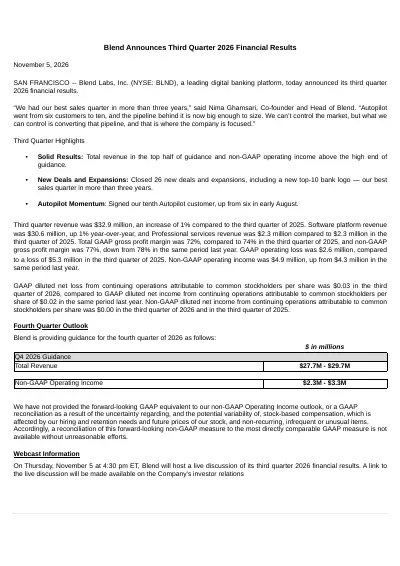
Thanks, Nima, and thank you to everyone else joining us on the call. Total revenue for the third quarter was $32.9 million, up 1% year-over-year and in the upper half of our $31.5 to $33.5 million guidance range.
Mortgage Suite revenue was $17.4 million, down 2% year-over-year and within the -4% to +3% range we discussed on our August call. We saw approximately 194,000 funded mortgage loans on our platform, down 4% year-over-year, and modestly below the 200 to 210,000 range we expected coming into the quarter.
As Nima described, the macro downturn started to affect us in September and drove that shortfall. Economic value per funded loan came in at $81, at the high end of the $80 to $81 range we guided to in August.
Consumer Banking Suite revenue was $13.2 million, up 5% year-over-year, above the high end of the -5% to +1% range we shared on our last call. Professional Services revenue was $2.3 million, consistent with our expectations.
Turning to profitability, non-GAAP gross profit was $25.4 million, and non-GAAP gross margin was 77.2%, compared with 77.7% in the third quarter of 2025 and 78.3% last quarter. That puts us at the low end of the 77% to 78% normalized range we've described.
The sequential decline primarily reflects Autopilot model costs, which scale with the number of loans Autopilot processes. I flagged these costs in August as small, but growing.
They're now having some effect on the margin line, although we don't expect that to be significant for at least the next year, and we're keeping our eye on the trend. Non-GAAP operating expenses were $20.5 million in the quarter, which includes a sequential step-up quarter-over-quarter due to our annual Blend Forum customer event, which happened in August.
Q3 opex was down 3% year-over-year, consistent with what we guided to in August. Non-GAAP operating income was $4.9 million, above the high end of our $3.5 to $4.5 million guidance range, and represented a non-GAAP operating margin of 14.9%, an improvement of nearly 2 points compared with the third quarter of 2025.
Free cash flow for the quarter was essentially flat, bringing the year-to-date total to $14.3 million. We ended the quarter with $44.2 million in cash, cash equivalents, and marketable securities, and, of course, no debt.
Next, I'd like to touch on churn, because I know it got some attention after our last call. Churn notices in the third quarter represented about $2 million of annual revenue, an improvement from about $3 million last quarter.
Year-to-date, and based on an even lighter churn quarter in Q1, that works out to gross revenue retention in the mid-90s on a churn-noticed basis, a very solid result for an enterprise software company. Again, most of the movement we've seen this year is lower-end customers moving to lower-end solutions, along with a few customers that closed or merged in this rate environment.
To be clear, we're not seeing new entrants change the competitive landscape in any meaningful way. The churn I just described reflects some of the pain the market is experiencing with the prolonged high interest rate environment, not a change in our competitive position.
Turning to guidance: on our August call, we expected fourth quarter industry volume to be down roughly 8% to 13% year-over-year. Fannie Mae's most recent forecast, which came out in October, now calls for a 23% decline year-over-year.
Adding in some conservatism, we expect fourth quarter market volume to be between 850 to 910,000 units, down 28% to 33% year-over-year. As we've seen over the last two months, refinance volume is highly sensitive to rate movements in both directions, the backdrop remains fluid.
With that context, here is how we see the fourth quarter playing out for us. We expect our total revenue to be between $27.7 and $29.7 million, a decline of approximately 8% to 15% year-over-year.
We expect Mortgage Suite revenue to be down 23% to 28% year-over-year. Again, our expectations here are driven primarily by the difficult macro environment that we are facing.
We expect economic value per funded loan of approximately $86 to $87, up from $81 in the third quarter. As a reminder, that per-loan figure moves inversely with volume because of some of the fixed fee arrangements within our customer base, lower volume in the fourth quarter mechanically lifts our EV PFL calculation.
About $3.50 of the step-up we expect between Q3 and Q4 is due to this mechanical lift. We expect year-over-year Consumer Banking Suite revenue growth of between +2% and +10% in the fourth quarter.
We expect Q4 non-GAAP operating income to be between $2.3 and $3.3 million, implying a non-GAAP operating margin at the midpoint of approximately 10%. As you might imagine, this is lower than we were expecting before this macro downturn, but some of the pressure on revenue does flow through to lower operating income.
Lastly, I'd also note that our fourth quarter outlook includes only Autopilot revenue under contracts signed today. None of the pipeline that Nima described is included in these numbers.
Looking beyond the fourth quarter, I want to touch on two things related to 2027: volume and EV PFL. On volume, the first quarter has an unusual comparison.
The first quarter of 2026 was a strong one for the industry, with market volume up 37% year-over-year, and the rate environment we talked about earlier carries straight into what is already the seasonally slowest quarter. We expect first quarter 2027 industry volume to be down around 30% year-over-year, at least as steep as the fourth quarter.
For the full year, our current macro view is for 2027 industry volume to be down high single digits to low double digits compared with 2026, with most of the year-over-year decline in the first half as we lap the more robust early part of 2026. On EV PFL, the quarterly figure moves with seasonal volume; we expect it to be highest in the first quarter for exactly that reason.
We've added a trailing 12-month view to the supplemental slides, and I'd encourage you to anchor on that. On a trailing 12-month basis, EV PFL was about $90 a year ago and is about $82 today.
Most of that decline came from two things that we've discussed before: the loss of one large customer and the transition of our verification and insurance products to a partnership model where we now record net revenue rather than gross. Core pricing has been stable throughout that time period.
From here, we expect that LTM EV PFL number to rise, beginning in the fourth quarter of 2026 and continuing into 2027. Some of that is the volume math I described earlier, but the rest is real economics: Autopilot contracts we've already signed converting to revenue, customers continuing to adopt Rapid and Close, and more disciplined pricing on renewals.
For the full year, we expect 2027 EV PFL to be up mid-single-digit percentages year-over-year, and we see more upside than downside to our estimates. Before I wrap up, I want to add a note on capital allocation.
We did close to $37 million in share repurchases in the first half of the year, although we did not have any share repurchases in the third quarter. We still have $13.2 million remaining under our authorization, but feel good about where our cash balances currently sit.
As we've always said, operational liquidity is the first priority for our cash, but buybacks remain the next use of excess capital, especially at recent trading levels, and we will continue to evaluate that opportunity. In summary, we delivered the third quarter we were aiming for: revenue in the top half of our range, profitability above the high end, and a better quarter in sales than we could have imagined.
The macro has become more difficult since our last quarter. We've tried to give you a clear and conservative view of how we see volumes through the first quarter and into 2027.
The drivers we control--pipeline conversion, Autopilot adoption, and the cost discipline we've continued to maintain--are what will determine how the long term plays out, and those are moving in the right direction. With that, let's open up the call to your questions.
Operator
We will now begin the question and answer session. If you would like to ask a question, please press star one to raise your hand.
To withdraw your question, press star one again. We ask that you pick up your handset when asking a question to allow for optimum sound quality.
If you are muted locally, please remember to unmute your device. Please stand by while we compile the Q&A roster.
Your first question comes from the line of Aaron Kimson with Citizens. Aaron, your line is now open.
Aaron Kimson
Great. Thank you for the questions.
Nima, you've been upfront about signing one-year contracts for Autopilot until you can agree on a longer-term value with customers. As customers start to open up the Autopilot box and see the $600 in lower cost per funded loan, 10% to 15% higher pull-through rates, and two to four days lower cycle time, where on the spectrum of the metaphorical scooter versus a Ferrari do you see customers viewing Autopilot as things stand today?
Nima Ghamsari
It's a great question. We sort of went into starting to monetize this in July, and we've had such great partnership from our customers, because I don't think anything starts out as a Ferrari even though there's a lot of promise behind it.
The partnership with our customers has driven a ton of improvement to it and also new products. I would say I don't want to take it for granted, but I already personally believe it's a Ferrari, and I think some of the continued improvement to the product is going to help, I guess, the world see that.
Some of our customers, the ones who have been the closest to us and working with us, already see it that way. I don't want to oversell the product, but I also don't want to understate the magnitude of improvement it can create, and especially as we drive out more partnerships with this.
Aaron Kimson
That's helpful. Then Jason, can you talk a little bit about the underlying dynamics of RPO?
It was sequentially higher, but down 7% year-over-year. How should investors think about how much of the delta is demand versus maybe a change in sales strategy where RPO today is a higher quality that's going to convert to revenue on a more specific timeline versus in the past there was always a question of over what timeframe RPO would convert to revenue?
Nima Ghamsari
I think
Jason Ream
J-- I think--
Nima Ghamsari
[unclear] or shall I put-- Jason, are you there? I know you're having technical difficulties, but--
Jason Ream
Can you hear me now?
Nima Ghamsari
We can hear you.
Jason Ream
Can you hear? I was talking for a while, and I didn't realize that the service had muted me.
Sorry, Aaron. I would actually urge you to not really pay much attention to RPO.
Obviously, as we don't have a straight subscription model; we have a usage-based model. While we do have some commitments and some revenue that does get deferred, RPO isn't really relevant for us because different types of products have different commitment levels from the customer, and so it's not something we focus on, and I would urge you not to either.
Aaron Kimson
Okay. Thank you.
Operator
Your next question comes from the line of Ryan Tomasello with KBW. Ryan, your line is now open.
Ryan Tomasello
Hi, everyone. I guess just on Autopilot, given the maturation of the pipeline there, are you at a point where you can share some more color on the pricing uplift that could come through for an individual customer relative to baseline EV PFL?
Then in terms of 4Q, Jason, you alluded to there being some contribution there to revenue. Are you able to size that for us?
Just generally looking for some numbers here that I know we're all itching for, but understand you guys want to keep this close to your chest still at this stage. Thanks.
Nima Ghamsari
Actually,
Jason Ream
it's a--
Nima Ghamsari
It's a great question.
Jason Ream
Go ahead, Nima.
Nima Ghamsari
I was going to say, I think, following up on the last question, I think it's sort of in the same vein. When we priced this thing initially for these one-year deals, we did intentionally price it less like a Ferrari and more like a scooter because actually for two reasons that I wish I said to the previous question.
One reason is, we're still obviously building out this product, and while it's going well, we want to keep momentum behind it. The other reason is it takes time for the market to absorb the changes and understand and believe the changes.
I think, actually, getting adoption for this product, that is my focus right now. We've priced it as a flat fee, a total price fee for lenders in year one to say, 'Hey, while we know this is more valuable for you, we don't expect you to sign some big, huge per-funded-loan, long-term contract until you really believe and see the value.'
While we don't have specific numbers and what that comes out to, there's pricing tiers from $100,000 or even less all the way up to $1 million for our customers, and it just depends on where they are from a size perspective. Sorry, Jason, to cut you off.
Jason Ream
No, I think you said everything I was going to say and more. Long story short, we're not disclosing the specific financials right now.
I think we're much more focused on, as Nima said, the adoption and the traction and the improvement in the product. As Nima mentioned in his prepared remarks, it could add $5 million to 2027 revenue just with the Q4 deals that we've got in the pipeline.
It could be meaningful, but I don't think we're so early at this point that we're not disclosing any specific financials for Autopilot yet.
Ryan Tomasello
Got it. Then within the Consumer Banking Suite, can you talk about how the home equity product has been holding up in the higher-rate environment?
I'm curious if you're seeing potentially some tailwinds there given the substitution effect versus cash-out refi, maybe improving, or if home equity is still kind of susceptible to weakening demand on higher rates? Thanks.
Nima Ghamsari
The Q3, we mentioned 26 deals in Q3. The rapid home equity products was one of the bright spots in Q3 for us, where it's a competitive market for home equity and we have a lot of the largest home equity lenders in the country on our platform.
Now it's how do you get customers and consumers that certainty around home equity lines and loans faster in that flow upfront, and a real decision, or at least a mostly confident decision so you can give confidence to the consumer that you can help them with their renovation, that you can help them consolidate their debt. I think, yeah, absolutely, there's a tailwind there and there's a strong market demand, including from small lenders, medium lenders, and some of the largest lenders in the country, to be able to offer something to help counterbalance their business.
That was a big bright spot for us in Q3, and we mentioned the new top 10 bank logo. They signed up for rapid home equity, we cross-sold another top 10 bank and a top 20 originator with rapid home equity.
I think that helped. Getting these things rolled out is going to be I think great for just generally the economy.
People need to be able to tap their equity in a tough financial environment for consumers, and our customers see that and they feel that's part of their mission to help them do that.
Ryan Tomasello
Great. Thank you, guys.
Operator
Reminder, if you would like to ask a question, please press star one to raise your hand. Our next question comes from the line of Joseph Vafi with Canaccord Genuity.
Joseph, your line is now open.
Joseph Vafi
Hey, guys. Good afternoon.
Congrats on all of the Autopilot progress here. Just wondering, as it matures, kind of follow-up here, any tweaks to overall pricing strategy, do you think, from here to help drive, maybe more sales of the entire suite leading with Autopilot?
Then, secondly, given kind of the outlook for the industry looking into next year, just wondering how you're thinking about your cost structure as we look into 2027. Thanks very much.
Nima Ghamsari
We haven't changed our pricing strategy on Autopilot in the sense that we've kind of said we're going to do these one-year flat-fee deals with customers for now. That we may change that next year.
I do think that there's a lot of demand for agentic products in the market, including from lenders that are not on Blend yet, as much as it pains me to say they're not on Blend yet. As much we'd love for them to be on Blend.
Finding ways for them to get on board quickly and have some pieces of Autopilot available to them when they sign up with us so they can see the value and get excited about the value, I do think it can be a market share catalyst for us if we decide to go in that direction. While I haven't historically talked too much in these forums about how we're going to use it to drive customer adoption, I do think that as customers get excited about an agentic product like this, it's going to also drive their peers who may not be on Blend yet to come towards us.
I'll let Jason answer the question about cost structure.
Jason Ream
Yeah. Look, Joe, as we've been very disciplined around cost structure, and we'll continue to be so, I guess.
Obviously, we're not guiding to 2027 yet, but I think we've built that muscle; we're not going to let it go to waste.
Joseph Vafi
Great. Thanks very much, guys.
Operator
Your next question comes from the line of Michael Turrin with Wells Fargo. Michael, your line is now open.
Michael Turrin
Hey, thanks very much. Appreciate you taking the questions.
I have two. The first is just can you speak more to what drove the outperformance on the Consumer Banking side of the business and what's assumed in the guide for 4Q, and just any commentary on how sustainable the growth you're seeing from that segment is from your perspective?
Jason Ream
Michael, look, we have a strong customer base in Consumer Banking, and obviously that remained steady in Q4, and that was helpful for us. As the last question highlighted, home equity is a strong point for us as well.
I wouldn't say that it completely offsets the macro pressure on the mortgage side of the house, but it has been doing well, and I think that's probably more based on the strategic push that we've made around home equity. I think that was a big contributor to the performance in Consumer Banking.
Michael Turrin
I appreciate the initial volume outlook for next year, and appreciate some of the forces outside of your control that you're contemplating. Jason, can you just speak to in that volume scenario you're framing, how much you're able to protect margin and the cash flow profile of the business, if that's indeed the scenario that we see in the first half of the coming year?
Jason Ream
Yeah. Look, as I talked about in our Q4 guidance, the downside of having a profitable model is that when revenue goes down, obviously, you're going to take a little bit of hit on margin.
I can't say that we're immune to revenue fluctuations causing any hit to the bottom line. That being said, Joe's question around cost discipline and expense management, we feel very strong there, and able to control our own destiny.
I think we also are seeing sort of a strong momentum in our customer base primarily around Autopilot and Rapid, that leads us to think that we have real revenue growth opportunity. Macro environment aside, obviously, that's a headwind for us, but we have our own tailwinds that we're trying to create to help us counterbalance.
Michael Turrin
Thanks very much.
Operator
Our last question comes from the line of Faith Brunner with William Blair. Faith, your line is now open.
Faith Brunner
Hey, guys. Thanks for taking my question.
Just looking at the deal volume in the quarter, I guess, would you say it was like a perfect storm of multiple factors, whether it was past go-to-market investments, growing awareness or referenceability for Autopilot? Is there anything specific you would call out just how we should think about maybe deal volume momentum going forward and how these deals will layer into the model?
Nima Ghamsari
I wouldn't say it's the perfect storm or luck. I've been flagging late-stage pipeline for a couple quarters, and before that, I said the pipeline was growing.
Then I think lenders saw our progress on innovation both within our core products as well as the Rapid and Autopilot suite. Rapid home equity, like somebody asked earlier, is very popular in the macro right now.
Autopilot changed the conversation. The largest lenders don't just see us as a point of sale anymore.
Actually, one point I wanted to make on working on Autopilot and pricing and packaging to get new logos, one of the most interesting things to me this past quarter was the sort of fintech bank that is using Autopilot MCP to integrate this into their own experience, which it's not something we've done historically because it was sort of you use our front end or you don't use Blend. Now they don't have to make that tradeoff.
I think the combination of those things, plus the fact that we were talking to one of the large industry players about just how much volume is going through Autopilot, it's a lot. In an environment like this, 90,000 applications worked in Autopilot, is a meaningful amount of the loan applications that are out there, and it's such an early product.
While I don't want to give a forward-looking statement on anything but the pipeline that I already talked about earlier, I don't think this was luck. Some of these deals were years in the making, and some of them were months in the making.
Some of this is just a timing game, and you continue to show our execution, we continue to show our focus, we've shown from a financial perspective profitability, and driven confidence in our business. We still have a lot of pipeline ahead of us, and on top of that, a lot of innovation that we hope and believe will drive a lot more pipeline in the future.
I just feel like this is a new era. This agentic world was in a lot of ways a gift to the lending industry, which has been historically very manual and very paper-based.
It was the thing that I've always wanted to make this industry something that felt like it was the most consumer-friendly industry, that the people working in this industry were not sitting there mired in the hundreds or thousands of pages of documents that they had to go through just to successfully approve someone for a loan. I feel like we're now finally able to execute on that as a team, and I don't think we've executed yet by any means.
This is our time. This is where execution really matters, and that's why I've been focusing so much with the team on execution.
I do think we've been executing very well on the go-to-market side and driving the pipeline to completion. We've been meeting our customers on their sites, at conferences, at our forum, which was a couple months ago, and I think all this stuff together over time boils into what's been a really good quarter for us, and hopefully we have more of those to come in the future.
Faith Brunner
All right, awesome. Thanks for the color.
Congrats again.
Operator
There are no further questions at this time. This concludes today's call.
Thank you for attending. You may now disconnect.