Prosegur Cash SA
Q3 FY2026 · Earnings Call TranscriptNovember 3, 2026
Operator
Good day, and thank you for standing by. Welcome to the Prosegur Cash Q3 2026 results presentation.
At this time, all participants are in a listen-only mode. After the speakers' presentation, there will be a question-and-answer session.
To ask a question during the session, you will need to press *11 on your telephone. You will then hear an automated message advising your hand is raised.
If you joined using device audio, click the raise hand button on your screen. To withdraw your question, please press *11 again or click the lower hand button.
Please be advised that today's conference is being recorded. I would now like to hand the conference over to your speaker today, Miguel Bandrés, Investor Relations Officer.
Please go ahead.
Miguel Bandrés
Good morning to everyone, and thank you for joining today's 2026 first nine months results call that will be presented by our CFO, Javier Hergueta, and myself. The presentation will take approximately 20 minutes.
In it, we'll go over the most relevant developments for our business during the period, as well as the key elements of our financial performance. Javier will review the period's highlights, the profit and loss account, our cash flow and debt evolution, as well as our transformation progress.
After, I'll cover the main developments per region, and finally, Javier will share main conclusions before opening the Q&A session. Should we not get to respond everything in this meeting, our IR team will follow up on an individual basis.
I want again thank you all for your attendance, and remind everyone that this presentation has been pre-recorded and is available via webcast on our corporate web page, which you can find at www.prosegurcash.com. Before handing over to Javier to share financials, I'd like to provide some context regarding the current landscape for cash.
Consistently, this quarter's news show cash's high relevance across all actors in the economic sphere, these being consumers, retailers, or legislators. This we can see happens in all geographies around the world and for different reasons, ranging from assuring the protection of cash for its inclusiveness, to the relevance it's getting due to the increasing visibility the hidden costs of digital payments are achieving.
In the first news from the Financial Times, we can read how cash is gaining traction in India as fees are being introduced on digital payments, causing prices to rise. This follows what we already shared in our last quarter regarding UPI.
When digital payments stop being free, their cost ends up being passed on directly to consumers, and cash regains its role as the efficient and neutral alternative. This is a fact that has taken place again, and makes assuring cash infrastructure at strong usage levels fundamental to warranty alternative, efficient, and resilient payment means.
Second, coming from the United States and published by Money.com, a new law in Maryland makes it the 10th state to require businesses to accept cash payments. This is one more step in a clear legislative trend aimed at protecting consumers' freedom of choice and the financial inclusion of those who rely on cash in their daily lives.
It is another example of the trend of growing concern among citizens and their legislative powers to warranty and protect the cash system. Such a debate taking place all over the world will only increase.
Legislators are and should assure the promotion and protection of the only mean of public money that has the unique characteristics of resilience, efficiency, privacy, and inclusiveness borne by cash. Third, in Argentina, as reported by [El Cronista?]
, cash is recovering, with more and more businesses offering discounts to those who pay in cash due to the high costs they face when payments are made digitally. It's a clear example of how merchants recognize cash as the most efficient means of payment, and how card and digital fees are ultimately borne by all consumers.
It is as well a sign that by promoting cash, they work on avoiding being dependent on digital payment systems that, without alternatives, will result in having absolute pricing power. Lastly, in Europe, we can read from Europa Press that 92% of Europeans demand that cash payments be warrantied during the negotiation of the legal tender in the European Union.
This confirms a strong public support behind the legal tender regulation, which aims to assure proper distribution and compulsory acceptance of cash across the union. It is particularly important that this legal tender regulation assures maximum protection to cash, eliminating the exclusions to its compulsory acceptance by all merchants.
This will strengthen it against other payment means, and will provide so that it can be always used by citizens in a free manner. These news are, as you can see, examples of how different aspects of cash are very present in the public debate for different reasons unique to cash.
With this, I'd like now to hand it over to Javier, he can share on the period's highlights.
Javier Hergueta
Thank you, Miguel. Good morning to everyone, and thank you as well for attending.
I would like to start by sharing some thoughts on the macro environment. In a rising oil price environment due to the conflict in the Middle East, we can see how inflationary tensions are building in different sectors of the economy.
This is happening as the increased oil prices put pressure on supply chains and transportation costs, mainly through diesel hikes that are eventually passed over to consumers. This is naturally forcing interest rates to be increased in an attempt to contain the mentioned inflation.
All together, an effect on consumption is patent to a lesser or larger extent depending on the service and geography. Within this, our financials show the resilience of our business model and its capacity to generate cash in adverse and uncertain environments such as the one we're in.
Despite that, we continue to deliver organic growth in such an environment. I would specifically mention again Argentina, that continues to undergo extreme macro adjustments that are having an even more significant effect on consumption.
The first nine months of 2026 show a clear acceleration of growth in our top line in euro terms and a solid cash generation. The change in trend we anticipated in the second quarter regarding the positive impact of currencies evolution has consolidated in the third quarter.
Sales reached €1,510 million, growing by 1.4% in euro terms in these nine months, with a strong acceleration in the third quarter stand-alone, where the top line grew by 5.3% year on year, with foreign exchange, as just mentioned, contributing positively for the second quarter in a row and at a higher rate than in Q2. At margin level, EBITDA improved by 1.2% year on year, with margin over sales in line with the previous year, while net income grew by 2.1%.
Transformation continues to contribute strongly to our growth. Transformation products reached 36.2% of sales, and excluding the Avos divestment, they accelerated their growth to 8.3%.
The share of total sales hence improved by 110 basis points on a reported basis and by an even more remarkable 180 basis points when we isolate the Avos sale. Turning to cash generation, free cash flow amounted to €83 million, 10% higher than in the first nine months of 2025, clearly above EBITDA growth.
Committed to financial discipline, we have been able to reduce our total LTM net debt by €53 million, and our leverage ratio reduced to 2.2 times, 0.1 times lower than in the same period of 2025. Finally, I would highlight two additional milestones: S&P improved the outlook of our rating, which now stands at BBB with a stable outlook, clearly providing a relevant and objective third-party endorsement to our conservative financial management.
This being very important always, it's especially more now in order to optimize financing costs in the above-described rising interest rates environment. Plus, EthiFinance upgraded our ESG rating, recognizing the progress of our sustainability agenda.
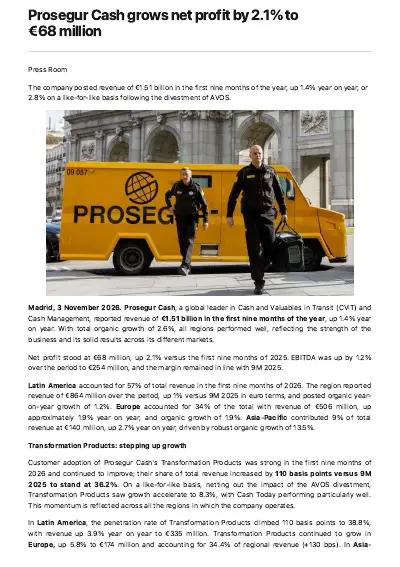
With this overview, let me now move on to the financials. Looking first at the income statement, sales reached €1,510 million in the first nine months of the year, a 1.4% increase versus 2025.
As shown on the right-hand side of the page, organic growth was positive at 2.6%, while inorganic had a -1.3% impact mainly due to the Avos divestment, and foreign exchange contributed a positive 0.2%. With all this, it is important to underline the change in trend in euro growth.
After the improvement already shown in the second quarter, the third quarter stand-alone accelerated, with sales rising by 5.3% in reported terms. EBITDA amounted to €254 million, growing 1.2% year on year, with an EBITDA margin of 16.8% of sales.
After depreciation of €94 million, EBITA reached €160 million, down by 2.4% and a relative margin of 10.6%. Amortization of intangibles was stable at €60 million, and financial result totaled €27 million, slightly better than last year, with which EBIT totaled €117 million, 7.8% of sales.
Taxes reached €49 million, implying an improved tax rate of 41.9%, 260 basis points better when compared with 44.5% in the first nine months of 2025, and consistent with the decrease we have been predicting. This reflects both the impact of tax efficiency actions, as well as the evolution of our country mix.
With all this, net income reached €68 million, increasing 2.1% year on year, while consolidated net income reached €65 million, up by 0.7%. Lastly, earnings per share increased by 1.5% to 4.39 euro cents.
Overall, the P&L shows a positive trend in sales and net income, with a clear acceleration in the third quarter and the above-mentioned positive currency contribution. Moving now to cash flow and net debt, we have increased free cash flow by 10%, well above the 1.2% rise in EBITDA, while increasing CapEx and reconfirming our focus on disciplined financial management, substantially improving our total net cash flow by €48 million.
By line, with an EBITDA of €254 million, provisions and other items deducted €43 million, while income tax detracted €48 million, €19 million less than in 2025. CapEx reached €54 million, increasing our investment pace that includes higher customer-related CapEx to support commercial opportunities, and working capital consumption was €26 million, €11 million lower than last year, despite the organic growth of the period and positive €4 million if considering the stand-alone quarter.
As a result, free cash flow amounted to €83 million, of which in the third quarter stand-alone, we generated €54 million. After interest payments of €19 million, positive M&A inflows of €9 million, dividend and treasury stock payments of €2 million, and other items of €6 million, total net cash flow was positive by €66 million versus €18 million in 2025.
Our net financial position lowered from €711 million at the beginning of the year to €641 million at the end of September. Foreign exchange also had a positive €5 million effect in the period.
Including IFRS 16 debt, deferred payments, and treasury stock, total net debt was reduced to €784 million, that is €53 million lower than one year ago and €45 million lower than at the end of June. With this, our leverage ratio reduced to 2.2 times, 0.1 times lower than at the end of September 2025, being this is all recognized by the previously shared S&P rating improvement.
Turning to the next page, transformation products reached €546 million on a reported basis, growing 4.6% year on year and representing 36.2% of total sales, compared with 35.1% in 2025. The evolution is even clearer excluding Avos, divested earlier in 2026.
When this is isolated, transformation products accelerated their growth to 8.3%, reaching €536 million, a 50 basis points increase over the 7.8% growth we reported in the first half. Ex-Avos, penetration increased from 33.9% to 35.7% of sales, a 180 basis points increase versus the first nine months of 2025.
Cash Today continues to show a solid performance and remains a key contributor to this growth. Customer acceptance across markets continues to grow as we deploy new solutions for different segments, and as clients enjoy the benefit of these solutions that integrate efficiency and security with a better cash management.
As the environment we do business in evolves at an unprecedented pace, our transformation initiatives allow us to continue growing, but what is most important, they open us to a very promising future with solid growth perspectives. Transformation, therefore, remains one of the clearest levers to improve the quality of growth and the profitability profile of our company.
With this, I hand it back to Miguel for the regional overview.
Miguel Bandrés
Thank you, Javier. I'll first turn to Latin America, our largest region, representing 57% of group sales.
Sales in LatAm reached €864 million in the first nine months, growing by 1% in euro terms, compared with a 1.7% decline in the first half of the year. This results from a 1.2% organic growth and a minus 2% inorganic effect due to the mentioned Avos divestment, and a relevant positive foreign exchange contribution of 1.8%, reversing the long-standing negative currency trend in the region.
The improvement is especially visible in the third quarter stand-alone, where sales in euros grew by 6.6% year on year, consolidating acceleration already seen in the second quarter. Performance has been good across the region, with the exception of Argentina, that as Javier pointed out earlier on, continues to show a pronounced slower activity due to the reforms taking place.
We're confident that as time evolves, the measures taken place will bring the already existing GDP growth in the country from energy and mining or agro to consumption, and hence grow our business. Transformation products continue to deliver strongly in the region.
They reached €335 million, growing by 3.9%, and penetration increased from 37.7% to 38.8% of sales, that is 110 basis points improvement year on year. Summarizing, the region combines growth in euros with increasing penetration of value-added transformation solutions that are now reaching almost 40% of total sales.
I will now turn to Europe, that accounts for 34% of group sales. Revenue in the region reached €506 million, growing 1.9% year on year.
This performance is mainly organic. We see an improvement of organic growth in the quarter stand-alone of 20 basis points, quarter on quarter, up to 1.3%.
It shows a positive trend in the markets we participate in, despite the fact that growth continued to be affected, as Javier as well highlighted earlier, by the slowdown of non-euro currency traffic in our forex business as a consequence of the conflicts in the Middle East that have impacted some of our routes between Europe and Asia mainly. Transformation products continue to progress well, reaching €174 million and growing by 5.8% to represent 34.4% of sales.
That implies a 130 basis points improvement over the first nine months of 2025. The commercial performance of the region remains positive, and the continued increase in transformation penetration supports a better mix for the future.
With this, I move to Asia-Pacific, that represents 9% of group sales, and continues to show an even stronger underlying growth. Reported sales reached €140 million, 2.7% above last year, turning positive in euro terms versus the first half of 2026.
Organic growth accelerated to 13.5% from 11.8% in the first half, more than offsetting a negative 9.2% foreign exchange impact, which continues to smoothen. Taking Q3 as a stand-alone, organic growth reached a very remarkable 16.6%.
Transformation products grew by 5.2% to €37 million, and the penetration continues to rise, reaching 26.1% of sales. This is a 60 basis points improvement over the first nine months of 2025.
We must underline this improvement, especially when considering that the core business continues to be very strong on the back of solid cash demand and growing outsourcing. Asia-Pacific again shows its relevance for the present, and most importantly, for the future of our company, with high cash usage, strong outsourcing opportunities at an initial stage, and a high appetite for transformation.
With this, I finalize our geographic review and hand it back to Javier.
Javier Hergueta
Thank you, Miguel. To conclude, and as I started this presentation, the first nine months of 2026 show an acceleration of growth in sales with improved transformation, reflected in an improved EBITDA with solid cash generation.
Sales grew by 1.4% in euro terms to €1,510 million, with a clear acceleration in the third quarter stand-alone, where they raised by 5.3%, and currencies have turned into positive contributors for the period. EBITDA improved by 1.2% in line with last year, where the EBITA margin stood at 10.6%, and net income increased by 2.1% versus 2025.
Transformation continues to gain relevance. Transformation products reached 36.2% of sales, and excluding Avos, accelerated their growth to 8.3%.
Free cash flow reached €83 million, 10% higher than in the first nine months of 2025. Total last 12 months net debt decreased by €53 million, and leverage reduced to 2.2 times, 0.1 times lower than a year ago.
Lastly, S&P improved the outlook of our BBB rating to stable, and EthiFinance upgraded our ESG rating. As said, in a permanently uncertain environment that is taking a toll on consumption, our model continues to demonstrate resilience and adaptability, and we are confident it's better prepared than ever for the future.
Thank you very much again for your attention, and now we would like to open the floor to your questions.
Operator
Thank you. As a reminder, to ask a question, you will need to press *11 on your telephone, or if you have joined via device audio, click the raise hand button and wait for your name to be announced.
To withdraw your question, please press *11 again or click the lower hand button. We will now take our first question from the line of Joaquín García-Quirós from JB Capital.
Please go ahead. Joaquín García, JB Capital, please go ahead.
Joaquín García, your line is open. We will now go to the next question from the line of Manuel Lorente from Santander.
Please go ahead.
Manuel Lorente
Yes, hello. Good morning.
Can you hear me?
Operator
Yes, we can. Go ahead.
Manuel Lorente
Sorry. [laughter] Okay, my first question is regarding operational margins.
It looks like you have had a pretty decent quarter in terms of top-line evolution with a little bit of help from FX, but look like underlying trends are remains more or less solid. However, we have seen some minor deterioration on the profitability side.
This is the logical consequence of, let's say, higher transport logistics costs in your business, or you have had also some mix effects in terms of geography, or some also aspects on the forex business. I was wondering whether you can elaborate a little bit on where we should expect going forward in terms of margins in the current high fuel prices backdrops and so on.
Javier Hergueta
Good morning, Manuel. In line with your question about the operating margins, it has a lot to do with the mix impact that you're mentioning, but concentrating mainly on two sides.
Argentina is still performing at low levels, so that has an impact in terms of the overall combined profitability. Also, our forex business, which is a very seasonal business and where typically Q3 is the strongest quarter, is suffering from the context, geopolitically.
It also, on a comparison basis, is not helping in the profitability in the quarter. Those are the main two levers there.
Also, we have increased a bit the investment in terms of OpEx in efficiencies for the use of AI, and that might have as well, to a lower extent, some impact. Overall, I would say that if you look at the rest of the business as a whole, excluding the forex and Argentina situation, the profitability is looking good.
If you exclude Argentina, margins are improving as a whole, and that's a good signal. Those are the main aspects that are impacting the profitability in this Q3 and in the nine months accumulated figure as a consequence of that.
Manuel Lorente
Great. Just probably a follow-up on Argentina, then.
Do you expect any stabilization, recovery, consolidation, or whatever you want to call it, in the next, let's say, quarters, or very difficult to say, and the last part of 2026 and also 2027 will be a largely, let's say, muted geography for your business?
Javier Hergueta
Sorry, Manuel, I didn't get it right. Is the question related to the overall performance or the Argentina business, or what was it?
Manuel Lorente
On Argentina.
Javier Hergueta
Okay. On Argentina itself, we're seeing that the context is still of lower inflation together with strong adjustments coming from the government, so that makes consumption still perform at low levels.
For as long as consumption is still low, it is difficult to see a better performance of the business itself. I would tend to think that taking into consideration that we have elections in Argentina in '27, there might be a better context to soften adjustments progressively towards the election taking place.
Therefore, we would be expecting that also reflects into a better performance quarter by quarter. As of today, in terms of the macro performance, I think it is very much dual.
You have some industries like petrol, agro, or mining that are performing strongly, but the rest of the economy is probably, I would say, at a very low level, and that affects private consumption, which is the driver for our business itself. We hope that it will improve in the coming quarters, but still we are in that context as of today.
Manuel Lorente
Great. Just probably my final question is on the debt reduction front.
Very supportive trend in terms of working capital. Additional color on trends or proactive initiatives that you are taking in order to back that working capital improvement would help.
Finally, I see on your free cash flow statement a significantly, let's say, increase in cash. Probably is that FX-related quarter on quarter that justifies a significant reduction on the net debt levels at the end of the quarter?
Thank you.
Javier Hergueta
In terms of debt reduction, when you look at free cash flow itself, two main drivers or levers that are helping us improve our free cash flow generation. One is on the tax payments, which are significantly lower than last year, mainly due to the payments in advance made in Argentina the previous year, which we're recovering now.
Then it's working capital, which is reducing its consumption compared to last year or to even first half this year. There's a lot of focus on managing working capital.
I think also the FX environment is helping in the sense that typically when there's massive devaluations, the accounts receivable tend to have to be impacted, let's say, in euro terms, which is not the case right now. For as long as we keep focusing on that, and the FX remains more or less in the same trend that we're seeing, we would anticipate that same pattern to remain for the rest of the year.
Then from free cash flow to net debt, we have the M&A contributing due to the sale of Avos, and we also have a positive contribution from the FX thing. On a comparative basis versus last year, we don't have the level of one-offs that we had in the past.
All that is helping us reduce our net debt to a significant extent. Going forward, we will keep the same focus on it.
Nevertheless, please keep in mind that the dividend is to be paid in Q4, and that will have an impact in our final net debt figures. The remaining trends we expect to remain in line with what you're seeing now.
Manuel Lorente
Great, thank you.
Operator
Thank you. We will now take the next question from the line of Álvaro Bernal from Alantra.
Please go ahead.
Álvaro Bernal
Hi. Thank you for taking my question.
I have two. The first one is regarding AOA.
Here, more or less, where is the limit? We're seeing a reacceleration this quarter in the organic growth.
How long can you imagine to sustain double-digit growth in this area? Also, where do you see the cap in the profitability for this area as well?
Javier Hergueta
Good morning, Álvaro. With regards to AOA, I think we've been seeing double-digit organic growth for long now.
I think it's every quarter in the last four or five years, we've been posting double-digit organic growth. I would say it's a very sustained trend already, which is supported by cash usage increasing in most of the geographies where we operate and still outsourcing potential, which materializes on a progressive manner.
Those two factors we are still seeing the same all across the region, we don't anticipate in the short term that we should see a different growth profile. When will that [laughter] revert to single-digit figures?
Hard to envision, but for the time being, we are seeing the underlying performance of the business, remaining strong despite the negative FX impact, which has softened a bit in Q3, but still the net growth in euro terms in the quarter is of a double digit. In terms of profitability, I think the region is not very far from group average margins, as you saw in the H1 figures, and we would expect that if the business keeps growing at this same path, and we materialize the opportunities that we see there, we should see the business reinforcing that situation right now, and probably keep improving in the coming quarters or semesters, that is when we show the margins per region.
There's no specific cap in mind as such right now. What we're saying is that there's potential in the business, we're trying to squeeze that, and for as long as we keep growing, we feel that on a country-by-country basis, the profitability could also follow the same trend.
Álvaro Bernal
Very clear. My second question is regarding CapEx, pretty stable to date this year.
I just was trying to map around my mind how much of this is due from the change business not being performing well, because in the past we have seen CapEx bumps upwards due to the rollout of new stores or new centers of Change, and how much could this change if next year things turn around and long-haul travel stabilizes once again?
Javier Hergueta
I would say that out of the total CapEx figure, the forex business is not representing a significant amount. In fact, I would say it's pretty much in line or even a bit lower than it was in the past.
Going forward, I would say that there are a couple of openings, the backlog of which will take place or are taking place late '26 or early '27 of a couple of airports that we won, which we are quite comfortable with, and that will increase a bit the CapEx for '27. Other than these specific projects themselves, we don't foresee a major upward move in the CapEx of the forex business other than the two openings that we just said.
Álvaro Bernal
Very clear. Thank you.
Operator
Thank you. As a reminder, to ask a question, please press *11 or click the raise hand button on your screen.
We will now take the next question from the line of Enrique Yáguez from Bestinver Securities. Please go ahead.
Enrique Yáguez
Hi. Good morning.
Just three follow-up questions because most of my original questions have been answered. The first one is coming back to the impact of Argentina in order to have a better sense of how is impacting your results.
I don't know if you could provide a pro forma figure of what would have been the group or the region organic sales excluding this country, if it would be growing at high single digits organically or not, just to have a better sense of how it's impacting the situation in this country. Second, regarding the Asia-Pacific, given the very strong performance of the group and that the profitability levels are not far of the group levels, wouldn't be advisable to allocate more resources or CapEx to accelerate the transition in this business area?
Just the final question is also about a topic that has been dealt with, the CapEx, just to confirm that no CapEx increase should be expected for the next year, because the CapEx this year, it's a surprise, it has been below my estimate. I thought that there was going to be an acceleration given your preference for the organic growth.
Any further comments on this would be appreciated. Thank you very much.
Javier Hergueta
Thank you, Enrique. We'll go one by one on your questions.
On the first one, on the situation excluding Argentina, well, you know we don't report on a per-country basis, but trying to give you some color around that, when we look at the figures ex-Argentina at a group level, we are very much on that mid-single-digit figures that we've been mentioning for several quarters already on an accumulated basis. In euro terms, it's even better or stronger given that excluding the peso, most of the currencies in our footprint are evolving positively, especially in Latin America.
At regional level, it is more or less the same trend. We are around that mid-single-digit figure on an accumulated basis on the nine months.
Related to the CapEx, first on AOA, I would say that we are investing in AOA, in that growth figures that you're seeing. A lot of that is still coming from the traditional business, as we said.
There's cash usage, there's outsourcing, and that requires some investments itself, which we are undertaking, and we will keep doing so in order to capture the opportunities that we see in the region. If we look at it more on a global perspective, which is your third question, I would say that probably total CapEx figure for full year '26 would be a bit higher than last year.
I think last year we ended up on €82 million of CapEx if I'm right. Probably a bit higher than that.
Going forward, I would say that we will be quite likely round the €90 million figure, from 90 to 100, depending on the opportunities that may arise in the different regions throughout the year, and how strongly client CapEx for specifically Cash Today evolves, and maybe a bit closer to that 90 million figure depending on how things evolve. That will be like a reference, I would say, in the longer term.
Enrique Yáguez
Thank you very much.
Operator
Thank you. Once again, to ask a question, please press *11 or click the raise hand button on your screen.
There are no further questions at this time. I will now like to turn the conference back to Javier Hergueta for closing remarks.
Javier Hergueta
Thank you everyone for taking your time and for participating into today's conference call. As usual, should you have any further queries, you know that our IR team remains available at all times.
In any case, we hope to hear all of you and see you back in the next quarterly results presentation. Thank you very much.
Operator
This concludes today's conference call. Thank you for participating.
You may now disconnect.