Cellnex Telecom S.A.
Q3 FY2026 · Earnings Call TranscriptNovember 5, 2026
Maria Carrapato
Hello, good evening, and welcome to our 9-month 2026 results conference call. Apart from our usual participation, the meeting is going to be led by Marco and Raimon, and then we have our CEO for our Northern Cluster, Nuno Carvalhosa, who will be talking about our new and exciting project in Poland.
Let me hand over to Marco, who will give you some opening comments on the results.
Marco Patuano
Thank you, Maria. Good afternoon, everyone.
Let me start with the six main highlights. Looking at our performance over the first 9 months, we combined continued organic growth with greater operational efficiency and strong cash generation, supporting continued shareholder remuneration.
Let's start with the revenues. Revenues grew organically by 4.9%, 3.6% from colocation and build-to-suit, and 1.3% from indexation.
Very important, we achieved this growth with 22% less growth capex, reflecting greater capital efficiency. As a second point, let's focus on the cost base.
Our larger tower base does not have to mean a larger operating cost base. Continued operating efficiency reduced opex by 4.4% year-on-year, expanding our EBITDA margin to 84.8% from 83.1%.
Lease payment increased by just 2%, with land efficiency investment helping to offset inflation and offsetting a 2.5% larger tower base. This is the operating leverage of our platform coming through in the numbers.
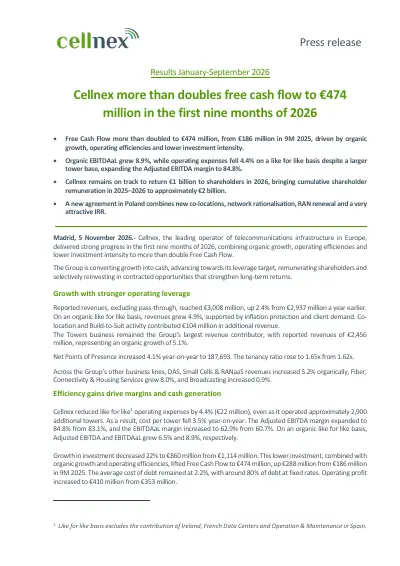
As a third point, the operating performance and financial discipline, which are delivering strong recurring cash generation, recurring levered free cash flow per share up by 18.3% to €2.09 per share, with share cancellation from buybacks driving additional per share growth. Free cash flow reached €474 million in the first 9 months, €288 million more than a year ago.
Leverage declined to 6.13 times from 6.28 times at the end of year 2025, and our 5 to 6-time target remains unchanged. Our average cost of debt remains at 2.2% with around 80% at fixed rate, and the stronger cash generation supports organic deleveraging, whilst we continue to return cash to shareholders through dividends and share buybacks.
Staying in the finance, we signed a €375 million loan with an 8.5-year average maturity with the European Investment Bank to support existing plans for infrastructure deployment in Spain, France, Italy, and Portugal. This is the third financing agreement with the European Investment Bank, and it reinforces our longstanding partnership with competitive terms and a tenor that will help strengthen our financial structure and extend our average debt maturity.
Finally, we're excited to share with you our new transformational project in Poland, a great example of how we can unlock further value from infrastructure we already own. It is an industrial blueprint on how to create value for all our stakeholders.
It brings together new colocation, site rationalization, and accelerated RAN renewal. This project improves all our financial metrics in Poland.
The investment we are making brings much higher future revenues, profitability, and return on invested capital. It is a clear example of our capital allocation discipline, bringing an IRR at more than double of our cost of capital.
We will share part of our efficiency with our client, making a new form of industrial collaboration while making better use of our platform. On this, Nuno will drive you through the Polish project.
I hand over to Raimon, which will take you through our main highlight, and then we will pass the floor to Nuno. Raimon.
Raimon Trias
Thank you, Marco. Good afternoon, everyone.
The financial overview shows how revenue growth translates into cash flow and per-share performance. These growth rates are on a pro forma organic basis.
Revenue growth of 4.9 translates into a 6.5% growth in adjusted EBITDA and 8.9% in EBITDA after leases, reflecting operating efficiencies and proactive land management. The combined strengths of our operating performance, efficiencies, and disciplined financial management delivered 11.2% organic growth in recurring levered free cash flow, and the share cancellation from buybacks driving additional per-share growth to 18.3%.
Focusing on consolidated revenues, we grew organically by 4.9%, supported primarily by our core tower business, which we will explain shortly. Colocation and other businesses together with build-to-suit and fiber contributed €104 million, equivalent to 3.6% of growth before indexation, demonstrating our ability to grow our business more efficiently with lower investment.
On a reported basis, revenues excluding pass-through reached €3,008 million, up 2.4% year-on-year. Points of presence continue to reflect healthy commercial activity, with demand for both colocation and new sites across our platform.
In the third quarter, we added 1,120 net new PoPs, comprising 956 gross colocations and 506 build-to-suit. Poland led the growth in the quarter with 673 net new PoPs, already reflecting our new transformational project.
Comparing 9 months 2026 with 9 months 2025, gross colocation and build-to-suit grew by 5,567 and 2,979 PoPs, respectively, with churn of 1,094 PoPs. This represents an annualized growth rate in net PoPs of 4.1%.
We continue to see demand from our clients to expand their coverage and increase network capacity, as is reflected in the operating growth throughout the year. Turning to our core tower business, we delivered organic revenue growth of 5.1% on a pro forma, supported by continued colocation, build-to-suit delivery, and contractual escalators.
Reported tower revenues reached €2,456 million, up 3.3% year-on-year. Our other business lines complement this performance with distinct growth drivers.
Fiber, connectivity, and housing services grew organically by 8% on a pro forma basis, adjusted, as for the French data center disposal in the first quarter 2026, and driven primarily by the continued rollout of the Nexloop project in France. DAS, small cells, and RAN-as-a-service grew organically by 5.2% on a pro forma basis, excluding the discontinued O&M activity in Spain.
Finally, broadcasting grew by 0.9% on a like-for-like basis. Turning to efficiencies, operating efficiencies and disciplined land management are allowing us to grow our tower base while reducing the combined cost of operating and leasing our sites.
Operating expenses on a pro forma basis decreased by €22 million, or 4.4% year-on-year. Land efficiency investments is helping to mitigate inflation and increase size of the tower portfolio.
On a pro forma basis, cost per tower decreased by 3.5% year-on-year. Together with revenue growth, this cost discipline expanded EBITDA margin to 84.8% from 83.1% a year ago, and EBITDA after leases margin to 62.9% from 60.7%.
On our EBITDA margin, we are one year ahead of our target plan. Let me show you how this strong operating performance translates into cash flow.
Operating growth, efficiencies, and disciplined financial management together delivered a stronger pro forma organic recurring levered free cash flow of 11.2%. Cancellation of shares from our share buybacks provided a further uplift to the recurring levered free cash flow per share to 18.3%, combining stronger cash generation with the benefits of shareholder remuneration.
Reported free cash flow reached €474 million, an increase of €288 million year-on-year, as stronger recurring cash generation and lower build-to-suit capex intensity reinforce cash conversion. On a per-share basis, free cash flow reached €0.71, almost three times on a year-on-year basis.
As you all know, our contractual structures and financial discipline help to protect against macro headwinds. Around 65% of our core tower revenues are linked to CPI, while the remaining 35% benefit from fixed escalators of 1 to 2%.
Exposure to energy inflation is almost entirely mitigated, with around 80% of costs passed through to tenants and the residual exposure hedged through forward contracts and power purchase agreements. On the cost side, operating efficiencies, economies of scale, and active lease management help keep increase below inflation.
This combination creates operating leverage, leaving our net exposure to inflation positive. Raw material price increases also have limited impact given contractual structures, particularly on build-to-suit projects.
On a final note, as Marco highlighted, 80% of our debt is fixed rate, impacts of the more challenging environment will be progressive as we refinance upcoming maturities. On the balance sheet, we continue to make progress towards our leverage target while delivering shareholder remuneration.
At the end of September, committed liquidity stood at approximately €5 billion, including €1.6 billion of cash and €3.4 billion of undrawn credit lines. Our 2026 to 2028 maturities are largely funded, giving us flexibility to navigate market windows.
IFRS 16 leverage declined to 6.13 times from 6.28 at the year-end 2025. Excluding the €1.3 billion of share buybacks completed since 2025 that were not considered in our Capital Markets Day 2024, pro forma leverage would have been approximately 5.76 times, illustrating the underlying deleveraging capacity of the business.
Our leverage target remains unchanged at 5 to 6 times. Our debt profile reflects the funding discipline that supports recurring cash flow generation.
Around 80% of debt is fixed rate, limiting the immediate exposure of cash interest to market rate movements, while our average cost of debt stands at 2.2%. With an average maturity of 4.2 years and a diversified funding mix, we retain flexibility to manage upcoming refinancings.
A recent highlight that Marco mentioned a few minutes ago, at the beginning of November, we signed a €375 million loan with an 8.5 years average maturity with the European Investment Bank to support existing plans for mobile infrastructure deployment in Spain, France, Italy, and Portugal. This third financing agreement with European Investment Bank reinforces our longstanding partnership with competitive terms and a tenor that will help strengthen our financial structure and extend our average debt maturity.
I will now hand over to Nuno Carvalhosa, CEO of our Northern EU Cluster, who will give you some more color on our Poland transformational project.
Nuno Carvalhosa
Thank you, Raimon. At our 2024 Capital Markets Day, we set out three priorities: promoting colocation growth, fostering colocation-to-suit, and pursuing tower rationalization.
Our business in Poland is a strong fit for all three, with two independently acquired portfolios of passive infrastructures with a low tenancy ratio. Poland is a country in need of better coverage and higher capacity in the mobile networks, and because of a somehow delayed 5G auction, Poland was also in the need of a rapid rollout of 5G.
Working together with Polkomtel, we have shaped an industrial project that improves network quality and strengthens our partnership while delivering better economics for both companies. It is a blueprint of how we can proactively create industrial value for our clients, helping them have the best possible networks and also allowing them to capture parts of the value such a project creates.
Importantly, it allows for better economics for Cellnex, namely through a higher asset use and stronger cash conversion. The project combines three main elements through 2030.
First, approximately 3.2 thousand committed new colocations, with a further 2 thousand committed from after 2030. These new colocations contribute to increased revenues and EBITDA after leases.
Second, site rationalization involving approximately 4.2 relocations, improving the use of our assets and contributing to increased EBITDA after leases through savings in both leases and operating costs. Third, accelerated RAN renewal and deployment of 5G configurations, enabling a wider network improvements and optimization program with an increase in revenues and profitability.
We are also accelerating BTS delivery under our existing Play program from 2028 to 2027, bringing forward the associated contribution to revenues and EBITDA after leases. Together, these elements combine contracted growth, a more efficient footprint, and network modernization.
This project reflects disciplined capital allocation with double-digit unlevered post-tax IRR and driving long-term tenancy ratios over 2 times by 2035. Incremental capex totals €500 million over 2026 to 2030 versus our previous projections to support an increased scope in footprint and accelerated rationalization plan.
The project combines attractive returns for Cellnex with benefits shared with our customer. With that, I hand back to Marco to put this project into the broader group context.
Marco Patuano
Thank you very much. I'm sorry, I did not switch on the microphone.
Thank you very much, Nuno. To sum up, this first major tower rationalization project in Europe addresses continued demand for capacity and coverage.
Nuno, I think it's the first in the world. I've never heard about such a big Not
Nuno Carvalhosa
to the extent of my knowledge, indeed.
Marco Patuano
Okay. To sum up, the first major tower rationalization project in the world addresses continued demand for capacity and coverage.
It puts our strategic business model into practice to improve asset returns and cash conversion. We're combining network rationalization with an expanded client base to capture higher returns with an IRR of more than double our cost of capital.
Importantly, we're strengthening our client partnership through additional long-term network commitments that will last at least until 2046. We're proving again our ability to proactively and successfully manage our business relationship, as we have already shown in the like of Spain, the UK, and we're on track to demonstrate in France.
To conclude, let me leave you with four messages. First, our growth is releasing more cash.
Strong organic growth, a more efficient cost base, and a lower BTS capex intensity are translating into stronger free cash flow. Second, that cash generation allows us to progress towards our leverage target whilst continue to reward shareholders through dividends and share buybacks.
Third, our new transformational project in Poland opens an exciting opportunity to unlock further value from assets we already own, combining contracted growth, shared efficiencies, and network modernization with attractive IRR. It's a win-win-win project for Cellnex, for our clients, and for our shareholders.
Finally, we reiterate all our 2026 and 2027 guidance on a like-for-like basis. Our new Poland transformation project implies €300 million capex impact on free cash flow in 2027, and it is set to bring us significant growth and increased returns in the future.
We continue to create long-term value for our clients, for our platform, for our shareholders. With that, Maria, back to you.
Maria Carrapato
Thank you. Thank you very much.
Now let's go to the questions. The first question on the list comes from Akhil Dattani from J.P.
Morgan.
Akhil Dattani
Hi. Good afternoon.
Thanks for taking the questions. The first one was just to try and understand how we should think about the economics of this Polish new contract a bit better.
Marco, I guess it's interesting and obviously relevant to understand this is a double-digit unlevered IRR, but I guess the challenge for us is to understand a little bit about how that should impact our forecasts going forward. I just wanted if you could help us understand how we should try and think about it.
I guess there's two different ways that I was trying to get it right in my head. One is, at the moment, we obviously have certain forecasts that we're modeling for Poland, and I'm sure we have all slightly different assumptions.
Is there something you can help us with to understand maybe what the compound growth rate of revenue or EBITDA is going to be going forward, or maybe some other way to help us conceptualize exactly what this does to the numbers in Poland going forward? That's the first thing, just trying to really understand.
We understand the capex, we understand it's a good return, but I guess just trying to understand exactly what that means relative to existing assumptions. Then the second thing is, Poland's been an interesting market for you in that it seems to have been a leading market on a number of themes.
I remember a few years ago, this was the market where you did an active sharing arrangement as well. I'm just trying to understand how we should think about that.
These are two scenarios where Poland's been leading. When you think about the rest of your footprint, are there other markets where you've already got active negotiations?
Is this something that you think certain other markets are better suited than others? Just help us understand a little bit better, beyond Poland, how broader could this theme be.
Thanks a lot.
Marco Patuano
Sure. I try to drive you a bit more, as you said, the conceptualization.
If you want to have more modeling details, of course the IR team is at your disposal for every question in the coming days. Let me put the conceptual framework.
Point number one, Poland is a big country in terms of land, as more than 300,000 square kilometers, with a population that is one of the large European countries. If you make apple with apple, an average MNO in Poland has a sort of 12 to 13 thousand PoPs.
You compare with Italy, an average MNO has 20 to 25. It's evident that Poland need growth.
The other data point is ARPU in Poland is not very high, you need growth and you need to make the growth efficiently. Continue multiplying and work in standalone is a bad idea because the network will be very expensive.
The idea is we have to incentivize our clients to go together and to share as much as they can, because every time we share something, we can dismantle a tower. Dismantling a tower, you save the lease, you save the maintenance, you save the energy, you save a lot of costs that, let make an easy number, I can tell you we're talking about something between €10 and €13 thousand per site.
You easily understand that if you release more than 4,000 sites, you're making available a part of saving that is pretty big, and you can reinvest together with the client a part, transferring part of the saving to the client, and this is the win for the client, and the client with this money self-finance part of the investment in the 5G. This investment comes back to us with a broader network, more PoP, more towers, everything is increasing at a price that is good for the client and which help us because part of the saving are retained by us.
This is how the mechanic works. Of course, this is a multi-year project.
You can imagine that moving 4,000 towers, swapping more than 10,000 antenna, increasing 3,000 3,000 PoP takes more than a year. Numbers.
In our original plan, we had €300 million. The new plan costs total €800 million, we have a delta of 500.
I make it simple: €500 is the delta. All the rest is a different timing.
What we do with Play, we agreed to anticipate the investment we had with them by one year. What is the impact on the total expending?
Zero, because it's an anticipation. Simple numbers is we invest €500 million for making higher revenues using operating leverage in order to have a growth in EBITDA that is more than the growth in revenues, and we deliver to our client a modern network.
To your second question, yes, it's a model that can be replicated, but the trick is that you have to make on sites. If you make a project that have to call the attention not only of the CFO, but the CFO, CTO, CEO of your client, it has to be big, because if it is not big, ultimately the NPV of the project, you see the pain of moving, but you don't see the gain because the gain is too small.
Can be replicated? Yes, it can.
It can be replicated almost everywhere, I would say, but it's obvious the bigger the portfolio, the more you have the possibility of making network rationalization. As always, you need to break the ice.
Now, I'm sure that the Polish example will be something that all the CTO will look with a lot of attention. We are in the hands of Nuno, which is our top gunner in this, and so I hope that I was clear, Akhil, because this is a great project, it's very new.
If some of the colleagues want more details or want to speak with Nuno, more than happy to continue on the topic.
Akhil Dattani
Yep, that's super clear. Just one super quick thing, it doesn't need a very long answer, it's just, would there be a CMD update, because I guess you gave a CMD out to 2027, I guess if we're trying to understand the numbers better into the mid-term, is there some sort of vision as to when we might get an event like that, which would then help us with those mid-term expectations?
Marco Patuano
Sure. We have guidance until 2027, somewhere in 2027, we have to make an update.
It's a topic that we are discussing with the board. The ideal moment is as soon as we have a touch of clarity on France, more than happy to share, because I can eventually do it tomorrow morning and I tell you, I don't know what's going to be happening in France.
So, 2027 for sure we will do it.
Akhil Dattani
Very clear. Thanks very much.
Marco Patuano
Thank you, Akhil.
Maria Carrapato
Now moving on to the next question comes from Maurice Patrick at Barclays.
Maurice Patrick
Thanks. Thanks, guys, for the call and taking the questions.
Just for me, a question on the the cost side, please. You've you've spoken in the in the presentation, in the prepared remarks, about the strong EBITDAaL growth driven by your your your cost focus.
You talked about being, I think, a year a year ahead, I think, in terms of your EBITDAaL margins. I I guess curious as to as we look towards 2027 and the guidance you've reiterated today, love to get some more understanding around the the ability of taking more costs out in the next 12 months, and what how that what that implies in terms of the kind of margin progression we should assume for for next year.
Then just as a quick side side question, please. On the UK, you've you've been speaking for some time now about the likelihood of the UK catching up with the rest of Europe.
As a as a UK resident, I can certainly vouch for the hope that that you'll be right. We've recently had Vodafone Hutchison having a capital markets event where they've been talking about their extent of wanting to have the best network in the UK, but then VMED O2 and BT saying they don't see a need to kind of really make any big change and they're really happy with their sort of 5G investments and network slicing.
Would love to get your your views in terms of when you think that sort of UK acceleration will come through. Thank you.
Marco Patuano
I leave Raimon on the cost, and I take the UK, but you have to know that Nuno is on the ground in the UK as well, I ask Nuno to help me in the second part.
Raimon Trias
Okay. Hi, Maurice.
I'm going to start with the cost. As you have seen, this year we are €9 million better in terms of cost, mainly coming from the opex, where we have €22 million, and this has been quite recurrent over the past couple of years, no?
We have been explaining you the different initiatives that we have been undertaking, and it's true that we have managed to accelerate by one year the EBITDA margin that we were expecting for next year into this year, this 84 84.8%. That is a very good improvement.
Can we expect further savings in the coming years? The answer is, as we have always said, we always try to keep doing savings that mitigate the inflation in our cost, and it's our target trying to mitigate.
This year, we are doing much better. It's true that we have accelerated savings, but we cannot expect always to accelerate faster.
At least we need to maintain saving the inflation cost.
Marco Patuano
Thank you. Yes, this year we saw something a bit unusual that the cost of the 2026 in absolute value are below the cost of 2025.
On the UK, I give you my gut feeling. There are two numbers that don't match.
One are the targets that Vodafone is giving in terms of quality, in terms of coverage, in terms of bandwidth at the edge of the network, in terms of speed, etc., and the number of antenna. The 26,000 seems to me a little bit low.
If I look to the traffic growth and a bit of the congestion that I see in the UK, I think that they should target more 30,000 than 26,000. How is doing Vodafone, I leave to Nuno to give you because he's on the ground, but I've been very vocal.
I was expecting at least BT reacting a little bit before. They are plenty of activity in this moment.
That they've been super active on the fiber, which took a lot of their attention. It's also true that they were starting from a comfortable position of being the leader in quality in the UK, they could react a little bit later, but it's not to consider for granted forever.
Nuno, what is your view?
Nuno Carvalhosa
I was going to pick on that exact topic, which is BT has been enjoying for many years a strong lead in terms of perceived network quality. That, for the one side.
For the other, I would say that the operational complexity that goes into a project of the ambition and size that VodafoneThree is putting together takes time to pick up, to gain momentum, and to later on start producing results. Indeed we are waiting to see a stronger reaction from the other operators.
As you rightly pointed out as well, BT has been in a very public push to force the deployment of fiber throughout the country. VMO2 they have their challenges of their own, I would say that these are probably the reasons that help explain the fact that it's taking a bit longer than what we would have expected for the competitors to react.
Marco Patuano
Do you expect 2027?
Nuno Carvalhosa
Yes, we do.
Marco Patuano
Yes, we do. Me, too.
Maurice Patrick
Thank you.
Marco Patuano
Thank you.
Maria Carrapato
Moving on to the next question from Ondrej at UBS.
Ondrej Cabejsek
Hi, everyone. Thank you for the presentation.
I had a follow-up on Poland, please. I'm just trying to understand what kind of overlap, if any, there is between the rationalization, the 4,200, and then the up to 5,200 colocations.
What is the relationship between those two? Because you mentioned, Marco, that there are, say, 13,000 sites per operator in the country, are we going to be basically seeing 9,000, the 5 plus 4.2, as being shared out of the 13 in the end, or how does this actually work?
That's one question. Then maybe if I pivot to Italy, if you can update us, please, just on I guess your point of view on the spectrum renewal process, whether you still think that the requirements embedded in the proposals would translate into something like 15,000 sites, I think you mentioned, Marco, last time in the country, or whether that view has changed a bit.
When do you expect all of the stakeholders to agree on the process? What do you make of Iliad's insinuations that you could host some of the sites that they plan to move from Inwit, as they said earlier today?
Thank you.
Raimon Trias
If I understood properly, Ondrej, on the first question, you were asking if there's overlapping between the 3,200 colocations and the rationalization. It is two different things.
The 4,000 rationalization, it is sites that we have today with Polkomtel that we're going to be dismantling and moving to sites that we have with Play. It's moving from one site and moving to another site where we'll have tenancy 2.
The other 3,000, it's growth, new antennas, new colocation on existing towers of Play as well, but it's two different things, not overlapping one with the other.
Marco Patuano
Nuno, are you worried about the rooftops?
Nuno Carvalhosa
No, I'm not worried about the rooftops, no.
Marco Patuano
For you to know, it has been a big issue in Germany. In our case, when you did it in Portugal, it was I don't want to say easy, but manageable.
Nuno Carvalhosa
Yes, it was definitely not easy, but it did not stop us from doing a very successful delivery for a new entrant in the country.
Marco Patuano
On spectrum renewal, sorry, Ondrej, the line was a little bit disturbed, if I understood properly, you were asking spectrum renewal in Italy. The process has been questioned partially, I would say, questioned by AGCM, the antitrust authority.
Why I say partially? Because AGCM did not oppose to the concept of having an early renewal or a renewal in exchange of investment.
This was not the point made by the antitrust. The antitrust made the point which is if we freeze today the same level of spectrum that was awarded years ago, it's not impossible that this is unbalanced vis-à-vis the change in market share of the different operators.
Suggested to take into consideration not only the need of more investment, but also the need, or the possible need, of some spectrum rebalancing. I always like to see the glass that is half full, the good is that the concept of a spectrum renewal in exchange of more investment is considered okay.
Now, how many PoPs imply the target that AGCOM was setting? It was particularly high, I think that this eventually is a bit too ambitious, because when you make the total investment that is needed in order to cope with this target, it's more than the cost of the licenses, it's a bit weird that in order to save money, you spend more.
I think that some fine-tuning is needed, which means that possibly it will not happen before the year-end. We continue to believe that the process will see the light at the end of the tunnel, it's going to be Q1, end of the Q1, beginning of Q2.
I would put it in the springtime.
Maria Carrapato
Okay.
Ondrej Cabejsek
Thank you. If I may
Maria Carrapato
Go ahead.
Ondrej Cabejsek
If I may have a quick follow-up, thank you, making a bit of a link between the two countries. I was just wondering, because I believe Polkomtel has no CPI cap on your MSA, with this renegotiation, has there been any, I guess, attempts by the customer to change that along the lines of what I guess has been raised as an issue by your competitors, anchors in Italy?
Is there any change in that regard to the Polish contract?
Marco Patuano
The Polish contract, like every contract, is made of many things. We have been reopening the dialogue on a few topics.
One, for example, was the SLAs. We discussed the SLAs with our client and we have been fixing demanding, but feasible SLAs.
That it was one of the strong points of attention of Nuno. The other, we have defined a reasonable cap of inflation, then we have to consider that we're not in Switzerland, we are in Poland, reasonable has a specific meaning in Poland, which is different from Switzerland.
Sorry if I don't enter too much in the details, but yes, those are the two most important among many others that you have been negotiating.
Ondrej Cabejsek
Yep.
Marco Patuano
Okay.
Ondrej Cabejsek
Thank you very much.
Marco Patuano
Welcome.
Maria Carrapato
Now moving on to Roshan at Deutsche.
Roshan Ranjit
Great. Evening, everyone.
I've got a couple of questions, please, and just going back to the Poland project, please. I think, Marco, back in 2020, when you guys kind of announced the augmented TowerCo, you said you needed kind of buy-in from the MNOs.
You mentioned a kind of I think the word you used was a share and they will share in the upside of this project. I guess that mechanism is potentially seeing an anchor customer move to a secondary.
Is it possible to get a sense of what the pricing delta is there? Clearly, you get the upside of fewer lease costs or maintenance costs, but it would be interesting to understand how that works.
Perhaps tied to that, and without going into too much modeling questions, you said you accelerated the Play BTS. Looking at your BTS tracker, you've got €300 million of BTS to deploy.
Now, is there scope to rationalize that 300, something which you previously talked about, combining BTS? Could reality that €300 million not be €300 million, although it is more front-loaded than before?
My second question is very quick, it's just on Spain. Now, appreciate it's volatile from quarter to quarter, depends upon what's happening with Digi and their RAN.
You did highlight perhaps pick-up in the second half of the year in terms of PoP deployment. Given that Q3 wasn't anything too special, should we expect a bigger pick-up in Q4 then in PoP deployment in Spain?
Thank you.
Marco Patuano
Yeah. I give you the elements for making the math.
I told you that every time we dismantle a tower, we save, depending on the case, but something between €10k and €13k. It's obvious that if I'm in a rural area, the land costs less, and if I'm in the center of Warsaw, the land costs more.
These are more or less the two elements. The idea is that we split by two, is a sort of 50-50 that we do with our client.
When we move an antenna, we move this antenna and this antenna to the client will cost a price that is reduced by the level of the saving that we're going to share with him. It's not a difficult algebra.
Spain, you have to remember what we announced when we made the agreement with Orange. They made my life easier and it's not MásOrange, it's just Orange.
When we made the agreement with Orange, there was a sort of a decoupling between the impact in revenues and the impact in PoP decommissioning. The PoP decommissioning was divided in two big tranches: the one in 2025, which has been completed pretty much up front-loaded, it was at the very beginning; and one in 2026, that has to be completed this year.
The impact in terms of revenue was not related in price per quantity, but it was negotiated among the two CFOs having a scale of discount and recovery after the time. The 2026 is still a moment in which, in terms of PoPs, with Orange, we're completing the decommissioning.
We signed, as the agreement with Vodafone. The agreement with Vodafone includes the possibility to transfer onto our towers a certain number of PoPs.
I'm not sure that we are going to be able to start transferring or moving or installing PoPs already in Q4, but believe me that our Spanish team is working full steam. Last, there is the network sharing between Digi and Telefónica.
This is fully in the hands of Telefónica that is progressively opening PoP after PoP to Digi. They have their calendar and they follow their calendar.
Roshan Ranjit
That's great. Thank you.
Marco Patuano
Thank you very much.
Maria Carrapato
Now moving on to the next question from Rohit Modi at Citibank.
Rohit Modi
Hi. Thank you for the opportunity.
Two questions, please. Firstly, on the churn and the PoP additions this quarter.
The churn was higher than what you have done in last few quarters, and also the PoP additions have came down. I understand there is a bit of Spain thing, but then if I see Switzerland, there is a decline in PoPs.
If you can give a bit more color if this is kind of a new PoP addition run rate, normal run rate that you are expecting in future. Second question is around refinancing.
Thank you for the color in this slide, but just trying to understand, given the refinancing due in 2027, and I understand you have credit facilities to use, but if you use that, what kind of impact do you expect on your interest cost for next year, and then how that going to impact your free cash flow guidance range? Because it's like a €200 million guidance range on free cash, just trying to understand where we should incline, towards higher side or mid lower side.
Thank you.
Marco Patuano
Good evening, Rohit. On the churn, we had some churn in Italy from Fastweb, which was RAN sharing on Wind, and you can easily understand that being Fastweb now Swisscom-Vodafone, not necessarily they need this RAN sharing, progressively they are releasing some RAN sharing.
The good of the story is something that I've been blaming for years, so that the RAN sharing in Italy is priced very cheap, sometime bad news turns into good news because we are not losing significant revenues. On Spain, I already mentioned.
UK pretty uneventful, and France totally uneventful. On PoP additions, as the build-to-suit is progressively fading out.
In this moment, what we saw this year is France a bit light compared to previous years, and it's totally understandable because of the SFR SFR case. Poland doing great, because in Q3 Nuno started with the project in Poland, and we will see further acceleration Q4 and in Q1 next year.
We have to consider that Poland weather is not your best friend, Q4 and Q1 you have to face that weather is not really really helpful. All the rest is doing according to the plan, and on the UK we already commented before that we are here waiting for the D-Day.
Raimon, on the debt?
Raimon Trias
On the debt side and on the leverage, you have seen before in the presentation that we have as of today more or less €5 billion of liquidity between the cash and the undrawn credit facilities, this is giving us flexibility to see when is a good window to exit into the market and enter the market. We have been holding now for some months, as you have seen, but it's true that over the next 2 years, we need to refinance 5.5 of debt maturities, no?
We are looking at seeing when it's a good moment to go to the market. Clearly today, if we issue, the cost is going to be a bit higher than what we were expecting before.
If we go for 5, 7 years, the cost might be at 4.5% or 4.7%, more or less, a bit less than that, it's a bit higher than what was our original plan at 3.75%, 4% more or less, but we are having, as I know, there are ways to try to mitigate that increasing cost, no? As of today, we have the liquidity, as I said, that gives us the flexibility, and we will see when we exit into the market if we see that there's a good window to secure the financing and increase the maturity of the debt.
One of the things that we have done and you have seen is the European Investment Bank financing. It's a very good terms.
It gives us 8.5 years of maturity, it's helping us to improve, and we will keep on working like that, trying to make sure that we balance the cost. Also, remember that 80% is fixed cost and we are today at 2.2%, any new issuances will not have that much of a significant impact for the coming year.
That's why we have reiterated the guidance on a like-for-like basis.
Maria Carrapato
Moving on, the next question comes from Ulrich at Bernstein. That's
Ulrich Rathe
fine. Thanks very much.
Appreciate it. Most of my questions have been answered already at this point, but one question is, you did one refinancing with the EIB, and I think in the release you haven't actually disclosed the terms.
Is there any way you can tell us how that looked? I think in the prior answer you said it's very good terms.
Could you just talk about that a little bit, given that you have a very low cost of debt, but most of it trades now quite a bit below par at this point? Thank you.
Raimon Trias
As our debt is trading extremely well today in the market. This European Investment Bank financing that we have done, we have shared a few terms, just the maturity, 8.5.
The cost per se, you know more or less how they work, is Euribor plus a margin, and it's a quite significant attractive margin that is helping us improve our cost of variable debt, it's improving on a marginal basis the cost of variable debt that we have today.
Ulrich Rathe
Thank you.
Maria Carrapato
Now moving on, Fabio from Mediobanca is the next question.
Fabio Pavan
Yes, hi. Good evening.
Two questions, if I may. First one is a follow-up on Italy.
I was wondering if you agree with the need to link spectrum renewals to the actual availability of passive infrastructure rights, and if so, I was wondering if in your view regulator also shares this view. The second question is on what's going on in the US with satellite D2D developments, as you managed to put a slide in your presentation deck.
Can you, Marco, share with us your view on what's going on there? Thank you.
Marco Patuano
Sure. On Italy, I would say that we have to avoid to make confusion between what are the investment that an operator commits to make and what are the content of specific contracts between operators and tower companies.
I continue to believe that tower companies have to be considered a strong partner to the operators in order to let them invest at very reasonable terms, reducing their investment, with as an active seeing what has been the content of contracts that has been negotiated in the past. I think that this is a very important principle, that if you want to continue to benefit from the investment coming from a specialized company like the tower company with a specific cost of capital, which is an infra cost of capital, well, at this point, the important thing is the stability of the legal and the regulatory framework, not only for the MNOs, but also between MNOs and TowerCo.
I stop here because I think that whoever wants to understand, understood. On satellite, it's super interesting what's going on, because so, let's oversimplify.
The news flow coming from Starlink and SpaceX is telling several things. Point number one, satellite for delivering carrier-grade quality in urban areas is not okay.
If a satellite company wants to provide an integrated service which is D2D plus in a service-intense area, there are only two ways to do it: one is you build your own network; or two, you make an agreement with an existing MNO on terms that have to be non-predatory, it has to be good terms. If I see what is happening in the US, the move that SpaceX seems to embrace is they wanted to build, let me say, a relatively small network.
Of course, it's 80,000 towers, 80,000 antenna is a very good number for my colleagues in the US, but if you change your hat for a second, these guys are going to have 80 MHz versus AT&T, Verizon who have 300 MHz. The difference of the capacity of the two networks will remain very material: 80,000 antenna vis-à-vis something close to 200,000 antenna, which is the MNO coverage today.
Is it true that they will complement with the D2D? Yes, but pay attention, because today with the D2D, you send an SMS.
You don't even send a WhatsApp, okay? This gives you the possibility of looking to Europe what the European large MNOs are doing, that they're saying, "Okay, let's work together, Orange, Deutsche Telekom, Telefónica, let's work together in order to find a common ground for having an intelligent way of cooperating with a satellite constellation in a friendly way and not in an opposition way."
Is it going to work? I don't know.
What I tell you is that today replicating the SpaceX strategy in Europe needs the spectrum, which is going to come with the DNA. We are here to see.
Fabio Pavan
Very clear. Thank you, Marco.
Marco Patuano
Thank you.
Maria Carrapato
Moving on, the next question comes from Abhilash Mohapatra at Exane BNP.
Abhilash Mohapatra
Hi. Good evening, and thanks for taking my questions.
I've got a couple on Poland, please. I think when it had been announced, it had sort of mentioned low double-digit IRR.
Has that changed in the meantime? Is this additional returns?
Given that the Polish risk-free rate has gone from 1% to 6% in the meantime, is this still a good deal? In other words, is this a deal that you wanted to do, or is this about honoring an old deal at a time when the counterparty there seems to be facing challenges, as we've seen with Cyfrowy and talk of refinancing the debt and with the share price down?
Then also related to that, I think in the original agreement, there was a mention of up to €600 million of additional capex for build-to-suit and the RAN equipment upgrades that Cellnex would pay for. Sounds like that's now gone up to €800 million.
What's the difference between these two figures? Related to that, should we think of additional revenues versus the originally announced from the financial?
Thank you.
Marco Patuano
Sure. The return, and please, Nuno, correct me if I'm wrong, the return in Poland is in the, I would call it, low teens, it's a very good return if you take a group WACC that I see several analysts use a 6.5%.
It's something that goes in the direction of being two times. Am I happy investing the shareholders' money at two-time the WACC?
Yes, I am. I would like to find good project like this.
The beauty of this project is it combines a very good return for us with a very attractive proposition for the client, because if you speak with our client, is not going to tell you, "Oh, my god, these guys are killing me with their prices." On the contrary, exactly the contrary, no, we're making possible for them to anticipate and very quickly roll out a brand-new network, brand-new, by the way, for using only non-high-risk vendors, it's a full brand-new network way bigger than before, because at the end it's going to be twice as big as before.
It's a very good point. How to split, how to reconcile the 800 million with the remaining 300 million?
The 800 million are made of three components. One is reinforcing all the sites that have to host two antennas instead of one.
We are completing the build-to-suit program with Play, which is the famous €90 million that we anticipating this year. The first component is preparing the network to host more antenna.
The second is dismantling. Dismantling doesn't come for free, you have to make an operation of dismantling.
The third is renewing the RAN. Nuno?
That's it. More or less.
Did I answer?
Abhilash Mohapatra
Thank you. Just if I may quickly squeeze in a follow-up on the UK.
Vodafone in their recent sort of UK Capital Markets Day had alluded to this idea of additional synergies from leases. They were not very specific, additional €100 million of savings or so by 2031.
Could you please confirm, does that have any impact at all on your Hutch MSAs, or is that unrelated, and we've seen no impact to your business?
Marco Patuano
Since they have the synergies before 2031 and my contract expire in 2037, I would say that if they want us to discuss with them, more than happy, but not because I have an obligation, but because we are always happy to sit with our clients and to discuss with our clients, but I sit on contracts that are lasting until 2037. All or nothing at renewal.
Maria Carrapato
Just conscious of time, it's getting quite late in the evening. Moving on to Andrew Lee.
Hi, Andrew, from Goldman Sachs.
Andrew Lee
Good evening. Just a quick question for me then.
The equivalent points of presence growth remains suppressed at 3.5% this quarter, and I think part of that is due to the tapering build-to-suit, as you mentioned during the presentation. It is also partly due to temporary, particularly lower build-to-suit.
Just wondering if you could give us any kind of forward-looking expectations on reacceleration on that equivalent points of presence growth. Do you expect that to accelerate in Q4?
Then have you got any visibility on a further acceleration or more definite expectations of acceleration through 2027? Thank you.
Marco Patuano
On Q4, as we were discussing, we will see Poland further increasing the activity. On France, we decided to front-end load all the work on the build-to-suit that we had.
We have still something to do, but not very big numbers. I would say that we are going to progress in line with previous quarters, with France a bit softer and with Poland a bit stronger than what we expected.
On build-to-suit, yes, we are tapering build-to-suit, as we explained during the Capital Markets Day. We are completing the programs, and so progressively the BTS will become less and less important.
On colocation, we have a steady growth that we expect to continue. Thank you.
Thank you. Next question from Ottavio Adorisio at Bernstein.
Hi. Good evening, everyone.
Just two questions from my side. The first is on the Poland capex profile.
You mentioned €500 million of incremental capex between 2026 and 2030, and €300 million in 2027. Can you give us a sense of how that capex shapes up across the remaining years, 2026, 2028, 2029, and 2030?
Secondly, just on the free cash flow impact, you mentioned €300 million in 2027. Is that purely capex, or does that also include working capital and taxes?
Thank you. Thank you, Ottavio.
On the profile of the capex, 2027 is going to be the peak year, because in 2027 we concentrate a lot of the relocations and of the network modernization, so that's why you have €300 million in 2027. 2026 is relatively small, because we are starting now, and then the remainder is spread between 2028, 2029, and 2030, tapering down as we complete the rationalization.
On free cash flow, the €300 million is the capex impact. Of course, you start having positive EBITDA contribution coming from the new colocations, but then you have working capital and interest, so that's why we guided to around €300 million net impact on free cash flow in 2027, which is why we reiterated the 2027 guidance range adjusting for this project.
Thank you, Marco. Moving to Fernando Cordero from Banco Santander.
Hello. Good evening.
Thanks for taking my question. Just wanted to follow up on the Poland project and the rationalization.
You mentioned 4,200 sites being relocated or dismantled, and 3,200 new colocations. Could you give us more detail on the potential for alternative uses of those sites or incremental revenues?
Nuno mentioned edge computing and energy services. Could you elaborate on that?
Yes, Fernando.
Nuno Carvalhosa
With our client, they are based on the dismantling of these sites. Hence, the reason why I'm saying that, for as long as we find profitable enough reasons, we'll do so.
Just quickly, edge computing, it's absolutely suited for this type of infrastructures. If anything, edge computing, at least in Europe, has been elapsing a bit.
There's been this recurrent promise that it would start picking up, and until now it has not taken place. We can use the sites as well, for example, for providing energy services, resilience, for flexibility.
These are just to name a few, some of the types of valorization that we can do from these sites.
Marco Patuano
Nuno business.
Nuno, is that in the IRR you've given, or could that potentially be incremental upside?
Marco Patuano
No, it's not in, it's a potential incremental upside. The only point that I wanted to make is pay attention when you say that we have the energy.
We have some 10 or/ 100 kW, and when you talk about inferencing AI, you're talking about half a megawatt upwards. Yes, it's true, we are already on the grid, and which is super super good.
On top of what you were saying, when in Spain we released approximately 400 towers, we were ready to dismantle 400 towers that were made unnecessary by the MásOrange consolidation, then 100 out of 4 100 has been reused. Now don't take that if it was 400 is 100, is 4,000 is 1,000.
I don't want to tell you this, but yes, your point is correct.
Interesting. Thank you very much.
Maria Carrapato
I'm really conscious of time. Now we've got some people in here that need to go and catch some planes, but the second to last question is coming from Arnau at Bestinver.
Arnau Camus
Good evening, and thank you for taking my question. We have seen renewed speculation around a potential take private of Inwit, and earlier this year there were also news flow suggesting a possible combination between Cellnex and CTIL or Phoenix Tower, if I remember well.
I appreciate you cannot comment on market rumors or hypothetical transaction, but more broadly, do you see a potential take private or larger industry combination as a credible scenario for Cellnex? Thank you.
Marco Patuano
The only comment I want to make on a take private is the check is very big. That's the only comment I want to make.
Then it's a rumor, we tend not to comment on rumors. I take your suggestion on M&A.
I think that there are two M&A, two kind of M&A that people like us should look at. One is big or eventually cross-border M&As, and these with this market sentiment, I don't see them very, very easy to happen.
Then you have in-market consolidation. Also that everybody talks about MNO consolidation, and there is also the tower market that sometime is too fragmented.
There are countries in which the market is too fragmented, and this make available synergies, and with synergies, again, you can share the synergy with your client and you end up with a happy client, with a better return, with good business. I think that the M&A season, I don't see really beyond the corner the big cross-border, but the in-market, I think that could represent an interesting value-creation opportunity.
Maria Carrapato
Now closing the call with the last question from Nick at Berenberg. Hi, Nick.
Nick Lyall
Hi, guys. I hope you can hear me.
It was just a very quick one, Marco, on savings, please. Just very good opex savings in the quarter.
I think your opex is down about 8%. Is there anything particular that's changed in the quarter in terms of initiatives, and how much further can you go?
Also, how much is this linked with the increased mix of colocation as opposed to BTS growth, please, and just the sort of combining of sites and raising of tenancies? Thanks very much.
Marco Patuano
Okay. On savings, this year we created a transformation project with a transformation office.
At a certain point, you cannot make big savings if you continue to do the same things in the same way, you have to change the way you do the things. The second is we started investing heavily on not only on IT, but on IT plus AI.
If you put together the two things, making the things slightly differently and on other side working more with more automated processes, we're working slightly different than before, which delivers more speed, a company that is leaner. It's not only that the company spends less, it's normally faster, and so you stop wasting time in activity that give you not enough value.
This is the reason why. We changed our approach to efficiencies, and this is working.
There's no magic, it's just a focus, and when you focus on something, normally you get the result. Of course, the management team approached and embraced a new philosophy, because you can push as much as you want, but if the management team doesn't buy the concept, you go nowhere.
I didn't get your second if there was a second question or not.
Raimon Trias
No, it was a comment to see if the cost was impacted by the mix of colocation, build-to-suit.
Marco Patuano
No, it's not.
Raimon Trias
There is no impact. The only difference there is on the leases.
If you have less build-to-suit, the lease cost increase is lower, but not on the normal opex.
Nick Lyall
No, interesting. Thanks very much.
Marco Patuano
Thank you.
Maria Carrapato
Thank you, everybody, for staying on until so late tonight. As usual, we're always available for taking your questions and follow-ups.
We know we've given you some exciting new news, you may have additional questions you'd like to cover. Look forward to speaking to you in the coming weeks.
Bye.