Grifols, S.A. Class A
Q3 FY2026 · Earnings Call TranscriptNovember 2, 2026
Dani Segarra
Hello, everyone, and thank you for joining us today for our third quarter 2026 financial results. My name is Dani Segarra, and I head Investor Relations and Sustainability.
Today, I'm joined by Nacho Abia, Chief Executive Officer, and Rahul Srinivasan, Chief Financial Officer. As is our usual practice, today's call will last about an hour, including the Q&A session.
Please note that this call is being recorded. You can find additional materials, including today's presentation, in the Investor Relations section of the Grifols website at grifols.com.
A transcript and replay of the webcast will also be available on the Investor Relations website within 24 hours. Turning to slide 2, I would like to remind everyone that forward-looking statements may be made during this call.
These may include, among other things, comments regarding the company's future operating and financial performance, statements about our future expectations, clinical developments, regulatory timelines, and the potential success of our product candidates. These statements are based on current expectations and available information as of the date of this call and are subject to certain risks and uncertainties that may cause actual results to differ materially from those discussed today.
Grifols financial statements are prepared in accordance with EU IFRS and other applicable reporting provisions, including alternative performance measures, or APM, as defined by the European Securities and Markets Authority. Grifols management uses APMs to evaluate financial performance as the basis for operational and strategic decision-making.
These APMs are prepared for all the time periods presented in this document. As announced earlier this year, the Board of Directors has decided to initiate a process to evaluate a potential IPO of the Grifols US biopharma business.
Any such transaction remains subject to legal and regulatory requirements, internal approvals, and market conditions, among other considerations. While we are currently limited by applicable laws and regulations in what we can say, we will provide updates as and when appropriate.
Moving to today's agenda, now I will turn the call to Nacho. Nacho?
Nacho Abia
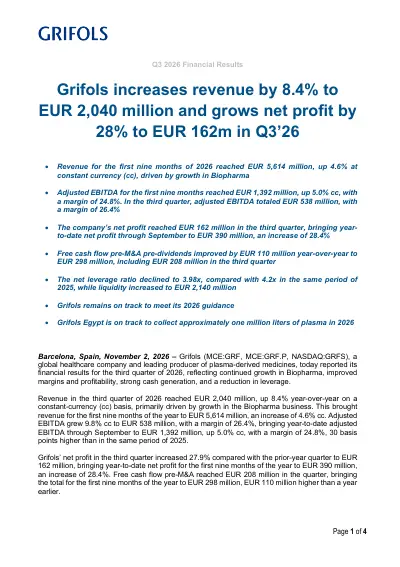
Thank you, Dani, and thank you all for joining us today. In the third quarter of 2026, we are happy to report that we deliver strong results across our key financial and operating metrics, well aligned with our annual plans and keeping us on track to deliver our full year 2026 guidance.
Growth in our core franchises is translating into improved profitability, stronger cash conversion, and lower leverage as we continue to execute on the priorities we set at the start of the year. These priorities remains unchanged: delivering sustainable growth, strengthening our financial position, and advancing the strategic initiatives that will drive sustainable value creation in the future.
Let me take you through the quarter and the progress we are making on these priorities. Q3 was led by Biopharma, which grew 10.3%, supporting group revenue growth of 8.4%, both at constant currency.
That commercial performance, together with continued operating discipline, translated into adjusted EBITDA of €538 million and a margin expansion to 26.4% in the quarter. The contribution from the quarter brings nine-month revenues to €5.6 billion, up 4.6% at constant currency, and adjusted EBITDA to nearly €1.4 billion, with nine-month adjusted EBITDA margin at 24.8%.
We remain on track to deliver our full year adjusted EBITDA margin guidance of 25%. We're also making progress on translating earnings into cash and reducing leverage.
Free cash flow before M&A reached nearly €300 million for the first nine months, while total leverage declined to just below 4x. The good performance in the first nine months of the year, together with our confidence in continuing to deliver positive results in the upcoming quarters, has led the board to announce a 2026 interim dividend of 15 cents of euro per share.
Rahul will take you through the financial drivers and our balance sheet in more detail. Beyond the financial results, we have continued to move forward on several initiatives that I'd like to highlight.
In Egypt, we continue to advance our strategic partnership, supporting the country's goal of plasma self-sufficiency and improving access to plasma-derived medicines across Egypt and the broader region. Our plasma collection volumes continue to scale in the country, and we continue to develop the supporting fractionation, purification, testing, and logistics infrastructure to create an integrated platform that will support the evolution of our global sourcing model.
I will return to Egypt later in the presentation. In Diagnostics, the team continue to make progress on our repositioning strategy.
Following the successful launch of advanced immunohematology in Q2, we continue to advance the development of [Izard?] , immunoassay platform, and [Mundaca?]
, the molecular NAT platform, further strengthening our portfolio and expanding our opportunities in adjacent markets. The dissolution of our joint business with QuidelOrtho better positions us to capitalize on these innovation-led opportunities.
While the headline growth of Diagnostics will remain negative this year due to the ending of that joint business, our underlying growth is positive, driven by solid growth in blood typing solutions and improved performance in NAT. We remain optimistic about the future of this business and are focused on strengthening our market position, driving sustainable growth, and enhancing profitability and free cash flow generation.
We also continue progressing in our assessment of a potential IPO of our US biopharma business and will provide updates as and when appropriate. Finally, we have successfully completed the upgrade of our ERP system to SAP S/4HANA, an important milestone that strengthens the IT infrastructure supporting our business.
Together with our financial results, these highlights demonstrate our continued progress in delivering initiatives we believe create value for the business and our shareholders. Before I move on from this slide, I also wanted to provide a brief update on Canada.
In mid-August, we proactively and voluntarily paused plasma collection at all our 17 donation centers there. Recently, in close coordination and alignment with Health Canada and working together with our partner, Canadian Blood Services, we began a phased resumption of plasma collection.
Throughout this period, our commercial operations in Canada have continued uninterrupted as we have sourced plasma from the US to meet demand in the market. We remain committed to our long-term partnership in Canada, to the importance of self-sufficiency for the Canadian market, and to maintaining the highest standard of quality, donor safety, regulatory compliance, and operational excellence.
Turning to slide 6, let's take a closer look at what is driving Biopharma's performance. IG remains our primary growth engine.
Industry demand continues to be strong across core markets and therapeutic areas, and we are executing well within our markets, especially subcutaneous IG, which supports a favorable product mix. Our IG revenues grew 11.3% at constant currency in the third quarter, bringing year-to-date growth to 12.3%.
Subcutaneous IG revenues grew 40.3% in the quarter, with year-to-date growth reaching 25.6%. Importantly, IG growth is not dependent on a single product, therapeutic use, or treatment modality, but is supported by a diversified portfolio of IV and subcutaneous therapies serving a broad and growing patient base.
That diversification is central to the resilience of the IG franchise, as I will discuss on the next slide. Alpha-1 and specialty proteins also delivered a very strong quarter, up 18.2%, supported by a significant contribution from rabies.
Year to date, growth reached 4.6%, consistent with the mid-single-digit growth we expect for the full year. On albumin, let me state the obvious: performance remains challenging.
Albumin declined 13.2% in the quarter and 13.9% year to date, both at constant currency. The revenue decline primarily reflects market conditions in China, where the regulatory environment and elevated inventories continue to weigh on selling market demand and pricing.
I will discuss albumin in more detail on slide 8. First, let me turn to slide 7 to discuss IG and the structural drivers supporting the continued growth of this franchise.
I would like to step back for a moment from the quarter and talk about the breadth and durability of IG demand, supported by decades of clinical experience and continued innovation. IG is used across a wide range of therapeutic areas, and three of the most important conditions—primary immunodeficiency, secondary immunodeficiency, and CIDP—continue to deliver significant growth.
Our pull-through data from 2024 through half of 2026 shows sustained growth across these key therapeutic areas, including continued double-digit growth in secondary immunodeficiencies and mid- to high-single-digit growth in CIDP, including through the first six months of 2026. Primary and secondary immunodeficiencies together account for about half of the IG use in the United States.
We see growth potential in both areas, particularly in secondary immunodeficiencies, driven by factors such as the rise in incidence of cancer and other conditions that compromise the immune system. Those factors, along with increasing diagnosis rates in PID, should drive continued growth in the population of patients who could benefit from IG.
Our ongoing commercial efforts in primary immunodeficiencies, together with our SIGMA study with Gamunex-C and our EXCEL study with Xembify in secondary immunodeficiencies, position us well to capture this growth opportunity across IV and subcutaneous therapies. Underneath all of this is a key differentiating factor for IG that is difficult to replicate: the multimodal mechanism of action of plasma-derived therapies.
By acting across multiple pathways in the immune system, IG plays an important therapeutic role in a range of immune-mediated conditions, including CIDP. This differentiated therapeutic profile is relevant when considering the potential impact of emerging non-plasma technologies, many of which act through more targeted mechanisms.
In CIDP, growing disease awareness creates further opportunities to identify and treat patients. Newly diagnosed patients continue to predominantly initiate treatment with IG, reinforcing its position as the first-line treatment.
Through our EXPERT study, we are working to expand Xembify into CIDP, with the potential to offer patients greater treatment options. Taken together, diversified and growing demand, a differentiated therapeutic profile, and targeted innovation provide a strong foundation for sustained growth in IG.
Turning to albumin, China continues to be the world's largest market, accounting for approximately 700 million grams of annual demand. The market remains a strategically important one for Grifols, and our commitment to serving the Chinese patient population is unchanged.
Restrictions on albumin prescribing in China have led to a downward adjustments in market volumes. At the same time, elevated inventories continue to weigh on selling volumes and pricing.
When we last updated you in July, we expected market conditions to stabilize during the second half of the year. What we are seeing now is that the adjustment is taking longer than anticipated, particularly as the market continues to work through elevated channel inventories.
We are beginning to see some early signs of improvement in sell-out trends, but these have yet to translate to a sustained recovery in reported sales, and it is clear that China albumin will take a bit more of time to normalize. We're navigating this situation by focusing on good execution and the commercial levers within our control.
Together with Shanghai RAAS, we are adapting to the evolving market environment by broadening our reach across tier 2 hospitals and retail pharmacies, increasing our marketing and engagement with local and regional bodies, and pushing our medical teams to expand albumin-related disease awareness. There is no silver bullet, but we are optimistic these efforts will deliver results over time.
In parallel, we are progressively developing opportunities beyond China to diversify our geographic exposure. The US market is an important part of that effort, where differentiated formats such as Albutein FlexbAG can support our medium-term commercial development.
We're also expanding our commercial focus in traditional markets with attractive price structures and exploring cross-selling with other portfolio products where it creates value. Our priorities are clear: protect and strengthen our position in China through disciplined execution and the development of a more geographically diversified albumin franchise.
Alpha-1 is a different type of opportunity. Here, value creation comes from developing a market where an estimated 80% to 90% of patients remain undiagnosed and, as a result, untreated.
Our strategy to unlock this potential is built around three priorities: clinical evidence, treatment convenience, and diagnosis. First, clinical evidence.
SPARTA is designed to further strengthen the clinical evidence supporting augmentation therapy, evaluating both the current standard dose and a higher dose versus placebo. We continue to expect topline results in late Q4 '26, with a market presentation in Q1 '27, depending on timing.
The outcome will be determined by the data, but positive results could help strengthen the evidence base and support broader awareness and access to treatment. Second, treatment convenience.
Our Alpha-1 subcutaneous 15% program is now in Phase III, aimed at providing patients with greater flexibility and convenience in how they receive treatment. Third, diagnosis.
Clinical and innovation alone will not unlock the full potential of this market; we also need to identify more patients. Alongside with our clinical programs, we're working to expand screening and improve diagnosis rates.
One example is our partnership with Alpha Decode, aimed at accelerating patient identification and diagnosis. The earlier patients are diagnosed, the sooner they can access appropriate treatment.
Together, these initiatives address three critical barriers to market development: strengthening clinical evidence, expanding treatment options, and improving patient identification. As a global leader in Alpha-1, we have the expertise, commercial capabilities, and clinical programs to help develop this market, and we are committed to capture the opportunities that will emerge.
Now I'd like to come back to Egypt, a central component of our value creation plan and where we are working in conjunction with the Egyptian government to support the country's goal of plasma self-sufficiency and improve access to plasma-derived medicines. Last year, we achieved full self-sufficiency in factor VIII, albumin, and IG for Egypt, a notable milestone.
Egypt is not simply about adding plasma collection capacity. It is about building an advantaged, integrated source of plasma that will enable us to progressively optimize and improve our global sourcing footprint and cost profile.
Operationally, Egypt continues to scale, with monthly plasma collection volumes nearly doubling since the beginning of the year, putting us on track to collect approximately 1 million liters in 2026. We continue to build out the integrated plasma ecosystem, with 18 collection centers today expanding to 20 by the first quarter of 2027, and we expect to develop an additional 20 centers in the coming years to support 3 million liters of annual plasma collection in Egypt.
In parallel, we continue to develop the fractionation, purification, testing, and logistical infrastructure required to operate the platform end to end. A critical milestone for Egypt has been the European Medicines Agency regulatory approval, which enable us to progressively integrate Egypt into our global plasma sourcing network to supply international markets.
Integrating Egypt into our global network gives us greater flexibility to optimize plasma allocation. As Egypt increasingly supplies international markets, we can make more efficient use of our US collection infrastructure and retain US-collected plasma in the US market, where it creates the greatest value.
Economics are equally important. Egypt has a structurally attractive plasma collection cost and higher protein yields, supporting margin expansion as volumes scale.
This is the strategic opportunity Egypt represents: a more competitive and flexible global plasma sourcing model with the potential to structurally improve our cost base and support meaningful long-term value creation. That brings me back to the broader message of today's update.
We are executing on our priorities: growing our core franchises, improving profitability and cash conversion, strengthening our balance sheet, and advancing the strategic initiatives that will drive future value creation. With that, let me hand it over to Rahul.
Rahul Srinivasan
Thank you, Nacho. Turning to slide 12, our financial highlights for Q3 and the first nine months of 2026.
The key financial message from the first nine months is that the improvement in financial performance we anticipated in prior calls is materializing. Stronger operating performance is translating into higher profitability and cash generation, supporting continued deleveraging and greater financial flexibility.
Before I begin, please note that the growth figures I discuss will be in constant currency unless otherwise specified. Group net revenues reached €2.04 billion in the quarter and €5.614 billion through nine months, with Biopharma again leading the growth.
That operating momentum translated into adjusted EBITDA of €538 million and continued improvement in group profit and free cash flow. Revenue growth accelerated to 8.4% in Q3, bringing growth through nine months to 4.6%, consistent with the second-half improvement we anticipated.
Reported gross margin reached 39.6% in Q3 and 38% through nine months, in line with the quarterly progression we anticipated. This improvement was achieved despite the year-to-date headwinds from the donor center network restructuring costs, Biotest ramping up Yimmugo sales, China albumin, and the dissolution of the joint business in Diagnostics.
The main drivers of our gross margin expansion are volume growth and favorable product mix in Biopharma and further optimization of plasma sourcing and collection costs, including some initial small contributions from Egypt that will scale as our Egypt collections ramp up over time. Adjusted EBITDA reached €538 million in the quarter and €1.392 billion for the first nine months, representing 9.8% growth in the quarter and 5% growth year to date.
Adjusted EBITDA margins for the quarter expanded 60 basis points to 26.4% and by 30 basis points to 24.8% for the nine-month period. For the full year, we continue to target an adjusted EBITDA margin of 25%, consistent with our guidance for the year.
Group profit through the first nine months increased 28.4% year on year to €390 million, reflecting stronger operating performance and improved below-the-line expenses. We achieved €298 million in free cash flow before M&A for the first nine months of 2026, up 59% or €110 million year on year.
We continue to be encouraged by our improvement in free cash flow performance, which I will elaborate upon in a few slides. These results demonstrate the operating leverage we are working to sustain over the medium term.
Total net leverage stood at 3.98x and secured net leverage at 2.5x. The continued decline in credit agreement leverage reflects growth in adjusted EBITDA and improved free cash flow.
Together with liquidity of €2.14 billion, this leaves the balance sheet in a stronger and more flexible position. On slide 13, we summarize the net revenue performance by business segment through nine months.
Biopharma remains the engine of our growth, driven by industry volume expansion and our commercial execution. Immunoglobulins continued to grow at a double-digit rate driven by the sustained traction of Gamunex in the US and core European markets, as articulated in prior calls.
Revenue performance was further supported by the US launch of Biotest Yimmugo, albeit margins temporarily dilutive to the group. Xembify, our subcutaneous IG, continues to see strong double-digit in-market demand, with subcu IG delivering over 25% growth through the first nine months.
Both IVIG and subcu IG have benefited from some year-to-date phasing-related gains. As Nacho mentioned earlier, albumin performance remains weaker than we expected.
Regulatory restrictions in China continue to affect the market, and channel inventories remain elevated. Although we are seeing some early signs of improvement in sell-out, sell-in volumes remain under pressure.
Destocking will take time, but China remains a critically important market for Grifols and the broader plasma industry. Taking a step back, in 2026, we have constrained our IG volumes growth to deliver EBITDA growth and to better balance our last-liter economics.
Given the continued weakness in the albumin market, we anticipate pursuing a similar value-oriented strategy in the quarters ahead. Between our continued strong commercial execution, mix benefits, and ramp-up of Egyptian plasma, we have multiple levers at our disposal to navigate the current market environment, and we remain confident in our long-term value creation playbook.
In Alpha-1 and our specialty proteins portfolio, we had a very strong quarter. For Alpha-1, we are seeing higher treatment numbers as patient access conditions improve following a challenging reauthorization period earlier in the year.
Demand for HyperRAB remains strong, with particularly strong seasonal demand in the US this year helped by a warm summer. In June, our US team launched FibriCLOT, our new fibrinogen concentrate for patients with congenital fibrinogen deficiency in the US, adding to our specialty proteins.
I also want to flag that given the phasing-related gains that had benefited our Q3 Biopharma results, please expect more modest Biopharma growth in Q4 that is lapping a strong sales quarter from Q4 2025. We manage our business on a full-year basis, and full-year Biopharma performance remains in line with our full-year expectations and views communicated on our prior calls.
Turning to Diagnostics, the 7% decline continues to reflect the dissolution of the QuidelOrtho joint business, an impact that will continue through the end of 2026. Excluding this effect, Diagnostics grew 2.3% on an underlying basis through nine months.
The Diagnostics division remains focused on executing its multiyear repositioning plan. Finally, foreign exchange has been a year-to-date headwind of over 300 basis points to reported revenue growth.
However, with recent strengthening of the US dollar, FX was a mild tailwind to growth in Q3. Turning to slide 14, we are pleased with the improvement in adjusted EBITDA in Q3 and nine months year to date.
Even as we experienced more weakness than anticipated in albumin, continued volume growth and positive mix in IG, strong performance in our Alpha-1 and specialty portfolio, optimization in our plasma cost per liter, and good operating cost control drove 9.8% growth in adjusted EBITDA in Q3 and 5% growth through nine months. Margins expanded by 60 basis points in Q3 and 30 basis points through nine months.
For the year, we continue to target 25% adjusted EBITDA margin for the group. Over time, we expect our adjusted EBITDA to converge more with our reported EBITDA.
Through nine months, the main change in adjustments versus prior year relate to the donor center optimizations that we discussed on our Q1 call. These optimizations were unlocked by the EMA approval of Egyptian plasma and are positive for our long-term network efficiency.
By shifting part of our resourcing to a more cost-effective EMA-approved hub in Egypt, we are structurally derisking our plasma supply, expanding margins, and reinforcing the underlying fundamentals of our business model. Consistent with prior years, we will continue to assess the carrying value of certain non-core capitalized R&D projects as we apply greater discipline to capital allocation.
None of these non-core projects impact the go-forward equity or credit story for Grifols. We expect to complete that assessment in Q4.
Any resulting potential impairment would be non-cash and would not affect adjusted EBITDA, free cash flow, or credit agreement net leverage. Turning to slide 15, I wanted to share more information about the moving pieces of our adjusted EBITDA margin progression this year.
You can see on the left the reported gross margin and the progress we've made on the recovery since the beginning of the year. During the first half of the year, our gross margins were 200 basis points below 2025 levels, pressured by the impacts of US plasma center restructuring and China albumin.
In Q3, we recovered to 30 basis points ahead of the prior-year levels. This improvement was achieved despite incremental margin headwinds from Biotest Yimmugo sales, a Q3 accrual related to our Canadian plasma centers, and continued China albumin weakness.
The drivers behind the underlying improvement are Biopharma volume and price mix, improving plasma costs, and the early contributions from Egypt—all positive trends that we will work to continue in the coming years ahead. On the right-hand side, we show the operating expense evolution.
The story here is one of good cost containment while continuing to resource the business where it creates value. We expect to continue to apply this discipline to the business over the long term.
Turning to slide 16, we continue to deliver meaningful improvement in free cash flow and cash conversion, and we remain on track to deliver on our full-year guidance for free cash flow pre-M&A. In the first nine months, free cash flow pre-M&A was €298 million, or €110 million better than 2025.
As a percentage of EBITDA, free cash flow conversion through nine months improved meaningfully to more than 20%, albeit benefiting from some meaningful phasing-related gains. The particular callouts on year-to-date free cash flow are on inventory, where we continue to invest to support the needs of our Biopharma business, and capex taken together with capitalized IT and R&D spend as a percentage of sales continues to normalize from the 2024-2025 peak.
Consistent with prior guidance, we expect cash interest costs to be in line with 2025 despite needing to refinance maturing, attractively priced debt earlier this year and the Fed and ECB interest rate rises this year. Finally, please remember that the impact of euro-dollar FX movement is broadly neutral on free cash flow pre-M&A.
In conclusion, our free cash flow trajectory is progressing as planned. Finally, slide 17.
This slide runs through our leverage position and liquidity profile. We've made solid progress on the balance sheet, deleveraging entirely organically from 5.5x in June 2024.
You will notice that this slide shows our most recent credit agreement net leverage position to two decimal places. I do that just to make the point that our credit agreement leverage is now finally below 4x, and I want to take the opportunity to recognize the efforts of the entire company and the board.
This has taken many years of hard work and discipline to achieve this important milestone. Of course, there remains further work to be done as we prioritize continued deleveraging alongside our other capital allocation objectives.
Alongside the strong organic deleveraging progress, we have significantly reshaped our liquidity profile in the last two years that currently stands at €2.14 billion, over three times the liquidity we had in September '24. This liquidity position gives us ample room to support our capital allocation objectives and manage our normal working capital needs.
It additionally serves as a buffer to cover unexpected funding needs. Most of this liquidity is from our undrawn revolving credit facility that does not have much of a cash interest drag, allowing us to run the business with optimized cash levels, using any surplus cash to pay down debt, as we did with the redemption of €500 million of our most expensive debt earlier this year.
As you are aware, we do not have any significant maturities until the fourth quarter of 2028. Now, most of the debt in our capital structure is either callable or prepayable without significant penalties, allowing us to be more opportunistic as we consider our refinancing or debt redemption strategies.
Looking forward, leverage should continue to progressively improve over time as adjusted EBITDA continues to grow, and our improving free cash flow generation provides optionality to reduce debt over time. Given our year-to-date performance and our financial position, the board has approved an interim dividend of €0.15 per share, payable in early December 2026.
With that, let me hand it back to Nacho to conclude the presentation.
Nacho Abia
Thank you, Rahul. I would like to conclude today's presentations with a few final remarks.
As we look across the business today, what is encouraging is not simply the performance of any individual business or initiative, but how the different elements of our strategy are coming together. Our Biopharma business continues to benefit from the structural growth drivers we discussed today: strong demand for IG and increasingly favorable mix, and growing contributions from Alpha-1 and specialty products are demonstrating the strength and resilience of our portfolio.
What is particularly encouraging is that this growth is translating into better economics. Through commercial execution, operating discipline, and leverage across the organization, we are expanding profitability while continuing to invest behind our future opportunities.
At the same time, we are building advantages that we believe will differentiate Grifols over the long term. Egypt is a great example.
What started as a self-sufficiency project for Egypt has become a strategic sourcing initiative that is evolving into a platform that can enhance supply security, improve our cost structure, and increase the flexibility of our global plasma network. Alongside these priorities, we continue to advance opportunities that can create additional value.
In Alpha-1, we are working to expand the market itself through clinical evidence, innovation, and improved diagnosis. In Diagnostics, we are focused on positioning the business to better capture its growth potential and strategic value.
Importantly, we are not only growing the business, but we are also converting that growth into cash. Improved cash generation and continued deleveraging are strengthening our financial flexibility and giving us greater capacity to invest, execute, and create value for shareholders.
Collectively, these priorities all point to the same outcome: a stronger company with a more resilient growth profile, expanding profitability, improving cash generation, and multiple opportunities to create value over time. Based on the progress we have delivered year to date, we remain confident in achieving our 2026 guidance and in the long-term trajectory of the business.
With that, I will hand it back to you, Dani.
Dani Segarra
Thank you, Nacho. Now let's turn to the Q&A session.
Please remember to press *5 to ask a question. We need to place a limit of two questions per analyst.
If you have follow-ups, please dial *5 again to get back on the list. Our first question today is coming from Charles Pitman at Barclays.
Charles, please?
Charles Pitman
Hi, guys. Charles Pitman from Barclays.
Thanks very much for taking my questions, and congrats on the deleveraging achievement so far. Two questions, please, from me.
Firstly, just on phasing: so noting the strong rabies number mentioned in the release and commentary around 3Q versus 4Q, but reiterated confidence in the FY26 guidance, I'm just wondering if, firstly, you could just give us a quick reiteration of what that sales guide is for FY26 and what the driver of this rabies dynamic was, and just confirm, is there any phasing to account for in IG other than accounting for the tough 4Q comp? Then just secondly, on R&D as a percentage of sales, we've seen R&D show a 100 bps decline year on year versus 3Q25, while capitalized R&D has increased 24% year on year.
Just wondering if you could explain what's driving this change. Is this related to any changes in the Diagnostics business following the change in your partnership?
Thank you so much.
Rahul Srinivasan
Hey, Charles. I guided to modest growth in Q4 '26 versus Q4 '25.
I think overall that you should expect, if you recall, Q4 '25 was a very strong sales quarter for us, and we're anticipating Q4 '26 to be better, but only modestly so. With regards to your and as you think about IG, I think that similarly translates to IG as well, you can extrapolate that to IG.
On your question about R&D and capitalization, I think in our Q1 or Q2 call earlier this year, I referenced the us beginning to we hit the various milestones that we expected to on our Mundaca project, which meant that we started capitalizing Mundaca. That's a successful achievement of our milestone, which explains partially the increase in the capitalized R&D.
You're right in your comment.
Nacho Abia
Charles, if I would add, other than the capitalization of Mundaca, I think that we've been rationalizing our R&D expenditure in the last few periods. Essentially, we are focusing on those initiatives that we believe will move the needle the most.
We've been quite selective in where is the money going in terms of R&D investment. We think that we are protecting those areas that must be protected, but at the same time, was a number of projects that were canceled over the last years as we couldn't see them through.
Charles Pitman
Thank you very much.
Dani Segarra
Thank you, Charles. I think that covers it.
Let's move to the next question. It comes from Jaime Escribano at Banco Santander.
Jaime Escribano
Hello. Hi.
Good afternoon, guys. A couple of questions from my side.
The first question would be on the business, in terms of albumin, if you can provide further color on the recovery based on your comments and also your peers. It seems it's taking a little bit longer.
Any further color on how is final demand dynamics and when should we see the channel destocking at normalized levels would be great. The second one is regarding the free cash flow guidance for this year and also the mid-term for 2027.
Because doing some back-of-the-envelope calculations, if in Q4 this year you make something similar to Q4 '25, it looks, according to my numbers, that you would be in the higher part or even above the €570 million that you have guided in the upper part of 2026. It would leave fairly doable free cash flow of around €600 million for 2027 in order to achieve your targets for 2027.
Any color that you can provide or how you feel on these targets, how confident you feel, and whether you can even exceed them, I think would be very helpful for us and investors. Thank you.
Nacho Abia
Thank you, Jaime. Let me take the first one, and Rahul will take the second one.
I don't want to be speculative about our situation in China. I think that a couple of quarters ago, I was more optimistic that in the second half of the year, the market will recover, which has not been yet the case.
It's true that what we are seeing at this point is a sell-through recovery, I think the sell-through levels are at a positive levels already, not highly positive, but positive. That certainly, we take it as a very positive sign.
At the same time, market inventory remains high, and we don't know exactly how much inventory our competitors have in China, it's difficult to predict. I anticipate that we will still see, probably in 2027, because the comparisons will be already with a 2026 that has been depressed versus the previous year, more stability, certainly, on the pull-through or on the market demand, but to be seen how fast the current inventory in the markets will be flushed out.
Rahul Srinivasan
On free cash flow, Jaime, when I presented the free cash flow slide, I referenced some phasing in our year-to-date performance, some of that phasing will unwind in Q4 '26. We remain confident about achieving our free cash flow guidance for '26 and, indeed, remain confident about achieving the target that we set out for the period to '27.
Absolutely agree with the statement that you made there as well.
Jaime Escribano
Thank you.
Dani Segarra
Thank you, Rahul. Nacho, let's move to the next question.
It comes from CaixaBank BPI. Guilherme, please go ahead.
Guilherme Sampaio
Hello. Thank you for taking my questions.
Two, if I may. Working capital contribution to cash flow in Q3 has more than offset the EBITDA improvement.
Should this level of incremental IG inventory building persist into Q4, and could you reconcile these incremental investments with the objective to slow down growth space in this protein? The second question is regarding Diagnostics.
Dynamics in Diagnostics improved materially this quarter. Could you explain us better what happened specifically this quarter?
Sure.
Rahul Srinivasan
Let me take both. Look, on working capital, no concerns around the conscious investment that we've made in inventory.
It's entirely consistent with what we've said in every quarterly call this year, that we will be investing in inventory levels. This is entirely consistent with our plans, and we're not concerned about achieving our full-year free cash flow guidance for the year.
That deals with the first question. Your question on Diagnostics?
Nacho Abia
I can take that, Guilherme. I think in Diagnostics, what we are seeing is obviously the QuidelOrtho income is not coming, and that's what you see the numbers declining versus previous year.
Our other two pillars of the business, blood typing solutions and NAT testing, they both are growing. I think the combined I think it is mentioned in Rahul's presentation is growing 2.3% combined.
There's a combination of something like high single digit or mid to high single digits in blood typing solutions and a couple of percentage points in NAT. I think we see that we are growing with the market or above the market in many of the places where we play in Diagnostics, but obviously the QuidelOrtho impact is going to be visible through the entire year.
Dani Segarra
Thank you, Guilherme. We have a second set of questions from Charles at Barclays.
Charles, please?
Charles Pitman
Hi, guys. Just following up, please, on a couple of other small points.
Firstly, on SPARTA, just noting that that's set to read out by the end of the year. I'm just wondering if you could provide us a little bit more detail on what you see as the key benchmark efficacy bar to meet your CT lung density preservation over three years, just setting expectations for that readout.
Just if you're able to give us anything further on the US IPO, just when we might be able to expect to hear more on this strategy and whether the board would choose to move ahead, just thinking kind of how progressed is this review now versus when it was first announced in 1Q. Thank you.
Nacho Abia
Let me take on SPARTA, Charles. There's not much we can say.
I think that we plan to present the results in the Q1 of 2027. Essentially, what SPARTA is doing is to evaluate the efficacy and safety of a standard dose and double-dose Prolastin-C versus placebo in slowing emphysema progression over three years.
That's what is being tested, right? With a primary endpoint to change from baseline in whole lung PD15 on CT densitometry measuring lung tissue density loss over time.
It's not a pharmacokinetic-only study. That's what we can say.
Obviously, we don't have any idea about the results so far, but I think it's coming closer. As we say, as soon as we have the results at the end of this year, we will make the presentation of them in Q1 2027.
Rahul Srinivasan
On IPO, Charles, look, it's a critical decision for the board. They're being diligent in their assessment.
I do not expect an update on the IPO until 2027. As we said earlier on, we will provide updates as and when appropriate.
We are limited from a legal and regulatory perspective, in terms of what we can say. For now, I'll leave it at that.
I will also say the focus clearly is about unlocking value. That's the clear focus from the board's perspective.
Charles Pitman
Very clear. Thank you.
Dani Segarra
Thank you, Charles. Thank you, Rahul.
The next question is coming from Jaime. I guess that there is some follow-ups here.
Jaime, please?
Jaime Escribano
Hi, guys. Thanks.
Just a couple of follow-ups. Just to complete the top-line outlook, if you can elaborate a little bit further on the Alpha-1 and specialty, obviously double-digit growth in Q3.
How should we think about Q4 and beyond? Then the other, at least on my estimates that was positive, was the gross margin at 39.5%.
Nine months 2026 at 38%, Rahul provided a soft guidance of around 38% for the year, you are already there. I was wondering how comfortable you feel with this and even whether you believe that there is a little bit of upside on top of guidance.
Thank you.
Rahul Srinivasan
Sure, Jaime. Look, I think we guided on Alpha and our specialty proteins, we guided to 5%, mid-single-digit growth for the full year in '26.
I will reiterate that. We feel comfortable with that guidance for the full year.
On your second question on gross margin, gross margin reported has a number of things happening within it. In fact, in the annex, you will see reference to an adjusted metric as well.
Have a look at the annex as you think about the adjusted metric, which I think is the source of your question. When you look at gross margin reported year to date versus '25, these were the key drivers: China albumin was a headwind, plasma center reorganization a headwind, we talked about the Diagnostic joint business as well being a small headwind, and then finally Biotest Yimmugo US sales, which is very additive from a top-line perspective, but in the short term, dilutive from a gross margin standpoint.
A lot happening in that gross margin reported number that needs to be unpicked. If you look at the annex, you'll see reference to some of the adjustments.
For me, as you stated as well, in our Q4 call when we provided guidance for this year, I mentioned 38% as being the benchmark for the full year '26. As you rightly say, we're already at that 38% level.
We go into our Q4 needing to replicate that 38% to achieve the full-year number. On track, so far so good.
A bit of work to do in Q4 as well.
Jaime Escribano
Thank you.
Dani Segarra
Thanks for the questions, Jaime. Let's move to the next one.
It comes from Guilherme, BPI again.
Guilherme Sampaio
Yes, thank you for taking my questions. Again on IG, on the second half of the year.
You mentioned just a quarter ago that you might grow in the second half by mid to high single digits, possibly the low end of this target is quite conservative regarding Q4. Is the high end a good reference for this second half of the year?
The second one is related to the growth in Egypt plasma collections. There's been a good run rate throughout the year.
Do you expect this second-half run rate to persist over 2027 and 2028, or the progression should be a bit more back-end loaded, meaning that most of the ramp-up should be more to 2028, 2029? Thanks.
Rahul Srinivasan
Look, I'll take both, Guilherme, and Nacho, feel free to chip in if you'd like to. Look, on IG, you've seen our Q3 number relative to Q3 '25.
The number speaks for itself. However, remember, Guilherme, we manage our business on an annual basis, not on a quarterly basis, not on a semiannual basis.
As I mentioned earlier on as well, what we're trying to do is make sure that we are modulating and we're optimizing the right level of IG growth together with what we're seeing in the albumin market. To essentially choose one and ignore the other would be a short term strategy.
Right? The focus from our standpoint is to optimize EBITDA growth, margin improvement, not necessarily chase top-line growth and it not be accretive certainly as you think about value creation.
Your second question was remind me?
Nacho Abia
On Egypt.
Rahul Srinivasan
Oh, Egypt. Yeah.
Year to date, Egypt ramp-up is very small in our gross margin numbers. You will begin to see much greater impact of Egypt in '27.
Certainly, as Egypt ramps up, even greater in the years in '28 and '29, remain very positive on that outlook.
Nacho Abia
Just to add on that, Guilherme, I think that our progress in Egypt is steady and continuous. What we see month after month is that the collections in every of the centers that we are operating is increasing.
I think that we're still not by any means at the peak of what we can collect from those centers, and it's going to be increasing over the next months in a kind of a linear basis. No, it's not very much back-loaded, especially for next year.
I think that we will finish this year with 17 centers, 18 centers already operating, and these centers obviously some of them already have been in the market for a while and have good run rates, and this will be complemented with additional centers. It's a kind of a linear and steady growth that we are going to be seeing in '27 and in the years to come.
Dani Segarra
Thank you, Nacho. Thank you, Rahul.
Guilherme Sampaio
Thank you very much.
Dani Segarra
Thank you, Guilherme. There are no further questions at this time, this conclude today's call.
Hold a second. Okay.
Álvaro from Alantra. Okay, Álvaro, please go ahead.
Hi, thank you for taking my question, and sorry for bringing maybe a more negative tone on such good results. Regarding this morning, there was several publications about increased regulatory scrutiny by European agencies.
If you can talk about this, discuss, and put our concerns to rest, would be very helpful.
Nacho Abia
Thank you. Thank you, Álvaro.
Look, I think obviously we welcome any initiative from the EMA or from the FDA in anything that has to do with patient safety. We know that in this industry, and this is included in our indication, in the indication of all the products and all the IGs in the market, there is a potential number of adverse events that obviously we work to minimize, but that sometimes happen.
It's I wouldn't say normal, but not infrequent that the regulatory authorities wants to take a look on that. This is not focused on Grifols by any means.
It's across the entire industry. This is a discussion that is an ongoing discussion with the EMA authorities and also with the FDA every time we see certain increase on adverse events.
As I say, it's nothing that has never happened. It happened from time to time.
We take those obviously very seriously, and we work with the authorities on this. As I say, it's part of the indication as well in the product.
Dani Segarra
Thank you
very much. Clear.
Dani Segarra
Thank you, Álvaro. Thank you, Nacho.
Now yes, that was the last question for today. Thank you for having us and for your support.
Our Investor Relations team remains available for any follow-up questions. Thank you so much.