Bristol-Myers Squibb Company
Q3 FY2026 · Earnings Call TranscriptOctober 29, 2026
Operator
Welcome to the Bristol Myers Squibb Third Quarter 2026 Earnings Conference Call. All participants will be in a listen-only mode.
Should you need assistance, please signal a conference specialist by pressing the star key followed by zero. After today's presentation, there will be an opportunity to ask questions.
To ask a question, you may press star then one on your telephone keypad. To withdraw your question, please press star then two.
Please note this event is being recorded. I would now like to turn the conference over to Chuck Triano, Senior Vice President and Head of Investor Relations.
Please go ahead.
Chuck Triano
Thank you, and good morning, everyone. We appreciate you joining our third quarter 2026 earnings call.
With me this morning with prepared remarks are Chris Boerner, our Board Chair and Chief Executive Officer, and David Elkins, our Chief Financial Officer. Also participating in today's call is Adam Lenkowsky, our Chief Commercialization Officer, and Cristian Massacesi, our Chief Medical Officer and Head of Global Drug Development.
Earlier this morning, we posted our quarterly slide presentation to bms.com that you can use to follow along with Chris and David's remarks. Before we get started, I'll remind everybody that during this call, we will make statements about the company's future plans and prospects that constitute forward-looking statements.
Actual results may differ materially from those indicated by those forward-looking statements as a result of various important factors, including those discussed in the company's SEC filings. These forward-looking statements represent our estimates as of today, and should not be relied upon as representing our estimates as of any future date, and we specifically disclaim any obligation to update forward-looking statements, even if our estimates change.
We'll also focus our comments on our non-GAAP financial measures, which are adjusted to exclude certain specified items. Reconciliations of certain non-GAAP financial measures to the most comparable GAAP measures are available at bms.com.
Finally, unless otherwise stated, all comparisons are made from the same period in 2025, and sales growth rates will be discussed on an underlying basis, which excludes the impact of foreign exchange. All references to our P&L are on a non-GAAP basis.
With that, I'll hand it over to Chris.
Chris Boerner
Thanks, Chuck. Good morning, everyone, and thank you for joining our Q3 2026 earnings call.
We reported another quarter of double-digit growth in our growth portfolio and progressed our plans to de-risk the pipeline to position the company for long-term success. We have seen several positive registrational readouts and regulatory approvals over the past few months, and we expect more to come, bringing the next wave of launches into sharper focus.
We are executing well commercially, our differentiated pipeline is advancing nicely, and we continue to operate with discipline, which gives us strategic flexibility to invest for sustainable growth. Based on the strength of our results, we are raising our full-year guidance.
David will provide additional details on this shortly. Let me start with our Q3 performance on slide 4.
Our growth portfolio continues to deliver solid results, with sales increasing 12%, driven by a broad set of differentiated products. We generated strong performance in key brands, including Reblozyl, Breyanzi, Opdualag, Cuvantiq, and Camzyos.
We also continued to expand the reach of our medicines. In September, Camzyos received approval for an expanded indication and became the only FDA-approved therapy for pediatric patients with obstructive HCM.
We also achieved an important milestone in the quarter with the FDA's accelerated approval of Zinbextus, the first approved CELMoD, and the newest addition to our portfolio. Zinbextus is approved for the treatment of multiple myeloma, where the combination of a highly efficacious and convenient oral option is an important treatment advancement for patients in both community and academic settings.
We are encouraged by positive early launch feedback and by the compelling Phase 3 data we announced earlier this month, where Zinbextus demonstrated a meaningful improvement in progression-free survival. We will present these data at ASH in December.
These results further strengthen our conviction in CELMoDs and our broader targeted protein degradation platform, where BMS is a clear leader. Behind Zinbextus, our second CELMoD, mezigdomide, has a PDUFA date of May 13th, 2027.
Mezigdomide offers the potential to introduce another highly efficacious and convenient oral option for a different segment of multiple myeloma patients. We also continue to advance golcadomide in lymphoma, and we'll present the first Phase 2 data in frontline follicular lymphoma at ASH.
The momentum in our late-stage pipeline has accelerated. In the past two months alone, we announced positive data for four registrational studies.
These include: Zinbextus PFS, as I mentioned earlier; admilparant in idiopathic pulmonary fibrosis; interim results for RYZ101 in GEP-NETs; and orlo-cel in relapsed and refractory multiple myeloma. Let me comment on the last three.
Admilparant met its primary endpoint at the 60 mg dose with a favorable safety and tolerability profile that supports its potential as a first-in-class IPF treatment. IPF is a progressive and often fatal disease where there remains a need for effective, well-tolerated treatment options like admilparant.
We will discuss the IPF results with regulators and expect Phase 3 results in progressive pulmonary fibrosis in the first quarter of next year. PPF is a larger opportunity and another area where admilparant has significant commercial potential.
With respect to RYZ101, our actinium-based radiopharmaceutical therapy, we are encouraged by the interim readouts in GEP-NETs. These results demonstrated a clinically meaningful improvement in PFS in patients whose disease has progressed following existing lutetium-based therapy.
These were the first Phase 3 results for an alpha-emitting targeted RPT, representing an important milestone for RYZ101 and further strengthening our conviction in radiopharmaceuticals as a platform. We are engaging with the FDA on next steps towards regulatory submission.
Finally, orlo-cel, our GPRC5D-directed CAR-T, delivered positive results in the registrational Phase 2 Quintessential study this September, a milestone that underscores its potential to set a new standard of care in the post-BCMA multiple myeloma market. This study represents the only prospective trial exclusively conducted in the post-BCMA quadruple-class exposed setting, a growing patient population with poor outcomes and no therapies approved specifically for this segment.
As these programs advance, we are building the manufacturing foundation for the next generation of our medicines, with two US investments recently announced. In Houston, we shared plans for a new state-of-the-art manufacturing campus at Generation Park, an approximately $2.3 billion investment that will create nearly 500 skilled jobs.
This facility will give us manufacturing flexibility across small molecules, biologics, and antibody-drug conjugates. It is also designed to evolve and scale to meet patient needs for decades to come.
In Indiana, RayzeBio is investing more than $170 million to establish a new radiopharmaceutical manufacturing facility, complementing its existing footprint in the state and creating up to 100 new jobs by the end of 2029. Together, these investments support the next wave of medicines coming through our pipeline and advance our US manufacturing commitments.
Turning to slide 5. As we look ahead, we have several meaningful readouts over the remainder of 2026 and into 2027.
Before year-end, we expect Phase 3 data for milvexian in secondary stroke prevention and Sotyktu in lupus. With Cobenfy, we will share open-label Alzheimer's disease psychosis data from the ADEPT-1 and from the long-term extension ADEPT-3 studies at CTAD next month.
In 2027, we continue to expect results for milvexian in atrial fibrillation in the first quarter. We also anticipate additional data from the broader ADEPT program, bipolar 1 data from the Cobenfy BALSAM studies, and the first registrational data for golcadomide in high-risk frontline LBCL.
While we have made good progress in our pipeline, there's more to come. As we close out the year and move into 2027, we are focused on a few key priorities, as noted on slide 6.
First, sustaining the momentum across our growth portfolio. We now have eight growth portfolio medicines, each annualizing over $1 billion based on Q3 sales, giving us a broad base of growth drivers.
Second, translating pipeline progress into filings, approvals, and successful launches. Zinbextus is an early example of that progression, and as additional studies read out, our focus will be on launch preparedness and moving with urgency to bring these medicines to patients.
Third, continuing to rewire how we operate. We're focused on becoming faster and more efficient in R&D, and over the past year, we have made changes across the organization to strengthen how we design and conduct clinical trials.
At the same time, we continue to drive productivity and efficiency, including through our organizational structure, capital allocation decision-making process, and the use of technology. That discipline gives us flexibility to invest behind the growth portfolio and pipeline, pursue business development where it makes sense, and return cash to shareholders.
Taken together, we are entering the final quarter of the year with real momentum. Our growth portfolio is performing well, we're advancing our pipeline with meaningful wins, and remain highly disciplined in ensuring our cost structure is aligned with our revenue base.
The team is energized and focused on delivering value for patients and our shareholders. With that, I'll turn it over to David.
David Elkins
Thank you, Chris, and good morning, everyone. Our third quarter results reflect continued strong execution across our growth portfolio and continued strength from Eliquis.
We remain focused on financial discipline, balancing investments in our growth drivers with continued productivity improvements. Based on our performance year-to-date and our outlook for the remainder of the year, we are further raising our full-year guidance.
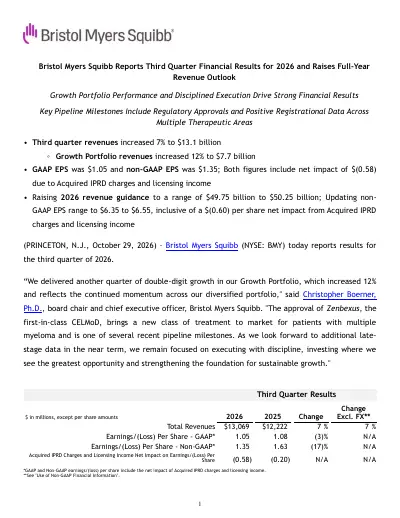
Let me begin with a review of our third quarter results. Starting with slide 8, total revenue in the third quarter increased 7% year-over-year to approximately $13.1 billion.
Growth portfolio revenue rose 12% to $7.7 billion, driven by double-digit growth across several products. Our legacy portfolio revenue increased 1%, with growth in Eliquis more than offsetting the declines from generic entry across the remainder of the legacy portfolio.
Turning to product performance on slide 9, starting with oncology, for Opdivo, revenue decreased 6% year-over-year to approximately $2.4 billion, primarily reflecting continued conversion to Cuvantiq in the US and in Europe. Cuvantiq continued its strong launch trajectory with revenue of $334 million, representing sequential growth of 28%, and is now annualizing at over $1.3 billion.
Opdualag delivered another quarter of strong double-digit growth, driven by continued global demand and its leading position as a standard of care in frontline melanoma in the US. Turning to slide 10, Reblozyl grew 22% to $750 million, reflecting continued uptake in frontline MDS-associated anemia.
Breyanzi posted 48% growth, resulting in revenue of $526 million, driven by its best-in-class profile and strong demand in both the US and in international markets. Moving to cardiovascular and immunology on slide 11, Eliquis revenue was approximately $4.7 billion, up 26%, driven by net price, along with strong demand and continued market share gains.
Eliquis sales in Q4 will be impacted by the upcoming LOE in Europe, which will be partially offset by the continued growth in the US. Camzyos revenue increased 42% to $420 million, reflecting continued strong demand growth, including new patient starts and deeper penetration into the community setting.
On a sequential basis, revenue was impacted by the typical inventory drawdown during the third quarter, which we expect will normalize in the fourth quarter. Now moving to immunology, global revenue for Sotyktu grew 25%.
We are supporting the recent indication for psoriatic arthritis in adults and look forward to the upcoming Phase 3 readouts in lupus, expected by year-end. I will wrap up our product performance review on slide 12 with neuroscience.
Cobenfy revenue grew 33% to $57 million in the quarter. On a sequential basis, inventory destocking offset increased demand.
We anticipate that revenue will more closely track prescription volume going forward. Let's now move to the P&L on slide 13.
Gross margin in the third quarter was 68.4%, reflecting product mix and, to a lesser extent, a one-time expense for a contract termination. Operating expenses for the third quarter were $4.1 billion.
We continue to benefit from our strategic productivity initiative, which is enabling us to reduce expenses in identified areas while maintaining flexibility to invest in multiple growth-oriented opportunities. Our effective tax rate in the quarter was 14.1%, reflecting jurisdictional earnings mix and the impact of acquired in-process R&D charge.
We had a 58-cent per-share impact from acquired in-process R&D and licensing income in the quarter. Considering all these factors, diluted earnings per share was $1.35 for the quarter.
Turning to the balance sheet and capital allocation highlights on slide 14, we remain in a solid financial position, with approximately $13 billion in cash, equivalents, and marketable securities as of September 30th. We generated approximately $4.2 billion in operating cash flow during the quarter.
In terms of capital allocation, we maintain a strategic and balanced approach to deploying our strong cash flows. Business development remains a priority, and we are regularly evaluating opportunities in the therapeutic areas we know best while continuing to return cash to our shareholders through our commitment to the dividend.
Now moving to guidance on slide 15. We are increasing our full-year revenue guidance based upon our year-to-date results and our current projections for the balance of the year.
When excluding the third quarter acquired in-process R&D charges and licensing income of 58 cents per share, the midpoint of our 2026 non-GAAP EPS guidance would have increased by approximately 15 cents per share. After including the 58 cents per share previously referenced, our expected non-GAAP EPS guidance range for 2026 is now $6.35 to $6.55.
We are maintaining our projections for gross margin, operating expenses, and tax rate, while slightly lowering the expense level on our other income and expense line. Incorporated into these revisions is a total legacy portfolio revenue decrease now expected to be between 3 and 5%, while we continue to expect Eliquis full-year revenue growth of 20 to 25%.
In closing, our strong performance year-to-date reinforces our confidence in the business. We remain focused on executing across our growth portfolio and pipeline while maintaining financial discipline to deliver long-term value for our patients and shareholders.
With that, I will now turn the call back over to Chuck for Q&A.
Chuck Triano
Betsy, could we please poll for questions?
Operator
We will now begin the question and answer session. To ask a question, you may press star then one on your telephone keypad.
If you are using a speakerphone, please pick up your handset before pressing the keys. We ask that you please limit yourself to one question.
To withdraw your question, please press star then two. At this time, we will pause momentarily to assemble our roster.
The first question today comes from Michael Yee with UBS. Please go ahead.
Michael Yee
Hey, guys, thanks for the question. Congrats on the good quarter.
Recently you had results for the admilparant drug, as you just mentioned, and there were some mixed results in the IPF study. Could you just comment a little bit about your confidence at the 120 mg high dose, which had some more mixed results, and whether you still expect that dose to be working, and that you still have high confidence in 60 and 120 in the PPF study to complete the package?
Thank you.
Chris Boerner
Thanks for the question, Mike. Cristian.
Cristian Massacesi
Good morning, Mike. Thank you for the questions.
Let me tell you, I'm pleased with the positive top-line results for the Phase 3 ALOFT IPF study. I believe that this drug has the potential to be the first-in-class LPA1 antagonist.
In a setting like pulmonary fibrosis, that's very difficult to treat, and honestly, a very challenging drug development area. As we announced, the trial met the primary endpoint at 60 mg with statistically significant improvement in FVC.
In addition, we have seen an excellent safety and tolerability profile. This is both with 60 mg BID and 120 mg BID.
For instance, the number of discontinuations for adverse events were lower or the same level of placebo. 120, going to your question, we have seen a decline in FVC, but not statistically significant.
Our preclinical work demonstrated an adequate target coverage with both doses, 60 and 120, but you may recall that we did not formally test 120 mg in Phase 2 setting clinically. It was a modeling.
We had ran in the Phase 3 study. We continue to analyze the data, we continue to dig into the data, and we will present the data in medical meeting next year.
Anyway, we are pleased with this outcome. We will discuss these results with health authorities, and we are looking forward to the outcome of PPF study happening next year.
We cannot predict what will be the outcome according to the doses, but we are testing both of them, and we will see the outcome.
Chris Boerner
Thanks, Cristian.
Chuck Triano
Next question, please, operator.
Operator
The next question comes from Alex Hammond with Wolfe Research. Please go ahead.
Alexandria Hammond
Thanks for taking the question. Since iberdomide was approved in August, and mezigdomide approval is expected kind of mid-year next year, I guess what are you seeing on the ground in the early weeks of launch?
What feedback are you hearing from the community and academic myeloma physicians on uptake, tolerability, and where they're using it? Thank you.
Chris Boerner
Thanks for the question, Alex. Adam?
Adam Lenkowsky
Alex, we are excited to have launched Zinbextus. It's the first approved CELMoD in the market.
Now it's still early in the launch, but our teams are executing well, we're pleased with the adoption that we're seeing over the first few weeks on the market, and physician feedback has been positive, largely based on the strength of the MRD results, as well as the simplicity of use. We're seeing use come from both the community and the hospital setting.
We do expect the majority of use to come from the community, where 70 to 80% of patients are treated, we'll see that longer term. Our teams are focused on establishing a broad base of prescribers and reinforcing the efficacy, the safety, and, quite frankly, the simplicity of using Zinbextus to replace Revlimid- and Pomalyst-based regimens.
We also are excited about the PFS data, which will further augment the efficacy profile, and we look forward to presenting these data at ASH. We're seeing good commercial potential for Zinbextus, and for mezigdomide, we're excited to launch that as well and aim for both products to be foundational therapies in the community by replacing IMiDs over time.
Chuck Triano
Thanks, Adam. Let's take our next question.
Operator
The next question comes from Seamus Fernandez with Guggenheim. Please go ahead.
Zach Dunn
Thank you for the question. This is Zach Dunn on for Seamus Fernandez.
Just to start, as you mentioned, there's been a series of positive Phase 3 programs that have read out successfully, and I'm not sure these are getting fully appreciated. What do you think the market is missing from these readouts?
Then focusing on the upcoming readout for milvexian in SSP, based on the baseline characteristics and assuming the as-index and time from index event data are reliable, how confident are you that SSP can still be successful? We and a lot we have talked to have looked at those forest plots from OCEANIC-STROKE, any color you can provide there would be helpful.
Thank you.
Chris Boerner
Thanks for the question, Ben. Maybe on the milvexian question, Cristian, you could start, and then I'll close out with just your comments on the market.
Cristian Massacesi
You, Seamus, started with the readouts. Let me go there first.
We are pleased, I'm pleased to see that this 2026, we are getting a very good pace, a very good flow. Last year, when we started, and we discussed that, we explained how much scrutiny we put in every single trial to try to mitigate risks that intrinsically every trial may have.
I think this start to pay off. What I'm pleased that we have a positive outcomes across therapeutic areas: in hematology, in immunology, we will have cell therapy.
This looks good. If we close this year, because there are three remaining this year, SSP and the two Sotyktu studies in lupus, with positive outcome, I think we can be very pleased on the rate of success that we will score in 2026.
Your specific question, SSP, I think, I would put in the big picture first. This study was designed based on a very solid Phase 2 trial that we run, showing 30% risk reduction in strokes and with a very careful selection of the dose and the benefit-risk profile, efficacy, safety.
I imagine you refer to the randomization window, that there are maybe different compare some competitive studies. We based all the criteria when the patient randomized based on our own Phase 2 and based on a prior Phase 3 studies, and what I can tell you that the data are pointing that the randomization window that we selected could provide the best efficacy.
We're looking forward to see SSP data this year, and of course, we are also very eager to see the A-fib readout, Q1 next year.
Chris Boerner
Ben, the only thing I would just add on top of what Cristian just said is, in our discussions with investors, we have been very focused on emphasizing that the long-term focus that we have is building a strong company that can deliver sustained growth, particularly as we get into the next decade. To do that, we think we've got to continue to do, frankly, what we've demonstrated this year, which is drive the business that exists today—you see that in our quarterly postings—deliver on our late-stage pipeline, Cristian and team have done a really nice job of scrutinizing those studies, we're obviously happy with the results that we've seen with orlo-cel, Zinbextus, admilparant, and RYZ101, we're looking forward to the additional readouts we have through the rest of this year and into next year, and as we discussed in our prepared remarks, being very disciplined in how we operate from a financial standpoint and executing consistently.
We're obviously happy with the performance we've seen thus far, but the team is heads down in making sure we continue to deliver across each of those areas going forward.
Chuck Triano
Thanks, Chris. Betsy, let's move to the next question, please.
Operator
The next question comes from Akash Tewari with Jefferies. Please go ahead.
Akash Tewari
Hey, thanks so much. Can you frame the admilparant opportunity relative to some of the historical products in this space, and also maybe investor expectations around milvexian or Cobenfy?
We're seeing JAKs that have one of the best launches in IPF despite a modest FVC, and PPF could be a bigger opportunity than IPF. Could this actually be one of your biggest products, now that you have the IPF data?
Did admilparant show a benefit on time to event or mortality in your IPF trial? Thank you.
Chris Boerner
Adam, do you want to take that, and then Cristian, you can chime in?
Adam Lenkowsky
Akash, thanks for the question. We think there's significant need that remains for new and improved disease-modifying therapies in both IPF and PPF that are both effective and well-tolerated.
That includes impacting how patients feel, it includes how patients function, and ultimately, the impact on survival rates, as is dismal survival rates in both IPF and PPF. We hear from KOLs that taking a holistic approach to the data is going to be important, and that includes, as you mentioned, looking at both the primary and the secondary endpoints of the study.
We know that safety and tolerability will be a key area of differentiation for admilparant. Even with the advent of newer therapies, GI tolerability and cough, they are challenging to manage, especially in an older comorbid patient population.
Cristian talked about the ALOFT study showed a positive impact on FVC, but also admilparant demonstrated a well-tolerated safety profile where discontinuations due to adverse events were similar to placebo. There's a real opportunity to gain share as effective and well-tolerated treatments like admilparant come to market.
We also expect the market to grow significantly. I've talked about this previously, where today it's a $4 billion market, we think this market could nearly double as we're going to start to see the creation of a large second-line switch and our add-on market with newer treatments available.
We've got a number of pre-launch activities underway, with a focus on bringing in pulmonology expertise to the company, providing education to physicians on this new and promising mechanism, and we're also looking forward to the PPF readout early next year, because that is the larger commercial opportunity that can complement the IPF results.
Chris Boerner
Thanks, Adam. Anything to add, Cristian?
Cristian Massacesi
Akash, your question is more related to some key secondary endpoint outcomes. We didn't disclose this.
We talked in the press release about the primary and some of the safety profile. I can tell you that we are pleased with the overall outcome of the trial, and we will present this data in a medical meeting next year.
Chris Boerner
Thanks, Cristian. Let's move to our next question, please.
Operator
The next question comes from Matt Phipps with William Blair. Please go ahead.
Eric Don
Hi, this is Eric Don for Matt Phipps. Just a question on the ADEPT trials.
With ADEPT timelines reiterated for 2027 again, was wondering if you could give some specifics on current enrollment progress, as well as site quality remediation, and if we should expect the ADEPT-1, 2, and 4 readouts to land together or be more staggered throughout the year?
Chris Boerner
Thanks for the question. Cristian, do you want to take that?
Cristian Massacesi
Thank you, Matt, for the question. Let me start, actually, with the program status, as you were asking for.
Everything is tracking as we guided. We have a potential interim analysis for ADEPT-1 later this year, and we anticipate top-line readouts for all the ADEPT program throughout 2027.
Some readouts can coincide or can be more or less the same time, or can be staggered. ADEPT-1 is event-driven, for instance.
I think Chris mentioned in his opening remarks, we also expect, on top of ADEPT program, the readouts of our bipolar 1 program in 2027. Very important year for Cobenfy in terms of data flow.
I want to point out one aspect that is important to your attention. In November, we look forward to the CTAD presentation in Boston.
There, we will present two data sets. The first is the open-label lead-in period from the ongoing ADEPT-1 study, and the second data set is from the open-label extension rollover study ADEPT-3.
Both cohorts, substantial number of patients, all patients treated with Cobenfy. This presentation will address some improvements in psychotic symptoms with KarXT.
Of course, we waiting the randomized control studies to read out, but I think this CTAD data are encouraging in our view, and support, I believe, support the ongoing development program.
Chris Boerner
Thanks, Cristian. Great, let's move to our next question, please.
Operator
The next question comes from Carter Gould with Cantor. Please go ahead.
Carter Gould
Good morning. Thanks for taking the question.
You've got a number of small-cell lung cancer studies expected to read out over '27 and '28. I was hoping you could talk about your confidence and the relevancy of these studies in light of the Imdelltra frontline data, and if that augurs any sort of changes to your strategy.
Thank you.
Chris Boerner
Cristian?
Cristian Massacesi
Thank you for the good question. The data we have seen at ESMO are quite impressive, and, actually, we welcome this data in a such difficult disease like extended disease, small-cell lung cancer.
As you said, we have ongoing registrational studies with atigo in combination with nivolumab and standard chemotherapy. The study is completed.
We are just now looking at the readout, and we are running the combination with fumitamig and standard chemotherapy. We don't know, of course, the outcome of this study and how they can benchmark, but I think these are studies that allow us, first of all, to benchmark the activity of an novel mechanism of action like atigo in this space, but targeting an important antigen expressed in most of the patients with small-cell lung cancer tumors, but also for our PD-1 VEGF, this will give us a benchmark, because then we will prepare the next step.
As we started the combination with fumitamig plus a DLL3 engager from Boehringer Ingelheim that we announced, we are paving the road with the next wave, because we believe our asset can play in this space, of course, through combinations with engagers.
Chris Boerner
I think the only other thing I would add is just that, as you look at impressive data, and I would agree these are impressive data, over time in all of these hard-to-treat diseases, small-cell being one of them, what's likely to occur is you're going to see patients continue to be subtyped, and additional therapies be required to treat patients, not only in initial lines of therapy, but in subsequent lines of therapy. I think at the end of the day, there's going to be room for multiple agents to be engaged to help treat these patients.
Chuck Triano
Thanks, Chris. Let's take our next question, please.
Operator
The next question comes from Courtney Breen with Bernstein. Please go ahead.
Courtney Breen
Hi, Bristol team. Thank you so much for taking our question today.
I just wanted to zoom into milvexian and expectations in terms of the atrial fibrillation readout. Can you help us understand with regards to the Q1 release that we're expecting, are we likely to see the details and numerical details in that press release, or are we just going to get a positive or not positive trial details there?
We're trying to figure out kind of how long do we need to wait throughout next year to actually get validation on the likely utilization of this product, given that non-inferiority number on the primary endpoint is going to be so critical and there's a wide range that can meet a successful trial? Thank you.
Chris Boerner
Thanks for the question, Courtney. We understand that the A-fib study is an important opportunity for us.
There's obviously a lot of focus. Of course, I would be remiss not to remind everyone that we need to put this study in the context of a much broader and very rich pipeline that we've got.
Having said that, we get how important this readout is. In terms of how we're going to communicate in our initial press release, look, we're going to work to give an accurate view of the outcome of the study and a view that allows you to get a sense of the opportunity that we have with A-fib.
We understand that in that context, providing more specifics in the press release will likely be important, but we're going to need to balance this, of course, with ensuring that we can communicate the data in a more fulsome way at a future medical conference. What I can tell you is that we're going to be working with our partner on this program to strike that balance.
Chuck Triano
Thanks, Chris. Let's take our next question, please.
Operator
The next question comes from Chris Schott with J.P. Morgan.
Please go ahead.
Chris Schott
Great, thanks so much. Just one follow-up from an earlier question and then a second one.
On IPF, I think you mentioned potential for add-on usage for the drug. I guess specifically there, do you think additional studies would be needed to maximize commercial value, or would your existing data set here be enough?
Then just on the core question I had was just as we think about 2027, just any initial pushes and pulls we need to think about in the business, and maybe just extending that a little bit longer-term, do you think there's anything the Street's kind of getting wrong in terms of whether it's '27, '28, '29, kind of how the company's going to manage through this upcoming LOE cycle, as you're thinking about kind of, again, where consensus is currently? Thanks so much.
Chris Boerner
Chris, thanks for the question, Chris. Chris, do you want to start?
Cristian Massacesi
Let me start. The study that we ran, as as an equal distribution of monotherapy and add-on treatments, and we don't comment on the outcome on subgroups.
You will see when we will present the data. Adam, do you want to add anything on the market needs?
Adam Lenkowsky
No, I agree, Cristian. That's why I talked, Chris, about the increasing, expanding size of the market, because, prior to the launch of this next wave of innovation in both IPF and PPF, there was very little add-on and switch use because of the high rates of mortality.
In fact, 50% of patients in this disease, they do not survive 5 years. It also, there's a very high level of discontinuation.
Half the patients discontinue treatment within 12 months. The creation of a very large second-line switch and/or add-on market after the use of generic Ofev and Esbriet will become much more significant opportunity for these newer treatment options.
Said we look forward to the PPF readout. It's a larger commercial opportunity, and ultimately will complement the positive IPF results.
Chris Boerner
David, do you want to comment on the '27 question?
David Elkins
Thanks. Chris, thanks for the question.
Look, we feel really good about how the business is performing this year, and I think the three quarters of beats and the momentum that we have as we exit '26 going into '27. That growth portfolio is really performing well, and as we talked about earlier, having eight products that are now annualizing over $1 billion in that growth portfolio really shows the diversity of that.
Not to mention the Phase 3 trials that we've been talking about today coming out. We're looking forward to adding those to the portfolio as we head into next year.
Then, I would say on the other side, as we already talked about with Eliquis, we anticipate that $1.5 to $2 billion step down in '27. Lastly, our strategic productivity initiative, that $2 billion worth of efficiencies that we are well on track to achieve that by the end of '27.
Then as we look from a cash flow perspective, continue to have strong cash flow generation. We ended with $13 billion of cash on hand, which gives us further strategic flexibility as we think about the portfolio.
Feeling really good about the execution this year and that continuing as we go into '27.
Chris Boerner
Chris, the only thing I would add is just that we've been consistent in saying what we're focused on and executing against that. As we think about the business today, we feel good about the momentum we have going into Q4.
We hope that and anticipate that will continue into 2027. We've got some wind at our back with respect to late-stage development, but clearly, there's a lot of focus we have as a company on strengthening R&D and continuing to deliver, not just on that late-stage pipeline, but also progress the earlier pipeline so that we drive sustained growth over time.
Then, of course, we're going to be aligning our opex base, as David just alluded to, to the opportunity that sits in front of us, while also investing in growth opportunities. We've been really disciplined about doing those things throughout the course of this year, and that's what we're going to stay focused on.
Chuck Triano
Thanks, Chris. Betsy, let's move to the next question, please.
Operator
The next question comes from Asad Haider with Goldman Sachs. Please go ahead.
Asad Haider
Great. Thanks for taking the questions, and congrats on all the progress.
A couple of big-picture questions for Chris. First, just on BD.
Given this remains a top capital allocation priority, would be curious to hear any updated thoughts on how you're thinking about ideal stage of development, therapeutic area, deal structures, and even transformative deals. Then, second, just would also be interested in hearing any updated framing on your efforts to embed AI across the research organization.
Know that you have partnerships with both Anthropic and NVIDIA. On the Anthropic announcement earlier this week, they said that they are looking to accelerate drug development with Claude.
Bristol was named as one of six partners in that effort. What can you tell us about the progress you're seeing across the organization with these partnerships, particularly as it relates to any quantifiable metrics or KPIs that your team's are reporting back to you?
Thank you.
Chris Boerner
Thanks, Asad. Maybe I'll start, and then Cristian can chime in with the AI questions specific to R&D anyway.
Let me start on the BD question. BD continues, as we've said consistently, to be a top allocation priority.
We've got a very strong late-stage pipeline, but we're always going to be looking for opportunities to source innovation externally if it makes sense for us to do so. The criteria that we're going to continue to use as to how we do that is, we're going to be looking for opportunities that make sense for us from a scientific standpoint, they've got to fit and align with us strategically.
Clearly, if there are opportunities for us to strengthen the near-term growth portfolio, we're going to be keenly interested in looking at those. Ultimately, across all of these deals, they have to make financial sense.
In terms of size, we continue to be agnostic on the size of the deal. Far more critical to us is, does it make sense for us to be the rightful owner of the opportunity, does it make strategic sense, and can we show value to our shareholders?
Then in respect to therapeutic areas, again, we're going to focus mainly on those areas where we know well in therapeutic areas that makes sense for us. Maybe before I turn it over to Cristian, let me comment briefly on AI investments.
Look, AI, as we've said on previous calls, is an important area of investments for us. We are focused really on thinking about how we can embed AI where it makes sense across the entire value chain of the company, everything from early-stage discovery through commercialization, manufacturing, and virtually all of our enabling functions.
The way we think about that is setting very specific targets that ultimately can be incorporated into operational plans. We talked previously about the fact that we've put forward a 20 to 30% reduction in drug testing timelines, cutting in half the time from drug target selection to lead molecule identification.
Those are just two examples. While we're making AI tools broadly available at the enterprise level, we're also working towards targeted investments where we can articulate an ROI.
As it relates to Anthropic specifically, I think that agreement fits broadly into that strategy. Cristian, do you want to comment specifically on R&D?"
Cristian Massacesi
Sure, Chris. Let me start telling that, through AI, we are accelerating, actually, our research and development projects.
This is now a concrete fact that we can start to measure. You need to break down your research and development drug journey, because doesn't exist one solution that can solve everything.
There are specific solutions that are more focusing on research, either from early development, and then late development projects. I think in research and discovery, AI can impact the quality, but also the speed, how you develop drug candidates, and how you bring fundamentally new INDs to your organization.
This is very tangible. We have multiple examples, happy to share offline, that we are now having in place.
In development, AI can be helpfully in increase your efficiency in terms of optimizing cost, having a pace in the way you run your projects, and then there is a second aspect that is increase your probability of technical success. This is something that we are integrating more and more in the way of working.
Just the announcement of two days ago with Tempus and Pathos is an example of it, because we will put together large data set in neuroscience, and we will work to have models that can help us to predict outcome. Is a concrete thing that is happening and is helping in delivering our beautiful portfolio drugs that, of course, require pace.
Chris Boerner
David, do you want to comment on the BD question?
David Elkins
Asad, thanks for the question on BD. Look, we're actively evaluating multiple opportunities across varying deal structures: partnerships, licensing, and where appropriate, acquisitions.
Our North Star on this is about strong, sustainable growth, late into the decade, and that's what we remain focused on. We're going to be financially disciplined around this approach, but also strategically aligned.
As we've done in the past, it's going to be in the therapeutic areas that we have the scientific capabilities, but as well as the commercial strength to maximize the value of that. We remain very active, and we're going to stay focused and financially disciplined.
Chris Boerner
Thanks, David. Great.
Let's move to the next question, please, Betsy.
Operator
The next question comes from Mohit Bansal with Wells Fargo. Please go ahead.
Mohit Bansal
Great, thank you very much for taking my question. I want to turn attention to Cobenfy, highly.
It does look like this quarter you saw 33% year-over-year growth, but the numbers still appear modest relative to what we were all thinking about how big this asset could be. Maybe this is a question for Adam, what are you seeing as the largest constraint here?
Is it the identification of patients, or physician willingness to prescribe, tolerability, what exactly is going on? How do you think Alzheimer's may be different than what you're seeing in schizophrenia?
Thank you.
Chris Boerner
Thanks for the question. Adam?
Adam Lenkowsky
Mohit, thanks for the question. We expect Cobenfy to deliver continued growth in schizophrenia, with significant upside potential from future label expansions.
In the quarter, you're right, we saw 33% growth year-over-year, but we also saw, quarter-on-quarter, a roughly 3 to 4% growth in total prescription volume, but net sales were impacted by an inventory decrease, which followed an inventory build in Q2, like we see with many products in our portfolio. We expect that this will normalize in Q3 Q4, and as such, the growth will continue to track along with the TRX increase that we expect to see.
Now, we're seeing several positive leading indicators for the brand. We're driving consistent increases in new prescribers, with the number of prescribers doubling from last year.
We've established differentiation across negative and cognitive symptoms of schizophrenia. However, we have clear areas where we need to make further progress.
We need to accelerate new patient starts, we need to improve repeat prescribing. I think one of the bigger challenges that we've seen is, we've been educating physicians on the importance of rapidly titrating Cobenfy to the effective dose of 125 mg.
In order to do that, that's the way physicians will maximize efficacy. They can use antiemetics when needed to help minimize nausea and vomiting, which occurs within the first few weeks of initiation, and there's still far too many patients that we see remaining on the 50 or 100 mg dose.
When patients are on an effective dose and the GI toxicities managed appropriately, we have truly seen remarkable results for this product. Now, as it pertains to Alzheimer's disease, as this is a much larger market, roughly 7 million people diagnosed with Alzheimer's disease in the US, and 30 to 50% of patients have psychosis, whether that's hallucinations and or delusions, or agitation.
Virtually all patients have cognitive impairment. This is a fundamentally different market than schizophrenia.
There are no approved treatments today in ADP. Alzheimer's patients with psychosis have been treated off-label for many years with D2s, and unlike schizophrenia, what you see is PCPs and nurse practitioners and PAs are responsible for treating the majority of patients, with 50% of patients treated in a long-term care facility.
Why is that important? In addition, antipsychotics have significant safety limitations.
They carry boxed warnings that are specific to elderly patients with dementia, and we know that D2s are associated with long-term side effects like sedation, cognitive impairment, and movement disorders that are significant issues for long-term care facilities, where they need to carefully monitor off-label utilization of antipsychotics. Safety becomes increasingly important in an elderly patient population, and we know Cobenfy is not associated with those adverse events, doesn't carry a boxed warning.
That said, we will take the learnings from schizophrenia, and we're going to need to set appropriate expectations with patients and physicians, build confidence around managing the nausea and vomiting with Cobenfy, but Cobenfy would be the first product approved for ADP, and we believe has the potential to play a really important role in treating these patients over time.
Chris Boerner
Great, thanks, Adam. Let's go to our next question, please.
Operator
The next question comes from David Amsellem with Piper Sandler. Please go ahead.
David Amsellem
Hey, thanks. Another Phase 3 readout you had recently was RYZ101, and with that in mind, I know it was only interim data, but maybe talk through just the path forward from a regulatory perspective, and also contextualize the market opportunity here, the addressable patient population, both US and ex-US, and how are you thinking about peak sales potential?
Thank you.
Chris Boerner
Thanks for the question. Maybe start with Cristian and then Adam.
Cristian Massacesi
Thank you, David, for the question. We truly excited about these readouts because, as Chris was mentioning in his opening remarks, is a first.
There are three reasons. The first is alpha, actinium-based radioligands are working post-lutetium, and potentially can work instead of lutetium.
This is the first take-home message for me. The second is BMS the first with this novel modality.
The third is the confidence in the platform, because these readouts in GEP-NET, very important, but as RayzeBio is a very important IND engine for our organization. We have the backup molecule in this space, a better molecule, and we have programs in liver cancer, GPC3, and in prostate cancer, SSTR3, novel target.
There are a few others, of course, that are coming up. This is an important outcome we will be presented in terms of the Phase 3 readout next year, and of course, the team started interacting with authorities.
Adam Lenkowsky
Just to add on to what Cristian said, we're pleased with the positive data readout of RYZ101. This will be the first product launch from our radiopharmaceutical platform.
Saw positive PFS interim data in SSTR2-positive GEP-NETs, and it does validate our highly potent actinium-based approach. Just remember, GEP-NETs are rare tumors.
We estimate the incidence of GEP-NETs at approximately 18,000 patients diagnosed annually in the United States. When you look at patients who are progressing from Lutathera, it's roughly 70% of patients will go on to need a subsequent therapy.
While there are no approved treatments today, our focus will be on establishing RYZ101 as the clear standard of care after Lutathera. Commercially, it's a relative modest opportunity.
However, bigger picture, we see RayzeBio as a true IND engine with multiple INDs expected in the next 5 years that will ultimately enhance our oncology portfolio with unique platform and pipeline.
Chris Boerner
Thanks, Adam and Cristian. Betsy, let's move to the next question, please.
Operator
The next question comes from Geoff Meacham with Citibank. Please go ahead.
All right,
Geoff Meacham
morning, everyone. Thanks for the question.
Was curious on the pace of conversion to Cuvantiq. Maybe just help us with how far along that transition is today.
Then strategically, how much of a priority is that relative to, say, fumitamig or the RayzeBio program? Just trying to think of how you guys view the oncology franchise for you over the kind of longer-term in the next era.
Thank you.
Chris Boerner
Thanks for the question, Geoff. Maybe Adam, you start with Cuvantiq, and then I can kind of chime in on the second part of that question.
Adam Lenkowsky
Sure. Thanks, Geoff.
We're pleased with Cuvantiq performance. The team continues to deliver strong commercial performance and execution.
Geoff, we've now converted roughly 17% of IV to subQ launch to date. We're seeing increasing use across multiple tumors, with uptake in our monotherapy indications, as well as in combination.
We routinely hear feedback from the community, specifically that Cuvantiq improves practice efficiency with a 3-minute in-office subcutaneous injection, and patients prefer Cuvantiq when offered the opportunity for this formulation and truly novel technology. We're tracking well against our expectation that physicians will convert at least 30 to 40% of our IV business to Cuvantiq.
We're tracking towards the higher end of that range, and we're pleased with the Cuvantiq performance and what this means for patients and physicians.
Chris Boerner
Look, the way we think about oncology treatments generally is that we're going to be looking for opportunities to, first of all, bring differentiated platforms and products to market to help patients across multiple tumors and different lines of therapy, as we talked about to the previous question on small-cell. What I'm excited about as to where the pipeline is going is what you see playing out is that we've got very exciting platforms that are beginning to produce meaningful medicines.
You see that in our CAR-T program, which continues to perform very well. We're very excited about subsequent opportunities that we have there with products like orlo-cel.
You see that in the CELMoD program with, as a brand and with iber and mezi, and of course, that is a platform that's going to continue to produce new INDs as well as new products. We referenced in the prepared remarks golcadomide.
The RYZ101, as you just heard, is the first of what we believe is going to be an important radiopharmaceutical platform. Then if you go beyond platforms and just look at potentially differentiated assets, you've got products like Pumi, which you referenced.
I would be remiss to not mention Eisai brand, which showed very good data at ESMO, we have a number of products there. We would put Cuvantiq into that context.
Cuvantiq is an important new medicine for patients that improves upon the existing therapies that we have, notably Opdivo in immuno-oncology. We've got a nice pipeline of differentiated products and platforms, and we're excited to continue to bring those forward and help a lot of patients across tumors.
Chuck Triano
Thanks, Chris. Next question, please, operator.
Operator
The next question comes from Trung Huynh with RBC. Please go ahead.
Trung Huynh
Hi, guys, thanks for squeezing me in. You recently disclosed a patient in your Phase 1 autoimmune CAR-T trial died of sepsis pneumonia after zola-cel infusion.
You said it's unrelated to the June pause, but the patient had a late onset of non-ICANS motor symptoms. Can you perhaps walk us through your updated thoughts on the path forward for zola-cel in autoimmune, and the risk-reward for CAR-T in autoimmune?
Thanks very much.
Chris Boerner
Thanks for the question. Cristian, do you want to start?
Cristian Massacesi
Sure. Thanks, Trung, for the question.
Let me start telling you that we truly remain excited about zola-cel program because, when we look at the totality of our data, we had 190 patients treated in Phase 1, the overall safety and efficacy profile of this product is truly compelling. Zola-cel provided meaningful benefit to patients that have severe autoimmune disorders, some of them with organ damage already, and many of these patients remain off disease-modifying therapies.
The potential is all there. As we said, we implemented a voluntary pause to review clinical data across the program.
This is the reason why the program is paused currently. After an extensive analysis of all our data, we identified that the root cause was a change that we made in the selection and activation of a reagent.
We are now made the proper adjustment of it, and we are working with authorities to restart the clinical program as soon as possible. Going to your question on the Grade 5, that was, unfortunately, one fatal case of septic pneumonia, is the only Grade 5 event across all zola-cel program out of 190 patients.
We are fully committed, with all of our expertise in cell therapy to bring this product, this CAR-T in autoimmune diseases.
Chris Boerner
Trung, maybe let me make one additional comment on zola-cel. Look, I have the distinction of having been in cell therapy before we thought it would work in hematology, never mind autoimmune diseases like late-line lupus or MS.
Remember, the patients that we're enrolling in these studies are patients with very severe, debilitating, and in many cases, life-threatening disease, and our goal here is to achieve immune reset and hopefully, by doing so, enable long-term durable remissions. When you're doing drug development, as Cristian alluded to, in very difficult-to-treat settings with a new modality like this, you're always going to be evaluating the benefit-risk profile.
The way you do that is the way we've done it, which is to be very rigorous in setting up a strong DMC, working with the best-in-bed investigators in the field, and engaging transparently with regulators. What I will tell you with zola-cel specifically is we are seeing potentially transformational activity.
We're excited to continue this program. What we're going to do is continue to be rigorous in how we conduct the study, be transparent with the broader community, but I'll tell you our investigators and we are excited to see the potential of this product in this modality.
Chuck Triano
Thanks, Chris. Operator, let's take our last question, and then Chris will give a quick wrap-up.
Operator
The last question today comes from Evan Seigerman with BMO Capital Markets. Please go ahead.
Evan Seigerman
Hi, guys, thank you so much for taking my question. I want to ask the BD one slightly differently.
There's been a bit of a disconnect in the amount that you've spent in BD over the past 12 months versus some of your peers, but does this difference primarily reflect valuation discipline, confidence in your internal pipeline, or your ability to grow the growth portfolio to fill the LOE gap? Any color would be great.
Thank you so much.
Chris Boerner
Sure. Thanks for the question, Evan.
Let me reiterate what I said before, which is that BD continues to be a top capital allocation priority. I think David provided a nice view of how we think about the types of deals that we have and will continue to be looking at.
We're certainly not waiting for anything, if there's an opportunity that makes sense financially for us, can improve our ability to deliver sustained growth, we have the capacity to be in the mix. What I would say is we continue to be very active in the space, and if a deal we think makes sense for us, we're going to be engaged.
That's been the approach we've taken over the last number of years, and that's going to continue to be our focus going forward. With that, I want to just say a big thank you to everyone for joining the call today.
I know today in particular is a busy day. Let me just say in closing that we are delivering strong performance from an increasingly diversified growth portfolio, as you've seen over the last few months, our pipeline is coming into focus and beginning to translate into new launches, and importantly, we continue to be operating with financial discipline.
As we continue to execute, we're well-positioned to deliver long-term durable growth into the next decade, but, of course, none of this happens by accident, I want to give a very sincere thank you to my colleagues around the world for their continued focus and commitment on the mission that we have to serve the patients who need our medicines. Thank you all for joining us today, and as always, the team's available for follow-ups.
Operator
The conference has now concluded. Thank you for attending today's presentation.
You may now disconnect.