BranchOut Food Inc.
NNASDAQ:BOFQ2 FY2026 · Earnings Call TranscriptAugust 13, 2026
Operator
As a reminder, this conference is being recorded. It is now my pleasure to introduce your host, Mr.
John Dalfonsi, Chief Financial Officer. Thank you, sir.
You may begin.
John Dalfonsi
Thank you. I'm going to start with a forward-looking statement and then talk about the agenda.
Before we begin, I'd like to remind everyone that today's call contains forward-looking statements, including statements regarding outlook, guidance, and expectations for future performance. These statements are subject to risks and uncertainties that could cause actual results to differ materially from those we discuss today.
For discussion of these risks, please refer to our most recent 10-Q and subsequent 10-K and other 10-Q filings with the SEC. Forward-looking statements speak only as to today's date, and we undertake no obligation to update them except as required by law.
We will also reference certain non-GAAP financial measures. Reconciliations to the most directly comparable GAAP measures are available today's press release and the appendix in any presentation.
With that, I'm going to jump into the earnings call. Consistent with our other earnings calls, we have a agenda we always like to go over, a summary and kind of recap of our strategy that remains the same.
Eric will go through our customer summary. Eric will go through plant operations and continue efficiency and margin improvement in the plant.
Then sales prospects. Then I'll finalize it with financial review of the quarter that was just released at market close.
To go into our summary, just highlight we had our highest quarterly revenue of $4.45 million net. Obviously, the gross revenue was higher.
Strong customer execution across all channels. Key takeaway is we continue to execute our strategy of creating innovative products for customers to secure long-term business that's reoccurring, and to create full utilization of our plant with a 40% margin target.
That's always been our plan, and we feel we're making good progress towards that. One change is that you're seeing a big step function up in our revenue guidance for the fourth quarter, and I'll go over full-year guidance when we get to the financial part.
We're going to need to produce 70,000 kg, up from we were averaging 45, to meet the demands that are coming in terms of sales. Eric will talk a little more about that.
I'm going to hand it over to Eric, who's going to go over the customer summary, plant operations and continuing efficiency, and margin improvement, and sales prospects.
Eric Healy
Perfect. Thank you, John.
This is Eric Healy, CEO of BranchOut Food. Good afternoon, everyone.
Excited to go through the last quarter and what we have coming up here. Q3 was a fundamental improvement in the company in terms of the high-level revenue, as John mentioned.
The breakdown of sort of what we accomplished in that quarter is strategic to what we'll talk about here for Q4 and beyond. The big one was, of course, our Sam's Club product that we had the one-time rotation.
The product went in, and it sold extremely well. We met and exceeded their thresholds, we were successful in turning that over to an everyday reoccurring order.
We're currently building that order right now, and it will be continuous moving forward. That's going to be back in the stores come September timeframe and continuously.
The quarter itself, Q3, there was still some of that production was first time, some of the products in that production were kind of the first time we had really scaled them up and dialed in the product quality and the efficiency and the attributes we wanted. We also invested heavily in marketing that product in order to secure this follow-on business.
There was some rapid shipping, kind of a lot of those things that we associate with customer acquisition in the beginning to secure that long-term business. While we were happy with our record revenue, all these things are reflected in the margins for the quarter.
In addition to that, the other big piece in that quarter that was, again, good on the revenue side, not so great on the margin side, was our industrial ingredient business. We had a very large opportunity with some strawberries, specifically organic and conventional strawberry for our ingredient partner.
Unfortunately, they needed it during the off-season of when strawberries are available, we ended up paying about 2x for the raw material. That, of course, impacted our margins.
The good news is that has turned into a much bigger piece of business now going in again to Q4 and beyond. We have orders from them for the strawberry that we can now produce during the season and getting more foresight and getting these orders ahead of time during the season, we can contract the raw material and do it during the optimum time.
With that, we essentially spent some margin up front to secure the business, and we now have this reoccurring bigger piece of business. There's a lot of that kind of baked into Q3 that we want to explain.
We believe we were strategic in the way we went to bat there, and setting us up for a very big Q4 and beyond. Beyond that, we had some Costco business that was first time.
We had the mango chips in Costco Bay Area that did very well, among other things. Q3 was a successful quarter.
We see it, again, setting us up for a very successful Q4 and beyond. That's kind of the background of what we accomplished that quarter and what we believe this is going to do for us going into Q4, and really right now as our factory is ramping up for these new orders.
As John mentioned, we've always sort of averaged around 35 to 45 metric tons per month, and we've talked about utilization quite a bit here and how important that is for our business. Historically, that's only been about, maybe 40, 45% utilization in our plant.
With all these new orders that we have booked now, we are starting to ramp up our production output to 70, we have some 80 80,000 kg months coming up here before the end of the year. This is all for booked business.
Again, it's this reoccurring Sam's Club order. It's all this new industrial ingredient business.
We have a lot of new Costco business as well. We're also launching into Target right now, as we've said recently in some press releases, we have five SKUs going in branded in Target.
There's just a lot of stuff coming online right now, a lot of new sales that are, frankly, very exciting and more importantly, getting our factory to that utilization level that we've always said that we need to get to for profitability. At these levels, all of our models indicate that we should be break-even, beyond break-even really.
We believe that a lot of this business now, instead of being kind of one-time big orders that come on and off, some of this is more reoccurring. That should really help our bottom line as well.
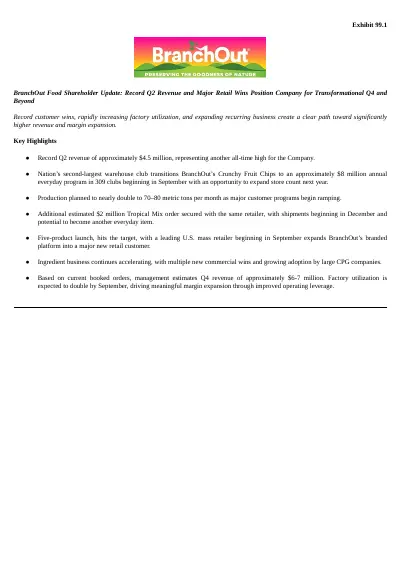
It sets us up for a very exciting step function in revenue as well. We believe that Q4 should be around $6 to $7 million, depending on kind of when some of the orders ship at the end of the year.
We think that we can sustain that level. The revenue moving forward shouldn't be as lumpy, and we should be able to sustain sort of that level going forward.
It's a very exciting time. We're in an inflection point right now.
This is really what we've been investing into the last two years since we opened our plant, and we're very very proud of our team, both on the sales and ops side for getting us to where we are here. With that, John, I'll turn it over to you if you have anything else, and then we'll go into kind of future sales prospects beyond what we currently have.
John Dalfonsi
Sure. What I want to do now is move to our actual 10-Q and how we did for the quarter.
Where I always like to start with, if you've listened to these calls before, the balance sheet. If you look at our balance sheet, we have $8.1 million in current liabilities and 7.7 assets, $8.1 in current assets and $7.7 in current liabilities.
You have to take a closer look at this. It shows we only had $200,000 in cash.
Like I've said in other earnings calls, cash, accounts receivable, inventory, you got to look at them as one, because every dollar we have we're rolling into orders, because we're trying to keep up. One thing that has happened from day one since we've opened the plant is that The orders are not a problem.
We're getting a lot of orders. Then given that we're getting so many orders, it kind of turns into a just-in-time manufacturing.
If you look at our inventory turn, it's $3.3 million. Even if you take $14 million, which are kind of trailing sales, when you're looking at a $6 to $7 million run rate right now, the inventory turns are even faster.
They're less than 90 days. Remember, the products on the water for 60 days.
Really, cash instantly gets turned into inventory and then which gets turned into accounts receivable. For example, we have over a million cash on the balance sheet, but that is getting recycled into inventory.
Really, our capital needs are all around working capital. If you look at the current liabilities, the 7.7 really is a 4.7.
You got that $3 million note payable. If you recall, that's Dan Kaufman at Kaufman Capital.
It's an 8% note. He's a friendly investor.
He's the largest shareholder. He will extend that loan as long as need be to our ultimate goal, which is a revolving credit facility from a commercial bank.
That's kind of what our AR is as strong as it gets with Costco and Walmart and Sam's Club and MicroDried, their billion-dollar family. Inventory is all sold.
It has a long long long shelf life. When I look at our balance sheet, yeah, I feel it's very healthy.
I look at more of our current ratio of 2:1. Let's see.
That convertible note is Kaufman Capital's convertible note that will ultimately convert. He's converted some already.
That's in my opinion, kind of the pertinent things to look at on our balance sheet. Then when you go to the income statement, we basically had a 2% gross margin.
The reason behind that is when you look at our product mix, Costco was 20% of the revenue. We actually did pretty well on gross margin, 43%.
MicroDried, which is 33% of our revenue, those were the organic strawberries, where our gross margin was 3%. Like Eric said, when you buy these raw materials, if you buy them on the off-season, it's the highest dollar you pay, which makes you think that, well, geez, what we're moving to is buying raw materials during the high season and just making the products then, and that saves 50% on the raw materials.
Then the Sam's Club, we had to air ship, we'd said we thought air shipping was out of the way. We had to air ship that.
That gross margin was 14%. That was 31% of the revenue.
When you look at it all, plus the utilization, since we're running at 30 to 40%, what we had to absorb, it's kind of a break-even gross margin. If you look further in, I think there's tremendous opportunity, because just by buying on high season versus on the spot market, raw materials are 50% of our cost in Peru.
Then increased in kilograms going to that 70,000, we don't need any further people to execute on 70,000, really no more hiring. I think you're going to see stronger gross margins.
That I feel is the opportunity with this company. Those are kind of my high-level comments, the things that I feel are really important to take a look at.
The last couple things I want to talk about is guidance. We're a little over seven we're over $7 million for the six months, and we got two quarters to go.
That's to get something with a two in front of it, that's 13 to go. We will make $20 million plus of product in the plant.
The question is, is it delivered by December 31? Might be a couple million dollars that don't kind of hit delivery where we can invoice the customer till January.
Something with a two in front of it, although we make something with a two in front in the plant, some of it might slip over. It might be a number closer to 18 for the year.
We're still getting orders and delivering them, it could be down to the wire. That's kind of my thought there.
I guess if you think about it, we've made that something with the two in front of it in the plant. If you look at our run rate based on our fourth quarter, $6 to $7, maybe it's eight, maybe it's a little higher than that, we're clearly in the 30s with that run rate.
The last thing I get a lot of questions on is capital. We've only issued 500,000 shares this year.
That was with our ATM in January and February. We've had a lot of warrant exercises, and then Kaufman Capital has given us debt.
We may need some top-off capital. Might be a little more debt from Kaufman.
We still have a little left on the shelf, so that may or may not happen. The bottom line, given it does, it's strictly to cover working capital and because of our growing orders.
Those I feel are the pertinent things. I'd like to hand it over for Q&A.
Operator
Thank you. We'll now be conducting a question-
Eric Healy
Sorry, let me go into the sales prospects. I got a few updates there, if we can do that real quick.
Operator
Go ahead.
Eric Healy
Yeah. Exciting stuff ahead.
The Sam's Club order is just sort of our foot in the door with that retailer. We believe about an $8 million reoccurring business based on the sell-through we had initially.
We are only in half of the doors at this point, we believe that if we continue to perform, there's an opportunity maybe mid next year to expand that door count pretty significantly. There's a category review coming up in March, so that's something that we see as a good possibility that could grow significantly.
We have this second order that's going into Sam's that we've talked about as well. It's the tropical mix, it's our core three tropical fruit chips, the pineapple, banana, mango, and that's going into a multipack format, it's a very different eating occasion than the other product that's in there now.
That product is a one-time rotation. It'll be on shelf in January.
That one as well, though, if it performs, which we expect it to, could easily convert to an everyday item as well. That's about a $2 million order at the end of the year here that we hope turns into an everyday continuous order.
The industrial ingredient partner and others in that space is also growing rapidly. We did about $2 million in 2025.
We think this year will be close to seven, and next year could be 10-plus in that channel. We're seeing a lot of adoption of our products, a lot of strawberry, as I mentioned.
We're starting to do a bunch of blueberry. Then our tropical products are currently we're working on a couple different programs with some big CPG customers that are integrating them into their recipes of their products.
That's a exciting part of our business that continues to grow rapidly. Costco, lots of stuff going on with Costco.
We have a organic apple chip that's going in here in a couple months, and then we have another order of the pineapple chips at the end of the year, four truckloads going to the Southeast. That one keeps going.
They keep reordering that, so that's a great proof point. We did just get an order last week, actually, for our cheesecake.
That's something we've been talking about for a long time. We're super excited about it.
It's completely new, innovative product, and Costco just committed to the first order of that. That'll be going in in time for the holidays this year in the Texas region.
We think it's very innovative. There's never been anything like it, and we expect that to do well and grow as well.
That's exciting. We are also getting our dried cheese products out there.
That's a brand-new product line, but we've already got some traction with that. We have a very large retailer.
They have about 9,500 doors across the country that will be testing it here in the next couple months. If that test goes well, that would convert into an everyday business with them that could be anywhere between $4 to $6 million annually.
It's another big one there that could turn into something. With that, we're going to take those dried cheese products, we're very bullish on them, and we're launching them in the convenience store channel.
It's a channel that our sales team knows very well. We have experience there, and we think there's a big opportunity there.
With that, that's kind of all the big things. There's a lot of smaller opportunities or opportunities that aren't quite as close yet.
As John said in the beginning, new sales and new sales prospects have never been our problem. We continue to bring these in.
Right now, it's really the focus on the plant to effectively double their throughput to deliver on what we have. That's essentially what I got.
Let's go ahead and turn it over to questions.
Operator
Thank you. We will now be conducting a question-and-answer session.
If you would like to ask a question, please press star one on your telephone keypad. A confirmation tone will indicate your line is in the question queue.
You may press star two if you would like to remove your question from the queue. For participants using speaker equipment, it may be necessary to pick up your handset before pressing the star keys.
One moment, please, while we poll for your questions. Our first question comes from the line of Ryan Meyers with Lake Street Capital Markets.
Please proceed with your question.
Ryan Meyers
Hey guys. Thanks for taking my questions.
Thinking about the $6 to $7 million guide for the fourth quarter, as we enter into 2027, how much visibility do you already have into sort of maintaining this level or building from that level going forward into '27?
Eric Healy
Good question. I would say a lot more than we've ever had before.
This Sam's Club everyday is about a baseline of about $8 million annually, so that's a new base business that we've never had. We've always had this very peaky, unpredictable revenue from club and others.
I'd say with that, there's also the ingredient business, and with our partners there, they give us pretty good foresight now. We're getting very good at planning out 6 and 9 months ahead.
There is still Costco that comes in, and they'll hit us with big orders, and it's hard to predict that. I think we're moving in the right direction significantly, right?
I can't say that we have six to seven booked solidly into next year, but we're starting with a much better base business.
Ryan Meyers
Got it. That's helpful.
Then, as you guys look to double the production, is there any way you can help quantify sort of the gross margin improvement that you expect to see from that as we progress through the rest of the year?
Eric Healy
Yeah. It's a great question.
We built a very large plant, right? We built this plant assuming that we would get to this level, and we got there pretty quick, right?
When we go to the customers or go into retail, we price our products there's two considerations. There's what is the market willing to accept, we kind of look at like products on the shelf or kind of competitive products in the space.
Then we look at our costs, but we've always had to assume that that plant is fully utilized to a reasonable degree, right? We haven't actually gotten there yet.
This will be the first time where the plant is at the utilized level that we've always sort of assumed when we price the products to retailers. We've always said 30 to 40 margins, and I think this will sort of unlock, you'll kind of see the model come to life as we intended it to.
Before, earlier this year, right, only utilizing the plant at about 40% with all the overhead costs in there, there's a lot of overhead that goes into the products that will effectively be cut in half. It's hard to quantify, but I believe that once the plant is fully utilized, we'll start seeing some of those margins that we've always talked about.
Ryan Meyers
Okay.
John Dalfonsi
Ryan, I want to give a little more granularity to that, because we're spending a lot of time on this. Number one is 50% of your cost, Peru is about 70% of our total cost, we really don't have a lot, very little overhead.
We have six people. Then you kind of have your non-cost of goods, that's more of the packaging, the shipping, expenses from the time it leaves the plant to the customer.
The raw material is 50% of the cost, and if you think about it, these orders are sporadic. They're just-in-time orders, you got to buy on the spot market.
You're paying double. For example, the strawberries were $2 a kilogram.
On the high season, you can get them for a dollar a kilogram. Now that we have this everyday business, we can plan the strawberries for a dollar a kilogram.
That's 50, it's 100 100% savings. Also, just sourcing in general, as we focus on the core five, which are strawberry, banana, pineapple, apple, and mango, we can really, really, really focus on buying on high season and bringing those costs down.
That's going to be a big impact. We're seeing that already.
Secondly, just production flow. You got to air-dry these products before you put it in the EnWave machine.
There's a very tight standard deviation of kind of moisture that you could put it into the EnWave machine. Optimizing the air-drying process, which we're well under way of that.
The last thing I'd say is packaging. We can package inside the plant and save a significant amount of money.
We think five, six, seven points right there. Those are just things that scratch the surface.
The way to kind of think about this is you have this plant that opens, everything's coming at once. Now a year and a half in, we're kind of under our legs, and now really looking on how to utilize and how to get the margins up.
That's a little more granularity. Hope that helps.
Eric Healy
No, the packaging is really exciting. We didn't mention that earlier, but it's a pretty obvious thing for us to do.
It's not a very technically challenging operation. If you look at our numbers, by the end of 2026, we will probably have spent a million five on outsourced packaging needs that we've had for our retail products.
With maybe $150,000, $200 grand in CapEx, we can bring all of that in-house for next year, and we're looking at doing that. To date, it's been more about focusing on what we do best down there is dehydration, but we feel like we're in a good place now to bring that in, and I believe it's going to be a pretty big unlock with our margins.
Ryan Meyers
Okay. Got it.
Thanks, guys.
Operator
Thank you. There are no further questions at this time.
I'd like to turn the call back over to Mr. Dalfonsi for any closing remarks.
John Dalfonsi
Thanks for joining, and we look forward to the next quarter. Thanks for your time.
Operator
Thank you. This concludes today's teleconference.
You may disconnect your lines at this time. Thank you for your participation and have a wonderful day.