Boardwalk Real Estate Investment Trust
Q3 FY2026 · Earnings Call TranscriptNovember 4, 2026
Operator
Afternoon, ladies and gentlemen, and welcome to the Boardwalk Real Estate Investment Trust third quarter 2026 earnings call. At this time, all lines are in listen-only mode.
Following the presentation, we will conduct a question-and-answer session. If at any time during this call you require immediate assistance, please press star zero for the operator.
This call is being recorded on Wednesday, November 4th, 2026. I will now turn the conference over to Eric Bowers, VP of Finance and Investor Relations.
Eric Bowers
Thank you, Vanessa, and welcome to the Boardwalk REIT 2026 third quarter results conference call. With me here today are Sam Kolias, Chief Executive Officer; James Ha, President; Gregg Tinling, Chief Financial Officer; Samantha Kolias-Gunn, Senior VP of Corporate Development and Governance; and Samantha Adams, Senior VP of Investments.
We acknowledge the traditional lands on which we live and work and our shared commitment to respect, stewardship, and community. Before we get to our results, please note that this call is being broadly distributed by way of webcast.
If you have not already done so, please visit bwalk.com/investors, where you will find a link to today's presentation as well as PDF files of the trust financial statements, MD&A, and quarterly report. Starting on slide two, we would like to remind our listeners that certain statements in this call and presentation may be considered forward-looking statements.
Although the expectations set forth in such statements are based on reasonable assumptions, Boardwalk's future operation and its actual performance may differ materially from those in any forward-looking statements. Additional information that could cause actual results to differ materially from these statements are detailed in Boardwalk's publicly filed documents.
I would like to now turn the call over to Sam Kolias.
Sam Kolias
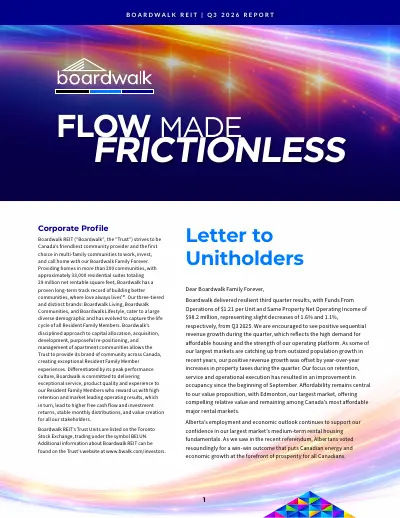
Thank you, Eric. Starting on slide four, welcome everyone to our Boardwalk family forever and to our Q3 2026 results.
Redefining BFF, Boardwalk Family Forever, is at the top of our organizational chart. Family is everything.
Community, team, performance guides us to be the first choice in multi-family apartment communities to work, invest, and call home. Together with our residents, associates, investors, partners, capital, environment, community, we are all essential and interconnected family members, with our true north where love always lives, creating a win-win-win.
Together, we go far. Our leaders put our team first, and our team puts our resident family members first.
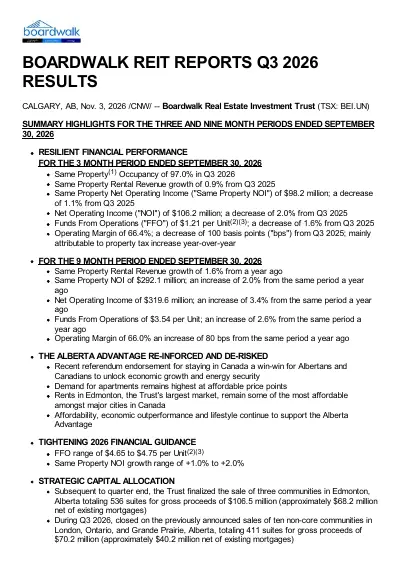
Guided by the golden rule, we have a peak-performing customer service culture that creates resilient results, as we can see on our next slide, five. Continued resilient performance with GAAP and non-GAAP measures: from the same quarter last year, same-property rental revenue increased 0.9%, and same-property net operating income decreased 1.1%.
Our operating margin reduced by 140 basis points to 67%, mostly a result of increased property taxes in the second half of the year. Our funds from operation decreased mostly a result of asset sales.
Our asset sales provide capital for our normal course issuer bid program, which has helped to mitigate our FFO per unit decrease of 1.6%, demonstrating the impact of strategic capital allocation to maximize free cash flow. Profit is down as a result of a non-cash reduction in our IFRS net asset value.
I would like to now pass it over to Samantha Kolias-Gunn.
Samantha Kolias-Gunn
Thank you so much, Sam. We are extremely grateful for our team, our Boardwalk family's perseverance, performance, and continued commitment to our purpose: bringing our resident family members home to love always.
Continuing on to slide six, our operational stability and commitment to affordable housing. Rental market fundamentals in our core markets are competitive.
Demand remains for more affordable housing despite supply deliveries focused on higher-end luxury product to justify high construction costs. We are grateful for our partnership with CMHC and our federal governments that have implemented effective public policy to build more supply that has resulted in a balancing of the rental markets across Canada, providing more affordability to all Canadians.
We continue to deliver on our commitment to provide much-needed affordable housing in a more competitive environment with our experienced, peak-performing team; exceptional product quality with over $1 billion invested since 2017 in rebrand and repositioning efforts; and dedication to our Boardwalk family as responsible community providers. Our self-regulation provides us with resilient results across various market cycles, as we remain flexible with our new and renewing rental rates, maintaining stability in occupancy, margin, NOI, and reputation.
Paired with our strong financial foundation, minimum distribution policy resulting in maximum reinvestment and free cash flow growth, strategic repositioning, unparalleled customer service, and on our foundation of strong family values, we remain in a position to deliver stable performance. Moving on to slide seven, our strategic rebranding enhances our resident member experience and exceptional quality at an affordable price, keeping our occupancy high at 97%.
Per Rentals.ca data, our average occupied rents of $1,609 for a two-bedroom apartment are attractive, especially relative to the Canadian average of $2,221. Moving on to slide eight, affordability continues to drive positive population and leading economic growth in our core markets of Alberta and Saskatchewan.
Alberta currently has the strongest population growth on an absolute basis due to interprovincial migration, resilient net non-permanent resident numbers compared to other provinces, and a higher natural component. Quebec has delivered strong results, further evidencing the strong demand for affordable housing.
Ontario remains stable. Please refer to our appendix for more data on the resilience of our core markets, Alberta and Saskatchewan, and the important role these provinces play as strategic engines for Canada's long-term prosperity.
With the referendum now behind us, Alberta enters its next chapter with greater certainty and a constructive backdrop for continued investment. As our Premier, the Honourable Danielle Smith, highlighted in her address on October 20th, there is renewed recognition across Canada of the importance of Alberta's energy, agriculture, technology, and natural resources to our national economy and long-term prosperity.
Alberta continues to attract significant capital investment across energy, pipelines, power generation, technology and AI, infrastructure and housing, and aircraft assembly, such as the most recent federal financing of $2.5 billion awarded to De Havilland, who manufactures essential firefighting aircraft. While Saskatchewan's strength in agriculture, potash, uranium, and energy continue to support investment and economic resilience, a combination of energy security, economic competitiveness, relative affordability, and infrastructure investment provides a strong foundation for job creation, population growth, and sustained economic activity across our core Prairie markets.
We would like to now pass the call on to Gregg Tinling, who will provide us with an overview of our quarter results, strong balance sheet, fair value, and ESG. Gregg?
Gregg Tinling
Thank you, Samantha. Slide nine shows our key operational metrics.
The trust retained high occupancy during Q3 2026 by focusing on retention and by leveraging its vertically integrated operating platform to limit the time to complete suite turnovers. The trust's approach to strategically moderate its lease renewal rates over the last number of years, while markets were heavily undersupplied, also contributed to maintaining higher occupancy in a more balanced market.
Overall, demand remains strong for affordable housing. Average occupied rent increased sequentially and when compared to the same quarter a year ago.
Although vacancy loss increased, the trust was able to reduce incentives that helped contribute to the higher revenues reported for Q3 2026 compared to the same period a year ago. These results reflect the success of our strategic initiatives aimed at maximizing free cash flow and diversifying our product offering, delivering meaningful financial performance.
Slide 10 provides an overview of leasing spreads for new and renewed leases under our self-regulated, resident-friendly-centric model. This approach continues to drive strong retention and referrals while keeping turnover and operating expenses low.
On a year-over-year basis, leasing spreads have moderated, reflecting a more balanced supply-demand environment. Positive market rent adjustments were implemented in some communities where rental fundamentals were strong.
In other communities, market rents were adjusted downwards in pockets that had experienced higher deliveries of new supply and where rents were on the higher end of the price spectrum. On a blended basis, leasing spreads trended slightly negative during the quarter, a reflection of our focus on retention in a more competitive market.
Our strategic flexibility with new rental rates combined with positive renewal spreads enabled us to preserve high occupancy while maintaining solid operating margins and net operating income. We will continue to focus on maintaining high occupancy and maximizing resident retention.
This strategy reinforces our commitment to providing affordable, resident-friendly housing in our core markets while also reducing costs and steadying operational performance, delivering long-term value for all stakeholders. Slide 11 shows sequential quarterly rental revenue growth.
Rental revenue growth has increased gradually through the first three quarters of 2026 and is consistent compared to Q4 2025. With increased competition, Boardwalk focused on maintaining high occupancy while balancing market rents and rental incentives in order to achieve its NOI optimization strategy.
Turning to slide 12, for Q3 2026, same-property net operating income decreased by 1.1% compared to the same quarter last year, as increased total rental expenses of 5.3% more than offset slightly higher same-property revenue growth of 0.9%. The increase in total rental expenses was primarily due to the significantly higher education property tax expense in Alberta for 2026.
I would like to remind everyone that same-property is defined as one that has been wholly owned by the trust for a period of 24 months or more from the reporting date. Slide 13 outlines Boardwalk's mortgage maturity schedule.
The trust debt portfolio is well staggered, with approximately 99% of the mortgage balance carrying NHA insurance through CMHC. This insurance remains in place for the full amortization period and, backed by the Government of Canada, enables access to financing at rates below conventional mortgage levels, with a current estimated five-year and 10-year CMHC rate of 4.05% and 4.45%, respectively.
Although current interest rates are above the trust's maturing rates over the next couple of years, the trust's maturity curve remains staggered, reducing the renewal amount in any particular year. Lastly, the trust has an interest coverage of 2.83 in the current quarter.
To date in 2026, of the approximately $815 million of 2026 mortgages maturing, we have renewed or forward-locked $579 million at an average rate of 3.89% and an average term of approximately seven years. Combined with our cash on hand as well as our unused credit facilities, we are well positioned with strong liquidity available.
Current underwriting criteria in our most recent submissions to CMHC and our lenders has remained in line with our historically conservative estimates. Please refer to slide 48, which summarizes our 2026 mortgage program completed.
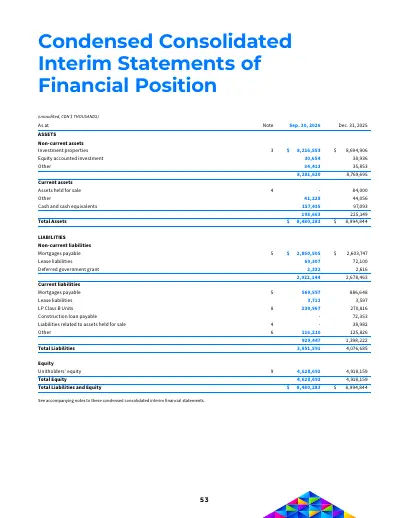
Slide 14 illustrates the trust's estimated fair value of its investment properties, excluding adjustments for IFRS 16. As at September 30th, 2026, the fair value of investment properties totaled $8 billion, compared to $8.6 billion as at December 31st, 2025.
The decrease in overall fair value is the result of asset sales completed, as well as an overall fair value loss adjustment recognized in the period. Current estimated fair value of approximately $248,000 per apartment door remains below replacement cost.
As it does every quarter, the trust will continue to review completed asset sales transactions and market reports to determine if adjustments to cap rates are necessary, as well as consult with our external appraisers. Most recent published cap rate reports suggest that the cap rates being utilized by the trust for calculating fair value are within their estimated ranges.
I would like to now turn the call over to Samantha Adams to highlight our capital allocation initiatives.
Samantha Adams
Thank you, Gregg. As we enter the final quarter of 2026, our capital allocation approach is unchanged: stay disciplined, be patient, and invest where we see the best risk-adjusted returns, and our focus remains on growing free cash flow.
Our value-add and repositioning program remains a key capital allocation priority. As highlighted on slide 15, seven of the 16 projects planned for 2026 are complete, and the rest are on track to finish by year-end.
These are cost-effective common area and amenity upgrades that improve the overall resident experience, preserve affordability, and support retention and long-term asset quality. Demand for high-quality affordable apartments remains strong, and these upgrades keep our properties competitive.
Slides 16 and 17 summarize our 2026 transactions. Year to date, we have completed or announced $629 million of sales at an average cap rate of 5.2%.
Once the remaining deals close, these sales will generate $342 million in net proceeds and reduce near-term capital spending by about $33 million. This includes $177 million of third quarter sales in London, Grande Prairie, and Edmonton that were sold at an average cap rate of 5.4%.
These properties were sold because of high deferred capital needs, operational challenges, or overexposure to certain markets. On September 1st, we also closed Project Casa, our joint venture with Desjardins Global Asset Management.
Our sales continue to close in line with our fair values, and we have used most of the proceeds to buy back units, as shown on slide 18. The NCIB remains our top priority because our unit price does not reflect the value of our portfolio.
Far in 2026, we have repurchased $245 million of units at an average price of $65.37. Private buyers in our core markets are paying cap rates of 4.75 to 5 and a quarter, while our units trade at an implied cap rate well above 6%.
That makes buying back our units the best use of our capital to date. I would now like to turn the call over to Eric Bowers to discuss our track record creating value.
Eric Bowers
Thank you, Samantha. Slide 19 highlights our track record of compounding FFO per unit and distribution growth over the last many years as a result of the trust's maximum cash flow retention policy.
This has enabled the trust to reinvest its cheapest source of capital, internally generated cash flow, into its communities to more than double FFO per unit since 2018 and compound growth on our regular distribution at an annual rate of approximately 12% since 2021. We are pleased to confirm our regular monthly distribution, equating to 15 cents per trust unit, or $1.80 on an annualized basis, for the months of December 2026 and January and February 2027.
Please note, as we approach our year-end, our team is in the process of finalizing and conducting our tax review and will provide any special distribution update in December to reflect the taxable gains from our active sales program throughout the year. Our regular distribution review is also conducted at year-end and is expected to be updated with our year-end results.
On slide 20, we highlight the strength of the trust balance sheet and the continued progress we are making on decreasing our financial leverage over time. In Q3, the trust debt to EBITDA ratio improved to 9 times, down from approximately 10 times in Q4 2025, while debt to total assets remained steady compared to the prior quarter at just under 43%.
The trust liquidity remains strong at approximately $403 million at the end of Q3. Slides 21 and 22 illustrate the exceptional value that the trust units continue to represent relative to private market valuations and the trust NAV per unit.
At the current unit price of approximately $63, the trust implied value of $195,000 per suite and implied cap rate of 6.5% provides the trust with an ongoing opportunity to invest into its own high-quality, lower-risk portfolio at historically rare and discounted levels through its NCIB program. During the quarter, the trust completed its NCIB for the current period, which is eligible for renewal in late November.
I would like to now turn the call over to James Ha to discuss the trust's latest financial guidance and provide closing remarks on the trust's proven platform and exceptional value.
James Ha
Thank you, Eric, and thank you to our entire Boardwalk team for your service and commitment to our resident members. As we look forward to closing on another successful year, slide 23 provides a final review of our 2026 outlook as we continue to demonstrate the strength of our platform and the resilience of affordable housing.
Across the country, we continue to see strong demand for affordably priced homes, while more expensive housing options remain competitive. Our improving occupancy is a reflection of our high affordability and the exceptional quality of our communities, and it has positioned us well as we head into the winter season.
Since our last report, we are seeing our overall results in line with our expectations. Our positive sequential revenue growth in this third quarter is offsetting the large increase in property taxes we are seeing in the second half of this year.
With this, we are pleased to tighten our outlook for the year with anticipated same-property NOI growth of 1% to 2% and FFO per unit between $4.65 and $4.75 for the year. Please note that this is forward-looking guidance, and we will provide an update if there are any changes to this outlook as we finish the year.
As customary, we will introduce our 2027 outlook and guidance with our upcoming fourth quarter results. In closing, our focus on delivering the best quality and affordable communities is why our residents make Boardwalk their first choice as the place to call home and reward our team with continued high occupancy and high retention rates.
Slide 24 highlights a few key benchmarks that our team has and continues to work toward improving. As shared earlier, Boardwalk offers the best value in housing, with some of the most affordable rents in the country at just over $1,600 a month.
Our operating margins have improved significantly as we continue to find new ways to optimize our NOI despite higher non-controllable expenses, such as property taxes. Our unique business model retains and compounds cash flow, allowing us to organically improve our balance sheet with one of the lowest debt-to-EBITDA ratios amongst our peer group.
Our unique platform, disciplined approach to capital allocation, and experienced team continues to demonstrate our ability to create value for all our stakeholders. We would like to thank again our resident members, our team, our partners, and all our stakeholders for making us your first choice in housing.
Thank you, and we would now like to open up the line for questions. Vanessa?
Operator
Thank you. Ladies and gentlemen, we will now begin the question-and-answer session.
Should you have a question, please press the star followed by the one on your touch-tone phone. You will hear a prompt that your hand has been raised.
Should you wish to decline from the polling process, please press the star followed by the two. If you're using a speakerphone, please lift the handset first before pressing any keys.
We have our first question from Jonathan Kelcher with TD Cowen.
Jonathan Kelcher
Thanks. Good afternoon.
First question, and I know this is early and you give formal guidance in February, but just from a high level, how are you thinking about revenue growth and expense growth for next year?
James Ha
Hey, Jonathan, it's James. As you pointed out, we're going to provide our formal guidance with our fourth quarter results.
What we're focused in on is maintaining and growing occupancy. We just cannot thank our team enough for all the hustle, all the work that we're doing to keep our 97% occupancy because it is competitive out there.
As we said in our prepared remarks, we're seeing really strong resilience in the affordable segment of the housing market. The more expensive, where there is a lot more supply, remains very competitive, and our team is doing a great job winning market share and maintaining that occupancy at 97%.
Jonathan Kelcher
Okay. Then on the expense side, are there any sort of big things like you had the property tax this year?
Is there anything you see out there beyond sort of normal course growth?
Gregg Tinling
Hi Jonathan, it's Gregg. Again, it's too early to say.
We did get hit with the Alberta education property tax increase this year. You'll see that that's hit in Q3 and will hit Q4.
Although it's too early to tell, we don't expect a similar increase in that regard next year. We'll give you more update in February.
Jonathan Kelcher
Okay. Fair enough.
Then just secondly, looks like you are building liquidity, you're through the NCIB, and I get the NCIB is best use of any sort of cash you bring in right now. Are you guys starting to look at any acquisitions?
Samantha Adams
Hey, it's Samantha Adams speaking. We are.
We remain, though, highly selective. We continue to review opportunities that come our way to find the very best acquisition.
I think, as you highlighted, it has been a challenge this year given the wide gap between our unit price and private market valuations, which is why we've allocated the majority of our net proceeds to the NCIB. We are seeing some opportunities.
Yeah.
Jonathan Kelcher
Okay. That's helpful.
I'll turn it back. Thanks.
Operator
We have our next question from Tom Callaghan with BMO Capital Markets.
Tom Callaghan
Thanks. Good afternoon.
Maybe just to follow up there on the acquisition opportunities and more broadly the private market, perhaps a little bit early, but have you started to see any movement with respect to pricing or expectations just given the movement in yields and rates?
Samantha Adams
Hi, it's Samantha Adams again. I think it's too early at this stage, as the rate changes are still fairly recent.
It's something we're certainly going to monitor as we move into 2027. No, as of yet, we haven't seen a significant impact.
Tom Callaghan
Got it. Then maybe switching gears, just with respect to spreads and on a blended basis, did see a bit of sequential slowing there in Q3.
Can you just give us a bit of a sense for what you've seen kind of post-quarter on the spread side of things?
James Ha
Hey, Tom, it's James. Fairly consistent.
Again, it's remains quite competitive out there. We're moving into typically a slower winter season, but that also means a little less turnover as well.
We're seeing some consistency. I think renewals are very similar to what you're seeing or what we've seen over the last few months.
Tom Callaghan
Okay. In that kind of 2% range on the renewal side of things is kind of reasonable, to what you're seeing?
James Ha
For what we're seeing over the next couple of months, I think, as we've said, we're seeing it quite consistent.
Tom Callaghan
Okay. Thanks, James.
I'll pass it back.
James Ha
Thanks.
Operator
We have our next question from Brad Sturges with Raymond James.
Brad Sturges
Hey there. Just following along Tom's questioning there, how do you think incentive usage will trend, I guess, heading into Q4, Q1, kind of slower leasing season, generally speaking?
James Ha
Hey, Brad, it's James. Incentive usage again fairly consistent with what we're seeing.
Again, our priority and focus is going to be to maintain that high occupancy. On the renewal front, keep in mind, over the winter season, because there is less turnover, a larger proportion of our lease activity is going to be renewals.
On newly seen, we're going to remain flexible with prospective new residents, as we know there is a lot of competition out there. I know I've said that a few times now.
Again, I can't thank our team enough for the amount of work and effort that we're putting in to continue to win market share. Overall incentive usage, we're applying them on new leases, and for the most part they're coming off on renewals as well.
Brad Sturges
Okay. Maybe just going back to the private market discussion there, just you've had a really good year selling non-core assets into kind of a strong demand backdrop.
Have you seen any changes in the buyer pool in terms of depth or composition? Is there still a window available to continue to maybe opportunistically sell more non-core assets?
Samantha Adams
Hey, Brad, it's Samantha Adams speaking. Now, we haven't seen a shift in the buyer pool specifically.
What we are noticing is more and more interest from Quebec, Ontario, and BC for some of our non-core communities. In terms of what we can expect or what we're looking for, as we move into 2027, again, I think it's a bit early to tell what the private market is going to do.
We're sort of currently reviewing our disposition strategy for 2027 this quarter, and we'll be able to provide a better update alongside our broader 2027 guidance in February.
Brad Sturges
Okay. Thanks.
I'll turn it back.
Operator
We have our next question from Jimmy Shan with RBC Capital Markets.
Jimmy Shan
Thanks. James, I know you did mention competitive out there a few times.
I'm assuming you're referring to the Calgary market in particular. I guess on that market, the rental under construction seems to be edging up still.
When do you see that market turning?
James Ha
Hey, Jimmy, it's James. I'll start on this.
We're actually seeing it competitive across the country, and again, it's more price-point focused. In Edmonton, our average rents are very affordable.
In Regina and Saskatoon, our average rents are very affordable. In Calgary, we've really high-graded our portfolio over the past several years, and so, relatively are seeing a more competition in Calgary.
Across the country, depending on price point, if we are competing in the more expensive segment of the market, that's where you are seeing a lot of choice for residents. In terms of supply, I'll pass it over to Eric.
Eric Bowers
Hey, Jimmy, it's Eric. From a supply standpoint, we still do have quite a bit under construction in Calgary.
Year-to-date, what we've seen in general for starts is they're down about 15% compared to the same time last year cumulatively through September. Supply is always relative to demand, as we know.
We're going to get a new immigration levels plan here in the next couple of days. I would say good news is, from an employment perspective and as Samantha alluded to in her opening remarks, there's some really good drivers that we're confident we'll continue to see migration into the province.
Jimmy Shan
Are you guys hearing anything on the immigration front?
Sam Kolias
Hello, Jimmy, it's Sam. We're just reading the same news everybody else.
We are big advocates, as we've said over many other calls, of economic migration that in the past with a past administration proved very well with our Prime Minister Harper and proved to be very very prosperous for all of us in Canada. We continue to be an advocate for economic migration, and we are waiting to see the budget announcement the next couple days to see how that's covered.
Jimmy Shan
Okay. Thank you.
Thank you.
Operator
We have our next question from Kyle Stanley with Desjardins.
Kyle Stanley
Thanks. Afternoon, everyone.
Maybe just sticking on the kind of immigration conversation here for a second. Looking at your top 10 reasons for moving out, I'm just trying to figure out where in those top 10 would you classify kind of maybe some of the non-permanent residents who have been either forced to leave the country or uncertain about their status and where would those people not renewing fall?
How impactful has that been to your portfolio, obviously knowing that maybe there's fewer non-permanent residents in Alberta relative to the rest of the country? How would you look at maybe a higher immigration target?
How would that help?
James Ha
Kyle, it's James. We actually talked about this with our team in terms of creating a category for it, but then we had some privacy concerns.
We've opted not to do that. It really varies, but I would say most are actually going to be in that moving out of town bucket for the non-permanent resident non-renewals.
You can see, there is a modest increase in that. When we speak with our teams, we hear a lot of unfortunate stories of folks who are here, have been here for many years, working multiple jobs, with kids, with family, who are going to school here, who are paying their rent on time every single month, being asked to leave the country because their permit wasn't renewed.
Our team has done a really good job of backfilling and re-renting those units, but at the same time, certainly, those are the type of stories where maybe are not quite what our immigration policy adjustment was intending to do. Certainly I think we're, as Sam said, we're watching the budget for tomorrow and the next couple of days to see what comes out with that.
Obviously, as Samantha talked about in her prepared remarks, we have a lot of work to do here in Canada. We have projects to build.
We have an economy to build and grow, and that's going to take people. A little more immigration would create more household formation, which obviously is a positive driver in terms of absorption for this affordable housing that we have here.
Again, we're watching the news along with everybody else.
Kyle Stanley
Okay. Good.
That makes sense. As you've mentioned, obviously, the elevated competition a number of times and the focus on occupancy, there's been a lot of conversation about preserving the 97%.
Is that the main goal or do you see upside getting above that 97% in the next little while?
James Ha
Our team wants to. We're pushing.
Again, I think our more affordable communities, where we have lower average rents and amazing value, we continue to be full in those. It's really just the higher-priced, more expensive communities where, again, I'm confident we are winning market share and we are ahead of the market there, but that's also where we're seeing more turnover because there is more choice for residents.
Certainly, Kyle, we'd love to build more occupancy as we head into 2027, but also want to recognize our team here because we are also very happy that we were able to build some occupancy through the summer leasing season.
Kyle Stanley
Fair enough. Just the last one for me.
Your same-property revenue growth in Quebec looked quite strong this quarter. Just wondering if you can talk about the drivers there and maybe the sustainability of that growth.
James Ha
Yeah. In Quebec, one of the biggest I don't want to say nuances, but is lease volume in the summer months.
With heavier lease volume in the months of July, that obviously flows through into the quarter. That actually offset some increases in expenses that we also saw in Quebec, specifically related to R&M and the need to complete inspections that were mandated by the province during the quarter.
Our Quebec portfolio continues to perform well. Our team in Quebec is working hard.
Similarly, though, as we said, across the country, there is competition in Quebec. We all have to be on our game.
Our team is on their game, and that's allowing us to continue to perform well.
Kyle Stanley
Okay. Thanks for that.
I'll turn it back. Thanks, Kyle.
Operator
Our next question comes from Mario Saric with Scotiabank.
Mario Saric
Hi. Thank you, and good morning.
Just coming back to the immigration topic, I think there is this general kind of enthusiasm or expectation that the updated immigration numbers could be positive for the sector. If we just focus on Alberta and kind of setting aside the sovereignty question that was on the referendum, there were kind of several immigration-related questions on that that received greater than 50% support.
Do you think there's any implications from that for rental demand going forward and kind of Alberta's leading population growth that we've seen in the last two, four years? Hi,
Sam Kolias
Mario, it's Sam. What we heard is questions one to nine are very ambiguous.
You can almost, on the immigration question, say yes and no mean the same thing. What does that mean?
We can all agree that we need more teachers. That's one thing we ask our policymakers, and people all the time, our public.
We can all agree we need more healthcare and doctors, certainly, because it's hard for everybody to see a doctor when everybody needs one. There's obvious wins in immigration, economic immigration that we can all agree on.
What we try to do as advocates of tried, tested, proven public policy is to find common ground on policy that we can all agree on. Those are immigration discussions that we all agree on and are continuing to be big advocates.
Hard to disagree with the needs of our people. We the people, for the people, by the people, of the people is always a tried, tested, proven way to govern.
Mario Saric
Okay. Thanks for that, Sam.
Then just my next question, coming back to the blended lease spreads. They have gone from about 10% in '24 down to essentially flat now.
I appreciate that most of the competition that you're seeing is at the higher rent level or the new construct level. Does that kind of explain all of it?
For example, do you have any stats where you have the blended lease spread by rent amount, for example? I'm just trying to get a sense for how broad-based kind of the blended lease spread erosion has been across the portfolio by rent type.
James Ha
We can look at producing that, Mario, and maybe be added to our investor deck in the coming months. I think you could look at our occupied rents over that exact same period.
As our portfolio is certainly tilted more towards the high-value, high affordability, and you've seen our occupied rents. Contrast that with maybe Rentals.ca data, which is listings-based, which is going to be at the higher end, because as we've talked about in the past, that's where most of the vacancy is.
If you track that trend on the Rentals.ca average rents in those municipalities, we've seen those list rents come down. At the same time, our occupied rent, albeit to your point, Mario, at a lower growth rate, that has continued to trend upwards.
I think that gives you a bit of an indication, but a great idea. We'll look to maybe track our average rents by brand and see if we can add that to our investor presentation over the next month or so.
Mario Saric
Great. That would be interesting.
Maybe, James, just sticking with you, the 10-cent guidance range for Q4, it's about 9% of your implied 1.16 at the midpoint. Can you maybe walk through some of the assumptions that get you to the 4.65 versus the 4.75 for the year?
James Ha
Really, it's going to be utilities is the big swing factor at this juncture, Mario. It's really depends on how warm or how cold a winter we face over the next couple of months.
Revenue, again, especially with the update that we provided here and the update we provided in October with our operational update, you can track kind of where revenue's headed on the expense side. I don't know if there's anything else to add here, Gregg.
Gregg Tinling
I can give some more color. Repairs and maintenance definitely increased during the quarter, and there was a couple of big items there that we just didn't anticipate.
One was in Quebec. James touched on it earlier.
Basically, the Quebec equivalent of Workplace Safety and Insurance Board, they mandated some inspections and testings that we need to get done under new regulations. That involved testing of about 2,500 suites.
Also in Alberta, we had record rainfalls in Edmonton and Grande Prairie in Q3 that also resulted in higher R&M that was not anticipated.
James Ha
The 5 cents on either side of that midpoint, Mario, and that's $2.5 million, right? It's really utilities is going to be our biggest driver for low to high there.
Mario Saric
That makes sense. Sorry, my last question.
Just, we've talked about supply and how competitive it is out there, but Samantha did kind of highlight the De Havilland project, $2.5 billion. There's several kind of federal initiatives over the next couple of years that could mean big projects and big job growth for the Prairies and Alberta in particular.
Without getting into kind of the detail about each project, when do you think roughly we'll start to see the job impact associated with all of these larger-scale projects that are on the drawing board?
James Ha
You said it bang on, Mario. That's why we're all excited about the outlook, but the big question is when.
Again, we've got a budget coming out tomorrow. We're waiting to read that and see when this investment can get started, but that big question is the same as you had, is when.
Mario Saric
Okay. That's it for me.
Thank you.
James Ha
Thank you.
Operator
We have our next question from Matt Kornack with National Bank of Canada, pardon me.
Matt Kornack
Not Chicago. Just quickly, it's t-shirt weather out here in Toronto.
If you can give us a sense, we're halfway through the quarter. I have seen some snow on some webcams for the ski resorts out west, but is it trending kind of normal or colder than normal out west at this point?
James Ha
Matt, this week it's warm. We've got a high 10 degrees Celsius here in Alberta.
It's warm right now. It was cold last week.
We're supposed to have a super El Niño, but, again, that's why we have a range for the balance of the year. If you have a better indicator for weather, please let me know.
We would love to know.
Matt Kornack
I do not. On the property tax side, it was a pretty steep increase.
I think you had mentioned it, but it all seemed to have come in this quarter. I know part of that is also related to school taxes.
Is that a seasonal thing? I know you also will probably try to get some refunds or contest some of these, but how should we think about this quarter as a representation for the property tax expense across the portfolio?
Gregg Tinling
Hi, Matt, it's Gregg. Property taxes for Q4 should be similar to Q3.
The increases in Alberta that we referred to earlier, those took effect in July, at the beginning of Q3, and it's for the second half of the year. It's a timing issue, but yeah, Q4 will be consistent with Q3.
Matt Kornack
The good news on property taxes, Matt Sorry, go ahead, James.
James Ha
Sorry, Matt. I was just going to add the good news on those property taxes is we actually received some good news from our Premier and Finance Minister here in Alberta just last week, slightly bringing down that education tax, but more importantly, providing the market with certainty on that over the next three years.
That education tax represents about a third of our total property tax, and so we were happy with that announcement that came out last week. Now, that said, there are a couple of other inputs into property taxes, including assessment and the municipal portion, and so, our team is working with our various municipalities over the next couple of months to try to pin down a number for our upcoming guidance.
We are happy to hear that that education tax at least has been made more consistent for the next few years. Just
Matt Kornack
I know you're not there yet, but for '27, because we're forecasting it, it's going to be 15 million or so for the next two quarters, but will it step down on average into '27 to something more like what you would have had for the entire year for '26?
James Ha
We always recommend with property taxes to look at it on a full-year basis. The payments amongst the two halves of the year are a result of our tax installment payment plans that we have with each municipality.
Over the long run, Matt, when we look at any given year, for the most part, property taxes portfolio-wide generally increase an inflationary factor, right, somewhere between, call it, the 2% to 4% range. This year was obviously an exception to that, but again, we'll look to gather more information on that, but for estimates purposes over the long run, we've seen that fairly consistent.
Matt Kornack
Okay. No, appreciate the color there.
Then just on expenses more broadly, looking at kind of R&M, you've done relatively well there on keeping that growth low, and also G&A is trending pretty well. Can you give us a sense as to whether there's I think we've talked about this a few times in the past, but whether there's more to go in terms of the ability to keep expenses below inflationary growth outside of the non-controllable costs?
Gregg Tinling
The team continues to work hard at managing our controllable costs. Even more so, the emphasis is on that given the challenging times.
We're working hard. They're cognizant of it.
Admin, they've done a great job there, and we think that admin will come in around probably close to around $11 million per quarter for the year.
Matt Kornack
Okay. Thanks, guys.
Appreciate it.
James Ha
Thanks, Matt.
Operator
We have our next question from Dean Wilkinson with CIBC.
Dean Wilkinson
Thank you, and hello to my BFFs. Just like to circle back on the rate conversation.
When you reported Q1 back in May, the Canadian 10-year was 3.70. When you reported Q2 in August, the Canadian 10-year was 3.70.
Looking at it today, it's 3.70. I look at our CIBC house forecast for where it is in 2028, it's 3.70.
You can see a trend there. Maybe the question for Samantha and James is, is this rate conversation actually happening with the purchasers and sellers of real estate out there and your lenders, or is this more a conversation you're having with, say, people like me that are trying to read too much into week-to-week movements on rates?
Samantha Adams
Hi, Dean.
Dean Wilkinson
It's Samantha. It's a self-deprecating question, but, yeah.
Samantha Adams
Love it. No, we are not having that conversation from the investments team perspective.
It really hasn't factored in to date in our discussions with purchasers of our non-core communities. Will it have an impact through 2027?
Again, I think, as I said earlier on the call, it's too early to tell. Far, it hasn't really been a factor.
James Ha
I think just to add to that, Dean, you hear Eric talk about this all the time in terms of the importance of laddering our mortgage maturity curve. This is exactly why, because you're right.
We were right around 3.70 in those periods that you talked about, but it was just 2 months ago that we were close to 4. If we're kind of in the market every single month, it just provides us with a bit of that timing hedge.
At the end of the day, as Samantha had said, we continue to see really attractive investment opportunities at attractive cap rates, and we'll look to take advantage of that both on the sale and the acquisition side.
Dean Wilkinson
Have you seen any material change in financing spreads? It seems to me on the surface they may have come in, but are you seeing anything different there?
Eric Bowers
Hey, Dean, it's Eric. I think compared to a year ago, they've come in a little bit, but generally they've been fairly consistent over the last little while.
If I'm comparing it to a year ago, yeah, I would say they've come in a little bit. So.
Right.
Dean Wilkinson
Rates up a little, spreads in a little, net-net you're borrowing at the same rate. Appreciate it.
Thanks, guys.
James Ha
Thanks, Dean.
Operator
There are no further questions at this time. I will now turn the call over to Sam Kolias for closing remarks.
Sam Kolias
Thank you, Vanessa. As always, if there are any further questions or comments, please do not hesitate to contact us.
Gratitude, we would like to thank our entire team that puts the extra in ordinary day in and day out. Our team is truly extraordinary.
Thank you, loyal residents, CMHC, our lenders, partners, and of course our unitholders, from far and wide and local. It really is all about our BFF, our Boardwalk Family Forever, whose huge shoulders we stand.
As leaders, we continue to do everything we can to support continued growth in extraordinary. We really can't thank our extraordinary team and great leaders enough.
We are pleased with our resilient results on a foundation of exceptional value, service, and experience we continue to provide our resident family members, our investors, and all our stakeholders. We conclude home is where our heart is, our heart is where our family is, and our family is where love always lives.
There are many choices today on where we choose to live. There is only one place to call home: home to love always.
Our future is Boardwalk Family Forever. What can be more important than choosing where to call home?
God bless us, and now more than ever, grant us all peace, our greatest prize of all.
Operator
Ladies and gentlemen, this concludes today's conference call. Thank you for your participation.
You may now disconnect.