Boss Energy Limited
Q1 FY2027 · Earnings Call TranscriptOctober 28, 2026
Matt Dusci
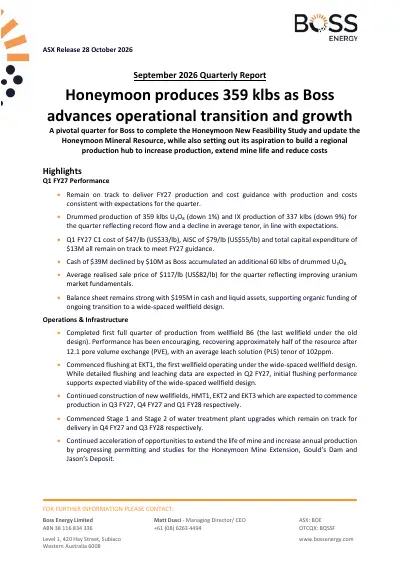
Thank you, Darcy. Good morning everyone, and thank you for joining the Boss Energy September quarterly results call.
Joining me on the call this morning is Justin Laird, our CFO. I'll take you through our first quarter performance, the transition underway at Honeymoon, and the work progressing across our regional growth projects, and we'll take questions at the end of the call.
Turning to slide two. The September quarter was pivotal for Boss.
We delivered the new feasibility study and updated the Honeymoon mineral resource, and established the foundation for the operation's future. We also set out our ambition to build a larger, low-cost, longer-life uranium business through a regional production hub.
Delivered ahead of schedule, the new feasibility study confirms the viability of the wide-spaced wellfield design. It forecasts approximately 13.8 million pounds of production over nine years, supporting economic production through to at least FY34, and provides a pathway to improve Honeymoon's cost structure.
The work also underpins the next stage of our strategy. At our September market day, we outlined our aspiration to bring Honeymoon, Jasons deposit, and Goulds Dam together through one processing plant, making greater use of the infrastructure we've already built.
Our aspiration is to produce 2.5 million pounds annually at an all-in sustaining cost of around $65 per pound by early 2030s. Achieving this will materially increase production, reduce unit cost, and extend operating life.
We also began the transition to wide-spaced wellfield design. Flushing commenced on EKT1, our first wide-spaced wellfield, and early performance has supported confidence in the design.
The first leaching results are expected in the December quarter and will provide the next operating evidence against our study assumptions. Alongside these strategic milestones, Honeymoon delivered 359,000 pounds of drummed uranium, supported by record flow, despite rainfall contributing to 19 days of lost production.
Production and costs were consistent with expectations, and FY27 guidance remains unchanged. We finished the September quarter with approximately $195 million in cash, investments, and uranium inventory, and no debt, supporting our capacity to fund the transition.
The quarter established a clear direction for Boss. Our task now is to turn that technical foundation into consistent operating performance, ramp up our production, and advance the regional opportunities that can build the long-term shareholder value.
Turning to slide three, and Honeymoon production. Drummed production was 359,000 pounds, broadly consistent with the June quarter.
Ion-exchange production was 337,000 pounds. Record flow helped offset the expected decline in average tenor as existing wellfields mature.
Heavy rain in August contributed to 19 days of lost production across the quarter. We brought forward some planned shutdown activities during this period.
We have several programs of work to build our operational resilience. B6 completed its first full quarter of production.
This is the first wellfield at East Kalkaroo, and its performance has been encouraging. It has achieved recovery of approximately half of the resource after 12 pore volumes exchanges, with an average leaching solution tenor of 102 ppm.
Flushing required only 0.6 pore volumes, with low calcium levels and acid consumption. For the December quarter, we expect production to be broadly consistent with September, with higher flows offsetting declining tenor.
Full-year production guidance remains at 1.25 to 1.3 million pounds. Turning to slide four.
We're now implementing the wide-spaced wellfield design, as set out in the new feasibility study. Honeymoon's high permeability, hydraulic connectivity, effective confinement, and low acid consumption provides the technical basis for this approach.
Wider spacing allows leaching solution more time to interact with mineralization, and access a larger area with fewer wells and less infrastructure. The design balances these benefits against a slower production response as spacing increases.
EKT1 is our first wide-spaced wellfield. Flushing has commenced, with encouraging early performance.
Final flushing data and the first leaching results are expected in the December quarter, which will provide further operating evidence against the NFS. The NFS assumes a 49-meter injector-to-extractor spacing.
EKT1 is testing 58-meter injector-to-extractor spacing, while HMT1 will test 70-meter injector-to-extractor spacing, allowing us to assess the performance of these wider-spaced wellfields against the study assumptions. Construction continues at HMT1, EKT2, and EKT3.
The encouraging leaching performance at B6, together with initial flushing response at EKT1, reinforces our confidence in the technical work underpinning the new feasibility study. Turning to slide five.
The water treatment plant upgrades are a key enabler of the production ramp-up outlined in the new feasibility study. Both stages remain on track.
Before a new wellfield starts leaching, we use treated water to condition and flush the wellfield. This manages calcium and chlorides.
The water treatment plant supplies the RO permeate water required for wellfield flushing, while also meeting ongoing plant requirements. Water treatment capacity therefore governs how quickly we can bring a new wellfield into production.
The NFS assumes approximately eight new wellfields each year, and each preconditioning and flushing takes approximately about 45 days. The staged water treatment upgrades are built into the development schedule and the resulting production profile as outlined in the new feasibility study.
Stage 1 improves the capacity and availability of existing plant, and we expect to complete this work in June quarter of FY27. The work addresses nine debottlenecks, improves our cleaning requirements, softening settling performance, and hydraulic constraints.
Stage 2 provides major capital expansion required for the life-of-mine schedule, with completion expected in March quarter of FY28. This is targeting approximately 300 cubic meters per hour of RO feed.
We also see opportunities to improve the ramp-up by reducing the water requirements for first flushing and wellfield conditioning. The NFS assumes one pore volume of flushing, compared with historic operating averages around about 0.7.
We've also commenced studies to better understand calcium distribution and behavior, and to access alternate approaches to acidification and preconditioning. The aim is to reduce our permeate demand and potentially decouple wellfield conditioning from water treatment plant circuit, providing greater flexibility in bringing on new wellfields online.
Turning to slide six, and cost. C1 cost for the quarter was $47 per pound, compared with $45 in June.
All-in sustaining cost was $79 per pound, compared with $70 in June. Both measures are below the full-year guidance range.
We expect unit costs to increase as average tenor declines through the year. We're on track to remain within our FY27 guidance range for cost.
Total capital expenditure was $13 million. This comprised $9 million of sustaining expenditure, primarily EKT1 first fill costs and construction activities across new wellfields, and $4 million on processing facilities.
Sustaining expenditure was slightly below expectation because rain temporarily interrupted drilling and construction. Process facility expenditure was in line with expectations and remains weighted towards the second half of FY27.
Full-year capital guidance remains at $58 to $65 million, comprising $33 to $37 million of sustaining capital and $25 to $28 million for process facilities. As outlined in August, FY27 is a transitional year.
Turning to slide seven. Our balance sheet supports the transition, while retaining exposure to uranium price.
We sold 301,000 pounds of uranium during the quarter, generating sale revenues of around about $35.2 million. The average realized price was $117 Australian per pound, or $81.8 US per pound, up approximately 9% from the June quarter.
We expect stronger realized pricing in the December quarter at approximately $87 to $89 US per pound. At the end of September, we held $39.2 million in cash, $31.4 million in investments and other liquid assets, and uranium inventory carried at $124 million.
Together, these totaled $194.9 million, with no debt. Cash decreased by $10.5 million during the quarter as we continued to fund operations and capital investment.
At the same time, uranium inventory increased by approximately 60,000 pounds, to 1.641 million pounds. The chart illustrates the potential market value of the uranium inventory.
At a uranium price of US$90 per pound and exchange rate of 70 US cents, the inventory would be valued at approximately Australian $211 million. The accounting carrying value remains the lower of the cost and net realized value.
Our uncontracted position and uranium inventory provides commercial flexibility and exposure to stronger uranium prices. Our balance sheet supports funding the transition to wide-spaced wellfield spacing from existing resources and ongoing sales.
Turning to slide eight. As we outlined at our market day, our regional hub strategy aims to build a longer-life, low-cost operation by bringing three deposits together through the existing processing plant at Honeymoon.
The NFS provides the foundation for this strategy, which just covers the Honeymoon deposit. Jasons deposit and Goulds Dam contain a further 45.1 million pounds of reported mining mineral resources, bringing the total combined resources across three deposits to 65.9 million pounds.
We're assessing how Jasons and Goulds Dam could utilize the infrastructure and processing capacity already established at Honeymoon, reducing the capital investment required to develop these deposits. The studies include a trunkline connecting Jasons to Honeymoon and a satellite loaded resin facility at Goulds Dam for transport to the existing plant.
This would allow uranium recovery at both deposits to be processed through Honeymoon's downstream facility. The potential benefits include lower capital requirements through the use of existing infrastructure, staged investment at each of the deposits as they advance, and greater operational flexibility.
Increasing production through a shared plant would also spread our fixed costs over more pounds, supporting lower unit cost. Our aspiration is to increase production to 2.5 million pounds per annum at an all-in sustaining cost of approximately Australian $65 per pound by the early 2030s, while extending the operation life into the 2040s.
Turning to slide nine. We progress the approvals and technical work required to define the development pathways for each deposit.
For the Honeymoon mining extension, we have submitted the EPBC referral and expect a referral decision in the December quarter. Preparation of the mining lease application continues.
At Jasons deposit, technical work required for the referral stage is complete, environmental studies are nearing completion, and the EPBC referral documentation is well advanced. Diamond core drilling has commenced, with 15 holes planned for approximately 1,900 meters, to improve our understanding of hydrogeology, mineralogy, and mineralization.
A resource delineation program comprising of about 137 drill holes for approximately 15,600 meters is scheduled to commence in the December quarter. The program aims to improve confidence in existing resource and increase the resource through testing known mineralization extensions.
At Goulds Dam, studies are underway to access the preferred processing configuration, including the opportunity to load uranium onto resin on site and transport it back to Honeymoon for processing. Turning to slide 10.
At Alta Mesa, where Boss holds a 30% interest, with enCore Energy being the operator. Alta Mesa produced 10,000 pounds during the quarter on a 100% basis, compared with 45,000 pounds in the June quarter.
Boss received no product during the quarter. State permitting delays prevented new wellfields from coming online in time to replace declining production from existing wellfields.
Plant production has now stopped pending the availability of new wellfields. PAA3 is expected to commence production in December quarter, followed by PAA8 in the March quarter, both subject to permitting.
Securing these approvals and bringing the new wellfields online remains the immediate priorities for enCore. Turning to slide 11.
This was a significant quarter for Boss. We delivered production and costs consistent with our expectations, and completed the new feasibility study for Honeymoon.
Drawing on historic operating data and detailed technical analysis, the new feasibility study established the foundation for the next phase of development. At our market day, we also outlined our ambition to build a longer-life, lower-cost operation through a regional processing hub.
We're now putting that work into practice through the transition to wide-spaced wellfield spacing. Flushing commenced at EKT1, construction progressed across the new wellfields, and both stages of the water treatment upgrades remain on track.
These activities advance the production ramp-up as outlined in the new feasibility study. FY27 production guidance remains unchanged at 1.25 to 1.3 million pounds, with C1 costs of $51 to $56 per pound and all-in sustaining cost of $83 to $92 per pound.
Our debt-free balance sheet supports this work, while our uncontracted position retains exposure to stronger uranium pricing. In parallel, we're advancing the studies to approve and approvals for the regional hub, taking a disciplined approach to capital as each opportunity develops.
I would also like to welcome Peter Botten, who commenced as chair on the 30th of September, and thank Wyatt Buck for his contribution as chair and his continued service to the board. This quarter established a clear pathway forward.
We recognize that confidence we will build through consistent delivery, operating safely, delivering the transition reliably, and progressively improving our cost structure and production profile. This is our focus for the quarters ahead.
Thank you, and with that I'll hand you back to Darcy for questions.
Operator
Thank you. If you wish to ask a question, please press star one on your telephone and wait for your name to be announced.
If you wish to cancel your request, please press star two. If you're on a speakerphone, please pick up the handset to ask your question.
Your first question comes from Hugo Nicolaci with Goldman Sachs. Please go ahead.
Hugo Nicolaci
Morning Matt and team, thanks for the update this morning. Maybe just firstly on Honeymoon, your production in the quarter for 1Q sort of well above your implied guidance range for the full year despite bringing some of that maintenance forward and you're guiding to a consistent IX production next quarter, which would then imply obviously a step-down in the second half.
Can you just walk us through how much of that's conservatism versus uncertainty around the grade into that second-half outlook?
Matt Dusci
Good question, Hugo. Look, we've provided that guidance of 1.25 to 1.3, but ultimately we're always trying to try and do better.
When we've outlined the new feasibility study, we've also outlined opportunities to accelerate that ramp-up profile. What we'll see for FY27 is we'll see grade decline slightly as we transition to these wide-spaced wellfields, trying to get that transition right's quite important for us.
Ultimately, too, if we can start to drive some of the optimization work programs we're doing on top of what we delivered at the new feasibility study, then I'm hopeful some of that may come in for back end of FY27. Right,
Hugo Nicolaci
oh, that's helpful. Then sort of second one just on your contract book: you've guided to realizing $87 to $89 a pound next quarter, and then 124,000 lb a quarter for the legacy contract in the second half.
Can you just confirm that's essentially 100% of that legacy contract for FY27 gets delivered in the second half, so that December quarter realization's essentially entirely at spot?
Justin Laird
Hi, Hugo. Justin here.
You're right that for the legacy contract deliveries in '27, that represents 100% of the legacy contract deliveries for calendar year 2027.
Hugo Nicolaci
Got it. Then for calendar year 2026, does that mean you've met your contract deliveries already at the September quarter, and then the December quarter is all spot pricing?
Justin Laird
For calendar year 2026, our contract book is mostly full. We currently have pre-executed forward sales for the Q4 calendar year 2026.
Hugo Nicolaci
Got it, that's helpful. Then just last one, if I can, on Alta Mesa.
Production there halted. Can you just walk us through what your understanding of the timeline is from here and does this potentially add additional costs when you start to add wells back in and bring the plant back online versus if production was just continued, rather than stopped?
Matt Dusci
I'll answer some of that question. You mean, final permitting on PAA3 extension and PAA8, they're expected in December and March quarters respectively.
As those permits come in place, production profiles would ramp up. It would be fair to think that cost structures while you're in this intermediate phase of not producing plus ramping up would be impacted.
Hugo Nicolaci
Got it, that's helpful. I'll pass it on.
Thanks, guys.
Matt Dusci
Sorry, Hugo?
Operator
Thank you.
Matt Dusci
Thanks.
Operator
Your next question comes from Alistair Rankin with RBC. Please go ahead.
Alistair Rankin
Oh, thanks. Good morning, Matt and Justin.
Just the first one about EKT1 wellfield. You said that the early flushing has supported confidence in the new feasibility study design.
Respect that you're going to give a bit more detail next quarter, but so far can you just talk through what you've actually sort of observed so far that has allowed you to sort of make that statement about growing confidence?
Matt Dusci
Yeah. Hey, Alistair.
Commentary in the quarter was we've got confidence on that initial results of what we're seeing out of flushing. We haven't completed all the flushing, but we expect to be in a position to do that shortly and bring EKT1 online and producing again shortly.
Why we say there's confidence, and there's a couple of things that drive that language and why. Results to date, we see contact between injector and extractor wells, we know we've got hydraulic connectivity on that spacing cuz we've seen the contact between those.
What we've also seen is pH come down, and sulfates increase, and that most importantly, we've seen that over the expected time frames and pore volumes that we've assumed. With pH coming down, contact between injector and extractors, pH of the wellfield now sitting about 2, and achieving those over the right times and pore volumes, leads us to that statement that we've got confidence, given initial data of what we have at the moment.
In terms of what we will do is we will provide more data in the next quarter because by that time we'll have initial leaching data come through.
Alistair Rankin
That's really helpful. Appreciate that, and look forward to next quarter.
Just also on wellfield B6, I think you mentioned that recovered about half its resource after 12 PVE, pore volume exchanges, which looks like a pretty good result. Then also low acid consumption as well.
I guess how does that compare with the model? How does that compare with your model, like what your model was predicting, and I guess what does that tell you about East Kalkaroo relative to the Honeymoon domain, because that's where the upcoming EKT wellfield has been built?
Matt Dusci
Yeah. It's roughly similar to the model, but slightly better than what we've assumed under the model.
Why we have that commentary in there is there was always this uncertainty whether East Kalkaroo is different to Honeymoon, how it will perform, and the result to that is, look, we think East Kalkaroo will perform as well, if not better than natural Honeymoon domain. Honeymoon domain, from a system and mineralization perspective, is probably the most complicated part of Honeymoon, although it's the highest grade.
From a leaching characteristic perspective, it's probably the most complex of the full Honeymoon deposit.
Alistair Rankin
Gotcha, that's really helpful. Thanks.
Operator
Thank you. Your next question comes from Branko Skocic with J.P.
Morgan. Please go ahead.
Branko Skocic
Morning, guys. Just on Honeymoon, I was keen to understand your views around recoveries and how you expect these to trend as the lower-grade material comes through the plant over the coming quarters.
I've noticed that recoveries have been stepping down, only marginally, just as the tenors have been declining over the last 6 to 9 months.
Matt Dusci
Yeah. It's roughly in line with expectation at the processing plant.
We have been doing a little bit of trials on elution and elution circuits and sequencing. What that has done is led to some variability and a little bit of recovery associated with the front end of the process plant as we continue to optimize because we also brought in all those additional columns.
It's important to note that the front end of the plant, that recovery just gets recirculated. The key recovery element where you lose metal is in the precip circuit, and that's holding good.
Branko Skocic
All right, that makes sense. Second question for me was just on Alta Mesa, and I'm really just trying to get a sense for your go-forward strategy here and whether you'd be open to putting the asset under strategic review.
Matt Dusci
As we talked in the market day, our immediate focus for myself and Justin and the team has really been on Honeymoon, but now we've got that feasibility behind us, it's something that we will consider associated with Alta Mesa. One element I'm keen to ensure that we always do is as a business, we remain disciplined on capital.
We need to generate shareholder returns on our capital investment and make sure that that's part of us as an organization, us as a culture, and us as a business. It's fair to say if we're not seeing capital returns, or expected capital returns, for shareholders, then as a business, we've got to make decisions.
Branko Skocic
No, it definitely makes sense. If I can just stay on that point just for a second, just get a sense for I guess your quarterly cash contributions towards that JV.
It's just a little bit difficult to see in the accounts. I'm sure it's in there.
Justin Laird
Hi, Branko. Justin here.
Thanks for the question. You're right.
Not much cash contributed to the joint venture. You would have seen in the June '26 accounts that there's a payable recorded to the joint venture.
That payable has grown a little bit during the quarter, but largely remains consistent with what was in the June accounts.
Branko Skocic
Makes sense. Appreciate your time.
Thank you.
Operator
Thank you. Your next question comes from Daniel Roden with Jefferies.
Please go ahead.
Daniel Roden
Hey, guys. Thanks for taking the question.
Just wanted to ask on I guess your I guess cash and inventory balance. Going back to your strategy day and sort of strategic outlook, you have a target to be at a minimum $50 million of cash, which we're under at the moment.
I guess noting that there's a bit of capital commitments going into Honeymoon wide-space and Alta Mesa, and there's a bit of capital as well. I guess how do you think about I guess buffering the I guess liquidity in your cash balance from a capital management perspective?
Justin Laird
Hi, Daniel. Justin here.
Thanks for your question. Our capital priorities will remain consistent with that market day, you would have seen that during the quarter, cash balance reduced to $40 million, and we accumulated that additional 60,000 lb of inventory.
We try to balance that cash requirement and sales as needed. As an example for the quarter, had we sold those 60,000 lb during the quarter, we would have achieved a realized price around that $82 US a pound.
By accumulating that 60,000 lb, it will probably mean that if we sell those pounds in either Q4 calendar year 2026 or Q1 calendar year 2027, we'll probably receive a realized price in the low 90s. We continue to expect that uranium price to increase, and therefore we balanced that sales book to match our cash flow profile.
To the extent that capital is lumpy, then we will balance that sales profile to meet that lumpy capital requirement.
Matt Dusci
Yeah. While as part of that strategy, we're trying to keep that 40 to 60 US capital, Australian capital.
Daniel Roden
Yep, no, I appreciate the color, guys. Maybe just on the I guess cash operating costs for the quarter, on a cash dollar millions basis was a bit of a step-up.
Was I guess the payables timing, royalties, pull-forward of shutdown work, can you maybe pick a little bit of what that step-up from, I think last quarter was about 15, and then we stepped up to about 22 million dollars on cash operating costs? What's there?
How do we bridge that?
Justin Laird
Yeah. If you look at the C1 cash cost and then the variance in terms of that cash operating cost, there was a difference of about $5.4 million.
That $5.4 million was comprised of $2.2 million of royalties, which is included in that cash operating cost line, but not in the C1 cash cost. There's an additional $1.2 million in consumables, which was mainly purchases of resin for the ion-exchange columns.
Then there was some additional working capital movements, there was about a million in trade payables, $0.7 million in prepayments, and $0.2 million in selling costs.
Daniel Roden
Yep, okay. No, thanks for that.
Oh I'll hand it over. Thanks, guys.
Operator
Thank you. Your next question comes from Mark Wiseman with Macquarie.
Please go ahead.
Mark Wiseman
Oh, good day, Matt and Justin. Thanks for the update here today.
My first question's just on the resilience of the operations there at Honeymoon, the rainfall impact. If you hadn't drawn down metal from the circuit, it maybe would've been a little bit soft.
I'm just wondering, these rain impacts that seem to be recurring, is there anything you can do to build more resilience? Is it about roads or reagent inventory at the site?
Is it something you're thinking about?
Matt Dusci
Thanks, Mark. Good question.
In August, we had two events, two rainfall events totaling 100 100 mil, you can imagine a 100 mil events, that sort of rainfall does have a significant impact on site, and we have seen more rainfall events having impacts. There's a couple of elements to that on how we actually build this business resilience, and now we've got this plan of building out a long-life, low-cost operation, then we can actually really do some of these programs of work to drive that resilience as a good operation would.
When you talk about rain, and business resilience is not just associated with rain, but other elements that we can continue to drive improvement and assets across the business. From a rain perspective, there's a couple of elements that have impact.
One is site access, including getting reagents to site. Second element is our reagent storage, and in how much reagents we store on site.
Then the third element is associated with access to wellfields, how do we access the wellfields, ensure that we don't have to turn wellfields off just because it's wet. Then there's programs of work associated with each three elements of what I just described to build that resilience through adverse rain events.
Mark Wiseman
That's great. Would any of those have a material impact on reagent inventories or sustaining CapEx to address some of these items, or is it all smaller-ticket sort of things?
Matt Dusci
Smaller-ticket things.
Mark Wiseman
Okay. I just had one other question on Alta Mesa, following on from the other discussions.
Is there a scenario where you're going to have to inject more funds into that JV in any material way, particularly if you weren't going to be willing to do that? It seems like without any production coming in, there's probably going to be some cash calls there to prepare for the next phase.
Matt Dusci
That would be a fair assumption, but it's a little bit far too early for us to comment.
Mark Wiseman
Okay. Thanks.
Operator
Thank you. Your next question comes from Glyn Lawcock with Barrenjoey.
Please go ahead.
Glyn Lawcock
Morning, Matt, Justin. Can I just ask on that question on Alta Mesa, then?
Can you give us a sense of what the balance sheet at Alta Mesa looks like at the moment, like how much cash they've got? Is there anything you can help us understand?
What is
Matt Dusci
I can't comment on that, Glyn. We're working under a joint venture and a joint venture structure.
Glyn Lawcock
All right. We just have to wait, but I guess you'll tell us if and when you had to put cash in.
Matt Dusci
Exactly, and just as a business, we want to drive shareholder value, we recognize that Alta Mesa, with that production rate ramp-down, having said that, enCore's working hard to get that production up. They're working closely with regulators to get those additional wellfields up and running.
You can imagine that's a priority for them as a business as well.
Glyn Lawcock
Maybe you can just help us understand the options, then? If it needs additional funding, does it necessarily have to be a cash injection from the two owners, or are there other options you're contemplating as well?
Matt Dusci
It's again too early for us to comment, Glyn.
Glyn Lawcock
Cool. Then maybe just on your aspirational target next decade, 2.5 million pounds per annum at all-in sustaining cost you gave us, I believe from memory you're permitted to 3.3.
Is that still correct? Is 2.5 just your early estimate at the moment, or what's your confidence level around 2.5?
Could you push the envelope and push us towards the permit? Thanks.
Matt Dusci
Yep. The 2.5 is really what the back end of the plant could do.
It will require a little bit of capital injection in the precip and probably some, again, it's business resilience/runtime improvements. Under the 2.5, that's the lightest capital scenario.
Once you've delivered that light capital scenario, then you'd be looking at what additional capital you would need and the return on that capital to get production rates beyond the 2.5, which would mean further capital in the back end of the processing plant. The Honeymoon permit from an export perspective is at that 3.3.
Glyn Lawcock
Okay. This is really like a phase one of maybe what could be a couple of phases if all went to plan, you could maybe look at phase one, phase two, and ultimately, if the economics stack up, push towards 3.3.
There's nothing outside of the economics that you would see to prevent 3.3?
Matt Dusci
Exactly. The 2.5 is quite a simple stage because that's least capital required.
Glyn Lawcock
That's just really the pipeline from one and the trucking road from the other, really?
Matt Dusci
Correct.
Glyn Lawcock
All right. Thanks a lot.
Operator
Thank you. Your next question comes from Alistair Rankin with RBC.
Please go ahead.
Alistair Rankin
Follow-up, guys. Just further to the regional hub and around Jasons deposit, understand that you're advancing that EPBC referral documentation and you commented that the technical work is completed, which is good.
I'm wondering if you could remind us what additional testing you're going to do at Jasons. I think you've got some upcoming drilling going on as well, some delineation drilling.
Just what additional work you need to do there and to build your confidence about committing to that satellite deposit.
Matt Dusci
Yeah. It's a good question.
Specifically on Jasons, there's a series of programs of work to get that into a financial investment decision, and that would be at feasibility, pass feasibility level. We are undertaking that work.
First pass of that work is this delineation drilling that we're committing to. That drill rig's about to go out next week, and they'll complete that over the next 2 to 3 months of that delineation drilling.
That'll feed into a new resource model. We'll do the reactive transport wellfield simulations, we'll make sure all the permeability modeling's complete, and ultimately, too, do some additional leaching characteristics, which have been preliminarily done.
That will all feed to a feasibility study and into a FID.
Alistair Rankin
Thank you.
Operator
Thank you. Your next question comes from Matt Hope with Ord Minnett.
Please go ahead. Hi,
Matt Hope
yeah. I was just interested in B6.
You said you used the old wellfield spacing at 30 by 30, and you seem to have had strong recoveries. Does that suggest that potentially moving to the wide-spaced model was premature, and the old spacing would work across East Kalkaroo, or is there something different about B6?
Matt Dusci
No, it just means leaching characteristics, we're seeing strong leaching characteristics. They're all positive leaching characteristics at Kalkaroo, Far East Kalkaroo, and as a result of having evidence of good leaching characteristics, it's fair to say that those characteristics would also apply to the wide-spaced wellfield design.
Matt Hope
Would the tight space from what you've seen so far have worked anyway, and recovered what you originally had in the enhanced feasibility study from just from what you've seen on B6 so far?
Matt Dusci
Remember the wide-spacing provides better optimization than the tight spacing under hydraulic conditions, permeability, and also leaching characteristics. Although we're seeing good leaching characteristics out of the close spacing, which is a positive, the optimized route is still this wide-spaced wellfield design, and that's again to drive cost and cost structure.
Matt Hope
Cool. Thanks very much.
Operator
Thank you. There are no further questions at this time.
I'll now hand back to Mr. Dusci for closing remarks.
Matt Dusci
Thanks, Darcy, and thank you everyone for joining us today on the call. This quarter really established the technical foundation through the new feasibility and set our ambition for what we want to do with the operations, and that's ultimately to develop a long-life, low-cost operation.
For us and the team, our focus really is on consistent delivery, progression that wellfield transition, and delivery against FY27 plans, and look at how we continue to improve and strengthen the business. We look forward to updating you on the progress next quarter.
Thank you, everyone.
Operator
Thank you. That does conclude our conference for today.
Thank you for participating. You may now disconnect.