Brown & Brown, Inc.
Q3 FY2026 · Earnings Call TranscriptOctober 27, 2026
Operator
Good morning and welcome to the Brown & Brown, Inc. Third Quarter Earnings Call.
Today's call is being recorded. Please note that certain information discussed during this call, including information contained in the slide presentation posted in connection with this call and including answers given in response to your questions, may relate to future results and events or otherwise be forward-looking in nature.
Such statements reflect our current views with respect to future events, including those relating to the company's anticipated financial results for the third quarter and are intended to fall within the safe harbor provisions of the securities laws. Actual results or events in the future are subject to a number of risks and uncertainties and may differ materially from those currently anticipated or desired or referenced in any forward-looking statements made as a result of a number of factors.
Such factors include the company's determination, as it finalizes its financial results for the third quarter, that its financial results differ from the current preliminary unaudited numbers set forth in the press release issued yesterday, other factors that the company may not have currently identified or quantified, and those risks and uncertainties identified from time to time in the company's reports filed with the Securities and Exchange Commission. Additional discussion of these and other factors affecting the company's business and prospects, as well as additional information regarding forward-looking statements is contained in the slide presentation posted in connection with this call and in the company's filings with the Securities and Exchange Commission.
We disclaim any intention or obligation to update or revise any forward-looking statements, whether as a result of new information, future events or otherwise. In addition, there are certain non-GAAP financial measures used in this conference call.
A reconciliation of any non-GAAP financial measures to the most comparable GAAP financial measure can be found in the company's earnings press release or in the investor presentation for this call on the company's website at bbrown.com by clicking on Investor Relations and then Calendar of Events. With that said, I will now turn the call over to Powell Brown, President and Chief Executive Officer.
You may begin.
Powell Brown
Good morning, everyone, and welcome to our third quarter earnings call. Before we get into our performance for the quarter, we wanted to recognize the 5,000-plus teammates from our Accession acquisition that marked their 1-year anniversary on August 1st.
It's amazing what we've accomplished over a relatively short period of time, and we look forward to everything we will accomplish together in the future. A bit later, we'll provide additional color on our accomplishments and the first year of performance.
Additionally, we'd like to highlight that last week, our board of directors raised our dividend by 9%, which represents an increase for the 33rd year in a row. Now, let's move on to our results for the quarter.
In total, our overall financial performance represented a continuation of the improvement we delivered last quarter. Retail had a good quarter and performed above the top end of our expectations.
Specialty distribution had some incremental headwinds and came in below our expectations, which we'll talk about in a few minutes. Our overall improvement was the result of utilizing our robust specializations to win more new business.
I'll provide some comments regarding our performance, the insurance markets, and our customers. Then Andy will discuss our financial performance in more detail, including a first-year recap for Accession.
Lastly, I'll wrap up with some thoughts on our AI journey and closing comments regarding outlook. Then we'll open the call up to Q&A.
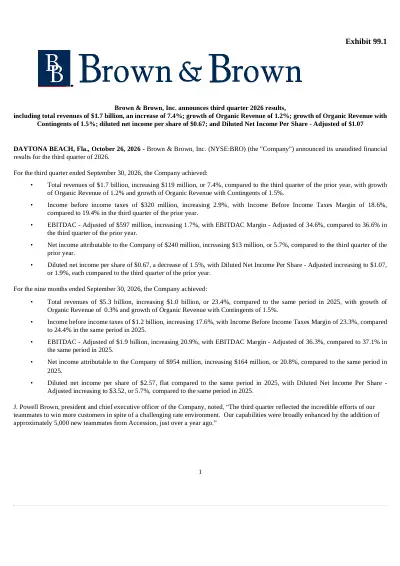
I'm on slide 5. For the third quarter, we delivered revenues of $1.7 billion, growing 7.4% in total.
Organic revenue increased 1.2% from the prior year and 1.5% when including organic contingents. Our adjusted EBITDAC margin decreased 200 basis points to 34.6%, and our adjusted earnings per share grew nearly 2% to $1.07.
Through the first nine months of 2026, we generated strong cash flow from operations and repurchased $750 million of our shares. That includes $250 million in Q3.
On slide number 6, from an economic and customer investment standpoint, conditions in the third quarter were consistent with the first half of the year. Sentiment remained relatively stable, but varied based on industry and customer size.
Some customers were more bullish than others regarding their level of hiring or investments and we were generally influenced by exposure to inflation and interest rates. Rate changes this quarter were fairly consistent with the first half of '26.
Rates in the admitted market moderated downward slightly compared with the first half of this year. Casualty and auto rates continued to increase, with primary casualty generally up 2% to 5%, although the pace of increases for auto moderated slightly in some regions.
Excess and umbrella layers continue to see the largest increases and capacity continues to tighten for certain classes. Non-CAT property moderated downward and was generally flat to down 5.
Workers' compensation rates continue to decrease at rates similar to the first half of 2026. Outside the US, commercial rates in the UK, Ireland, and the Netherlands remain modestly negative, with larger accounts seeing greater decreases than smaller accounts.
Shifting to the E&S markets, property rates decreased 15% to 35%, and casualty rates continue to increase at a pace similar to the first half, with transportation and excess casualty remaining quite difficult to place. For employee benefits, medical rates increase 9% to 11% driven by high-cost claimants and surging health care costs.
Materially higher medical and pharmacy costs are more pronounced for smaller fully-insured groups. These cost pressures continue to create demand for our advisory and consulting capabilities as customers need to evaluate plan designs, employee contributions, and alternative funding arrangements, including self-funded and captive solutions.
Overall, when we step back and look at both the economy and the insurance market, customers are operating with discipline, while overall growth and investment levels remain steady. The insurance market continues to be competitive for many lines, while casualty pressures persist.
In these market conditions, we believe our capabilities position us well to win more new business and help our customers navigate this complex landscape. I'm on slide number 5.
Let's transition to the performance of our two segments for the third quarter. Retail delivered organic growth of 2.6% and 2.5% when including organic contingents.
These growth rates reflect continued incremental improvement in our net new business and good performance within our employee benefits and bond practices. In addition, the growth was driven by the alignment of our teams to enhance collaboration, identify incremental opportunities, and generate new business wins that leverage our capabilities.
Turning to Specialty Distribution, organic revenue growth for the quarter was down 80 basis points and increased 30 basis points, including organic conditions. As we discussed last quarter, we anticipated organic growth of +2% to +4% for the second half of the year.
The third quarter performance was below our expectations due to several factors. First, the desire of admitted carriers to write more business and the abundance of capital drove incrementally more downward pressure during the quarter.
For binding and personal lines accounts, we realized incremental movement from the E&S market into the admitted market. As an example, we're seeing admitted carriers now wanting to write in California and Texas.
In addition, available capacity drove prices and terms downward even further for certain programs, primarily commercial earthquake. As we've mentioned previously, our disciplined approach to underwriting means we will walk away from business at certain times with the objective to balance organic growth and profitability.
Second is our lender-placed program. While we did realize the $10 million of revenue delayed from last quarter, this same amount was offset by another delay on onboarding a portfolio of loans.
When our customers acquire portfolios, they provide an estimate of loans as well as projected onboarding timelines. Due to size and complexity, the volume and timing can change over quarterly periods.
We anticipate onboarding these loans during 2027. Finally, a quiet storm season resulted in lower than anticipated flood claims processing revenue.
Areas where we delivered growth were in brokerage and programs for casualty, professional liability, and public entity lines. In our CAT-exposed lines of business, we saw increased policies in force, even though our revenues declined due to significant rate decreases.
Despite Specialty Distribution facing cyclical headwinds as CAT property rates declined and some policies returned to the admitted market, we have a great business. It's differentiated capabilities, a broad global distribution network, and world-class carrier partners.
This has enabled our team to deliver double-digit organic growth over the past five years and organic growth above 8% over the past 10 years. We've been through cycles like this and have confidence that our team knows how to navigate this market for the long-term success.
Now, I'll turn it over to Andy to discuss our financials in more detail.
Andy Watts
Great. Thanks, Powell.
Good morning, everybody. I'll dive a bit deeper into our consolidated results and certain non-GAAP financial measures.
As a reminder, when we refer to EBITDAC, EBITDAC margin, income before income taxes, or diluted net income per share, we're referring to those measures on an adjusted basis. We delivered total revenues of $1.7 billion, growing 7.4% as compared to the third quarter of 2025.
We had another good quarter for contingent commissions that grew by over 8% on an organic basis. Income before income taxes increased by 1.3%, and EBITDAC grew by 1.7%.
Our EBITDAC margin was 34.6%, a 200-basis-point decrease from the third quarter of the prior year. Over half of this decrease was driven by approximately $29 million of lower interest income as compared to the prior year when we were holding cash for the acquisition of Accession.
Our effective tax rate for the quarter was 25.5%, slightly higher as compared to 24.7% in the third quarter as a result of an increase in state taxes. Diluted net income per share increased by 1.9% to $1.07, with growth slower than revenues due primarily to the higher investment income in the prior year.
Lastly, our dividends paid per share increased by 10% as compared to the third quarter of 2025. Moving on to slide number 9.
The Retail segment grew total revenues by 10.8%. This expansion was driven by the combination of acquisition activity during the past year and organic growth.
Regarding the litigation impact associated with individuals who left and joined a startup broker, current period adjustment to organic revenue was $16 million. Based on currently available information, we are not changing our previously communicated expected full-year impact for 2026 of $50 million to $60 million.
Our EBITDAC margin expanded 10 basis points from the third quarter of last year. The increase was driven by disciplined expense management, revenue phasing from Accession, and the impact of synergies.
Moving on to slide number 10. Specialty Distribution grew total revenues by 8.5%, driven by the acquisition of Accession.
Our EBITDAC margin decreased by 60 basis points to 43.3% due to lower organic growth and investments in our European wholesale capabilities. Moving on to slide number 11.
Turning to Accession. The third quarter marked the first anniversary of the acquisition.
During the past year, over 5,000 new teammates have become part of the Brown & Brown team. Pleased with the cultural alignment, financial performance of the business, and the progress of our integration efforts.
During the first year, Accession generated approximately $1.7 billion of revenue as well as EBITDAC margins and accretive diluted earnings per share that were substantially in line with our expectations. Regarding our EBITDAC synergies, we previously communicated our full-year estimate for 2026 would be in the range of $30 million to $40 million.
Based on the efforts of our teammates, we're increasing our full-year 2026 expected benefit to approximately $50 million. The incremental synergies reflect strong execution across the organization and include operating efficiencies, enhanced carrier engagement, and the continued alignment of our go-to-market capabilities.
We are now targeting run-rate net EBITDAC synergies of $175 million by the end of 2028, up from the $150 million previously anticipated. Regarding integration costs, when we announced the acquisition, we estimated incurring $200 million to $250 million over the first three years.
With the higher expected synergies, we are increasing our range to $250 million to $300 million. In addition, GAAP requires that we expense certain prefunded or debt-like items that approximate $90 million.
As such, they will be recorded incrementally to the $250 million to $300 million. From an integration standpoint, we have made incredible progress.
Key milestones include aligning leadership structures, operating models, and brands. We also harmonized teammates benefits and producer compensation, integrated financial and HR systems as well as controls, consolidated offices and selected businesses, and refined our carrier engagement strategies.
We want to thank all our teammates for their incredible efforts to achieve these major milestones in the first year. While substantial work has been completed and there's still more to do, we believe the hardest part is behind us.
We see meaningful opportunities on the horizon as our teams collaborate more closely, leverage broader capabilities, and create new opportunities to serve customers and carrier partners. Pleased with the performance of the Accession business and teammates for the first year.
We also remain confident in our ability to deliver incremental organic growth, margin expansion, and long-term shareholder value on a company-wide basis. We've got a few other comments.
Transitioning to cash flow and the balance sheet. We generated $1.1 billion of cash flow from operations, increasing approximately $135 million, or 13%, as compared to the first nine months of 2025.
Our ratio of cash flow from operations to total revenues was 22% for the first nine months and was substantially in line with the prior year. We anticipate continued strong cash generation in the fourth quarter and will balance our deployment of capital between hiring people to help us grow organically, share repurchases, deleveraging, and M&A.
Regarding outlook and taking into consideration the improvement we've delivered over the past couple quarters, we are now anticipating Retail's organic growth, excluding contingents, to be in the range of 2% to 3% for the fourth quarter. For Specialty Distribution, based on our earlier comments regarding market headwinds as well as the incremental negative impact of certain nonrecurring and timing-related items of $8 million to $12 million, we're anticipating organic growth, excluding contingents, to decline 2% to 4% in the fourth quarter.
As it relates to 2027, currently in the process of finalizing our budgets, and based on what we see today, we are expecting improving organic growth, excluding contingents, for both divisions. For the Retail segment, we're projecting organic growth in the range of 2% to 4% and 1% to 3% for Specialty Distribution segment.
Once we finalize year-end results, we'll clarify or adjust the ranges based on incremental information. Few other comments regarding contingent commissions.
Within Specialty Distribution, taking into consideration accrual adjustments in the fourth quarter of last year and anticipated adjustments in the fourth quarter of this year, we're anticipating our year-over-year contingent commissions for Specialty Distribution to decrease $14 million to $16 million in the fourth quarter as compared to the fourth quarter of 2025. With that, let me turn it back over to Powell for an update on our AI initiatives and closing comments.
Powell Brown
Thanks, Andy. Good report.
We want to update you on the progress of our AI initiatives. 90 days ago, we announced a partnership with McKinsey, Accenture, and Anthropic to further strengthen our business with an AI-first mindset.
This phase has four priorities: enhance our technology foundations, further equip our teammates with new skills and tools, evolve how we operate, and most importantly, deliver better outcomes and experiences for our customers. Our efforts are surrounded by a responsible framework anchored in strong cybersecurity and governance that was designed to accelerate our years of investment in data analytics and technology.
Our latest accomplishments include completing a comprehensive assessment of our technology environment, building a governance and cybersecurity structure so the AI use cases and agents operate within clear controls, and establish a value management office to measure investments and returns by initiatives. We've also moved quickly to deploy incremental AI capabilities in addition to all teammates having access to Co-Pilot over the past year.
In just 45 days, we deployed Claude to over 6,000 teammates with more than 90% actively using the platform. We're also in the process of rolling out Claude to the next group of teammates.
From an implementation standpoint, we're using AI throughout the insurance placement process across most of the company, including prospecting, submissions, claims analysis, analytics, and data extraction, just to name a few functions. Our continued experiences and results reinforce our view AI is not a disruptor to our model, but rather is an accelerator.
Everything we've built and will build is to help our teammates serve customers better. This is the idea behind Compass, which we announced in our press release last week.
Compass is a connected intelligent ecosystem that integrates AI-powered capabilities with our proprietary data analytics and specialized knowledge within our Retail segment to support important risk management decisions and recommendations. By the end of this year, we expect Compass-powered assistants and business intelligence solutions to reach thousands of teammates, with an expanded suite of customer solutions planned throughout 2027.
We're building out our 2027 plan and will outline it, including investments and related benefits, when we release our year-end earnings. To give a preview, we will not announce a multiyear, multi-hundred-million-dollar program.
This landscape is evolving quickly, and we believe the prudent approach is a one-year measurable tranches that tie the dollars we invest more closely to the returns that we expect. Now, a few final comments.
From an economic perspective, we expect conditions in the markets in which we operate to remain stable and relatively consistent with what we've seen through the first nine months of the year. As a result, we expect investment and hiring to continue at levels similar to the last few quarters, with some companies deferring larger capital investments.
As our customers have done in the past, they will navigate current challenges and capture opportunities to deliver growth. From a pricing standpoint, we expect rate changes for most admitted lines for the fourth quarter to remain consistent with the third quarter, with the potential for some continued slight moderation.
In the E&S market, we're looking at it from three perspectives. First, we expect casualty rates to continue increasing.
Second, we expect CAT property rates will remain down in the fourth quarter. Please remember, in years with low or no CAT property losses, property markets can do and have done some very unusual pricing at year end.
Third, we expect the admitted markets will remain competitive on certain accounts that are currently written in the E&S space. Our balance sheet and cash flow remain strong, and our capital allocation philosophy is unchanged.
We're focused on hiring teammates to help us grow organically, share repurchases, debt reductions, and selective M&A, with the goal of deploying capital we generate annually to drive long-term shareholder value. In closing, we're pleased with our progress and accomplishments this quarter.
Our focus remains on the customer and disciplined execution. There will be continued headwinds within our wholesale business and CAT property programs, but we believe the diversity of our businesses and our talented leaders will help deliver improving organic growth in 2027.
As we continue our AI journey, we will enhance the effectiveness and productivity of our teammates to help deliver better customer outcomes, resulting in incremental organic growth and margin improvement. Now, let me turn it back over to Crystal to open the lines for Q&A.
Operator
Thank you. At this time, we will conduct the question-and-answer session.
As a reminder to ask a question, you will need to press star one one on your telephone and wait for your name to be announced. To withdraw your question, please press star one one again.
As a reminder, we do kindly ask that you please limit your questions to one at a time. Please stand by while we compile our Q&A roster.
Our first question will come from Michael Phillips from Oppenheimer. Your line is open.
Michael Phillips
Thanks. Good morning and thanks for the time.
I wanted to start with Specialty, I guess. You're expecting it to rebound next year to I think you said 1% to 3%, Andy said.
I want to make sure I understood your opening comments on the headwinds that you listed. Those sounded to me, at least most of them except for the one on the lender-placed program, sounded like they may be here to stay for a while.
Can you go through whether you agree with that or not, and how you expect the Specialty to rebound given those opening comments?
Andy Watts
Hey, good morning, Mike. How you doing?
Andy here. I think when we look out to kind of taking into consideration what [unclear] will be some headwinds heading into 2027.
We also know that we've got some growth in some businesses for next year. That would include a number of our specialty businesses that came over through the acquisition of Accession.
That includes our reinsurance, MGU, our affinity programs, our captive management programs. They've got good projections next year, and then that helped drive some growth in the back end of the year, but that's building going into next year.
We've also got some of the timing that we talked about in our lender-placed program. That business is expected to come on next year.
Don't know exactly the date on it because some things are moving around there, but that will also help us in moving forward in that business. We feel comfortable with that growth from those businesses that'll help offset the headwinds on the CAT programs, as well as wholesale, and get us into that low single digits for organic growth.
Michael Phillips
Andy, thank you. Maybe just a little more general question.
When in your experience with larger acquisitions, do you ever see maybe a slowdown, a temporary slowdown in the acquired business organic growth just from maybe broker distraction as they deal with the integration? In general, and then have you seen any of that just recently with your Accession acquisitions at all?
Powell Brown
The short answer is, this is Powell, Mike. The answer at a conceptual level is yes.
As we've said, the performance of the acquired business is in line with the overall business. Now we're one business, we don't break it out anymore.
The answer is, when you're bringing two groups together, particularly large organizations, there is a lot going on. Yes to your first question.
The second part is performed, some better, some, similar, some below. It's just like anything else, there's lots of different.
Andy alluded to several of the businesses that he alluded to in the SD area, some of those have seasonal growth patterns, and those were not reflected in 2026 because that occurred prior to August of the year. That's also next year.
Thanks, Mike.
Andy Watts
Yeah. Mike, that was why, when we listed out the accomplishments that we've done in the last year, that's some serious heavy lifting that we just pulled off in the last 12 months.
Did it cause some disruption? Probably did somewhere inside of when you're moving parts around.
Our comment was, we think we got the hardest part behind us. Our view when we go through these acquisitions is try to get it done as quickly and as thoughtfully as possible.
Now, we still got some more to go, but we'd rather just get it behind us and move forward. We feel like we're one united team now, which is really good.
Michael Phillips
Okay. Thank you, guys.
Appreciate it.
Andy Watts
Thank you.
Operator
Thank you. Our next question will come from Andrew Kligerman from TD Cowen.
Your line is open.
Andrew Kligerman
Hey, good morning. Powell, you talked a little bit about hiring.
Could you give us a little color on net hiring and maybe the change in your producer count this year and where you see that going next year?
Powell Brown
Andrew, couple things. One, I want to clarify that we're always looking to hire talented people across the system.
You asked specifically about producers and I'll address that. We are always looking to hire talented people.
As we have a stated goal to get to $8 billion of revenue as our next intermediate step. In order to get there, we're going to either have to hire or acquire a number of very talented people.
That's the first thing. As it relates to numbers specifically, we don't discuss the specifics in terms of numbers, but I would tell you that we are hiring more producers today, but that's not new.
I'm saying we are reinforcing, and some people have, I think, misinterpreted some of our comments or seemingly and the information that was put out that there's some correlation between our statements on talent and retention or something to that effect. Our producer retention inside of our organization, and remember, we don't talk about Accession anymore post 8/1, but the retention of our producers in that business prior to the 1-year anniversary and Brown & Brown were very similar.
We're very pleased with a larger acquisition, the retention of those people. That's those producers, that's number one.
Number two, again, there's lots of changes out there as you know in the insurance space, which can create opportunities for certain people who may not be happy in other places to come to Brown & Brown. We're always talking to people about that.
We've hired a number this quarter, and we'll continue to hire people in the coming quarters. The interesting thing about that, the flip side is that people realize that we have good people too, they want to try to hire our people.
We're doing the very best to create a platform for our producers to be the most successful and arm them with the most capabilities to be successful, which in turn will enable them to grow personally, financially, and otherwise, and help us grow the business.
Andrew Kligerman
Got it, Powell. I'd like to get a sense also, as we look at the specialty business or actually just before that, Powell, should I get the sense that net hiring will be up without any particular guidance?
Then my follow-up question is just around the different subsegments of Specialty. It sounds like Arrowhead Specialty has the most juice in it as you talked about some of the unique programs there, MGU, reinsurance, affinity.
I think that's allocated all in Arrowhead Specialty. I'd like to get a little more color on what's going on there.
Then maybe a little bit on Arrowhead Programs and Bridge Specialty and how they're doing in terms of growth.
Powell Brown
Sure. Okay.
The short answer to question one is yes, that's the desire. As it relates to two, the answer is yes, a number of those that you point to are in the Specialty segment.
Let's start with just wholesale for just a moment. Remember, our wholesale business, we have lots of binding authority, we have a good bit of property and casualty and professional, but in there, in the binding authority and personal lines in our wholesale space, one of their biggest headwinds is the admitted market continued intrusion into that space.
As there are certain accounts that I call betweeners or in-betweeners or whatever you want to call it, that typically look more like an E&S account, but in a softening rate environment, admitted carriers will come in and write those. Then when the market stabilizes, typically those float back into the E&S market.
That's the first part. The second part, as is in the last several years, there have been a lot of challenges in personal lines in places like California and Texas and others, but those two in particular.
There was a lot of business that rolled into the E&S market in California, and some of the admitted carriers have gotten comfortable with rates and terms through the insurance department out there to be able to write some of that business. What I would say is they're facing normal pressure just like anything else.
It's very competitive in the wholesale space. If you talk to anybody private or public, that was what they would say.
Remember, the makeup of our wholesale business might be slightly different than theirs, the results of every wholesaler are highly dependent on the portfolio of businesses that are in there. As it relates to Specialty or Arrowhead regular or programs, if you think about it, several of the big programs that have been discussed are wind-related businesses, quake-related businesses, and lender-placed businesses.
Quake and wind, although Q3 is not a big property quarter, it is a big quake quarter, cuz quake is every quarter. There's a lot of pressure there.
That's very positive for our customers, but it's a challenge to grow. Then lender-placed is not as much premium, it's not subject to such wild whips in the pricing.
As I alluded to earlier, portfolios, we are given direction on when portfolios we think are coming online, and sometimes those don't happen as planned. We think that's a great business, it's just facing challenging dynamics right now, and they'll work out their way through it.
Thanks, Andrew.
Andrew Kligerman
Thank you.
Operator
Thank you. Our next question will come from Gregory Peters from Raymond James.
Your line is open.
Gregory Peters
Good morning. Thank you for providing the organic guidance, not only for the fourth quarter, but give us an early view on what you think 2027 might look like.
You also highlighted some contingent headwinds in the fourth quarter. Could you give us some ideas of what's going on there?
If this is related to price competition and movements between the E&S admitted side of the market, is it possible that when we look and think about contingents for next year that it could be a very tough comp as competition continues to ripple through the marketplace?
Andy Watts
Good morning, Greg. It's Andy here.
Let me take that and just add a little bit more color to it. On the contingent front, as we're making accruals throughout the year and then generally doing adjustments towards the end of the year or early in the year when we start receiving the cash.
We did have positive adjustments in the fourth quarter of last year in Specialty Distribution. As we look through some of the accruals we made this year, we think we've got some adjustments that we'll need to make downward in the fourth quarter.
That's what causes that kind of $14 million to $16 million impact year over year in the fourth quarter. If you look at it on a full-year basis for '26, we had a really, really good year for contingent commissions.
We're very pleased with that. As it relates to 2027, still getting our arms around those as we're working through the projections.
Probably would anticipate some downward pressure in '27 on contingents in Specialty Distribution just, again, as overall profitability is shrinking in some of the programs. It will pull some of those down some.
Probably not going to see potentially what might be talked about in the general market because, again, we're calculating these on a program-by-program basis. Our comments not relevant to Retail.
Those are pretty consistent over time, they don't move by a tremendous amount.
Gregory Peters
Got it. Thanks for that that color.
I I guess, I'll I'll pivot to the slide 11, which, you talk about the Accession year in review. You highlight the the projected EBITDAC synergies.
I think you called out an unusual ex- additional expense that's not inside this $250 million to $300 million number that's on the slide deck. Can you just give us, I I thought this is a multiyear basis, you say a multiyear project.
You you kind of leading me with a leaving us with the impression that a a big chunk of the heavy lifting has been done. Maybe you can give us sort of some more detail on progress update on the integration.
Andy Watts
Sure. Let me tackle the first one on it, Greg.
As part of the acquisition, the legacy Accession had a number of agreements in place on some of their previous acquisitions. Those need to be paid out post our acquisition.
In that case, GAAP's going to require that we actually expense those because they're associated with performance in the future. Those were funded by the sellers for him, so that's why we're calling that out.
It's kind of individual, something that occurred pre-acquisition. That's the $90 million.
You will see that flowing down into the integration costs. We just want to be clear on that front.
As it relates to the overall integration, we still have some systems work still to be done in Retail, and we've made a lot of progress, but we still have that underway. We still have some offices we still need to consolidate, we haven't finalized all that work at this stage.
Then we have some additional combinations that still need to occur in Specialty Distribution.
Gregory Peters
Got it. Thanks for the answers.
Andy Watts
Thank you.
Operator
Thank you. Our next question will come from Mark Hughes from Truist.
Your line is open.
Mark Hughes
Thank you. Good morning.
Andy, any early thoughts on margins just roughly speaking as we think about Q4 and 2027 EBITDAC margin?
Andy Watts
We haven't given any guidance yet, Mark, on '27 margins. We'll tackle that when we get through year-end results and everything.
As it relates to the fourth quarter, if you take into consideration our commentary on revenue guidance, as well as contingents, we would expect that margins will be down in the fourth quarter compared to last year.
Mark Hughes
Okay. Then how about cash flow next year?
I think you're up 13% year to date with integration costs, etc. How do you think about cash flow trending relative to revenue?
Andy Watts
Should be good and we would normally anticipate that our conversion ratio on a normal basis is kind of that 24% to 26% of revenues. We'll keep heading back towards that range as the interest income comes down, but we would expect that ratio from where we are this year to increase a little bit next year, expecting good cash flow.
Mark Hughes
Yeah. If I might sneak one in.
The quake pressure you're seeing, is that largely pricing or is there a mix in so far as maybe bigger carriers are just taking more of the quake along with their underlying property exposure? Is there some competitive dynamic like that?
Powell Brown
Yeah. It's a bit of both, Mark, because what you have is you are seeing admitted carriers providing a sublimit in some instances where they might not have been doing that before or a slightly higher sublimit.
I think of it more as pricing pressure, but there is absolutely a component of admitted markets assuming some of it too. Yes.
Mark Hughes
Thank you.
Operator
Thank you. Our next question will come from Tracy Benguigui from Wolfe Research.
Your line is open.
Tracy Benguigui
Thank you. Good morning.
You gave helpful color on the reverse flow from non-admitted to admitted in California, Texas, and commercial earthquake. Should we think of it as relatively bespoke to those pockets or is it showing up more broadly even on the margin?
Powell Brown
The answer is, it can happen anywhere, Tracy. I think that's a good distinction.
I just used that because we were talking about those components. Remember, binding authority business is everywhere, personal lines business is everywhere.
You have accounts that, and they don't have to just be property. These can be casualty accounts, or professional where somebody in an admitted market will write it for a couple years even though it looks and acts like a not admitted account.
It is everywhere, yes.
Tracy Benguigui
To be sure, you're seeing it everywhere, more broadly?
Powell Brown
Correct.
Tracy Benguigui
Okay. This also may be a very basic question, but when you say you're walking away from programs because of your underwriting discipline, given that you're not a balance sheet company, is that primarily a reflection of the fronting carriers pulling back and applying tighter standards and your discipline basically is a second derivative of that?
Or is that driven more by your own focus on shared profitability, where you walk away from a program if it won't clear your hurdle rate?
Powell Brown
Okay. It's typically not a program, it could be accounts inside of a program, so that's the first clarification.
The second thing is, we are the largest delegated underwriter, we know in the United States, but we believe in the world. We have relationships with both insurance companies and reinsurance companies and the way we approach it is similar in either scenario.
What I would say is typically, carriers are looking to achieve certain metrics on programs. We're given the authority to underwrite business within certain parameters.
In the event that there are accounts that actually don't fit those parameters, the carrier could one, accept one on a one-off basis or make a wholesale modification to what they're looking to achieve. At the end of the day, we believe that we must deliver profitable growth or profitable premium to our carrier partners, and as a result of doing that for decades, we have a lot of support because it is truly a partnership.
Again, there might be an account that is a good account. You can put it in any category, but somebody will do something in a market like this that doesn't make sense, and we have to take the disciplined approach and walk away from it.
In many instances, we may get the opportunity to match or improve on in our programs area, not every scenario, but in many instances, to match the terms and conditions. If they don't fit, we don't do it.
Tracy Benguigui
Thank you.
Andy Watts
Thank you. Hey, Tracy.
Just one other thing just to keep in mind, and this is why we provide two metrics: the organic and then organic with contingents. We've talked about this on a few different calls in the past is, when we go through cycles like this, right, and you're never going to have this match I'm going to talk about on a quarterly basis or sometimes on an annual basis, but when you've got rates going up where they did a number of years ago, right, that drives up overall profitability.
Contingents are up in our programs, right? Then you go down the back end of this thing on rates, right, our contingents continue to still be very high, but those two need to be looked at together, okay?
Don't look at them separately like that. You won't end up with the right outcome.
Tracy Benguigui
Thank you.
Andy Watts
Yeah.
Operator
Thank you. Our next question comes from Pablo Singzon from J.P.
Morgan. Your line is open.
Pablo Singzon
Hi. Good morning.
First question I had, the upsized '26 EBITDA synergy number, how much of that showed up in 3Q '26 vis-à-vis an expected incremental benefit in 4Q?
Andy Watts
If you look on it, Pablo, we said originally we're anticipating $30 million to $40 million for this year. We took that range up to approximately $50 million for this year.
Pablo Singzon
Right. The question was, how much of that already showed up in 3Q versus what might show up in 4Q?
Andy Watts
We haven't broken out that level of granularity by quarters. It's building over time, you'll see some incremental, but you're not going to see an incremental $15 million or $20 million in the fourth quarter.
It won't jump by that much.
Pablo Singzon
Got it. Thank you.
Andy Watts
Then
Pablo Singzon
my second question is a bit broader. Brown's margins have always been industry-leading.
The question is, do you have a view on the structural ceiling for your business, if any? Do you think current technology, including AI, helps lift that?
I guess I'll just throw one more in there, right, just on the topic of margins. Is overall margin expansion contingent on growing Specialty faster than Retail?
Thank you.
Powell Brown
I'd like to comment on that. I'll take the last question first.
No, it's not, but historically it has grown more quickly than Retail on an organic basis. Number two, if you think about it, what we're trying to do is deliver the best customer outcomes, and obviously, the investment community wants growth.
We, Andy and I might argue, growth at all costs, except if you have a good margin. We are fortunate we do have a good margin.
What we want to do is grow the business more organically with good margins. The short answer is, could our margins go up if we didn't invest in the business the way we think we need to invest in the business?
The answer is yes, but we're not going to do that. It's going to be very balanced, and it's very clear to us what is valued and we understand that, and so we're very focused on growing our business organically and profitably, Pablo.
Andy Watts
Thanks, Powell.
Operator
Thank you. Our next question will come from Rob Cox from Goldman Sachs.
Your line is open.
Rob Cox
Hey, thanks. Good morning.
Just first question on the litigation impacts, I saw there was no change in guidance as it relates to the startup broker. I think there was also a favorable judge ruling for you all this quarter.
Just as we think about 2027, would you think that there could be any lingering litigation impacts, or do you think that'll wrap up in 2026?
Powell Brown
I think that's going to stretch for a while. I wish that the system would move more quickly, but we don't have any idea, Rob, on that.
Just so you know.
Andy Watts
Yeah. From a settlement standpoint, Rob, there'll probably be some carryover of some revenues into '27.
Again, probably not a significant amount because not all of the business was a 1/1 or anything, we'll have some carryover.
Rob Cox
Great. Then just wanted to hopefully put a finer point on the Accession revenues from July and over the trailing 12-month acquisition integration period in the acquisition revenues, just trying to tie out how that might compare to sort of 2024 revenues for Accession and think about how to disaggregate the drivers between net new business and pricing, deal breakage, or anything else?
Andy Watts
Rob, when we announced transaction, we said it was around about 1.7 billion. It's still right around that range.
During that time, we did dispose of a couple businesses that just don't fit with us strategically. Not that they're bad businesses, they just don't match with the Brown & Brown model.
We have some businesses in there that have performed really well. We have some businesses that are cyclical in nature with it.
Then we got parts of it that grew very similar to Brown & Brown and all. Really pleased with the underlying performance on the pieces that we can control.
Some things we cannot control in the marketplace, but when we step back and look at the business, it's performed really, really well for us since acquisition over a year ago.
Powell Brown
The other thing, if I can interject, Rob, is the number of talented people far exceeded even our expectations. We knew they had a great group of people on the team, but once we joined forces, we really realize that and are pumped about the combined entity and the capabilities that we now have as one organization.
Andy Watts
Rob, if your question was around breakage or something like that, just to come back and put a finer point on this one, if the concern and we've heard this swimming around out there in the marketplace that we've lost all kinds of producers and everything else, that is absolutely factually incorrect. Our retention of producers on the legacy Accession side has been really good.
It's right in line with Brown & Brown. We're very, very pleased with the retention, not only producers, but all of our teammates.
Rob Cox
Great, thank you.
Andy Watts
Thanks.
Operator
Thank you. Our next question comes from Elyse Greenspan from Wells Fargo.
Your line is open.
Elyse Greenspan
Hi, thanks. Good morning.
My first question is on Retail, right? You guys gave us fourth quarter and guidance for next year.
Q4 2% to 3%. Next year, you said 2% to 4%.
Obviously, part of it depends where you fall in the ranges, but I guess as you're thinking about '27, what are you seeing is getting slightly more favorable relative to what you're expecting to be the drivers of organic growth in the fourth quarter in Retail?
Powell Brown
We're just more pleased with the execution of our plan, and we've talked about that in terms of go-to-market strategy, placement, how we're doing business with certain partners across the platform, both in wholesale and from a carrier standpoint. It's a combination of all of those, and remember, Steve Hearn and the team rolled out the plan in Q1.
It started to take shape in Q2. You're starting to see some opportunities that have come out of it in Q3, and we think although it's not linear in nature, it'll continue to improve in Q4 and going into next year.
That's how I'd answer that, Elyse. Good morning.
Elyse Greenspan
Thanks. Then my second question is on programs.
I just want to make sure I'm not missing something. I think you said, right, there was some negative timing from the lender-placed program that was $10 million in Q3.
Q4 guide implies another $8 to $12 million. Then are you expecting all of that, around $20 million, all to come back in '27 in the 1% to 3% guide?
Then also with the programs organic guide, are you expecting Accession to be a tailwind relative to what the guide would have been without it?
Andy Watts
Good morning, Elyse. On the guidance for Specialty Distribution for '27, yes, that would include the timing from this year being recognized in '27.
Again, we don't know the exact dates on some of that. Then we do have some onetime items in the fourth quarter, some 606 adjustments that we know we need to make.
That won't impact going into next year on it. From growth expectations, we touched on this earlier in Specialty Distribution.
Yes, we are anticipating that those businesses will contribute to our organic growth. Just for clarity, as we move forward now as a company, we're not breaking out and saying here's what legacy Accession or legacy Brown & Brown did.
We're one company at this stage as we move forward. Specifically in Retail, we've combined offices, etc.
You actually can't split them apart anymore, and that's a really good thing. That means that we've combined efforts and capabilities and teammates.
Elyse Greenspan
Thank you.
Andy Watts
Yeah.
Operator
Thank you. Our next question will come from Andrew Andrew from Jefferies.
Your line is open.
Andrew Andersen
Hey, good morning. You had cited some investment in European wholesale capabilities as a margin headwind.
Could you just talk about what you're investing in there, kind of what growth opportunities you're investing behind, and when that could contribute to specialty organic growth and margins?
Powell Brown
Sure. We've been making those investments throughout this year, the calendar year of '26, and that would be embellishing North American wholesale capabilities and international wholesale capabilities.
As we have a nice London brokerage business and some program businesses there, but we have some really neat opportunities in the wholesale component. We're pleased with the performance of our London business, even in Q3, and we anticipate that to continue to improve into next year.
We've been making the investments this year. We have obviously called it out that will continue to be a slight headwind into Q4.
The answer is we anticipate and we're starting to see some of the benefits already, but into next year and beyond.
Andrew Andersen
Perfect. Thanks.
Andy Watts
Hey, just to help manage expectations for everybody on the phone, we've still got a number of people in the queue. We're going to run till about 9:15 and then cut it off.
We'll try to be crisp on questions and responses on this and try to get through as many people as possible.
Andrew Andersen
Okay? Thanks.
Technology costs had increased this quarter, I think offsetting some benefit on comp. As you build that '27 plan, should we expect total tech spend to increase further, and when do you see those benefits beginning to offset that investment?
Powell Brown
We're going to get into all of that in the January call. We'll have a much better idea.
We are finalizing all of that right now. We're going to lay out a 1-year spend, '27 spend, and projected benefits in January.
Andrew Andersen
Thanks. Uh-huh.
Operator
Thank you. Our next question will come from Alex Scott from Barclays.
Your line is open.
Alex Scott
Hey, thanks for taking it. Wanted to ask about retention, not producer retention, but more client retention in Retail.
I guess we're hearing from some of the private equity-backed middle-market brokers that they've seen, or at least one of them, saw some decline in retention that attracted some interest. Just wondering if that's an industry dynamic, and if you're seeing a little more churn in the customer base, and if you're a net winner of that?
Powell Brown
The answer to the question is anytime you have dramatic price changes, you will probably see a little uptick in your churn or switching of clients. The reason being is good producers will try to exploit that and go and talk to people sometimes before people have spoken to their client about it.
Not exclusively, not all the time, I'm just saying as a general rule. Is our retention outside of normal levels?
No, not. If you're going to make the comment, have you seen a little more churn in your Retail book, the answer is yes, we have, and that is expected in this type of cycle.
One of the things that's interesting, depending on the people, the producers, the organization, whatever the case may be, there are people who are in our industry, and some are at Brown & Brown, but they're all over the place, who have not seen a softening rate environment. They came in as the market was going up.
There are different dynamics in different parts of the cycle. That's how we'd address it, Alex.
As a result, though, we are writing a ton of new business. The opportunities ahead we believe are very significant.
That's why Andy and I have spoken about the increased capabilities across the platform and why we're so excited about that because our producers have more arrows in the quiver to help deliver for our customers and prospects. All of that is a positive, but I'm just saying that there is a lot of activity out there, and we're trying to be more than just active, if that makes sense.
Alex Scott
Yep, that's helpful. Second question I had is on the increased synergy guidance, the 175 mil.
Does that reflect revenue synergies, or is that all expense synergies? Maybe if you could comment quickly on the revenue synergies you're focused on executing on.
Andy Watts
Hi, Alex. As when we originally communicated, we said that the 150 million was, again, going to be predominantly all from expense synergies over time.
Most of that incremental 25 is also anticipated to come from expense synergies. All right.
Alex Scott
Thank you.
Andy Watts
Thank you.
Operator
Thank you. Our next question comes from Yaron Kinar from Mizuho.
Your line is open.
Yaron Kinar
Thank you. Good morning.
Should the increased admitted market appetite for business previously placed in the E&S market be a tailwind for the Retail segment? If so, should we expect maybe a bit of a lift to 4Q organic outlook?
Powell Brown
I would say that in concept, possibly slightly. I would rather guide you towards a neutral because there's so much change in a changing marketplace, and with the property rates being down, I wouldn't want to give you the impression that that is an offset to the downward pressure on pricing rates.
I would caution you, Yaron, about that.
Yaron Kinar
Okay. That's helpful.
Then for my follow-up, switching gears a bit, free cash flow picked up meaningfully compared to the first half. M&A was modest.
Yet buybacks remained steady at $250 million. Why not accelerate the repurchases given the strong free cash flow generation and the current share price?
Powell Brown
Typically, we like to invest in our business out of cash flow that's generated and when it's generated. We've sort of taken the position that we would buy stock back if and when the price is appealing, but we have not seriously considered the idea of a leveraged stock buyback.
Yaron Kinar
Just to be clear, I'm not talking about leverage, I'm just talking about deploying the free cash flow that accelerated in the quarter.
Powell Brown
Yeah. As I said, Andy and I, I know Andy has outlined this, but we have some debt repayment that comes up in Q4 in December as well.
We're working through how to do that as we consider how and what we might do in share repurchases as well. We're thinking about deploying the free cash.
I don't want anybody to think that we're not. If you notice, in the history of at least that I've been in this situation, we've bought now $850 million back in the last year, and prior to this year, I think we had purchased back total Was it, Andy, 267 or something like that?
Total, all.
Andy Watts
No, it would be higher,
Powell Brown
quite. The answer is we've bought more back in the last year than in the history of the company.
We will continue to try to deploy the capital in the best ways that we think make sense, and share repurchases right now are right near the top.
Yaron Kinar
Thanks so much.
Powell Brown
Thanks.
Operator
Thank you. Our next question will come from Josh Shanker from Bank of America.
Your line is open.
Josh Shanker
Thank you for taking my question. Given the time constraints, I'll ask both real quick, they're related.
When we talk about organic growth guidance out there, how should we think about unit volume versus a year ago or what not? Obviously, pricing's a headwind, but pricing's always going to be there.
What's it mean for the actual amount of contracting and the amount of policies that you're seeing through? How's that changed versus a year ago?
You mentioned the prepared remarks that more product was coming online in admitted markets in the Florida and Texas markets, which was viewed as a positive, but also I would argue that in a difficult marketplace, that's really Brown & Brown's opportunity to shine and demonstrate value for their customers. How do those two things contrast with each other that yes, there's more product, but when there's more product, there's also more competitors who can easily place that risk?
Powell Brown
Right. Let me talk about unit volume today versus a year ago and in construction and just in hiring.
If you take out, as I know you've probably done all of these numbers and are more familiar than even we are, if you take out all the construction and/or spending as it relates to new technology and AI-related spends, that makes the economy look a lot different in terms of GDP growth, number one. Number two, as it relates to it, it is highly dependent on parts of the country as it relates to unit and volume growth.
People, I believe, leaders of businesses are much more cautious today in light of geopolitical and economic potential outcomes. I.e., what do the midterms do?
What is the situation in the next two years in the United States relative to economic policy? Then global conflict.
How does, it just think about oil going to if it went to $120 a barrel. What I would say is this, it's highly dependent on the business.
I think that the level of enthusiasm by business leaders that I talk to is more muted today, and I would point to if you take out all AI and frontier spending and related spending from GDP, what is it? It's at least 100 if not 150 basis points down is my understanding.
I look at that. As it relates to more units, and I want to make sure, Josh, I'm answering the question, when you're talking about more units in Florida, are you talking about more carriers writing in the state or what are you talking about in terms of that?
I just want to make sure
Josh Shanker
I I'm talking about both. Is Brown & Brown growing?
When we talk about 1% or 2% 3% organic growth guidance, that's not a lot of growth, but of course there's pricing in that. I want to know how busy is Brown & Brown, and the extent to which that number might hide or accurately show the extent that growth is really happening at the company.
That's the first question. The second question relates to your comments about more availability of product in the admitted lines and treating that as a good thing, but it's also when more product comes out, Brown & Brown being able to deliver for their clients, it's easier for everyone else to deliver for their clients as well.
Powell Brown
Yeah. Let me assure you that we're working very hard at Brown & Brown.
There's no question about that. Number two, I'm an optimist, but I'm a realist, which means when you have more product to deliver to customers, you have better customer outcomes.
We can control and try to control the controllables. We cannot control the economy, we cannot control pricing, but we can control the quality of the products and the thought process and the advice that we give to our customers and prospects.
Although the thought process is fine, I think you're thinking about it one way, I actually would tell you and caution you about that because we actually look at it and say, okay, do we have enough new business inventory? Are they high enough?
Do we have the right people in the right spots? How are we using technology to the benefit of our customers to deliver better outcomes?
All of those are things that we think about. Let's just use Florida.
Because of the amount of CAT property, it's hard to grow your business organically in let's say Southeast Florida, and yet we're writing an inordinate amount of new business and our policy counts are going up. That's telling you something.
There's a nuance there, and I know that you understand our business, but you got to be in it and see it to really understand that part. Because it is not easy in an environment, particularly let's just say you write condominiums in Dade, Broward, and Palm Beach County, that's an extreme example.
It's tough to grow your business.
Josh Shanker
Okay. I guess coming back to the first question, is there any way we can think about unit volume in regards to the guidance that you're giving of 1% to 2% 3% organic growth?
Powell Brown
Josh, that would presume from your standpoint unit growth inside of there. Just remember, unit growth is only one component of the revenue growth, right?
You've got rate in there, you've got exposures, limits, deductibles, there's a ton of moving parts. I think to our earlier comments, we are seeing policies growing in a number of our programs.
We are doing a good job of growing our customer base also through all of it. That doesn't always play out perfectly, though, in the actual revenue number because of all of the other moving parts back and forth.
We feel really good with the underlying performance of the things that we can control.
Josh Shanker
Thank you for all the details. Appreciate it.
Powell Brown
Yeah. All right, thanks.
Operator
Thank you. Our next question will come from Meyer Shields from Keefe, Bruyette & Woods.
Your line is open.
Meyer Shields
Hi. Pardon me.
Try to be quick. I'm just hoping we can get a sense as to the property pricing expectations that are underlying the Specialty Distribution 2027 organic outlook?
Powell Brown
We are still working on those as we finalize our budget. I would tell you that there is a feeling out there that property rates, CAT property rates will be somewhere between 10% and 20% down in the industry.
I would tell you, if you asked me right now that I think it's on the high end of that. That one of the reasons that Andy said we will be finalizing our budgets this quarter, and then we'll give any additional feedback on our next call.
Meyer Shields
Okay. Thank you.
Really quickly, I guess, are we seeing any closer of the bid-ask spread in terms of M&A?
Powell Brown
The short answer is in some cases, and sellers' expectations, albeit were unrealistic, some are trending down and some aren't. The answer is I would tell you that ultimately don't try to infer by headline price, be it high or low, that the entire industry is pivoted.
I think it's very specific to each individual business: the quality of the business, the growth of the business, the leadership in the business, the specialisms in the business, all of those other things. That's a nice way of saying not really.
Meyer Shields
Okay. Thank you very much.
Powell Brown
Appreciate it.
Operator
Thank you. Our next question comes from Bob Huang from Morgan Stanley.
Your line is open.
Bob Huang
Hi, good morning. First question is on employee benefit pricing.
Can you maybe just help us get a better sense of what's pressuring the market today? It seems like some folks have workers' comp and disability loss trends that is not trending the right way.
Is it fair to say that you're seeing this trend is likely to continue into 2027? Just curious if that's going to be reflected in pricing going forward.
Powell Brown
Now, wait a minute, Bob. You started with EB and then you ended with work comp.
Are you trying to make sure we talk about the correlation between the two, or I thought you wanted to talk about pricing in EB?
Bob Huang
Let's do employee benefits. Sorry about that.
Powell Brown
Okay. These are very high-level comments about EB.
Think about medical trend, high-cost claimants, and specialty pharmacy, okay? Medical trend, 7% to 9%, depending on who you're talking to typically.
High-cost claimants, highly dependent on the individual customer. You could have a family that has premature babies, you could have all cancer, an organ transplant.
Sometimes they have multiple things in a policy year. Then pharmacy, specialty pharmacy, that is not just GLP-1s, that is actually including all types of specialty pharmacy.
As you can see in many, many, many programs out there, and we see this across our customer base, people that intended for GLP-1s to be used for weight loss have seen it used for other things. They see that there are benefits for it and you have a wider usage, or people were using it and not changing their dietary and/or exercise routines.
It was used for weight loss only as opposed to get you to the certain threshold and then you come off. There's a lot of discussion around specialty pharmacy pricing, and that is only can continue.
Now, I will make one interesting comment just since you made the question, which is depending on the way your workers' compensation plan is set up, if we handle the workers' compensation and the employee benefits, you can see movement from one area to the other depending on the design of the platform. If you have a more restrictive EB platform in some or offering, sometimes you'll see higher work comp claims, and sometimes those higher work comp claims will move over into the EB area.
There is a correlation, and I'm not saying direct, you got to walk through there, but it is threading the needle, and in EB, we are talking to all of our clients about plan design to manage cost because cost is a major issue. Bob, I'd just again want to make sure that clear, we've been talking about this for a number of years.
This trend has been going on for 5 to 10 years, and it doesn't appear to be slowing down.
Bob Huang
Got it. Really appreciate that.
Second question is on some of the things you mentioned a little bit earlier. Can you maybe help us unpack a little bit more details on the habitational and the construction programs?
I know you talked about a little bit, but just curious if there's any additional color on what that is trending going forward?
Powell Brown
Sure. Let's just say, and these are anecdotal evidence, because I'm not in this every day like I used to be.
In Southeast Florida, when rates go up for five or six years, and then in actually two years, the rates come down from 2024-25 levels to the equivalent rate in 20 20 2015 or 2016, that's pretty darn dramatic. That's 30% decrease on a 30% decrease.
What's a little bit misleading there is in that period of time, underwriters also were increasing insurance to value. When somebody says we can replace the apartment building for $200 a square foot, everybody knows you can't build a apartment complex in Southeast Florida of good construction for $200 a square foot.
You have something built in there. Quite honestly, if you take out the adjustment for increased cost of construction, these rates are way back into the early 2000s would be the equivalent.
That's a dramatic fall, right? That's number one.
Number two, as it relates to what I was alluding to on construction, is in my mind, construction is all about what is your workload or log in the next 12 months? More specifically, do you have anything beyond, let's say, 9 months?
What you see in periods as the economy would slow or when things have been really hot, you might see in areas of the country where all of a sudden contractors don't have as much workload. Is that telling you that they are actually just down, or is the economy slowing down?
You got to look at it, and it's different in different parts of the country, I'm not trying to draw a parallel and say because this is happening in Orlando, that's indicative of the entire country. That's not what we're saying.
The answer is rates are continue to be down in habitational countrywide in property. Liability is typically up or flat, and particularly in umbrellas, it's higher.
Then in construction, we have a lot of good contractors and a lot of them are growing, but I'm just saying the question that we have is, what's their inventory look 12 months out?
Bob Huang
Got it. Really appreciate that.
Thank you.
Powell Brown
Hey, Crystal, we're going to take a final question and then go ahead and wrap, okay?
Operator
Thank you. Our last question will come from Michael Zaremski from BMO.
Your line is open.
Michael Zaremski
Hey, thanks kudos to you all for extending the call given the demand. I'll just go with one question.
Powell, when I kind of hear your comments about the '27 outlook in Retail being 2% to 4% organic growth in relative to the rate environment, to me it sounds like more business as usual. I'd be curious if you agree or disagree.
You mentioned Steve Hearn rolled out a plan in 1Q and it's your go-to-market strategy right now. I don't know if you're willing or able to kind of reflect a bit of kind of what key old things kind of Steve Hearn's plan, your all's plan, kind of attempted to fix to kind of bring your organic back to much healthier levels relative to the market.
Thanks.
Powell Brown
I I think the way I'd answer the question, Michael, is the following. Number one, we had a lot of really good capabilities prior to Steve Hearn's leadership in Retail.
Having said that, I think we are collaborating and using those capabilities better. That's what I would basically say.
There's not a a criticism on pre, post Steve. That's not that's not where I'm going.
I just think that again, it's complemented by the addition of 4 5,000 new teammates and the capabilities that came with Accession, and and we're all one now, let's not lose sight of that. Again, somebody earlier asked, when you bring a large organization into your organization, there's a lot of people focused on some things that were internally, and you got to do that.
I think that we're through a great deal of that, not all of it, but a great deal of that, and we're just focusing on executing better. I think Steve and the senior leadership team in Retail are doing a great job of leveraging the capabilities, delivering for our customers, and doing it in a in a way that is helping deliver better customer outcomes with our carrier partners and our distribution partners.
I'm very positive on our business. I would wrap up, Crystal, and making my final comments as we wrap up by saying this.
Number one, in my history at Brown & Brown, that's 31 years, I'm the most pleased with the leadership team and the way we're delivering for customers than I ever have been, number one. Number two, do I think that we could execute a little bit better, and were we a little bummed on the under- performance in one of our divisions?
Sure. The answer is, we're going to work our way through that because both of our divisions are very good businesses.
Number number three, I would tell you, it's all about people. We are going to continue to allocate our capital in the best way we see fit, but we're always looking for talented people, and we got a lot of them on the team, and we're excited about what the future presents.
Thank you all very much, and we look forward to talking to you in January. Thank you, Crystal, and have a nice day, everyone.
Operator
Thank you. This concludes today's conference call.
Thank you for your participation. You may now disconnect.