Brixmor Property Group Inc.
Q3 FY2026 · Earnings Call TranscriptOctober 27, 2026
Operator
Greetings, and welcome to the Brixmor Property Group third quarter 2026 earnings conference call. At this time, all participants are in a listen-only mode.
A question-and-answer session will follow the formal presentation. If anyone should require operator assistance during the conference, please press *0 on your telephone keypad.
Please note this conference is being recorded. I will now turn the conference over to your host, Stacy Slater.
Please go ahead.
Stacy Slater
Thank you, operator, and thank you all for joining Brixmor's third quarter conference call. With me on the call today are Brian Finnegan, CEO and president; Steve Gallagher, chief financial officer; and Mark Horgan, executive vice president and chief investment officer.
Before we begin, let me remind everyone that some of our comments today may contain forward-looking statements that are based on certain assumptions and are subject to inherent risks and uncertainties, as described in our SEC filings, and actual future results may differ materially. We assume no obligation to update our forward-looking statements.
Also, we will refer today to certain non-GAAP financial measures. Further information regarding our use of these measures and reconciliations of these measures to our GAAP results are available in the earnings release and supplemental disclosure on the Investor Relations portion of our website.
Given the number of participants on the call, we kindly ask that you limit your questions to one per person. If you have additional questions, please requeue.
We would also note that today's call is intended to focus on our third quarter operating and financial results, and we'd appreciate it if questions focus on those topics. At this time, it's my pleasure to introduce Brian Finnegan.
Brian Finnegan
Thank you, Stacy, and good morning, everyone. We delivered an exceptional quarter, reflecting continued operating momentum and strong execution across the business.
Retailer demand for space in high-quality, grocery-anchored centers remains robust. Traffic to our centers continues to grow, and new supply remains limited.
While there continues to be volatility in the broader environment, particularly around interest rates, inflation, and the capital markets, the underlying fundamentals of our business remain very healthy. Against that backdrop, we remain focused on what we can control: executing our strategy with discipline and continuing to create value across the Brixmor portfolio.
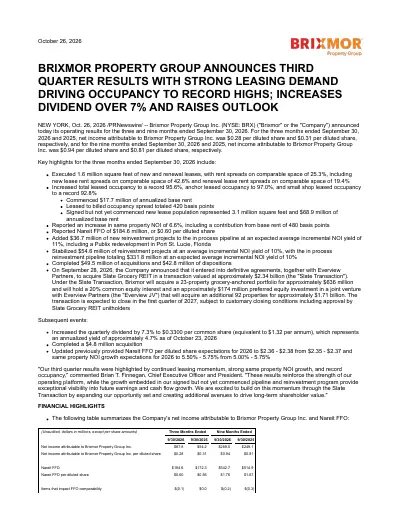
That execution was clearly reflected in our third quarter results. We increased Nareit FFO per share by 7% over the prior year and grew same-property NOI by 6.6%.
We returned to our record level of total leased occupancy, generated exceptional leasing economics, and continue to advance our reinvestment pipeline at attractive returns. Given the strength of our performance during the quarter, we again raised our full-year outlook for both same-property NOI and Nareit FFO per share.
Our board also increased the quarterly dividend by more than 7%, reflecting the strong visibility we have into continued earnings and cash flow growth. The strength of the quarter further reinforces our confidence in the Slate transaction announced last month.
The opportunity is a natural extension of the strategy we have successfully executed across Brixmor, creating value through redevelopment, occupancy upside, and meaningful rent mark-to-market. Our focus between now and closing is straightforward: making sure we are positioned to begin executing on day one, and our third quarter results provide a clear demonstration of what our platform can deliver.
Starting with leasing, we executed approximately 1.6 million square feet of new and renewal leases during the quarter at a blended comparable rent spread of 25%. New lease spreads were 43%, including anchor spreads above 70%, while renewal spreads exceeded 19%.
These results show how effectively our team is capturing the significant mark-to-market embedded in our portfolio, and the gap between our in-place rents and the rents reflected in our forward leasing pipeline gives us a meaningful runway to capture additional mark-to-market over time. Just as importantly, we're using this environment to continue improving the quality and relevance of our centers.
During the quarter, we continue to grow our relationships with leading retailers across a range of categories, including multiple leases with Ross and TJX, as well as another new lease with Trader Joe's. Our team also continues to operate with greater speed and efficiency.
We completed our eight largest anchor leases during the quarter in less than 60 days, including one with a leading off-price retailer in under 30 days. Our national retailer relationships, together with the investments we've made in technology and AI, are helping us streamline the leasing process, reduce downtime, and accelerate rent commencement.
Ultimately, that allows us to more effectively capitalize on the strong retailer demand we're seeing across the portfolio. That activity drove total leased occupancy to 95.6%, up 80 basis points sequentially and 150 basis points year over year.
Small shop occupancy reached a new record of 92.8%, while anchor occupancy increased to 97%. With anchor occupancy still 70 basis points below its prior peak, we see additional upside ahead.
Those occupancy gains also benefited from an 88% retention rate, up 300 basis points year over year, as tenants continue to succeed at our centers and renew with us at near record rates. Importantly, we continue to have excellent visibility into what comes next.
We ended the quarter with $69 million in our signed but not yet commenced pipeline after commencing approximately $42 million of rent year to date. That pipeline provides a clear bridge between the leasing activity we're generating today and future NOI and earnings growth.
Turning to reinvestment, it remains one of the most compelling uses of capital in our business and a key driver of long-term value creation, allowing us to deploy capital into assets we already own at attractive double-digit incremental returns. During the quarter, we stabilized four projects representing $55 million of investment at a 10% average incremental return.
We also added six new projects to the active pipeline, representing approximately $37 million at an 11% return. At quarter end, our active pipeline totaled approximately $322 million at an expected return of 10%.
Beyond the active pipeline, we continue to see a substantial runway of high-return reinvestment opportunities across the portfolio. The projects we added during the quarter illustrate both the depth and breadth of that opportunity.
In Port St. Lucie, Florida, we're redeveloping the Eastport Plaza to accommodate a new 50,000-square-foot Publix prototype.
This is our sixth reinvestment project with Publix, with several more already identified in our future pipeline. At Westridge Court and Block 59 in suburban Chicago, we're building on the successful first phase of the transformation with the addition of a 97,000-square-foot IKEA, the retailer's first large-format location in our portfolio.
We also continue to build momentum in our outparcel program, adding three projects during the quarter and bringing our year-to-date total to 13. We see a deep pool of opportunities to further densify our centers and generate attractive returns.
Turning to transactions, we acquired Village West Shopping Center in Southern California for approximately $50 million during the quarter. The center is anchored by a high-performing Stater Bros.
grocery store and is exactly the type of acquisition we target: high-quality, grocery-anchored real estate where our platform can create additional value through leasing, remerchandising, and reinvestment. We also completed approximately $43 million of dispositions, bringing year-to-date proceeds to approximately $166 million.
Importantly, these sales are consistent with the capital recycling strategy we have been executing independent of Slate. We are selectively monetizing assets where we believe we have substantially completed our value creation plan and can redeploy those proceeds into opportunities offering more attractive long-term growth and returns.
Despite higher rates, demand for grocery-anchored open-air retail remains deep, giving us confidence in our ability to continue executing our capital recycling strategy while remaining disciplined on pricing and certainty of execution. Stepping back, the core business has tremendous momentum.
Occupancy is at record levels with additional upside ahead. We have meaningful embedded rent mark-to-market, and our reinvestment pipeline continues to generate attractive opportunities across the portfolio.
Slate provides another meaningful avenue to put our platform and capabilities to work and extend that growth over time. Most importantly, our team continues to execute at a very high level, and I want to thank everyone at Brixmor for another outstanding quarter.
With that, I'll turn the call over to Steve for a deeper review of our financial results and updated 2026 outlook. Steve?
Steve Gallagher
Thanks, Brian. Our third quarter results reflect another period of strong execution across the portfolio, with growth in same-property NOI and FFO supported by continued strength in the underlying business.
Same-property NOI increased 6.6%, driven by a 480-basis-point contribution from base rent, with healthy occupancy growth, strong expense recoveries, and contributions from ancillary and other income also benefiting results. Nareit FFO grew over 7% to $0.60 per share.
That performance is reflected in our updated outlook for the year. We increased our expectations for same-property NOI growth to 5.5 to 5.75% and FFO per share of $2.36 to $2.38, reflecting the strength of our year-to-date results, including same-property NOI growth of 6.2% year to date.
The increase reflects broad-based strength across all components of NOI supported by our team's execution and the favorable operating environment. Of note, we expect fourth quarter growth to moderate as we lap elevated ancillary and other income, reflecting prior-year comparisons and timing rather than weaker portfolio fundamentals.
As we look beyond the fourth quarter, we continue to have strong visibility into growth in 2027 and beyond, supported by the stacking of rent commencements and higher average billed occupancy. Approximately $55 million of rent is expected to commence in 2026, with another $48 million from our signed but not yet commenced pipeline expected to commence in 2027, before the benefit of additional leasing activity.
The opportunity extends beyond rent commencements. Below-market rents continue to provide significant embedded upside, while the transformation of the portfolio has reset our rent growth opportunity meaningfully higher.
Anchor leases expiring in 2027 without options average approximately $11 per square foot, compared with new and renewal leases in the mid- to upper teens. Beyond the mark-to-market opportunity, contractual rent bumps add to that embedded growth.
The health of our tenant base is reflected in high retention, solid collections, and low bad debt, and our redevelopment pipeline continues to create meaningful value across the portfolio. Taken together, these factors provide strong visibility into growth as we move into 2027, delivered efficiently with capital expenditures at historic lows for this portfolio.
Importantly, that visibility is before considering the additional growth opportunity from Slate. The transaction adds an additional source of long-term growth through below-market rents, occupancy upside, redevelopment, and the benefits of applying our operating platform across the portfolio.
The precise 2027 FFO impact will depend on closing timing, purchase accounting, and the ultimate mix and pricing of transaction funding. We'll provide details on our 2027 outlook with our year-end earnings, as usual.
From a balance sheet perspective, we ended the quarter with approximately $1.5 billion of liquidity, including $183 million of cash, $1.25 billion of availability under our revolving credit facility, and approximately $115 million of anticipated proceeds under unsettled forward equity contracts. Net debt to adjusted EBITDA was 5.2 times on a current-quarter annualized basis, and we expect leverage to temporarily improve further through year end as we execute on our capital recycling activity ahead of the Slate transaction closing.
Subsequent to quarter end, we are currently working on a delayed draw term loan with our broader bank group for $400 million, with closing expected in the fourth quarter and drawing in conjunction with closing. We also executed $400 million of forward-starting swaps on our existing $500 million term loan, providing additional certainty around our borrowing costs.
With our strong liquidity, access to multiple sources of debt capital, and an active transaction market, we have significant flexibility as we complete the funding for the Slate acquisition. Overall, we are well positioned heading into 2027, with strong embedded growth and visibility in the existing portfolio, additional opportunities from the Slate transaction, and the balance sheet flexibility to execute on both.
With that, I'll turn the call over to the operator for Q&A.
Operator
Thank you. We will now be conducting a question-and-answer session.
If you would like to ask a question, please press *1 on your telephone keypad. A confirmation tone will indicate your line is in the question queue.
Please limit yourself to one question. You may press *2 if you would like to remove your question from the queue.
For participants using speaker equipment, it may be necessary to pick up your handset before pressing the star keys. Our first question will come from Michael Goldsmith with UBS.
Michael Goldsmith
Good morning. Thanks a lot for taking my question.
Question is just on the leasing and in particular the anchor occupancy pick-up. I know it dipped last quarter, and that was well known at the time.
I was just wondering if there was any sort of noise in the number this quarter, or is that just kind of clean leasing? Then, as you think about the SNO pipeline, it compressed a little bit.
Are we kind of approaching the period where kind of the build-up in leasing is starting to get released and so we should start to see the benefit from that over the next couple of quarters? Thanks.
Brian Finnegan
Michael, thanks for the question. I think clean leasing is a good way to describe it.
We had discussed on the last call the expected bounce-back in occupancy in the back half of the year, and it did so in a big way. You look at the quality of tenants that we continue to add to the portfolio, whether that's grocers like Trader Joe's, Ross, TJX, and getting that done a lot faster.
As we think about the occupancy trajectory, there's certainly more room to run, as I mentioned in my remarks. We're still below prior peak.
Then you think about that signed but not yet commenced pipeline, we commenced about $17 million of rent during the quarter, we still have that sitting there at around $69 million, we're continuing to replenish that pipeline and it gives us great visibility on growth in to next year. I'd kind of say as expected, but really the team did a tremendous job of not just getting those anchor leases done, getting them done as fast as we ever have.
Michael Goldsmith
Thank you very much.
Brian Finnegan
Thanks, Michael.
Operator
We'll go next to Haendel St. Juste with Mizuho Securities.
Haendel St. Juste
Hey, guys. Thanks for taking my question.
Not a question specifically on Slate, but I guess I'm curious about the deal funding, capital recycling, and balance sheet implications. Can we expect to see leverage tick up a little bit?
Is the plan for that to kind of organically kind of delever over time through free cash flow? Then how much will dispositions perhaps play a role in the funding of that?
Curious about that and then maybe some color in the transaction market, what you're seeing and how that's impacting maybe your near-term deployment plans there. Thanks.
Steve Gallagher
Thanks, Haendel. I would just start by saying our expectations are really the same as they were around a month ago, except we have additional clarity on the term loan, but maybe Steve and Mark can provide some color on the rest of the question.
I provided in my commentary just to help people understand. As Mark executes under the capital recycling, as we sell assets heading into the end of the year and preparing for that closing, you will see us naturally delever as that cash goes onto our balance sheet.
Our expectation is that leverage ultimately remains sort of where we are. Ultimately where that leverage sits will depend on a couple of factors, including the timing of the transaction and the funding requirements.
Mark can hit on sort of what we're seeing in the transaction market. The market
Mark Horgan
look, it's been a very interesting market over the last several months. I would highlight we closed two deals in September that really priced over the summer.
They closed at expected values. We've seen rates go up a bit, we've seen rates come now back down a little bit, and through all of it pricing really's only moved slightly at best.
The reason for that is demand. We're just seeing very strong demand from capital seeking exposure to open-air retail and the really strong operating fundamentals that Brian and Steve kind of hit on in the call.
That depth of demand is really what's supporting values. Frankly, we've been really popular since the Slate announcement.
Well-capitalized buyers are reaching out, seeking assets, because they're finding the market to be quite competitive. With respect specifically about funding the Slate transaction, as we talked about a month ago, we're in the market with assets today.
We see very clear demand for assets. We've got about $130 million that we have under contract or in negotiations today.
We're in preliminary discussions on a range of other assets, some of which we'll go to market with, some of which you might just go direct to all this capital looking for assets. The only other thing I would highlight in that $130 million includes some land parcels that really today are low or non-yielding, we're really really confident in our ability to fund the transaction accretively here.
Haendel St. Juste
Thank you.
Brian Finnegan
Thanks, Haendel.
Operator
Our next question will come from Todd Thomas with KeyBanc Capital Markets.
Todd Thomas
Hi, good morning. I wanted to ask about the same-store NOI growth forecast, which implies a modest deceleration in the fourth quarter.
Steve, you mentioned some ancillary income headwinds. Can you provide a little bit more detail there and thinking about your comments around non-option expirations, looking ahead and taking into account this year's leasing and earn-in heading into '27, curious about the base rent contribution specifically, how we should think about the 4.8% growth in the quarter and whether that can be sustained heading into 2027?
Brian Finnegan
Todd, let me take the second part in terms of the rent growth upside. We're almost 4 years running now of renewal growth in the mid-teens.
We have higher retention. Traffic was up at our portfolio every month this year.
Our tenants continue to perform. You've seen that percentage rent line outperform as well.
We're getting percentage rent from operators we hadn't historically. The health of that portfolio is very strong, and so we see continued growth as it relates to mark-to-market and renewals, and Steve can touch on trajectory as goes into year end for
Steve Gallagher
that. When you think about the ancillary headwind, in the fourth quarter of last year, we really had one large incentive payment from a redevelopment that we did.
That is coming through through the entirety of the year, it's not a year-over-year comparison issue, it's just all of that hit in the fourth quarter versus being spread throughout the year. That's why we highlighted it last year.
We highlighted it on the last earnings call just to help people understand where that headwind was going to come, but ultimately is going to be part of our earnings trajectory going forward.
Brian Finnegan
I think I would just add, and look, we're pleased with the trajectory in NOI growth for the year. We raised our outlook again.
We've had record-low small shop move-outs, from a health-of-the-portfolio perspective, Todd, and the core fundamentals, we're very confident in that trajectory, and like Steve said, where things may be lumpy in a given quarter, but this was as expected.
Operator
Moving on to Michael Griffin with Evercore ISI.
Michael Griffin
Great, thanks. Wanted to touch on the small shop leasing for a bit.
Saw leased occupancy reached 92.8% in the quarter. Seems like there's more potential upside here, particularly within the SNO pipeline.
Can you give us a sense in the near to medium term how much further this leased occupancy could move on the small side? Are you getting any pushback from tenants?
Are occupancy cost ratios ticking up, as it relates to resistance that they might have from signing higher rents or higher renewals?
Brian Finnegan
Yeah. Michael, thanks for the question.
We continue to have significant visibility on upside in our small shops, and it's really consistent with what's driven small shops to date. It is deployment of our reinvestment pipeline.
You look at that future reinvestment pipeline, and small shop occupancy trails the portfolio by several hundred basis several hundred basis points, and you see that level of uptick as we bring those projects online. We're pleased with the growth that we've had to date, but we definitely see a lot more room to run as it relates to small shops.
I and I think in terms of your second question on small shop health and ability to pay increasing rents, our tenants are performing, right? Retention rates up 300 basis points year over year.
Again, small shop move-outs this year are record lows for the portfolio for the fifth consecutive year. What's really encouraging to us is the the quality of those operators that we've been attracting.
Consumers are demanding more of the suburbs. That leads to higher-quality quick-serve restaurants.
It leads to higher-quality service operators, higher-quality medical users, and you can see that coming through in our portfolio. They're driving traffic.
They're renewing with us. From that perspective, tenants are not paying increased rents at this level unless they're healthy and their sales correlate to the ability to pay those.
That what what gives us a lot of encouragement of not just driving small shop occupancy going forward, but doing it with great operators at continued higher rents.
Michael Griffin
Thank you.
Brian Finnegan
Thanks, Michael.
Operator
Our next question comes from Craig Mailman with Citi.
Craig Mailman
Hey, good morning, everyone. I don't know, Brian or Mark, who wants to tackle this one, but just going back to the commentary about pricing being pretty sticky here despite the move in rates, just given the flood of capital kind of coming in to the group.
Just kind of curious on I guess the make-up of that capital and the depth of it. How much of that is just capital that needs to be put out the door because it was raised in a fund that has their deployment period's coming to an end, and so for them, pricing is less of an issue because they want to get fees on that?
Once that kind of dries up, is there a potential that pricing starts to move because expectations have to change on that incremental capital that's raised and the return requirements that they're telling their kind of investors that they're going to be able to hit going forward?
Mark Horgan
I appreciate the question. From a scale perspective, from what we can tell, there is a range of capital coming into the space.
It's what you've seen return to our space is the very traditional pension fund capital, you're seeing sovereign wealth LP capital come in, high net worth is seeking the capital, and we're also seeing 1031 capital coming into the space for particularly out of some folks in the data center space who sold some land for data centers, are seeking exposure to retail, given the fundamentals of the business. As far as the scale of it, it seems very large.
What we're tracking, from what we've just had inbound calls on, is billions of dollars of capital today. As far as pricing being sticky, if you look at cap rates of retail over time, it has generally been stickier than some other asset types, that we really haven't seen things drop super low across the entire industry.
They generally don't spike up that high when you see rate movement because of the overall fundamentals of the sector. As far as we can see today, we feel very confident about liquidity, and we don't expect to see large pricing change.
Where I think you will see pricing change is, frankly, assets that require a lot of debt, so that's new construction pricing, assets without growth, that's probably where you're seeing the biggest impact on pricing. As far as assets with good growth opportunities that we chase and I think a lot of folks are looking for, you're seeing very tight pricing.
We've seen assets real time, post rate movement, priced well into the 5s across multiple markets that might be on the margin, but we're expecting to see a healthy demand for assets at attractive cap rates today.
Operator
Our next question will come from Samir Khanal with Bank of America.
Samir Khanal
Good morning, everybody. I guess, Brian, when I look at your in-process reinvestment pipeline, roughly $330 million now, I think it's around a 10% yield, and you talk about occupancy reaching record levels.
How should we think about the opportunity there is in that pipeline and sort of the size of that pipeline over the next couple of years? Thanks.
Brian Finnegan
On the redevelopment pipeline, I think what encourages me about it is not just the size of it, but the nature of it, right? As you've seen us the last couple years, our projects have gotten larger with a similar risk profile.
You look at what we've done in college towns like Davis, California, great suburbs like suburban Chicago, where we're adding a 100,000-square-foot IKEA, and I mentioned the pipeline that we have with Publix. That pipeline is also part of what attracted us to the Slate portfolio as well, but independent of that, you still have $1 billion just in what's in our active pipeline today and in the future pipeline we show you every quarter.
Three of the assets that we bought this year immediately went into that future pipeline, Mark and team are finding those opportunities as well. Thinking about the rest of the Publix developments that we have, the outparcel opportunity that we have, and we've already done about 110 outparcels across the portfolio, we see a similar level in what we have today in the ability to densify our site.
It's going to continue to be a core strategy for the company. We've improved our expertise over time, and what really excites me about it is just the size of that pipeline and the types of projects that we've been able to deliver and we'll continue to deliver over the next several quarters.
Operator
We'll go next to Greg McGinniss with Scotiabank.
Greg McGinniss
Hey, good morning. Brian, you mentioned the improving ability to reduce downtime and accelerate rent commencements.
Can you quantify that change in terms of how many days you've cut from lease signing to rent paying, whether for shop or big-box tenants, and what's assumed with regards to the SNO pipeline disclosure for 2027 starts?
Brian Finnegan
Yeah. Can you repeat the last part?
Greg, I missed the last part.
Greg McGinniss
Just trying to understand if the acceleration in rent commencements is applied to what's been disclosed for expected 2027 starts on the SNO.
Brian Finnegan
Got it. I think we have constantly thought about here, what's the value of a day in rent, right, on average across the portfolio, through all of our functions?
I think where you can see it in the data across the board is in legal. We're down about 25% in our time in legal over the last 2 years.
We've reduced the size of our short-form lease. Our legal teams, our leasing teams, in terms of the relationships that they've developed with their tenant counterparts, has really helped that, as well as deploying technology.
It's taking us a lot less time today to generate a lease. It's taking us a lot less time to reconcile a lease when the lease is done, and also understanding what some of those clauses are that tenants will live with.
It can be hard to quantify just the days in the time from lease execution to opening because scopes are different. What I would say, though, and you can see this coming through in the reduced capital that we're having to spend, is tenants are taking on more existing conditions.
Particularly national tenants have beefed up their construction departments so that they can take fixed-cost TAs and be able to control both sides of the schedule. That's allowed us to deliver space and do it much more efficiently and get those tenants started a lot sooner.
The other thing I'd point to is the relationships that our redevelopment folks have with local municipalities to work through the permitting process. It's another reason, back to Samir's question, why we've been able to get some of these projects done, particularly outparcels, in what were historically very challenging jurisdictions.
If you put all that together, it really speaks to the outperformance of us pulling dates forward in the third quarter and something that we continue to be focused on, improving this as we get into 2027.
Operator
Caitlin Burrows with Goldman Sachs has our next question.
Caitlin Burrows
Hi, good morning, everyone. I was just wondering if you could comment on bad debt in the quarter and then the watch list going forward.
I know it's been relatively small recently, but wondering if there's been any shifts. Thanks.
Brian Finnegan
Steve can touch on the quarterly trajectory, but I would just say, Caitlin, the health of the tenancy is the strongest it's ever been. One of the ways you can see that is in bad debt.
We lowered our outlook at the start of the year. We improved that outlook throughout the year, and we've maintained it because third quarter went as expected.
If you think about the tenancy and who we've grown with, H-E-B entered our top 40 last quarter. We've grown with Trader Joe's, we've grown with Sprouts, we've grown with Aldi, we've grown with all the off-price users, we continue to grow with Publix.
Thinking about the signatures that we have, we had a question on small shop tenancy earlier, we've done more with national and regional tenants, and even those local operators, which we want unique local operators at our shopping centers, they still only represent 17% of our rent, and even the signatures we're getting there are the strongest they've ever been. As we think about collection trends, retention rate, and overall small shop occupancy growth, and frankly the growth that we're getting in renewals out of small shops, the health of the portfolio remains very strong.
The watch list is lower than it was today. We continue to watch certain categories that may close stores, like drugstores.
We've reduced our exposure to office supply significantly, but as we sit here today, we're operating from a great position of strength as it relates to the underlying tenancy of the portfolio.
Operator
We'll go next to Alexander Goldfarb with Piper Sandler.
Alexander Goldfarb
Hey. Morning down there.
Brian, question on Slate and the Brixmor platform. Previous to the deal, you had spoken about the breath of the Brixmor leasing relationships and how you were a top landlord to many of the national tenants.
Obviously, Slate makes you bigger. Just curious if in thinking about this deal and thinking about the company going forward, if you see the need to be even bigger to create even better relationships and standing with the retailers or if as you look over the national playing field, you see markets where some of your strong tenant relations don't really have a presence, and therefore, you guys acquiring there is a way to sort of expand those tenant relationships into new markets, just trying to understand sort of how you look at it and if it's more a negotiating leverage standpoint or it's a chance to really bring tenant reach to new markets?
Brian Finnegan
Yeah. It's a great question, and I think it's really one of the things that made us even more convicted about the opportunity here, Alex, over the past month, as we've been talking to our national retail partners and their desire for us to not just show them what's available in the Slate portfolio, but to talk to them about our plans and our reinvestment plans, particularly on some of those Publix and other grocer reinvestments.
We have been growing the company. Ahead of Slate, half of the acquisition activity that we did as a public company was in the last 2 years, but it's been very intentional.
It's been in markets that we know really well. It's been in places where we can put our platform to work to drive outsized value.
That's exactly the way that we looked at the Slate transaction. It was a unique opportunity for us, and we're thrilled to be moving forward towards closing in the first quarter.
As we think about the scale of the portfolio, we had 900 million visits over the last year. We have 8,000 leases.
We're among the top landlord to every major retailer in the country. We have the access and the partnership that we need ultimately help them grow, and we're going to look at our acquisition strategy going forward in the same way is: is there ability in our markets to find new opportunities to put our platform to work, to do it accretively, to add assets that'll complement the long-term growth profile?
I expect us to be able to do that, but that's how we think about it versus growth for growth's sake.
Alexander Goldfarb
Thank you.
Brian Finnegan
Thanks, Alex.
Operator
We'll go next to Jamie Feldman with Wells Fargo.
Jamie Feldman
Great. Thanks for taking the question.
You had newly spreads at 42.6%, renewals 19.4%, total spread 17.4%. Beyond these headline rents, where are you having the most success in proving lease economics?
Is it contractual escalators, term, options, guarantees, TI, or landlord work? Then, going back to your answer to a prior question just in terms of the improving quality of the tenant you're bringing into the portfolio, what does that mean for your negotiating leverage?
Can your 1.7% in-place contractual rent growth realistically move towards the 2.6% achieved on recent new and renewal leases?
Brian Finnegan
Yeah. Jamie, to answer your question, I'd say kind of all of the above, and let's point to some specific data points in that.
You look at a portfolio today that's recovering a few hundred basis points ahead of billed occupancy. That was the direct opposite in 2019.
Our team's focus on improving CAM clauses, strategically deploying fixed CAM, which is now 41% of our ABR and growing at 4.2%. You mentioned our average growth: 2.6%.
We've been continuing to drive that higher. It's not something that we just started working on the last few quarters.
We've taken that from 90 basis points in 2016 to 1.7% today. We definitely see the ability to grow that further.
We don't get to touch all of the portfolio in a given year, but our team's being very opportunistic. As it relates to removing or reducing options, we're doing that as well.
We've almost completely removed those from local tenant leases. If you look at the options that we are giving to some regional tenants, we've introduced fair market value concepts or we're growing them well in excess of their growth rate.
With national tenants, we're reducing what was historically a number of options that were just kind of commonplace in those leases. We're negotiating those much harder.
I would say just as it relates to kind of leverage, the reason that we're driving these rents is because our tenants are succeeding at our centers. We've transformed so much of the portfolio, we've invested a lot, we brought a lot of great tenants in, they're continuing to drive traffic.
When you do that, it ultimately helps the entire shopping center. It's a business where it matters who your neighbor is, and we continue to see that, and that's why we're so excited about what we have going forward, the tenants that we're opening, the redevelopments that we're bringing online, including the ones that we brought in during the quarter.
Expect to see that not just in the headline rent growth, expect to see it in the continuing improvement in those other aspects of the lease.
Operator
We'll go next to Floris Van Dijkum with Ladenburg Thalmann.
Floris van Dijkum
Hey, thanks, guys. Following up on the cruising speed question.
Your cruising speed, as you rightly point out, Brian, has increased quite nicely. 1.7% in place today, I think 2.6 on the new deals over the last 12 months.
Question is: How does Slate compare to that? Does that add to the cruising speed or detract?
Then number two, I guess, is how many years of 2.6% growth in new leases do you need to achieve before you hit 2% average cruising speed in your portfolio? Presumably, you can model these things out because you know your pipeline pretty well.
How long of a trajectory to get to that? Again, does the Slate portfolio add or detract from that from that growth?
Brian Finnegan
I think we're entering with a pretty good starting point as it relates to Slate. That team has been delivering renewal growth in the mid-teens over the last year.
They've been doing new lease growth in the 40% range. For us, that gets us very excited about ultimately what we think our platform can deliver as we start to take on these assets, particularly as we think about the redevelopment upside in a subset of that portfolio.
What we've learned over the last month has only made us more convicted in that opportunity. I think it can be challenging to model that level of growth out for several years.
What I can say is we continue to improve it, and the growth rates at 2.6% are again off the highest rents we've ever signed as a company. We continue to see a long runway.
Steve touched on in his opening remarks in terms of what's expiring and where we're signing those leases, retention rates going up, renewal growth continues to be in that kind of mid- to high-teens level. Look, on top of that, we expect to continue to improve our in-place bumps, and going forward, we will continue to improve what the underlying growth is of the portfolio.
It is tough to quantify today how many years that'll take, but we are seeing steady improvement.
Operator
Our next question will come from Linda Tsai
Linda Tsai
with Truist. Hi.
Thanks for taking my question. I think the 88% retention ratio is near Brixmor's historical high.
Do you view the high 80s as a new steady state, or does that change temporarily with incorporating the Slate acquisition in terms of potential remerchandising?
Brian Finnegan
Look, I think, Linda, this is more of a result than kind of an aim for us to get to a higher retention rate. If you think about the portfolio historically, it was in the kind of low 80s.
That has gone higher into the mid- to high 80s. I think you can expect us around this level, probably towards the high end.
Part of our business plan will always be to recapture space that is either under market or underutilized when we have the ability to do that upon a lease expiration, and we're not going to let a retention rate stat drive that decision at an asset level, when ultimately we think that's the best thing for the property, and we can create a lot of value going forward. What I would say, though, is I think what you're seeing in those retention trends are really the health of the portfolio, everything that we've done coming through in terms of improving our tenancy, improving the ability of our tenants to succeed at our centers, and that's just one stat of many that shows you the health of the portfolio, in addition to low move-outs, in addition to the renewal rates that we've been able to achieve.
We're proud of it. I think you can expect kind of that mid- to high 80s range, but it's not something that, say, we're definitely striving to achieve.
It's more a result of the work we've done.
Operator
Moving on to Jon Petersen with Jefferies.
Jon Petersen
Oh, great. Thank you.
Another question on the Slate acquisition. I think if you run some of the demographics on it, the household income and population density is below the portfolio, but if you look over the last few years, the growth of income and population is much higher than your existing portfolio.
I'm just curious, as you think about deploying capital, how you think about that trade-off between kind of infill, high-income locations versus more higher-growth areas?
Brian Finnegan
Yeah. We've never managed the portfolio specifically for demographics.
As we think about the markets that we're going into, though, that growth rate, John, is something that we paid a lot of attention to, as well as our conversations with the tenants, and frankly the demand that we're seeing from tenants to want to explore opportunities in the portfolio. You think about the strength of the grocers there, whether it is Publix, Harris Teeter, or Kroger, how they've reinvested in those stores, they certainly see the growth that's happening in those markets and something that we do as well.
It's a data point. It's something that we consider, but as we looked at this and said to ourselves, we're growing in Atlanta, we're growing in the Carolinas, we're growing in Orlando, we're growing in Jacksonville, these are all places that have very high growth rates.
You're seeing positive trends throughout their economies, you're seeing investment, and from that perspective, we like the trajectory, but more importantly, we like what we're hearing out of the gate from the tenants in those centers.
Jon Petersen
Thank you.
Operator
We'll hear next from Paulina Rojas with Green Street.
Paulina Rojas
Good morning. This Slate transaction brings a JV partner, a preferred equity investment, and also fee income, a different mix from Brixmor's traditional growth.
My question is, what is your appetite for repeating this template in the future? How open are you to management fees playing a bigger role going forward through more transactions like this?
Brian Finnegan
I think, Paulina, the answer is the same as it was before the Slate transaction. It is we'll consider it.
For us, it's always been: Is there alignment from a business plan perspective? Does the opportunity in front of us justify some of the additional complexity that does come along with JV partnerships?
This is not our first rodeo with joint ventures. We've had them with large institutions in the past.
It's something that we haven't done in a few years, but we've certainly had them in the past. I think it's something that we will consider.
We do like the aspect of having the bulk of the portfolio with no property-level debt. Steve, Stacy, and team have worked very hard on our balance sheet, but where the opportunity presents itself, particularly with a great partner like Everview and another institution that's investing alongside them with Avia, that with the opportunity that we had in front of us made a lot of sense.
Will we look at it again? The answer is it depends.
I think for us, we'll continue to look at these on a one-off basis, but I'm really proud of the team in terms of how we move forward with the transaction. We are starting integrating a joint venture partnership and came through with one of the best operational quarters that we've had in the company's history.
I think from that perspective, it's an option for us, but it's really going to be opportunity-dependent.
Operator
We'll hear next from Mike Mueller with JPMorgan.
Mike Mueller
Hi. Your reinvestment pipeline has about a 10% return expectation.
Does the underwriting here and the returns you need flex up and down with larger interest rate moves like it does with acquisitions, or is it just kind of a different animal because of the implications for the whole property and you're kind of starting off with higher yields to begin with?
Brian Finnegan
I think we've always approached investments, Mike, through the lens of interest rates going up, and whether that is acquisitions or our reinvestment underwriting. I think from a reinvestment standpoint, if anything, as we've done larger projects over the past few years, the change you've seen in our underwriting is much more confidence in those pre-leasing levels.
We're not bringing anything into that active pipeline that's spec. We've actually increased those pre-leasing levels fairly significantly, and then ultimately, too, having great visibility on costs.
Despite some of the uptick in rates and inflation, we actually had seen material costs kind of moderate this year. We have had some pockets of labor pressure, but it hasn't been material, and so from that perspective, having great visibility on that and conviction on that when we move into these projects is something that we're really focused on.
I think if anything, that's been the additional focus versus the rates on the reinvestment investments, but I'd say across the board, we're always approaching these through the lens of rates going up.
Operator
Greg McGinniss with Scotiabank has our next question.
Greg McGinniss
Hi. Steve, I just wanted to follow up on the guidance.
We appreciate that the increase in same-store gave its contribution to the increased FFO per share expectations, but term fees are also coming in higher year to date than prior commentary indicated. What's the balance between those two items in terms of the penny increase to the midpoint, and what are term fee expectations for Q4?
Thanks.
Steve Gallagher
If you go back to where we really started the year, right, we knew term fees were going to be a headwind as we looked to our 20 26 guidance. It was a $0.03 headwind in our initial guide.
Now term fees, as can be lumpy. If you actually look at the term fee that we recorded in the quarter, the majority of it was actually for rent, and it goes to a lot of what Brian was talking about, the quality of the name on these leases of a entity going bankrupt in the US and having a UK guarantor allowed us to collect over $2 million from that tenant.
When we talk about the health of the leasing dynamic, that's a lot of what we're referring to. That's what really led to it in the quarter, but when you look at the move in same-property, obviously that implies about a penny, penny and a half.
The LSI is more or less within our expectations for the year.
Greg McGinniss
Great. Thanks.
Operator
As a reminder, if you'd like to ask a question, please press *1. We'll go next to Omotayo Okusanya with Deutsche Bank.
Omotayo Okusanya
Yes, good morning. Just a quick question around 2027, as you kind of start to sharpen up our models.
Just curious if there's anything in '27 that the team would like to kind of point out from a modeling perspective that maybe we should be aware of, or whether you kind of expect '27 to be kind of fairly clean and kind of business as usual?
Steve Gallagher
It's definitely not going to be business as usual with Slate coming on, I'll point that, and obviously we'll give guidance on that in February. I think the one item, and I mentioned it in my script, is we do have swaps burning off in the middle of the year in July, and we did put in $400 million of new hedges for when those drop off, but outside of that, I think everything else is pretty well disclosed as far as where we stand heading into 2027.
Operator
This now concludes our question-and-answer session. I would like to turn the floor back over to Stacy Slater for closing comments.
Stacy Slater
Thanks, everyone. We'll see a lot of you at Nareit in a few weeks.
Operator
Ladies and gentlemen, thank you for your participation. This does conclude today's teleconference.
You may disconnect your lines and have a wonderful day.