ABB India Limited
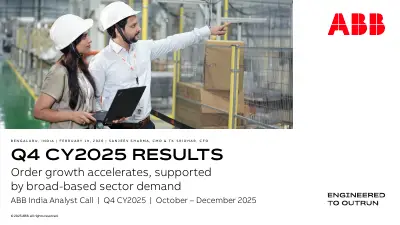
Q4 FY2025 · Earnings Call TranscriptFebruary 23, 2026
Operator
Ladies and gentlemen, good day and welcome to ABB India Limited's quarter four, October to December quarter, CY2025 conference call. As a reminder, all participant lines will be in the listen-only mode, and there will be an opportunity for you to ask questions after the presentation concludes.
Should you need assistance during the conference call, please signal an operator by pressing star, then zero on your touchtone phone. Please note that this conference is being recorded.
Any unauthorized recording of this call is strictly prohibited. The recording will be made available on the company's and SEBI's website subsequently.
I now hand the conference over to Mr. TK Sridhar, Chief Financial Officer of ABB India Limited.
Thank you, and over to you, sir.
T.K. Sridhar
Thank you, Michelle, for organizing this. Very good morning to all of you.
Welcome to the Q4 2025 investor call, and this also is the full year for ABB. Along with me on the call, I have Sanjeev Sharma, Managing Director of ABB India Limited; I have Kiran and Ganesh who are from Electrification division; and also I have Sanjeev Arora leading the Motion; and also we have this time Balaji for Process Automation.
I think not wasting a minute now, Sanjeev, over to you.
Sanjeev Sharma
Thank you, Sridhar. Good morning to all of you.
Thanks for joining this call. We will give you some business highlights, followed by Sridhar supporting the financial highlights.
We have a slide before this?
T.K. Sridhar
I think
Sanjeev Sharma
next slide is basically
T.K. Sridhar
the
Sanjeev Sharma
India at a glance.
T.K. Sridhar
All right.
Sanjeev Sharma
We'll kind of highlight to you, again, for the people who are joining us for the first time, that ABB Group is a 140-year-old company which has sustained itself over various industrial cycles, and the core reason for that is that it's an innovative company, keeps on rediscovering itself based on how we add productivity and value to our customers. In India, ABB is present and manufacturing for over 75 years, and our expertise in the portfolio is on the electrification and automation.
These are the sweet spot in terms of how the world is developing and how India is developing in terms of electrifying everything and also automating everything. That's where our portfolio is positioned.
We have a substantial footprint. We operate out of four manufacturing locations spread across the country.
We have 28 sales offices to reach out to the customer and even getting deeper penetration with 750-plus partners. We have 25 shop floors which have distinct product manufacturing, and we are exporting to 30 countries from India.
Now, when you look at the business highlights, CY2025, it has been a very consistent growth as connected with our previous years. We had the highest-ever orders at about 14,115 crores, which was 8% growth.
If you look into CAGR growth from '21 onwards, it has been 16%. Our backlog is at the strongest at 10,471 crores, which has grown by 12%, and if you look into CAGR for last five years, it's 21%.
Our revenue grew by 8% to 13,200 crores, and CAGR of five years is 17%. PBT in 2025 was 2,230 crores with a margin at 16.9%, and if you see our CAGR, it has been 39%.
Profit after tax is 1,669 crores. If you look into the EPS, it grew by 33% CAGR over last five years and currently at 78.78 Indian rupees.
The final dividend declared and approved by board is at 29.59 per share. Return on capital employed is 21%, which is something we feel good about in terms of how we manage our businesses, which are 18 businesses operating in 23 market segments.
Next slide, please. If we focus on quarter four CY2025 financial performance, we had 52% order growth in this particular quarter and 27% base business growth in this quarter.
This is something we are very encouraged after a few quarters prior to it, which were not as strong because the market was taking a breathe-over after five years of strong growth. Now, we have some good signs in last quarter and we'll continue to see the market building up in the quarter we are presently and also going forward.
At the same time, when you join us quarter to quarter in 2026, you'll be able to observe how the market and our goes on top of it. Now, if you really look at the innovation and investments we are doing, we have continued to expand our portfolio in different business divisions.
We added a new line for energy-efficient drives, and also we had a launch of next-generation machinery drives. When we do these kind of introductions in the market, one is we do localization, and also it opens up new market segments, and also it gives much more deeper penetration into the existing customer base.
That's where you can see our businesses continue to compound growth year over year. On sustainability side, we are very proud that ABB India is only the fourth company in India to receive AWS Gold Certification for water stewardship with stakeholders for Nelamangala facility.
This shows that we are very conscious of our role in sustainability in practice, and as a management team, we do it because it's the right thing to do in a country like India and also in the locations we are present. Our ESG initiatives are covering 51% of our suppliers, and we continue to receive different recognitions, and our latest was from GRIHA for Sustainability Excellence and National Stock Exchange's ESG Leader rating.
Next slide, please. Strong order momentum across most segments was visible, namely, the top of those charts were transport, building, and infrastructure, discrete process automation, or other process industries, renewables, and data centers.
With this, we have an order backlog of 10,471, and you can see that is a market segment where we have momentum. These are the sweet spot industries for the country, and they have a long runway ahead of us in terms of the growth, and I think our customers like our products, they like our technology, and they also have good relation and deeper relationship with our businesses, and we are very confident we continue to grow as these market segments and country grows.
Now, if you see the kind of breadth of wins that we get in the market, it gives you the diversity of the customers and diversity of our portfolio it plays out. For example, we gave rectifier solutions for reliable, stable ultra high DC power for a large infrastructure and manufacturing major.
We supplied low voltage switchgear for a data center major, so that's because that in data center, most of the computing power, a lot of energy connected to it, and our low voltage switchgear and the medium voltage switchgear behind it enables it, backed up by our UPS systems, and also the utility side, when you have the air conditioning and cooling been done, our motors and drives, they participate in a significant there. Propulsion systems for Indian Railways, so that's another area wherein Government of India has long plans, and we see a long runway for us there.
Of course, electric powertrain solutions for metals major wherein we combine drives and motor capabilities to give a solution which is most optimum and helps in save a lot of energy for our customers. Same thing in the ethylene cracker in a petrochemical project, we had a robust scope integration, and also robotics for a newly formed automotive company of an established industrial major for an auto major.
This is something with the established players as well as new players. They are reposing a lot of confidence on us to supply them the robotics solutions.
Now, one of the important recipe for us to grow is to have a continuous customer engagement with the existing customers and also undiscovered geographies, and that has been our drumbeat in last many years, and that continues to expand us in multiple new market segments, deeper penetration in geographies, and also new applications which were not available in the country, but now with the entrepreneurs bringing in a lot of value-add into the country, we continue to grow the market. Most of the customers should be aware of our products and solutions, but we make sure they are very comfortable with our offerings, and they appreciate what we can do for them.
Now, as we have been mentioning to you, next slide, please. These are the 23 diverse market segments we indicate to you every time.
Emerging industries in our case are renewables, electronics, data centers, infrastructure and transport, and the core industries. These are the places wherein a lot of activity is taking place, and we find that we have a very good suite of industries to play for our journey forward.
We are very long on India, and we stay very consistent with what we supply to these customers. Whether a particular market segment is up or it is down for a period, our ability to serve them stays unchanged.
We serve the segments which are up or down. We don't chase up segment and neglect.
That's the reason we have a very consistent relationship as well as loyalty from our customers across the segments. Next one.
India-Europe Trade Agreement FTA has been signed. Of course, there are a lot of projections what can happen and what it will mean.
It will take some, maybe six months or so. I met some people over the weekend who were involved in these kind of agreements, mainly from EU side.
They are very upbeat about it, and they believe it will take another five, six months before this gets ratified, and then we will start seeing the benefits of it. These are some projected benefits, but I would say one should wait and watch.
Whenever such FTAs happen, it becomes a two-way street, and more confidence gets developed on the both sides, and that is always a net positive for India. In my opinion, I think it will be net positive for ABB India in terms of our ability to deploy more portfolio, serve industries better, and also integrate back our supply chains back into the EU, wherein we have a very large manufacturing and technology base.
Let's wait and see. It's a positive impact that we should factor for future, and we have factored it for future.
Next one, Indian Union Budget 2026-2027, I think we do believe there is a lot for emerging industries, which is our focus, there's a lot for infrastructure and transport, and there's a lot for core industries. This is something which will play out as we go forward.
It doesn't play out quarter to quarter. It plays out in quarter, one year, two years, three years.
That's something we are very positive about because this is something which is forming the industries and the market in front of us. We have good confidence to invest in our capacities as well as our capabilities to serve these markets that will expand in front of us.
When it comes to sustainability in practice, we are very proud of the achievements our team has achieved across all our locations, and our kind of a focus wherein you can see that we have reduced our GHG emissions by 87%, zero waste to landfill we four units have achieved it, four locations. Water-positive units, four locations have achieved it, and water recyclability is at 44%.
ABB India is the fourth company in India, as I mentioned, which has received the AWS Gold Certification. Those of you who happen to visit us anytime, I think you'll be able to experience it first-hand what it means.
This is not we do for PowerPoints, we do it because it's the right thing to do, and our customers experience it when they come here, and most of our customers really value this because they themselves are trying to implement in their locations, and they have a very deep dialogue with us apart from our products and solutions, how we can co-partner to make sure that these sustainability initiatives are not only in ABB, but they are also with the customers and also with our suppliers. We are also very proud that our products itself contribute, when the client implements these products in their plants and machinery, it reduces the energy consumption, which has a direct and indirect impact on the GHG emission of our customers.
We are quite happy about the overall focus we have in this area. Our CSR initiatives, they are across education and skilling, diversity and inclusion, and communities and environment.
We have very clearly defined impact zones where our presence is felt, and our central team as well as our locational team in Nashik, Faridabad, Baroda, Nelamangala, in Peenya, they find projects nearby and also far area to make a big impact in this. We have been spending 100% of our CSR allocation in last 10 years, and we continue to make sure it works.
Since our margins have expanded over a period of time, our CSR spend also has expanded over a period of time. Factors that we are watching out for 2026, I think there are more positives which are domestically held.
One is a economic power that we are unleashing at the India level. Green energy and sustainability is a very strong momentum in the country.
Urbanization and smart infrastructure again has a good momentum. Consumerism and lifestyle upgrade with the premiumization is something which is very visible even for our portfolio.
Our customers don't compare us with the relatively lower brands and the cheaper products. They are always looking for us when they really want a reliable, available, serviceable solution.
That shows that there's a confidence in ABB products and offerings, and this is not only limited tier-1 cities, we see a very sustained demand in tier-2 and tier-3 cities wherein the aspirational entrepreneurs as well as aspirational class really demands best of the products. Automation and AI, there again a lot of work being done, and our customers can experience a lot of services which are based on AI and the machine learning solutions.
We have a suite of products which are being used mainly out of Automation division. The downside, which all of us know and I think nobody is spared across the globe, is about the global uncertainty, which again if you really look into the history of time, that never goes away.
It keeps coming back one way or the other, and all what we have to do is to learn how to deal with it, and having seen certain cycles in our lifetime, I think we are well prepared to deal with forex fluctuation, volatile commodity fluctuations, some kind of cross-border topics, but we have seen those cycles and we know how to adjust whenever that gets elevated. With this, thank you for listening to me, and I'll hand it over to TK Sridhar to provide you more financial highlights, and later we'll come back for questions.
Thank you.
T.K. Sridhar
Thank you, Sanjeev. I think the summary was really important for us to understand how the markets are playing out and what are the factors which are going to drive and sort of what we need to watch out for.
On this, I think I'll go to the next slide, which is the summary for Q4 '25. A strong quarter in terms of orders, base orders up 27%, and we also had the benefit of large orders which was there, and that's why we could see 52%.
We spared these orders, which were something which were delayed the last two quarters. I remember the two quarter calls where we were mentioning that the decisions are being delayed and it's something which is not lost out, and this is something which is proving that.
Order backlog, clear 10,400 crores of order backlog, good visibility for the future revenues, and 70%, out of this 10,400, 30%, 35% is large orders which get executed over a period of time, not in the next year itself, and then we have the base orders which will form the rest of it, which will get executed over the next few quarters as we see. Revenues, 6%, 3,557 crores.
I think it was a good catch-up after we had good festival period in between in October and November. I think we could still meet a 6% is what we see.
Profitability, EBITDA at 15.4, and PBT at 16.2, and PAT at 12.2, and we have a cash balance of 5,694 crores. Profitability, I think we know that we are higher on the material cost at this point of time.
We are at 61% compared to 58% levels what we were earlier. I think broadly the reasons are, A, I think first of all, we consciously took a decision in the beginning of this year to use imported material to address the QCO concerns and that was a strategic decision and that has proved to be beneficial for us, and that we could see that because of this reliability, we were also able to have a good base order growth because customers believe that we will stay resilient in these circumstances as well.
That's something which has definitely a reason to push up the material cost. Also, we have the forex and the copper and metal prices which are going up at this point of time, and so that has probably led to the higher material cost and a mix of orders between projects, product, and services as well.
I think all this put together has basically caused this material cost to increase, and we should also understand that '23 and '24 were those periods where demand was higher than supply because it's an execution of the pent-up demand of the COVID period, and that gave us a leverage to have a price premiumization in the market, and that's something which is now getting stabilized. Therefore, we have this scenario as what is playing on the material cost.
There is a good part is that there has been no one-off cost in terms of any surprises on the material cost. This is something what we believe this should be right levels as what we see.
Cash, of course, it has been pretty clear. The next is EBITDA margin, we are at 15%.
I think it's slowly moving into the commentary on EBITDA margins going forward as well. Profit before tax is 16% compared to the levels what we were last year to what we are today.
Of course, PAT and EPS, we alluded upon during Sanjeev's discussion. The next slide is around structural analysis of P&L.
I definitely told about material cost, I will not repeat upon it. Now, the personnel expenses include a 65-crore impact of labor code, and that's something which we thought should be taken not as an exceptional item, but as an part of the normal expenses because we believe that it's a part of the normal revision what happens for personal expenses, and we believe that it's better to be conservative than take it as an exceptional item to show a better profitability per se.
Otherwise, I think there are no other surprises. We, of course, got an advantage because of the mark-to-market gain on account of commodity derivatives, which had to be done.
If you look exactly two quarters before, we were hit by the exchange rate at that point of time, but on an overall basis for the year, I think we are quite normal. There's a 23.7 crores gain, which is just 0.2% of the total revenue.
Just alluding to a bit of more on the division-wise details. Electrification, a front-runner on the growth, 43% up compared to the previous year.
Of course, they had a good order from a data center as well in this particular quarter, which helped them to hop the ladder. Of course, the other thing is the base orders stood up to gain the particular fraction.
Revenues, a 6% growth. Strong order backlog, 3,300 crores roughly, and a profitability of 21.4.
Of course, it's something to also have to do with the QCO and the profitability and the impact of the forex. Motion, mobility order from the transportation sector really helped over here again.
While on Motion, I would like to clarify that does not include the Titagarh order, which was announced in the month of February, and that is something which will form part of the Q1 2026 performance. We are up 25% on the orders, 7% on the revenues, and strong order backlog of 4,200.
They also have large orders of railways, which will get executed over a period of time. The profitability is constant at 16.5.
Automation, they were a bit subdued in the last few quarters. In this quarter, those orders which were delayed, as what Balaji was mentioning earlier as well, that opportunity pipeline is there, but what is happening is the decision on the orders are sometimes getting delayed, and that's something which got decided in this quarter.
Therefore, we could see a good growth of 34% on the orders. This as it means is a good backlog which gets capable of execution in the coming quarters.
Strong margins, I would say, for PBIT at 14.7, and that's probably because of the services as what we see. Robotics, I think they also grew definitely higher, 570 crores for the quarter.
It also had an one-time large order from an automotive sector. Revenue slightly lesser, 5%.
Backlog, of course, very strong compared to what it was in the last periods because of the large orders what they got, and profitability definitely higher. Last slide, I think this is something which we show constantly is understand how do we operate.
EL is almost 43% of the total revenues, what we have, 35% from Motion, 18 and 5% of PA and Robotics to mention. Products, we are definitely high on the products, we are 79% this year is products business, and that's because probably Process Automation was slightly lower in revenues, and that is one of the reasons for this.
Channels to markets, OEMs and EPCs and definitely other and the end users are definitely four market channels we have. Channel to market, they are performing in line with what we expect and the businesses which we are doing.
Geographically, 11% 10% of exports because we see domestic growing faster, and also we had a bit of a global uncertain topics to deal with initially. Still, I think 10% on a higher base of 2024 on exports and 90% domestic is definitely a stronger performance to say.
Yeah. This is basically the financial insights.
I was able to cover in 10 minutes per se, I think we can start to take the questions, that is good 30 minutes for us today. Thank you very much.
Operator
Thank you very much, sir. Ladies and gentlemen, we will now begin with a question-and-answer session.
Anyone who wishes to ask questions may please press star and one on their touchtone phone. If you wish to withdraw yourself from the question queue, you may press star and two.
Participants are requested to use only handsets while asking a question. Ladies and gentlemen, we will wait for a moment while the question queue assembles.
The first question is from the line of Renu Baid Tugalia from IIFL Capital. Please go ahead.
Renu Baid Tugalia
Hi. Good morning, team, and congratulations for the strong results.
My first question is, Sanjeev, if you look at the order flows excluding the automotive large order in RO, your broad comments still have been fairly positive on the ordering environment as we look for CY26. Given that metro order also has been announced for Jan, how should we look at the ordering flow momentum heading towards the next calendar year?
In general, what are your views on the broad investment sentiment? Have they improved or they're still same, they're expected to accelerate over the next year?
That's the first question. Second, margins for last year, on annualized basis, were about at 16% excluding the impact of the new labor code.
Now that incrementally demand outlook and volumes are looking better, how should we look at the margin environment for the next 12, 15 months? Can we expect margins to improve, have they bottomed out, or they're likely to be range-bound the way they have been for the last 2 to 4 quarters?
Hi.
Sanjeev Sharma
I can take the first part. Thank you, Renu.
Thanks for the question. Second part, Sridhar, you can look into future and give an answer.
As far as demand outlook is concerned, it definitely looks positive, as confirmed by the business leaders who are running different businesses. When we look into the aggregate demand outlook for ABB India, what it really means is how is the demand outlook for each of the 18 businesses.
We are the aggregate sum total of all the businesses. Right now, we feel that there is a demand building up after a breather in early quarters of 2025.
At the same time, it is never a good idea to declare a victory or declare a trend with one quarter results. We shall continue to watch how the quarter one, quarter two, quarter three, quarter four builds.
I think that will show very clear indications how sustainable and how resilient the markets are. As we look into our customer engagements and also the market segment engagement, it seems to be moving in the right direction in our view.
Sridhar?
Renu Baid Tugalia
Which could be the key end markets which are driving this?
Sanjeev Sharma
If you go into our chart, wherein you see you have a spread of emerging market, infrastructure, as well as the core industries. Emerging market segments are going really very strong.
Also the middle segment, which is infrastructure, there again we have good traction. Core industries, which were kind of, I would say, muted in past, but that forms about 52% of our volumes.
We are seeing good green shoots and there's a good mix of orders coming from the core industry, especially metals, as well as in the chemical, oil, and gas, and other market segment in the core segment. We are seeing investment profile increasing in the core segment as well.
That segment, though it is low growth for last many quarters, given that it is 52% of our volume, if that moves, it moves us quite well. It's a combination effect of all the three core areas that we focus on, Reenu.
Renu Baid Tugalia
Thank you. Thanks,
T.K. Sridhar
Sanjeev, to call on your question for the margin, thing is that—
Operator
Excuse me, sir. You're not audible right now.
We can't hear you. We lost you, Sridhar.
Please hold the line, ma'am. Management is reconnecting now.
Sir, can you hear us?
T.K. Sridhar
We could hear you, but in between we dropped. I think we just again reconnected.
Renu Baid Tugalia
Yes, sir. Please proceed.
We couldn't hear anything what you said, Sridhar. You may have to start again.
Thanks. That's good.
T.K. Sridhar
I will do that, not a problem. Look, we were talking about margins.
I think the profitability, and especially on PBT over the five-year period, we have a good traction of PBT at PBT levels. Today, 2025, we closed it at 16.9%, give and take another 0.5% for the labor code impact, literally we are talking of 17.5.
Last year, we were at 20.5, no doubt about it. I think that gap is more to be attributable to the reasons which are not on the company's control, which is the forex and commodity prices, and also the increasing stabilizing of price in the market.
Therefore, the premium what we could normally get on account of demand-surplus situation is something which was not possible in 2025 and also as we had QCO. Now going forward, how does this basically pan out?
I think I go back to the slide which Sanjeev said as to what is happening and what is going to be the play in the market. I think there is a bit of a crude view that the markets are going to revive, and with the private CapEx, which is expected to happen out in the Q4, in 2026, thanks to the budgets and also the trade impacts, which are giving a bit of a positive sign at this point of time.
Having said that, I think what will remain as a risk to manage is, of course, forex and metal prices, right? Our ability to respond to the market with a balanced view between how much price increase to do and how much we should absorb depends on local market situation as such.
Having said that, I think a trajectory at the PAT level, we're talking of between 12% to 15% still holds good, right? I think I believe that if we have volumes kicking in more than what we are doing today at 6%, 7%, probably that should give us an extra mileage to manage and do a margin accretion.
Renu Baid Tugalia
Sure. Do you think there'll be positive tail impact from rating change for motors from IE2 to IE3 standards towards the second half of the year?
Sanjeev Sharma
Sanjeev Arora is with us. Sanjeev, did you get the question on the IE2 and IE3?
Sanjeev Arora
See, if I may get that right, then you can please correct me. I think you are talking about that if it moves from IE2 to IE3 the minimum efficiency levels for India, what would be the impact?
Am I right? Did I get that question right?
Okay.
Renu Baid Tugalia
Yes.
Sanjeev Arora
Thank you. Very good question, and thanks for that.
I think it is high time that we mature towards IE3 and IE4 efficiency levels. If it happens, it's a welcome move because now if we talk about India growing not only domestically, but also exports, all the majors what you talk internationally, all the countries, they have moved to IE4 as the minimum efficiency.
If we have to grow on export part, our machinery has to have that kind of motors with that efficiency levels. I think that's one.
Second part is that this will not only help in improving our exports, but also the sustainability and the energy efficiency theme, which is core to ABB's, I would say, one of the pillars of operations.
Sanjeev Sharma
With this, we can save a lot of electrical energy, which can be utilized for further expansions. I think just to mention that more than 50% of our own production has already moved to IE3 and IE4, and we have been pioneering this efficiency theme in India and also have brought IE5 technology, which is, again, synchronous reluctance technology, free from permanent magnet, already introduced, and customers are accepting that with open arms.
That's my take. I hope I've been able to give you the answer.
Renu, just to sort of round it up, right? We are 13,000-crore company, out of which Motors is one portion of it, and out of that, IE3, IE5 is another fragment of it, right?
The entire company is just not driven by Motors, but it has 18 divisions, right, which contribute to the entire volumes of the company, and therefore it is an sort of an product of all these 18 divisions working together. Can we move to the next question, please?
Operator
Sure. Thank you.
Sanjeev Sharma
Thank you, Renu.
Operator
Thank you. Ladies and gentlemen, in order to ensure that the management will be able to address questions from all the participants in the conference, kindly limit your questions to only one per participant.
Should you have a follow-up question, please rejoin the queue. We'll take the next question from the line of Atul Tiwari from JPMorgan.
Please go ahead.
Atul Tiwari
Sir. Thanks a lot.
Sir, would it be possible to throw some light on what proportion of your cost of goods is imports from EU as of now, and what is the weighted average tariff that you pay on that?
T.K. Sridhar
I think it's a very operational question, right? Most of our imports are from EU because all of feeder factories are from EU, right?
I think that being the case, if we are 10% on exports in terms of revenues, we are almost 20% on imports, right? I think we are still exposed to imports, a net importer as such.
I think that's basically what it is.
Atul Tiwari
Okay. Sir, any color on weighted average tariff that you pay as of now?
T.K. Sridhar
I think that's different on different products. Depends upon the classification what we have, right?
I think this is something which is quite, I would say, sensitive information to disclose at this point.
Atul Tiwari
Sir. Sir, QCO impact, has it continued in this quarter because, based on the news flows, we gather that government has kind of rolled back most of the QCO orders, or is that a wrong impression?
T.K. Sridhar
Let me give one answer, one bit of the answer. Other thing, I will pass it on to Kiran to supplement that.
See, in 2025, it is a strategic decision, as what I mentioned, to stock our material to cater to our customers with it from imports, right? That imported material will get consumed over the next two quarters, right?
Therefore, we will have a bit of a higher material cost which will cross in at this point of time. Now coming to the next part of the question, which is how is the QCO playing out, Kiran, over to you.
Kiran Dutt
Thanks, Sridhar. Thanks, Atul, for this question, because it's a very important topic, and we have been discussing this particular topic from the past one year.
There is nothing called rollback of a QCO. Just to make it a bit understandable, it's actually the timelines which have been enhanced for testing.
That's the crux of the story where the government has very clearly indicated that QCO for sure is going to be implemented, no doubt in that. The first phase is already in flow, and most of the companies, even the peers and us, have already tested our products and solutions as per QCO norms, whatever is the policy, and we have already got it done.
However, for the second phase of implementation, the government has given some more time due to the availability of labs which are required. That is where all the manufacturers, including ABB, are following this particular process and following the policy of the government.
It's only the question of timelines, it's not the question of rollback.
Atul Tiwari
Sir.
Operator
Thank you.
Kiran Dutt
Thank you.
Operator
Thank you, sir. A reminder to all the participants to kindly limit their questions to only one.
We'll take the next question from the line of Umesh Raut from Nomura India. Please go ahead.
Umesh Raut
Hi, sir. Thank you so much for this opportunity.
My first question is pertaining to—
Operator
Mr. Raut, I'm sorry to interrupt you, sir.
Please use your handset.
Umesh Raut
Is it fine now?
Operator
Yes, sir. Please proceed.
Umesh Raut
Yeah. My first question pertaining to 23 diverse market slide that we mentioned, where if I look at the breakup now, on a quarter-on-quarter basis, certain industries have moved towards lower or modest medium-term outlook segment, especially larger sectors like auto and food and beverages.
I think despite that, we are mentioning our outlook as being more of optimistic in near term. Second, within these three segments, if you can help us with the contribution from emerging industries and infrastructure and transport.
I think in opening comment, you have mentioned core industries contributing about 52% to total volumes for the company.
T.K. Sridhar
I will give some light on the contribution. I go back to what our composition is.
10% is exports, 90% is domestic, and this 90% of our revenues come from all these 23 market segments. Out of this 90%, I think 52%, as Sanjeev was mentioning, is from the core sectors, and the balance 25 23% is between emerging sectors and the broad split.
It is 23, 25, and that's how it is.
Sanjeev Sharma
Just to let I think your analysis is right, but the life is not as linear as we mentioned. What happens is when these segments which are so-called emerging, they become a larger size, rate of growth, the percentage rate of growth normalizes.
They move there, but at the same time, the size of the industry has become larger. Also, with our strategy and our portfolio expansion, we go for higher penetration, we also go for more customer coverage.
Then what happens is that also correlates to the net growth rather than a linearity with where the segment is.
Umesh Raut
Just a follow-up on this, if you can—
Operator
I'm sorry, sir. Mr.
Raut, I would request you to kindly rejoin the queue for follow-ups, please. We have others who are waiting for their
Umesh Raut
turn.
Operator
I'm sorry, sir. Thank you.
We'll take the next question from the line of Mohit Kumar from ICICI Securities. Please go ahead.
Mohit Kumar
Good morning, sir, and thanks for the opportunity. My question is that can you help us understand the order prospect for the data centers?
Are you seeing larger prospects compared to, let's say, at the beginning of CY25?
Sanjeev Sharma
We have Ganesh Kothawade, our ELDS leader, as well as Kiran on the call. I'll hand it over to Ganesh.
How do you see data center market building up going forward?
Ganesh Kothawade
Thanks for this question. Myself, Ganesh Kothawade.
I am responsible for distribution solution business of ABB India. It's a very emerging segment to the electrical industry, and we really see a very strong which is coming from the data center.
There are not only the hyperscale's who are putting up the data centers, but there are a lot of big Indian houses, they also have a very big plan to put up the data centers in India. Apart from the big hyperscale data centers, there are many data centers which we see in the pipeline which is coming from the colos also.
Overall, we are very optimistic and see a very, very strong demand and the inquiry pipeline which is coming from the data centers.
Sanjeev Sharma
Thank you, Ganesh. Ganesh supplies directly into data center or to the people who are building those data centers.
Kiran's portfolio, that also has a good exposure to data center, but that's typically dealt by our integrators and channel partners. How's that building it up for Kiran for the products and the solutions our panel builders sends to?
Kiran Dutt
Thank you, Sanjeev. Very important question, Mohit, and very very interesting and emerging market as well at this point of time for us.
You have seen the AI Summit happening, and you know that the data center is going to pick up because of this AI Summit as well. A lot of limelight and a lot of interest being shown by the consumers as well.
When it comes to the system integrated part or, for example, for even the direct supplies, I think both hyperscale and colocations are seeing a very big trend in terms of the capacities being utilized at this point of time. At the same time, new capacity is coming out.
We are seeing megawatt capacities now and going towards gigawatt capacities as well in the future. It's quite a very interesting topic at this point of time, and the system integrators are really leveraging the opportunities what are available in the market.
We believe that this is a great opportunity for all of us to get into it and give right solutions. You also saw in the opening comment made by Sanjeev that we have also secured a very large low voltage switchgear order for one of the largest of the data centers in India.
Sanjeev Sharma
The way to see ABB portfolio is that when we say we are focused on hyperscale and the mid-scale data center, that is our direct supplies into them. What Kiran deals with is the all data centers because they have connected flow to where our panel builder and our channel partners work.
Basically we can now cater to the complete bandwidth of the data centers wherein in the low end of the data centers, we have more low voltage solutions and some medium voltage solutions going. In the mid-size as well as hyperscale, we have the complete portfolio that flows into it.
Of course, not to mention the UPS, which is a very kind of a product which is very much liked by the data centers because it's a fault-tolerant UPS wherein it can be kind of serviced online while it is working with 100 kW modules. There are very good design advantages our portfolio has when we deal with the data center segment in the different market segments within data center.
Yeah. Understood.
Mohit Kumar
Thanks.
Ganesh Kothawade
Sanjeev, I would just like to add one more point.
Sanjeev Sharma
Yes, Ganesh, please go ahead.
Ganesh Kothawade
Because in the recent budget, this tax holiday up to 2047 is also going to make a India market very attractive to put up the data center for the overseas companies.
Sanjeev Sharma
Understood. Absolutely.
Thanks for pointing that out as well.
Ganesh Kothawade
Thank you.
Operator
Thank you, sir. We'll take the next question from the line of Amit Mahawar from UBS Securities.
Please go ahead.
Amit Mahawar
Hey, Sanjeev. Hi.
Sir, I just have one question on the the pace of ordering, both base and large. We we concluded CY25 with a reasonable growth of 13% in base orders.
We hardly had large orders and, kind of until the last part of December. Do you think 2026, as a year, is a year where you will have not only data centers, I can see 15, 16 billion in the order book now from data centers, that's a large number for you, but also from, metals.
We have two, three other segments where the large order can out-perform significantly in the '26 period. Also in base orders, it's been two years that the channel partners have been very, very conservative, which cyclically looks better now that for exporters in India the trade, the tariff barrier concern is behind, the budget was supportive.
Private segment for all the companies that report numbers has been going up. Do you think '26 is a year of very significant shift in the ordering run rate that last saw three, four years ago?
Any comments on both base and large orders with some colors. Thank you.
Sanjeev Sharma
This large orders typically come from our Process Automation division and also some of the ETO orders in ELDS, Robotics, and many others. Let me give this opportunity to Balaji.
Balaji, how do you see the process automation or automation market at this point of time, and how do you see the project pipeline developing in the energy and the process industries side?
G. Balaji
Thank you, Sanjeev. From context of 2025, yes, I had stated that the market started quite muted until the first half of the year, and then we started some movements and that resulted in order conversions as well.
2026, I would say that the momentum is there. There are definitely movements.
I think especially to say in energy industries that deals with oil and gas, power, specialty chemicals, and pharmaceuticals, we see some very good opportunities in power, especially power generation, which has been quite low for past few years. We have a good pipeline of opportunities in power generation.
Refining is still strong. There are good opportunities in refining.
In both these cases, we have greenfield opportunities, which means these are new projects starting up from ground. We also have a good amount of opportunities in the repair and modernization, which is an ongoing activity.
That should cover the base orders from the repair and modernization and the large orders coming in from all opportunities available in the greenfield. Similarly, in the process industries that deals with metal, mineral, mining, these heavy industries, what we also see is there are quite a good of opportunities for the big-ticket items, and we shall continue to stay close to the customer and see how much we can convert during this year.
Overall, I would say a positive outlook as things stands today.
Sanjeev Sharma
Thank you, Balaji.
G. Balaji
Thank you. Thank you.
Operator
Thank you. Yes, sir.
The next question is from the line of Sameer Thakur from Ambit Capital. Please go ahead.
Sameer Thakur
Hi. Thanks.
Just to follow up on data center. What is the data center exposure in sales and backlog?
Have you seen any acceleration in interactions in data center market? A bit color on that would be great.
Sanjeev Sharma
Data centers actually, it gets some large orders, it becomes large in the pipeline. In the 2025, we got a few compared to the previous years.
I think in the backlog which we have of 10,441 crores, I think roughly 10%, 11% would be data center orders.
Sameer Thakur
Thanks. Just squeeze in one more.
Just what's happening in the price for different divisions?
Sanjeev Sharma
What's happening for
Sameer Thakur
the? Prices in different divisions.
If you can comment on the pricing.
Sanjeev Sharma
Customers always demand lower prices. That's the reality of life.
What we do is we continue to localize, make sure our portfolio is at the right cost level and meet the customer's request. At the same time, premiumization of the portfolio is taking place, we have a good overall effect.
It's always a balancing act. On the pricing side, but for one or two particular products, we don't see as such any critical pressure at this point of time.
Sameer Thakur
Thank you. That was all
Sanjeev Sharma
from me. Thanks, Sameer.
Operator
Thank you. The next question is from the line of Subhadip Mitra from Nuvama.
Please go ahead.
Subhadip Mitra
Good morning, and thank you for the opportunity. This is just a clarification on I think one of the earlier answers that you gave I think to Reenu's questions.
I believe you mentioned 12% to 15% as the sustainable growth number. I'm not sure whether you mentioned that as the sustainable margin or the sustainable top-line growth number.
Also on this QCO impact, once the imported stock of materials is done, where do you see the sustainable margins stabilizing? Thanks.
T.K. Sridhar
Let me answer one question. When I talked about 12% to 15%, I told about the PAT margin.
That's where I said that that's something which should be the corridor in which we should move, knowing well that we have QCO issues which will have to be handled for the next two quarters as what we see because that's the material what we have had. Also the orders what we'll execute in the next three to four quarters, that's what we see, right?
That's what it is. Now, coming to the growth of revenues, right?
Sanjeev Sharma
Growth of revenues at this point of time, if you look at our overall revenues, I think we have been growing at year-to-date, we grew at 8% at this point of time. I think I was mentioning that the 10,000-crore order backlog definitely has 30%, 35% of large orders which has got to executed over the next couple of years to come.
That being the case, then we need to really book orders in the market during 2026 for revenues in 2026, right? That remains our ability to book the orders and execute them.
I think we will have to make sure that our target is always to have double-digit growth on the revenues as well. Let's see how it proceeds, how the market proceeds, how these other orders get finalized.
Thank you.
Operator
Thank you. The next question is from the line of Harshit Patel from Equirus Securities.
Please go ahead.
Harshit Patel
Thank you very much for the opportunity. Sir, my question is on the Process Automation orders.
This segment has not kept pace with the other two large segments in the last two to three years. You have also highlighted the delayed decision-making by the customers, and we have seen that correcting in the last quarter as well.
While the orders in the 4Q were strong, our order book is almost at the same level which was there in 2022. Do you think we would have lost some market share in this two to three years, or we have performed in line with the CapEx environment in this industry, and it was just a factor of the delayed decision-making?
Just your thinking and the outlook on this.
Sanjeev Sharma
We have performed in line with how the segment is developing. What we find is that there are opportunities in the marketplace.
We are very selective what kind of projects we do. We always go after high quality and somewhere where the value added by us is appreciated by the customer because we have a lot of domain expertise and specialization in the automation area.
If you really go back, I don't know how long you've been following this particular market segment, it's a cyclic area, and if you go back 20 years, you will find that there is a lot of cycles that come and go. Typically, if you have a cycle which is a downcycle, what we do is we continue to maintain the quality of our support to customers, which shows up in the OpEx orders as well as CapEx orders and also the brownfield expansions.
We stay engaged with the customer because we are the long-term partners for them. Yes, last quarter, we did see expansion.
As Balaji mentioned that we are seeing now pipeline building up nicely, and we hope that we can get a fair share of that in the coming quarters.
Harshit Patel
Understood, sir. Thank you, and all the best.
Operator
Thank you. The next question is from the line of Mohit Pandey from Citi Group.
Please go ahead.
Mohit Pandey
Yeah. Good morning, sir, and congrats on a good quarter.
Sir, just wanted to get more color on competitive intensity in the market. Last two quarters, you indicated Chinese competition as well, and we understand some of your European competitors are setting up incremental capacities in India.
In light of that, just wanted to hear your thoughts around this.
Sanjeev Sharma
On the competitive intensity, I think at this point of time, it's largely domestic of the established players. Now, as far as the Chinese players are concerned, I think last quarter what we talked about was if the industrial goods imports are open, we'll have to wait and watch and see what impact that can come.
We haven't seen any direct impact yet, but we do see in certain large projects wherein one or two customers, when they're executing large project, they may prefer equipment out of China. I think we have seen that in past, but that was almost in my memory nine months to one year ago.
It's not a kind of a very repetitive phenomenon as yet in the marketplace. As far as the European competitors are concerned, I think most of the known European competitors we have, they're already present in the market.
Then, of course, you'll have as the market expands, you will also continue to see the expansion of the competitors. You can see that we're a global company, we face all these competitors in different markets and at a global or regional or the domestic level.
We know how to kind of respond to such competitors, and our focus to stay number one or number two in the areas we operate stays there, and we continue to do what it takes to manage the competitive intensity. I think going forward, if the market landscape changes, we continue to adapt accordingly, but we haven't seen anything new other than the existing competitive intensity offered by the established players.
Mohit Pandey
Understood, sir. Thank you so much, and wish you all the best.
Sanjeev Sharma
Thank you.
Operator
Thank you.
Sanjeev Sharma
Let's go to the last one probably.
Operator
Sure, sir. Thank you.
Ladies and gentlemen, this will be the last question for today, which comes from the line of Parikshit Kandpal from HDFC Securities. Please go ahead.
Parikshit Kandpal
Hi, sir. Congratulations on a great quarter.
Sir, first question is on the data center portfolio. If you can help us understand versus the parent, what parent is servicing globally, what percentage of that will be servicing from India?
We also understand that parent has developed some very power-efficient solutions like SSTs, solid-state drives and transformers, or is developing the solutions. When do we expect that kind of product to come into India because when this hyperscalers come into India in a big way, it will mirror when global data center supply chain, which may benefit us?
Just want to understand that contribution, how much can it go from here on.
Sanjeev Sharma
Thanks for this question. You're right.
Our global—
Operator
I'm sorry to interrupt you, sir. You are not audible right now.
Parikshit Kandpal
We cannot hear you.
Sanjeev Sharma
All right, I think there was a bit of a break. Let's—
Operator
Yes, sir. Please continue.
Sanjeev Sharma
Our global management has highlighted the importance of data center for ABB, given our strong footprint of electrification. Data center is nothing but computing the power you require, that's a core, and then, in order to support that computing power, you need to have a lot of power infrastructure that supports that computing power.
We come into play on the supplying the power at the low voltage level and the medium voltage level to the data centers and also the utilities which do the cooling of the data centers, which consumes high-efficient motors as well as drives to support that part of utility. That's what our footprint is.
Here, hyperscalers, especially they are experimenting a lot and researching a lot together with us in terms of how to make sure not only create higher availability and reliability of the data centers as the size and the intensity of the power increases, but also how that can be optimized. Within that optimum scenario, a lot of new technologies are developed and being experimented.
As far as India is concerned, whenever any customer demands as per their design criteria, any of ABB technology is seamlessly available. It is not a question whether we have to get that technology in India, it automatically and seamlessly flows to us.
It basically depends upon how the demand is forming and what the customer aspirations are during the design phase. We keep introducing those ideas to the domestic data center players, and most of them are listening to it very carefully, and hopefully that should come part of their design criteria in future.
Parikshit Kandpal
Sure, sir. Thank you.
Operator
Thank you.
Sanjeev Sharma
Thank you.
Operator
Thank you, sir. As that was the last question for today, I would now like to hand the conference over to Mr.
TK Sridhar for closing comments. Thank you, and over to you, sir.
T.K. Sridhar
Thank you, Michelle, for moderating the call. All the people on the call, thank you very much for the interest which you have shown, and always your support and clarifications help us go a long way in giving more data and more relevant data so that your decisions are better off.
Thanks to the management who was a part of this particular call and the preparations there too. Thank you very much.
We meet again in the next quarter call.
Operator
Thank you, members of the management. On behalf of ABB India Limited, that concludes this conference.
We thank you for joining us, and you may now disconnect your lines. Thank you.