Hua Hong Grace Semiconductor Limited Class A
Q3 FY2026 · Earnings Call TranscriptNovember 5, 2026
Operator
Ladies and gentlemen, thank you for standing by. Welcome to Hua Hong Semiconductor's third quarter 2026 earnings conference call.
Today's call is hosted by Dr. Peng Bai, Chairman and President, and Mr.
Daniel Wang, Executive Vice President and Chief Financial Officer. Please be advised that your dial-ins are in listen-only mode.
However, at the conclusion of the management's presentation, there will be a question-and-answer session, at which time you will receive instructions on how to participate. The earnings press release and third quarter 2026 summary slides are available to download at our company's website, www.huahonggrace.com.
Without further ado, I'd like to introduce you to Mr. Daniel Wang, Executive Vice President and Chief Financial Officer.
Thank you.
Daniel Wang
Good afternoon, everyone. Thank you for joining our Q3 2026 earnings conference.
Today we will first have Dr. Bai, our Chairman and President, provide an overview of our third quarter performance.
I'll then take you through our financial results in detail and offer guidance for the upcoming quarter. We'll then open the floor for a question-and-answer session.
Since we have successfully completed the acquisition of Huali Microelectronics in Q3, Huali Microelectronics is now formally consolidated into the listed company's financial statements. For your ease of reading and analyzing, we still provide data excluding Huali this time.
We'll discuss details during the call. With that, I now turn the call over to Dr.
Bai.
Peng Bai
Thank you, Daniel. Good afternoon, everyone.
Thank you for joining our earnings call. In the third quarter of 2026, as Daniel said earlier, the company completed the acquisition of Huali Microelectronics, bringing the year-long effort to a successful close.
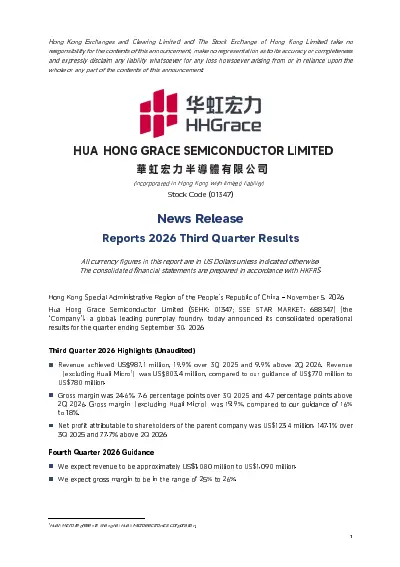
As a result, all financial reports now include Huali Microelectronics, unless otherwise specified. In the quarter that just passed, Hua Hong Grace achieved a revenue of $987.1 million, representing a 19.9% year-on-year increase on a restated comparable basis.
Excluding Huali Microelectronics, revenue was $803.4 million, above the upper end of last quarter's guidance of $770 to $780 million. Gross margin stood at 24.6%, up by 7.6 percentage points year-on-year.
Excluding Huali Microelectronics, gross margin was 19.9%, above the upper end of last quarter's guidance of 16% to 18%. Profit attributable to shareholders of the parent company was $123.4 million.
Revenue hit an all-time high by a large margin, and key financial metrics delivered significant improvement year-on-year and quarter-on-quarter. During the quarter, the company maintained a high fab utilization rate, witnessed a steady upward trend in shipments and average selling prices, and continued to execute capacity expansion projects on schedule.
Integration of Huali Microelectronics has been proved financially accretive and operationally synergistic. The 12-inch business now accounts for 70.7% of total revenue for the company.
Artificial intelligence-related products continue to drive global semiconductor market demand. The industrial automotive markets are also gradually improving.
As a specialty technology foundry with a broad technology portfolio, Hua Hong Grace has seen increasingly higher demand for MCU, flash memory, power management, and power discrete products, with correspondingly tight supply in some segments, even as we continue to expand capacity. We expect the pattern of rising volume and prices to continue for some time.
The company will remain laser-focused on operational excellence and delivering value for our shareholders. Now, I would like to hand the call over to our CFO, Daniel Wang, for his comments.
Daniel Wang
Thank you, Dr. Bai, for the inspiring remarks.
Now, let me walk you through a summary of our financial performance for the third quarter. I'll then provide our revenue and margin outlook for Q4 2026 before opening the floor for the question-and-answer session.
First, let's review our financial results for the third quarter. Revenue achieved $987.1 million, 19.9% over Q3 2025 and 9.9% above Q2 2026, primarily driven by increased wafer shipment and improved average selling price.
Excluding Huali Microelectronics, revenue was $803.4 million, exceeding our guidance of $770 million to $780 million. Gross margin was 24.6%, 7.6 percentage points over Q3 2025 and 4.7 percentage points above Q2 2026, primarily driven by improved average selling price, partially offset by increased depreciation costs.
Excluding Huali Microelectronics, gross margin was 19.9%, exceeding our guidance of 16% to 18%. Operating expenses were $100.5 million, 14.3% lower than Q3 2025, mainly due to decreased depreciation expenses and engineering wafer costs, and 13.6% below Q2 2026, mainly due to decreased labor and engineering wafer costs.
Other loss, net was $8.7 million, compared to other income, net of $16.3 million in Q3 2025, primarily due to increased finance costs. It was 84.4% over Q2 2026, mainly due to share of loss of an associate in Q3 2026 compared to share of profit of associates in Q2 2026.
Income tax expenses was $13.4 million, 30.5% over Q3 2025 and 75.5% above Q2 2026. Profit for the period was $120.1 million, 314.1% over Q3 2025 and 137.8% above Q2 2026.
Net profit attributable to shareholders of the parent company was $123.4 million, 147.1% over Q3 2025 and 77.7% above Q2 2026. Basic earnings per share was 6.6 cents, 144.4% over Q3 2025 and 78.4% above Q2 2026.
Annualized ROE was 6.8%, 3.6 percentage points over Q3 2025 and 2.8 percentage points above Q2 2026. Now, let's take a close look at our Q3 2026 revenue performance.
From geographical perspective, revenue from China was $760.8 million, contributing 77.1% of total revenue and an increase of 14.6% over Q3 2025, mainly driven by increased demand for MCU, flash, smart card IC, logic, and general MOSFET products, partially offset by decreased demand for analog products. Revenue from North America was $111.9 million, an increase of 75.1% over Q3 2025, mainly driven by increased demand for power management IC and MCU products.
Revenue from other Asia was $76.9 million, flat with Q3 2025. Revenue from Europe was $37.6 million, an increase of 104.3% over Q3 2025, mainly driven by increased demand for MCU products.
With respect to technology platforms, revenue from embedded non-volatile memory was $252.5 million, an increase of 42.5% over Q3 2025, mainly driven by increased demand for MCU and smart card ICs. Revenue from standalone non-volatile memory was $147.6 million, an increase of 28.2% over Q3 2025, mainly driven by increased demand for flash products.
Revenue from power discrete was $202 million, an increase of 19.5% over Q3 2025, mainly driven by increased demand for general MOSFET products. Revenue from logic and RF was $185.2 million, flat to Q3 2025.
Revenue from analog and power management IC was $199.9 million, an increase of 13.5% over Q3 2025, mainly driven by increased demand for power management IC products. Now, turn to our cash flow statement.
Net cash flows generated from operating activities was $377.3 million, 35.2% over Q3 2025, mainly due to increased receipts from customers, and 10.1% lower than Q2 2026, primarily due to increased labor payments in Q3 2026. Capital expenditures were $601 million in Q3 2026, including $571.8 million for 12-inch fabs and $28.2 million for the 8-inch facilities.
Other cash flow generated from investing activities was $51 million in Q3 2026, including $26.5 million interest income and $24.5 million receipt of government grants for equipment. Net cash flows generated from financing activities was $1,114.6 million, including $1,167.6 million capital contribution from non-controlling interests, $74.2 million proceeds from bank borrowings, and $100,000 proceeds from share option exercises, partially offset by $99.9 million of bank principal repayments, $26.4 million interest payments, and $1 million of lease payments.
Now, let's move to the balance sheet. Cash and cash equivalents was $6,048.4 million on September 30, 2026, compared to $5,062.4 million on June 30, 2026.
Other current assets increased from $950.4 million on June 30, 2026, to $1,005.1 million on September 30, 2026, mainly due to an increased value-added tax credit. Property, plant, and equipment was $8,167 million on September 30, 2026, compared to $7,520.5 million on June 30, 2026, primarily due to capacity expansion.
Interest-bearing bank borrowings increased from $3,985.8 million on June 30, 2026, to $4,008.9 million on September 30, 2026. Total assets increased from $16,019 million on June 30, 2026, to $17,072.7 million on September 30, 2026.
Total liabilities increased to $6,407.4 million on September 30, 2026, from $6,062.2 million on June 30, 2026. Debt ratio decreased to 36.1% on September 30, 2026, from 37.8% on June 30, 2026.
Finally, let's discuss our outlook for the fourth quarter of 2026. We expect revenue to be approximately $1,080 million to $1,090 million, with a projected gross margin of 25% to 26%.
This concludes my financial remarks. We'll now begin the Q&A session.
Operator, please assist. Thank you.
Operator
Thank you. We will now begin the question-and-answer session.
To ask a question now, please press star one one on your telephone and wait for your name to be announced. To withdraw your question, please press star one one again.
A moment for our first question. Our first question comes from the line of Leping Huang from Huatai.
Please go ahead Leping, your line is open.
Leping Huang
Thank you for taking my questions. First, congratulate for the very strong third quarter results.
If my calculation is correct, your standalone revenue go up by 12% sequentially, and the ASP go up by 7%, and your gross margin also hit the upper end of your guidance at the 19.9%. Dr.
Bai, could you share what are the specific drivers in terms of application and the pricing for this third quarter results? Also look into the fourth quarter, you guide for the $1,080 to $90 million revenue.
Which part is coming from the Huali consolidation, which part is coming from the continuously ASP and the volume? It is my first question.
Peng Bai
Okay. Thank you, Leping.
Let me try to answer your question. For Q4 guidance, the revenue is basically based on the volume we think we'll get out and the averaging selling price.
The volume side, the increase mainly come from the new 12-inch capacity expansion what getting out from the Fab 9A. It's the Wuxi site.
In term of Huali Microelectronics, the capacity we don't expect to be much increase, whatever we're getting in Q3 will be more or less what we're getting in Q4. In that regard, the incremental increase in revenue is not coming from Huali Microelectronics from the volume standpoint of view.
The other factor is the averaging selling price. Averaging selling price, we have been taking pricing action during the course of this year.
Some of them it happened at a different time points during the course of the year. Some later action actually going to realize in Q4.
Therefore, there is, if you look at the average selling prices in Q4 versus Q3, we still expect some increases, a small increases just based on the price action we have already taken during the course of the year. I don't know if that answer your question.
Leping Huang
What are the applications which drive your quite strong ASP growth in this quarter? Yeah.
Which specific product is driving, yeah?
Peng Bai
In terms of technology platform where we applied more significant pricing increases include MCU, include flash memory, and some in power management, and even selectively in power discrete. The magnitude of increase is pretty much follow the order as I just mentioned.
Logic for us is mostly CIS, and we haven't had much significant power pricing increases. There are some small increases.
Basically, we have increased the prices across the board, some more, the order is the order I just said in terms of the technology platform: MCU, flash memory, PMIC, and CIS. RF, obviously, we don't have too much volume.
Then power discrete selectively.
Leping Huang
It's very clear. Thank you.
My second question is for Daniel. Congratulations for the formal consolidation of Huali Microelectronics.
With Huali officially on board, could you help us to understand what will be the financial impact going forward in terms of the operating expense and the capital expenditure and the depreciation looking ahead? Also, when we can expect some synergy from this Huali and the Hua Hong's consolidation?
Thank you.
Daniel Wang
Thank you, Leping. The acquisition of Huali Microelectronics is a incredible transaction for for for the company, okay?
As you are all aware that Huali Microelectronics has approximately a a monthly capacity of about 40,000 wafers. It generates around $700 million revenue, okay?
Gross margin is approximately about 40%, 40%, I think this what we can we we we're achieving, okay? We expect to give us a a a more than $200 million net profit, okay, net profit.
On net basis, in terms of margin, it will deliver HHGrace a addition of about three to four points on on our overall gross margin. This is going to it's a it's a big impact to us.
This quarter we achieved virtually at a, 21.4%. If you really look at this thing, it is, if we're not Huali Microelectronics, then it will be only around like 17% on gross margin.
Leping Huang
Okay. It's very clear.
My third question is to Dr. Bai.
We see I have a question about the silicon photonics, which is very strong market expectation on this subsegment these days on the future potential growth. Your peer, both globally and domestically, also announced a few projects to expand the capacity here.
Dr. Bai, what's your view on this market and what's Hua Hong's plan in the future on the silicon photonics market?
Thank you.
Peng Bai
Thank you. Silicon photonics, obviously, is a growth area.
It's definitely related to AI-driven applications, one of the growth area. It become apparent this year that it's probably going to continue to grow.
This is also a area that in China, specifically, there's a large demand for. I want to make two points in response to your question.
One is that we are already in the silicon photonics area. If you look at an optical module, inside there's quite a few different chips, and some of them we already are making them, like MCU, some of our MCU products, some of the customers put it into an optical module.
Some of the power management chips, they also put it in there. There are also power discrete.
In that regard, we are not a new player. It's just that we participate at a device level as opposed to be at a more integrated system level.
What we have done in order after recognize that this is probably going to be one of the fast-growth area is that we did go through a strategic discussion about silicon photonics, look at what we want to maximally participate in this segment. In other words, we have looked at all the silicon-based devices inside a optical module.
That's include the modules that currently being utilized as well as the future module that's going to come online as a result of AI either due to some of the high-compute areas. We look at the whole segment, look at what are the products, the device-level products that we need to be making.
We definitely want to participate in all silicon-based devices. We're expanding this area from the point we already have some percentage point in there, but we want to expand in terms of the share, in terms of the type of products that we want to make.
We haven't looked at the non-silicon-based. There's some of the optical stuff that are non-silicon-based.
We obviously are also monitoring that, but we haven't decided to get into, because there's enough silicon-based devices that we want to first address and get our share out there. In that regard, I would also mention that in our next capacity expansion projects that we're going to undertake, probably in 2027, next year very very soon, that the power management and silicon photonics, those are the two areas that we want to add significantly more capacity.
We also added quite a few development projects in this area. In short, to answer your question, silicon photonics is an important area.
It's already an area we already participate. We want to expand our footprint in terms of technology offering as well as the capacity.
Definitely we hope it will become one of the growth factor for us in the future.
Leping Huang
It's very clear. Thank you very much.
Peng Bai
Thank you.
Operator
We will move to our next question from the line of Ziyuan Wang of CITIC Securities. Please go ahead Ziyuan, your line is open.
Ziyuan Wang
Thank you for taking my questions. This is Ziyuan from CITIC.
Firstly, I want to congratulate for the excellent Q3 performance and the Q4 guidance. My first question is I want to follow up on the question of the price increase.
For Bai Zong, could you share some outlook for the downstream demand and the capacity utilization for next year? If we look at next year, how do you assess the sustainability for the price hike?
Do you expect the price hike to continue, and how long do you expect the ASP hike to hold? Thank you.
Yeah.
Peng Bai
Thank you. This indeed is a question we all we also ask ourselves every single day, every single week.
The prices, we basically we follow the market demand, supply. Usually, when there is tightness in supply, and that does give us a us opportunity to increase the prices.
We are doing this thing very carefully in in consultation with our customer, because we obviously need to make sure that our customer are in agreement with us whenever we we we increase prices, because they also need to address their market, their end of the market. That's I want to first make sure that I say this clearly that the the all the pricing action we have taken, we have done so in consultation with with our customer, and they are usually based on the market condition.
It's basically supply-demand balanced situation. With that disclaimer, if I look at the current situation, we continue to see some places that demand outstrip the supply we can provide.
Therefore, I do expect that selectively we will continue to increase prices somewhat. I think that will be true for 2027.
Beyond that, I think we have to monitor this very carefully, because the market conditions do change. I think from our standpoint of view, our crystal ball probably don't look very far beyond, but 2028 maybe it's possible.
Given overall secular growth rate of of the entire semiconductor company, the AI-driven growth wave this time around, and our the HHGrace, our company, the particular role, a particular place we have in this overall market, they all give me some confidence that our competitive situation actually going to improve. Therefore, as long as the market demand remains strong, I think we can manage to increase the prices selectively.
Not across the board, it's mostly the areas that we think that we we cannot supply enough relative to the demand. I know you probably know want to know the the numbers, but this year we probably manage to to increase 10% to 15% next year on average.
Average everything out, some are higher, some are lower, some are flat, but average about 10% to 15%. I I don't want to be very aggressive next year, but I do expect that we will have an increase as well.
I think when we talk to you next quarter, at the end of the at the end of the year, we probably have a better reading about 2027. We might come to give you a range of increases worth considering.
That's that's the kind of number we're talking about.
Ziyuan Wang
Got it. Thank you, Bai Zong.
My second question is, as we can see the DRAM, there will be a transition towards the 3D structures or 3D stackings. I want to ask, does the company see any opportunity to participate in any part of that value chain, for example, in related with some logic wafer or something?
That's my second question. Thank you.
Peng Bai
Okay. Thank you.
In the memory area, actually both NAND and DRAM, one of the technological evolution is, as you correctly observed, try to separate out the memory cell, the true memory parts, and try form the peripheral logic into some kind of a two different die, and through some kind of a stacking to put the whole product together. If this trend continue, which NAND probably already doing this now, and DRAM is also embarking on the same direction.
Both looks like it's going to happening. This particular trend for both NAND and DRAM, does provide a new opportunity for logic foundry to at least provide the logic parts of the logic die, the logic part of the memory product.
Now, in that regard, it should be net additive to the demand to logic foundry. We also have to look at how the memory company are by definition IDM.
Their tendency is probably to do everything themselves. They might decide to outsource part of the logic, they might decide to in the long term, at least, to do everything themselves, so that they can control all parts of the memory product.
It depends on that particular dynamic, that particular decision. It will ultimately decide how much more business we, as logic foundry, will get.
In the end, it's going to be a net positive for us. Short-term, I think we definitely will see addition to our business just because they probably going to decide outsource some of the logic die for their memory product.
That's how I look at it. In fact, we already have some collaboration projects ongoing with the DRAM guys in this regard.
It just take a bit of time to see eventually how big or how much volume that we will get.
Ziyuan Wang
Got it. That's very clear.
Thank you, Bai Zong. That's all my question.
Operator
Thank you. We will now move to our next question.
Our next question comes from Ziye of Guosen Securities. Please go ahead Ziye, your line is open.
Ziye, your line is open, please unmute and proceed with your question. Hi
Zi Ye
Dr. Bai and Daniel, thank you for taking my question.
I'm Ziye from Guosen Securities. My first question is for Dr.
Bai. Where do you think we're standing in the semiconductor cycle?
Since the AI demand is very strong, but the consumer may be a little bit weak, how do you see the demand trends in next following quarters?
Peng Bai
That's again a very good question. I think the AI wave is definitely coming very strong this year, and also the magnitude of increases probably caught most people by surprise, especially the DRAM side, the memory, started with the memory side.
Now it probably start to also percolate into specialty technology, logic specialty technology side of things. As our Q3 results as well as Q4 results that we expect, it's basically a reflection of that.
How long is it going to last? There's this cycle, I think most people are optimistic in 2027 this trend will continue, even people predicting 2028.
As I said earlier, we don't look beyond two to three years, it's hard to have a very clear crystal ball. We will just see how that eventually evolve.
There's one point I make based on historical experience is that when we get into this supply-demand imbalances, typically the cycle lasts when the new capacity start to come online massively. This time DRAM as well as the logic guys are all building new capacity, but the new capacity takes I would say two to three years to get online.
If you're based on historical pattern, usually a cycle lasts for two to three years when the new capacity come online, let's start to correct the supply-demand imbalance. This time there are people arguing that it's a supercycle because of the demand exceed the rate the new capacity is being built, therefore may last longer.
This is an optimistic view. If I personally do not know the answer, I'll be honest with you.
I would say, based on historical experience, the two to three years is a reasonable assumption. Beyond that, it is a competition between how fast the demand goes up and how fast you can build new capacity.
That's the answer to you. Now, the demand side, obviously AI being a new kid on the block, a new application, that itself is evolving, and that including all the market expectation, valuation of the AI-related company.
This is different from the actual demand for semiconductor product. That is still there, very much strong.
It's just the valuation of all those language models, how eventually the end-market application going to manifest or going to land themselves in some kind of a profitable manner given the amount of investment, that is still pretty open. At this stage of the game, I believe we're still in this infrastructure building, because AI, just like the early-day stage of the internet, there's going to be a phase that even if the end-market application is still evolving, still not very clear, who knows eventually which one is going to end up to be the most profitable or most useful way of using AI.
You do need to build infrastructure first. We are in that infrastructure building phase.
Semiconductor, the chips, are really the new oil of the industrial age. We are building the infrastructure.
I think I'm confident this demand is going to be there from HHGrace standpoint of view, and this cycle should last for foreseeable future. Thank you.
Zi Ye
Thank you. Also I have a quick follow-up.
It seems we always have better performance in different end markets, even in consumer parts, we have better performance than the market growth. What's our positioning in different sector, and what's our market strategy in following quarters?
Peng Bai
You are speaking to the complexity of the semiconductor supply chain. We are logic foundry, we play in the fabrication layer of this supply chain.
Usually when we summarize our results or summarize our output, we put them into different technology platforms, like MCUs and PMIC and BCD and power device, power discrete, or logic and RF. Those sort of the classification speak to a technology platform, more or less, that it's directly relates to our capacity, how we build our capacity.
Now, on those technology platform, our customer builds the VLSI integrated circuit product. Those products, like MCU, some of them goes to new application, the AI-related application, some of them goes to the consumer, some like PMIC, the power management, well, I use this example.
Power management, you need that in a AI server boxes, you also need that in a cell phone or in a computer, a normal PC, for example. The real question is when we see in terms of the end market, they are very different.
The consumer is a different end market, AI server boxes are different end market. In the end, for a given technology platform, we always have products that end up in the growth area of the end market, we also have product that end up into a not growing very fast segment of the market.
In the current situation, the consumer, because the high memory products prices, there's a depressing effect in the consumer product, especially cell phone and PCs, computers, the traditional computer. Those purely is a end market that don't grow very fast.
On the other hand, all the AI-related end market grow really fast. To us, it's going to be in the end averaging effect.
If I look at the PMIC, this year we are growing really nicely. What does that mean?
It means that most of the product that we make are in the AI-related area. The consumer area didn't grow that fast, but on average we still grow.
Some of the technology platform are mostly in one area, those will grow faster, it will be the higher end of the growth rate. Some of them is more into a consumer part of the end market, like a CIS, imaging processor, that's mostly in the consumer.
That we don't see a huge increase, but we are not seeing decreasing either, because it's that even CIS as a product is also widespread now across the entire economy, entire industry. The averaging effect we see is the net we see a increase in demand for our product.
I don't know if I explain this complexity well enough, but that's the situation we're dealing with. Now our customers will also purposely steer their towards a higher-growth area of the market, so that in the end translate into a higher demand for us.
That means that a bigger portion, a large portion of our technology platform get used by our customer to make products that go into higher growth area of the end market.
Zi Ye
Very clear. Thank you, that's all my questions.
Operator
Thank you. Our next question comes from the line of Qingyuan Lin of Bernstein.
Please go ahead Qingyuan, your line is open.
Qingyuan Lin
Thank you for taking my question, and congratulations, Dr. Bai and Daniel, for getting a pretty good quarter results.
My first question is around the sort of the demand sustainability. You did mention that we expect next year the supply-demand imbalance will continue, and from this quarter we saw that consumer, industrial, and auto has been quite strong.
Could you help to take a look at, from the customer end or what's driving all this kind of a strong demand? Because right now it feels like market all focused on AI, but doesn't look like we have that much of AI exposure, but still getting pretty good records.
Kind of projecting that into 2027, there are some concern that this strong demand is just because of inventory stock-up. How do we think about the sustainability of this?
Thank you.
Peng Bai
In terms of the market demand, we still see the AI-related infrastructure building will continue to be a growth driver for us. In addition, in the second half of this year, we also saw industrial automotive markets are also improving.
I think, in terms of the end market, AI for sure, industrial and automotive are also growing. As I explained earlier in the previous question, if I use PMIC as an example, large part of platform are making products for AI servers or AI-related industrial products, robots and all that stuff.
I think we continue to see the growth in those markets, and therefore we should expect that 2020 at least the 2027 should be a strong market year for us.
Qingyuan Lin
Very helpful. Along the line, my second question is around our capacity expansion.
Obviously, this year we're still ramped up the Fab 9A, and then next year will be Fab 9B. In terms of the current market situation where clearly the demand is actually stronger than we might have originally expected, do we start to see sort of acceleration of our capacity expansion into this year and also maybe next year, and also how that would impact our CapEx?
Thank you.
Peng Bai
Yes, thank you. That's a good question.
Actually we are fortunate to have a Fab 9B right at the stage that we start to introduce the equipment into the fab. Obviously, taking into account the market condition, we adjusted our equipment plan, such that we were trying to address the parts of the market that we have a shortage.
We already adjust our equipment plan, such that as we introduce the equipment into the fab, as we speak, because we started in the middle of September to get new fab into that, into the Fab 9B. We call Fab 9B, that's a brand-new empty fab right now, that we will address where we think the market demand is highest, also where we think that it's the most beneficial for us.
That is already happening. Even after we account for the capacity expansion of Fab 9B by the time we get done, we still see shortages, because most of the capacity expansion we're doing right now for next year, large part of it is already spoken of by our customer.
We'll definitely continue to look for ways to increase our capacity, expand our capacity, and we will also expand in a way that try to address this supply-demand imbalance.
Qingyuan Lin
Do we have any guidance on changing potentially our CapEx number for this year and next year?
Peng Bai
Basically, in terms of the total amount of capacity expansion is going to be limited by the available cleanroom space we have. That part, the cleanroom space next year is not going to change, because the Fab 9B is the one we have to fill.
We will fill with the highest possible speed, we also fill it with equipment that give us the most benefit in terms of the results, in terms of the financial results or capacity results. That part is pretty much set.
Unless during the course of the next year we find the other ways to increase our capacity, which is not out of a question, it's possible, but it's just that I don't have any specific things to update you guys. If we get to that point along the way, we obviously will update you.
Qingyuan Lin
Thank you so much. Maybe last part is around the Fab 9B equipment purchase, because looks like the market is getting tight in the equipment supplies as well.
Do we see the localization ratio will go up, and also do we see that potentially we could get into a bit of a equipment sort of shortage for our Fab 9B build-in?
Peng Bai
Yeah. I think we expect our fab utilization to be at 100% or even a little bit higher if we find some productivity increase throughout the year for all, including all the new capacities that are going to come online.
We will fully utilize them. Not a problem.
Qingyuan Lin
Got it. Thank you so much, this is all my question.
Operator
Thank you. Our next question comes from the line of Tracy Cui of CLSA.
Please go ahead Tracy, your line is open. Please unmute and proceed with your question.
Tracy Cui
Sorry, thank you for the opportunity for me to raise questions, and also congrats on strong results. My first question is also want to ask about the demand outlook.
Just wondering across the different chips platforms, which part you may see more continued stronger demand? I understand you already talk about strong PMIC and also maybe CIS a little bit less excited.
How about the other platforms, such as flash, MCU, and power semis, etc.? Just wondering how are these other different types of chips, how do you see the demand outlook?
Peng Bai
For demand outlook, if I just look at HHGrace from our narrow angle, this is the order I see the demand strength from high to low: MCU, flash memory, PMIC, and power discrete, and CIS. That's the order.
Tracy Cui
Got it. Thanks.
Maybe my next question is about the gross margin outlook. Just wondering maybe in going to the next year, and maybe in also more mid-term, how should we expect our gross margin trend, cuz considering different factors, such as pricing and product mix, and also depreciation, etc.
How should we expect the gross margin trend entering to next year?
Daniel Wang
Yeah. Tracy?
Hi Tracy, it's Daniel. Our overall gross margin has been improving throughout quarters this year.
I think at the end of the day, for 2026, our gross margin is going to be above 20%. That's I'm very, very confident about.
As for 2027, I think with the ASP increase that Dr. Bai just talked about earlier, we expect the momentum will continue throughout 2027, and we will see another 10%, 15% price hike.
I expect the gross margin will hopefully get to around 25% or even above percent.
Tracy Cui
Got it. Thank you.
Thank you Daniel and thank you, Dr. Bai.
That's all for my questions. I will go back to the queue, thank you.
Operator
Thank you. As a reminder, before we move to our next question, if you wish to ask a question now, please press star one one on your telephone keypad.
We will now take our next question from the line of Szeho Ng of BOCI. Please go ahead Szeho, your line is open.
Szeho Ng
Thank you. Thanks, gentlemen.
Actually two questions from my side. The first one is regarding our AI exposure.
I'm not sure if you can share with us the ballpark AI exposure for the company right now and maybe two, three years down the road?
Peng Bai
We actually have a statistical way we try to basically look at our sales and categorize them into different end market. That old categorization seems to be outdated.
In the view of the new market condition, we probably need to revise that. In the old way of dividing was some computing, communication, consumer.
That clearly doesn't fit the current AI-driven marketing. As I think if you just purely look at what is AI-related, what is not AI-related, that definition, frankly, is a bit of a nebulous right now, I would say, that because the AI is also percolating into different segments.
The fact that we clearly benefited from the AI wave this year, I would say at least more than 50% of our product are goes into AI-related. That cut across all the technology platforms, as I explained earlier.
When we say we have a BCD technology platform, that large part of it goes to AI, that small part of it goes to consumer. When we see we have a CIS logic platform, large part of it goes to consumer, a significant probably goes to AI-related, because the robotics also use CIS for their image processing.
It's going to be a little bit difficult or getting a very good accuracy of that end-market segment requires a little bit of working on our end. We were just discussing changing the end-market categorization, we can probably better answer the question that you just asked.
I would say, I would venture to guess right now without very accurate data to back it up, that more than 50% of our product are all in the AI-related field, otherwise, I wouldn't see this much growth this year.
Szeho Ng
Understood. The second question, last quarter you shared with us some of the book-to-bill ratio for your product lines running at something like 1.5 times or even 2 times.
Are you still seeing the book-to-bill ratio running at that high level, or you see some sign of a moderation on book-to-bill?
Peng Bai
The supply-demand situation obviously vary quite a bit from different market segment, different type of product. There's areas that we're clearly have a two to one build ratio, then there's the area that more or less supply-demand is unbalanced.
I would say on average, it's probably at least 50% of the order we cannot fulfill. Now, I want to caution you to use the build book ratio, because for our industry, this is not probably a typical target.
The reason I want to caution you is that this is also a function of the pricing. If the price is low, then the book ratio can be one thing.
If you prices high, then obviously it's going to reverse. Our perfect situation is that I don't want to have a very high build book ratio, by raising the prices closer to a supply-demand balance point, if you understand what I'm trying to say.
Szeho Ng
I see. Got you.
Maybe the third question, my last question, for Daniel. At the gross margin side, I think back in the COVID times, actually the company delivered gross margin something like 30% plus.
How likely for us to see the gross margin to back to that level? Is it something doable?
Is it easy for us to achieve that level? Did you get the question?
Daniel Wang
Hey Szeho. Gross margin will Yeah, gross margin will continue to improve over time.
Our gross margin literally, went up by 7% to 8% percentage points this year as we continue to keep utilization rate at extremely high level, improve product mix, mostly because the price hike, price the hike, okay? I expect that this will continue throughout next year.
As I said earlier, I think gross margin for 2026, I think we're pretty confident at this point it's going to exceed more than 20%, okay? It will, overall it will continue as we continue to release more capacity, improve ASP, and our Fab 9A next year year will actually will be will be fully load fully loaded, and that will also improve the gross margin as well, as long as we keep at the extremely high utilization rate.
With the, with the price improvement another 10%, 15% next year, I think, we we should be able to do pretty well with gross margin improvement.
Szeho Ng
Got you. Thank you very much.
Operator
Thank you. Ladies and gentlemen, that's all the time we have for questions.
I will now hand back to Mr. Daniel Wang for closing remarks.
Daniel Wang
This concludes our call for today. Once again, thank you all for your valuable time and questions today.
It has been wonderful. We appreciate your continued support and look forward to speaking with you and seeing you again next quarter.
As we are approaching year end, we wish you all a very happy holiday season and a very prosperous year of 2027. Thank you.
Operator
Ladies and gentlemen, thank you for your attendance. You may all disconnect now.