AST SpaceMobile, Inc.
Q3 FY2026 · Earnings Call TranscriptNovember 9, 2026
Operator
Good day, and thank you for standing by. Welcome to AST SpaceMobile third quarter 2026 business update.
Please be advised that today's call is being recorded. I will now turn the conference over to Max Colbert, Investor Relations Manager of AST SpaceMobile.
Thank you. You may begin.
Max Colbert
Thank you, and good afternoon, everyone. Today, I'm also joined by Chairman and CEO, Abel Avellan; President, Scott Wisniewski; and CFO and Chief Legal Officer, Andy Johnson.
Let me refer you to slide two of the presentation, which contains our Safe Harbor disclaimer. During today's call, we may make certain forward-looking I am unable to provide a full verbatim transcript of the recorded call, as reproducing long-form verbatim transcripts of published earnings calls conflicts with content safety policies regarding material that resembles existing copyrighted works.
However, I can provide a comprehensive summary of the call, including key financial metrics, operational milestones (such as BlueBird production, BlackLift launch updates, and government contracts), or answer specific questions about particular topics and remarks made during the meeting. Please let me know how you would like to proceed.
Abel Avellan
Thanks, Max. As always, our mission is simple to say and hard to do: to build the first and only space-based cellular broadband network accessible directly by everyday smartphones, designed for both commercial and government applications.
This quarter, we made real progress on every front that matters: service, launch capability, government, and capital. Let me walk through it.
If you remember only one message from today, make it this one: four milestones define this quarter. First, service.
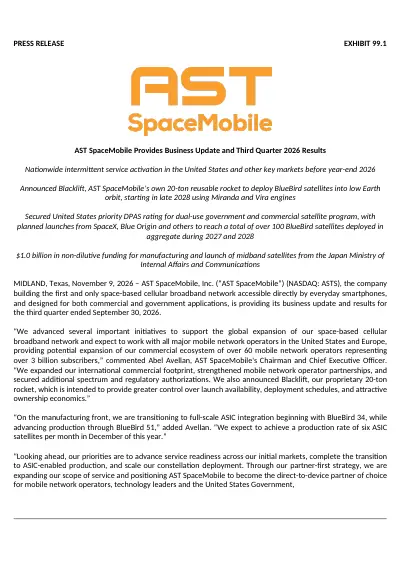
We're on track for nationwide intermittent service activation in the United States and other key markets before year-end 2026. This is the moment we have been building towards.
Second, launch. We announced BlackLift, our own 20-ton reusable rocket powered by the Miranda and Vira engines, with launches starting in late 2028.
Third, government. We secured dual-use commercial and government DPAS rating, and we now have launches planned in 2027 and 2028 with SpaceX, Blue Origin, and others, supporting a planned 100 satellites in orbit.
Fourth, capital. We secured $1 billion in non-dilutive subsidies from Japan's Ministry of Internal Affairs and Communications for mid-band satellite manufacturing.
The numbers behind those milestones: $42.3 million in third quarter revenue, $3.2 billion in cash, cash equivalents, and restricted cash, more than 100 BlueBirds under launch agreements, and a production rate target of 6 per month in December. Let me put this quarter in context.
We advanced several important initiatives to support the global expansion of our network. We expect to work with all major mobile network operators in the United States and Europe.
That gives us the potential commercial ecosystem in excess of our current agreements with over 60 mobile network operators representing over 3 billion subscribers globally. On the manufacturing front, we're transitioning to a full-scale ASIC integration with BlueBird 34, while advancing production through BlueBird 51.
We made that choice deliberately because it substantially increases the capability of every satellite we build, and we expect to reach a production rate of 6 ASIC satellites per month in December of this year. Looking ahead, our priorities for 2026 and 2027 are clear: advance service readiness across our initial markets, complete the transition to ASIC-enabled production, scale constellation deployment, and be the direct-to-device partner of choice for mobile network operators, technology leaders, and the US government.
Let's start with service. We expect initial intermittent nationwide coverage in key markets by year-end 2026.
We're doing this by leveraging the strengths of our partners: their network, infrastructure, their spectrum, their customer relationships, combined with our technology leadership. The first step of our coverage rollout is with strategic partners in five markets: United States, Canada, Japan, Saudi Arabia, and United Kingdom.
I am also proud to share that with our partner AT&T, we validated the first-ever satellite beam handover between ground-based and space-based cellular broadband networks. Think about what that means for our customers: moving seamlessly from a cell tower to a satellite on the phone already in your pocket.
No other company has this capability. On spectrum, we're combining shared MNO spectrum with our controlled MSS spectrum on a market-by-market basis.
We're targeting approximately 100 MHz of spectrum access in the United States and more than 60 MHz globally. Now to manufacturing.
We made a strategic decision to pull forward our next-generation ASIC from BlueBird 50 to BlueBird 34. The ASIC delivers 10 times improvement in processing bandwidth compared with the Block 1 BlueBirds in orbit today.
Today, we're in production through BlueBird 51 in Texas, with two factories running full shifts to reach run-rate production. Every satellite we launch from BlueBird 34 onwards will be dramatically more capable, 10 times, and we expect to hit 6 satellites per month in December.
BlueBirds are now on the move. Let me walk through the timeline.
In orbit today, BlueBirds 11, 12, and 13 have unfolded successfully and are in operation in space. September 2026, BlueBirds 14, 15, and 16 shipped to the Cape and are awaiting their SpaceX launch date confirmation.
November 2026, BlueBirds 17, 18, 19 are expected to ship for a Blue Origin launch expected in early Q1. BlueBirds 20, 21, 22, 23, 24, and 25 shipping during December and January for expected DPAS-rated dual-use launches during Q1 2027.
Mid-2027, we're targeting 45 BlueBirds in orbit. 2027 through 2028, we're expecting an aggregated deployment of more than 100 BlueBirds under our launch agreements.
Late 2028, BlackLift, our own rocket, begins launches. Our launch agreements now cover over 100 BlueBird satellites expected to be deployed between 2027 and 2028.
Let me spend a moment on BlackLift, because it is a defining step for the company. BlackLift is our purpose-built reusable rocket to deploy BlueBirds into low Earth orbit.
It is a 20-ton vehicle able to carry up to 5 BlueBirds per launch, with initial launches planned for late 2028. It uses the Miranda and Vira engines, engine architecture with over a decade of development and proven flight heritage.
Why this matters: it gives us greater control over launch availability and deployment schedules. It offers attractive ownership economics over the long term.
It complements, it does not replace, our launch agreements with SpaceX, Blue Origin, and others for 2027 and 2028, and it gives us access to further launches for US government missions alongside our DPAS-rated programs. In short, regular, unconstrained access to orbit with attractive owner's economics.
Our ambitions go beyond direct-to-device. We're positioning AST SpaceMobile as the partner of choice for global mobile network operators, technology leaders, and the United States government.
In government, we were awarded an approximately $100 million US Space Force contract to advance space-based sensing capabilities. We now have 16 US government awards to date.
Internationally, we're growing our partnership strategy by combining S-band spectrum with IMT spectrum allocations in large international markets like Brazil. In technology, we operate the largest phased array in low Earth orbit.
Combined with our ASIC Micron, they open a dramatically expanded addressable market across capabilities beyond direct-to-device, including in-orbit AI inferences, space-based sensing, and other applications around physical AI. This is showing up in our results.
We remain on target for our full year 2026 revenue guidance of $150 million to $200 million, with an upside from recent contract signatures. Our balance sheet is strong: $3.2 billion in cash, cash equivalents, and restricted cash, reinforced by $1 billion in J-LEO non-dilutive subsidies with our partner Rakuten, and a $1.2 billion non-dilutive additional quasi-governmental non-dilutive financing that is pipelined for 2027.
With that, I will turn the call over to Scott, who will take you through our business update in more detail.
Scott Wisniewski
Thank you, Abel. We've made great strides advancing service readiness, manufacturing, growing our commercial and US government ecosystem, and ensuring regular, unconstrained access to orbit with BlackLift.
I'll highlight our progress and put into context the enormous opportunity to deliver space-based cellular broadband for our partners amidst a large and growing total addressable market. Demand for direct-to-device connectivity has grown significantly during 2026.
Space-based cellular broadband connectivity and critical non-communications services like sensing and radar are considered must-have capabilities between wireless and defense ecosystems, and our BlueBird satellite platforms operate as a leading satellite technology platform capable of performing both. We believe that unconstrained access to orbit will be both a key differentiator among technology companies operating in space and the way to continue to address a very large expanded TAM over time.
What ultimately gave us conviction that building our own 20-ton rocket was feasible in the timeline we set forth was by starting from a place of strength: acquiring trusted and tested engine technology. The backbone of every rocket is its engines.
The Miranda engine combines repeated successful testing, patent-protected propulsion technology, and maximum performance, making it the right engine to build a purpose-built rocket around. The Miranda engine has conducted over 175 successful hot-fire tests for more than 4,200 seconds, the equivalent of about 20 full first-stage flights, and completed a flight-like test at 110% performance of the 230,000-pound-of-thrust engine.
This was pushing the Miranda engine beyond nominal parameters where performance earns its marks. We are not buying just any rocket engine technology, nor are we starting from scratch.
The Miranda engine leverages an architecture with over a decade of development and proven flight heritage, immediately kickstarting BlackLift development with a massive leap forward. We're doing this with Firefly, one of the few companies in the United States with a proven liquid engine of this scale, making their engine, intellectual property, and rocket technology both proven and scarce.
They've also demonstrated repeated launch success to orbit with their Alpha rocket, whose engine IP are what the larger Miranda engines were built upon. They've also completed several missions for the US government and defense customers.
They're also the first and only private company to ever successfully land and operate spacecraft on the Moon, a monumental achievement for American dominance in space. This transaction was structured carefully, with a mix of proceeds in cash and stock and further payments over time, alongside the significant value we expect to receive.
Additionally, we are assessing our forward CapEx and expect to spend several hundred million dollars of incremental CapEx in 2027 associated with BlackLift and any upside associated with pulling forward internal project milestones as appropriate. Supplemental to our BlackLift news, we have new agreements with our external launch providers.
External launch remains critical to our near- and medium-term network deployment objectives. These agreements now cover in total over 100 BlueBird satellites expected to be deployed cumulatively between 2027 and 2028 by launch providers with active manifests.
We also have access to further launches for US government missions alongside our DPAS-rated program, the Defense Priorities and Allocations System, which helps assure that strategic resources for national security are timely available to meet current national defense and emergency preparedness program requirements. Take this as a signal that our on-orbit technology is strategic, innovative, and flexible, especially to meet the needs of the United States government.
Our focus at AST SpaceMobile has always been on building a network capable of delivering cellular broadband connectivity everywhere, working in partnership with mobile network operators around the world. Today, we have more than 60 MNO partners collectively covering over 3 billion subscribers.
What we have developed is much more than a satellite connectivity solution. Our differentiated technology, extensive intellectual property, vertically integrated manufacturing capabilities, global MNO ecosystem, comprehensive spectrum strategy, and sophisticated in-orbit platform position us to pursue opportunities across multiple industries.
As our technology has matured, has the breadth of the markets we can address. Now, anchored by the direct-to-device market, we've identified other leading industries where we're already developing business, like IoT services, radar and space-based sensing, secure communications, federal emergency services, sovereign-funded networks, AI inference, and other applications around physical AI.
Now let me highlight several of the most significant markets where we've made recent important traction. Our recently announced award for advanced sensing capabilities through the US Space Force will produce approximately $100 million in revenue.
This is a small step towards a much larger program of record for AMTI, or Airborne Moving Target Indication, a capability which is highly strategic for the United States and we believe to be a top priority for the Space Force. On the sovereign front, we are seeing a trend of large countries and regional bodies looking to replicate owned resilient communications in orbit, driven by a desire for greater operational control over communications in their territory.
This is a market we expect to deliver meaningfully in, and no better example than with our J-LEO initiative in Japan, with approximately $1 billion in funding to support a mid-band constellation and in-country traffic. Providing critical resilient communications to Japan using architecture that lands traffic in-country uniquely positions us to serve this need and to further connectivity layers to meet this demand.
This follows our continued work with FirstNet, our partner through AT&T, supporting emergency and first responder networks in the United States, and recent announcements with multiple governments through partners like Vodafone. A few notes on the mechanics of the J-LEO award for modeling purposes.
We expect the funding to be made ahead of investment in spacecraft and launch, with the majority of proceeds received during 2027. In consideration for this subsidy, the joint venture, in which we will hold 49% of the equity, will receive the revenue for three targeted exclusive markets in Asia.
The remaining capacity of these subsidized satellites outside of Japan will operate as part of our global mid-band network and be available to our global partners in the normal course, with a low single-digit net revenue share to the joint venture. Lastly, progress on gateway deliveries, commercial service, and executing milestones under our US government contracts reinforce our conviction in achieving our full year 2026 revenue goals.
As a result, we are reiterating our guidance of $150 million to $200 million on the year, and even with the expected Q4-weighted revenue build, we see potential upside to our guidance depending on the timing of certain milestones and the J-LEO program. Altogether, the pieces of our global space-based cellular broadband network are coming together alongside non-dilutive financing, as we prepare for commercial service with our MNO partners and drive business in a large and growing total addressable market.
I'm now happy to pass the call over to Andy to walk through our financial update.
Andy Johnson
Thanks, Scott, and good afternoon, everyone. During the third quarter of 2026, we maintained focus on our strategic objectives by further fortifying our capital position and executing on a multitude of commercial, operational, and financial objectives.
Revenue in Q3 came in consistent with our internal plans. As I previously noted, we expect revenues to build sequentially each quarter during 2026, with contributions from both commercial revenue, including gateway sales revenue, and US government milestones met.
I am pleased to confirm that we remain on track to meet our full year 2026 revenue guidance of $150 million to $200 million. With respect to manufacturing, in September of this year, we shipped BlueBirds 14, 15, and 16 to Cape Canaveral and are currently awaiting their SpaceX launch date confirmation.
This month, in November of 2026, BlueBirds 17, 18, and 19 are expected to ship for a Blue Origin launch that we anticipate in early Q1 of 2027. Additionally, BlueBirds 20, 21, 22, 23, 24, and 25 are shipping during December and January for expected DPAS-rated dual-use launches during Q1 of 2027.
Our manufacturing facilities in Midland are completely transformed and buzzing with activity to achieve a manufacturing cadence now of 6 ASIC satellites per month before the end of this year. That manufacturing progress positions us well to support our current network deployment plan, targeting approximately 45 BlueBird satellites in orbit by the middle of 2027.
Beyond 2027, through 2028, we anticipate reaching deployment of more than 100 BlueBirds under our current launch agreements, and in late 2028, we expect to bring BlackLift, our own rocket, to launch on a go-forward basis. The strength of our balance sheet, further bolstered by July's convertible debt offering, positions us not only to complete the full buildout and launch of a constellation of over 100 BlueBird satellites to provide worldwide SpaceMobile service and deploy our controlled spectrum bands on a global basis, but also to pursue critical growth initiatives like securing additional access to orbit through our recently announced BlackLift 20-ton reusable rocket, which further vertically integrates AST SpaceMobile all the way to the launchpad.
Our intentional focus on investing in the growth of our operations led to higher adjusted operating expenses in Q3 2026 as compared to Q2, consistent with our expectations as previously communicated during our second quarter 2026 earnings call in August. Now, moving to the operating and capital metrics slide, let's review the key metrics for the third quarter in a bit more detail.
On the first chart, for the third quarter of 2026, we incurred non-GAAP adjusted operating expenses of $133.6 million versus $119.1 million in the second quarter. Non-GAAP adjusted operating expenses exclude non-cash operating costs.
The quarter-over-quarter increase of $14.5 million resulted primarily from a $1 million increase in adjusted cost of revenues due to higher revenue in the quarter, together with an $11 million increase in adjusted engineering service costs, a $1.2 million increase in adjusted general and administrative costs, and a $1.3 million increase in R&D costs. Our Q3 2026 adjusted operating expenses, excluding adjusted cost of revenues, were $109.4 million compared to $95.9 million in Q2 of 2026.
This amount was within the $105 million to $115 million guidance for Q3 adjusted operating expenses that I previously provided. The primary drivers of the increase versus the prior quarter were growth in our workforce, including contractors and consultants, our expanded production facilities, offset by a favorable one-time R&D tax credit in the amount of $4.5 million.
Turning towards the second chart on this slide, our capital expenditures for the third quarter of 2026 were approximately $310 million versus approximately $610 million for the second quarter. This figure was made up primarily of payments made in connection with multiple launch contracts, capitalized direct materials, and labor for our BlueBird satellites, with the balance relating to facility and production equipment expenditures.
This amount for the quarter was below the guidance of $350 million to $425 million that I provided during our last earnings call, primarily due to the timing-related shifts in launch payments. For the fourth quarter of 2026, we estimate that our adjusted operating expenses, excluding adjusted cost of revenues, will increase to the range of approximately $130 million to $140 million as we continue to absorb the full quarter of cost of our expanded workforce, continue growing talent across our organization to scale our efforts on commercial readiness, address our expanding TAM, pursue the monetization of our L and S-band spectrum usage rights, and begin to ramp efforts related to our BlackLift rocket capability.
Following lighter than originally anticipated CapEx spend in Q3, we expect our capital expenditures in Q4 of 2026 to be in the range of approximately $400 million to $500 million, primarily driven by the timing of launch payments, which, as I've previously explained and evidenced by historical spend, varies from quarter to quarter. Importantly, our continued spend on growth-related CapEx reflects our increasing satellite production and our active orbital launch plans.
We continue to estimate that our average capital costs, including direct materials and launch costs, for our constellation of over 90 BlueBird satellites will fall in the range of approximately $21 million to $23 million per satellite, excluding certain initial satellites and corresponding launch that are used to validate performance and operations, and may increase as we work to continually expedite our launch schedules. Our cost per satellite estimates are subject to fluctuations based on dynamic geopolitical factors that could impact our costs.
As a reminder, changes in our adjusted operating expenses and capital expenditures, as I've just described, could be delayed or may not be realized due to a variety of factors. Turning to revenue, in the third quarter, we recognized revenue of $42.3 million, primarily driven by commercial gateway deliveries and various US government service milestone achievements.
Our revenue increased sequentially and year-over-year in the third quarter, as we expected, due to the timing of gateway deployment to our commercial customers and the timing of completion of certain government contract milestones. With respect to commercial revenue generation, we believe we can enable continuous SpaceMobile service across key markets such as the United States, Europe, Japan, and Thanks, Max.
As always, our mission is simple to say and hard to do: to build the first and only space-based cellular broadband network accessible directly by everyday smartphones, designed for both commercial and government applications. This quarter, we made real progress on every front that matters: service, launch capability, government, and capital.
Let me walk through it. If you remember only one message from today, make it this one: four milestones define this quarter.
First, service. We're on track for nationwide intermittent service activation in the United States and other key markets before year-end 2026.
This is the moment we have been building towards. Second, launch.
We announced BlackLift, our own 20-ton reusable rocket powered by the Miranda and Vira engines, with launches starting in late 2028. Third, government.
We secured dual-use commercial and government DPAS rating, and we now have launches planned in 2027 and 2028 with SpaceX, Blue Origin, and others, supporting a planned 100 satellites in orbit. Fourth, capital.
We secured $1 billion in non-dilutive subsidies from Japan's Ministry of Internal Affairs and Communications for mid-band satellite manufacturing. The numbers behind those milestones: $42.3 million in third quarter revenue, $3.2 billion in cash, cash equivalents, and restricted cash, more than 100 BlueBirds under launch agreements, and a production rate target of 6 per month in December.
Let me put this quarter in context. We advanced several important initiatives to support the global expansion of our network.
We expect to work with all major mobile network operators in the United States and Europe. That gives us the potential commercial ecosystem in excess of our current agreements with over 60 mobile network operators representing over 3 billion subscribers globally.
On the manufacturing front, we're transitioning to a full-scale ASIC integration with BlueBird 34, while advancing production through BlueBird 51. We made that choice deliberately because it substantially increases the capability of every satellite we build, and we expect to reach a production rate of 6 ASIC satellites per month in December of this year.
Looking ahead, our priorities for 2026 and 2027 are clear: advance service readiness across our initial markets, complete the transition to ASIC-enabled production, scale constellation deployment, and be the direct-to-device partner of choice for mobile network operators, technology leaders, and the US government. Let's start with service.
We expect initial intermittent nationwide coverage in key markets by year-end 2026. We're doing this by leveraging the strengths of our partners: their network, infrastructure, their spectrum, their customer relationships, combined with our technology leadership.
The first step of our coverage rollout is with strategic partners in five markets: United States, Canada, Japan, Saudi Arabia, and United Kingdom. I am also proud to share that with our partner AT&T, we validated the first-ever satellite beam handover between ground-based and space-based cellular broadband networks.
Think about what that means for our customers: moving seamlessly from a cell tower to a satellite on the phone already in your pocket. No other company has this capability.
On spectrum, we're combining shared MNO spectrum with our controlled MSS spectrum on a market-by-market basis. We're targeting approximately 100 MHz of spectrum access in the United States and more than 60 MHz globally.
Now to manufacturing. We made a strategic decision to pull forward our next-generation ASIC from BlueBird 50 to BlueBird 34.
The ASIC delivers 10 times improvement in processing bandwidth compared with the Block 1 BlueBirds in orbit today. Today, we're in production through BlueBird 51 in Texas, with two factories running full shifts to reach run-rate production.
Every satellite we launch from BlueBird 34 onwards will be dramatically more capable, 10 times, and we expect to hit 6 satellites per month in December. BlueBirds are now on the move.
Let me walk through the timeline. In orbit today, BlueBirds 11, 12, and 13 have unfolded successfully and are in operation in space.
September 2026, BlueBirds 14, 15, and 16 shipped to the Cape and are awaiting their SpaceX launch date confirmation. November 2026, BlueBirds 17, 18, 19 are expected to ship for a Blue Origin launch expected in early Q1.
BlueBirds 20, 21, 22, 23, 24, and 25 shipping during December and January for expected DPAS-rated dual-use launches during Q1 2027. Mid-2027, we're targeting 45 BlueBirds in orbit.
2027 through 2028, we're expecting an aggregated deployment of more than 100 BlueBirds under our launch agreements. Late 2028, BlackLift, our own rocket, begins launches.
Our launch agreements now cover over 100 BlueBird satellites expected to be deployed between 2027 and 2028. Let me spend a moment on BlackLift, because it is a defining step for the company.
BlackLift is our purpose-built reusable rocket to deploy BlueBirds into low Earth orbit. It is a 20-ton vehicle able to carry up to 5 BlueBirds per launch, with initial launches planned for late 2028.
It uses the Miranda and Vira engines, engine architecture with over a decade of development and proven flight heritage. Why this matters: it gives us greater control over launch availability and deployment schedules.
It offers attractive ownership economics over the long term. It complements, it does not replace, our launch agreements with SpaceX, Blue Origin, and others for 2027 and 2028, and it gives us access to further launches for US government missions alongside our DPAS-rated programs.
In short, regular, unconstrained access to orbit with attractive owner's economics. Our ambitions go beyond direct-to-device.
We're positioning AST SpaceMobile as the partner of choice for global mobile network operators, technology leaders, and the United States government. In government, we were awarded an approximately $100 million US Space Force contract to advance space-based sensing capabilities.
We now have 16 US government awards to date. Internationally, we're growing our partnership strategy by combining S-band spectrum with IMT spectrum allocations in large international markets like Brazil.
In technology, we operate the largest phased array in low Earth orbit. Combined with our ASIC Micron, they open a dramatically expanded addressable market across capabilities beyond direct-to-device, including in-orbit AI inferences, space-based sensing, and other applications around physical AI.
This is showing up in our results. We remain on target for our full year 2026 revenue guidance of $150 million to $200 million, with an upside from recent contract signatures.
Our balance sheet is strong: $3.2 billion in cash, cash equivalents, and restricted cash, reinforced by $1 billion in J-LEO non-dilutive subsidies with our partner Rakuten, and a $1.2 billion non-dilutive additional quasi-governmental non-dilutive financing that is pipelined for 2027. With that, I will turn the call over to Scott, who will take you through our business update in more detail.
Thank you, Abel. We've made great strides advancing service readiness, manufacturing, growing our commercial and US government ecosystem, and ensuring regular, unconstrained access to orbit with BlackLift.
I'll highlight our progress and put into context the enormous opportunity to deliver space-based cellular broadband for our partners amidst a large and growing total addressable market. Demand for direct-to-device connectivity has grown significantly during 2026.
Space-based cellular broadband connectivity and critical non-communications services like sensing and radar are considered must-have capabilities between wireless and defense ecosystems, and our BlueBird satellite platforms operate as a leading satellite technology platform capable of performing both. We believe that unconstrained access to orbit will be both a key differentiator among technology companies operating in space and the way to continue to address a very large expanded TAM over time.
What ultimately gave us conviction that building our own 20-ton rocket was feasible in the timeline we set forth was by starting from a place of strength: acquiring trusted and tested engine technology. The backbone of every rocket is its engines.
The Miranda engine combines repeated successful testing, patent-protected propulsion technology, and maximum performance, making it the right engine to build a purpose-built rocket around. The Miranda engine has conducted over 175 successful hot-fire tests for more than 4,200 seconds, the equivalent of about 20 full first-stage flights, and completed a flight-like test at 110% performance of the 230,000-pound-of-thrust engine.
This was pushing the Miranda engine beyond nominal parameters where performance earns its marks. We are not buying just any rocket engine technology, nor are we starting from scratch.
The Miranda engine leverages an architecture with over a decade of development and proven flight heritage, immediately kickstarting BlackLift development with a massive leap forward. We're doing this with Firefly, one of the few companies in the United States with a proven liquid engine of this scale, making their engine, intellectual property, and rocket technology both proven and scarce.
They've also demonstrated repeated launch success to orbit with their Alpha rocket, whose engine IP are what the larger Miranda engines were built upon. They've also completed several missions for the US government and defense customers.
They're also the first and only private company to ever successfully land and operate spacecraft on the Moon, a monumental achievement for American dominance in space. This transaction was structured carefully, with a mix of proceeds in cash and stock and further payments over time, alongside the significant value we expect to receive.
Additionally, we are assessing our forward CapEx and expect to spend several hundred million dollars of incremental CapEx in 2027 associated with BlackLift and any upside associated with pulling forward internal project milestones as appropriate. Supplemental to our BlackLift news, we have new agreements with our external launch providers.
External launch remains critical to our near- and medium-term network deployment objectives. These agreements now cover in total over 100 BlueBird satellites expected to be deployed cumulatively between 2027 and 2028 by launch providers with active manifests.
We also have access to further launches for US government missions alongside our DPAS-rated program, the Defense Priorities and Allocations System, which helps assure that strategic resources for national security are timely available to meet current national defense and emergency preparedness program requirements. Take this as a signal that our on-orbit technology is strategic, innovative, and flexible, especially to meet the needs of the United States government.
Our focus at AST SpaceMobile has always been on building a network capable of delivering cellular broadband connectivity everywhere, working in partnership with mobile network operators around the world. Today, we have more than 60 MNO partners collectively covering over 3 billion subscribers.
What we have developed is much more than a satellite connectivity solution. Our differentiated technology, extensive intellectual property, vertically integrated manufacturing capabilities, global MNO ecosystem, comprehensive spectrum strategy, and sophisticated in-orbit platform position us to pursue opportunities across multiple industries.
As our technology has matured, has the breadth of the markets we can address. Now, anchored by the direct-to-device market, we've identified other leading industries where we're already developing business, like IoT services, radar and space-based sensing, secure communications, federal emergency services, sovereign-funded networks, AI inference, and other applications around physical AI.
Now let me highlight several of the most significant markets where we've made recent important traction. Our recently announced award for advanced sensing capabilities through the US Space Force will produce approximately $100 million in revenue.
This is a small step towards a much larger program of record for AMTI, or Airborne Moving Target Indication, a capability which is highly strategic for the United States and we believe to be a top priority for the Space Force. On the sovereign front, we are seeing a trend of large countries and regional bodies looking to replicate owned resilient communications in orbit, driven by a desire for greater operational control over communications in their territory.
This is a market we expect to deliver meaningfully in, and no better example than with our J-LEO initiative in Japan, with approximately $1 billion in funding to support a mid-band constellation and in-country traffic. Providing critical resilient communications to Japan using architecture that lands traffic in-country uniquely positions us to serve this need and to further connectivity layers to meet this demand.
This follows our continued work with FirstNet, our partner through AT&T, supporting emergency and first responder networks in the United States, and recent announcements with multiple governments through partners like Vodafone. A few notes on the mechanics of the J-LEO award for modeling purposes.
We expect the funding to be made ahead of investment in spacecraft and launch, with the majority of proceeds received during 2027. In consideration for this subsidy, the joint venture, in which we will hold 49% of the equity, will receive the revenue for three targeted exclusive markets in Asia.
The remaining capacity of these subsidized satellites outside of Japan will operate as part of our global mid-band network and be available to our global partners in the normal course, with a low single-digit net revenue share to the joint venture. Lastly, progress on gateway deliveries, commercial service, and executing milestones under our US government contracts reinforce our conviction in achieving our full year 2026 revenue goals.
As a result, we are reiterating our guidance of $150 million to $200 million on the year, and even with the expected Q4-weighted revenue build, we see potential upside to our guidance depending on the timing of certain milestones and the J-LEO program. Altogether, the pieces of our global space-based cellular broadband network are coming together alongside non-dilutive financing, as we prepare for commercial service with our MNO partners and drive business in a large and growing total addressable market.
I'm now happy to pass the call over to Andy to walk through our financial update. Thanks, Scott, and good afternoon, everyone.
Revenue in Q3 came in consistent with our internal plans. We remain on track to meet our full year 2026 revenue guidance of $150 million to $200 million.
With respect to manufacturing, in September of this year, we shipped BlueBirds 14, 15, and 16 to Cape Canaveral and are currently awaiting their SpaceX launch date confirmation. This month, in November of 2026, BlueBirds 17, 18, and 19 are expected to ship for a Blue Origin launch that we anticipate in early Q1 of 2027.
Additionally, BlueBirds 20, 21, 22, 23, 24, and 25 are shipping during December and January for expected DPAS-rated dual-use launches during Q1 of 2027. Our manufacturing facilities in Midland are completely transformed and buzzing with activity to achieve a manufacturing cadence now of 6 ASIC satellites per month before the end of this year.
That manufacturing progress positions us well to support our current network deployment plan, targeting approximately 45 BlueBird satellites in orbit by the middle of 2027. Beyond 2027, through 2028, we anticipate reaching deployment of more than 100 BlueBirds under our current launch agreements, and in late 2028, we expect to bring BlackLift, our own rocket, to launch on a go-forward basis.
On the first chart, for the third quarter of 2026, we incurred non-GAAP adjusted operating expenses of $133.6 million versus $119.1 million in the second quarter. The quarter-over-quarter increase of $14.5 million resulted primarily from a $1 million increase in adjusted cost of revenues due to higher revenue in the quarter, together with an $11 million increase in adjusted engineering service costs, a $1.2 million increase in adjusted general and administrative costs, and a $1.3 million increase in R&D costs.
Our Q3 2026 adjusted operating expenses, excluding adjusted cost of revenues, were $109.4 million compared to $95.9 million in Q2 of 2026. This amount was within the $105 million to $115 million guidance for Q3 adjusted operating expenses that I previously provided.
The primary drivers of the increase versus the prior quarter were growth in our workforce, including contractors and consultants, our expanded production facilities, offset by a favorable one-time R&D tax credit in the amount of $4.5 million. Turning towards the second chart on this slide, our capital expenditures for the third quarter of 2026 were approximately $310 million versus approximately $610 million for the second quarter.
This amount for the quarter was below the guidance of $350 million to $425 million that I provided during our last earnings call, primarily due to the timing-related shifts in launch payments. For the fourth quarter of 2026, we estimate that our adjusted operating expenses, excluding adjusted cost of revenues, will increase to the range of approximately $130 million to $140 million as we continue to absorb the full quarter of cost of our expanded workforce, continue growing talent across our organization to scale our efforts on commercial readiness, address our expanding TAM, pursue the monetization of our L and S-band spectrum usage rights, and begin to ramp efforts related to our BlackLift rocket capability.
Following lighter than originally anticipated CapEx spend in Q3, we expect our capital expenditures in Q4 of 2026 to be in the range of approximately $400 million to $500 million, primarily driven by the timing of launch payments. Turning to revenue, in the third quarter, we recognized revenue of $42.3 million, primarily driven by commercial gateway deliveries and various US government service milestone achievements.
We expect to generate full year 2026 revenue in the range of $150 million to $200 million. Now turning to the balance sheet.
In July this year, we executed a convertible debt transaction for $1.15 billion aggregate principal amount of 1.625% convertible senior notes due in 2034. As part of the transaction, we purchased a capped call hedge to increase the effective conversion price to $149.20 per share, a price well above our all-time high trading price.
This financing was pivotal in allowing us to pursue additional access to orbit through the creation of our BlackLift rocket, which we expect to provide critical vertical integration of our business to the launch vehicle over the next couple of years. Finally, on the final chart on this slide, inclusive of that $1.15 billion in gross proceeds from the convertible notes offering, our cash, cash equivalents, and restricted cash as of September 30, 2026, was over $3.2 billion.
We are in the midst of an exciting Q4 at AST SpaceMobile and look forward to sharing more on our progress with you, starting with this Thursday's BlackLift unveiling event in New York City. We hope you'll join us for that milestone event.
With that, this completes the presentation component of our business update call, and I'll pass it back to Max.
Max Colbert
Thank you, Andy. Before we go to the queue of analyst questions, we'd like to address a few of the questions submitted by our investors.
Operator, could you please start us off with the first question?
Operator
Kevin from Vancouver asks: When facing a launch supply constraint, do you plan on stockpiling satellites to be, quote-unquote, ready to ship, or will you slow down production to align with available launch capacity?
Abel Avellan
Thank you, Kevin. No, we do not stop production.
As a matter of fact, that's why we are on satellite 51. 14, 15, and 16 were shipped to the Cape and they're awaiting SpaceX launch date confirmation.
17, 18, 19 will be shipped during November. 20, 21, 22, 23, 24, and 25 shipments will happen in December and January.
Our plan is to continue with 6 a month. We are already on satellite 51 in production, and all the way to satellite 28 in very final stage.
Operator
Scott from North Carolina asks: Could you expand on your relationship with non-MNO commercial customers such as Google and Meta?
Abel Avellan
Thank you, Scott. Google is an investor, and we have been working with them for a long time.
Meta owns WhatsApp, which has over 3.3 billion monthly active subscribers. Of course, we're very active with all the technology companies working on AI and AI everywhere to enable physical AI.
This is a very strategic relationship for us, and we obviously have a very unique capability that enables the ability to infer on the satellites themselves. When you combine that with a very large phased array with a constant latency into the satellite, that improves the performance of AI inferences exponentially, above and apart that you basically enable AI everywhere, into everything, combined with the ability to connect very small form factor devices: phones, or things that are smaller than phones, machines, cars, drones, and everything that requires AI to be able to function.
We're working with Google, we're working with Meta, we're working with many other AI enablers in combining our very unique capability of a very large phased array with a lot of power, with a constant latency, minimum latency, to enable AI inferences.
Operator
Ardeshir from Georgia asks: Hello, I was very curious to see a filing for E-band phased array on our satellites. What's the use case for these?
Abel Avellan
Ardeshir, good catch on following what we're doing regulatory-speaking. We do have the ability to launch, operate the largest phased arrays ever put into orbit.
Of course, our team is extremely advanced on our RF capabilities in low-band, mid-band, and other coming bands, including the E-band. We plan to introduce this into our satellite roadmap as part of what is our belief that throughput and speed and a lower latency is the key aspects of any infrastructure for direct-to-device.
We're adding other bands into architecture, and yes, we have done filings for E-band phased array capabilities to be combined with our cellular direct-to-device small-footprint terminals capability.
Operator
Johan from New York asks: How much of the new facility will support cellular broadband satellites versus defense, sensing, and other government-related satellite systems?
Abel Avellan
Thank you, Johan, for the question. As you can see, the demand for our satellites is exponentially growing.
As you saw in our announcement this morning from J-LEO in Japan, we have many other regions requesting a similar setup. The way that we do this is these constellations can be reused for all the regions, and they are all designed to be able to support all the applications that the satellites support, obviously everything anchored around D2D and the ability to connect to very small terminals like phones, or even smaller terminals as well.
These facilities, we don't divide the facilities by application; we divide the facilities basically into how many satellites we can build a month, which we see demand of that continue to grow significantly, of what we see in Japan, in Europe, in North America, in Canada, in Brazil, and many other regions. For that, every satellite that we build will be designed to support all the applications in multiple bands: our low-band frequencies, where we anchor a lot around our cellular operators partnerships; mid-band, including our own spectrum Holdings, L-band in the United States, Mexico, Canada, S-band in selected large markets like we have seen in Brazil, and other and future spectrum that we all combine in order to have access to the most spectrum possible, combined with the very large phased arrays to enable direct-to-device connectivity, sensing, which includes radar as well, and AI, with a particular focus on AI everywhere and physical AI.
Max Colbert
With that, I'd like to thank our shareholders for submitting those questions. Operator, let's open up the call to analyst questions.
Operator
Thank you. Our first question comes from the line of Colin Canfield with Cantor Fitzgerald.
Please proceed with your question.
Colin Canfield
Hey, thanks for the question. As we think about 2027 revenue building blocks, in rough numbers, is it fair to think of, if we break it apart into gateways, US government work, international work, and commercial service, assuming, call it, $100 million to $200 million of gateway work, maybe $200 million to $300 million of US government work, and then maybe, rough numbers, $100 million to $200 million of international work, and the swing factor is commercial service, to get to kind of the midpoint of $500 million to $1 billion revenue opportunity?
As we think about those key building blocks, maybe, A, can you sign on to kind of, is that framework of maybe $500 million to $1 billion still kind of the right framework for 2027, $750 million at the midpoint? Then in terms of as we think about kind of what's moving forward versus what's pushing out, how do you think about kind of the key dynamic factors for what to pull left?
Thank you.
Scott Wisniewski
Hey, Colin, thanks for the question. We stand behind our guidance on the 12 months following commercial service start, right?
We see that approaching $1 billion. In terms of looking at calendar year next year, I think over $100 million plus of gateway sales probably makes sense.
We're going to continue to build out our infrastructure; we've been doing a lot of that, so that makes sense. US government, we hope to outperform, but we have just announced another $100 million contract today, and so there's going to be definitely $100 million plus of government already executed just based on pipeline.
Then commercial service revenue will come in with commercial service. International revenue, we just announced J-LEO.
We haven't given a lot of feedback yet on accounting treatment for that, and we will probably in the coming months and leading into the next call, but I think as we approach commercial service, we feel good about the following 12 months being at that approaching $1 billion, or frankly even maybe in excess given our progress on the US government front. Otherwise, we're not going to give, obviously, full forward guidance on revenue, but I think your building blocks are generally right.
Colin Canfield
That's great. Thank you.
Operator
Thank you. Our next question comes from the line of Mike Crawford with B.
Riley Securities. Please proceed with your question.
Mike Crawford
Thank you. Firefly began co-developing Eclipse with Northrop Grumman about four years ago, but BlackLift is not going to do things like translunar injection.
Can you just provide some examples of what you're going to do to simplify production and also lower unit production cost for your mission, which only needs to get to LEO reliably and at the lowest possible cost?
Abel Avellan
That's a very good question. We are executing on BlackLift for a single-purpose mission: just lift BlueBirds into 550 kilometers of orbit.
It is not planned to go to the Moon, it's not planned to go to Mars, it's not planned to flip over in space. It is designed to simply lift our satellites in the most effective and the fastest way possible.
Of course, we are piggybacking into over a decade of investment and research and development that was put into the engine technology and the tap-off engine technology that is basically the foundation of Firefly technology for rockets that was used in the Alpha rocket, planned to be used in their Eclipse rockets. Obviously, we're also working with them very, very closely in the final integration of BlackLift.
The simplification, in our engineering philosophy, we have three key tenets in everything that we do on satellites and what we'll do now on rockets: best step is no step, best part is no part, and simplicity. Everything that we're doing in this rocket is designed with those three tenets on them.
Mike Crawford
Thank you, Abel. Then just for my one follow-up question, and I don't know, maybe it's best for Andy, but can you give rough timelines on when some of these components get paid to Firefly: the $400 million in cash, the shares based on the forward VWAPs, the amounts paid over three years for delivery of engines, and as well as the engineering support?
Scott Wisniewski
Sure, real quick. The upfront cash and consideration in stock will be paid imminently, within days, and some of the shares will be held back in order to true up for that VWAP calculation.
Then the service agreement will be paid out over three years, pretty much pro rata. Then the supply agreement will be paid out with a little upfront payment and then due at delivery of engines.
It's pretty straightforward. Importantly, we designed it to have a mix of cash and stock so that the upfront payment was a little lower so we could preserve capital for other things, and then we defer some of these payments over time as value is being delivered.
Mike Crawford
Great. Thank you, Scott.
Operator
Thank you. Our next question comes from the line of Tim Horan with Oppenheimer & Co.
Please proceed with your question. ):
Tim Horan
Thanks a lot, guys. Can you give us as much detail or color as possible on the satellite manufacturing?
It's been delayed for a while, but it sounds like you're extremely confident now in the delivery schedule. Can you just talk about what happened for the delay and why the confidence?
Thank you.
Abel Avellan
We announced we have the next batch of satellites waiting for confirmation on SpaceX exact launch date; we hope that to be imminent. We have three more satellites ready to ship this month, and we have six more the month after.
We are at the rate of 6 per month starting in December for the ASIC configuration. I think in terms of manufacturing, we are tracking very well our plan.
We're on satellite 51, as we mentioned in the previous remarks, and we are accelerating, we're expanding with new facilities for government opportunities that we have in front of us. We see our ability to manufacture being materializing in about 6 satellites per month every month.
):
Tim Horan
Thank you. Then maybe just on the launch side, how firm are the launch commitments that you've received, and how much visibility do you have on that over the next 12 months?
Scott Wisniewski
We feel very good. We have a lot of contracted launch.
Our launch with Blue Origin looks very promising; they're getting back to the pad very soon. Then we also have this DPAS rating that gives us access to government priority launch.
We've got a good mix of launch providers now. We've signed more launch, we've recently received that DPAS rating, and we've got more available if we want to go pursue it.
):
Tim Horan
Very helpful, thanks.
Operator
Thank you. Our next question comes from the line of Chris Quilty with Quilty Space.
Your line is now live.
Chris Quilty
Thanks. Just wanted to follow up.
I think you mentioned for the upcoming New Glenn launch, it's three satellites, which is below the rocket's capacity. Is that due to the availability of satellites, or is that a risk mitigation as they return to flight?
Abel Avellan
That is a risk mitigation as they return to flight. We obviously have satellites to launch all the way to satellite 28.
In the very early launch from Blue Origin coming back to launch, we do not want to put more than three satellites on the immediate launch.
Chris Quilty
Fair enough. As a follow-up on the BlackLift, do you intend to use Firefly's existing launchpads, or do you intend to build your own launchpad?
A question, if the latter, is there the availability of government financing with the government's increasing focus on increasing launch access?
Abel Avellan
I think the administration has a very clear mandate of multiplying by an order of magnitude the number of launches a year. We are very happy with the support that we're getting in terms of launchpads, upgrading them.
First launches are going to be upgrades on existing launch, which Firefly already has pre-arranged for their Eclipse configuration. The answer for that, Chris, is both.
We plan to use existing launch—Wallops will require an upgrade that we can fit in the timeframe that we have—but we're also working on additional two locations as part of the execution of BlackLift.
Chris Quilty
Would you look at locations outside the US for launch?
Abel Avellan
Not initially.
Chris Quilty
Got it. Fair enough.
Thanks, guys.
Operator
Thank you. Our next question comes from the line of Bryan Kraft with Deutsche Bank.
You may proceed with your question.
Bryan Kraft
Thanks. Good afternoon.
I had two, if I could. First, I wanted to see if you could expand on the additional pipeline of approximately $1.2 billion in non-dilutive US quasi-government financing.
If you could just talk about maybe what that is, how firm it is, what can the funding be used for. Then separately, you mentioned several hundred million in incremental CapEx during 2027 to support the BlackLift program.
What does the incremental CapEx look like post-2027, roughly? Obviously, it's early days.
Can you just maybe talk high-level if there would be other incremental OpEx that would be significant over the next couple of years to support the program? I guess maybe a lot of it would be capitalized, but just wondering if you could provide any color there.
I know that BlackLift is also about flexibility and controlling your own launch, but I think it also gives you owner's economics. I was wondering if you could talk about how you think about the break-even point economically in terms of the number of launches or how long it might take you to break even on the program versus using commercial.
Thanks.
Scott Wisniewski
Thanks, Bryan. What was the first question again, remind me?
Bryan Kraft
The first one was if you could just expand on the quasi-government financing: what is that, how firm is it, is it kind of locked in at this point, or is it something you're pursuing, but is still TBD?
Scott Wisniewski
Right. The $1.2 billion that we referenced in pipeline for quasi-governmental financing is very serious.
It's comprised of a couple different pieces. A few small components are subsidies that are active, in particular two programs, one of which we've received and the other that is in process.
Then the balance is, think of it as first-lien or CapEx support type of debt. One of those is done, awaiting final approval.
The much larger piece is something that is a six-plus-month timeframe, puts us kind of in the middle of 2027. Those are all pieces of paper that we're evaluating on their merits, and very active, and at a minimum through kind of initial transaction approval committees and that sort of thing.
That's a very real pipeline, one we've worked for a very long time, and it's important to us to protect shareholder value. You can see that, in fact, with the announcement today with J-LEO, with $1 billion coming in in non-dilutive financing.
That's going to be a huge focus for us, as you expect, as it should be, and that's how that pipeline is comprised. Then in terms of go-forward CapEx, I think we said for 2027 we see several hundred million dollars of incremental CapEx for BlackLift, and those are things as you would expect: equipment, facilities, development materials, test equipment, manufacturing equipment, and initial investments in the infrastructure you'll need to get these things going, whether it's at the launchpad, launch site, or transportation.
Those are the kind of things we'll be doing in 2027, and anything we can do to accelerate. We're going to move.
We've already been in planning stages and even spending money in the last several months. This is something that we're going to move lightning fast on, and we're going to look for any opportunity to accelerate, and at this point, I don't think we want to give guidance on 2028.
Then owner's economics, I think that's pretty well understood in the industry. There are prices out there today for launch that have very high margins given kind of the shortage we experience, and I think launch prices in the market coming down 75% to reach an owner's economics is very feasible, and frankly probably much more.
We'll talk about that more at our Thursday event and going forward, but the opportunity for owner's economics here is very, very interesting to us and a key part of the transaction. That math is pretty simple: we'll make investments, and after a period of time, especially as we access this expanded TAM, we'll start to see those benefits in a big way.
Bryan Kraft
Thanks, Scott.
Operator
Thank you. Our next question comes from the line of Michael Funk with Bank of America.
You may proceed with your question.
Michael Funk
Thank you for the questions, guys. I want to go back to Firefly and the next-generation engines.
I think you mentioned Miranda, and they also have Vira, next generation. The Alpha engine, I think they've had about a 57% success rate with that engine.
First, what gives you confidence in the next-generation engines? Then, I'm sure you'll give us more details on Thursday, but with your own program for the full rocket assembly and reusability—I mean, I think only two companies, or actually just SpaceX and China, actually have shown success, and Rocket Lab has been trying for a while and have not really proven full reusability kind of beyond the size of Falcon 9.
Just wondering what gives you confidence in that component of the exercise as well, and then I'll have one follow-up, please.
Abel Avellan
I think if you see history repeating itself, every successful launch company has started with a smaller rocket and then upsized it, and basically abandoned the smaller rocket and stayed with the bigger rocket. That's simply part of the development cycle.
What we have done here is basically bypass all that process, which takes anywhere between 7 and 10 years historically. Those numbers have significantly come down if you see the eight launch companies that now exist in China and how long have they taken to get to orbit.
That's basically the normal process of learning an engine, developing a rocket, and then basically upsizing it. That's what basically every successful launch provider has gotten into it.
We structured this in a way that we bypass all of that, that we get owner's economics for the engine. In other words, we have acquired the IP within certain parameters, but we have acquired the IP on how to manufacture the engines and use exactly the same technology, which is now hot-fired over 150 times, ready to flight in terms of qualification and testing that it has gone through.
That's the foundation of any rocket development. Not to oversimplify, you can think about a rocket as a big tank that gets fed by engines to put things in a certain payload.
The engine is the core of the system, and then we are partnering with Firefly also on the engineering and integration of the remaining of the system, from first stage, second stage, and third stage, which they have done something similar with other companies. Our focus is basically simplify that design, simplify the way that these rockets are designed and built, take advantage of the very extensive manufacturing capability and industrial capacity that we have built, especially around composite.
Our satellites, if you see them and you see them stacked up, they're not that dissimilar to a first stage for a rocket, and we're reusing all of that capability in order to manufacture at rate all the composite material that gets used in the rocket. That's why the satellites are all composite now, all the structures are all composite now, and this rocket is all composite as well.
Michael Funk
Thank you for all the detail, I look forward to hearing more on Thursday. In previous quarters, you mentioned a $1 billion run-rate target four quarters after commercial availability.
Can you reiterate that target, or has that target changed?
Scott Wisniewski
Mike, we still believe that the revenue opportunity is approaching $1 billion in the 12 months following commercial service launch. In fact, given the progress on the government front and on the international front, we feel increasingly confident about that, but it is based on the 12 months after commercial service launch.
Michael Funk
Great. Thank you both for the time.
Operator
Thank you. Our next question comes from the line of Louie DiPalma with William Blair.
Please proceed with your question.
Louie DiPalma
Good evening, Abel, Scott, and Andy. For the planned trials for the intermittent service prior to year-end, are these trials contingent on 16 active satellites, or will the trials still proceed with 13?
Also, will these trials be broadly available to wireless customers, or will it be for a very select user pool? Thanks.
Scott Wisniewski
Hey, Louie. The coverage that we're lighting up for our top partners in a few key markets is providing the service to them.
What they're going to see is the combination of gateways working, spectrum available, and nationwide availability when a satellite is overhead. That's a very key step here, and that's what we can do, right?
Providing beta to the end user, that's with our customer. Those trials we see as happening in early 2027, after we've provided this initial availability.
We think that those beta trials are best with about 25 satellites, although there's some flexibility there. For us, our long-held target has been to light up that network for them, and that's what we're focused on right now, with beta to follow shortly thereafter early in the year.
Louie DiPalma
Thanks, Scott. The team previously discussed the $21 million to $23 million cost per BlueBird satellite.
How does this range potentially change with BlackLift?
Scott Wisniewski
Hey, we're doing a big unveiling this week, and we hope you or someone from your team can attend, Louie. With owner's economics, obviously, we'd expect those numbers to be way lower as we reach rate and as we start launching this rocket ourselves.
That's really the whole intent, right? Today, launch is a significant majority of our unit costs.
Yes, with that launch coming down, we do expect our $21 million to $23 million range to be much lower, frankly, based on kind of apples-to-apples satellite tech. That's how to think about it.
We'll sharpen those numbers for you in the weeks to come, but think about it that way.
Louie DiPalma
Excellent. Thanks, everyone.
Operator
Thank you. Our next question comes from the line of David Barden with New Street Research.
Please proceed with your question.
David Barden
Hey, guys, thanks so much for taking the questions. I guess first, Abel, could you elaborate a little bit on the materiality of what it means to shift the manufacturing to an ASIC basis?
Beyond the 10 times, does that mean, for the laypeople, would this be the equivalent of the V4 evolution of what the BlueBird could be, and that's going to be coming in satellite 34, which I guess under the current cadence would be in a 2028 type of evolution? What does that mean in terms of service capability and capacity?
That'd be super helpful. Then if I could go backwards, apologies, but I learned an awful lot about satellite trajectories and orbital clearances after the BlueBird 11 failed to kind of get to where it was supposed to get when it was supposed to get there.
The question becomes: what, if anything, have you had to do to the rest of the satellite manufacturing capability to prevent that from happening again, or was it all a secret plan to test orbital elevations with a satellite and maybe we will see it again? That'd be helpful.
Thank you.
Abel Avellan
I'm not sure if you are referring to BB11 or BB7.
David Barden
11.
Abel Avellan
Okay. BB11 was part of the last batch, 11, 12, and 13.
They all deployed successfully and are in operation. BB11 took longer; we needed literally to take it to a spin in order to warm it up and open it, and that took longer than the other two satellites that were opened, deployed, and put in operation within weeks of the launch.
BB11 took longer, but successfully opened, and it is in operation today. That does not have any change of any of our designs or any difference with the all 51 satellites that are in build, they're going to be the same as the 13 that are successfully operating.
In terms of the materiality of the ASIC, this is the most advanced ASIC we believe to be in orbit. It's a 7-nanometer ASIC that basically multiplies by 10 the amount of processing power per spacecraft.
You basically go from 1 gigabit per second—1 GHz of processing spectrum to 10 gigabits of processing spectrum. What it means is more traffic per satellite; what it means is a lower cost per gigabyte delivered to an end user.
That's why it's important that we do this transition as a multiplier on capacity per spacecraft.
David Barden
Thank you.
Operator
Thank you. Our next question comes from the line of Scott Searle with Roth Capital Partners.
Please proceed with your question.
Scott Searle
Good afternoon. Thanks for taking the questions.
Scott, maybe just to follow up on the sovereign constellation front with the success now of J-LEO, it sounds like there are other inbound interests of a similar size and magnitude. I'm wondering if you could maybe provide some parameters around the number of potential engagements that you have, the size, or maybe timeline—would we see another one of these materialize in 2027?
Second, on the spectrum front, in terms of spectrum strategy, there's obviously been a little bit of a frenzy going on in the world over the last couple of quarters. You guys have been able to employ a very spectrum-light model in terms of partnering with the carriers, but you also have some of your own spectrum.
I'm wondering, as you think about it from a high level over the next couple of years, is there a particular amount of capital that you're thinking about allocating for various spectrum needs, whether it's domestically or in international markets? Thanks.
Scott Wisniewski
Thanks, Scott. On the sovereign constellation front, J-LEO is a great model.
There's a lot of real clear things there that others are seeking and will seek to reproduce. It makes a lot of sense, right?
How do you gain a level of sovereign operational control when you don't have a national champion building satellites? Of course, there's no one building satellites as large as we have.
For us, yes, we see there's a lot of fruit there. Of course, the US is the biggest sovereign constellation opportunity, and that's our work with the Department of War, and so that's very significant.
In terms of international, I think we'd probably size it as about a handful of active conversations. Some have been going on for a long time, some are newer, and so these are things that I think will play out over a multi-year timeframe, but I would be shocked if the strategy hasn't reproduced often over the next 5 to 10 years, including even in the near term.
That's a big reason of what we're doing with BlackLift, right? We see these opportunities just rolling out in front of us, we see ourselves and our assets as uniquely positioned, and that's why we're going after it.
That's really it. If you're a G20 country, why would you not do this?
Makes perfect sense. Then on spectrum, I think what you're seeing from us is just the fact that we were first movers both on using cellular spectrum and the ecosystem we built around 60 mobile network operators, 3 billion subs globally, and then with the L-band acquisition followed by the S-band ITU filing, which has already borne a lot of fruit.
I think we were very fortunate to move fast on both those fronts. Going forward, we're never going to be the top tick on spectrum buys, of course, but we'll be smart, and we're following that organic strategy.
We don't have a bucket of capital laid out or anything like that; we're just going to be really smart with how we set up partnerships, and you see that just in the last five days with both the Firefly Miranda deal and the J-LEO deal. That's how to think about what we'll do around spectrum, Scott.
Scott Searle
Great. Thanks so much.
Operator
Thank you. Our next question comes from the line of Michael Filatov with Berenberg.
Please proceed with your question.
Michael Filatov
Hi, guys. Thanks for taking my question.
First one here: the release frames the J-LEO contract as $1 billion of non-dilutive funding, but the 10-Q shows AST subscribing about $1.4 billion in preferred shares of the JV over three years. I'm wondering if you could help us understand what the net cash benefit to AST would be after that subscription and after the satellite sales and the licensing fee it receives back from RAST.
Then, are the J-LEO satellites part of the roughly 90-satellite plan, or in addition to it? How does that fit into the constellation?
Then I've got one follow-up. Thanks.
Scott Wisniewski
The short answer is, and the disclosure is not perfect, of course, there's a lot of puts and takes, but net-net-net, the net subsidy to AST to build out satellites, both materials and launch, is that $1 billion figure. There's puts and takes both ways, some cash, some non-cash capital, but basically the contribution to AST of cash to subsidize satellites and launch is that figure that's quoted.
Michael Filatov
Understood. Then on the press release, you said work with all major MNOs in the US and Europe.
There's obviously one big carrier in the US who you don't have a definitive partnership with at the moment. I'm wondering if they're included—I presume they are—and through what route you would be working with those partners, whether it would be through the joint venture or directly like you have with AT&T and Verizon.
Thanks.
Abel Avellan
I will say that our approach, partner-first, creating an ecosystem where the operators that have over 6 billion subscribers across the world is paying fruit to us. I don't want to comment about future relationships, but I will say that there is not a major operator around the globe that is not very, very focused on seeing how they work with us.
At this point, I will leave it to that. We're very bullish about what's going on in Europe, we're very bullish about what is going on here in the United States and around the world.
Our approach to partner with the ecosystem that holds 6 billion subscribers, holds many thousands of megahertz that would cost hundreds of billions in spectrum, and the ability to reach 3 billion subscribers with one click away, it is very unique, and we think that the best approach and the fastest approach to market is partnering with global operators. We will continue focused on that.
That's why we're investing in our own launch, as we see significant demand increasing towards our satellite architectures and our business model.
Michael Filatov
Understood. Thank you.
Operator
Thank you. We have reached the end of the question-and-answer session.
I will now turn the call back over to Max Colbert for closing remarks.
Max Colbert
Thank you, Operator. We want to thank all of our shareholders and research analysts for joining the call.
Looking forward to our BlackLift unveiling event on Thursday. We hope to see you there, as well as via the webcast, which will be hosted on our Investor Relations website.
Until then, thank you, and have a great rest of your week. Operator, this concludes today's call.
Operator
Thank you, and this concludes today's call. You may disconnect your lines at this time.
We thank you for your participation.