Imperial Oil Limited
Q3 FY2026 · Earnings Call TranscriptOctober 30, 2026
Operator
Good day and welcome to the Imperial Oil's third quarter 2026 earnings call. Today's conference is being recorded.
At this time, I would like to turn the conference over to Mr. Peter Shaw, Vice President of Investor Relations.
Please go ahead, sir.
Peter Shaw
Good morning, everyone, and welcome to our third quarter earnings conference call. I am joined this morning by Imperial's senior management team, including John Whelan, Chairman, President, and CEO; Dan Lyons, Senior Vice President, Finance and Administration; Cheryl Gomez-Smith, Senior Vice President of the Upstream; and Scott Maloney, Vice President of the Downstream.
Today's comments include reference to non-GAAP financial measures. The definitions and reconciliations of these measures can be found in attachment six of our most recent press release and are available on our website with the links to this conference call.
Today's comments may contain forward-looking information. Any forward-looking information is not a guarantee of future performance, and actual future performance and operating results can vary materially depending on a number of factors and assumptions.
Forward-looking information and the risk factors and assumptions are described in further detail on our third quarter earnings release that we issued this morning, as well as our most recent Form 10-K. All these documents are available on SEDAR+, EDGAR, and our website, I'd ask you to refer to those.
John is going to start this morning with some opening remarks, and then hand it over to Dan, who is going to provide a financial update, and then John will provide an operational update. Once that is done, we will follow with a Q&A session.
With that, I will turn it over to John for his opening remarks.
John Whelan
Thank you, Peter. Good morning, everybody, and welcome to our third quarter earnings call.
Hope everybody is doing well, and as always, we appreciate you taking the time to join us this morning. Since our last earnings call, we've seen continued volatility in commodity markets, driven by geopolitical events, highlighting the important role Canada plays as a reliable supplier of energy, and the additional opportunity for Canada to play an even larger role going forward.
We've also seen policy announcements to support growth in Canada, such as the productivity mega-deduction and regulatory reforms to improve project approval timelines. Governments and industry continue to work closely together to put in place the conditions needed to support a globally competitive, growing, and lower emissions Canadian oil sands sector.
I remain encouraged by the progress to date. Further fiscal certainty and regulatory reform can unlock significant industry investment, improving our economy and creating jobs.
Imperial is uniquely positioned with our advantaged portfolio of high-quality, undeveloped resource that underpins the opportunity to materially grow, with the potential to double our gross operated production. Looking at the current quarter, our results benefited from our integrated business model, in particular, our downstream segment, which delivered record earnings, reflecting tightness in refined product markets as we continue to reliably deliver the fuels Canadians need.
We generated over $3.2 billion of cash flow from operations in the quarter. Excluding the impact of working capital, cash flows from operating activities were nearly $3 billion.
In the quarter, we increased our cash balance to $2.9 billion even after funding our capital expenditures, dividend payments, and accelerated share repurchases. We continue to see strong market conditions in October.
We're on pace to complete our NCIB by year-end, and are well positioned to return additional surplus cash to shareholders in the new year. As we continue to maximize the value of our existing assets, I want to highlight a few key achievements.
In the downstream, I'm particularly pleased with the team's progress in achieving record renewable diesel production, allowing us to provide low carbon, locally produced renewable diesel fuel to the tight Canadian market, while capturing significant ongoing value from this strategic investment. In the upstream, we recognize the third quarter was below expectations.
The team at Kearl was challenged this quarter with a third-party pipeline outage caused by a transformer failure that resulted in a full production shutdown for a few days. Last quarter, I shared that we were expecting to end the year at the low end of upstream production guidance range, and we still remain on track at Cold Lake and Syncrude to achieve that.
However, as we disclosed in the press release this morning, given the impacts of third-party events on Kearl's year-to-date production, we are now targeting gross annual production of 280,000 barrels per day at Kearl. Stepping back from the quarter for a moment, I'd like to recognize the team at Kearl for achieving an important milestone: 1 billion barrels of cumulative production in the third quarter.
I'm very proud of this accomplishment and the team, and I'm excited for what's to come. We continue to target higher volumes in the fourth quarter and remain confident in our strategy to maximize value at Kearl and Cold Lake, including previously shared higher volumes and lowering unit cash costs.
Overall, we feel really good about our strategy and the investments we're making to grow free cash flow, progress long-term growth, and return substantial surplus cash to shareholders. On that note, I'll pass it over to Dan to talk about our financial performance.
Dan Lyons
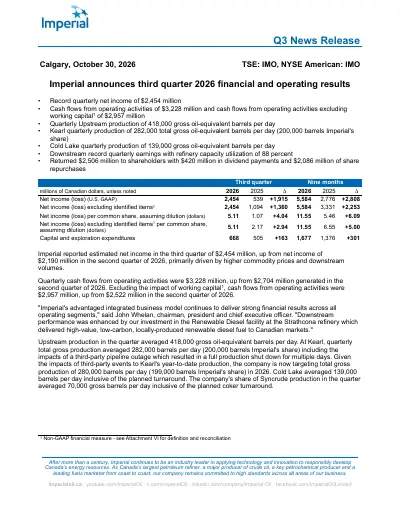
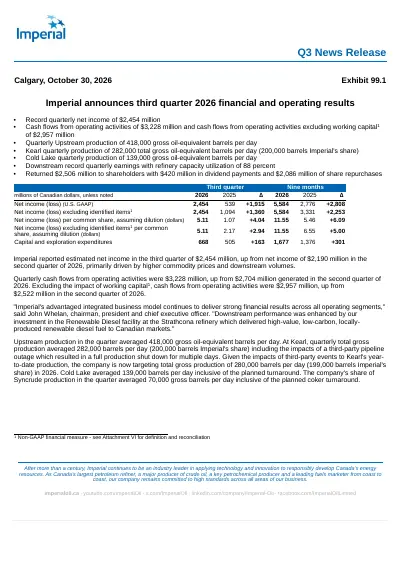
Thanks, John. Starting with financial results for the third quarter, we recorded net income of $2 billion 454 million, up $1 billion 915 million from the third quarter of 2025, primarily driven by higher commodity prices.
Excluding the impact of $555 million of identified items in the third quarter of 2025, net income increased by $1 billion 360 million. When comparing sequentially, third quarter net income is up $264 million from the second quarter of 2026, primarily driven by higher margins and volumes in the downstream, partially offset by lower crude prices.
Now shifting our attention to each business segment and looking sequentially, upstream earnings of $941 million are down $358 million from the second quarter, primarily due to lower realizations. Downstream earnings of $1 billion 555 million are up $768 million from the second quarter due to higher margins and volumes.
Our chemical business generated earnings of $52 million, down $13 million from the second quarter. Moving to cash flow, in the third quarter, we generated about $3.2 billion in cash flows from operating activities.
Excluding working capital effects, cash flows from operating activities for the third quarter were nearly $3 billion, up about $1.4 billion from the third quarter of 2025. We ended the quarter in a strong cash position, with about $2.9 billion of cash on hand.
Now shifting to capex, capital expenditures in the third quarter totaled $668 million, $163 million higher than the third quarter of 2025 and $137 million higher than the second quarter of 2026, driven by timing impacts in the upstream. In the upstream, third quarter spending of $514 million focused on sustaining capital at Kearl, Syncrude, and Cold Lake.
Increases in the quarter were associated with heavy equipment deliveries and project milestones at Kearl, as well as mine progression activities at Syncrude. In the downstream, third quarter capex was primarily spent on sustaining capital projects across our refinery network.
Another item of note regarding capital, if the productivity mega-deduction becomes law as expected, eligible capex associated with assets acquired and available for use after September 14th will provide accelerated tax benefits. This will support added free cash flow generation going forward.
Shifting to shareholder distributions, in the third quarter, we continued to demonstrate our long-standing philosophy of returning free cash flow to shareholders, paying $420 million of dividends and returning almost $2.1 billion through accelerated share repurchases under our normal course issuer bid program. We anticipate completing our accelerated NCIB program by year-end.
Commodity prices have remained strong over the first month of the fourth quarter, positioning us for continued robust free cash flow generation as we close the year. We also ended the quarter with a healthy cash balance, as was already stated.
These factors, as John noted, leave us well positioned to return additional surplus cash to shareholders in the new year. Finally, this morning we declared a fourth quarter dividend of 87 cents per share, in line with our third quarter dividend.
Imperial remains committed to shareholder returns, as demonstrated by 32 consecutive years of annual dividend growth. I'll now turn it back to John to discuss the company's operational performance.
John Whelan
Thanks, Dan. Want to take the next few minutes to share key highlights from our operating results.
Upstream production for the quarter averaged 418,000 gross oil-equivalent barrels per day, up 4,000 oil-equivalent barrels per day versus the second quarter of 2026. This was primarily driven by the absence of the planned Kearl turnaround, partially offset by a third-party pipeline outage, which resulted in a full production shutdown at Kearl for multiple days, and the planned turnaround work at Cold Lake and Syncrude.
I'll now cover highlights from each of these assets, starting with Kearl. Kearl's quarterly production was 282,000 barrels per day gross, up 25,000 barrels per day versus the second quarter of 2026.
The increase was primarily driven by the absence of planned turnaround work, partially offset by a third-party pipeline outage caused by an electrical transformer failure. The transformer failure, affecting the Woodland Pipeline, resulted in a temporary production outage in mid-September.
Production was impacted for several days before takeaway capacity was restored. While the outage impacted production during the quarter, we continue to progress key initiatives on the path to growing Kearl's production to 300,000 barrels per day in 2028.
A great example is the successful start-up of our flotation column secondary recovery project. The project adds incremental production by recovering additional bitumen from the ore already being processed through the plant.
This is a highly capital-efficient project with minimal incremental operating cost. As we look to next year, we're looking forward to realizing the full benefits of the secondary recovery units I just discussed, but also the volume growth that will be supported as we realize the benefits from our prior investments in extending plant turnaround intervals.
We have no planned major turnarounds at Kearl in 2027 or 2028. Our next planned major turnaround will be in 2029.
Moving next to Cold Lake highlights, Cold Lake's quarterly production averaged 139,000 barrels per day, down 10,000 barrels per day versus the second quarter of 2026, primarily driven by the planned Mahihkan turnaround work that started in September and was recently completed in October, ahead of schedule and on budget. In addition, we remain focused on the transformation at Cold Lake, with Leming SAGD ramping up through the quarter and currently producing 10,000 barrels per day.
Our Grand Rapids SA-SAGD project continues to exceed expectations, with production in excess of 21,000 barrels per day. Now, in terms of future in situ growth opportunities, on our Aspen lease, we continue to progress the enhanced bitumen recovery technology pilot, with start-up remaining on track for early 2020 2027.
As I look to the future, we've got three key high-quality in situ development opportunities in our portfolio. We're focused on solvent recovery technology to maximize value.
Our Aspen, Clark Creek, and Corner assets, together with our advantaged technology, underpin our long-term growth opportunities, with the potential, over time, to double our gross operated upstream production. To round out the upstream, I'll cover Syncrude results.
Imperial's share of Syncrude production for the quarter averaged 70,000 barrels per day, down 3,000 barrels per day versus the second quarter of 2026, mainly due to the coker 8-2 turnaround, which is now complete. Syncrude continued to utilize the interconnect pipeline to import bitumen and gas oil to ensure high upgrader utilization.
This enabled approximately 10,000 barrels per day, our share, of additional Syncrude Sweet Premium production. Now let's move to the downstream.
In the third quarter, we refined an average of 381,000 barrels per day, representing a utilization of 88%. Compared to the second quarter of 2026, refinery throughput was up 50,000 barrels per day, mainly driven by the absence of planned turnaround work at Strathcona, partially offset by an unplanned third-party pipeline outage.
At Strathcona, we continue to increase renewable diesel production and reached our highest production to date. Given that renewable diesel is produced from canola feedstocks rather than crude oil, it does not contribute to our reported refinery throughput, but it provides a margin uplift, supporting significant ongoing incremental earnings, as reflected in our positive downstream product mix factor of $170 million in the third quarter and $400 million year-to-date.
Work associated with debottlenecking rail logistics at Strathcona to enable higher crude runs, while supporting continued growth in canola throughput, is progressing well and is anticipated to enhance refinery crude utilization by year-end. We experienced an 18-day unplanned third-party pipeline outage beginning in late August.
The outage reduced feedstock availability across the downstream and resulted in overall refinery throughput being curtailed approximately 12,000 barrels per day during the quarter. Despite that third-party outage, we remain confident in our downstream guidance range.
At Sarnia, the team recently completed a planned turnaround that ran from mid-September through late October. The work was completed safely and successfully, ahead of schedule and on budget.
With our planned turnarounds now complete and market conditions remaining very favorable, we are entering the final months of the year well positioned to maximize available capacity and deliver a strong finish to 2026. Petroleum product sales were 474,000 barrels per day, up 28,000 barrels per day compared to the second quarter 2026, primarily driven by opportunistic domestic sales and higher exports.
Overall, across our Canadian network, we saw very similar demand for each of our primary petroleum products in the third quarter of '26 relative to 2025. Turning now to chemicals, earnings in the third quarter were $52 million, down 65 down from $65 million in the second quarter 2026, but up $31 million from the third quarter of 2025 due to higher product pricing.
In closing, despite a dynamic external environment, our priorities remain unchanged. We're focused on capturing the full value of our advantaged integrated business, growing profitable volumes, advancing structural cost improvements, and increasing cash flow generation.
With all our planned turnaround activity complete, we're focused on delivering a strong finish to the year. With the accelerated normal course issuer bid expected to wrap up by year-end, we are well positioned to return additional surplus cash to shareholders in the new year.
We continue to advance our restructuring plans, firmly in the implementation phase, guided by a robust and disciplined approach, and things are progressing well. As shared previously, we will capture significant long-term efficiency and effectiveness benefits as we further transform our business, leveraging rapidly advancing technology and ExxonMobil's global capability centers.
Operationally, our focus remains on execution excellence. We remain confident in our plans to achieve 300,000 barrels per day at Kearl and a unit cost of $18 per day per barrel at Kearl, and 165,000 barrels per day and a unit cash cost of $13 per barrel at Cold Lake.
Through disciplined implementation, we will continue to strengthen the competitiveness of our operations, maximize the value of our asset base, and deliver superior long-term returns to our shareholders. I'm very encouraged by the progress made by governments and industry to improve the investment climate and support global competitiveness of our industry.
As I mentioned earlier, further fiscal certainty and regulatory reform can unlock significant opportunities, especially for Imperial, which is uniquely positioned with very material growth potential. As always, I want to thank our employees for their commitment, expertise, professionalism, and teamwork.
Their dedication to safe operations, execution excellence, and customer and community service is what makes our achievements possible. I'd like to thank all of you once again for your continued interest and confidence in Imperial.
With that, we'll move to the Q&A portion of the call, and I'll hand it back to Peter.
Peter Shaw
Thank you, John. As always, we'd appreciate if you could limit yourself to one question plus a follow-up so that we can get to all the questions.
With that, operator, could you please open up the lines for questions?
Operator
Thank you. The floor is now open for questions.
At this time, if you would like to ask a question, please click on the raise hand button, which can be found on the black bar at the bottom of your screen. When it is your turn, you will receive a message on your screen from the host allowing you to talk, and then you will hear your name called.
Please accept, unmute your audio, and ask your question. If you are dialling in by phone, please press star nine to raise your hand and star six to unmute.
As a reminder, we are allowing analysts one question and one follow-up. Time permitting, we will return to you for additional questions.
We will pause a moment for the queue to form. Our first question comes from Greg Pardy from RBC Capital Markets.
Please unmute your line and ask your question. Greg Pardy, please unmute your line to ask your question.
Greg Pardy
Hey, good morning, and [clears throat] sorry for that, a little new technology this morning. John, I wanted to maybe just come back to your comments just around upstream growth potentially doubling over time.
The question is as follows: how much appetite does IMO have for upstream growth? How connected is that to finalization of the MOU?
Essentially would any of these projects now perhaps, like Corner and so forth, start to coincide with the timing on Aspen? Sorry, there's a bunch in there, but that's the gist of it, is how much do you want to grow?
John Whelan
Thanks for the question, Greg. I think clearly what's happening externally in the investment climate is really important, and the framework that industry put in place with governments through the non-binding trilateral MOU, and the work we're doing today to turn that into a definitive agreement, and all the things that we put in there to ensure our businesses are globally competitive, that is really important work.
Again, I'm really pleased with the progress we've made. We continue to work very closely with the government.
You've seen some of the conditions that were in that, or the things that we felt needed to be put in place, you see progress made on those already, like the accelerated capital cost allowance, the Impact Assessment Act, improvements in project timelines. Those were things that we felt we needed to improve the competitive environment, and we see government acting on those.
I feel very encouraged about it. I think for us, we still think about ultimately our decision is going to be driven by technology readiness, project economics, and again, that broader fiscal and regulatory environment.
I think with all this, of course, as we talked about, we're doing the enhanced bitumen recovery technology pilot. It's going to start up early next year.
We've said that's going to take two or three years to prove out the technology, and we'd be in a position to FID Aspen at the end of the decade. I will tell you though, with everything that's going on, we've funded Aspen with SA-SAGD back in 2018, and we've got I would say reinforced, even further confidence in that technology because of our experience at Grand Rapids.
It's probably performed beyond our expectations, and we've learned things from that that we can build into it to make SA-SAGD even better. I will say with our enhanced understanding, confidence, and improvements around SA-SAGD, and looking at the timing for the EBR technology, which is still our preferred long-term development, we will look at do we want to bring Aspen forward.
Instead of that FID at the end of the decade, we are looking at do we want to bring it forward, and we have options, I think, in the technology we may use for an initial phase. Again, EBR is still our preferred long-term development.
We're going to certainly test that optionality, but ultimately will be driven by technology, project economics, and the fiscal environment. I'm really encouraged by what I'm seeing.
I don't see us doing Aspen, Clark Creek, and Corner all in parallel. I still see us sequencing those things, where we kind of get into a program of work.
If you think about all the work that has to be done, I think we still see the benefits of kind of design one, build many, and a program of work where you can ramp up to a rate and execute efficiently. I don't see kind of bringing them all forward, doing them all in parallel.
I do see the possibility that we'll look at Aspen and the timing of that, and then we'll try to execute this as a program. Hope that covers what you were thinking about.
Greg Pardy
No, no, no, like, no, no, I I think that's a very, very fair answer. There's a lot of moving pieces and so on.
I'm glad, secondly, just glad you brought up, your unit cost targets with, with Cold Lake and then with Kearl. If as you reflect, maybe on on on cal '26 operating performance, like, not Imperial's finest, but that being said, it certainly appears as though a lot of the factors have been, external and to some extent one-offs.
Is that a fair characterization? Then as you think about it and talk to your team and so forth in terms of the achievements that you have, on unit op-ex, like the objectives you have at unit op-ex, are those do those numbers, continue to be in your view pretty highly achievable, in part because of the volume growth you'll see?
I'm putting words in your mouth, but I just want to make sure I'm characterizing the right way.
John Whelan
No, you are, Greg, exactly as we see it. Our volumes were a little lower this year than we were looking for, and you're right, a number of third-party impacts on us.
As we've looked across the performance of the assets, we don't see systemic issues. We see one-offs that we're going to learn from.
We dig into, we learn from those. We see nothing in the underlying performance that causes us any doubt whatsoever on our future targets around volumes growth and unit cost reduction.
All the fundamentals that were in place to get to those rates and unit cost numbers are in place. The secondary recovery projects, the longer time between shutdowns, the improvements of productivity and recovery, all of those fundamentals are in place.
We remain very, very confident on those plans, and there's nothing in the performance this year that causes us any doubt whatsoever on that.
Greg Pardy
Very good. Thanks a lot, John.
John Whelan
Thank you, Greg.
Operator
Thank you. Our next question is from Manav Gupta from UBS.
Please unmute your line and ask your question. Manav, please press star six to unmute.
Manav Gupta
Hi. Figured it out finally.
I'll have two questions and I'll ask them upfront. First, your cash is building, you're generating a lot of cash, and I'm just trying to understand once the NCIB finishes, are there more ways you can return more cash to the shareholders?
My second question, I asked the same question to your parent: your outlook on your global refining and how long do you see these margins elevated, if you could talk a little bit about that? Thank you.
John Whelan
Thank you, Aayush Ayush. I'm going to start with the refinery and downstream margins, and then I'm going to come back to the capital allocation question.
First off, we feel really good about our downstream business and you saw it in the results in the quarter. We've got a very strong business here, with high margins in the base case, extremely high margins at the moment, lots of barriers to entry, we feel good about our logistics, low-cost Western Canada crude at export parity, import parity in terms of our products that we sell, and very strong brands with Esso and Mobil.
It's a business we feel really good about, and the structural advantages that we have in place there. With the current geopolitical situation, which started with a supply shock in the environment and elevated refining margins, we do feel it's hard to say for sure how long it will persist, but we do feel that it could persist for longer.
It started with the supply shock, but kind of what we're seeing right now is, interestingly, the crude supply has not fully, but significantly recovered, but the refining capacity has recovered much more slowly. Three aspects of that: we've got Russia running at about 50% utilization of their refinery network.
If you look at that versus the crisis in Ukraine, they've got about 1.3 million barrels a day of refining capacity offline. We see Middle East shipping, while the crude shipments are now at about 70% of the pre-conflict period, maybe even a little higher, the refined products coming through the strait are only about 35% of what they were before.
There's limited refined capacities there. Then we have China with export restrictions on their refined products.
It does appear that refining capacity has been slow to recover. It's a little uncertain how all those things play out, and the pace of recovery will be an important factor on it, but there's a lot of things that have to recover to see margins go back to where they were before.
We feel very good about the business, and I think we're probably going to see margins to a degree into the future as well. Then in terms of capital allocation, the main thing I'll tell you is nothing has changed in our philosophy on capital allocation.
We're sitting on a strong cash balance today. We're going into the fourth quarter with what looks like strong margins at this point in time as well.
Obviously, we'll look at the options for returning surplus cash in the new year. Our philosophy hasn't changed.
We have a track record of returning surplus cash to shareholders. We're comfortable with where our debt is.
We're not trying to allocate capital to that. Our goal is to return 100% of our surplus cash to shareholders.
If you look back over the last 5 years, we generated $25 billion of free cash flow, and returned $24 billion. That philosophy hasn't changed.
It'll always depend on commodity prices and things, but I think we're in a strong position to continue to return surplus cash flow in the new year.
Manav Gupta
Thank you so much.
John Whelan
Yeah.
Dan Lyons
Maybe I'll just add a little bit, because you said, do we have tools other than the NCIB. Obviously, as I said, we plan to wrap up our NCIB this quarter, and we can't renew the NCIB till the end of late June in 2027.
Share buybacks earlier in the year would have to be through a substantial issuer bid, which is the tool we've used in the past on numerous occasions. Yes, we do have tools, and as John said, our cash is strong now.
With commodity prices where they are, despite doing the accelerated NCIB in the fourth quarter, there's every chance that our cash balance will actually grow. It looks like we'll see what happens, but it looks like we'll have a substantial cash balance at year-end, and our long-standing philosophy is to return that timely to shareholders.
Just a little more color.
Operator
Thank you. Our next question is from Aayush Gupta
John Whelan
from Wolfe Research.
Operator
Please unmute your line and ask your question. Aayush Gupta from Wolfe Research, please unmute your line.
Aayush Gupta
Hi, thanks for taking my question. This is Aayush Gupta on behalf of Doug Leggate and Wolfe Research.
Congrats on a solid quarter. I was wondering about the WCS discount.
Where do you see the WCS discount heading into 2027? What's really driving that, and how do you manage that exposure?
John Whelan
Thank you, Aayush, and I'm getting used to the technology as well. I think, Manav, the last question was from you, and I indicated it was Aayush, our
Aayush Gupta
apologies. It
John Whelan
turned out well, both of you folks there. Certainly, we have seen the WCS differential widen.
We have seen that over the last number of months. A number of things causing that.
Obviously, a strong pull on light barrels globally relative to heavy barrels when you look at the refining utilization and cracks around distillates. We have seen that widen.
Then some increased supply on heavy oil, both from Canada, Venezuela, and the Middle East. Those things have contributed to that.
We do anticipate that the differential will widen in the fourth quarter. We're starting to see that.
Most of that is driven by the sharp increase in freight rates out of the Gulf Coast. Transportation costs are up significantly, 8 to 10 times, and VLCCs are going for close to a million dollars US a day in freight rates.
We do see that contributing to higher differentials in the fourth quarter. That said, the absolute price of WCS remains extremely constructive.
When you look at where WTI is, yes, the WTI is up, the differential has widened, but the WCS price remains very constructive. At the end of the day, we recognize we don't control those things, and our focus is on, as you've heard from us before, low-price resiliency in the business.
We have very low cash break-evens, 20 less than $25 a barrel WTI for the business. When you include the dividend and sustaining capital, less than $35 a barrel.
Again, we've got a business that's designed across a broad range of price forecasts, but even with these higher differentials, WCS remains very constructive.
Aayush Gupta
Thank you, that makes a lot of sense. Appreciate your answer.
John Whelan
Thank you.
Operator
Thank you. Our next question comes from Menno Hulshof from TD TD Securities.
Please unmute your line and ask your question.
Menno Hulshof
Good morning, everyone. Thanks for taking my question.
I'll just start with one on the upstream outlook into the end of the year, which you did touch on in your opening remarks. Can you maybe just give us sort of a sense of what the bookends on Q4 production could look like and where could we see the sort of the biggest increases or decreases at the asset level through the end of the year?
John Whelan
I think, again, we look to finish the year strong on all our assets. We've got all of our planned turnarounds behind us.
The signal is very clear to maximize production. I think when you look across all of them, we've got a clean run coming into the fourth quarter, and good conditions to have a good, strong fourth quarter.
I can't be very specific on all of them, other than the kind of commentary we've provided. We did indicate the last quarter we thought we'd be at the low end of the upstream guidance.
We've shared that Cold Lake and Syncrude kind of remain in that area, and then we indicated the target for us for the total year for Kearl is now below the low end of the Kearl-specific guidance by about 5 kbd at 280 kbd for the year. We're in a good place, I think, Menno, for a strong fourth quarter, no planned shutdowns, and that's what we're looking to do.
Menno Hulshof
Great. Thanks for that, John.
Then the second question, it probably ties a bit into what Greg was asking, just converting the MOU into definitive agreements. Is there anything you can share in terms of confidence level in hitting the November 15th deadline, since it's only a couple of weeks away?
Then, I guess as a follow-up to that, is it fair to assume that we won't get an announcement on royalty concessions until all of that gets nailed down?
John Whelan
I think one piece of this obviously is growth royalty incentives, which we're working with the province, and I can't really speak to when the province will feel comfortable to make announcements around that. What I can really say is, look, I remain really optimistic and encouraged by the progress that we've made.
We've got our federal government, provincial government in Alberta looking to as their stated objectives: energy superpower for Canada, doubling production in Alberta. That's very constructive.
Then I will tell you, industry, our Oil Sands Alliance, myself and my counterparts in the Oil Sands Alliance, we continue to meet every single week on this topic, and we have people on our teams working with both the federal and provincial government every day to progress what we put together in the non-binding MOU. We're all targeting towards November 15th.
I will tell you, there's still a lot of work left to do. You're right, that's only a couple of weeks away.
There's no lack of energy or desire to get to definitive agreements. The exact timing, we're going to make sure we do the right things that enable us to execute on the definitive agreements.
Most importantly is, for me, is the shared ambition to make this happen, and the work that's going into that. I remain really encouraged about where we are.
Menno Hulshof
Thanks again, John. I'll turn it back.
John Whelan
Thanks, Menno.
Operator
Thank you. Our next question is from Patrick O'Rourke from ATB Capital Markets.
Please unmute your line and ask your question.
Patrick O'Rourke
Hey, good morning, guys, and thanks for taking my question. I guess maybe just a little bit more on the question asked by Menno, but in particular with Kearl, if you look at the new guidance implies a pretty strong end of the year for that particular asset, that would be within a rounding error of record performance for the asset.
We're a third of the way into the quarter here. Can you maybe comment on how that particular asset's performing?
I know one of the benchmarks you look at is the sort of high-output days, about 300,000 barrels
John Whelan
per day. I'll say a few words and then ask Cheryl to chime in as well.
You're right. The 280 does, the numbers that you describe are correct, and that's exactly the target we've put out for our team.
We've done it before, and we feel confident about where we are with all of our scheduled work behind us. As we talked about in some of the other questions, you look at some of the things that we've experienced, including in this quarter, third-party related outages.
When we look at the fundamentals of the assets, we feel we are capable of putting record performance on the board. We have to deliver that, but we feel the capability is there to do it.
I'll ask Cheryl to chime in with a little more color.
Cheryl Gomez-Smith
Sure, and I'll add a little bit more in terms of our confidence to get there. A few things and this really gets to the how we're going to do that.
We've already advanced our mine sequencing, and that's really to increase the tonnage to the plant. Exactly what you're talking about.
The interesting part, of course, as we're heading into winter, we're already staging more ripping dozers. When you get to these open mine faces, you want to have those ripping dozers, and as well as ensure an active shovel face.
That's just getting ourselves set up. The other help in this space is we have more engineered roads than we've had in history.
What we know about that is our trucks like to run better on those engineered roads. The final thing I'll tell you is with our 797s, they have built-in features which improve wheel traction.
In the upcoming weather, they run better. All of this in mind sets us up for how we're going to deliver, which, to your point, is going to be one of our best ever fourth quarters.
By setting ourselves up to deliver that.
Patrick O'Rourke
Great. Thanks.
Another question here, just with respect to the RD, things look like they're going really, really well. Looks like the federal government is considering some changes to the CFR and some of the credits associated with renewable diesel domestically produced.
What sort of impact would that have from a financial perspective, and is it from the way at least I'm reading, you can correct me if I'm wrong, some of those enhancements to the credit factor would be retroactive back to the start of the year and how that would be recognized by Imperial?
John Whelan
Thanks, Patrick. I'll say a few words, then I'll hand over to Scott.
I would just, at the highest level when I think about this project, which we feel really good about and the stronger performance that we're now seeing, enables us to better able to capture higher margins driven by that tightening in the US market fundamentals and so on. What I would tell you overall is that we've evaluated this project over a broad range of market and policy scenarios, and we're very comfortable with the resilience of the project over a broad range of those.
It's not a single regulation in a single jurisdiction that we're reliant on. There is a number of things that make this project work, and it is working for us.
In terms of the clean fuels regulation, I will tell you we're working very closely with the government. We provide input to that, and so we're not uncomfortable with where this is headed, and I'll ask Scott to say a few more words about it.
Scott Maloney
Sure. Thanks, John, and thanks for the question, Patrick.
As John mentioned, we worked really closely with the government on the what I would call tweaks to the clean fuels regulation that's being proposed now. Really the objective behind that is try to make sure that the program is balanced, with the amount of credits that can be generated, with the obligation that continues to increase as we go year on year to really reduce the carbon intensity in the market of these fuels.
That balance is what's helpful for that program to remain effective, and we're very confident in our renewable diesel project will continue to be a key contributor to generate credits and maintain that balance. We're pretty confident about the outlook today, as John mentioned, but even in the future scenario, with these potential tweaks coming into play.
Patrick O'Rourke
Thank you very much.
Operator
Thank you. Our next question is from Dennis Fong from CIBC.
Please press star six to unmute your line and ask your question.
Dennis Fong
Hi, good morning, and thanks for taking my questions. I guess the first one that I have here focuses a little bit on the downstream flexibility, and maybe falls along the lines of a couple of the predecessor questions.
Can you remind us as to the flexibility Imperial has in terms of processing their own barrels or flexing towards more heavy, again, in light of the wider WCS differentials, as well as the preferences in terms of obviously capturing a greater amount of diesel output, just again given the refined product pricing in the market?
John Whelan
Thanks for the question, Dennis. Again, I'll say a few words, then I'm going to pass over to Scott.
I'll let Scott talk about the specifics. We do have some flexibility on the amount of heavy we run.
There's some limits to that, but we do have some flexibility on the amount of heavy, and we do have some flexibility on the products we generate, and obviously, right now Scott's team is looking at that every day, every hour, and optimizing what feedstock we take in, and what products we produce. There are some limits, clearly.
These are big refineries and they are piped up a certain way, but we do have flexibility, and we optimize that on a daily basis. I'll let Scott talk about a little more the details around that.
Scott Maloney
Sure. Thanks for the question, Dennis.
As we think about the downstream business, we think about flexibility in a few different ways. The first one is getting the right feedstocks to run in our refineries to make the products with the highest uplift, and I've kind of shared that on a couple of the prior quarters about how we're targeting the most profitable barrels that we can run and then produce finished products in.
In our specific business, we do have some uniqueness with the coker unit in our Sarnia refinery that allows us to ramp up some of those heavier crudes. That supports us taking advantage of some of these market considerations.
Then when you think about finished product production, we also have the ability to ramp up what we call maximum distillate signals versus maximum gasoline signals as we're thinking about producing products in our refineries. The way we're thinking about it in this current environment is we're running our refineries to make enough gasoline to meet all of the needs for the Canadian consumers, and then what we're doing with the refinery is just tuning up to go for a maximum distillate signal on top of that, we can actually get more access to the diesel and jet barrels that are more profitable in the market right now.
That's how we run our refineries. Then, thinking about flexibility, we also think about it quite a bit in our midstream logistics network as well.
I've shared that before, that once you have these products, then we utilize that coast-to-coast logistics setup that we have to most efficiently get the products to the market that need it the most. That also gives us an advantage in the full value share of the fuels business.
That's how we think about it, and we set our teams up to run efficiently in the base case, and then that allows us to have access to higher margins when they're available in the marketplace.
Dennis Fong
Great, thank you for that color and commentary. My second question here shifts the focus back to the upstream.
Cheryl, I really appreciate some of the comments that you made around Q4 and your readiness for a stronger throughput, specifically at Kearl, going to the end of the year. I was hoping if you could provide us some incremental color just on the thoughts around mine progression.
I know in John's prepared remarks he discussed a little bit around the completion of some of the mine plan development and progression and kind of opening up off that capacity in the 2028 time frame, but really as it also relates to ore quality, as that was one of the key items that was cited as kind of a year-over-year change as well.
Cheryl Gomez-Smith
Sure. Thank you for that question, Dennis.
I'm going to go back to a couple things that John mentioned before, which is really what's underpinning our confidence in the future. I'm looking more towards beyond 2024.
If I think about it, step back, we've made significant optimizations over the past few years, so as we think about that going forward, that cumulative effect will be happening next year and beyond. John mentioned about our recovery projects that we just brought online, KFCC, which are additional float cell columns.
Those will contribute next year. Of course, without a turnaround, that'll be a help.
Kind of the underpinning in the foundation here is around our continued focus on productivity and reliability, which really talks to our digital, our technology, and so forth. Mentioned that several times, but we continue to unleash that really just as a kind of foundational table stakes.
Now, to answer your question, in 2027, we'll be shifting from not only producing from our North pit, but in 2027, we'll begin to produce from our new East pit. When we look in terms of ore quality, everything that we've done with delineating the wells and so forth, we anticipate and looking forward to East pit being stronger from that perspective.
The other thing that East pit will bring along with it as well is a strong engineered road network, as well as fewer ramps. If I take all that to account, and what we're going to see in 20 in 2027, it'll be that increased diversity in ore headings, and then all of the positive impacts that I've just shared in terms of productivity and reliability.
This is really that "and" equation I continue to emphasize, which'll be all of these setting in place that we've been working on for years that'll come forward next year.
Dennis Fong
Great. Thank you so much.
John Whelan
Thank you, Dennis.
Operator
Thank you. Our next question is from Travis Wood from National Bank.
Please unmute your line and ask your question.
Travis Wood
Good morning, guys. Question, it goes back to the MOU, and I'm just trying to get an understanding of what that critical path looks like for the group, you guys specifically, as it relates to the carbon capture segment, any kind of spending cadence that you can help us understand.
Then, as it relates to Pacific Link, is the goal here, and maybe the delay from November 15th, is the goal to work with the federal and provincial governments to effectively try to get that carbon capture cost to net zero, meaning with the help of the mega-tax reduction, potentially royalty savings, maybe there's some tolling negotiation that can go on the pipeline itself. Is that the right way to think of it longer term, in terms of net cost to the Oil Sands Alliance group?
John Whelan
I think, Travis, what we put in place in the trilateral MOU, we're trying to do really three things, or three interconnected things here. We're trying to create an environment where it's more globally competitive to invest in production growth, and that's where you get into growth royalty incentives, accelerated capital cost allowances, you get into timelines around project approvals that are best in world class and predictable.
Part of it is production, growing the production. Now, the other parts are a pipeline to the West Coast so we have egress to take away that increased production.
Then another part that's important for the government and for us, if you think about our company, we talk about the "and" equation of providing reliable, affordable energy and reducing emissions, is the Pathways projects to capture carbon. Those are three elements of what we're trying to make work, what some have coined as the grand bargain.
That's what we're working through. What's in the trilateral MOU, which is actually non-binding and we're moving towards the definitive, what industry has said we would commit to is a 6 megaton per annum Pathways project.
The governments have said they'll commit to a pipeline to the West Coast, a million barrels a day, and then setting in place the fiscal and regulatory framework to incentivize the investment that needs to go into production growth to fill that pipeline and support the Pathways project, which is a cost to the industry. That's the components of it that we're trying to get in the right balance so all of those things work together.
That's really what we're trying to do. Obviously, if we look at the carbon capture storage side of it, it is a cost to the industry, and we're looking at other aspects that will be benefits to the industry, like the capital cost allowance acceleration and growth royalties.
Overall, you have a collective environment that is globally competitive and will incentivize investment. That's pretty complex, so that's why I think, but again, I'm encouraged.
We're working really well together to try to get the marriage of all those things in place that works for everybody.
Travis Wood
Okay. No, that makes sense.
Appreciate the detailed color there. My second question would be, you talked about, and kind of it marries with the growth prospect, potentially accelerating Aspen, depending on probably how this MOU shakes out.
How would Aspen rank, and maybe this is too strategic and you might not want to answer this, but how would Aspen rank as you look at this upcoming land sale, and the potential ease of surface access to some of these caribou lands? Is there anything that could leapfrog Aspen in terms of future development from the thermal perspective, or would Aspen, given the pilot and the data that you guys have, would that still rank at the top of the list as we think about future growth?
John Whelan
When we just look at our portfolio, I would tell you, Aspen is, and we've been very clear about this, we feel very bullish about the quality of the resource, very bullish about the technology that we're developing, EBR or even SA-SAGD, to apply there. Then we have other opportunities, like Mahihkan SA-SAGD at Cold Lake, getting Kearl to 300, getting Cold Lake to 165.
Those are very attractive opportunities that we have, very low-flowing, very capitally efficient. Then the next, in terms of our organic growth, Aspen is the next best thing in our portfolio.
It is extremely advantaged given the technology and the quality of the resource. We're very bullish on it.
Travis Wood
Thank you. Would there be potential with this land sale to expand the resource adjacent to the projects already in the pipeline?
John Whelan
I would just say for us, we are very pleased with the existing portfolio of organic opportunities we have with Aspen, Clark Creek, Corner, and the opportunities we have at our existing assets. We're focused on unlocking the potential of those opportunities that we have today.
We feel extremely bullish about them, positive growth.
Travis Wood
Okay. Perfect.
Appreciate the commentary.
John Whelan
Thank you, Travis.
Operator
Thank you. That concludes today's question and answer session.
At this time, I would turn the conference back to Mr. Peter Shaw for any additional or closing remarks.
Peter Shaw
Thank you, and so on behalf of the management team, I'd like to thank everyone for joining us this morning and navigating through the new technology. If there are any further questions, please don't hesitate to reach out to the investor relations team, and we'll be happy to answer your questions.
With that, enjoy the rest of your day and have a great weekend.
Operator
This concludes our conference for today. Thank you for participating.
You may now disconnect.