OMV Petrom SA
Q3 FY2026 · Earnings Call TranscriptOctober 29, 2026
Operator
Good afternoon, ladies and gentlemen, and welcome to the OMV Petrom earnings call. Today's presentation will last around 30 minutes and will be recorded.
By now, you should have received the presentation by email. The slides and the speech are also available online on www.omvpetrom.com in the Investors section.
These also include the cautionary statement regarding forward-looking statements. Now, let me hand over to Simona Cruțu, Manager of the Investor Relations and Stakeholder Engagement Department, who will moderate the event.
Simona Cruțu
Good afternoon, ladies and gentlemen, and thank you for joining us. We'll have a presentation followed by a Q&A session.
Christina Verchere, Chief Executive Officer, will provide the key highlights about the macroeconomic and regulatory environment, as well as our operational performance in the third quarter. Alina Popa, Chief Financial Officer, will give you more details on our financial performance and a brief outlook.
Afterwards, they will be available to answer your questions. We recommend you to register for the Q&A session during the presentation by pressing *11 on your telephone keypad.
You can also register during the Q&A session itself. I'm now handing over to Christina.
Christina Verchere
Good afternoon, ladies and gentlemen, and a warm welcome to our conference call that will take you through our performance in the third quarter of 2026. Let me first draw your attention to our legal disclaimer, which you can read in detail on slide two.
In the third quarter of 2026, we delivered robust operational performance supported by our integrated business model, despite a volatile and challenging market and geopolitical environment. At 2.8 billion RON, our third quarter clean CCS operating result was more than double year-on-year, with improved results in all three business divisions.
Our operating cash flow in the third quarter of 2026 was 67% higher year-on-year at 3.7 billion RON. The clean CCS return on average capital employed reached 16 percentage points.
Before going into details on each division, I would like to highlight our focus on high availability and utilization of our assets, as well as efficiency and optimization of our operations. In R&M, we had an excellent utilization of our refinery at 100%, and refined product sales increased by 10% year-on-year.
In Gas and Power, the Brazi power plant net electrical output was 3% higher year-on-year, covering 12% of Romania's electricity production over the quarter. In E&P, our unit production cost improved by 6%, reflecting our cost reduction efforts and also a favorable foreign exchange effect.
During the third quarter, we further focused on delivering on our 2030 strategy. I would like to start by confirming to you that our strategic project, Neptun Deep, is on track, and we will have more details on the next slide.
We are also advancing with our renewable power projects, moving decisively from project phase to execution and production. Out of our more than 1.3 gigawatts planned by 2030, around 65% has already passed the final investment decision.
As announced yesterday, we have reached around 100 megawatts in operation. All these figures are net to OMV Petrom.
In addition, as part of our power storage strategy to build over 300 megawatts by 2030, in the third quarter, we signed the engineering, procurement, and construction contract for a battery energy storage system to be installed at the Isalnita solar farm, the first large-scale solar project wholly owned by OMV Petrom. The battery storage facility will have installed capacity of 20 megawatts and is expected to be completed in around seven months from the signing of the contract.
We are also progressing on our journey to become the first major producer of renewable fuels in Southeast Europe. Our SAF/HVO project is progressing as planned with the goal to be on-stream in 2028.
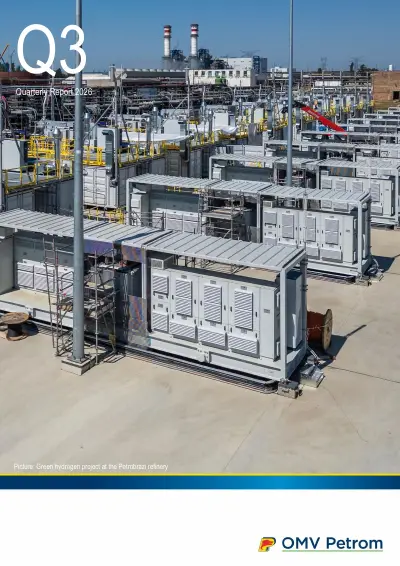
Construction is progressing across key work fronts, including equipment installation and pipe rack rehabilitation. For the green hydrogen facilities, all 11 electrolyzer modules and stacks have been delivered and installed, with medium-voltage cable installation and connections completed.
Electrical substation installation is progressing, with all equipment delivered and installed. In the next months, we will handle utilities hook-up, testing, and commissioning to gradually start operations soon after.
The green hydrogen component benefits from EU funding, with around €50 million non-reimbursable grant received from the National Recovery and Resilience Plan in the second and third quarters of this year. In HSSE, the total recordable injury rate for the rolling period October 2025 to September 2026 was 0.46.
Moreover, we continued our efforts to reduce greenhouse gas intensity with projects on all three business segments. Neptun Deep project is a strategic investment for OMV Petrom and for Romania.
With around €4 billion development capex, the project is expected to deliver approximately 140,000 barrels of oil equivalent production per day at plateau for nearly 10 years. As communicated during our recent Capital Markets Day, project execution is progressing well and has now reached almost 90% budget progress.
We have now completed eight of the 10 development wells and are targeting first gas in the first half of next year, with plateau production by end of the third quarter of 2027. The offshore platform has been installed, drilling is ongoing, pipeline to shore is installed, and onshore works at Tuzla are progressing.
The next phase focuses on completing subsea connections, testing, commissioning, and final readiness checks before production start. Let us now take a look at the evolution of commodity prices in the third quarter of 2026.
The persistent conflict in the Middle East and attacks on regional energy infrastructure has led to unprecedented volatility in global energy markets. After starting the quarter at around $68 per barrel, Brent price rose sharply, reaching a peak of $132 per barrel in mid-September.
Although prices later moderated as export disruptions were partially mitigated, the price remained elevated at around $120 per barrel by the end of the quarter. For the third quarter, average Brent price was $97 per barrel, up 40% year-on-year, but 7% lower quarter-on-quarter.
Markets for some oil products have also been particularly affected, especially those for diesel and jet fuel, both reaching again record-high quotations. Thus, OMV Petrom indicator refining margin exceeded $41 per barrel on average in the third quarter on strong gasoline and diesel crack spreads in the context of higher pricing environment, as well as a result of the geopolitical tensions in the Middle East, as well as Russian ban on diesel exports.
The indicator refining margin impact is partly offset by higher crude supply, logistics, and insurance costs triggered by the geopolitical context. European gas prices remained at high level, still volatile in the third quarter, reflecting geopolitical uncertainty, evolving supply conditions, and continued demand to replenish storage ahead of winter.
In the third quarter of 2026, the CEGH price averaged €65 per megawatt-hour, up 80% year-on-year and 36% quarter-on-quarter. Gas prices on the Romanian centralized market increased at a lower extent, as the country has less direct exposure to disruptive global LNG supply.
Day-ahead prices averaged around €58 per megawatt-hour, up 71% year-on-year and 24% quarter-on-quarter. Baseload electricity prices in Romania increased by 60% year-on-year and 36% quarter-on-quarter to an average of €149 per megawatt-hour.
The average CO2 price increased by 9% quarter-on-quarter, reaching €82 per ton. Looking now at the Romanian macroeconomic environment, the latest available data shows that GDP decreased year-on-year by 0.6% in the first half of 2026.
In October, the IMF reduced its projected GDP growth for Romania for 2026 to a negative 0.5% from a positive 0.7%. IMF forecast for 2027 Romanian GDP growth was also revised down to 2.2% from 2.5% in the previous estimate.
The consumer price index for the month of September 2026 versus September 2025 was 6.6%. While the base effects from last year's electricity price cap removal in July and tax increases in August should support an easing, inflation remains the highest in the European Union.
In its latest projection report, the National Bank of Romania expects inflation to rise further in the fourth quarter, which would lead to an upward revision of its full-year forecast. Looking at the Romanian energy sector in the third quarter of 2026, based on our internal estimates, the demand for our products was mixed.
Demand for retail fuels was 2% higher year-on-year, remaining resilient despite higher prices, also supported by a shift of wholesale customers to retail chains amid constrained product availability. Commercial fuel demand fell by 11% year-on-year, also reflecting weak economic activity and structural demand adjustments to persistently higher fuel prices.
Gas demand decreased by around 5% year-on-year, with declining consumption from both industrial and household consumers. Power demand was 6% lower year-on-year, while domestic production also decreased by 6% year-on-year.
Romania was a net importer of power in the third quarter of both 2025 and 2026. The contribution from solar, wind, and gas increased year-on-year, while production from nuclear, coal, and hydro sources decreased, in part due to significantly low water levels in the Danube River.
In the context of the Middle East conflict, at the end of July 2026, the Romanian Parliament agreed to reinstate the crisis situation for the oil and fuels market. The law is applicable for a period of three months from 7th of August to the end of October.
It provides for capping the retail commercial margins at the 2025 level, adjusted with inflation for the gasoline and diesel sold in Romania. No cap on refining margin is applied.
It also provides for a solidarity tax calculated using a progressive tax rate depending on the average monthly diesel or Brent quotations, whichever results in a higher rate. For the third quarter, this translated into an amount of 266 million RON, reflected as a special item in and roughly equally split between E&P and R&M.
The law also introduced a dynamic excise reduction mechanism between 5% and 25%. A draft government decision aiming at extending the applicability of the regulation by three months until the 31st of January 2027 was published for consultation this week.
On the gas market, regulations for households and heat production for households remains in place until March 2027, but with a more limited scope compared to the period before April 2026. As a result, the percentage of our gas sales subject to regulations decreased to 5% in the third quarter of this year from around 69% in the third quarter of last year.
We continue to emphasize that free market principles are essential for fostering investment and that any market interventions should remain temporary and directly routed to vulnerable customers. Let me now move to the performance of our divisions, starting with Exploration and Production.
Clean operating result in E&P increased by 168% year-on-year, reaching 1.2 billion RON in the third quarter. This was mainly driven by higher hydrocarbon prices, favorable foreign exchange effects on revenues, and lower production costs, partly offset by higher royalties and gas supplemental taxes and lower sales volumes.
Hydrocarbon production in the third quarter decreased by 6% year-on-year, mainly due to natural decline and impact from different maintenance schedules, partly offset by the contribution of workovers and new wells. The production cost per barrel of oil equivalent improved by 6% year-on-year to $17, reflecting lower costs, mainly lower expenses with personnel, services, and energy, as well as favorable foreign exchange.
For the full year 2026, we estimate the Brent oil price to be above $95 per barrel. We expect to produce more than 100,000 barrels of oil equivalent per day with no divestment impact considered.
We continue our cost management measures, aiming for a production cost similar to last year in the context of persistently inflationary pressures and unfavorable foreign exchange trends. Alina will provide more details on capex later.
In Refining and Marketing, the clean CCS operating result almost doubled year-on-year to 1.6 billion RON in the third quarter of 2026. This result reflected exceptionally high refining margin and high refinery utilization.
These were partly offset by a lower contribution from sales channel margins, reflecting our moderate pricing policy in the context of regulatory interventions with caps at 2025 levels. Refining product sales were 10% higher year-on-year.
Retail volumes increased by 6%, more than the market demand. Non-retail sales volumes were 18% higher on increased commercial sales as a result of higher equity products availability compared to the third quarter of 2025.
For the full year 2026, given the developments on the international market, we estimate the indicator refining margin to be above $20 per barrel. Current market disruptions may lead to a widening of crude oil differentials to dated Brent, which is not reflected in the refining indicator margin, nor in the full-year sensitivities.
The refinery utilization rate is estimated to be above 95% in line with our strategic targets. We estimate demand for retail fuel products in Romania to be stable year-on-year and our retail fuel sales to be higher.
For total refined product sales, we also anticipate an improved year-on-year performance due to expected higher equity product availability in a year without a planned shutdown. In Gas and Power, the clean operating result increased by 46% year-on-year, mainly from a stronger power business.
The gas business delivered a positive result, although below the prior year level in the context of lower sales volumes and increased turnover taxes linked to higher gas prices. We achieved an excellent result from our power business, built on improved results from the Brazi power plant, benefiting from favorable market conditions and a slightly higher net electrical output.
In addition, improved margins were achieved from volumes bought from third-party sources. For the full year 2026, we expect demand for gas to be stable year-on-year and the demand for power to be slightly lower.
Our total gas sales volumes are envisaged to remain broadly flat. Our net electrical output is expected to be slightly higher than in 2025 despite a longer planned shutdown.
Please let me now hand over to Alina for more details on the financial results of the third quarter of 2026.
Alina Popa
Thank you, Christina, and good afternoon also from my side. I will continue our presentation with slide 11, starting with some highlights on the income statement and also presenting key developments in our cash flow statement.
Group clean CCS operating result more than doubled year-on-year, reaching 2.8 billion RON, with improved results in all three business divisions. The clean consolidation line was -77 million RON in the third quarter of 2026, mainly reflecting the margin elimination for gas quantities injected into storage, as well as the higher unit margins for crude and fuel products in stock, despite lower crude and fuel products inventories.
For the third quarter of 2026, we recorded inventory holding gains of 121 million RON due to crude oil price evolution. We recorded net special charges of 106 million RON in the third quarter.
These include the temporary solidarity contribution due for the third quarter in total of 266 million RON, partially offset by net temporary gains from derivatives. For comparison, in the third quarter of 2025, we recorded net special charges of 170 million RON, mainly related to impairments in Exploration and Production segment.
The net financial result was a loss of 94 million RON compared to a gain of 466 million RON in the third quarter of the previous year. The third quarter of 2025 included the one-off effect related to a positive outcome from a litigation.
As a result, in the third quarter of 2026, the net income attributable to stockholders was 2.3 billion RON. The 0.5% tax on turnover amounted to around 85 million RON for the third quarter of 2026, mostly booked in the Refining and Marketing segment.
As for the 0.5% tax on constructions, we accrued in the third quarter around 19 million RON, mostly in the Exploration and Production division. The tax for the entire year 2026, amounting to around 75 million RON, was fully paid in May.
With regards to our cash flow statement, in the third quarter of 2026, the cash generated from operating activities before net working capital changes was 3.5 billion RON. For comparison, the amount recorded in the third quarter of the previous year was 2.8 billion RON.
Working capital changes led to a cash inflow of 165 million RON in the third quarter of 2026 compared to a cash outflow of 621 million RON in the third quarter of 2025. The cash inflow reflects higher liabilities, mainly related to increased taxation driven by the solidarity contribution and higher E&P taxes.
These were partly compensated by higher receivables and inventories. The increase in receivables was mainly related to amounts to be received from our joint venture partners.
Inventories increased mainly due to higher cost for petroleum products following the increase in crude oil prices, as well as gas injection into storage. Overall, the operating cash flow in the third quarter of 2026 amounted to 3.7 billion RON, 67% higher than in the third quarter of 2025.
Our net payments for investing activities amounted to 2.1 billion RON, mainly reflecting a cash outflow for organic capex of 2.5 billion RON and 0.3 billion RON grants received for the green hydrogen plant. The net cash position, including leases, decreased to 2.8 billion RON at the end of September 2026 versus 5.7 billion RON at the end of September 2025.
Moving now to slide 13, total capex for the first nine months of 2026 at 6.6 billion RON was 27% higher year-on-year. More than 70% of this amount was spent in Exploration and Production, mainly for Neptun Deep project, as well as for drilling 18 new wells and sidetracks and performing more than 410 workover jobs.
In Refining and Marketing, investments increased by 46% to 1.5 billion RON, mainly for SAF/HVO projects. In Gas and Power, we invested 406 million RON, 62% higher year-on-year, reflecting the progress of the renewable power portfolio.
For the full year 2026, the General Shareholders Meeting was convened for the 6th of November to approve an increase of the capex budget for this year, mainly due to different investment phasing in Neptun Deep project. The total cost estimated for Neptun Deep project remains broadly unchanged, and we expect first gas in the first half of 2027.
Overall, subject to the GSM approval and assuming a predictable and competitive regulatory and fiscal environment, we plan net organic capex of around 10 billion RON. Additionally, potential inorganic capex is estimated at up to 0.4 billion RON.
To conclude our presentation today, let's take a look at our outlook for 2026 on slide 14. We have presented already our expectations for the relevant business segment indicators for 2026.
In the context of a better market environment and despite higher planned investments this year, we now expect free cash flow before dividends to be broadly neutral, building on our results for the first nine months. We are closely tracking global developments and continuously evaluating the impact on our business.
The assumptions and targets for the period 2027-2028 are currently under review as part of our annual mid-term planning process. Given the increased visibility in Neptun Deep project schedule, we updated the average production for the years 2027-2028 to more than 140,000 barrel per day.
We are confident that our strong financial position and integrated business model will help us navigate in this volatile environment. With this, we conclude our presentation, and thank you for your attention.
We are now available for your questions.
Simona Cruțu
Thank you, Alina. Let me remind you that if you want to ask a question, you need to press *11 on your telephone keypad.
We will now pause for a moment to assemble the queue.
Operator
We will now take our first question from Oleg Galbur from ODDO BHF. Please go ahead.
Oleg Galbur
Good afternoon, and thank you for the presentation, and congratulations on the strong results. I have several questions.
My first one relates to the agreement on the royalty adjustment, which has not yet been implemented. Now that Romania has a new government, when would you expect these agreed changes to take effect?
Secondly, given the continued volatility in refining margins, could you please tell us what average indicator refining margin did you have in the month of October? How much of the indicator margin is Petrom effectively capturing after accounting for crude differentials and logistics costs?
Thirdly, could you please provide more details on the increased 2026 capex? I understand that part of it is due to the shifting of Neptun Deep capex from '27 to '26, but I wonder how much is also driven by higher investments in low- and zero-carbon projects, as you mentioned.
Thank you.
Christina Verchere
Thank you, Oleg, and thank you for joining us today. I will take your first question with regards to license extension, which comes with the royalty adjustment, and then Alina will come to the refining margins and your 2026 capex questions.
As at the end of last year, we signed a set of principles with the Romanian state with regards to the extension of the onshore and Petrobrazi licenses, and then we progressed quite a lot of it, but then with the change and not having a government in place, obviously, things stalled at the decision-making level. Things were continuing to work at the technical level, and now that we have a government in place with the decision-making capabilities needed, we will be looking to move this forward as fast as we can.
Alina Popa
Hello, Oleg, also from my side. Going to your second question, on the October refining indicator margins, what we see at least until today is quite strong refining margins, somewhere around $22 per barrel in October so far.
Going to the second part of your question, indeed refining margin indicator is just an indicator, and in today's environment doesn't capture the full reality. What we see is that the crude premiums to Brent are significantly higher than what we have experienced in the past.
This is mainly due to higher freight costs and also higher insurance premiums. What I could indicate is that we see these premiums somewhere between three to five times higher than what we would be in normal times.
This means that these crude premiums reduce our realized refining margin by comparison with refining margin indicator. Moving now to your third question, if we look into the reason for capex increase for 2026, this is driven mostly by Neptun Deep project.
Here we talk about different phasing and moving from 2027 to 2026. It's also a little bit there some movements from 2025 to 2026 either.
There is also some exchange rate effect when we look into the RON-denominated budget, which is subject to our General Meeting of Shareholders. Overall, most important, for project like Neptun, we remain in broadly €2 billion capex for Neptun, as we have announced that we will have first gas in the first half of next year.
When it comes to LCB, there is nothing significant there in terms of capex increase.
Oleg Galbur
Thank you very much, Alina. If I just may ask, is there any chance to get a feeling of what is the differentials in the normal times, differentials to Brent?
Alina Popa
It's quite sensitive information. We have discussed a bit.
We do not provide this information, Oleg.
Oleg Galbur
Totally understood. Thank you.
Operator
Thank you. We will take our next question from Jonathan David Lamb from Wood & Co.
Please go ahead.
Jonathan David Lamb
Good afternoon. Thanks for the presentation.
I have a couple of small questions. One, your gas sales were down in the quarter compared to last year, and also your regulated gas sales were down a lot.
I understand that was partly due to the regulatory changes, but did you actually reduce your sales so as to sell more to the free market? Or is this because you sent more to Petrobrazi?
Or what was the reason for the drop?
Alina Popa
Do you want to say all the questions, Jonathan, and then we...?
Jonathan David Lamb
Right, okay. Then the other thing, you meant there was news the other day that you have three new renewable power plants online.
What's your expectation for production from them in the next quarter? Is there anything else?
I know you've got lots of things in the pipeline. Is there anything else that's coming on soon?
Alina Popa
Okay. That's it?
Or, Jonathan, do you have a third question?
Jonathan David Lamb
No, that's it.
Alina Popa
That's it. Okay.
Coming to the gas sales, you indicated correctly, the main reason for lower gas sales in Q3 this year versus last year is really lower regulated sales, which basically triggered for us lower sales overall. There is nothing else significant that I could mention otherwise.
When it comes to the three the renewables, indeed we are having a lot of activities there. It's still small in size, I would not expect that you see something really significant in terms of numbers.
That would be expected rather 2027, but rather 2028, to be honest. We indicated in our Capital Markets Day what will be the RES impact, somewhere around €100 million in 2030 as EBIT impact, while we have all the projects coming on-stream.
Next quarter still small.
Jonathan David Lamb
Yeah. Okay.
All right. Thank you.
Simona Cruțu
Thank you. Let me remind you that if you want to ask a question, you need to press *11 on your telephone keypad.
Operator
We will take our next question from Oleg Galbur from ODDO BHF. Please go ahead.
Oleg Galbur
Thank you. I have a follow-up question on the Romanian macro environment, because you mentioned that you see quite a weak economic environment in Romania, and I was wondering which areas of Petrom's business and earnings do you see as most exposed to this weak economic environment?
I think
Christina Verchere
it's a great question. I think what we've actually seen, if you actually even just see what's happened this year, is that demand for fuels has stayed stronger than we expected, given what's going on, although we have seen on the industrial side some impact there.
At the same time, there's still quite a lot of investment happening in the country with regards to the construction side, the road side, because of the EU funding coming in. That's a kind of slight balancer to that overall.
Alina Popa
Yes, and I would add, if we look into the fuels, what you can see that our retail sales and our total sales overall increased more than the market. This is in the context of a market distortion generated by this regulatory.
Also looking at the nature of our company, integrated company with the dual-brand approach, what we see, it's a movement from OMV sales rather to more Petrom sales. Correlated with our moderate pricing policy, we see that basically, this translated into higher sales for us, despite a weak environment overall, where basically we increased our market share.
All in all, if we look at this year, demand for retail fuels and gas is expected to be stable, while power demand, it is expected to be slightly lower. Then I think,
Christina Verchere
just pulling back, I think it was a very important thing actually to see a government put in place. This, I think we have seen actually that the rating agencies have been able to hold the investment grade.
I think this has been important, but we know that actually getting a government in place, really making and looking at the fiscal agenda of the country has been quite important to that. We know that is a key priority for this government as it comes in as well, and I think this will be a part of what does the economic environment look like going forward.
Let's see how that unfolds, Oleg, but it was an important step forward here.
Oleg Galbur
Thank you. That's very useful.
If I may, an additional question on the regulatory environment. The impact of this solidarity tax in the third quarter was at the level of 266 million RON, and I understand that it depends very much on the levels of crude oil and petroleum product prices, but in the current pricing environment, in this so far in October and what you expect for the fourth quarter, would it be fair to assume a comparable level of solidarity tax, or still it can be significantly lower versus what has been reported for the third quarter?
Thank you.
Alina Popa
Yes. What we see, Oleg, is that it was put in public consultation a draft which basically is prolonging the same terms, meaning the same what we have until now, which would indicate that in the similar price environment, we will have similar impact overall.
That's not yet approved, but it is a draft government decision that is public right now. You have all the details.
It depends on oil price and diesel quotations, and you can do simulations depending on how you see the quotations evolving.
Oleg Galbur
Understood. Thank you.
Operator
Thank you. We will take our next question from Irina Răilean from Mosaic 8.
Please go ahead.
Irina Răilean
Good afternoon, and thank you for the presentation. My question is regarding the gas market, and how do you see this deregulation starting April next year, given now that we have a government that says something like that it will be a gradual deregulation?
What can we expect from a gradual deregulation in your understanding? How, in general, are you adapting your commercial policy, or updating your gas contracts?
Under what assumptions? What available quantities do you forecast, or do you see a total deregulation starting April, or what factors do you take into consideration?
Because for now, it's quite uncertain, but you still need some available quantities. The second one also regarding the gas market is how correlated are your contracted gas prices compared to what's happening on the international markets?
How much of that growth is capable OMV Petrom to capture starting this gas year from October 1st?
Alina Popa
Thank you, Irina. Let me try to answer your questions.
When it comes to the gas market, clearly, we advocate for a free market. Free market principles are so important for developing our country and investments and so on.
We understand the need of intervention for vulnerable consumers, but the principle overall, it's free market. The regulation in place right now, it's until end of Q1 next year.
We will not speculate on what could happen, but it's clear view on our side that a free market environment creates the best basis for investments. When it comes to gas contracts, yes, this is the challenge we are living in that we need to navigate through times of uncertainty where you don't know exactly what will happen and so on.
We have a great sales team, all I can say, and they are used to volatility and uncertainty in the way they approach the gas contracts. When it comes to the second question on the gas prices, what we have experienced in Q3 was a bigger delta difference between the BRM, the Romanian stock gas market, and CEGH.
This was primarily driven by disrupted LNG supply, which affected the CEGH prices much more than our BRM. We have seen a difference of €6-€7 per megawatt, which is much higher than what we have experienced in other times where they were much more correlated.
When it comes to our realized price, we don't disclose our realized price, but we say they are broadly in line with the Romanian market for the unregulated quantities, of course. I hope this helps.
Irina Răilean
Thank you. One follow-up question regarding our gas market.
I saw the volumes on the BRM are quite low compared to the overall market, let's say. How useful do you see, or how relevant are those prices for the overall market, given the small liquidity of the BRM compared to the whole market or whole gas consumption?
Alina Popa
It always depends, but there is a certain correlation, I would say overall. With gas, it's always depending on when you do the contract, when you deliver the gas.
It's more complex, the gas market, than otherwise, because if you have a contract done a year ago with a price, it could be very different than a contract done now for the next month. It's quite a more complex the way this comparison can be done.
You look at day-ahead, you do look at contracts signed in the period. There is a correlation, this I can confirm, not a perfect correlation, but quite a high correlation overall.
Irina Răilean
Thank you very much.
Alina Popa
Welcome.
Operator
Thank you. We will take our next question from Daniela Mândru from Swiss Capital.
Please go ahead.
Daniela Mândru
Hi, hello everybody, and thank you for the presentation. I have only one question regarding dividends.
With this year, the free cash flow before dividends now expected broadly neutral, how should we assess the capacity for a special dividend alongside of base dividend and the remaining Neptun Deep funding requirements? Should we see scope for a substantial special dividend?
Alina Popa
Thank you, Daniela, for the question. Our dividend policy remains unchanged, and what is relevant there is that the relevant indicator is operating cash flow.
You look at operating cash flow that you estimate for this year, and then our dividend guidance says that dividends overall, the base dividend and special dividend, should be above 40% of operating cash flow of the previous year.
Daniela Mândru
That's
Alina Popa
the principle. We have a base dividend, which should be increasing, being higher than the previous year, we also indicated there 5% to 10%, but going further to that, to your question around special, you can see depending on your estimation of operating cash flow this year, what would be the second part around special.
Daniela Mândru
Thank you.
Simona Cruțu
As there are no more questions, I want to thank you for taking part in our conference call. For further information, please do not hesitate to contact the Investor Relations team.
Until our next call, we wish you all the best. Thank you.
Christina Verchere
Thank you.
Operator
That concludes today's conference call. Thank you for your participation, ladies and gentlemen.
You may now disconnect.