Loma Negra Compania Industrial Argentina SA
Q3 FY2026 · Earnings Call TranscriptNovember 6, 2026
Operator
Good day, and welcome to the Loma Negra Third Quarter 2026 Conference Call and Webcast. All participants will be in listen-only mode.
Should you need assistance, please signal a conference specialist by pressing the star key followed by zero. After today's presentation, there will be an opportunity to ask questions.
Also, Mr. Sergio Faifman will be responding in Spanish immediately following an English translation.
To ask a question, you may press star then one on your telephone keypad. To withdraw your question, please press star then two.
Please note that this event is being recorded. I would like now to turn the conference over to Mr.
Diego Jalón, Head of IR. Please, Diego, go ahead.
Diego Jalón
Thank you. Good day, and welcome to Loma Negra's earnings conference call.
By now, everyone should have access to our earnings press release and the presentation for today's call, both of which were distributed yesterday after market close. Joining me on the call today are Sergio Faifman, our CEO and Vice Chairman of the Board of Directors, and Marcos Gradin, our CFO.
Sergio and Marcos will be available for the Q&A session. Before we proceed, I would like to make the following safe harbor statements.
Today's call will contain forward-looking statements, and I refer you to the forward-looking statements section of our earnings release and recent filing with the SEC. We assume no obligation to update or revise any forward-looking statements to reflect new or changed events or circumstances.
This conference call will also include discussion on non-GAAP financial measures. The full reconciliation to the corresponding financial measures is included in the earnings press release.
Now, I would like to turn the call over to Sergio.
Sergio Faifman
Thank you, Diego. Hello, everyone, and thank you for joining us today.
I would like to start my presentation by discussing the highlights of the quarter. Then, Marcos will take you our market review and financial results.
Following that, I will share some final remarks before opening the call to your questions. Starting with slide 2.
Industry volume remained subdued during the third quarter. July and August were affected by still soft activity levels and heavy winter rainfall.
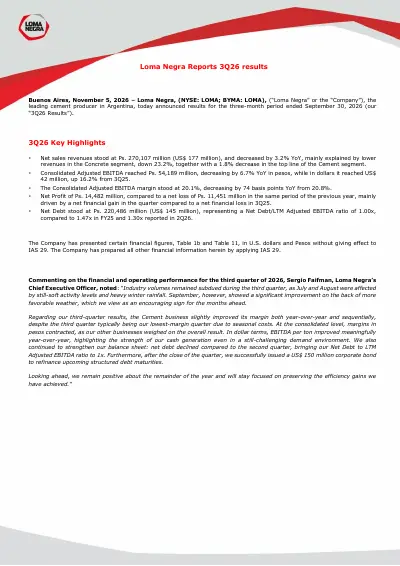
September, however, showed a significant improvement on the back of more favorable weather, which we view as an encouraging sign for the months ahead. In this context, our cement volume decreased 6.3% year-over-year, while consolidated net revenue declined 3.2% to Ps.
270.1 billion. In terms of profitability, consolidated adjusted EBITDA reached Ps.
54.2 billion, down 6.7% year-over-year, with margin contracting 74 basis points to 20.1%, as our other business weighed on the overall results. Our cement business, on the other hand, slightly improved its margin both year-over-year and sequentially, despite the third quarter typically being our lower margin quarter due to seasonality costs.
In dollar terms, EBITDA per ton stood at $32.5, up 24% year-over-year, highlighting the strength of our cash generation even in a still challenging demand environment. We also continued to strengthen our balance sheet.
As of quarter end, net debt stood at $145 million, $40 million lower than in the second quarter, bringing our net debt to adjusted EBITDA ratio down to 1 times. In addition, after the close of the quarter, we successfully issued a $150 million corporate bond to refinance upcoming structured debt maturity.
I will now hand off the call to Marcos, who will guide you through our market review and financial results. Please, Marcos, go ahead.
Marcos Gradin
Thank you, Sergio. Good day, everyone.
Please turn to slide 4. On the macro front, recent data points to a softer activity trajectory.
GDP grew 2% year-over-year in the second quarter, while the EMAE, Argentina's monthly economic activity indicator, declined 1.5% year-over-year in July and 1.7% in August, leaving cumulative growth at 1.2% through the first eight months of the year. Market expectations, according to the Central Bank's REM survey, point to growth of 1.5% for 2026 and 2.5% for 2027.
Construction activity also showed a softer performance during the quarter. The ISAC declined 4.5% year-over-year in July and 4.4% in August, the latest available data, although it posted a 0.4% sequential improvement in August on a seasonally adjusted basis.
Leading indicators were broadly flat. Registered private sector employment in construction declined 0.3% year-over-year in July, and building permits authorized in the same month were also down 0.3%, although they remain up 7.5% on a cumulative basis for the first seven months of the year.
Against this backdrop, industry cement dispatches declined 3.9% year-over-year during the quarter. July and August were both down 8.2% year-over-year, affected by still soft activity and heavy rainfall, while September rebounded strongly, growing 4.5% year-over-year and 18% sequentially on the back of more favorable weather.
In terms of product mix, bagged cement continues to outperform, growing 2% year-over-year, while bulk cement declined 8%, still weighed down by the construction environment. As a result, although bulk cement still represents the majority of the industry mix, bagged cement continues to gradually gain share.
Looking ahead, while the recovery remains uneven, September's performance suggests underlying demand is there and reacts once weather conditions normalize. This, together with RIGI-related projects beginning to move forward toward the end of the year, supports a more positive perspective for the coming months.
Turning to slide 5 for a review of our top-line performance by segment. Third quarter consolidated revenues decreased by 3.2% year-over-year.
The decline was primarily driven by weaker performance in the concrete business, followed by the cement and railroad segments, while higher revenue in aggregates provided a partial offset. Revenues from the cement, masonry cement, and lime segment decreased by 1.8% year-over-year.
Sales volume declined by 6.3%, mainly due to the adverse weather conditions discussed earlier. Our performance relative to the industry was also affected by masonry cement and lime, which follow demand trends similar to those of bagged cement.
Positive pricing dynamics mitigated part of the volume impact. Performance across dispatch channels remained mixed, with bagged cement supported by more resilient demand, while bulk cement continued to underperform.
Concrete revenues decreased by 23.2% compared with the third quarter of 2025, reflecting a 24.9% decline in sales volume. This was mainly attributable to a lower contribution from special projects, weaker demand related to public works, and reduced activity in industrial and architectural projects.
Better pricing partially cushioned the impact of lower volumes. Railroad revenues decreased by 2.2% year-over-year in the third quarter of 2026.
Favorable pricing dynamics were not sufficient to offset a 7% decline in transported volumes, mainly due to lower shipments of grain, frac sands, and basic aggregates. This was partially compensated by higher volumes of chemical and gypsum, supported by the resumption of services to Neuquén from the repair of the rail section in Bahía Blanca that had been damaged by late last year's storms.
Revenues in the aggregates segment increased by 3.7% year-over-year, as a strong pricing environment and an improved sales mix more than compensated for a 16.1% contraction in volumes. Volumes were affected by similar factors to those seen in concrete, particularly weaker demand from public works and construction companies.
Moving on to slide 7. Consolidated gross profit decreased by 4% year-over-year, with gross margin barely contracted 14 basis points to 17.2%, mainly reflecting lower net revenues, partially mitigated by also lower cost of sales.
Cost of sales decreased by 3% year-over-year, primarily reflecting lower costs in the cement and concrete segments, partially offset by higher cost of sales in the railroad and aggregate businesses. In the cement segment, cost of sales increased on a per-ton basis, suffered a marginal increase, mainly driven by higher depreciation.
Excluding this effect, unit costs remained broadly in line with last year. The use of clinker produced during the warmer months, together with the planned kiln shutdowns, helped mitigate seasonal energy pressures alongside lower fuel, electricity, packaging, and contractor costs.
In railroad, the increase of cost of sales was mainly related to higher track maintenance costs and, to a lesser extent, higher third-party services and payroll costs. The concrete segment narrowed its gross loss compared with the third quarter of 2025, although it still remained in negative territory.
Finally, SG&A expenses increased by 16.1% year-over-year, mainly driven by higher advertising and promotional spending, as well as consulting and IT services. As a percentage of sales, SG&A reached 11.1%, up 184 basis points compared to the third quarter of 2025.
Please turn to slide 8. Consolidated adjusted EBITDA for the quarter reached $42 million, up 16.2% year-over-year, while in pesos it stood at Ps.
54.2 billion, representing a 6.7% decline. The decrease in pesos was primarily driven by weaker performance in the railroad segment and, to a lesser extent, lower contribution from other businesses, partially offset by improved results in cement and concrete.
As a result, the consolidated adjusted EBITDA margin contracted by 74 basis points year-over-year to 20.1%, but remaining broadly stable compared with the previous quarter. In the cement segment, adjusted EBITDA margin expanded by 67 basis points year-over-year to 24.9%, primarily reflecting favorable pricing dynamics.
This more than offset the pressure on unit costs from lower volumes, which limited the dilution of fixed costs, as well as higher SG&A expenses. In the concrete segment, adjusted EBITDA margin improved 220 basis points to negative 4.6%, compared with negative 6.8% in the third quarter of 2025, supported by better pricing.
However, the segment remains in negative territory as current volumes are still too low to adequately cover its cost structure. In contrast, the railroad segment adjusted EBITDA margin turned negative, reaching negative 11% in the third quarter, compared with positive 3.4% in the same period of 2025, mainly driven by the higher costs discussed in the previous slide, partially offset by lower SG&A expenses.
The aggregate segment also recorded margin contraction, with its adjusted EBITDA margin declining to 19.4% from negative 16.7% in the same period last year. A stronger pricing environment partially mitigated the impact of lower volumes, while higher costs continued to weigh on the segment's profitability.
Moving to the bottom line on slide 10. Net income attributable to owners of the company amounted Ps.
15.2 billion in the quarter, compared with a net loss of Ps. 11.3 billion in the third quarter of 2025.
The improvement was primarily attributable to a net financial gain in the quarter, compared with a net financial loss in third quarter '25, despite weaker operating performance. This improvement was partially offset by higher income tax expenses, as the company recorded a net tax net tax expense in third quarter '26, compared with a net tax benefit in the same period of previous year.
On the financial side, the company recorded a net financial gain of Ps. 8.5 billion in the quarter, compared to a net financial loss of Ps.
38.3 billion in the same period of 2025. This year-over-year improvement mainly reflected a more moderate pace of peso depreciation, as well as lower net financial expenses, which declined to Ps.
7.9 billion from Ps. 23.3 billion in the third quarter of 2025, primarily due to lower financial expenses.
Moving on to the balance sheet. As you can see on slide 11, we ended the quarter with net debt of Ps.
220 billion and a net debt to adjusted EBITDA ratio of 1 time, a significant improvement from 1.39 times a year ago and 1.47 at the end of 2025. Cash flow from operating activities totaled Ps.
86.3 billion in the quarter, more than doubling the Ps. 42.6 billion generated in the third quarter of 2025.
This year-over-year improvement was mainly driven by favorable working capital dynamics, reflecting an improvement in trade and other receivables, together with lower inventory levels and higher tax payables. Regarding investment activities, the company used Ps.
18.8 billion, with CapEx totaling Ps. 18.1 billion, compared to Ps.
19.5 billion in the same quarter of last year. On the financing side, the company used Ps.
25 billion during the quarter, mainly related to loan repayments, compared to a net cash generated in the third quarter of 2025 when the company issued its Class 5 corporate bonds. In US dollar terms, net debt stood at $145 million, with an average debt maturity of 1.2 years.
As of quarter end, 91% of total debt was denominated in US dollars, while the remaining balance in pesos. As Sergio mentioned, after the close of the quarter on October 22nd, we issued our Class 7 corporate bond in the local market for $150 million with a 36-month tenor and a 6.25% interest rate.
The transaction was very well received by the market, and we would like to thank all investors who, as in each of our issuances, continue to place their trust in the company. Proceeds will be used mainly to refinance upcoming structured debt maturities, extending the average maturity of our debt, and further strengthening our debt profile.
Now for our final remarks, I'll hand the call back to Sergio. Thank you.
Sergio Faifman
Thank you, Marcos. Now to finalize the presentation, I please ask you to turn to slide 13.
While industry volume continued to come in below our expectations, still heavily affected by a particularly rainy winter, September showed that demand respond quickly when the weather conditions are supportive, which we see a positive sign as we look ahead. At the same time, many of the large-scale projects linked to the RIGI regime, whose filling and approval until recently were only news, are now becoming reality, with several of them already getting underway even before year-end.
We expect their contribution to demand to gradually build as the months go by. Bagged cement, in turn, is the segment where the outlook remains less clear, as its recovery will depend more closely on the evolution of the real economy, real wages, and the return of credit.
In this context, Loma Negra remains focused on maintaining healthy pricing dynamics and strict cost discipline in order to preserve profitability. Finally, I would like to highlight the successful debt placement completed in October, which strengthened our financial position and reaffirmed investor confidence in our company.
This is the end of our prepared remarks. We are now ready to take questions.
Operator, please open the call for questions.
Operator
Thank you. We will now conduct a question-and-answer session.
If you would like to ask a question, please press star then one on your telephone keypad. A confirmation tone will indicate that your line is in the question queue.
You may press star then two if you would like to remove your line. For participants using speaker equipment, it may be necessary to pick up your handset prior to pressing the keys.
Once again, star one on your telephone keypad. We also would like to ask that you please limit your questions to one question and one follow-up, please.
If you have additional questions, you may requeue for those questions, and they will be addressed. Also, please note that Mr.
Sergio Faifman will be responding in Spanish immediately following an English translation. Please hold momentarily while we assemble our roster.
Our first question comes from Chelsea Vatta of Latin Securities. Please go ahead.
Sofia Vatta
Hi, Loma team. Thank you for taking my question.
It's regarding volumes and what are the main drivers you see for 2027 that were not present in 2026? Thank you.
Sergio Faifman
Hi, Chelsea. Thank you for your question.
La verdad que lo primero que vemos es un cambio en las condiciones climáticas que nos han impactado mucho en el año 2026.
The truth is that we have seen is a change in the weather conditions that impacted severely during 2026.
Sergio Faifman
Lo que estamos notando en estos meses, si uno ve los volúmenes de septiembre de la industria, donde no ha llovido, los volúmenes fueron mucho mejor que el promedio de los últimos meses.
When you see an improvement, like in September, where the weather was better, the volumes start to pick up.
Sergio Faifman
En octubre, nuevamente con mucha lluvia, el volumen tuvo una caída.
In October, again with some rain, volumes are again below.
Sergio Faifman
Y la verdad que cuando uno ve algunos días sin lluvia, esa diferencia de volumen por ahí está en torno de 15 o 20% los volúmenes con lluvia.
When we see days with good climate, the difference is between 15% and 20% with these days, with these rainy days.
Sergio Faifman
Y lo que estamos viendo ahí que son varias obras que estamos licitando, algunas ya cerradas, respecto de proyectos de RIGI.
What we are seeing, looking forward, is some projects that we are participating in tenders linked to the RIGI regime.
Sergio Faifman
Ayer, por ejemplo, comunicamos la obra de Sade para el proyecto de Pampa de urea.
Yesterday, for example, we communicate that Loma is going to be participating in the project of a plant of urea.
Sergio Faifman
Y estamos participando en varias licitaciones de proyectos de RIGI que deberían traccionar volumen para el año próximo también.
We are also participating in some other tenders and projects that should boost volumes looking forward to 2027.
Sergio Faifman
La suma de esos dos factores más una recuperación general de la economía, somos optimistas respecto del volumen del año que viene.
The sum of these two factors, and also coupled with a recovery of the economy, we are optimistic about the outlook for next year.
Sofia Vatta
Thank you. Sorry, you mentioned the project with Pampa.
How much it represents in terms of dispatches for Loma?
Sergio Faifman
En verdad, ningún proyecto individualmente representa un volumen importante en cemento.
Individually, there is no project that has a significant weight in terms of cement dispatches.
Sergio Faifman
Es la sumatoria de muchos proyectos.
It's more the sum of these projects that will impact our volumes.
Sergio Faifman
Puntualmente, ese proyecto son entre 300 y 350.000 metros cúbicos de hormigón. That
punctually, this project is around 300,000 and 350,000 cubic meters of concrete.
Sofia Vatta
Thank you.
Sergio Faifman
All right.
Operator
Our next question comes from Andrés Cardona of Citi. Please go ahead.
Andrés Cardona
Hi, good morning, everyone. Thanks for the presentation and the opportunity to ask.
Question, it be a follow-up on the RIGI evidence on your backlog. If you could share some color about how it's looking like versus, I don't know, 1 year ago.
If you see evidence of the RIGI you kind of mentioned it that is boosting demand, but how much it could drive demand in 2027? Also, if you could share some outlook about pricing and margins for the 4Q '26?
Thank you, Sergio.
Sergio Faifman
Hi, Andrés. Thank you for your question.
La verdad que no tenemos números exactos de toneladas o de proyectos del RIGI para demanda del 2027.
We don't have exact figures in terms of tons or volumes regarding the RIGI for 2027.
Sergio Faifman
Te podría decir que en varios de ellos que estamos participando en licitaciones son volúmenes importantes y proyectos de 24 o 36 meses.
What can I say is that we are participating in several tenders that are significant projects, and many of those have a periods of 24, 30 months.
Sergio Faifman
También hay
varios proyectos de minería y demás que si arrancan también tienen consumos muy importantes. There are also projects linked with mining that we are seeing if they start.
Sergio Faifman
Quizás los proyectos de minería los vemos un poco más demorados, obviamente por ahí por contexto político y demás que por ahí están un poco más atrasados.
Probably these mining projects are a little bit backlog due to the political atmosphere, and we are waiting to see the follow-up of that.
Sergio Faifman
Todos los proyectos de Vaca Muerta, gas, petróleo y energía están avanzando a un ritmo más rápido.
All the projects linked to oil and gas are advancing at a more accelerated pace.
Sergio Faifman
En cuanto a precio, como vieron en el último balance, estamos logrando consolidar nuestra estrategia de precio.
In terms of pricing, as you have seen, we are consolidating our strategy on pricing.
Sergio Faifman
Estamos pensando y viendo un horizonte de lo que queda del 2026 y 2027 de mantener esta estrategia.
We are seeing looking forward to consolidate this strategy and pass.
Sergio Faifman
Con niveles similares de precio.
With similar levels of prices.
Sergio Faifman
Y con
varias mejoras que estamos trabajando y consiguiendo oportunidades en costos variables y costos fijos. On the other hand, always looking for opportunities regarding fixed costs and variable costs to improve our profitability.
Operator
This concludes our question-and-answer session. I would like to turn the conference back to Diego Jalón for closing remarks.
Diego Jalón
Thank you very much to you all to joining us this morning. We look forward to meeting you again in our next call for the upcoming quarter.
Obviously, if you have any other question, you can reach the IR team. Thank you very much.
Operator
The conference is now concluded. Thank you for attending today's presentation.
You may now disconnect.