Beyond Meat, Inc.
Q3 FY2026 · Earnings Call TranscriptNovember 4, 2026
Operator
[Good day?] Welcome to the Beyond Meat third quarter 2026 earnings call.
I do need to make an announcement. There is going to be about a 15-minute delay in the start of the conference.
The 8-K has been filed, and we'd like to give everyone a few minutes to digest its contents. Then we will start in about 15 minutes.
We appreciate your patience, and thank you. Ladies and gentlemen, please continue to hold.
The conference will begin momentarily. Thank you.
Welcome to the Beyond Meat third quarter 2026 earnings conference call. At this time, all participants are in listen-only mode.
Later you'll have an opportunity to ask questions during the question-and-answer session. To ask a question, you may press star then 1 on a touch-tone phone.
To withdraw your question, please press star then 2. Please note that today's event is being recorded.
It is now my pleasure to turn the conference over to Paul Sheppard, Vice President of FP&A and Investor Relations. Please go ahead.
Paul Sheppard
Thank you. Hello, everyone, and thank you for participating in today's call.
Joining me today are Ethan Brown, Founder, President and Chief Executive Officer, and Lubi Kutua, Chief Financial Officer and Treasurer. By now, everyone should have access to our third quarter 2026 earnings press release filed today after market close.
This document is available in the Investor Relations section of Beyond Meat's website at www.beyondmeat.com. Before we begin, please note that during this call, management may make forward-looking statements within the meaning of the federal securities laws.
These statements are based on management's current expectations and beliefs, and involve risks and uncertainties that could cause actual results to differ materially from those described in these forward-looking statements. Forward-looking statements in our earnings release, along with the comments on this call, are made only as of today, and will not be updated as actual events unfold.
We refer you to today's press release, our quarterly report on Form 10-Q for the quarter ended September 26, 2026, to be filed with the SEC, our annual report on Form 10-K for the fiscal year ended December 31, 2025, filed with the SEC, along with other filings with the SEC, for a detailed discussion of the risks that could cause actual results to differ materially from those expressed or implied in any forward-looking statements made today. Please note that on today's call, management may reference adjusted EBITDA, adjusted loss from operations, and adjusted net loss, which are non-GAAP financial measures.
While we believe these non-GAAP financial measures provide useful information for investors, any reference to this information is not intended to be considered in isolation or as a substitute for the financial information presented in accordance with GAAP. Please refer to today's press release for a reconciliation of these non-GAAP financial measures to their most comparable GAAP measures.
With that, I'd now like to turn the call over to Ethan Brown.
Ethan Brown
Thank you, Paul, and good afternoon, everyone. The third quarter was one of measurable progress.
Net revenues were stable sequentially, and gross margin, cost of goods sold, and cash use all moved meaningfully in the right direction. Today, I'll review our results, reiterate our strategy, and outline key deliverables.
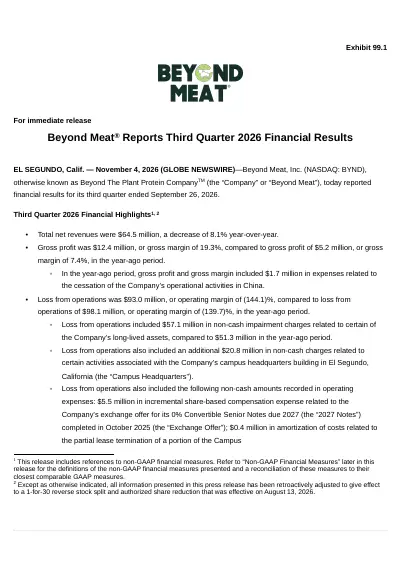
Total net revenues were $64.5 million, at the high end of our $60 to $65 million guidance. Revenue was down 8% year-over-year, an improvement from declines of 19.7% in the fourth quarter of 2025 and 15.3% in the first quarter of 2026, and roughly equal on a year-over-year basis to the previous quarter.
Our international retail channel, which includes our Europe retail business, grew 13.3% year-over-year, its third consecutive quarter of growth. Gross margin was 19.3%, up from 7.4% a year ago, and our highest in five years.
Cost of goods sold was $3.90 per pound, our lowest in five years. This is the most important takeaway of the quarter: early proof that the efficiencies we believe we have built into our manufacturing and into the supply chain are finally seeing the light of day, as we pursue our goal of a return to margins of 30% and above over the long term.
As has been the case, our operating expenses carried considerable noise this quarter as we continue to restructure the business. These charges are separate from the day-to-day cost of running the company.
They raise near-term expense, in most cases, on a non-cash basis, but we believe that they will produce longer-term savings. This quarter, operating expenses included non-cash charges related to the impairment of certain long-lived assets, as well as charges related to certain activities associated with our campus lease, partially offset by a credit from a reduced litigation-related accrual.
These activities associated with our campus lease, which should meaningfully reduce our future lease payments, and other similar actions are part of a broader effort, moving at a quickening pace, to bring our operating expense base in line with our current net revenues. I'll now turn to reiterating key elements of our turnaround strategy, which continues to rest on three pillars.
These are: 1, stabilize our core U.S. business while investing in growth in Europe and Canada; 2, broaden our strategic focus from plant-based meat to plant-based nutrition as Beyond, The Plant Protein Company; 3, drive operational efficiency and improve unit economics.
Pillar 1: stabilizing our core in the U.S. while growing in Europe.
Our core burger, ground beef, and dinner sausage products are showing signs of resilience at some retail accounts, though performance varies. Inflation and misinformation about the healthfulness of our products continues to weigh on U.S.
retail and, for that matter, U.S. foodservice.
We are responding through both product development and messaging, and I believe nutritional science will, over time, prevail over today's inverted nutrition narrative. In the meantime, we keep innovating on taste, nutrition, and clean ingredients to help consumers meet their health goals.
Beyond Steak filet is the clearest example of where our center-of-the-plate innovation is headed, and I believe it is the most compelling product since the Beyond Burger. It delivers 28 grams of protein, 3 grams of fiber, and 1 gram of saturated fat from avocado oil, with no cholesterol.
It is made with clean ingredients, including faba bean protein, mycelium, and avocado oil, and is both Clean Label Project Certified and Non-GMO Project Verified. We believe it gives consumers a way to enjoy more steak occasions, and as we make progress on unit costs, it may one day compete with lean proteins like chicken, for people who want high protein and low saturated fat.
Traction is early, but real. Launched on our direct-to-consumer platform about a year ago, Beyond Steak filet has become one of the best-selling items we have online.
It is now at Wegmans, H-E-B, Meijer, Sprouts Farmers Market, as well as Erewhon locations across Southern California. Price is also becoming part of the story, as we long expected.
At one major U.S. retailer, Beyond Steak filet is priced at $1.23 per ounce, roughly 40% below the lowest-cost beef steak, choice tenderloin, and less than one-third the price of grass-fed Angus tenderloin.
As history routinely makes evident, change does not happen all at once, but there are meaningful proof points along the way. We will keep telling this story of taste, nutrition, and health.
We will keep partnering with health organizations, doctors, nutritionists, and we will keep bringing consumers new-to-the-world products. Beyond Steak filet is one example.
Ground faba is another. The latter is made from four ingredients: water, faba bean protein, potato protein, and psyllium husk, and delivers 27 grams of protein, 4 grams of fiber, and zero cholesterol in only 140 calories, leading Time Magazine to name ground faba as one of the best inventions of 2026.
Our U.S. retail strategy is simple.
After years of moving between the refrigerated and frozen aisles, we are building consolidated frozen-aisle brand blocks so the consumer can find our full range in one place. We are pursuing this strategy through the positioning of existing products in the store and by adding innovation such as Beyond Chicken Pieces Spicy Buffalo, which was recently brought into the frozen set at more than 2,000 Kroger stores.
Like our other products, Beyond Chicken Pieces Spicy Buffalo boasts an impressive nutritional panel: 21 grams of plant protein, 0.5 grams of saturated fat, no cholesterol, and only 130 calories. Together with the original variety, it is among the first plant-based chicken products certified by the Clean Label Project, one of more than 20 such certified products in our portfolio.
We also strengthened our breakfast presence with Beyond Breakfast Sausage in original and spicy at Kroger, Sprouts, and Whole Foods nationwide. As we work toward stability and a return to growth in U.S.
retail, we are pleased with our third consecutive quarter of growth in our international retail channel, which includes Europe retail, and we are investing behind it. We have strong confidence in our leadership, team, assortment, and supply chain in Europe.
Europe does not face the same misinformation, and in part because we have not had to resize our operations footprint as we have had to do in the U.S., unit economics are more favorable. We expect continued progress and are fostering strong collaboration across the organization to bring innovation to these growing markets.
Pillar 2 is our evolution into Beyond, The Plant Protein Company. In 2026, we've been repositioning the company around delivering powerful plant-based nutrition to the consumer in convenient and delicious products, and have entered the faster-growing adjacent categories of beverage, powders, and bars.
We enter each with cost discipline top of mind and in partnership with our large family of early-adopting consumers. New products launch first on beyondplantprotein.com, where loyal Beyond fans help shape innovation, and where we can more tightly manage inventory, iterations, and timelines.
We then expand into retail and select geographies as product performance dictates. Our portfolio is an integrated set, not a collection of disparate products.
It lets consumers stack the superpowers of plants, from protein to fiber to polyphenols to phytosterols and beyond, by participating across products. Many of these nutrients, though not all, are missing at appropriate levels from the modern diet, and consumers benefit less as a result.
Spanning center-of-the-plate, beverage, powders, and bars, our portfolio offers an integrated path to plant-based nutrition that has the potential to deliver impressive health benefits, particularly when consumed along with whole plant-based foods. The first product was Beyond Immerse, a lightly carbonated drink aimed at the large and growing functional beverage market.
Each can has 20 grams of clean plant protein for muscle health, 5 to 7 grams of fiber for gut health, electrolytes for hydration, and antioxidants for immunity, at 100 to 110 calories, with no GMOs, dairy, or whey. We recently added Watermelon Strawberry, Limoncello Ginger, and Yuzu Grapefruit.
Immerse is available online, in select New York area retail through our distributor Big Geyser, and at Erewhon here in Southern California. Last month, we entered the energy category with Beyond Immerse Protein + Energy, which adds 160 milligrams of caffeine from coffee beans and guarana extract exclusively on beyondplantprotein.com.
Keep in mind that numbers are still quite small, but Immerse grew impressively quarter-to-quarter, and we are encouraged by its trajectory. Immerse delivers up to five functions in one can using only clean ingredients.
That stands in stark contrast to a market-leading protein beverage whose ingredient panel features the artificial sweeteners sucralose and acesulfame potassium, alongside various gums and gels, none of which we allow in Immerse. Our commitment to clean ingredients runs through all of our emerging brands, and we are proud that our nutrient powder line, Star Matter, recently received the Clean Label Project's Purity Award for its performance in rigorous testing for contaminants common in powders on the market today.
Pillar 3 is operational efficiency and unit economics. Strong execution across our global production network produced another sequential reduction in cost of goods sold to $3.90 per pound.
Three initiatives are driving it. First, production.
We've consolidated our network and built a continuous line at our Columbia, Missouri facility, which lets us bring previously outsourced volume in-house. Further investments in throughput and automation are expected to remove additional cost.
Second, materials. Despite inflation, we have lowered some costs through contract renegotiation, and we're pursuing more through RFPs, secondary sourcing, and formulation adjustments.
This work is relentless, and it matters more because inflationary pressures persist. Third, logistics.
We have lowered expenses despite rising fuel costs by consolidating our warehouse footprint and continuing to exit less profitable product lines. The full benefit of this work has been muted by lower sales volumes, which cause under-absorption of overhead.
Stabilizing the core and expanding into adjacent categories can drive top-line growth over time and help us absorb more of these costs. Meanwhile, we will keep pursuing savings in materials and production, scrutinizing operating expenses, and calibrating our facilities to volume.
As a management team, we are acutely aware that we must keep bringing down enterprisewide operating expenses with pace and intensity to reflect the size of our business today. We are attacking this through measures large, such as the partial lease termination, and incremental, such as tight controls across SG&A, and we are approaching 2027 with clear targets and plans.
To close, we have delivered meaningful progress in the third quarter. Though we have yet to return to growth, revenue was more stable sequentially, and our international retail channel grew 13.3%, its third consecutive quarter of growth.
We nearly tripled our gross margin year-over-year to our highest level in five years. We used far less cash than a year ago, posted a smaller EBITDA loss, and by negotiating a partial termination of our El Segundo lease, took another step toward rightsizing our footprint and future cost structure.
We continue to believe strongly in the future of plant-based meat and view current difficulties as part of the path of disruption. We are encouraged by the consumer response to Beyond Steak filet as one example, and by the favorable economics of the product, despite a vastly smaller supply chain and scale of production when compared to its animal protein equivalent.
We are not waiting for the pendulum to swing back to plant-based meat. We are forging what we believe is a bright path forward that centers on making the nutritional powerhouse contained within plants available to the consumer in convenient, delicious, and clean products.
We execute with a hyper-focus on a leaner operating model and a disciplined approach to innovation and market entry. We are pleased with our direction of travel, even as we see clearly there is much work ahead.
We will update you on our progress next quarter. With that, I'll turn the call over to Lubi to review our third quarter financial results in greater detail and provide our fourth quarter net revenue guidance.
Lubi Kutua
Thank you, Ethan, and hello, everyone. I'll begin my remarks today by reviewing our third quarter financial results in a bit more detail, and we'll then provide some brief comments on our fourth quarter outlook before opening up the call for your questions.
As Ethan mentioned, our third quarter results include certain significant non-routine items, reflecting various measures we are implementing as we continue to rightsize our business. I'll provide a bit more context on these items momentarily, including our rationale at a high level on how the specific measures are expected to benefit our business over the long run.
As is customary, however, let me begin by reviewing our operating performance for the quarter, starting with net revenues. Total net revenues decreased 8.1% to $64.5 million in the third quarter of 2026, compared to $70.2 million in the year-ago period.
The decrease in net revenues was primarily driven by a 10.9% decrease in volume of products sold, which primarily reflected lower sales of burger products to certain QSR customers in our international foodservice business, distribution losses of certain products in our U.S. retail and foodservice businesses, and general softness in the U.S.
plant-based meat category. The decrease in volume of products sold was partially offset by a 3.2% increase in net revenue per pound.
The increase in net revenue per pound was driven primarily by higher price realization on certain of our products, lower trade discounts, and changes in product sales mix, partially offset by unfavorable changes in foreign currency exchange rates. Looking at our sales results by channel, in U.S.
retail, net revenues decreased 13.2% to $24.8 million in the third quarter of 2026, compared to $28.5 million in the year-ago period. The decrease was primarily driven by a 20.8% decline in volume of products sold, which was largely attributable to distribution losses of burger and dinner sausage products within certain club stores, reduced points of distribution of breakfast sausage products within certain mainstream and mass retailers, and overall demand weakness in the plant-based meat category.
The decrease in volume of products sold was partially offset by a 9.5% increase in net revenue per pound, largely reflecting changes in product sales mix, higher price realization on certain of our products, and lower trade discounts. In U.S.
foodservice, net revenues decreased 9.7% to $9.5 million in the third quarter of 2026, compared to $10.5 million in the year-ago period. The decrease was largely attributable to a 12.6% decrease in volume of products sold, driven by reduced points of distribution and weak category demand, partially offset by a 3.3% increase in net revenue per pound.
On a year-over-year basis, net revenue per pound benefited from lower trade discounts and changes in product sales mix, partially offset by lower price realization on certain of our products. Turning to international.
International retail net revenues increased 13.3% to $17.9 million in the third quarter of 2026, compared to $15.8 million in the year-ago period. The increase in international retail channel net revenues was primarily driven by a 17.4% increase in volume of products sold, partially offset by a 3.4% decrease in net revenue per pound.
Volume of products sold benefited from increased sales of burger and ground beef products in European markets, and to a lesser extent, increased sales of burger products in Canada, while net revenue per pound on a year-over-year basis was primarily impacted by higher trade discounts and unfavorable changes in foreign currency exchange rates, partially offset by higher price realization on certain products and changes in product sales mix. Lastly, in international foodservice, net revenues decreased 19.4% to $12.4 million in the third quarter of 2026, compared to $15.3 million in the year-ago period.
Volume of products sold was down 17.5% year-over-year, primarily reflecting lower sales of burger products to certain QSR customers. Net revenue per pound in international foodservice declined 2.5% year-over-year, primarily due to changes in product sales mix and unfavorable changes in foreign currency exchange rates, partially offset by lower trade discounts and, to a lesser extent, higher price realization on certain of our products.
Now turning to gross profit and gross margin. Gross profit in the third quarter of 2026 was $12.4 million, or gross margin of 19.3%, compared to gross profit of $5.2 million, or gross margin of 7.4%, in the year-ago period.
This outcome represents our highest gross margin achievement since the third quarter of 2021, and is a testament to the hard work and focus our teams have performed in the face of a persistent, challenging environment. Gross profit and gross margin in the third quarter of 2026 were positively impacted by a 10.1% year-over-year decrease in cost of goods sold per pound, primarily reflecting improved manufacturing efficiency, including depreciation, a year-over-year decrease in inventory provision, and lower logistics expenses.
I would note that gross profit and gross margin in the year-ago period included $1.7 million in expenses related to the cessation of our operational activities in China, and there were no such expenses in the third quarter of 2026. Gross profit and gross margin in the third quarter of 2026 also benefited from a 3.2% year-over-year increase in net revenue per pound, as discussed earlier.
Total operating expenses were $105.4 million in the third quarter of 2026, compared to $103.3 million in the year-ago period. Operating expenses in the third quarter of 2026 included a $57.1 million non-cash impairment charge related to certain of our long-lived assets, compared to a similar charge of $51.3 million in the year-ago period.
To provide some more context, during the third quarter of 2026, we identified certain triggering events in accordance with accounting guidance under ASC 360 that indicated a need to test the company's long-lived assets for impairment. These triggering events included a significant decline in our market capitalization during the quarter, a change in the manner and extent of asset use, specifically relating to the commencement of a sublease of a portion of our campus headquarters facility, and lastly, continuing operating and cash flow losses in our business.
Consequently, and upon conducting an impairment assessment in accordance with ASC 360, we concluded that an impairment of our long-lived assets existed as of September 26, 2026. Separately, in the third quarter of 2026, we recorded a further non-cash charge of $20.8 million related to accelerated rent expense associated with a new partial lease termination.
This amount was allocated roughly evenly between research and development expenses and total selling, general, and administrative expenses within operating expenses on our income statement. Although these transactions create significant noise within our reported financials, as Ethan mentioned, we view them as prudent and necessary measures to rightsize our ongoing expenses with our current net revenues.
The full P&L and cash flow benefits from these measures, including actions related to the downsizing of our real estate footprint at our campus headquarters, will not be immediately reflected in our financials. However, as we seek to reposition the company for long-term sustainable operations, we expect to see an increasing positive impact over the near to mid-term horizon from these and other measures.
Lastly, in regards to operating expenses, and separate from the charges I just outlined, total operating expenses in the third quarter of 2026 also included $5.5 million in incremental share-based compensation related to the exchange offer for our 2027 notes completed in the fourth quarter of 2025, $0.4 million in amortization of costs related to a partial lease termination in 2025, $0.3 million in certain non-routine SG&A expenses, and a credit of $21.8 million reflecting a reduction in a litigation-related accrual. As a result, loss from operations in the third quarter of 2026 was $93 million, compared to loss from operations of $98.1 million in the year-ago period.
Below the line, total other income, net, was $10.1 million in the third quarter of 2026, compared to total other income, net, of $1.1 million in the year-ago period, with the year-over-year increase primarily attributable to a $13.3 million non-cash gain from the remeasurement of derivative liability, partially offset by a $2.5 million increase in interest expense and a $2.2 million decrease in non-cash gain from remeasurement of delayed draw term loan warrant liability. Net loss for the third quarter of 2026 was therefore $82.8 million, compared to net loss of $97 million in the year-ago period.
Net loss per common share, basic and diluted, was -$4.32, compared to net loss per common share, basic and diluted, of -$37.96 in the year-ago period. Note that these per-share figures have been adjusted to give effect to the 1-for-30 reverse stock split effected on August 13th, 2026.
Net loss per share in the year-ago period was calculated using our weighted average common shares outstanding prior to the completion of our exchange offer in the fourth quarter of 2025. Adjusted EBITDA in the third quarter of 2026 was a loss of $24.6 million, or -38.1% of net revenues, compared to an adjusted EBITDA loss of $33.5 million, or -47.7% of net revenues, in the year-ago period.
Now turning to our balance sheet and cash flow highlights. Our cash and cash equivalents balance, including restricted cash, was $169.3 million, and total outstanding carrying value of debt, net of debt discount, was $313.9 million as of September 26, 2026, which included the total undiscounted future cash flows of the remaining 2030 notes.
On September 23rd, 2026, we entered into separate privately negotiated exchange agreements with certain holders of our 2027 notes, pursuant to which we exchanged $15 million in aggregate principal amount of the 2027 notes for shares of our common stock. As part of the transaction, we issued an aggregate of approximately 1.55 million shares, and the exchanged 2027 notes were surrendered and cancelled, leaving $14.5 million in aggregate principal amount of the 2027 notes remaining and outstanding as of September 26, 2026.
Although we acknowledge the dilutive nature of these transactions, we again view these measures as prudent and necessary, and we believe they are aligned with the long-term interests of our shareholders as we prioritize near-term cash preservation and reduce our total indebtedness. Recall that our 2027 notes are due in March 2027.
Looking at our cash flow highlights, net cash used in operating activities was $37.3 million in the nine months ended September 26, 2026, compared to net cash used of $101.2 million in the year-ago period. Capital expenditures totaled $5.5 million in the nine months ended September 26, 2026, compared to $9.3 million in the year-ago period.
Net cash used in financing activities was $10.6 million in the nine months ended September 26, 2026, compared to net cash provided by financing activities of $90.8 million in the year-ago period, which included $100 million in proceeds from our delayed draw term loan facility. Finally, I'll touch briefly on our outlook, which we are continuing to limit to near-term net revenue expectations only.
In the fourth quarter of 2026, we expect net revenues to be in the range of $54 million to $59 million. With that, I'll turn the call over to the operator to open it up for your questions.
Thank you.
Operator
We will now begin the question-and-answer session. To ask a question, you may press star then 1 on your touch-tone phone.
If you are using a speakerphone, please pick up your handset before pressing the keys. If at any time your question has been addressed and you would like to withdraw your question, please press star then 2.
At this time, we will pause momentarily to assemble our roster. The first question is from Ben Theurer with Barclays.
Please go ahead.
Ben Theurer
Ethan, Lubi, thanks for taking my question. Good afternoon.
Two questions real quick. Obviously you're taking a lot of measures here, and you're working hard, and we're seeing finally a little bit of the gross profit coming through.
Given the challenges on the top line, and clearly your outlook for the fourth quarter, it gives us roughly $250 million, just coming back a little bit to where we were in the past during that period of time when we had pre-pandemic roughly that $250 to maybe $300 million top line, back in the days SG&A was still substantially lower than it is today, right? Roughly half.
As we think about it, the initiatives and what you've been doing, and clearly you've come a long way on the SG&A side, but how should we think about this conceptually? Where do you want to take SG&A to?
Or where do you have to take SG&A to, to make this work out? That would be my most pressing question.
Ethan Brown
Ben, thank you, and that's a good one. We see the same math that you're seeing.
Without getting into specificity, it's very clear that at this top line, we need to continue to reduce operating expense to fit into the current revenue. We're doing that, and some of these things that are very lumpy like the impairments around the partial lease termination, the subletting, on and so forth, are big steps in that direction.
Then we also have to continue to do incremental steps at department levels and so on and so forth. We do see the same math.
There's no silver bullet that we're looking for. That work has to happen, and it's a huge focus for us and for our new COO who's come in, really tasked him to help us get that down to where it needs to be.
It's a daily conversation to your [point?] , and something that we see.
Without repeating myself, I do look at this quarter and see a lot of proof points of the turnaround that we're executing. Obviously, the gross profit and gross margin being the highest in five years, the COGS being the lowest in five years, adjusted EBITDA being better, and then this cash use of $16.9 million the quarter.
Then if you look at the year, $38 million for the year so far, these are big, big improvements, just to give you a sense of what was going on last year at this time. We had already used $101 million, obviously had a lot of structuring going on.
The main message is that we've had so much restructuring going on, right? We have these very large charges coming in.
They're not necessarily related to running the business on a day-to-day basis. What I am doing is getting us to a point where we can run the business on a day-to-day basis at the right operating expense that's consistent with where we are on revenues.
I think to see that as the clear design rule.
Ben Theurer
Okay. Then my second question kind of associated with it, but maybe if you could give us a little bit color as to why the research and development expense kind of tripled from the run rate we had in prior quarters?
It used to be give or take $5 million, went up to $15 million. Was there anything particular in the quarter that just drove that up one time?
Just wanted to understand how to think about this then also go forward. I know you're not going to give much of go-forward data, but it's just was kind of eye-catching to see this go up so much on the research and development side.
Ethan Brown
I'll let Lubi answer that, because it is more of an accounting issue than an actual R&D issue.
Ben Theurer
Okay.
Lubi Kutua
That's right. Ben, I did mention in my prepared remarks, right, that there was a non-cash charge of $20.8 million that we recognized as accelerated rent expense.
This was related to a partial lease termination for a portion, and we allocated that...
Ben Theurer
[Part of that?] was in research.
Okay. Yeah.
Lubi Kutua
Exactly. That's what you're seeing there.
It is roughly half of that amount.
Ben Theurer
Basically if we're just thinking 4Q, we should be back at the 5 plus minus a few dollars, basically.
Lubi Kutua
Right. That's right.
Ben Theurer
Okay. Got it.
Perfect. I'll pass it on.
Thank you very much.
Ethan Brown
Thanks, Ben.
Operator
This concludes our question-and-answer session. I would like to turn the conference back over to Ethan Brown for any closing remarks.
Ethan Brown
Thank you. No, I think we covered quite a bit in the prepared remarks, and I hope that we delivered that clearly and answered.
What we see is continued progress across both the margin, across adjusted EBITDA, getting our COGS down. Really are pleased with the 13.3% growth in international markets led by Europe.
We're pleased by some of the things we're seeing in adjacencies, pleased by the distribution of steak that we're seeing, the quality of that product, and the degree to which it communicates the message that we want consumers to understand, which is this has tremendous potential for health, as well as tasting great. All of these things are pointing in the right direction.
I think what we need to make sure we're doing is getting operating expense down to the point where they matter. That's the task ahead, and so we look forward to updating you on that in the quarters to come.
Thank you very much.
Operator
The conference has now concluded. Thank you for attending today's presentation.
You may now disconnect.