Calix, Inc
Q3 FY2026 · Earnings Call TranscriptNovember 3, 2026
Operator
Greetings, everyone, and welcome to the Calix third quarter 2026 earnings conference call. At this time, all participants are in a listen-only mode.
A question-and-answer session will follow the brief prepared remarks. If anyone should require operator assistance during the conference, please press *0 on your telephone keypad.
As a reminder, this conference is being recorded. It is now my pleasure to introduce Nancy Fazioli, Vice President of Investor Relations.
Nancy, please go ahead.
Nancy Fazioli
Thank you, Sam, and good morning, everyone. Thank you for joining our third quarter 2026 earnings call.
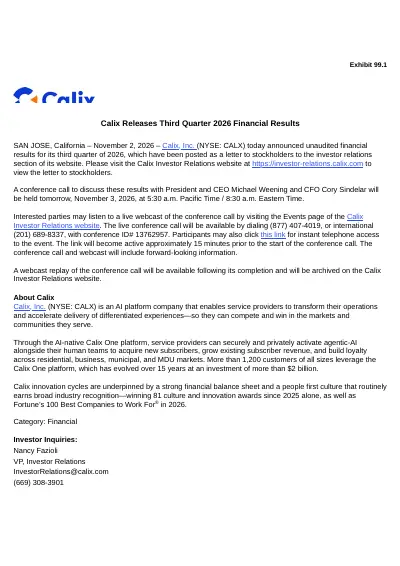
Today on the call, we have our President and CEO, Michael Weening, and Chief Financial Officer, Cory Sindelar. As a reminder, yesterday after the market closed, Calix issued a news release which was furnished on a Form 8-K along with our stockholder letter, was also posted in the Investor Relations section of the Calix website.
Today's conference call will be available for webcast replay in the Investor Relations section of our website. Before I turn the call over to Michael for his opening remarks, I want to remind everyone that on this call, we will refer to forward-looking statements, including all statements the company will make about its future financial and operating performance, growth strategy, and market outlook, and that actual results may differ materially from those contemplated by these forward-looking statements.
Factors that could cause actual results and trends to differ materially are set forth in the third quarter 2026 letter to stockholders and in the annual and quarterly reports filed with the SEC. Calix assumes no obligation to update any forward-looking statements, which speak only as of their respective dates.
Also on this conference call, we will discuss both GAAP and non-GAAP financial measures. A reconciliation of GAAP to non-GAAP measures is included in the third quarter 2026 letter to stockholders.
Unless otherwise stated, all financial information referenced in this call will be non-GAAP. With that, Michael, please go ahead.
Michael Weening
Thanks, Nancy. We have just returned from Calix ConneXions, where thousands of customers and partners joined us to discuss the path forward, and the reality that there is no version of the future where AI is optional.
A future we intend to lead for our customers and the markets we serve. With Calix One deployed since March, we deliver the trust and security that our customers require to be successful within the new AI reality, allowing us all to move from experimentation to execution safely.
In these uncertain times, we believe that predictability is highly valued by our customers and their subscribers, our team members, partners, and investors. For our customers, we provide predictability of cost through our leadership with open-weight models, the platform, and the evolution to specialized models that will land on all devices over time, and return on investment, as we operate billions of workflows annually, giving us unmatched insight into which agents and workflows will yield the greatest returns for our customers.
Predictability for customers extends into predictability for investors, as evidenced by the records that we broke in third quarter and the end-of-year forecast that will see revenue at the midpoint hitting 19% year-on-year growth, while OpEx leverage begins. At ConneXions two weeks ago, the new CEO of ALLO clearly stated the value of our platform pre-AI.
He had come from a multi-vendor broadband provider to ALLO, who has partnered exclusively with Calix. The Calix platform at ALLO yields 40% lower truck rolls, 60-point higher Net Promoter Score, and is supported by 25 IT people versus 400.
That is the power of our platform before AI. With Calix agent workforce, which was rolling out at a rapid pace, those results will expand as we automate functions and workflows, yielding new subscribers, revenue growth, reduced churn, and even higher profits for broadband providers, while our platform expands to managed service providers for apartment buildings and multi-dwelling units, and then on to hospitality.
Last week, we released the next step in our AI strategy: the Calix Communications Language Model, or CLM, and Calix Gems, which are designed to bring communications-specific intelligence to the right place across the platform, from the cloud to the network to the subscriber premise. This architecture will enable us to deliver increasingly specialized capabilities for platform customers, while enabling large service providers to partner with Calix by consuming our AI component capabilities into their unique environments.
That combination of a differentiated platform, expanding segments with the ongoing expansion of MDU, agentic workflows, AI agents, and the addition of specialized learning models, coupled with a customer success organization that is leveraging AI to enable customers to adopt at scale, gives us great confidence in the opportunity ahead and our ability to lead. Our third quarter results demonstrate that customers are responding.
This is the payoff from the investments we have made and the partnerships we have built with our customers. We went slow to build the platform correctly.
Now we move fast with our customers to compete, win, and expand. Cory, over to you to walk through the details of a strong quarter.
Cory Sindelar
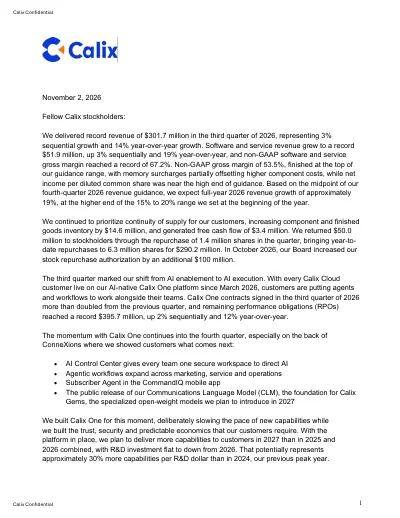
Thank you, Michael. We delivered record revenue of $302 million, up 3% sequentially and up 14% year-over-year.
A key highlight was record software and services revenue of $52 million, up 3% sequentially and 19% year-over-year, as our customers continued to win new subscribers and take market share. Calix One contracts signed in the third quarter more than doubled from the prior quarter, with RPOs reaching a record $396 million, up 2% sequentially and 12% year-over-year.
One important note: in connection with our customer supply assurance program introduced early in the third quarter, we began receiving non-cancelable appliance orders, which are added to RPOs. To avoid distortion of this key metric, we elected a practical expedient to eliminate the value of RPOs for contracts with a duration of one year or less, thereby eliminating hardware from RPOs.
As part of that elimination, the value of software and service contracts with a duration of one year or less, totaling $6 million, was also excluded. These software and service contracts were included in prior periods.
Without giving effect to this change, RPOs attributed to software and services would have grown sequentially by 4% and year-over-year by 13%. Non-GAAP gross margin was 53.5%.
Non-GAAP software and services gross margin reached a record 67.2%, increasing 340 basis points sequentially, driven by subscriber growth and continued optimization of our third-generation platform. As our customers continue to focus on subscriber experience and take share, our software and services revenue will continue to increase, expanding our software and services gross margins.
Non-GAAP appliance gross margin was 50.7%, which represents a sequential decline of 220 basis points, primarily due to higher memory component costs. We also continued to demonstrate operating discipline and early productivity gains from our human-centric AI investments.
Third quarter non-GAAP operating expenses were $124 million, representing 41% of revenue and down from 42% of revenue last quarter. Our balance sheet remains strong.
We ended the quarter with $155 million in cash and investments, after deploying $50 million to repurchase 1.4 million shares. DSO was 38 days and inventory turns were 2.8, reflecting improved collections and deliberate inventory investments to support customer demand and product availability.
After quarter end, we increased our stock repurchase authorization by $100 million, adding to the $44 million that remained at the end of the quarter. Turning to guidance: for the fourth quarter of 2026, we expect revenue to be between $311 and $317 million.
This outlook reflects the ongoing broad-based deployment data and order visibility across our customer base. Our fourth quarter non-GAAP gross margin guidance is 52.25% to 54.75%.
The range reflects component cost expectations as well as customer and product mix. As noted last quarter, we chose to include surcharges on new orders.
As such, we expect to recover a greater percentage of higher memory costs in the fourth quarter as we work our way to gross profit neutrality. Our fourth quarter non-GAAP operating expense guidance is $129.5 to $131.5 million.
The range reflects fourth quarter investments in our annual ConneXions customer innovation conference and five additional days in the quarter, partially offset by continued productivity gains. Setting aside the fourth quarter bump we see every year due to ConneXions, we expect operating leverage will continue as OpEx as a percentage of revenue continues to drift downward to 40% and below as we continue to deploy human-centric AI internally.
Our guidance for non-GAAP EPS is 41 to 49 cents. At the midpoint of guidance for the fourth quarter, our 2026 non-GAAP EPS is $1.76, which would represent an annual EPS growth of 30% compared to revenue growth of 19%.
Michael, back to you.
Michael Weening
Thanks, Cory. We have built the industry's leading AI-native platform.
Now we go fast with our customers, amplifying their teams and ours to compete, win, and expand at a rapid pace. Nancy, let's open the call for questions.
Nancy Fazioli
Thank you, operator. We're ready for questions.
Operator
Thank you. We will now be conducting a question-and-answer session.
If you would like to ask a question, please press *1 on your telephone keypad. A confirmation tone will indicate your line is in the question queue.
You may press *2 if you would like to remove your question from the queue. For participants using speaker equipment, it may be necessary to pick up your handset before pressing the star keys.
One moment, please, while we poll for questions. Our first question is from Ryan Koontz with Needham & Co.
Please proceed with your question. ):
Ryan Koontz
Great, thanks. Good morning.
I'm going to ask about RPOs and specifically software bookings there. Are you pleased with where you're at there in your recovery from the cloud transition?
Any trends within the mix of RPOs you'd point out, and what sort of year-over-year booking rate you think you can get to next year on software RPOs?
Michael Weening
I'll talk to the trends, and then Cory can talk about one specific nuance in RPOs. From a whether we're pleased, yeah, I'm wildly pleased, because what that showed was customers in Q3 actually started to commit to our AI where we're going from an AI point of view, even though our first workflows just started to roll out in August, which is the beginning, but as they start to see what's possible, a huge percentage of them just jumped in, as you saw by the doubling of the contracts, because they agree with where we're going.
Frankly, what it validated is that we're going to be the easy button for AI. Everybody in every market needs to figure out what their AI strategy is, and if you're the one who can provide that in a trusted and secure way, but also give them predictability of cost, which as we know with tokens and all those things is an issue, we've resolved that, but more importantly, give them a road map that shows where they get predictability of return on investment, which is very hard to acquire, and we can actually give that to them really clearly saying, here's a stack ranking of the workflows, we're implementing them in this order, and based upon everything and how you run your broadband business, this is the ROI on it.
Those were the early adopters, but I believe in the previous call, I had a customer who, and I'll reiterate this, who basically stated they've never bought into our longer-term vision with regards to what we're doing on the Smart side of stuff, no matter how much I tried to sell them on SmartTown and Smart Business and where we're going, he never bought in. They signed up in third quarter for 5 years.
The reason why is because they know they need artificial intelligence, it was time for them to get on the experience bandwagon, and doing AI and experience at the same time was highly valuable. Then having just come out of ConneXions where we had almost 3,000 people there, the momentum was incredible.
If you haven't had the opportunity to watch that event, that's the best event we've ever done. I could stand up there with confidence in front of all those customers and say, we have nailed it.
We absolutely 100%, if you sign up with us for the future with AI, we will give you everything you dreamed, and I can commit to that because, as I said on stage, our Chief Product Officer, who, congrats to him, he just won CTO of the Year here in the Valley, which is a pretty huge accomplishment. The reason why he won that is because he could stand up in front of our board in the last board meeting and say, we will deliver more innovation on our platform in 2027 than we have in all of 2026 and in all of 2025 combined.
More importantly, he will do that at flat to down from a budget point of view, showing a massive jump in productivity. Do I feel good about this?
Hell yeah. For sure.
Cory, you want to talk about the numeric nuance?
Cory Sindelar
Ryan, as I said in my prepared remarks, we wanted to avoid a distortion created by including appliance gross margin or appliance RPOs in that metric and keep it a pure software and services number. With that, we elected a practical expedient to eliminate contracts of a year or less.
Michael Weening
The six, yeah, if that's
Cory Sindelar
You need to add back $6 million to have a comparable number to prior periods.
Michael Weening
What would the RPOs and the percentage have been then?
Cory Sindelar
4% quarter-on-quarter and 13% year-on-year.
Michael Weening
Which is pretty good. ):
Ryan Koontz
Great. That's great, guys.
Michael, I totally agree with you on the certainty around costs and the easy adoption. It's very, very compelling.
It's exciting.
Michael Weening
Maybe another Ryan, we're the easy button, right? All you have to do is sign up, and then what happens is these workflows and agents just start popping out.
At ConneXions, I demonstrated when I was on stage just how trusted and secure this can be, because I gave the example of there was one of the employees of our customers did something funny. He tried to break one of our agents, and this was like you would use Microsoft Copilot or something like that.
He basically pounded on our agent inside Service Cloud and tried to get it to answer how many calories are in a McDouble, which I didn't know what McDouble was, I'm an Egg McMuffin guy, but it's basically a two-patty cheeseburger, and it has 400 calories in it, Lord knows, a lot of fat. It took him 51 tries before he could break it.
We also leave them with certainty that from a data privacy and security point of view that we're going to be able to protect them, because that you think about the data that they have, that's really important, especially in the look what happened from a cyber hacking this week where $6 billion got sold, $6 billion got stole off of a crypto exchange, right? The attacks are increasing from pretty much guaranteed that came from Korea.
These crypto attacks from these nasty nations continue. We give them that security, we make them really secure, and then we can demonstrate, hey, by the way, if you implement this, we're going to help you get 30% or 40% productivity.
):
Ryan Koontz
That's great, guys. Maybe just a quick follow-up, if I could.
Could you maybe characterize where you are in terms of some of your Tier 1 engagements, what kind of conversations you're having there, what kind of the nature of the business opportunities looks like, and maybe give a little color on size or larger?
Michael Weening
Ryan, good question. We have two large Tier 1s in North America that we deal with on a regular basis, as you're well aware of, and those continue to progress at a very rapid rate.
We're doing really well. On the international stage, we have started those engagements in 2026.
These are 18-to-24- or 36-month life cycles, and we have many engagements going on internationally. Those are 2027 through to '28 where, '28, what happens is you go and win some business in '27, demonstrate it, build footholds, and then you start to really drive revenue through the latter part of the next year and into '28.
Those are going well. I would say that, if you look at some of the press releases that we put out at ConneXions, there were two specific ones that are relevant to large customers.
The first would be our announcement that the SmartLife products are now on prpl. If you're not familiar with what prpl is, prpl is something that a bunch of Tier 1s have come together and built a standard around operating systems on prem.
Our SmartLife products are now available so that they can actually run those in a prpl container. That's just the first step for us.
We'll actually take our entire operating system, everything that we've done in ExOS on the prem, and we will make it prpl certified in the early part of 2027 so that anyone who wants to adopt our operating system can, again, prpl certified. The second part is with what we did with language models, and I cannot overstate how important this is.
The release of the Calix Communications Language Model was where we demonstrated that we're not just a data and experience company, we're an AI company. Let's be really clear.
We released a language model for the communication sector that is ahead of everybody else. No one else has done what we did, and what it is is we basically implemented specialized training so that language model would understand what communications service provider needs.
Again, if you go to calix.com, you can see that in my keynote, I actually talk about the release of language model. What differentiates that is that you can take a large language model and I can have it paint Cory on a pink unicorn flying over a mountain, which was exactly my reference, although he's John Deroche on stage.
All of that is useless when I'm running a broadband company. What I need is I need to understand how to network and provision.
I need to understand how to have great Wi-Fi, what is the experience in an apartment building, all those kind of things. We stripped away all that superfluous components, got the model down to a significantly smaller state, and then we trained the shit out of it at a very low cost.
In fact, the way that we trained it was really the innovation that we did with AI. That's one of our CLMs.
We will have multiples of these open-weight models that we have trained specifically for the communications market. Then the next big step for us is then that's where I announced the release of Calix Gems, which is what will happen is that we will then take those and slim them down further into very bespoke and specialized capabilities.
For example, we will have a CLM that is really great at just doing security, and it will be small enough because we're going to get it down to a couple hundred million parameters, where we can run it for cyber security on a premises system, or we can run it for Wi-Fi management on a premises system, or we can get a bigger version of that and run it in the network on an E9-2. The evolution of artificial intelligence is frankly what we're at the forefront on for the communication sector, because we are taking these open-weight models and transforming them into specialist models that our customers will leverage.
Our existing customer base will not need to understand any of that other than to know that we're doing it, because it's just going to show up. It's going to show up on an E9-2, it's going to show up on a GigaSpire, it's going to show up all across the new switches that we've just released.
That'll just show up on the appliances running as part of the operating system in the cloud, and, back to why we're the easy button for AI, because we're so far ahead of what's going on in the AI world that if you didn't see the CNBC interview that we did, look at how that interviewer is leaning forward, because we are way ahead, and we're going to keep our customers way ahead. Then to your question on the Tier 1s, that will be consumable by a Tier 1 where I have this massive, bespoke, custom Gordian knot of an infrastructure, and I will be able to say to Calix, you know what, I'm running prpl on a premises box, and because I'm so slow, I can only have one, I'm running prpl there.
What I'm going to do is I can run SmartLife on it. Oh, and by the way, I can also grab a CyberGem from us that will constantly be updated and will be the best way to protect their customers from a cyber point of view in a small or extra small language model that's specialized for Wi-Fi capabilities or cyber, and they'll be able to consume that from us.
Our differentiation in these large Tier 1s is that, for them, we will make artificial intelligence an easy button. That is all the elements, if you didn't parse that out from ConneXions, because ConneXions was at our regional customers, who ranged up to about a half million subscribers, but ):
Ryan Koontz
Right.
Michael Weening
embedded in there were some very clear messages for Tier 1s that will be the messages we bring to World Mobile Congress and all those and Network X and those places as we continue to roll those out at an aggressive pace. ):
Ryan Koontz
That's really impressive, Michael. Thanks for the run-down.
Appreciate it. Thanks for the question.
Michael Weening
Yeah. Thanks, Ryan.
Nancy Fazioli
Thanks, operator. Next question.
Operator
Our next question is from George Notter with Wolfe Research. Please proceed with your question.
George Notter
Hi, guys. Thanks very much.
Hey, I was just looking at the appliance growth in year-over-year terms, I think 12.5% is the number I'm looking at. I'm curious what that number looks like in unit terms.
Obviously, there are price increases, I think, embedded in that improvement in the appliance side. I'm just curious what that looks like in units.
Thanks.
Michael Weening
George, we don't break that out. Our deployment rates of GigaSpires continued to go up.
We've seen an increase in appliance sales, but to your point is that customers have been burning down inventory, frankly, because of the fact that they've been trying to work through that. GigaSpire deployments continue to increase in our customer base, which means that the core demand affiliated with it, George, is still there.
That's why we look forward into 2027 and we still see very strong demand, because GigaSpire growth keeps going up.
George Notter
Got it. Okay.
That's great.
Michael Weening
Good question.
George Notter
I'd like to understand some of the changes you made here in the current RPO metric. Could you explain what the customer supply assurance program was all about and why we're including appliance revenue in that number, and then I guess subsequently backing it out?
I'm just curious on the puts and takes with current RPOs. Thanks.
Michael Weening
I'll explain the program. You explain the financials, fair?
Cory Sindelar
Go ahead.
Michael Weening
Okay. The program from an assurance point of view is that they gave us a non-cancelable PO and then we guarantee the price for a period of time.
The benefit to customer is we're basically giving them some price assurance as it's been a pretty volatile time from an appliance with memories, right? What we get is we get assurance on their order flow.
That's what we put in place. Then, every single month, George, we thought, unlike in COVID where we only did one price increase in COVID, this is a very different time.
Every month, we change the surcharge on memory and we keep it up to date. Therefore, if they don't make that commitment, then they risk as if memory goes up again,
Cory Sindelar
the next order
Michael Weening
the next order will be at a higher price. That was kind of the incentive for them on why we did that, and it was well-received.
Obviously, no one likes price increases, but simple reality is everything in the world has gone up in price, whether it's gas or memory. Cory, why don't you walk through, George, on the RPO metric and what we did there to make sure it was not polluted.
Cory Sindelar
George, to ensure that we don't have an RPO number that includes both hardware and software, and we're distorting that growth rate on software, we decided to back out contracts of a year or less. All the appliances will be shipped within less than a year.
The certainty is for a 6-month window. The $6 million applies both to the RPO number that you would add back, you would also add it back to the current RPO number.
It goes into both, because it's all shorter term, a year or less.
George Notter
Super. Thanks very much.
Appreciate it.
Nancy Fazioli
Thanks, operator. Next question.
Operator
Our next question is from Chris Schwab with Craig-Hallum Capital Group. Please proceed with your question.
Ben Taxdahl
Hey, guys. It's Ben Taxdahl on for Christian Schwab here.
Just a quick question. We took the top line, we're at 19% or above the previous 15% to 20%.
I guess just any commentary on how we should think about '27. I know you guys probably can't guide '27, but just any commentary on, as it compares to '26 would be very helpful.
Michael Weening
I would say the biggest thing you should look at is the fact that we are we are we're the we have deployed the platform, that was in in March. We have all of our R&D organization on full throttle to build out sellable things to drive our sales organization so our customers can be more successful and win more.
As we go through 2027, I stand here telling you that we will deploy more capabilities into the market than we have in the last 2 years. The number I gave on stage at ConneXions was 1,400 capabilities versus, what we did in '26 and and '25, which comes out to about 1,300.
The value there is twofold. First, as evidenced by the momentum that we saw in contract closings in Q3 before, which was really the early jumpers, even before we got to ConneXions and, the release next week is a big release with a whole bunch of workflows and new agents and all these capabilities.
It's kind of like presaw it's there. Then we went to ConneXions, showed our customers what's going on, and so I would expect that there is going to be a lot of enthusiasm out of our base for these capabilities, because again, there is no reality where AI is not the center of everything, and anyone who doesn't have a kick-ass AI strategy is is cooked.
We're that easy button for a thousand service providers, and as I evidenced, in the previous commentary on where we're going with SLMs, we're going to be the easy button for Tier 1s, too. Then, with regards to the incremental capabilities, as I continue to mention, we've launched our Smart MDU product.
There's another big release in November, and then there's one, for Smart MDU what, the R&D organization says it's never done, but it gets to a significant level of completeness in February where the Smart the Smart MDU consumers are like, that's that's the product that I needed. Then you're going to see a massive expansion into new markets as we go after MSPs who sell to MDUs, those are non-fiber-based providers.
They're just the ones who build out custom integrations into complex buildings, and the expansion into hospitality. You're going to start us do seeing us do what we've never done before, which is actually expanding beyond broadband providers into MSPs and hospitality and those areas through the year.
How do I feel about the year? Cory not going to guide to that.
Pretty damn good.
Cory Sindelar
Ben, we'll fall back to our long-term financial target of 15% annual growth. We feel good about that.
That's our baseline as we roll into next year and look to work to improve upon that number.
Ben Taxdahl
Perfect. Thanks.
Then, just thinking about the long-term targets, shared earlier in the year, gross margin's going to be flat, consolidated gross margin's guide to be flat. I guess it kind of implies to me we're kind of expecting to maybe stabilize here, and then as we go into next year, we could see that increase from these levels.
Is that kind of right way to think about it?
Michael Weening
I would personally like to see the blow up of the artificial intelligence market to happen, because those jackasses are the ones who are driving up all the memory costs across the world and while losing hundreds of billions of dollars, while those of us who actually make money suffer at it. As that actually happens, then what will happen is you'll see the memory market collapse, because it's artificially high.
If you look at Marvell is making 90 points of margin or 85 points of gross profit, at some point that's going to What? Micron, making 85% of gross profit.
At some point, those guys are going to be punished aggressively for their greed and for what they've done to the broader market. Then at that point, we'll get to a more normalized state.
There'll be other countries who also start manufacturing memory as that capacity comes on, you're going to see a massive glut in the memory market, and it's going to do what it does every freaking time, which is the prices are going to drop like crazy, and we're going to throw that straight to the bottom line. When that happens, that's what we all got to wait for.
It's great to see Google lose half a billion dollars of or half a trillion dollars worth of market cap, maybe they'll actually get punished with regards to the stupidity on their capital investments, which will be great, and then that all falls to the bottom line for us so that we can actually have proper margins again. No, I'm not being hyperbolic.
Cory Sindelar
Hi, Ben. Let me give you a little bit of perspective.
Michael Weening
In case you're wondering, Cory waving me down, so, but it's true.
Cory Sindelar
From Michael's commentary, you can take that it's likely to be a very noisy environment,
Michael Weening
right?
Cory Sindelar
The AI data center build continues to put pressures on the supply chain, as well as we realign global supply chains to take into consideration geopolitics. Both those two things create a very noisy environment for supply chain and costs as we roll into 2027.
We are looking to do our best to manage through this with our program as we partner with our customers to get to a gross profit neutral state by passing along the costs without putting profit on top of it. I can't tell you, as I sit here, the rate of change as it relates to memory prices.
We're expecting it to flatten out relative to what we've seen in 2026, which should make it more manageable. I would also say that the pressures put on the AI supply chain build-outs are pressuring other parts of the supply chain.
Memory just happens to be the single largest one of those. I think you have it right.
I think we look to stabilize appliance margins at these levels and and try to build on where we are now, knowing that it could go up or down as we move into 2027 and we're uncertain about that.
Ben Taxdahl
That's extremely extremely helpful. That's all I got.
Thanks, guys.
Nancy Fazioli
Thanks, Ben. Next question, operator, please.
Operator
Our next question is from Joseph Cardoso with JPMorgan. Please proceed with your question.
Joseph Cardoso
Hey, good morning, guys, and thanks for the question. Maybe just following up on the margin question, but focusing on the other side of the portfolio here on software and services.
Obviously, saw a nice bump this quarter to the record that you guys kind of articulated previously. Maybe just curious, I think you talked about kind of this maybe a 70% type bogey going forward as maybe a little bit of a near-term or medium-term North Star.
How you thinking about trending there? Is that something we can see in the next couple of quarters?
Maybe what are the moving pieces there that we should be considering? Then I do have a follow-up.
Cory Sindelar
I think the volatility and the noise associated with the platform transition is now well behind us.
Joseph Cardoso
Yeah. Right,
Cory Sindelar
we articulated that we would get back to a new record, we did. From here, it's all about software revenue growth.
We are optimistic about the trajectory of RPOs and where that's headed with all the AI work that we're doing. Now it's just about adding subs and helping our customers go faster to accelerate the software revenues.
Yes, 70% is on the horizon. Is it in one quarter, two quarter, three quarters?
I can't say for sure, but it's inside that 2027 envelope. It's just going to continue to build there.
There is not a single day that goes by that software revenue does not go up, because remember, all of our software stack is all tied to subscriber adds. As our customers do better, we do better.
Mhm. With an NPS score of north of 70, 80, 90, our customers are the share gain winners, right?
They are taking market share because their whole focus is on subscriber experience. When they win, we win.
It's going to continue up. There's just no stopping it.
Yep,
Joseph Cardoso
got it. Then maybe switching gears just more on working capital dynamics and free cash flow.
Obviously, you guys kind of talked about it already in terms of the higher priced inventory kind of taking a toll here, but just curious as we thinking about how that trends going forward and maybe what needs to happen, any other levers at your guys' disposal that can kind of help with the trends as we think about our models in the subsequent quarters?
Cory Sindelar
We made a lot of progress this year on building that supply assurance with our customers to make sure that as they are taking share, we have appliances that can back them up. I think we've added almost $75 million or more onto the balance sheet over the last 12 months, ensuring that we have the inventory necessary to meet those customer demand environment.
As I look out to '27, I don't think we're going to need to be making the same level of commitment as we did in 2026. From a working capital perspective, you would expect to see free cash flow improve year-on-year inside of that trend.
Understand that at some point, I don't know when that some point is, the investments we had in inventory will reverse themselves and then obviously the free cash flow generation will accelerate much higher than where we've been. In this entire environment, we are looking to make sure that we are supply certain as our priority.
That allows us then to focus on footprint expansion. That's what we'll continue to do and knowing that free cash flow generation will accelerate at some point here in not-too-distant future.
Joseph Cardoso
Yep, got it. Thank you, Cory.
Appreciate the color.
Nancy Fazioli
Thanks, Joe. Operator, next question.
Operator
Our next question is from Scott Searle with ROTH Capital Partners. Please proceed with your question.
Scott Searle
Hey, good morning. Thanks for taking the questions.
I apologize, I got on a minute or two late, not sure if you addressed this, but, Mike, from a high-level macro perspective, certainly some momentum coming out of ConneXions, but are you seeing any slow down in terms of decision making or otherwise, given the current macro environment, interest rate environment? It sounds like you're still comfortable with that long-term 15% growth rate, but wondering what you're seeing on the margin.
Looking to '27 and '28, if you could comment just on the MDU opportunity in terms of what you think that's going to represent in the mix and how that ramps up in '27 into '28. Lastly, operating leverage, it seems like from an internal standpoint, you're seeing an incredible amount of productivity from your own AI implementation.
You'd laid out some goals at the Analyst Day in terms of '27, '28, I think, from an operating leverage standpoint. I'm wondering how you're feeling about that and if you're feeling better in terms of some of the internal productivity gains that you're seeing.
Thanks.
Michael Weening
That's three questions. All right.
What was the first one?
Cory Sindelar
Revenue and
Michael Weening
I did address that. I feel I feel very good about that as we went through the, there's multiple there's three really elements to that.
The first one is that we saw the momentum going up to ConneXions, because, the early adopters actually seeing that we are the AI easy button. As we went into as we presented at ConneXions, again, we had all those folks there.
It was an incredible event, and we demonstrated the road map for AI based on the inside insights that we have with regards to workflows. More importantly, the fact that we can do this at a really rapid rate.
We have a big release next next week where we're we're releasing more and more workflows and AI. We also talked about the fact that we were releasing or we announced the release of Workflow Studio, which is the ability for a service provider to actually take, think of our workflows as reference workflow, then they go into Workflow Studio and they have the ability to see the the MCP connections they have to other systems, they're able to see agents that the agent-to-agent that are connected to other systems, and expand out their workflows and do customizations to improve their business.
That was a that's a critical component. At the same time, tomorrow or next week, we release our agentic-based CommandIQ application, which is a huge step forward from experience, and then also AI Command Center, which is the ability to see everything that's going on from an AI point of view.
I feel very comfortable that as we go through 2027 that our customers, who have to face the reality that they need to do something on AI, and the and building it themselves is a fool's errand, and frankly is going to lead to death and and if not the hacking of their companies, because there's so much complexity around AI, that we are the ability to give them something that's secure, that they can trust, and that will provide predictable outcomes because we're looking at billions of workflows and building out what are the right workflows to improve a business. On the existing business, I feel very comfortable with our ability to to continue to grow, and that growth comes from one thing: them winning more subscribers and growing revenue per sub while reducing churn.
The metrics are very clear that we're adding GigaSpires at an increasing rate, and so that's going to continue. The other two segments are I also announced, and I'm not going to go reiterate that because you did join late, and I talked about the release of Calix's Communications Language Model, where we're going with Calix Gems, which are specialized learning models that are us, large, medium, small, and extra small, and those become yet another thing on top of the work that we're doing where SmartLife just got released to prpl, which is a standard that large customers use.
Our ability to actually go and partner with Tier 1s and help them, press easy buttons on experience and AI continues to expand at a rapid rate. Then the third part of that, which also addressed your second question on MDU, is that the Smart MDU product, there's a big release in November, and then one more in February, which Smart MDU gets to a level of completeness that frankly puts us as the dominant provider or dominant capabilities to serve the MDU market for broadband providers.
Then we are going to see a significant focus through 2027 as we take this massive growth in capacity that we have as the people have moved away from building the platform into the R&D organization, who has completely evolved their processes to drive massive productivity gains in research and development, and that'll be focused on managed service providers who support apartment buildings and MDU facilities, and then the expansion into hospitality, which is going to come at a very rapid rate through 2027. That's all rooted in what I said on stage at ConneXions, which is we will deliver more innovation in 2027 than we have in all of 2026 and all of 2025 combined.
Though that that number is roughly 1,300, and we expect to do 1,400. It's a massive jump in productivity.
My confidence with regards to our productivity on R&D side is evidenced by the fact that their CPO told a very interesting story that Shane shared on main stage, too, which is we had a function for a RADIUS server scoped at 15 man-months, and they did it in three. That answers your last question, which is, how am I feeling from a productivity point of view on on AI work internally?
That shows you what the R&D organization's doing, which is about a 30% to 40% jump in productivity, also evidenced by the fact that we expect the R&D budget in 2027 to be flat. Having a flat R&D budget delivering 40% more product functionality is a pretty incredible a testament to the power of AI.
Across across the broader organization, we look, implementing artificial intelligence inside an organization requires a massive managerial shift. What you, managers to be successful in the past, there's been there's a number of parameters on what you need to be.
To be a good leader, there's a number of things that you need to do. Now wait, I'm going I'm going to say this, Cory.
I'm going to explain what a good leader is. A good leader, is able to have a strategy, they understand how to implement that strategy and execute against it, they're able to attract talent and also manage talent, which means that they remove low performers, they coach people to a higher level of performance, and that attracts people to the team.
The the next thing that they have to add to that skill is the ability to analyze workflows. This is one of the the biggest skills that new leaders are going to require, which means you need to take a step back and understand, and and this is what's what's old is new again.
This goes back to, look, I'm old. We go back to the Six Sigma work, right?
It's not unlike Six Sigma work where you need to become as a leader, if you want to be successful, you've got to do the hard grunt work of actually applying like a Six Sigma mince- mindset to it, go through what are all your processes, understand what your humans on your team are doing, and then going through piece by piece, pulling all that apart, and saying, what will I agentify, I free my team from doing repetitive work that adds no value, and then how is my team going to evolve to to achieve outcomes like the R&D organization is going to do? What I didn't tell you was that we're going to drop R&D down by half.
I told you that R&D is going to be flat and deliver 40%, like a massive jump in productivity. That in the end is what we are doing from a leverage point of view, which is every single quarter, and in fact I have my ops reviews just before the board on Monday and Tuesday next week, and every team is getting, in essence, I can't say that, that's crude, an exam of their business from me and my Chief My My Chief of Staff, and what they're expected to do is grind through their organization top to bottom, understand how everything works, pull it apart, and agentify it.
This takes time. I think what you see in the results in Q3, as you saw, some sparkles of that coming through.
You hear the R&D stories, which is pretty bloody clear what the massive value is going to be there. Then the, in in the other areas of the business, you saw us go from 42% to 41% and you're starting to see the leverage come through.
The way I would describe this is, look, there was an article written about me in Selling Power last, a couple about a month ago, and one of the things they called out is that I'm a grinder. What, the good thing is my leadership team is filled with grinders.
This is what we do. I think that the Calix organization is going to be dramatically more successful than other organizations primarily because of the fact that I'm surrounded by a leadership team that thinks, who all thinks the same.
We know that we have to grind our way through our organizations and understand how all the work gets done, and root out inefficiencies, replacing those with AI to allow our teams to do higher value work. For example, if I have X amount of people in customer success today, if I double the size of the company, the goal should be I keep that flat and I do the and I do that work with agents and humans who are more effective.
That's the mindset that we're achieving, and I think you're going to see that from us, from myself and Cory, every single quarter we're going to be tell- we're going to be sharing with you how, something else that we grinded through and added agent agents to allow our teams to be more productive. Am I feeling encouraged?
The good thing is is that the distraction of the platform lift that we went through for 2.5 years is now behind us. The road forward is really freaking clear, and, my Chief Product Officer, Shane, and I joke about this all the time, the step that we're currently in is we're no longer trying to figure it out.
This is just work. This is just grind this shit out, and that's what we're doing.
We're going to grind it out through the end of the quarter and through 2027. We're in a unique position because we don't have where other companies are still trying to figure out what the heck they're going to do in this massively changing world, it's really clear.
Now we just execute and grind.
Scott Searle
Hey, perfect. Thanks so much.
Nice quarter. Keep grinding.
Thanks, Mike.
Michael Weening
Have a good day.
Nancy Fazioli
Thanks, Scott. Next question, please.
Operator
Our next question is from Tim Savageaux with Northland Capital Markets. Please proceed with your question.
Tim Savageaux
Hey, good morning. This is kind of good timing.
Question was going to be the follow-up on the operating leverage comments you guys made during the call. I guess, Cory, my question to you was going Well, first going to be, Michael, did you guide R&D flat to down?
Looks like you did. Then leading
Michael Weening
I want to comment on that. Let me just comment on that first part, is that, you know what's great, is that we didn't need to do that.
Actually, the leadership team inside the R&D organization, that was always their goal. 2.5 years ago, I said this in the If you haven't taken 10 minutes to watch the CNBC thing that Shane and I did last week, you should.
It's, and we'll repost this out, the entire interview. What was interesting, back in November of back in 2023, this is where Shane started to educate us all, and his leadership team started to educate us on the value of open weights and building the platform and all those things.
Then he also started to identify that we could really start to agentify how we built products. I would say what's great is that comment about R&D being flat in 2027 and with massive productivity gains is frankly just him doing what they promised to do.
They executed against that vision. We made the significant investments over almost what is now 3 years of hard, freaking work to get here, and now it's going to pay.
That's kind of how I contextualize it. Sorry, I just wanted to comment on that.
Tim Savageaux
No, great. I guess carrying that forward, Cory, the original question was going to be over what time frame do you expect to see OpEx drift below 40% of revenue?
It looks like you'll be there for the year in calendar '27 in this context. I just want to kind of bounce that off you in terms of expectations for operating leverage.
Let's just start there. I'll follow up.
Cory Sindelar
We outlined in our Investor Day back in April that we were looking to grow OpEx at half the rate of revenue growth in 2028. I think we've taken the goal internally to see where we can do to accelerate that into 2027.
While we're not committing that now, that is still a goal that we have is to accelerate that into 2027.
Michael Weening
We have to balance out is going into the new markets and I don't care what anyone says about AI, it's not replacing sales reps. It's just not.
It's going to make sales reps more productive. They're going to do less of what they hate anyways.
They all whine about it. I was a sales rep for 15 years.
I whined about it, which is internal stuff and analysis and all those things. They can be out there selling.
I want to be real clear. Sales is still sales, and anyone who thinks that AI is going to replace sales is probably a marketing or product person who's never sold anything in their life.
Those of us who understand the sales organizations know that AI will augment their capabilities, but you need talent. The investments that we make in 2027 are actually going to be in sales and marketing, because we're entering into new markets.
For example, take the MSP builder market with what we're doing on MDUs, our brand is well known with broadband providers, it's not well known in that market. We got to go make those investments to build brand.
We'll balance that out with massive productivity gains and OpEx leverage, but we got to go balance out how do we invest in to grow brand.
Tim Savageaux
Got it. And It's a long All right.
Can you hear me?
Michael Weening
Yes, we can.
Tim Savageaux
Great. Kind of hesitate to bring this up, but we've talked about memory a little bit.
My own observation kind of in the early part of the call was that, well, you seemed to have gotten a pretty good handle on this, even though it's still a fairly volatile environment, but if you look at the compression in appliance margins that we've seen throughout the year, Cory, can you estimate, I guess what this memory price increase has cost you this year, maybe from an earnings standpoint? Is it 500 bips on appliance margins and that's how we should look at it, and there's the potential, should we see some more favorable movement, what we could see on the flip side of that?
Cory Sindelar
Yes, but it's a time statement, I don't know when, right? I don't know what 2027 is going to bring.
I don't see it relenting in 2027. I still think there's going to be a fair amount of noise, and you're also then looking into a cost environment that is spreading beyond memory.
I think 2027 will be as challenging, if not more challenging, than 2026. Again, we're focused on supply, making sure that we have that, and price is secondary to that, Tim.
I can't tell you which way I think 2027 goes. You tell me kind of where memory goes, and I could probably give you a better answer.
Michael Weening
Hopefully, Nvidia loses a trillion dollars in market cap, that'd be great, and a couple of those folks. We'd actually see some of this.
By the way, well, it'll be interesting is the elections today, because there's a lot of questions with regards to data centers are an element of the election conversation, right? Do we just see this unmitigated, unstoppable building of data centers, which is consuming memory, or does something shift?
We'll see. Do people actually need to make profit?
Right? Lord knows, OpenAI and Anthropic should be bankrupt.
We can hope.
Tim Savageaux
Thanks a lot. Appreciate it.
Michael Weening
I know.
Nancy Fazioli
Thanks, Tim.
Operator
We have reached the end of the question-and-answer session. I would like to turn the floor back over to Nancy Fazioli for closing comments.
Nancy Fazioli
Thank you, Sam. Calix will participate in a number of investor events during the fourth quarter.
Information about these events, including dates and times and publicly available webcasts, will be posted on the Events & Presentations page of the Investor Relations section of calix.com. Once again, thank you to everyone on this call and webcast for your interest in Calix and for joining us.
This concludes our conference call. Have a good day.
Operator
This concludes today's teleconference. You may disconnect your lines at this time.
Thank you for your participation.