Avis Budget Group, Inc.
Q3 FY2026 · Earnings Call TranscriptNovember 4, 2026
Operator
Greetings, and welcome to the Avis Budget Group Third Quarter 2026 Earnings Conference Call. At this time, all lines have been placed on listen-only mode, and the floor will be open for questions and answers following the presentation.
Please note that today's conference is being recorded. I would now like to turn the call over to David Calabria, Treasurer and Senior Vice President Corporate Finance.
Thank you, please go ahead.
David Calabria
Good morning, everyone, and thank you for joining us. On the call with me are Brian Choi, our Chief Executive Officer, and Daniel Cunha, our Chief Financial Officer.
Before we begin, I would like to remind everyone that we will be discussing forward-looking information, including potential future financial performance, which is subject to risks, uncertainties, and assumptions that could cause actual results to differ materially from such forward-looking statements and information. Such risks and assumptions, uncertainties, and other factors are identified in our earnings release and other periodic filings with the SEC, as well as the Investor Relations section of our website.
Accordingly, forward-looking statements should not be relied upon as prediction of actual results, and any or all of our forward-looking statements may prove to be inaccurate, and we can make no guarantees about our future performance. We undertake no obligation to update or revise our forward-looking statements.
On this call, we will discuss certain non-GAAP financial measures. Please refer to our earnings press release, which is available on our website, for how we define these measures and reconciliations to the closest comparable GAAP measures.
With that, I'd like to turn the call over to Brian.
Brian Choi
Thanks, David, and thank you all for joining us. I want to start by coming back to what we discussed on our last earnings call to evaluate the results of this quarter against what we told you to expect.
In July, we said that the third quarter would look similar to the second quarter in several respects. We forecasted Americas fleet to remain down in the mid-single digits, with improved utilization offsetting some of the impact on rental days.
We expected RPD to remain roughly flat year-over-year, reflecting our decision to prioritize longer-duration, higher-contribution transactions. Our outlook for consolidated per-unit fleet costs was between $310 and $320 per month.
All of those operating metrics came in largely as expected. Americas fleet was down 6.5% year-over-year, while utilization improved 2.8%, resulting in rental days declining less than 3%.
RPD was slightly positive in both the Americas and International, increasing 10 basis points for the Americas and 70 basis points for International, excluding exchange rate effects. Consolidated per-unit fleet costs came in at $315 per month, exactly at the midpoint of our range.
While those operating metrics were consistent with our expectations, the ultimate financial outcome was not. On our last call, we said we expected year-over-year adjusted EBITDA growth in the third quarter.
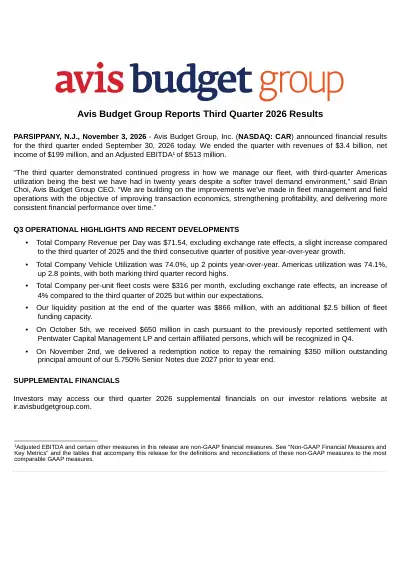
Instead, we delivered $513 million, which was roughly $50 million below what we anticipated when we spoke to you in July. Let me explain what drove the shortfall and how we're managing the business to return to EBITDA growth in the fourth quarter and for the full year.
Daniel will get into more detail during his section, but at a high level, the primary driver of our EBITDA shortfall was weaker-than-expected demand, particularly during the month of August. We knew that the calendar shift of Labor Day would create volume headwind in the final week of August, but the decline wasn't limited to that week.
To put this in context, TSA check-ins were down 2.1% in July and 2% in September. In August, they declined 4.4%.
Some of that reflects the Labor Day calendar shift, but even combining August and September to account for that shift, TSA volumes were down 3.3% year-over-year. That's not simply a holiday moving by a week.
That's fewer people getting on planes during one of the busiest periods of the summer travel season. Looking at the quarterly progression, TSA volumes grew 1.5% in the first quarter, declined 0.7% in the second quarter, and then fell 2.8% in the third quarter.
That third-quarter decline was approximately one percentage point worse than we anticipated when we spoke to you in July. International inbound travel to the US, as measured by CBP I-94 data, was even weaker, declining 8% in the third quarter.
Similar to the second quarter, as we saw these demand trends developing, we accelerated vehicle dispositions to adjust supply accordingly. There was an important difference between the two quarters.
While the used vehicle market remained relatively healthy, the third quarter is seasonally weaker than the March and April tax refund season. As a result, the gains we realized from selling vehicles were not sufficient to offset the EBITDA we lost from lower rental volume, as they had been in the second quarter.
At the same time, our transaction mix also affected revenue. With fleet constrained, we continued prioritizing longer-duration rentals while also serving our contractually committed commercial customers.
Those dynamics weighed on reported RPD and limited our ability to fully offset lower rental days through pricing. We fell short of our revenue expectations on both volume and mix.
While we can't control travel demand, we can control how we respond to it. This quarter, we did that by continuing to manage the fleet conservatively, keeping supply slightly below demand rather than carrying excess vehicles in the hopes of a recovery.
As we did in the second quarter, we were able to offset a meaningful portion of the fleet reduction through improved utilization. Americas had the highest third-quarter utilization in 20 years, despite continued elevated vehicle recalls.
Globally, utilization improved 200 basis points to 74%. We've spent considerable time over the past several quarters discussing the technology, operating processes, and asset management capabilities we're building into our network.
Those investments are allowing us to manage fewer vehicles more efficiently, which is important because in our business, every vehicle represents capital deployed, and every day a vehicle sits idle has an economic cost. While improved utilization offset a substantial portion of the fleet decline, the weaker rental volume still negatively impacted our operating leverage.
Operating expenses as a percentage of revenue were higher than we expected this quarter and did not adjust quickly enough to the weakness in demand we experienced in August. Daniel will walk through the detailed financial bridge in his section, but at a high level, the roughly $50 million shortfall to our EBITDA forecast can be attributed to approximately $33 million in the Americas, $15 million in International, and $2 million in Corporate.
From a tactical perspective, we managed the fleet effectively, but other cost drivers of our business did not adjust quickly enough to the demand environment we encountered. We've modified our outlook accordingly, and I believe our fleet is now appropriately sized for the demand we're seeing.
Before I turn it over to Daniel, I want to shift gears and discuss a separate strategic initiative we've begun this quarter. Over the past several years, we've undertaken two significant transformations across key areas of our business.
First, in 2024, following our fleet write-down, we overhauled our end-to-end vehicle lifecycle framework, from purchase through disposition. The tools and processes we use to acquire, maintain, and ultimately sell our vehicles today are fundamentally different than they were just a few years ago.
The greater precision with which we can manage gross and net depreciation has clear benefits to the income statement, but the more important outcome is the confidence we now have in the financial health of our fleet. Our new fleet philosophy is that every car is for sale every day, and that's only possible when you know that vehicle disposition across cohorts will lead to cash generation and deleveraging.
We are nimble enough today to flex our vehicle supply to industry demand on a real-time basis and have demonstrated this capability throughout this year. Second, in 2025, after coming off our lowest utilization year in the Americas since 2020, we began deploying a new operating system for our field teams called Compass.
The system gives direction to our operators and helps determine the next best action for each vehicle across rental operations, shuttling, and supply chain. We began deploying Compass across the network in earnest during the second half of 2025, and today it covers our entire Americas fleet.
The operational efficiencies generated by Compass allows our business to capture more rental days with fewer vehicles. The utilization improvements we've reported over the past several quarters are a direct result of this initiative.
Now, with these fleet and operating capabilities in place, we're turning our attention to a third major area of the business: revenue management. We've spoken in the past about our dynamic fleet pricing system, or DFP, but what we haven't discussed as much is that this system was developed and deployed more than 15 years ago.
As we've gained better visibility into our fleet and operations through new technology, we've also identified meaningful opportunities to improve how we manage revenue. In particular, operating with the historically tight fleet levels has forced us to make increasingly complex trade-offs between pricing, length of rental, vehicle availability, and the profitability of individual transactions.
Our existing revenue management system was not designed to optimize all of these variables together. That's becoming a more important limitation as we move forward toward managing our business based on contribution and return on assets, rather than simply rental days or headline RPD.
This quarter, we began investing in a significant modernization of our revenue management capabilities. We're approaching it with the same discipline and rigor we applied to fleet management and field operations over the past two years.
The benefit of these technology transformations come from the precision with which we're able to manage our business: VIN by VIN for fleet, and move by move for operations. We want to bring that same level of precision to revenue management, making better decisions about which demand we serve, when we take it, and at what price.
We're making those investments now, with the expectation that we'll begin demonstrating tangible financial benefit by the summer of 2027. We'll keep you abreast of developments on this front as they materialize, but for now, let me turn it over to Daniel, who will walk you through additional detail on the quarter.
Daniel Cunha
Thanks, Brian. As Brian described, this quarter tells two different stories.
Our operating performance was solid on several fronts, but our financial performance fell short of what we anticipated. Let me unpack both before we turn to the segments.
Total revenue was down 2% year-over-year on lower rental days, and adjusted EBITDA declined 8% to $513 million, approximately $50 million below our expectations. The demand environment was the main driver.
Brian walked through the TSA data and the third-quarter decline of 2.8% in US passenger volume, worsening 2.1 points quarter-over-quarter, and was the steepest decline since the first quarter of 2021. International travel slowdown was even more pronounced.
Inbound rental days declined 4.6%, and flight capacity into Europe from the Middle East was down 8%. With demand weaker and with our commitment to pricing discipline, we focused on what we could control: the size of our fleet.
We reduced it even further than we did in the second quarter, reflecting both the softer demand and continued gains in fleet productivity. Global utilization increased 200 basis points to 74%.
Utilization has now improved year-over-year for four consecutive quarters in both the Americas and the total company. In the Americas, utilization reached its highest level for any quarter in 20 years.
As Brian discussed, these gains are the result of deliberate investments in our capabilities, and we're confident they're sustainable. In short, the fleet, utilization, and pricing metrics came in as we expected; rental volume and revenue mix did not.
The revenue shortfall, combined with operating expenses that did not adjust quickly enough, drove the EBITDA miss. With that context, let's turn to the segments, starting with the Americas.
In the Americas, revenue declined 3% year-over-year to $2,550 million, and adjusted EBITDA declined 8% to $365 million. That was approximately $33 million below what we anticipated.
About $19 million of the gap came from the lower rental days, and about $14 million came from the costs reflecting weaker operating leverage. The decline in rental days reflected two factors: an average fleet that was 6.5% smaller than last year, and softer demand, particularly in August.
The market-wide drop in international visitors added to generally soft demand during the World Cup. Turning to pricing, Americas RPD, excluding exchange rate effects, increased 30 basis points year-over-year.
That was in line with the second quarter and with our expectations last quarter. Two mix effects held it back.
Our decision to prioritize longer-duration rentals during the summer peak reduced RPD by approximately 100 basis points, and as Brian explained, a heavier weighting towards commercial reduced it by another 40 basis points. Underlying market pricing was healthy.
As we aligned mix and pricing to our fleet through the quarter, RPD improved significantly. We exited September with RPD up nearly 4% year-over-year, and bookings for October and November are tracking at similar mid-single-digit levels.
That's encouraging, and we will continue to evaluate pricing and mix together with contribution margin, rather than looking at RPD in isolation. Once again, utilization closed much of the gap between demand and fleet.
Americas utilization was 74.1% in the third quarter, up 280 basis points year-over-year, and 72.5% for the first nine months, the highest on record. We achieved that even though no-fix recalls reduced utilization by 210 basis points in the quarter.
We entered the quarter with approximately 18,000 vehicles grounded and exited with approximately 14,000. Recalls remain a material cost.
In the quarter, grounded vehicles carried approximately $23 million of depreciation, interest, and related costs, bringing year-to-date total to $79 million before lost profits. On fleet costs, per-unit costs increased 7% year-over-year to $330 per month, compared with $309 last year.
The increase reflected lower residual values in the used vehicle market, which we expected entering the quarter, along with some timing effects. As we discussed in July, accelerating dispositions in the second quarter allowed us to capture favorable residual values in a seasonally stronger used car market.
That cohort of vehicles generated $24 million of gains in the second quarter. Had we held on to those vehicles, we would have lost $84 million in residual value.
That decision reduced revenue in both the second and third quarter, but it paid off. At best, we could have recovered about half of the $84 million in incremental adjusted EBITDA by keeping the vehicles.
Turning to operating expenses, total operating and SG&A expenses in the Americas declined approximately 2% year-over-year, but with rental days down nearly 3%, expenses per rental day increased approximately 1% to $42.30. We reduced absolute costs, but certain semi-variable costs did not adjust quickly enough to the drop in demand in August.
That loss of operating leverage costs us approximately $14 million in the quarter. On the savings front, we have a number of initiatives underway to free up resources so we can reinvest in new capabilities and growth, as Brian discussed.
Cost discipline is a muscle we focused on building this year, and we'll keep strengthening. It's part of our operating model.
A good example this quarter was a redesigned tolling program. We went live in August and were fully stabilized by September, thanks to flawless execution by our teams and the strong support of the toll authorities throughout.
Beyond the savings, the new program improved the customer experience with a single point of contact and more transparency. It also strengthens the program itself.
Dedicated accounts with the toll authorities give us full visibility, and we now have better technology, reporting, and analytics. Zooming out, our priorities in the Americas are clear: we will aim to preserve the gains we've made in utilization, improve our revenue mix, and make our cost structure more responsive to changes in demand.
Now, let's turn to International. In International, revenue excluding exchange rate effects declined 1%.
Adjusted EBITDA was $180 million, down 5%. Relative to our internal forecast, International accounted for approximately $15 million of the third-quarter EBITDA shortfall, driven mainly by lower rental days and higher-than-expected variable costs.
Adjusted for the closure of Zipcar UK, revenue grew 0.8%, with rental days down 1.7% and RPD up 2.5%, supported by strong ancillary sales. The decline in rental days reflects last year's network restructuring and customer mix changes, and the trend has improved by approximately one point each quarter this year.
Average fleet also declined 2%, in line with rental days, keeping utilization essentially flat year-over-year at 73.7%. On fleet costs, International continued to benefit from rotating out older, higher-cost vehicles acquired in prior years.
Per-unit fleet costs, excluding exchange rate effects, declined 2% year-over-year to $279 per month, compared to $285 last year. The bigger challenge in International remains the costs of our evolving customer mix.
As we've shifted towards leisure demand, we've increased our exposure to distribution channels that carry higher commissions and customer acquisition costs. As a result, operating and SG&A expenses per rental day, excluding exchange rate effects, increased approximately 2% year-over-year to $37.58.
We remain committed to the shift towards higher-return leisure customers, but a better revenue mix has to come with better control over the costs of acquiring and serving that business. That's why we're reviewing those expenses, along with our distribution and operating model, to convert more of our revenue into EBITDA.
As of September 30th, we had $866 million of available liquidity and approximately $2.5 billion of fleet funding capacity. On October 5th, we received $650 million in proceeds from PennantPark short-swing profit settlement.
Upon receipt, the temporary $200 million revolving credit facility we added in June terminated, as designed. On November 2nd, we delivered a redemption notice to repay the remaining $250 million of our 5.75% senior notes due in 2027 before year-end, which will bring our corporate debt down to approximately $5.7 billion by then.
The balance of the settlement proceeds will support our fleet funding requirements and liquidity. Our net corporate leverage ratio was 7.9 times at quarter-end, reflecting lower trailing 12-month adjusted EBITDA.
That figure excludes the settlement proceeds, which were received after quarter close. Including them, our leverage ratio would have been approximately 6.9 times.
In vehicle financing, we issued $650 million of AESOP term ABS debt in September to address our remaining 2026 maturities. As is typical with our ABS issuance cadence, we saw strong investor demand for our name, with September issuance demonstrating continued access to the ABS market, despite a more volatile rate environment.
On fleet acquisition, we have completed the majority of our model year 2027 negotiations. Capitalized costs and discounts are in line with the prior model year, and our vehicle mix better matches what our customers need.
Given the elevated level of no-fix recalls over the last 18 months, we have also shifted our purchase towards OEMs with stronger quality track records. As usual, we will remain opportunistic with spot purchases.
Adjusted free cash flow for the nine-month period was $198 million, a $715 million improvement over the first nine months of 2025. Our capital allocation priorities are unchanged.
We'll continue to prioritize debt reduction and capital expenditures that drive operational efficiency, reduce costs, and support margin expansion. Now, turning to our outlook.
We now expect full-year 2026 adjusted EBITDA of approximately $850 million, the low end of the range we provided in July. That implies fourth-quarter adjusted EBITDA of approximately $165 million, compared with $5 million in the fourth quarter last year.
The improvement is driven largely by factors within our control: a fleet that is now sized to our current demand, lower per-unit fleet costs year-over-year, cost actions already underway, and the pricing momentum we built in September. For the fourth quarter, we expect per-unit costs of $310 to $320 per month, and full-year outlook of $315 to $325 per month is unchanged.
With that, I'll turn it back to Brian.
Brian Choi
Thanks, Daniel. I think the third quarter highlighted both the progress we've made and where we still have work to do.
We've become significantly better at managing our fleet, and the utilization improvement we've delivered is evidence of that. When demand came in weaker than expected, particularly in August, we weren't able to adjust our revenue mix as quickly as we adjusted our fleet.
We've already begun making changes to how we manage pricing and transaction mix, while separately undertaking the longer-term modernization of our revenue management systems. Our fleet efficiency initiatives have steadily improved revenue per unit throughout the year.
What we're focused on now is combining those productivity gains with better RPD and mix to generate revenue growth and margin expansion. We saw that in October.
The fleet productivity improvements we delivered in the second and third quarters continued into the fourth quarter. What was different in October was that we also generated enough RPD growth to offset the decline in rental days.
Our Americas fleet was down roughly 7% year-over-year, but improved utilization limited the decline in rental days to approximately 3% in October. With RPD up 4%, we were able to generate positive revenue growth, despite having significantly fewer vehicles.
We have more than half of November's business already on the books and are seeing similar trends in our forward bookings. TSA check-ins remain down year-over-year, although the rate of decline has moderated.
Part of that moderation reflects the comparison against last year's government shutdown and associated TSA delays. While we don't see volume as a tailwind, we expect RPD growth to more than offset the decline in rental days during the fourth quarter.
That should translate into low-single-digit revenue growth for the consolidated business and substantial year-over-year growth in adjusted EBITDA. For the full year, we expect to deliver approximately $850 million in adjusted EBITDA, representing roughly 14% growth over 2025.
We've made significant progress in how we manage our fleet and improve its productivity. As we close the year, our focus is on combining those improvements with better revenue management to deliver more consistent revenue and EBITDA growth into 2027 and beyond.
With that, operator, we'd be happy to take questions.
Operator
Thank you. We will now be conducting a question-and-answer session.
If you would like to ask a question, please press star one on your telephone keypad. A confirmation tone will indicate your line is in the question queue.
Please limit yourself to one question and one follow-up question. You may press star two if you would like to remove your question from the queue.
For participants using speaker equipment, it may be necessary to pick up your handset before pressing the star keys. Our first question will come from John Healy with Northcoast Research.
Hi,
John Healy
thanks for taking the question. Brian, I wanted to just talk a little bit more about the initiatives, kind of this new phase on the DFP side of things.
Appreciate the outlining of it. Could you maybe help us with maybe what your desired output is?
I know you've kind of already mentioned it qualitatively, but maybe quantitatively what the potential outputs could be on the model. Thanks.
Brian Choi
Hey, John. I think it's too early to say quantitatively what we're trying to achieve with the model.
I don't want to give a range on that front. We're still early days in working at it.
We're talking about a look at our revenue base and how large that is. On a $10, $12 billion revenue base, small improvements yield dramatic results to the bottom line.
What I want to maybe give a little more color on is the level of work that we want to do around revenue management is going to be akin to what we did with the fleet side and the revenue management side. What you saw with both of those was substantial improvements to the KPIs that those initiatives are attached to.
With all of the work we've done with productivity improvements, you've seen that develop on utilization. Our goal is not just in revenue per unit or revenue per transaction, but with these new initiatives, we want to see better yielding show up on revenue per day sustainably, the same way that we've built for utilization.
John Healy
Great. Then just Daniel, I know you mentioned just some kind of initiatives on the cost side there.
I was wondering if you could elaborate on those a little bit going into next year. What sort of maybe cost tailwinds, headwinds do you have in the business, whether it's OpEx-driven or just kind of interest expense oriented with some of the movements and rates?
Thank you.
Daniel Cunha
Thanks, John. We definitely see opportunities, right, some of which we worked on this year and believe there's still a little bit more next year, and some in a large, complex areas that we are tackling no more head-on.
Just to give you a few examples, right, we have significant opportunities we think on vehicle damage. That's a very complex area here where we've made system investments and we designed a bit how we're operating the business.
We have significant opportunities we believe as well around third-party claims. That's also a very complex part of our business that we are rethinking.
We have a few initiatives underway to improve the level of sophistication of our procurement muscle. We are rolling out new P2P system.
We just rolled out a new contract management system. On the technology front, we're making investments as well to reduce the maintenance costs and modernize our tech stack that will simplify and make it a lighter load to take.
We have a few of those. The only thing I want to caution you, John, as well know, some of the headline savings may be substantial, we are reinvesting quite a bit.
I think we're taking a balanced approach like Brian described here, where we still see opportunities in sizable, complex areas of the business, and we will drop some of those savings to the bottom line and reinvest some of that to drive further growth for the improvement in years to come.
David Calabria
John, I'll just answer the interest side. We thought we were going to be lapping kind of the rate at this point, but with the base rates decreasing, there'll be a little headwind from a vehicle interest standpoint, but it'll be offset by having the remainder of the settlement funds in the vehicle programs, but it'll be a little headwind.
Operator
Our next question will come from Stephanie Moore with Jefferies.
Stephanie Moore
Hi, good morning. Thank you so much for the question.
I guess, taking a step back here, I think, if you think about this, a lot that has been done over the last year, whether it's the productivity initiatives, as you've called out, the advancements you've made from a revenue management tool standpoint, I'm sure I'm forgetting some of the other initiatives, but as you think about all that has happened, let's just say over the last year or so, what can this mean about the future earnings profile of Avis, especially compared to maybe prior peak years? I guess what I'm trying to say is maybe getting to the earnings level we saw in maybe 2022 is a little unrealistic, but how should we think about maybe prior peak earnings and what that can mean in terms of future earnings potential for Avis, just given all the actions that have taken place over the last year?
More of a strategic question. Thank you.
Brian Choi
Sure. Hey, Stephanie.
I'll start, and then Daniel can add. I think what we're trying to do and the question that you're asking is saying, 'Hey, what is a sustainable long-term earnings potential of Avis?'
Like you said, these COVID years, where every single macro factor that we deal with was a tailwind, we can't bank on that, and that's not something sustainable that investors attach multiple to. I think the work that we're trying to do is say, 'Hey, what are the things that we can improve on, initiative by initiative, to structurally become in a better place that puts us in a higher earnings potential?'
Take the utilization example. Between the years, pick the 10 years of, let's say 2024 to 2014, and X out just the really severe COVID year of 2020.
If you take those nine years in that 10-year span, utilization in the Americas was an average of 70%, with a trough of 69% and a peak, I think, of roughly 71%. You're in a 2% band over there.
The long-term earnings potential and the productivity with which you can operate the business, how many rental days you can serve with how small a fleet, you're stuck at those levels. The work that we've put in have structurally raised that.
If you account for the vehicle recalls, I think we're already close to seven points higher than we've been versus our historical average. Take that, and saying that you can serve the same rental days with that much fewer fleet, and think of how expensive our fleet is, that puts you in a structurally higher place.
We need to do those same kind of initiatives across our revenue management system as well. We want to be in a position where our RPDs are much more reliably growing as we've seen the major factors of our cost line items increasing.
To answer your question simply, Stephanie, I think that having $1 billion of sustainable long-term EBITDA is a must-have for this business, given what we're seeing on the labor side of things, what we're seeing on interest rates, what we're seeing in vehicle prices. That is a bare minimum, and I think that the work that we're doing puts us in a position to achieve that in the near future.
Daniel Cunha
Yes, maybe I'll just add, Stephanie, that improvements that we are chasing here, they may not sound dramatic on a top-line perspective, but in the business that per the guidance here is about 7% of annual EBITDA, right? Small improvements in margin of 1, 1.5 points, they make a substantial impact on bottom line.
We definitely see a path to chase those efficiencies through multiple areas, like I commented on John's question, on further improving operational efficiency and revenue, like Brian described. We think there is a path.
Obviously a lot of work between now and then.
Stephanie Moore
Thank you. Then just for a follow-up question, can you maybe talk a little bit about the demand trends that you're seeing in October and any early bookings from a holiday standpoint?
In a world when maybe airfare pricing is higher, what does that generally good or bad for your business? Thank you.
Brian Choi
Stephanie, I think we gave a little bit of color on what October is looking like. The demand trends that we're seeing are consistent with what TSA is reporting for October in terms of volume.
The way that our rental volume looks given a heavier reliance on airports, the two are very very neatly correlated. I think the difference in October that we're seeing is in terms of how we're managing yield and which business we're taking.
That's true for October and November. We made a lot of changes in terms of how we're managing our booking curves, and you can see this from August to September, where we went from August being kind of -1% in pricing to September being +4% in pricing.
You're seeing similar trends in October. In November, we have half of November booked, and that's showing similar trends as well.
I think it's still pretty early to talk about December. Maybe that's 25%, 30% booked.
What we're seeing now is several months in a row where we're being able to yield up. Now, whether high airfare prices are good or bad for rental car, I don't think that those two are correlated.
I think that high prices in airfares are typically coming from business customers, and in our business, commercial actually carries a discount to leisure rates, so that's one thing to consider. What we are taking away from the airlines is that there is a cohort of customers that is willing to pay for more if you give them more, and that's the area that we're focused in to being like, 'How do we charge a higher RPD, but provide greater value to customers?'
Initiatives like Avis First touch on that.
Operator
We'll go next to Chris Stathoulopoulos with Susquehanna.
Christopher Stathoulopoulos
Good morning. Brian or Daniel, on RPD for 4Q, I'm just doing the math here.
On total enterprise revenue up, it would suggest that RPD is up. If you could parse that between price and mix, and then how you're thinking about 2027, everything that's going on with the fleet, AI, all the premium initiatives, whether we can expect to see positive RPD.
Brian Choi
Hey, Chris. Maybe I'll start, and Daniel can chime in.
First, on 2027, we'll give more color on 2027 when we report our fourth-quarter earnings and give full-year 2027 guidance. More structurally, I can give you a little bit just more color on what we're doing on the revenue side of things to put us in the best possible position to capture yield going forward.
One of the things that we've been focused on in the past few months here is understanding our existing DFP systems and decomping what the limitations of that have been. DFP was developed to choose simplistically between length and yield.
In a tight supply environment, that seesaw leans towards length, and in a loose supply environment, it leans towards yield. Now, from our perspective, given all the work that we've done around fleet productivity and given how expensive the vehicles have become, the interest has become, we think we structurally have to be a better company about sweating our assets.
We are asset managers, and we need to make sure that we're able to capture the most amount of rental days with the fewest vehicles. That is a structural thing.
You should expect that to carry forward into 2027. I think the big thing that we've unlocked is that the current system as it stands is overly biased towards taking length.
I think it's suboptimally taking reservations too early. This was one of the things that came up with our operators, and it was this consistent belief that, 'Hey, we are taking too many bookings early.
If we're tight on fleet, we need to kind of hold the line and make sure that we take the best bookings as the reservation date approaches.' This is just something that we felt in the system in the second quarter.
After one of our competitors reported their second-quarter numbers in early August, that belief just became undeniable fact. From our perspective, we made significant changes to how we build our reservation book.
We've constrained certain channels. We're focused on shaping our yield curve, and that's a combination of system changes and manual intervention.
August was already baked by the time we had took this work on in earnest, but like I said in my prepared remarks, September already saw meaningful benefits from the work that we've been doing. Now, those are rudimentary changes.
We need to do the structural work and changes to our systems to make this better, but this is something that I expect to carry on into the fourth quarter and into 2027 and beyond. One thing that I also want to highlight here is I still believe we made the right decision to reduce fleet.
We're facing a weakening demand environment. The used car market, as is entering its seasonally softer period.
This isn't the time to hold thousands of additional vehicles in the hopes that, hey, we can capture a little bit more EBITDA. We took a conservative approach.
We wanted to protect the balance sheet. We, as a management team, would make that decision again.
I think the change in the assumption is that we had to sacrifice yield to operate with a tighter fleet. Had we untethered ourselves to the legacy pricing system and methodologies earlier, I think we could have achieved both.
From our perspective, that is the initiative for 2027. We need to be able to capture both.
This quarter, we left pricing opportunity on the table. We're not going to put ourselves in a position to be able to say that in the fourth quarter or 2027.
Yeah.
Daniel Cunha
I would just add a couple points, right. One is our pricing posture.
I would describe it as being a firmer stance around needing RPD, right. Whereas in the past, you may have prioritized days and optimized RPD for a certain level of rental days, I think we now have firmer expectations on RPD itself, right.
The rational is simple: the remaining inflationary pressures here across the business, and we need a certain amount of RPD just to protect margins, right. If you think about interest, like David described, we're going to be refinancing for the foreseeable future, some tranches that were put in COVID eras, and they'll carry higher interest rates.
Leases throughout our operations, right, now many concessions, they definitely have inflationary pressures: energy, fuel, labor, healthcare. Pricing, I think, is a must for the industry, and I think we're not the only ones, right.
As important as RPD is, I would just add that we've done extensive work over the past year around understanding our margins at a much more granular level, we built a ton of visibility around subsegments, length of rental, car class, specific customers, specific partnerships. We understand the margin contributions at a much greater level of detail.
Efforts that Brian is describing around revenue management is to be able to be very nimble to optimize not only RPD, but also the contribution margin below. There's a big lift, big capability for the company, and we'll continue to chip at it.
Christopher Stathoulopoulos
Okay. Then so, Brian, your comment before about the business generating a bare minimum of $1 billion, is that when all the revenue and cost initiatives are clicking here?
Maybe it would be helpful if we have some guardrails or anything around an algo as it relates to utilization, RPD, unit costs. When we think about next year, on a kind of a high-single-digit growth off the 850 puts you at sub-$1 billion.
I just want to understand the billion through a cycle. Is that on the table for next year?
Do you need another year or so for all these initiatives around premium cost savings, AI, etc., to kind of spool up? Just if you could help us think about the timing around that, or perhaps at a high level, the inputs here around utilization, RPD, unit costs, etc.
Thank you.
Brian Choi
Chris, like I said earlier, we'll get into 2027 guidance when we report next quarter, when fourth quarter is in the bag. We'll give a firmer outlook on the variables that you had mentioned.
From our perspective, though, I wouldn't say that a billion dollars is off the table for next year. I think our guidance right now is saying that we're going to be at 850.
You realize that some of these levers that we're focused on in terms of utilization and RPD have significant contribution to the bottom line. We'll give our range next quarter.
From our perspective, this isn't something that we can wait years to get to. This is a floor that we believe is immediately achievable, and the management team here is working to get it as soon as possible.
Operator
We'll go next to Chris Woronka with Deutsche Bank.
Chris Woronka
Hey, good morning, guys. Thanks for taking the questions.
Brian, you've given a lot of detail on things you're working on operationally, and on fleet, but I guess the question is, does that give you enough confidence given what might be going on with your peers? You have a couple big peers that are maybe in different places, but one of them might be able to shift strategy more quickly than others, and the other might be thinking about doing different things with their fleet, for example.
How much of this do you think is within your control versus how much of it is really going to depend on what the rest of the industry does, which you might not have perfect visibility on? Then I have a follow-up.
Thanks.
Brian Choi
Sure. Listen, in terms of certain initiatives, like the fleet purchase and utilization, there's a reason why we started with those.
Those are absolutely in our control and our control alone. The health of our balance sheet, how we buy cars, how we defleet cars, listen, of course there's macro factors at play, but those are largely within our control.
Same thing with utilization: how efficient we get at sweating our assets on a day-to-day basis, how we turn over our cars, that's kind of all on us. In terms of revenue management, of course, there's a competitive aspect to it, but the same cost factors that are pushing us to review this are headwinds for our competitors as well.
Interest rate is rising more for one of our competitors than it is for us, but it's rising for everyone. Labor cost is rising for everyone.
Leases and healthcare, like Daniel mentioned. This is something where it is a must-have for us in order to maintain an appropriate return on invested capital.
I do think that the environment itself, and given what the cost structures of our competitors look like, would suggest that it is attainable. What we've seen over the last few years, despite some of the noise around kind of some of our competitive landscape, is that they are rational players still throughout.
If anything, I think it's us that left yielding opportunities on the table. From this perspective, I do think that this is a little more in our control, and the work that we're putting in is focused primarily on that.
Chris Woronka
Okay. Appreciate that.
Thanks, Brian. Then the follow-up is '26, I think, has unfolded a difficult year to predict coming in.
It got more difficult. We had the Middle East breakout, there was World Cup, and uncertainty about how that would affect demand, and then calendar and late summer, and then elections and things like that.
Knowing that '26 is maybe a more difficult year to predict, but as you head into '27, you think about fleet and how '26 played out, is there any thought to just undercutting your initial forecast, whatever you think it might be for '27, and just saying, 'Hey, we're going to fleet 2, 3, 5% below that and starting from that standpoint of we'll buy more if we need it.' Is there any thought to kind of intentionally doing that or are you going to stick to kind of your traditional forecasting?
Brian Choi
Actually, Chris, I think that's the position that we took even this year. Given what we saw, it's down 7% right now in an environment where we're not in a recession.
Yes, there are challenges here and there, but I don't think we've ever been in a position where the fleet is down the magnitude it is relative to TSAs. We've already taken that position, Chris, and we're going to continue taking that.
Things change in our business very quickly, and with the booking windows shorter for us than even other areas of the travel environment, I think what we've learned this year, and the capabilities that we're trying to build as a company, is less about being accurate forecasters and being more nimble as a company to make the changes you need to when they arise. Even with this year, when the World Cup didn't pan out the way that it did, when August didn't pan out the way that we did, we were very quick to react to that and able to rightsize our fleet.
We want to be able to do that into 2027 and beyond, and across other key variables of our business that we mentioned earlier in this call, there's RPD and the variable costs.
Operator
Moving next to Dan Levy with Barclays.
Josh Young
Good morning. Josh Young on for Dan Levy, Barclays.
Thank you for taking the question. First question is just to see if we could maybe double-click on kind of the expectations for 4Q and being able to achieve the guide.
It sounds like RPD is largely going to be the key offset with demand still a bit uncertain. Wanted to see if you could maybe break down how much of the RPD expectation there is from industry versus internal initiatives.
Then also just kind of circling back, you mentioned the opportunity with Avis First, just how has that been trending versus expectations? Are we starting to see any of that pick up in 4Q and then maybe early milestones or targets for '27, if possible?
Thanks.
Daniel Cunha
I can start with Q4, and then Brian can chime in with Avis First. I would just share a little bit of context, a bit of a refresher on Q4 last year, right?
If you guys recall, it was a particularly challenging quarter, with government shutdowns, TSA disruptions, canceled flights that followed, and then the very high level of recalls, and then it was a quarter after we had had peak no-fix recall. The bulk of the improvement that we're seeing in Q4 and in the guidance is in the Americas.
Almost all of it, a big chunk, like you mentioned, right, the offset is pricing, right? We're expecting $60, $65 million increase in pricing, EBITDA-related increase in pricing year-over-year, and it's about 3 points.
We don't think the industry has to change very much for that to happen. As Brian mentioned, we're seeing in the early innings of the quarter here that level of pricing come through.
From our perspective, the industry, let's say, posture towards pricing has been relatively stable over the last few months, we're somewhat comfortable with this. The other lever here is utilization, right?
It's about another $30 million. We're expecting about 2, 2.5 points improvements.
Remember, we had a massive recall in July last year, and we entered Q4 with about 21,000 vehicles grounded last year. There is an improvement year-over-year related to that, plus the sustained fleet productivity gains that we've been discussing, right?
We had some challenges in net depreciation last year. With the disruption I introduced my comment with, we ended up selling more vehicles last year in a seasonally unattractive period, right?
Year-over-year, we're having $25, $30 million of better net depreciation on smaller volumes of sales, and also a better mix that we, let's say, plan to dispose in the quarter. The bulk of the rest safely, cost reductions.
We have a number of initiatives towards labor, shuttling, tolls, partnerships, vehicle damage, and we have a few that are contributing. You want to comment on Avis First, Brian?
Brian Choi
Sure. Josh, in terms of Avis First, we're still in the early innings, I don't want to overstate the near-term financial impact.
Now, of course, over time, we want this to contribute to meaningful revenue and EBITDA growth, but at this stage, the more important objective is proving that we can deliver a meaningfully better, a more premium rental experience at scale. The one thing I would say is we know that the demand is there.
We've intentionally constrained supply so that we can solidify the operation and protect the customer experience, because that has to be the foundation we build upon. Far, we're delivering against that.
Across thousands of rentals, our customer satisfaction is still 4.9 stars, and now we're growing Avis First internationally at Heathrow and Charles de Gaulle. More importantly than kind of what Avis First is going to deliver in the fourth quarter, it's part of a broader strategy to move the business towards higher-value demand, similar to what you've seen in other parts of travel, where premium experiences have become a more important driver of loyalty, mix, and economics.
We're building the foundation. The goal is clear: we want to serve different segments of customers, deliver a better experience, and earn stronger returns over time.
Josh Young
Great. Thank you.
Then as a follow-up, can you just walk us through kind of the latest expectations on the opportunity to in-house or use other partners on toll management? Sounds like that was kind of brought into focus a bit more this quarter.
How might this kind of play a role in 4Q and then also going forward? Thanks.
Daniel Cunha
I can take this. We're pretty happy with where we are with this program.
I think the key thing that we would like to highlight, right, was that we were taking a very hands-off approach, fully outsourcing that operation. We pivoted to a position where we now have full control, a better customer experience.
We have one point of contact, very important for us to improve on that. As far as the numbers, I mentioned we have several savings initiatives.
We are not going to disclose specifically each of them. There are some public numbers out there around the profitability that this contract had in the past.
That has been corrected, and from our perspective, we feel stable and very comfortable with the new operation.
Operator
We'll go next to Rajat Gupta with J.P. Morgan Chase.
Rajat Gupta
Great. Thanks for taking the questions.
Had a quick clarification on the third quarter, the Americas EBITDA. It looks like in your commentary on the rental days, one of the reasons you mentioned for the decline year-over-year was you wanted to stay a bit more selective on the business you were pursuing.
Also at the same time, the SG&A and OpEx delevered because of that. I'm curious if there's an opportunity to maybe rationalize that a bit more as you go into fourth quarter or next year.
Just curious to get your thoughts there. I have a quick follow-up.
Daniel Cunha
Hi, Rajat. I think there's one effort here just to highlight.
I think Brian mentioned how we saw during the quarter, July, but especially August, a sizable deceleration, right, in travel. TSA was down 4.4% in August.
Several areas of our P&L, if you think about staffing people, moving vehicles around, those tend to be very variable if you have enough lead time. If the demand changes very quickly, short-range, those are items that don't move as fast, right, we have to staff in advance.
While we're generally happy with the direction of the absolute dollars, right, we declined about 2% in the quarter, if demand drops faster than that in short-range, it's a sizable operation. It doesn't flip on a dime.
We will continue to work on this, right, and try to improve the demand and the mix to lower those costs and shift the revenues as much as we can onto channels that have lower costs and help us with the operating leverage. It's a bit of a visibility issue and timeline to execute on the operating cost per day.
Brian Choi
Rajat, the one thing that I would add is yes, we need to be more nimble about how we bring down our costs, but I think it has to be a two-pronged approach. We also need to manage the business we take to make up for unexpected volume declines through more intentional yielding, and that's the revenue management work I referenced earlier.
Rajat Gupta
Understood. That's helpful.
Just I wanted to touch on agentic AI. I'm just curious what the implications are for just Avis and the industry.
Are you seeing customers already use these tools to manage their bookings? How are you managing the inherent friction that the downward sloping price curve through the booking window creates in an agentic world?
Curious if there's any potential for just more stringent cancellation fees over time. Thanks.
Brian Choi
Yeah. Rajat, I think a few things to unpack over there.
It makes up a small percentage of our overall traffic right now, and when I say small, it's less than 1%, but it is something that we're monitoring, and it has obviously been growing quickly. Now, certain companies have taken the approach that they're going to be blocking the agents like Muse and Instinct, our posture is that we need to meet the customer where they want to be met, this is something that we need to work with, not against.
You mentioned cancellation policies. That's something that we need to consider as an industry.
We're the only industry, the subindustry within the travel sector that doesn't really have a cancellation policy. I think this is a disservice to our customers and very difficult to manage day-to-day operations, especially when you're running as tight a fleet as we are.
I think that's one thing to consider. More than that, I think we as a business and we as an industry have to get better about managing the yield curve.
It can't be sloping down. It has to be sloping up the way that it looks like in airlines, and I think this is a forcing mechanism for that.
The last thing that we need to consider is that as agents shop across all channels, we can't be saying, 'Hey, we just want as many pipes connected to our inventory as possible.' We're the ones with the cars, we need to be very selective about which channels we decide to give that supply to.
From our perspective, this should lead to fewer channels, but with deeper integrations with core partners. We're actually doing work around all three of those initiatives: about the more strategic channel partners, better management on the yield curve, and the cancellation policies starting to explore.
These are the things that I think we're going to have to factor in as AI increases.
Daniel Cunha
I'll just add a couple points, right. With everything going on in AI, the change is the speed.
They obviously carry some risks, but also some opportunities, right. While the rules of the game, the selection criteria by which customers wind up picking their rental company may change, I think there's still going to be something to say about quality, right, customer service, which are areas where we're very much focused, and price, right.
If you think about the opportunities related to that shift, right, there is a world in which more of the rentals, more of the bookings are done through our digital channels that carry better margins, lower selling costs, that could result in an uptick for us margin-wise. Obviously, we need to navigate it.
We're not looking at those numbers, like Brian mentioned, although the small percentage of the traffic being associated with AI in a dismissive way. I think we definitely expect those numbers to continue to grow, but we are going to try to leverage the opportunity in front of us and improve channel mix.
Operator
This concludes our question-and-answer session and will conclude today's teleconference. We thank you for your participation.
You may disconnect at this time, and have a wonderful day.