CBAK Energy Technology Limited
Q4 FY2025 · Earnings Call TranscriptMarch 30, 2026
Operator
Good day, ladies and gentlemen, thank you for standing by, and welcome to CBAK Energy Technology's fourth quarter and full year 2025 earnings conference call. Currently all participants are in listen-only mode.
Later we will conduct a question-and-answer session and instructions will follow at that time. As a reminder, we are recording today's call.
If you have any objections, you may disconnect at this time. Now I will turn the call over to Arina Tian, IR Specialist of CBAK Energy.
Miss Tian, please proceed.
Arina Tian
Thank you, operator, and hello, everyone. Welcome to CBAK Energy's earnings conference call for the fourth quarter and the full year of 2025.
Joining us today are Mr. Zhiguang Hu, Chief Executive Officer of CBAK Energy; Mr.
Jiewei Li, Chief Financial Officer and Company Secretary; and Evan, who will help with our interpretation during the Q&A session. We released our results earlier today.
The press release is available on the company's IR website at ir.cbak.com.cn, as well as from the newswire services. A replay of this call will also be available in a few hours on our IR website.
Before we continue, please note that today's discussion will contain forward-looking statements made under the safe harbor provisions of the U.S. Private Securities Litigation Reform Act of 1995.
Forward-looking statements involve inherent risks and uncertainties. As such, the company's actual results may be materially different from the expectations expressed today.
Further information regarding these and other risks and uncertainties is included in the company's public filings with the SEC. The company does not assume any obligations to update any forward-looking statements except as required under applicable laws.
Also, please note that unless otherwise stated, all figures mentioned during the conference call are in U.S. dollars.
With that, let me now turn the call over to our CEO, Mr. Zhiguang Hu.
Please go ahead, Jason.
Zhiguang Hu
Hello, everyone. Thank you for joining our earnings conference call for the fourth quarter and full year of 2025.
The fiscal year 2025 was a definitive transitional period for CBAK Energy, characterized by a comprehensive structural upgrade of our product portfolio, aggressive capacity expansion, and a deliberate pivot towards next-generation form factors. Despite the short-term bottom-line pressure inherent to such massive capacity transitions, our top-line growth demonstrated explosive momentum.
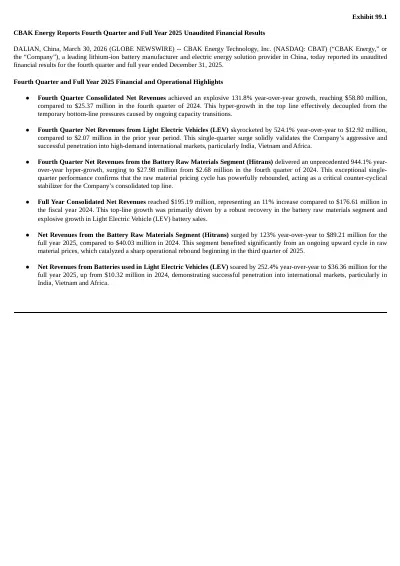
In the fourth quarter, our consolidated net revenue surged by 131.80% year-over-year to $58.80 million, $58.80 million. For the full year, consolidated net revenue reached $195.19 million, representing an 11 11% increase over 2024.
Let me detail the structural transition driving our core business. At our Dalian facility, our customers are actively transitioning away from our legacy 26-series battery, a product line with over a decade of history and 1 gigawatt-hour of capacity, to our newly introduced, highly advanced Model 40135 cells.
To support this paradigm shift, we successfully commissioned a new 40135 production line with a 2.3 gigawatt-hour capacity at the end of 2025. The market reception has been truly unprecedented.
Demand for the 40135 cells currently far exceeds our available supply, meaning we are selling every single unit we can produce, and our order book heavily outpaces our current ramp-up trajectory. Similarly, at our Nanjing facility, to alleviate the severe supply shortage for our highly sought-after Model 32140 cells, we successfully added two new production lines at our Phase 2 facility at the end of 2025.
This expansion adds 3.0 gigawatt-hours of much-needed capacity to complement the 1.5 gigawatt-hours already operational in Phase 1. We expect these two new high-speed lines to reach full capacity by early 2027.
Both our Dalian and Nanjing expansions are currently in an intensive capacity ramp-up phase. While this initial phase carries higher unit costs that have temporarily suppressed our gross margin and the short-term profitability, we view this as a necessary and highly strategic investment.
As our customers complete their transition to the Model 40135 and our Phase 2 facility completes its ramp-up by early 2027, we anticipate a dramatic and sustained resurgence in our top-line revenue. Furthermore, to ascend the value chain, starting in 2025, our wholly owned subsidiary Nanjing BFD initiated dedicated battery pack integration operations.
By assembling individual cells into complete plug-and-play battery systems, we bypass intermediate integrators to serve end users directly. Currently, these manufactured pack units are predominantly engineered for the light electric vehicle battery swapping infrastructure throughout the African market.
In 2025, we officially forged a deep strategic partnership with Spiro, one of Africa's largest two-wheeler battery swapping enterprises. I'm thrilled to report that Spiro has rapidly scaled to become one of our top five customers.
We are incredibly proud that our advanced battery cell technology is providing the essential momentum for Africa's new energy transition. To deepen this relationship, we are actively exploring further collaborative models, including the potential establishment of a dedicated corporate entity within the African region to directly assist and accelerate Spiro's localized business expansion.
This African success is mirrored across other key international markets, driving our explosive global growth where revenue from LEVs skyrocketed by 252% year-over-year to $36.36 million for the full year. In India and broader global market, our institutional client base has expanded significantly.
We have established deep collaborations with a highly prestigious roster of international blue-chip customers, including Anker Innovations; Scania, which became our direct ordering entity following its acquisition of Northvolt business unit that originally procured our products, now operating under Boshida; as well as Acer Energy, Shenzhen ACE Battery, and Inverted Energy. The endorsement from these global Tier 1 enterprises provides the strongest possible validation of our product reliability and safety.
Similarly, in Vietnam, we have forged a tight-knit partnership with a key client, DAT. As DAT's business volume has scaled, our shipment volume in the Vietnamese two-wheeler sector has experienced exponential growth.
As investors may be aware, the PRC government has initiate a phase-out policy for export tax rebates, reducing the rate for lithium-ion batteries from 13% to 9%, with further reductions to 6% by April 2026 and a complete elimination by January 2027. To proactively establish a dialectical hedge against this macroeconomic headwind and protect our international margins, we moved decisively to localize our global supply chain.
We have already incorporated our Malaysian subsidiary on April 30, 2025, and are actively pushing forward with physical construction of manufacturing facility there within this year to offer diversified, tariff-insulated sourcing options for our top-tier international clients. We also anticipate signing and announcing additional contracts with major international clients soon, which we believe will serve as strong catalysts for our shareholders.
Our raw material segment, Hitrans, delivered a powerful turnaround. Benefiting from an ongoing upward cycle in raw material prices, Hitrans experienced a sharp operational rebound beginning in the third quarter of 2025.
Full year revenue for this segment surged 123% year-over-year to $89.21 million. As the raw material pricing cycle continues its robust upward trajectory, we confidently anticipate Hitrans will reach new performance highs.
To structurally capture this momentum, Hitrans is aggressively expanding its proprietary infrastructure, including the ongoing construction of a new 10,000-metric-ton cathode manufacturing plant, slated for full operation in the first half of 2027, alongside a massive 37,000-metric-ton precursor facility. This strategic capacity injection will decisively elevate Hitrans' revenue ceiling in 2026 and beyond.
Strategically, we are also advancing our corporate structure. Our stockholders have approved a redomicile merger to change our place of incorporation from Nevada to Cayman Islands.
This move will allow us to streamline operational and administrative efficiency while simultaneously aligning our corporate structure with our aggressive international expansion strategy. Driven by the insatiable demand for our new 40135 and 32140 battery cells, the impending completion of our capacity ramp-ups, the continuing strength of Hitrans, and our expanding footprint across global LEV market, we project with absolute confidence that our consolidated sales will hit a record high in 2026, delivering explosive growth.
Now let me turn the call to our CFO, Jiewei Li, for deeper dive into our financials.
Jiewei Li
Thank you, Jason. 2025 demonstrated the resilient dialectical nature of our vertically integrated business model.
While our battery segment faced margin compression due to the aggressive ramp-up of our new production lines and rising raw material costs, our Hitrans raw materials segment capitalized on this exact macroeconomic environment. Looking at our fourth quarter results, consolidated net revenues reached $58.80 million, a 131.8% increase compared to Q4 2024.
This hyper growth effectively decoupled from the temporary bottom-line pressures caused by our ongoing capacity transitions. Within this, our battery business revenues were about $30.82 million, an increase of 35.8% year-over-year.
Despite a 10.6% decrease in the energy storage sector caused by the phase-out of our legacy Model 26650 sales at Dalian, we offset this decline through explosive growth in the LEV revenues, which skyrocketed by 524.2% to $12.92 million in the fourth quarter. Our Hitrans segment generated $27.98 million in Q4 2025, a massive 944.1% surge from Q4 2024, directly reflecting the escalating upward cycle of raw material pricing and robust downstream order placements.
Our gross profit for Q4 2025 was about $4.28 million, representing a gross margin of 7.3% compared to 13.1% in Q4 2024. This sharp margin compression was fundamentally driven by the transitional friction costs, suboptimal yields, and disproportionately high fixed cost absorption inherent to the initial ramp-up phase of the new Model 40135 in Dalian and Phase 2 Model 32140 lines in Nanjing.
Consequently, operating loss for the fourth quarter was about $8.01 million, and the net loss attributable to shareholders was $7.38 million. For the full year 2025, net revenues were $195.19 million, up by about 11% year-over-year.
Hitrans contributed $89.21 million, up by 123%, while the battery business contributed $105.98 million. Gross profit for the year was about $18.42 million, representing a margin of 9.4%, down from 23.7% in 2024.
Operating expenses increased to $36.86 million, up 12% year-over-year, driven by a 21% increase in R&D to $15.80 million. This deliberate expense expansion directly funded our next-generation technology roadmap, specifically accelerating the development of our advanced large-format cylindrical models, such as the 60150, 60135, and 60160, as well as highly specialized sodium-ion chemistries engineered for the extreme low-temperature resilience and fast-charging capabilities.
We also increased by 16% in G&A to $16.20 million, reflecting increased headcount for our new production lines. Our full year operating loss was about $18.44 million, and the net loss attributable to shareholders was about $19.10 million.
However, analyzing the bottom line requires a dialectical view of our risk management framework. First, our other income surged to $8.27 million, fundamentally bolstered by a highly lucrative $5 million compensation payment we strictly enforced and successfully collected from a cancelled customer order.
This underscores the robust legal and contractual protections we secure in our commercial agreements. Second, to proactively shield our margins from global volatility, 2025 marked our inaugural deployment of a sophisticated financial hedging structure.
We systematically executed foreign currency forward contracts, option swaps, and commodity contracts. While this proactive risk mitigation resulted in a calculated non-cash derivative fair value loss of approximately $0.44 million, it effectively neutralized extreme macroeconomic fluctuations and provided essential cash flow predictability for our supply chain.
Turning to our balance sheet and liquidity, our financial foundation remains robust and highly liquid. As of December 31st, 2025, we held cash and cash equivalents and restricted cash of $75.68 million, an increase from $60.79 million at the end of 2024.
Notably, despite the reported net loss, our net cash provided by operating activities was extremely strong at $48.55 million for the year, compared to $39.70 million in 2024. This powerful cash generation was primarily attributable to disciplined working capital management, including a $63.66 million increase in trade and bills payable.
We allocated $44.65 million to capital expenditures in 2025 to fund the aggressive construction and equipping of our new production facilities across Dalian, Nanjing, Zhejiang, and Anhui. In summary, the temporary margin squeeze is a calculated byproduct of scaling next-generation capacity.
With the Hitrans segment providing a dialectical hedge against the raw material costs, our battery capacity ramp-up scheduled for the completion in early 2027, and our deeply integrated global expansion progressing rapidly, we are structurally positioned for massive operational turnaround and record-breaking sales. Thank you, and we will open the floor for the Q&A section.
Operator, please go ahead.
Operator
Thank you. To ask a question, you will need to press *11 on your telephone and wait for your name to be announced.
To withdraw your question, please press *11 again. Please stand by while we compile the Q&A roster.
Thank you. We will now take the first question.
Question is from the line of Brian Lantier from Zacks Small-Cap Research. Please go ahead.
Brian Lantier
Good evening, everyone. Fantastic news to see Hitrans suddenly turning things around.
I wonder if you could talk a little bit about where you see gross margins in the battery business and when you think they might normalize as you ramp up capacity.
Jiewei Li
Thank you, Brian. Let me answer your question.
I think it's back in Q3 and Q4 when our Nanjing Phase 2 and our Dalian operations and new products kick in, our gross margin was affected severely. Right now we are in a phase of ramping up capacity and we believe that the Dalian facility ramp-up will be completed in the first half of this year which we have already received way enough orders for this new products.
For Nanjing Phase 2, cuz it's much bigger, our timeline is for early 2027, but we have confident to try our best to catch up the timeline, our target would be also the second half of 2026. The reasonable timetable will be early 2027.
Ideally, in the second half of this year, our gross margin will gradually rebound and I believe in the full year of 2026, the gross margin number would at least looks better than right now.
Brian Lantier
Great. Thank you.
Could you describe a little bit more about the cell-packing business and do you see that becoming a growth opportunity for the company, particularly in the LEV market?
Jiewei Li
I will answer the question first and then Evan, please help with the interpretation for Jason. If Jason has anything to add some points.
We have received a substantial order from one of our major African customers who actually originally from India. Starting early 2025, this substantial order kick in and I think all the cells they purchased were from Nanjing 32140.
In order to do that, we have already set up a battery pack assembly unit within our structure and this unit is dedicated to purchase cells from our Nanjing factory and put the cells into a battery pack and sell it to the African customer. This customer has already become one of our top five customers as of 2025.
We are also looking forward to a much deeper and more comprehensive collaboration with each other. Maybe in the future, our collaboration will extend beyond the area of LEV into energy storage sector.
I think this is what I want to add. Please Jason, to see if anything you want to add.
Zhiguang Hu
侯总,这个这边的问题就是关于我们更更进一步关于我们这个模组组装的这一块,然后尤其是这个未来的这个增长,你看怎么样?再一个就是尤其在轻型车这一块。刚才杰伟总已经大概讲了,就是说我们目前有一个独立的这个部门在在运营这个电池组装这一部分,然后主要是用我们买我们南京的32140产品,然后用于轻型车的这个组装,然后卖到非洲,同时未来也考虑做一些这个ESS储能方面的。除此以外关于上述的问题,你有没有别的想需要补充的? 是这样子,就主要我们未来的市场在LEV这块呢,我们的优势非常强,主要就是我们的产品在东南亚的一个高温性能,还有就是非洲的一个倍率性能,这个呢这两块市场是我们未来三年都会一个持续增量的市场。你补充一下这个就好了。
There's only one thing that Jason would like to add, which is the advantage of our battery cell using in the LEV market. This has already been demonstrated in the Southeast Asia market and India market.
Our product, no matter our cell or battery pack, performs really well in high temperature. This is very critical to this kind of application.
We think we may meet the same success as we already did in the Southeast and India market.
Brian Lantier
Great. Thank you.
That's really helpful. I guess one final question.
Are you seeing anything on the energy storage front as relates to grid storage, BESS companies, and is that impacting your R&D plans for new cell formats that could come out at the end of the decade?
Zhiguang Hu
The
Jiewei Li
translation for Jason.
Zhiguang Hu
Yeah. 下一个问题,就是说胡总,关于我们这个关于储能方面,我们有没有一些新的进展?比如说在一些大储,然后有没有一些研发上的一些计划?比如说研制这种新型新新的这种型号的电池来用于这个大储这方面。然后这个计划可以是由中远期的在未来10年内。
目前我们主要还是集中在这个家庭储能跟阳台储还有便携储这三个市场。目前主要是应用在我们的这个大圆柱产品。同时我们也在做大方形的持续开发。未来有可能在我们的新建的工厂在实现量产。我们大方形的话是有持续在研发中。
Currently for the ESS market, I think we are only focusing on the home ESS, balcony ESS, and also portable ESS, which are all smaller size. In addition, we are also in research and development of our big prismatic cell, which can be used in what you just mentioned, the grid-size energy storage system.
That would be one of our target product for this.
Brian Lantier
Great. Thank you very much.
Operator
Thank you. As a reminder, to ask a question, you will need to press *11 on your telephone and wait for your name to be announced.
To withdraw your question, you can press *11 again. We will now take the next question.
This is from the line of Charles Nemec, Individual Shareholder. Please go ahead.
Charles Nemec
Hello, and good morning. Now I've reviewed the 40135 ramp-up data and the margin compression.
I have a structural and validated solution for the thermal wall and charging limitations impacting your Dalian production. Now I submitted a brief to your executive inbox and I sent one to your engineers as well, and I'm just wanting to confirm that you've received that and if we could make a time to discuss those matters in a private forum.
Jiewei Li
Which engineer or which email address you contacted through?
Charles Nemec
The email I sent it to is let me find it here. [email protected]
Jiewei Li
Okay. Daily there are thousands of emails coming in, it may be in the junk box, it may just be affronted, can you just resend the email and we'll make sure that related personals would just look into it.
Charles Nemec
I can resend them all. I sent them on the 28th early in the morning, but I can resend them.
There's one to the CEO, the second-in-command, and your engineer, that all of you got a copy through that email, and I tagged you all.
Jiewei Li
We will just review it.
Charles Nemec
Okay. Thank you very much, and that's my only question, to see if you had gotten that.
Operator
Thank you. Seeing no more questions in the queue, let me turn the call back to Jason for closing remarks.
Zhiguang Hu
Thank you, operator. Thank you all for participating in today's call and for your support.
We appreciate your interest and look forward to reporting to you again next quarter on our progress.
Operator
Thank you all again. This concludes the call.
You may now disconnect.