CeriBell, Inc.
NNASDAQ:CBLLQ3 FY2026 · Earnings Call TranscriptNovember 3, 2026
Operator
Thank you for standing by. My name is Jordan, and I'll be your operator this day.
Welcome to the Ceribell Q3 2026 earnings call. All lines have been placed on mute to prevent any background noise.
After the speakers' remarks, there'll be a question-and-answer session. If you'd like to ask a question during this time, simply press star followed by the number 1 on your telephone keypad.
If you'd like to withdraw a question, press star 1 again. As a reminder, each participant is limited to one question per query, and you can requeue if you'd like to ask another question.
I would now like to turn the call over to Brian Johnston to start today's conference. You may begin.
Brian Johnston
Good afternoon, and thank you all for participating in today's call. Joining me from Ceribell are Jane Chao, Co-Founder and Chief Executive Officer, and Scott Blumberg, Chief Financial Officer.
Earlier today, Ceribell issued a press release announcing financial results for the quarter ended September 30th, 2026. A copy of the press release is available on the Investor Relations section of the company's website.
Before we begin, I'd like to remind you that management will make remarks during this call that include forward-looking statements within the meaning of federal securities laws, and that these are being made pursuant to the safe harbor provisions of the Private Securities Litigation Reform Act of 1995. Any statements contained in this call that relate to expectations or predictions of future events, results, or performance are forward-looking statements.
These statements involve material risks and uncertainties that could cause actual results or events to materially differ from those anticipated or implied by these forward-looking statements. Accordingly, you should not place undue reliance on these statements.
For a list and description of the risks and uncertainties associated with our business, please refer to the Risk Factors sections of our public filings with the Securities and Exchange Commission, including our annual report on Form 10-K filed with the SEC on February 24th, 2026, and quarterly report on Form 10-Q for the quarter ended September 30th, 2026. This conference call contains time-sensitive information and is accurate only as of the live broadcast today, November 3rd, 2026.
Ceribell disclaims any intention or obligation, except as required by law, to update or revise any financial projections or forward-looking statements, whether because of new information, future events, or otherwise. With that, I'll turn the call over to Jane.
Jane Chao
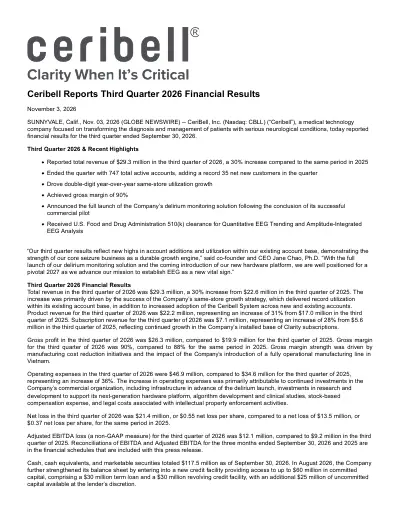
Good afternoon, and thank you for joining us for our third quarter 2026 earnings call. Q3 marked another strong quarter for Ceribell, as we delivered revenue of $29.3 million, growing approximately 30% year-over-year.
Underlying growth was driven by success across both core revenue drivers: adoption by more accounts and deeper penetration within our install base. In Q3, we increased our account base by a record 35 hospitals, to a total of 747 active accounts.
This is a reflection of the continued maturation and strong performance of our account acquisition team. We maintain a robust pipeline of unlaunched accounts that we expect to drive sustained growth in the coming quarters.
Headband utilization also reached a new record in Q3. Year-over-year usage per account grew at a double-digit rate, the highest we have seen since our IPO.
This build on our Q2 momentum and reflects the execution of our playbook: provider engagement, department expansion, and patient population protocolization. Department expansion is particularly accelerating.
We have expanded into more departments year-to-date in 2026 than we did during the entirety of 2025, and we expect to continue the pace. These results collectively serve to further validate our core seizure business as a durable growth engine.
Overlaying our core strategy, we are also making progress against several key initiatives we have launched this year to supplement our organic growth. First, we are seeing positive signs out of our newly established strategic account management team.
Through top-down engagement with regional health systems, we believe this team will drive new avenues for account growth. While these opportunities unlock after inherently longer sales cycles, we continue to see larger deals advancing through our sales funnel.
Second, our VA and DOD strategy remains a growth driver, with strong engagement with both government health systems. In Q3, we secured a commitment to further expand within VA, which should have a positive impact on active accounts and revenue growth in the coming quarters.
Finally, interest in our neonatal product remains strong, with ongoing pipeline development and activation of NICUs within new and existing accounts. With strong signal across each of these key 2026 initiatives, we are well positioned to drive continued revenue growth as we move into 2027.
Now, I'd like to turn our attention to delirium, our next major growth opportunity. Earlier this week, we announced the launch of our delirium monitoring solution.
We recently concluded a commercial pilot evaluating clinical utility and adoption among customers already using our seizure platform. 6 months later, I'm excited to report that the pilot has shown meaningful impact, both in optimizing patient care and in validating our delirium monitoring solution as a new revenue stream.
The encouraging results we shared last quarter have continued, now across a larger number of accounts. Customers reported improvements in clinical decision-making and positive user experiences.
In many cases, our solution is enabling long-term monitoring for the first time, which is especially notable in difficult-to-assess patients. To illuminate this clinical value, I'd like to share a patient story that highlights the unique benefits offered by our delirium monitoring solution.
In this case, a woman in her early 30s with sepsis was admitted to the ICU at a 150-bed community hospital and primary stroke center. The patient was not at neurological baseline.
The care team placed a Ceribell headband to evaluate potential causes. The system returned a seizure-negative result and a delirium-positive result, giving the team immediate, objective direction to focus on delirium management.
Before adopting Ceribell's delirium monitoring solution, this site's delirium assessments were inconsistent and rarely part of routine discussion. Here, the result prompted nurses, physicians, and pharmacists to review potential contributors together.
In a septic patient, antibiotics was not always questioned. This time, the team identified cefepime, a commonly used antibiotic with neurotoxicity, as a potential contributor to patient's delirium, and elected to transition the patient to a different antibiotic drug.
Besides the initial delirium detection, Ceribell also enabled continuous monitoring after the antibiotic adjustment. The delirium trend began to decrease.
By day 3, the patient was no longer delirium positive. The team believes the objective diagnosis and trend monitoring gave the team a clear reason to revisit the infection treatment decision, and the information necessary to determine that their strategy was effective in resolving delirium.
Clinicians at other sites have reported similar experiences, validating our value proposition and driving repeat usage. Ceribell helps care team to recognize delirium rapidly, while opening management pathways, from medication reviews to non-drug interventions.
As these experiences accumulate, we expect adoption to broaden and usage to become entrenched. Within the pilot, the clinical utility of our system has directly translated into commercial impact.
We are seeing a material increase in headband utilization by established customers who subsequently launched our delirium monitoring solution. Future growth is likely to result from patient population expansion, significant clinical utility from simultaneous monitoring for delirium and seizure, and engagement with customers.
This impact has proven durable, with our earliest customers having had at least 120 days of usage following launch. Importantly, usage impact was seen before our NTAP went into effect on October 1st, suggesting that clinical utility is the primary driver.
As we continued refining our launch practices, we have also seen even larger usage impact in more recently launched accounts. Based on these results, we believe that reducing barriers to adoption will enable us to drive meaningful commercial impact.
As we move into commercial launch, we are offering our delirium monitoring solution as a software upgrade to Ceribell customers at no incremental increase to the subscription fee. Instead, we are requiring interested customers to partner with us through program commitments that we believe are critical to maximize clinical utility and sustained usage.
For example, we ask our customer to ensure we can train more than 80% of their nurses and physicians during launch processes, and align on KPIs for delirium monitoring and management. We are also working with customers to ensure that they have sufficient recorder capacity to handle the increased patient volume and potentially longer monitoring durations for delirium.
This approach ensures that our customers are set up for success with high-quality launches. Providing the product without an incremental subscription cost largely avoids lengthy sales and contracting processes that could slow adoption.
That said, the launch process that we have seen drive impact requires thoughtful execution over time. Implementing such a disruptive technology involves customers evolving their practice and working closely with our team.
We expect that many accounts will adopt our delirium monitoring solution quickly, but broad scale conversion will occur over time. We believe this approach will ultimately maximize sustained revenue impact from increased clinical usage, the key metric for revenue contribution from our delirium monitoring solution.
We will continue to track the utilization impact as we move from pilot into full launch. As part of our 2027 financial guidance, we plan to provide a more granular perspective on anticipated revenue impact associated with this greenfield market opportunity.
Importantly, our strategy will be executed by our existing sales organization, provide greater leverage of our commercial infrastructure. We look forward to providing updates on these elements of our delirium monitoring solution's impact on our financial performance as well.
Our product development strategy rests on two core pillars: enhancing our algorithms to deliver better clinical insights, and innovating our hardware platforms to support the algorithms. Our delirium monitoring solution is an excellent example of the first pillar, as it expands our reach into new patient populations.
We also continue to develop other algorithms that increase the clinical utility of our product for our physician customers. Two such examples are recently FDA 510(k)-cleared algorithms for quantitative EEG trending and amplitude-integrated EEG analysis.
Quantitative EEG, or QEEG, extends three functionalities: alpha-delta ratio, relative alpha trending, and burst suppression monitoring. Clinicians commonly use these trends while managing complex neurological conditions, to help assess brain distress, reduced blood flow, or excessive sedation.
However, these outputs remain largely inaccessible for the bedside clinicians despite their clinical relevance. Our algorithm will change that.
We offer our customers greater insights into patients' brain activity. This materially strengthens our value proposition for both bedside users and neurologists.
These features will be released via a cloud-based software update next year. Meanwhile, our LVO stroke clinical program continues to move forward.
We are also actively exploring additional algorithm development opportunities to add to our platform. Collectively, these stand to drive more clinical impact and market expansion longer term.
We look forward to sharing updates on these potential opportunities in the future. Very excited about our progress in algorithm development, but we're not stopping there.
The second prong of our strategy is focused on enhancing our hardware platform. As we have discussed, we intentionally designed our new hardware platform to expand functionality and integrate additional modalities in support of our vision for EEG as a vital sign.
We are now thrilled to unveil the product name for this platform: Omni. The name Omni, which is Latin for "everything," precisely represents our vision for the future.
For the first time ever, hospitals can access the speed of point-of-care EEG while maintaining the comprehensiveness of conventional EEG, enhanced by our eight FDA-cleared algorithms that monitor the brain for seizure, status epilepticus, delirium, and other brain stress indicators, all in one platform: Omni. With Omni, we're introducing video, multiple-day continuous monitoring capability, EKG compatibility, and a parasagittal add-on to provide full montage coverage when needed.
This delivers the core features of conventional EEG without sacrificing the ease of use, speed, and accessibility of point-of-care EEG. Even more critical to our vision, the system was designed to run all our algorithms, enabling brain monitoring across multiple disease states.
It is one elegant solution that meets the needs of both bedside clinicians and neurologists, a tool we believe is truly unique. We will initiate a limited market release on Omni this quarter, and expect to launch the product in 2027.
We will share more details as we get closer to launch. As I step back, it is clear that our vision of EEG as a new vital sign is no longer theoretical.
After scaling our commercial presence and receiving nine FDA clearances in the last 18 months, we are now closer than ever to bring our vision to market. We see 2027 as a pivotal year.
Seizure detection will act as a durable base business. Both account acquisition and utilization are growing independently, compounding each other.
Our hardware and software enhancements will extend our category leadership. Our delirium monitoring solution will be fully launched.
Now, we have greater conviction in our ability to bring the totality of our innovation into a single product platform: Omni. Ceribell is at an inflection point.
After years of investment and growth, we're excited to begin our new chapter while continuing to deliver singular value to our customers and the patients they care for. With that, I will now turn the call over to Scott Blumberg, our CFO, to provide a review of the third quarter results and 2026 guidance.
Scott Blumberg
Thank you, Jane, and good afternoon, everyone. As Jane highlighted, total revenue for the third quarter of 2026 was $29.3 million, which is an approximately 30% increase from $22.6 million in the third quarter of 2025, and a 4% sequential increase.
The increase was primarily driven by success of our same-store growth strategy, in addition to increased adoption of the Ceribell system across new and existing accounts. Product revenue for the third quarter of 2026 was $22.2 million, representing an increase of 31% from $17.0 million in the third quarter of 2025.
Usage per account in Q3 grew by a double-digit percentage, the highest level we've seen since our IPO. Subscription revenue for the third quarter of 2026 was $7.1 million, representing an increase of 28% from $5.6 million in the third quarter of 2025.
We ended Q3 with an active account base of 747 hospitals, representing an increase of 35 accounts in the quarter. Gross margin for Q3 2026 was 90%, compared to 88% in the prior year period, demonstrating our ability to continue generating outsized gross profit that fuels our growth-oriented investments.
Based on today's tariff policy and current inventory positions, we expect to maintain margins in the high 80% range going forward. Total operating expenses in the third quarter of 2026 were $46.9 million, an increase of 36% compared to $34.6 million in the third quarter of 2025.
Non-cash stock-based compensation expense was $7.1 million in the third quarter of 2026 and $3.3 million in the prior year period. Sales and marketing expense of $25.0 million in the third quarter reflects continued investment in our commercial organization, including investments in our CAM infrastructure in advance of the launch of our delirium monitoring solution.
G&A expense of $14.5 million in the third quarter included expenses related to our ongoing IP litigation, which totaled $1.1 million. We expect litigation-related activities to remain low in Q4, though we may be subject to paying $2.9 million in deferred legal fees based on the outcome of our current ITC proceeding.
Research and development expense of $7.4 million in the third quarter reflects investments we've made into our platform, including our next-generation hardware, algorithm development, and clinical studies. Outsized growth in R&D expenses has driven meaningful impact, including accelerating commercial launch of both our delirium monitoring solution and Omni.
Net interest and other expense for the third quarter was $803,000. This includes $1.5 million in expenses associated with extinguishment of our prior debt facility, partially offset by interest income earned on cash and marketable securities.
With our new revolver-first debt structure, we expect that interest expense will decrease materially going forward to less than $1 million annually. Net loss was $21.4 million for the third quarter of 2026, or a loss of 55 cents per share, compared to a loss of $13.5 million, or a loss of 37 cents per share, in the third quarter of 2025.
A weighted-average share count of 38.5 million shares was used to determine loss per share in Q3 2026. Adjusted EBITDA reflects our net loss before interest, taxes, depreciation, and amortization expense, and also excludes non-cash stock-based compensation expenses, legal expenses associated with our ongoing IP litigation, and loss from extinguishment of our prior credit facility.
Adjusted EBITDA loss for the third quarter of 2026 was $12.1 million, as compared to $9.2 million in the third quarter of 2025. This reflects our continued strategy of thoughtfully deploying gross profits from our expanding revenue base back into the business to pursue long-term growth opportunities.
Our cash, cash equivalents, and marketable securities as of September 30th, 2026, were $117.5 million. We remain committed to our objective of achieving cash flow break-even with cash on hand, and the strength of our balance sheet and strong gross margin profile give us a high degree of confidence in our ability to do so.
Turning now to our outlook for 2026: We expect full year 2026 revenue to range from $115 to $117 million, up from our prior guidance of $114 to $117 million. This represents annual growth of 29% to 31% over 2025.
This change to guidance reflects the momentum we're seeing in our core business, with success driven both by new account additions and usage within our established account base. This range does not include material contributions from our neonate, pediatric, or delirium products, which we expect will begin to translate to revenue more meaningfully in 2027.
With that, I'll turn the call back to Jane.
Jane Chao
Thank you, Scott, and thank you all for your time today. Q3 reinforced the confidence we have in our trajectory.
Our core seizure business is a strong and predictable base. Our delirium pilot has been successful, and we are very optimistic moving into full commercial launch.
Our commitment to investing in innovation, including multiple new algorithms and our Omni platform, has set the stage for a pivotal 2027. We have less than 4% penetration in our core seizure market, which tells you how much runway is still ahead of us.
We are advancing into new greenfield markets with urgency and purpose. Our mission to establish EEG as a new vital sign remains our North Star, and the progress we made in Q3 give us every reason to push even harder.
Thank you again for joining us. I will now turn the call over to the operator for Q&A.
Operator?
Operator
As a reminder, if you'd like to ask a question, simply press star followed by the number 1 on your telephone keypad. Your first question comes from the line of Gracia Mahoney from Bank of America.
Your line is live.
Gracia Mahoney
Hi, this is Gracia on for Travis. Thanks for taking the questions.
I just wanted to start out, it looks like the subscription revenue is sort of offset a little bit of upside you had on product revenues this quarter. Wanted to see if there's anything to call out in a change in expectations versus three months ago and how that trend informed any - you're only raising the bottom end of the full year guide, while the top end's unchanged, and how maybe the new algorithm updates could factor into that outlook in Q4 and into '27?
Scott Blumberg
Thanks, Gracia. We saw quite a bit of strength on the product margin.
That was driven by the same-store growth driver there. We had record utilization per account growth, which reflected itself in the product revenue line.
Nothing really changes going forward. We still expect the majority of our revenue to come from product, but continue to see subscription as a durable, long-term growth driver.
Operator
Your next question comes from the line of Robbie Marcus from JP Morgan. Your line is live.
Hi, this is Henry on for Robbie. Thanks for taking the question.
Just wanted to ask a little bit more on delirium, and I was wondering could you talk about any changes to the commercial strategy that you might be planning now that delirium's here, maybe in terms of adding new accounts versus deepening accounts, and maybe also on the opex side? In the press release you called out some increased infrastructure costs in advance of that launch.
How should we be thinking about expenses going forward associated with this launch?
Jane Chao
Yeah. We see delirium drive both utilization and also accelerate the new account acquisition.
The more near-term, potentially especially in 2027, will see much more coming from utilization growth as it is quicker to turn our existing accounts to start using delirium. In the pilot, we saw very meaningful utilization increase.
However, in the longer term, we also anticipate more and more of our new accounts will start with seizure and delirium together, the accounts would launch at a higher usage or higher revenue. In terms of opex, it's very important for us to emphasize that the delirium launch would be leveraging our existing sales team, both our current CAM and TMs.
Let's take CAM as example, they already have very strong relationship with the ICU, they know the stakeholder, they go to these sites anyway. Not only we can leverage the existing sales force, there is a big synergy between seizure and delirium as well.
As we see the accounts grow in the commercial pilot, we see it's a growth of both seizure awareness as well as delirium-related patient expansion.
Operator
Your next question comes from the line of Brandon Vazquez from William Blair. Your line is live.
Brandon Vazquez
Hey, everyone, thanks for taking the question. Jane, you had mentioned, and I think this was in the press release too, that your same-store growth had reached double digits in the quarter in the utilization, and that that was one of the best numbers you've seen since the IPO.
I was hoping you could spend a minute talking about that. One, also maybe clarify a little bit the same-store metric.
I think us on the Street use a slightly different utilization metric. How do you define that?
Then two, what's driving it? Is it already seeing some of the benefits of pediatrics that is entering its first full quarter of launch?
Thanks.
Jane Chao
Thank you, Brandon. I'll answer your question about the same-store growth, and in terms of the metrics definition, maybe Scott can help cover that.
I would say it's really a continued execution of the playbook that we have established probably about 18 months ago. We did, very Ceribell way, a series of commercial pilot, and we become very focused on three drivers, that is departmental expansion, both expanding to other ICU as well as ED, and physician engagement and protocolization.
We really just continue build the team, have amazing team in place, and continue execution. Particularly, we saw the department expansion is accelerating, as I mentioned.
We started focus on emergency department last year, and we start to see a very strong buy-in from the ED as we significantly optimize the patient flow there. In terms of pediatric and neonate, as Scott mentioned in the call, it's still a little bit too early, because we have now close to 750 accounts.
Even we launched pediatric and NICU a few months ago, it's still going to take some time, because our install base is so big.
Scott Blumberg
Then as far as the metric definition goes, we run the business and collect data on utilization. Since we're a cloud-enabled device, we know precisely when our device is being used, as well as a lot of other data around the usage patterns.
That's how we monitor the business, that's how we incentivize the team. That number was record high.
There was a slightly lower number of purchases relative to usage this quarter. That's not something we endeavor to control.
We think over the long term utilization is the core metric, and that's where we were record high this quarter.
Jane Chao
Sorry, maybe I'll add one more thing about the same-store growth related to department expansion that's accelerating. We also see that that type of usage is even more durable and sustainable, because once you're in the department, each year as you launch in a different period of the year, you're only capture a partial revenue there.
It's not just, oh, we went there, usage grew, we actually know precisely the driver and KPI. That give us even more confidence that we'll continue this trend.
Operator
Your next question comes from the line of Bill Plovanic from Canaccord. Your line is now live.
All right,
Bill Plovanic
great, thanks. Good evening.
Can you hear me okay?
Jane Chao
Yeah.
Bill Plovanic
Oh, good. I wanted to talk about just one on delirium.
I was wondering if you could help maybe quantify it in some way, shape, or form for us in terms of how deep did the pilot go? How long do you think this will take to roll into all of your accounts?
Then what type of utilization increases did you see in the pilot? Is this a 25% increase, a 50% increase, or 100% increase?
How should we think about this impacting, and then how long it takes for the impact? Thanks.
Jane Chao
Thank you, Bill. It's a bit too early for us to quantify those very important questions you've asked, because we're just launching delirium as we speak.
However, as we get close to guiding 2027, we should be able to provide more granular guidance there.
Operator
Your next question comes from the line of Jayson Bedford from Raymond James. Your line is live.
Jayson Bedford
Good afternoon, and congrats on the progress. Maybe just to follow on Bill's question, the delirium pilot, you mentioned seeing material increases in headband utilization.
I was just a little unclear: Are you referring just to delirium, or are you seeing pull-through into higher utilization within seizure? Then my second question is just on the delirium software rollout.
Are there minimum volume commitments tied to this program? Thanks.
Jane Chao
Yeah. Clinically, it's very difficult to separate seizure and delirium, especially in the ICU or the floor setting.
ICU is our main target to launch delirium, all our commercial pilot sites were in ICU. Physicians monitor seizure and delirium together.
It's very challenging for us to separate. That being said, we have seen multiple drivers in the sites.
We saw patient expansion. For example, many sites did not monitor sepsis patient alone just for seizure, and because seizure and delirium together, they start to monitor sepsis patient or other patient population.
We also saw increase of existing patient, and our hypothesis there was because we have more face time with physicians and nursing team, we are further raising not just awareness of delirium, but also seizure. We think we're driving both the usage of seizure and delirium together.
Again, it's a joint monitor. We don't really separate them.
Scott Blumberg
As far as the commitments, we're setting up workflows and working with customers to ensure they're set up for success, and that's what we saw be effective in the pilot. It is driving material impact.
As far as contractual obligation to volumes, we're not requiring that, but the degree of consistency of usage patterns seen in the pilot gives us high conviction that if customers kind of follow the script here and engage with their customers, that we'll see the usage impact.
Operator
Your next question comes from the line of Josh Jennings from TD Cowen. Your line is live.
Hi, this is Brian for Josh. Thank you for taking my question.
I wanted to ask about the VA. You said you've secured a commitment to further expand in the VA.
Do you expect to see year-over-year growth in VA account additions in 2027 compared to this year? Can you share anything on the utilization growth that you've seen so far at VA accounts?
Scott Blumberg
I can cover the volume piece. The VA runs pretty strictly on a September fiscal year-end calendar, and so the commitment was secured towards the end of last fiscal year for this coming fiscal year.
The size of the commitment is reasonably in line with what we saw last year, and so we'd expect those to roll into the account base over the next two to three quarters or so. We're in a meaningful number of VAs, but we're still, even after we launch these accounts, in the minority, there's plenty of headway to grow.
Jane Chao
In terms of the VA usage, we don't quantify specific hospital systems. However, in general, when we see this top-down launches, we saw at earlier the usage tend to be a little bit lower than our typical average account.
However, as we gain more experience, also as our customer gain more experience, we do see a growth as we launch more and more VA accounts. As we continue gain more experience, we have confidence we'll continue drive not just getting into more VAs, but also sustainable usage in these accounts.
Operator
Your next question comes from the line of Marie Thibault from US Bank. Your line is live.
Marie Thibault
Hi, thanks for taking the questions. My question is mainly trying to understand the direction sales growth and expense growth might be headed.
I'm not asking for 2027 guidance, but just want to better understand when we might start to see an inflection from the territory managers that you started adding a couple years ago, and if we should be expecting increased investments as you move into the delirium launch and continue the neonatal and pediatrics. Just a better understanding of the trends here going forward.
Scott Blumberg
We've made investments this year that really fuel our growth drivers for 2027, which includes the strategic account management infrastructure for the regional health systems, delirium, and otherwise. As far as the infrastructure we have, we've largely made the investments for the stuff that's in front of us.
We do pay very close attention to decisions we make in terms of infrastructure investments, both on sales, R&D, and otherwise, to ensure that we align with our North Star, which is achieving break-even with cash on hand. That said, we do evaluate the most recent facts quarter-to-quarter and make investment decisions based on the most relevant and recent information.
Short answer is, we feel very good about the infrastructure we have, and we'll pay very close attention to the business, and in particular the success of delirium over the next few months, and make the right decision with the right information.
Operator
Your next question comes from the line of Jeffrey Cohen from Ladenburg Thalmann. Your line is live.
Jeffrey Cohen
Good afternoon, thank you for taking our questions. I wondered if you could expand upon the pilot for delirium with seizure, and can you talk about any learnings as far as clinical workflow, and maybe how that may relate to some of the guidelines that the societies have out there currently?
Jane Chao
Just to make sure I understand your question, you are asking about the workflow related to seizure and delirium, and what existing guidelines have in guiding the usage of seizure and delirium monitor?
Jeffrey Cohen
Yes, and how they may change.
Jane Chao
Yeah. The current guidelines are relatively separated when they guide how to triage and monitor seizure and manage seizure, versus how they detect and manage delirium.
That's why when we launch these accounts, we often go in and merge these guidelines together. It's more raise awareness of these guidelines to the patient.
I use sepsis patient as example, and there are many clinical evidence publications show that sepsis patient, about 10% to 15% of them, if they have altered mental status in ICU, they would have seizure. Then there are about 60%, 6-0% of sepsis patient would have delirium.
The patient seize, right after seizure, they could later develop delirium. Also the symptom of seizure and delirium is also very similar.
All this together makes very difficult for the bedside nurse and physicians to decide both, is it patient seizing or having delirium? Also, when you start the management pathways of seizure and delirium, are you on the right track?
That's exactly where our device come in, and we can clearly, for example, the case study I shared in earnings call, this woman in her 30s with septic shock, she could be having a seizure, but our device say, no, patient's having delirium, manage the delirium. That lead to the medication review of cefepime.
You could see a very similar presentation of patient, but the device might come back say, no, patient seizing, and that would completely change the course that would treat patient with anti-seizure medication instead of a medication review. That's some example of the workflow.
We obviously don't design the workflow for the hospital. We more share other hospitals' workflow and the existing guidelines to support our customers.
Operator
There are no further questions. I'd like to turn the call back over to Jane Chao for closing remarks.
Jane Chao
Thank you, everyone, for joining the call. We are very excited and proud of what we have accomplished in Q3, and we're very excited about what's ahead of us as well.
Look forward to sharing more of the good news moving forward.
Operator
This concludes today's meeting. You may now disconnect.