Canadian Apartment Properties Real Estate Investment Trust
Q3 FY2026 · Earnings Call TranscriptNovember 5, 2026
Operator
Hello, everyone. Thanks for joining us and welcome to the Canadian Apartment Properties REIT third quarter 2026 earnings call.
After today's prepared remarks, we will host a question and answer session. If you'd like to ask a question, please press star one to raise your hand.
To withdraw your question, press star one again. I will now hand the conference over to Nicole Dolan, Investor Relations.
Nicole, please go ahead.
Nicole Dolan
Thank you, operator, and good morning, everyone. Before we begin, let me remind everyone that during our conference call this morning, we may include forward-looking statements about expected future events and the financial and operating results of CAPREIT, which are subject to certain risks and uncertainties.
We direct your attention to slide two and our other regulatory filings for important information about these statements. I will now turn the call over to Brad Cutsey, President and Chief Executive Officer.
Brad Cutsey
Thanks, Nicole, and good morning, everyone. Joining me today is Stephen Co, our Chief Financial Officer.
Since our last call, I've continued to tour our properties and spend time with our teams across the country. What I've seen has further reinforced my confidence in the quality of the platform and the depth of expertise throughout this organization.
One of our most important accomplishments during my first full quarter is welcoming and onboarding James Lawrence as our Chief Operating Officer. James brings extensive property management experience, and he has quickly become an integral part of our leadership team.
We look forward to introducing him to many of you at our upcoming Investor Day, where he will outline our operating strategy and how we expect it to translate to operational gains. In future quarters, we also look forward to having James join these calls to provide updates on our operating performance and progress.
With that, let's turn to slide four and walk through some highlights for the year to date. From a capital allocation perspective, CAPREIT has completed approximately $88 million of acquisitions and dispositions in Canada so far this year, $145 million of property divestments in Europe, and the privatization of European Residential REIT for $99 million, which has provided us with greater flexibility to manage the sale of the remaining European assets.
We also continued to invest in our NCIB program, with approximately $101 million deployed this year to date. Operationally, while market conditions remain pressured across the multi-family sector, CAPREIT continues to demonstrate resilience.
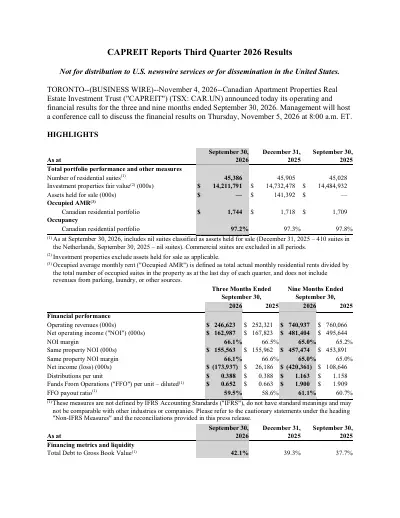
Occupancy for our same-property Canadian portfolio was 97.2% on September 30th, which remains above Yardi's latest quarterly national average of 95.3%. Looking into Q4, CAPREIT's occupancy has so far held relatively stable at 97.1% as of October 31st.
While maintaining healthy occupancy levels, we also achieved a 1.8% growth in our same-property occupied AMR year over year. Combined with effective cost control initiatives, our Canadian same-property NOI margin remained strong at 64.8% for the nine months ended September 30th, 2026, consistent with the prior year period.
On the balance sheet, total debt represented 42.1% of gross book value as of September 30th, 2026, up from 41.2% on June 30th, mainly due to a decrease in the fair value of our investment properties. Overall, these results reflect the strength of the portfolio and team in what continues to be a challenging operating environment.
That said, we continue to see some early signs of stabilization, as highlighted last quarter, with our blended change in rent on turnover turning positive for the first quarter this year, which Stephen will discuss in more detail later on the call. At current trading levels, our NCIB program continues to represent one of the most compelling uses of capital to drive FFO per unit growth.
You can see on slide five that since 2022, we've deployed approximately $1.1 billion to repurchase 24.8 million trust units at a weighted average price of $42.86—eight, sorry, $42.80 per unit. As mentioned earlier, during 2026, we've invested approximately $101 million to buy back 2.9 million trust units at a weighted average price of $34.83 per unit, which represents a sizable discount to our September 30th diluted NAV per unit of $52.94.
Going forward, our NCIB program will be a capital allocation priority, and we are committed to pursuing these repurchases on a leverage-neutral basis funded by disposition proceeds. I'll now turn the call over to Stephen to walk through our operational and financial results in more detail.
Stephen Co
Thanks, Brad. Let's start with our operating performance on slide six.
As Brad mentioned, leasing conditions remain competitive across many parts of the Canadian rental market, and our operating teams continue to execute well, maintaining a disciplined focus on managing occupancy, pricing, and resident retention. As a result, you can see on the slide that for each of our three largest regions, occupancy continues to compare favorably against broader industry benchmarks, supported by the strategic use of incentives necessitated by this current environment.
In the GTA, our largest market, occupancy was 98.5% as of September 30th, notably higher than Yardi's reported quarterly average of 95.4%. At the same time, we grew occupied AMR in Toronto by 1.9% year over year to $1,873.
This reflects the strength of our legacy portfolio alongside our ability to effectively balance occupancy and rental growth, even in today's more pressured conditions. In Vancouver, occupancy improved to 97.6%, ahead of Yardi's quarterly average of 96.1%, while occupied AMR of $1,962 was down by 1.2% year over year, largely reflecting continued delivery of new supply and a higher proportion of newly built properties in the Greater Vancouver portfolio.
In Montreal, occupied AMR increased by 4.8% to $1,520, while occupancy stood at 94.2—94.7% as of September 30th, lower than last quarter, but still above Yardi's quarterly average of 94.3%. This was again driven by supply, alongside a population decline versus last September due to federal immigration targets and softer international student enrollment trends contributing to greater renter choice and more competitive leasing conditions in this region.
Across the broader portfolio, rent growth continues to be driven by lease renewals and the embedded mark-to-market opportunity that exists within our legacy portfolio, the vast majority of which is located in rent-controlled markets. As of September 30th, the mark-to-market spread across the total Canadian residential portfolio is an estimated 16%.
However, our turnover remains weighted toward shorter-tenured leases that are above current market rents and continue to reset today toward today's market levels. Turning to slide seven, I'll provide an update on how the turnover dynamic evolved during the third quarter.
Approximately 48% of Canadian turnover during the quarter came from residents who had occupied their suites for less than two years. These leases experienced an average decrease in monthly rent of 5.2%, which is a further improvement from the declines of 7.1% in the second quarter and 10.8% in the first quarter.
The remaining 52% of the turnover came from residents with lease tenures of two years or longer, where we continued to achieve positive rent growth of 5.9%, up from 5.4% last quarter. As a result, our blended change in monthly rent on turnover returned to positive territory at 0.3% for the quarter.
This compares to -1.2% in the second quarter and -2.1% in the first quarter, reflecting continued moderation in negative rent spreads we're realizing on shorter-tenured leases. In October, overall change in rent on turnover was 0.4% for the month, a further step in the right direction.
Looking at the chart on the left of the slide, as of September 30th, approximately 32% of residents have lived in their home for less than two years, across which the occupied average monthly rent is $2.52 per square foot. Within this segment, approximately 18% of the in-place rents remain more than 5% above our estimated market rents.
Although this is down from 20% as of Q2, it highlights there is still some additional normalization to work through. The remaining 68% of our residents have lived in their homes for two years or longer.
These longer-tenure leases continue to generate positive average rent uplifts on turnover, even in the current operating environment, providing an important source of stability for overall rent growth until supply-demand fundamentals return to balance. Moving to slide eight, I'll walk through our same-property operating results for the region for the third quarter.
In our largest market of Toronto, which represents approximately 42% of our same-property NOI, we realized an increase in NOI of 0.8%, driven by AMR growth of 1.9% and relatively stable occupancy of 98.5%. Offsets include higher building and suite maintenance costs related to flash floods in August and early September, including plumbing repairs, waterproofing, roofing repairs, tree removal, and other storm-related maintenance and cleanup work at several properties.
Incentives were also up versus Q3 of 2025, but compared to Q2 of this year, incentives granted were down by 31% across the GTA. Our strongest NOI growth came from Ottawa, up 4.1%, and Halifax, up 3.3%.
Ottawa remains nearly fully occupied at 99.6%, while Halifax delivered the highest AMR growth in the portfolio at 4.4%. The regions facing the most pressure were London and Kitchener-Waterloo, as well as Calgary and Edmonton, as these markets continue to absorb new supply.
In London and Kitchener-Waterloo, NOI declined by 6.9%, reflecting higher maintenance costs and a 1.5% point decline in occupancy to 96.5%, while Calgary and Edmonton recorded a combined NOI decrease of 7.3%, mainly due to higher realty taxes. Elsewhere, Vancouver NOI declined by 2.7%, with AMR down by 1.7% for reasons already discussed, although occupancy improved 0.3 points to 97.7%.
In Montreal, NOI was essentially flat, as AMR growth of 2.3% was offset by a 1.8 point decline in occupancy to 94.5% due to the regional market conditions described earlier. With that, I'll now briefly cover our overall third quarter financial results on slide nine.
For the three months ended September 30th, 2026, same-property Canadian operating revenues increased by 0.6%. This includes the impact of higher amortization of incentives, which represented 1.6% of total Canadian operating revenues this quarter, up from 1.1% a year earlier.
However, as compared to Q2, the grant of new residential incentives across the portfolio was down by 27%, a further indication that leasing conditions may be easing. Operating costs grew by 2.4%, mainly due to higher building and suite maintenance costs in Ontario, as mentioned earlier.
Our same-property NOI margin was therefore down this quarter to 66%. Diluted FFO per unit was 65.2 cents, compared to 66.3 cents in the third quarter of 2025, down 1.7% year over year, primarily reflecting lost NOI from dispositions and higher interest expense, partially offset by lower trust and current tax expenses, as well as the benefit of trust unit buybacks.
Looking at our year-to-date results on slide 10, same-property Canadian operating revenues and operating costs each increased by 0.8%, resulting in a stable NOI margin of 64.8% for the nine months ended September 30th, 2026. Diluted FFO per unit was $1.90 for the first nine months of the year, with a FFO payout ratio of 61.1%.
Finally, slide 11 summarizes our liquidity position and laddered mortgage maturity profile. As of September 30th, our Canadian mortgages had a weighted average effective interest rate of 3.4% and a weighted average term to maturity of 4.4 years.
Going into the fourth quarter of 2026, we have nearly $300 million of our Canadian mortgages maturing, which currently carry a weighted average effective interest rate of 3%. In total, combined with top-up financings, we expect to complete approximately $1.2 billion in total mortgage refinancings for 2026, assuming no acquisitions or dispositions, with $960 million completed or committed as of today.
We have a further $655 million maturing in Canada in 2027, across which the weighted average effective interest rate is 3.3%. This compares to estimated current market rates of 4.2% for the five-year term and 4.6% for the 10-year term, which excludes certificate of insurance costs.
Moving ahead, we'll continue to strategically ladder our mortgage profile by refinancing at both the five-year and 10-year terms in order to mitigate renewal risk in future years. With that, I'll turn the call back over to Brad to wrap up on slide 12.
Brad Cutsey
Thanks, Stephen. Before we open the lines for questions, I'd like to close with a few thoughts.
Having now visited nearly 70% of our assets, I see clear value in CAPREIT's portfolio. We own high-quality, competitively positioned rental communities at some of the most sought-after addresses across Canada.
I also see opportunities to further improve operating performance and strengthen the earnings potential of our business. Importantly, realizing that potential will take time.
While we remain constructive on the medium-term outlook, we expect the next few quarters to remain challenging as the market absorbs new supply amidst slower population growth, and higher mortgage refinancing costs continue to pressure earnings. Positive blended rent growth on turnover and fewer new residential incentives granted this quarter versus Q2 offer early signs of stabilization, but we believe it's too soon to call a sustained recovery.
That said, I remain extremely bullish on our portfolio and its long-term potential. We see significant opportunities to continue to enhance portfolio quality and create meaningful value for our unitholders.
Looking ahead, our priorities are clear: strengthen leasing execution and resident retention, deliver consistent, customer-centric service, and use technology, data, and simpler processes to improve efficiencies across the platform. These actions will help reinforce the business through the near-term environment and position CAPREIT to benefit as market fundamentals improve.
We look forward to sharing more about our strategy and our priorities at our Investor Day in Montreal on November 19th. A link to join virtually will be available in advance, and we hope you can join us.
With that, operator, we're pleased to take your questions.
Operator
We will now begin the question and answer session. If you'd like to ask a question, please press star one to raise your hand.
To withdraw your question, press star one again. We ask that you pick up your handset when asking a question to allow for optimum sound quality.
If you are muted locally, please remember to unmute your device. Please stand by while we compile the Q&A roster.
Your first question comes from the line of Jonathan Kelcher with TD Cowen. Your line is open.
Please go ahead.
Jonathan Kelcher
Thanks. Good morning.
Brad Cutsey
Morning.
Jonathan Kelcher
First question, just on the turnover rents. Nice to see them improve versus Q2 and Q1.
You still got 18% or so that are 5% above. Would your expectation be that those stay plus or minus flat over the next few quarters and it really just depends on what leases turn?
Stephen Co
Jonathan. Assuming that market rents stay pretty flat, then it effectively comes down in terms of that under-two-year bucket.
However, I would just mention there is that some peak leases are aging into the two- to three-year bucket. Overall, I would say that, as market rents stay relatively flat, that blended rate will start to creep up.
Brad Cutsey
Jonathan, that number has come down a little bit, and you'll continually see that come down. It's come down from, I think it was 20% in Q2.
Jonathan Kelcher
Okay. What of market rents?
In your calculation of that, what have you done with market rents? Have you brought them down?
Like the last couple of quarters?
Stephen Co
No, market rents have stayed relatively flat, actually, for us. No, we have not done that.
Brad Cutsey
On the whole, we might have made adjustments regionally, but I would agree with that. Portfolio-wide, I'd say on average, it stayed flat.
Yeah.
Jonathan Kelcher
Okay. Then secondly, noticed that you removed the strategic repositioning slide from your deck.
Would it still be fair to say that you've got 12%, 13% of the portfolio that's non-core?
Brad Cutsey
Jonathan. We're going to go through a lot of capital allocation and more strategic initiatives on Investor Day.
I think what we were trying to do just keep this to the quarter and frame kind of the future on that Investor Day. We're pretty excited to obviously share a lot more with you about where we think we're heading and how we're going to get there.
Jonathan Kelcher
Fair enough. I'll look forward to that and I'll turn it back.
Thanks.
Operator
Your next question comes from the line of Sairam Srinivas with ATB Capital Markets. Your line is open.
Please go ahead.
Sairam Srinivas
Thank you, operator. Good morning, gents.
I will keep my questions
Brad Cutsey
quick
Sairam Srinivas
to the point, as you said, Brad. Just looking at rents, I know you spoke about a bit of a drag with respect to the recent near-term leases that are coming up.
How long do you expect that drag to sustain?
Stephen Co
Yeah. You're talking about the peak leases that are turning over, right?
I think what I communicated last quarter was about 18 to 20 months. For this quarter, it's come down, it's about 15 to 17 months left.
Again, assuming market rents hold flat.
Sairam Srinivas
In terms of the spread of these leases across different markets, are you seeing some markets being more opportunistic versus others?
Stephen Co
Sorry, can you repeat that, Sai?
Sairam Srinivas
When you look at these leases in the spread across your different markets, are you seeing opportunities where some markets would see a earlier recovery versus others?
Brad Cutsey
To be fair, it's very similar to what we mentioned last quarter. We remain very constructive on the GTA.
It's definitely trending in the right direction, which is great for CAP because such a big percentage of our portfolio is in the GTA. We're excited about that.
Then there's other regions where we're still seeing some challenges and headwinds per se that will probably have to work through 2027.
Sairam Srinivas
All right. Thanks, gents.
I'll look forward to the Investor Day.
Brad Cutsey
Thank you.
Stephen Co
Great. Thanks.
Operator
Your next question comes from the line of Matt Kornack with National Bank of Canada Capital Markets. Your line is open.
Please go ahead.
Matt Kornack
Morning, guys. Just trying to think of the build up to next year in terms of where we are today.
It seems like call it around 2% rent growth is possible, if you could give a sense on kind of how you think occupancy can trend. I don't know if you can make any gains there.
Then also on the margin front, it seems like if you maybe have 3% to 4% expense growth, modest growth on NOI, is that a fair way of looking at the organic growth profile into next year? Obviously, interest rates are what they are.
We'll see what they do. Just trying to figure out some of the moving parts for next year.
Brad Cutsey
I think that's fair. We're definitely looking to achieve some gains on the occupancy front, and I do think modest growth in the top line from a rent perspective is achievable.
We'll definitely continue to hopefully be able to use less incentives in the GTA, and we've already seen that. There are a couple markets where we're going to probably have to continue to use incentives given where there is oversupply.
Again, the GTA is our largest portion. I think your comments are fair, Matt.
Matt Kornack
Okay. I don't want to steal the thunder from your event upcoming in Montreal, but can you give us a sense as at these [laughter] that I want.
You mentioned in your commentary that you've seen some potential upside that you think there's some low-hanging fruit that you can do. Is that on the expense side, on the revenue side?
How should we think about
Brad Cutsey
that? I'm looking forward to that.
I think we're going to really highlight what operational excellence means, and specifically really excited for all of you and our investors to get to meet James Lawrence, and there's a couple of other key team members I think really deserve some spotlight with the investment community. I think we'll go into more detail there, Matt.
I really do want to wait and give the team its day to kind of walk you through thoughtfully, and I think it's just going to be a better format. Stay tuned.
There will definitely be highlighting from a top line and from an operating costs savings scenario on Investor Day.
Matt Kornack
That makes sense. Maybe just last for me in terms of the nature of demand that you've seen kind of through the busy leasing period.
I think it's students that have kind of stabilized. Obviously, StatsCan throws a bit of a curveball on what actual population growth numbers have looked like.
Are you seeing incremental pockets, whether it be young professionals, people working in some of these industries that the government's going to invest in, taking space? I know we've talked about household deconsolidation potential at some point, given the affordability, are you seeing some of those guys come back into the market?
Just any kind of sense as to how the demand dynamics are evolving and if there are major disparities regionally that you're seeing there?
Brad Cutsey
It's a great question. We were definitely starting to see young adults kind of moving out of their family homes, back in the market as you saw the unemployment rate in that cohort come in.
I would say we're probably seeing a little less of that demand going forward because I think as the tariff war and the war in Iran continue to ramp up, I think that kind of put the brakes. I think some of these young adults are kind of staying put.
We'll see where that heads now after the midterm elections. We'll see if there's a renewed sense of confidence within the marketplace.
What we missed in international students, there's no question. It does feel like it's starting to stabilize, meaning we're probably seeing the trough of the negative impact from the student enrollment kind of going away.
Interestingly enough, our regions where there's government base have actually performed quite well, hence being Quebec City and Ottawa being very good performing regions for us. We'll see where that takes us going forward.
We're looking for an immigration policy target to come out imminently. I'm looking on the table and some thinks it might be today.
We'll see where that leads. The overall tone, I think, is likely to be positive, I think that's good news on the demand front.
That said, the good news is overall, even where the demand is currently, the supply that we're seeing, now some markets better than others, but the supply that we're seeing is slowly starting to get absorbed. That's the good news.
Any real positive to the immigration front is just a real net positive to the overall fundamentals.
Matt Kornack
Great. Thanks for the color and looking forward to Montreal.
Brad Cutsey
Likewise. Thanks, Matt.
Operator
Your next question comes from the line of Kyle Stanley with Desjardins. Your line is open.
Please go ahead.
Brad Cutsey
Morning, Kyle.
Kyle Stanley
Kyle. Morning, guys.
Just going back to the leasing spread conversation. Obviously, encouraging to see the shift into positive territory.
Can you talk about the composition of the turnover in 3Q? It looked like a bit of a higher proportion came from the greater than two-year lease tenure versus maybe the past couple of quarters.
I'm wondering if that really was just mix of what turned in the quarter or do you see that becoming a more significant driver of turnover going forward?
Stephen Co
That's hard to tell. Within that two- to three-year bucket, I would say about 50% of it is those leases that are 5% or more above market.
We're going to do our best in terms of retention strategy, but if they do turnover, we kind of said it. Last quarter I said 18 to 20 months.
Now it's about 15 to 15 to 17 months. One thing I will add is just that those that are over the three-year tenure is providing still that healthy mark-to-market rent growth.
That is something that we're still very happy to see and again, as you saw on the Q3 numbers, that over two years was about 5.9% on rental uplift, and that has improved from Q2. Hopefully we'll see that continue to be, oh I wouldn't say increasing, but in that range.
Kyle Stanley
No, fair enough. Just on the same vein, obviously, a pretty substantial improvement year to date in the turnover spreads in that kind of shorter duration cohort, from 10 to seven to -5 now.
Can you just talk about what's happening in that section that's helping see rents turn more positively?
Stephen Co
I think it's mainly just market rents have, I would say, more or less stabilized. Therefore, that rate of change becomes less and less.
That's what you're seeing. From Q1, it was about -10%, and now it's about -5%.
What we see in October, it's about the same rate. As that lease tenure turns over, hopefully, if everything turned over, you're going to just see zero going for- like zero once that entire cohort shifts.
Kyle Stanley
Right. That makes sense.
Then just the last one, nice improvement on the incentive side this quarter. I do believe last quarter you kind of mentioned expecting incentives to remain elevated.
Just want to talk about, I guess, the balance between extending incentives and preserving occupancy, especially I guess as you head into the winter season. How are you thinking about that?
Brad Cutsey
It's pretty easy, Kyle. If we have a community that has elevated vacancy, we're going to use incentives if we can bring somebody in and fill it up.
There's no question. While we're trying our best to minimize the use of incentives, we really are prioritizing occupancy.
There's no question. The team knows that.
That's our number one operation priority right now. If we have to use some incentives in areas that are oversupplied or where there's just not a lot of leasing activity, we're going to use it.
That being said, we've been very cognizant with the leasing team this past quarter. If we've seen some strength within our portfolio, we've challenged them to take away the incentives and try to lease up without it.
I think that was really successful, and I think the team's done a really good job, and that was one of James's first initiatives, and I think James has done a really good job of helping bring in that in.
Operator
Your next question comes from the line of Brad Sturges with Raymond James. Your line is open.
Please go ahead.
Brad Sturges
Hey, good morning. Just one quick one for me.
Just on the NCIB program, you've been running about $30 million a quarter in the last few quarters, or at least this year. Is that still a good run rate at this point or should we think about it being more tied to capital recycling or dispositions going forward?
Brad Cutsey
Again, I'm just going to sound boring and just re-bridge that to November 19th. We're going to clearly walk everybody through our capital allocation priorities.
Brad Sturges
Okay. I'll turn it back.
Thank you.
Brad Cutsey
Thanks, Brad.
Operator
Your next question comes from the line of Jimmy Shan with RBC Capital Markets. Your line is open.
Please go ahead.
Brad Cutsey
Morning, Jimmy. Oh,
Jimmy Shan
thanks. Morning.
Just a couple questions on the GTA. When I look at the stats, AMR is growing, incentives, I think you said, are down 30%, if I heard right, and occupancies is quite high.
I know you said you're constructive, but do you feel like the market's bottomed? Then are you in a position now to actually start pushing rents?
Where are we on that sort of life cycle in that market?
Brad Cutsey
I think we're constructive. It remains constructive.
We've seen a couple quarters now of the trend going in the right direction. It's turned positive here.
I still would say we've got to caution what we say, Jimmy, because going into Q4 and Q1, they're very tough leasing time periods even in the best of markets, right? You just don't get a lot of movement in the months of December, January, and February.
I really want to caution my comments here. If things stabilize and we stay where we are today, I would say, yes, I'd be hopeful that we could start to push rents come the start of the leasing season in April.
Modestly.
Jimmy Shan
Okay. Modestly.
Would Toronto have a lot of the above-market leases? Would they be mostly in Vancouver, the ones that are turning now, or is there still a fair amount of above-market leases in that market?
Stephen Co
Jimmy. It's across the markets.
When there was the peak leases, even the legacy assets were getting really good rents. It's both in the legacy assets and in the new builds.
It's spread across. I wouldn't say it's disproportionate in one market or the other.
It's spread across.
Brad Cutsey
I would agree with that, and I'd also maybe point to Montreal as well.
Jimmy Shan
Right. Okay.
Thank you.
Operator
Your next question comes from the line of Mario Saric with Scotiabank. Your line is open.
Please go ahead.
Mario Saric
Hey, guys. Good morning.
Just maybe sticking to Toronto, the chart showing your occupancy versus Yardi, there's quite a substantial delta between the two. Are the occupancy that you're showing kind of weighted by neighborhood, meaning it's comparable to the neighborhoods that you're in, or are you comparing your portfolio to a broader kind of Toronto average?
Brad Cutsey
Mario. I wish we had that detail.
We're looking at the same numbers that you're looking at in the Yardi reports. It's the broader versus our own portfolio.
Mario Saric
Got it. Okay.
Coming back to Jimmy question in terms of asking rents starting to higher, where do you think the Yardi number has to go in order for market asking rents to start pushing higher from the 95.4%?
Brad Cutsey
I'm not going to answer that. I'm familiar with our communities and how our assets and our nodes set up within the markets that they're in.
That's how we look at pricing, Mario, I really am not in a position to answer a macro question on when are we going to get the pressures there.
Mario Saric
Okay. Then, Brad, you've talked about or you've highlighted kind of several reasons for optimism over the kind of medium to longer term in terms of recovery operationally.
You have highlighted a couple times that you expect challenges over the next couple quarters. By challenges, do you essentially mean kind of what we saw this quarter, a bit of FFO per unit erosion, some same-property NOI decline?
Just wondering if you can kind of define how you think about challenging in the context of the comments.
Brad Cutsey
It's pretty easy. Like I said, and I want to reiterate, we're constructive on the GTA.
That's our largest portion of our portfolio, I think there's a lot of reasons to have optimism there. From the rest of it, on the top line, there's some markets in which they're oversupplied or where we own have rents at the higher end, which still remain challenged.
We're going to have to wait till demand can help us out there, we got to see some of that supply be absorbed before we have some pricing power or even be able to see increases in the occupancy. From the top line, there's still going to be some headwinds in some of these markets, especially at the higher price points.
Mario Saric
Okay. From a same-store NOI perspective, that kind of sounds like it's something similar to what we saw this quarter for the next one to two?
Brad Cutsey
I think that's fair. I would also just say I think the glaring one, unfortunately, Stephen and his team did too good of a job, if you could say that in hindsight, but unfortunately, the one that hits us glaring right in the face that's really going to kind of be the biggest headwind is refinancing rates.
I think we're all aware of that, and I think that's priced in. Okay.
Mario Saric
Then just in terms of I think Matt was asking about '27. Is it fair to say, based on the commentary of maybe a bit of margin expansion, kind of inflationary cost pressure, but you do believe that same-store revenue growth, which kind of I think you've talked about it being roughly 1%-ish in 1% in '26, could you see that, if occupancies do go higher, could you see that kind of trending to the 2% to 3% range next year?
Stephen Co
I think, Mario, maybe we can provide that more color around Investor Day. As we lay out some of those operational strategy around our operational excellence focus, there may be more I would say insight for you to gather from that and that will make a more informed decision around some of the OpEx goals, be OpEx growth or revenue.
Where we stand today, just without any of those, when we talk about some of the OpEx costs, they are, I would say, realty taxes, 3% to 4%, and then you've got other types of costs that could be elevated, such as insurance costs and whatnot. Hopefully we have a more warmer winter, as we are experiencing right now, so that might have more of a tailwind for us.
Overall, all things being equal, costs are probably 3% to 4% as mentioned earlier.
Mario Saric
Okay. Then maybe coming back to the incentives, it was nice to see them come down as much as they did this quarter.
Do you have a breakdown of the 3.5 million of incentives offered between the less than two-year buckets and the greater than two-year bucket in terms of lease tenure?
Stephen Co
They'll all be under the two-year bucket because they'll only be on the new leases generally. There probably are some for our retention strategy, but they're not material.
Mario Saric
Okay. That's great.
Thank you.
Stephen Co
Thanks.
Brad Cutsey
Thanks, Mario.
Operator
We have reached the end of the Q&A session. I will now turn the call back to Brad Cutsey for closing remarks.
Brad Cutsey
I'd like to thank everybody for your time today. If you have any further questions, please do not hesitate to contact us at any time.
Thank you again, and have a great day.
Operator
This concludes today's call. Thank you for attending.
You may now disconnect.