Certara, Inc.
NNASDAQ:CERTQ3 FY2026 · Earnings Call TranscriptNovember 5, 2026
Operator
Good day, and thank you for standing by. Welcome to the Certara third quarter 2026 earnings conference call.
At this time, all participants are in a listen-only mode. After the speakers' presentation, there will be a question-and-answer session.
Please be advised that today's conference is being recorded. I would now like to hand the conference over to Jay Liu, Investor Relations at LifeSci.
Please go ahead.
Jay Liu
Good morning, everyone. Thank you all for participating in today's conference call.
On the call from Certara, we have Jon Resnick, Chief Executive Officer, and Faiz Mohammed, Interim Chief Financial Officer. Earlier today, Certara released financial results for the quarter ending September 30th, 2026.
A copy of the press release is available on the company's website. Before we begin, I would like to remind you that management will make statements during this call that include forward-looking statements, and actual results may differ materially from those expressed or implied in the forward-looking statements.
Please refer to slide 2 in the accompanying presentation titled Third Quarter 2026 Financial Results for additional information, which you can find on the company's Investor Relations website. In their remarks or responses to questions, management may mention some non-GAAP financial measures.
Reconciliations of these non-GAAP financial measures to the most directly comparable GAAP measures are available in the recent earnings press release available on the company's website. Please refer to the reconciliation tables in the accompanying materials for additional information.
This conference call contains time-sensitive information and is accurate only as of today, November 5th, 2026. Certara disclaims any obligation, except as required by law, to update or revise any financial projections or forward-looking statements, whether because of new information, future events, or otherwise.
With that, I will turn the call over to John.
Jon Resnick
Thank you, Jay. Thank you all for joining today.
When I hosted my first earnings call in February, I shared with you my initial impressions of Certara. That we have an extraordinary business, one that is strategically critical to the future of drug development.
On that February call, I also shared that 2026 would be about improving the ways we operate, reinvigorating growth, and setting the business up to realize its full potential. What followed was attention to a focused strategy, and targeted portfolio of businesses, placing customers at the center of everything we do, and a dedication to execution and operations.
Over the past three quarters, we have completed the divestiture of the regulatory medical writing business, reorganized our business around how customers buy our software and services, and brought in key talent to strengthen our commercial and product leadership teams. We have also moved quickly to embed AI across our offerings and our operations, and to define a multi-pronged strategy to accelerate growth.
There's more work to do, but we are executing against that plan. Turning to Q3, I am pleased to say the business is showing signs of strengthening.
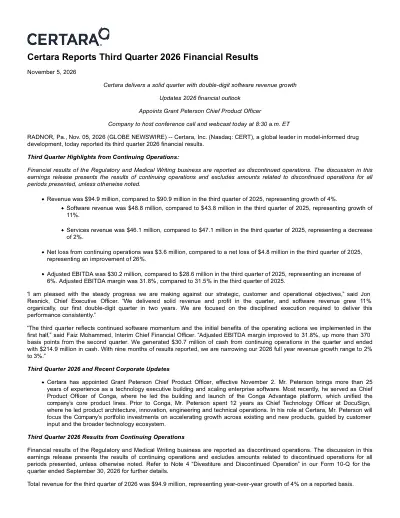
Revenue for the quarter was $94.9 million, up 4% year-over-year on a continuing operations basis. Adjusted EBITDA was $30.2 million, up 6% from the prior year, with a 31.8% margin, consistent with the operational actions that we have started to implement.
Today, we announced the appointment of Grant Peterson as Chief Product Officer. Grant previously served as CPO at Conga, and before that was CTO at DocuSign.
Grant's mandate is to focus our portfolio investments on accelerating growth in both existing and new products, guided by customer input and the broader technology ecosystem. Turning to software, in Q3, software revenue grew 11% to $48.8 million, our first double-digit organic software growth quarter in two years.
Software bookings were $46.9 million, up 15% year-over-year. Software now represents more than half of our revenue.
Notably, we are seeing growth across all of our core products, with momentum and opportunity for continued expansion. For Phoenix Cloud, we have now moved nearly 10% of all accounts to the cloud.
We expect future growth to be fueled by additional cloud conversion of our strong pipeline and adoption of our new AI offerings. For Pinnacle 21, we recently expanded a multi-million-dollar relationship with a strategic partner.
This is a good example of the adoption path for advanced tier modules of P21, MDR, Data Exchange, and CRF Creator. For Simcyp, we continue to see a high level of engagement from our customers and the scientific community, as well as historically strong renewal rates.
Our annual Simcyp Consortium meeting brought together our major customers in London to share insights, advanced modeling techniques, and shape the future of Simcyp software. We have previously shared the product and operational benefits powered by AI.
We are also leveraging our AI expertise in drug development to deliver an integrated AI platform that works across the drug development cycle. We believe our AI platform approach and direction will have the potential to fundamentally change how our clients can adopt the breadth of Certara's solutions.
Our early AI focus is to deliver our products as agentic components that can be integrated into customer workflows. Our AI path includes an MCP-enabled data integration platform that allows customers to access Certara's software and proprietary data.
We will continue to expand how we use AI to accelerate and broaden the delivery of our scientific content and applications. In 2027, we expect these new capabilities to further contribute to the growth and positioning of Certara.
These transformations have the potential to drive increased adoption, integration, and sales of our existing technology in three ways: by deepening software value to our customers and the connected development cycle; by creating new opportunities to engage with executive-level decision-makers; and ultimately, by introducing software-plus-services as integrated solutions to accelerate better decisions, whether dosing, trial design, or go/no-go determinations. Now, moving to services.
Service revenue was $46.1 million, down 2% year-over-year. Service bookings were $45.6 million in the quarter, with a trailing 12-month services book-to-bill of 1.15.
Over the past two quarters, we have divested non-core offerings, aligned software and services to take advantage of the flywheel, rebalanced our engagement model back towards specialists, and greatly expanded our customer outreach. The potential impact of these steps will take time to show in our numbers.
Still, we have seen some incremental improvement. Services revenue grew sequentially in Q3 by 3.5%.
Certara's scientific talent runs deep, with over 400 scientists holding advanced degrees, many of whom are recognized leaders in their fields with extensive peer-reviewed publications. Our experts play a critical role in shaping innovation and making biosimulation accessible to our customers in drug discovery and development.
Our leadership position is evidenced by the work we do for our customers. Most recently, we supported a top 10 European pharmaceutical client with a model-based meta-analysis applied to obesity treatment trials.
This novel quantitative approach allowed the client to optimally position the Phase 3 asset in a crowded field across different mechanisms and endpoints. We worked with a US-based biotechnology company to predict the first-in-human starting dose for its in vivo CAR-T candidate using our QSP CAR-T model, optimizing safety and efficacy for the asset.
We partnered with a US-based company that is licensing a novel compound from China. We are building models that connect early and late-phase studies to enable a Phase 3 FDA submission using Chinese and US data aimed at reducing redundant studies and accelerating the US filing path.
Finally, we're supporting a US biotechnology company that is advancing assets other developers set aside for rare pediatric cancers. Our teams use modeling and simulation to bridge existing clinical and non-clinical data to pediatric populations, allowing sponsors to make critical path decisions with more precision.
At Certara, we are strongest when we bring together all of our assets. In Q3, one of our major partners benefited from this approach, which contributed to their achieving a major milestone.
In this example, a biotech partner developing a novel oncology agent received approval under priority review for a cancer with historically few treatment options. This partnership spanned four years and more than two dozen Certara software and service solutions.
We began working with this team pre-IND and supported their clinical pharmacology organization all the way through a successful NDA, including drug interaction modeling, Phase 1 and Phase 2 PK analysis, and cardiac safety strategy. This exemplifies what differentiates Certara.
When our software, science, and regulatory expertise are integrated across the development path, partners get continuity and confidence, and we become embedded in how they make decisions. We see significant opportunities to replicate this model in the wider customer base, and we are organizing our strategies and our resources behind this approach.
To capture opportunities like this, we are reimagining Certara's commercial organization. Our new CCO is moving quickly to transform our customer engagement.
This transformation isn't just about selling with greater intensity. It's also about changing who we sell to and how we sell to them, leading with our science and innovation as we bring the full suite of our capabilities to our customers.
We are putting greater sales and marketing resources against segments like biotech, mid-sized pharma, CROs, and expanding our commercial footprint globally. To better reach mid-sized and biotech customers, we have developed outreach that leverages refined criteria, such as therapeutic areas or modalities, where our proven case studies are directly and immediately applicable.
For example, our success using modeling to support regulatory filings for GLP-1 therapies has resulted in increased outreach to other customers working in that therapeutic area. We're engaging emerging biotech early, before they scale.
In September, our Boston Biotech Forum drew 90 attendees from more than 70 companies. This programming is part of a larger campaign to deepen our relationships in this important sector.
APAC is relatively small for us today, but we see outsized growth potential. With this in mind, we have begun expanding in Asia, with roadshows in China, Japan, and Korea.
This approach has quickly brought us into contact with essential stakeholders in the region, notably including a delegation from the Korean government. We've also accelerated several operational improvements, including pricing reviews, incentives alignment, integrating our scientific experts into the sales process, a dedicated customer service function, and enhanced product training.
We have a distinguished history of sustained global regulatory relationships. We also continue to be at the forefront of certain important advances adopted by regulators.
This quarter, the FDA competitively awarded Certara contracts at CDER for its DataFit program, and CBER for its CBER-CV clinical data validation programs. The FDA has relied on Pinnacle 21 since 2011, and these awards extend that relationship at both centers.
The FDA also engaged our Simcyp team on a three-year research contract to advance biosimulation of dermal products. Certara is helping new approach methodologies, or NAMs, move from concept to routine use.
Our scientists work with global regulators and industry consortia to define what credible NAM evidence looks like. We advance our modeling technologies and work with customers on early use cases that test where these approaches can support regulatory decisions now and in the future.
The regulatory environment continues to evolve to favor MIDD adoption. In September, the FDA issued a direct final rule replacing the term animal tests with non-clinical tests across its regulations.
Operation Trailblazer is moving to execution, with the FDA's Expedited IND pilot now open. ARPA-H launched its SURPASS program on September 30th to fund simulation-driven adaptive trials.
The trend is global: ICH M15, the first harmonized guideline for MIDD, is now effective. Collectively, these recent regulatory developments point towards greater use of modeling and simulation across the development lifecycle, which is where our platforms, including Certara IQ and Simcyp, are focused.
In closing, 2026 is playing out in line with expectations. We are making progress against our priorities.
There's more work to do, and we remain focused. With that, I'll turn the call over to Faiz.
Faiz?
Faiz Mohammed
Thank you, John. Before I review the quarter, a reminder that my comments are on a continuing operations basis.
Results from the regulatory and medical writing business, which we divested on May 8th, are reported in discontinued operations, and our bookings results also exclude that business. As John said, the third quarter demonstrated meaningful progress against the priorities we set earlier this year.
Revenue increased 4%, led by 11% growth in software, and adjusted EBITDA margin improved to 31.8%, up more than 370 basis points from the second quarter. The quarter reflects continuing momentum and the initial benefits of the operating actions we implemented in the first half.
Turning to the income statement, total revenue for the three months ended September 30th, 2026, was $94.9 million, an increase of 4% year-over-year. Total bookings in the third quarter were $92.5 million, an increase of 4% from the prior year.
Trailing 12-month bookings were $409.2 million, an increase of 2%. Software revenue was $48.8 million in the third quarter, an increase of 11% year-over-year, driven by strong retention and continued growth across our major portfolios.
Trailing 12-month software bookings were $202.4 million, up 8% year-over-year. The results reinforce the underlying demand for our software portfolios.
Services revenue was $46.1 million in the third quarter, a decrease of 2% year-over-year. Trailing 12-month services bookings were $206.8 million, a decrease of 2% compared to the prior year, with a trailing 12-month book-to-bill of 1.15.
As John discussed, the transition to our specialist-led services model will take time to translate fully into bookings and revenue. Our focus remains on strengthening commercial execution and converting the pipeline.
Turning to profitability, the third quarter cost of revenues were $31.4 million, down 6% from $33.4 million in the third quarter of 2025, despite revenue growth of 4%. The decrease in cost of revenues were primarily due to a $1.6 million decrease in equity-based compensation expense, a $0.4 million decrease in professional and consulting expenses, and a $0.3 million decrease in equipment and software expense, partially offset by a $0.5 million increase in employee-related costs.
Operating expenses for the third quarter of 2026 were $61.1 million, compared to $58.1 million in the prior year period, an increase of $3.1 million. The increase was primarily driven by a $4.8 million reorganization, severance, and executive recruiting costs.
Adjusted EBITDA for the third quarter of 2026 increased 6% to $30.2 million, compared to $28.6 million in the prior year period. Adjusted EBITDA margin for the quarter was 31.8%, up from 31.5% in the prior year period and from 28.1% in the second quarter.
The sequential improvement in margin reflects the operating actions we took earlier this year, as well as continued discipline across the business. The improved cost structure provides additional flexibility to invest in AI, cloud solutions, and new product offerings while maintaining our focus on profitability.
Turning to earnings, GAAP net income and earnings per share are both impacted by non-recurring items. The third quarter net loss from continuing operations was $3.6 million, compared to a net loss from continuing operations of $4.8 million in the prior year period.
Income before income taxes improved by $2.7 million year-over-year. That improvement was partially offset by a $1.4 million change in income tax expense.
We recorded a $2.4 million tax provision this quarter, compared to a $1 million tax provision in the third quarter of 2025. Adjusted net income for the third quarter of 2026 was $13.5 million, compared to $13.8 million in the prior year period.
Diluted loss per share from continuing operations was 2 cents, compared to a loss of 3 cents in the third quarter of 2025. Adjusted diluted earnings per share for the third quarter of 2026 were 9 cents, compared to 9 cents in the third quarter of 2025.
Moving to the balance sheet, we ended the quarter with $214.9 million in cash and cash equivalents, up from $184.1 million at the end of the second quarter. The increase in cash primarily reflects $30.7 million of cash from continuing operations, supported by strong collections and working capital timing, and approximately $9 million of proceeds related to the divestiture.
As of September 30th, 2026, we had approximately $293 million outstanding on our term loan and $100 million available under our revolving credit facility. Our liquidity remains strong and provides flexibility to support our strategic and capital allocation priorities.
Turning to our revenue outlook, we are narrowing our 2026 full-year revenue growth range to 2% to 3%. We continue to expect software revenue growth to be above this range.
For services, we continue to expect it to be at or below the low end of that range as we work to convert our pipeline into bookings and revenue. Turning to our margin outlook, our previously communicated full-year adjusted EBITDA margin outlook was 29% to 31%.
Based on our performance through the first nine months of the year, we believe this remains an appropriate margin range for the fourth quarter. Our third quarter adjusted EBITDA margin of 31.8% reflects favorable software mix, continued expense discipline, and the savings now running through our cost base.
We expect these benefits to support profitability in the fourth quarter, while recognizing that quarterly margins may vary based on revenue mix and timing. Finally, we are updating our full-year 2026 adjusted EPS to 31 to 34 cents, reflecting greater visibility into our full-year performance.
Fully diluted weighted average shares are expected to be in the range of 155 to 157 million, and we are modeling an effective tax rate in the range of 25% to 30%. Overall, the third quarter represented an important step forward.
Software growth remained strong, adjusted EBITDA margin improved meaningfully, and the actions taken earlier this year are beginning to produce a more efficient operating model. We remain focused on maintaining that operating discipline, improving services execution, investing in our highest-priority initiatives, and delivering value to our shareholders.
With that, we will open up the call for questions. Operator, can you please open the line?
Operator
Thank you. We will now begin the question-and-answer session.
If you're dialed in and would like to ask a question, simply press * then the number 1 on your telephone keypad. Your first question comes from the line of Kevin Caliendo with UBS.
Your line is now open.
Tucker Remmers
Hello, this is Tucker Remmers on for Kevin. Can you parse out the improvement in software revenue and bookings between just demand environment improving and then the steps you've taken to enhance Certara's offering?
Was it the larger tier 1 and 2 customers responsible for the software growth, or was it really the tier 3 customers that have benefited from stronger biotech funding of late?
Jon Resnick
Hi, Tucker. Thanks for the question.
I think, look, to start with, I think like others, I think the end market looks strong. I think what's seen across the industry, I think we're seeing the same thing here.
From a software standpoint, we saw a strong performance across customers, across tiers, and across products, it's tough to discern a specific trend in one way or another. I think execution certainly is part of the story.
If we look across businesses and across layers, I think we executed pretty well.
Tucker Remmers
Then if I could follow up quickly, I think you previously targeted $10 million of cost savings. Can you talk about where Certara stands on that, and have you identified any further cost-saving opportunities?
Jon Resnick
We didn't give specific numbers this quarter. I think last quarter we talked about exceeding $12 or $13 million of run-rate cost savings.
I think that has continued to grow. I think some of the margin improvement that you saw in Q3 is as a direct result of some of the actions that were taken particularly in May and June last year.
I'd say just as a management philosophy and as an approach to this, this is not a one-off. We're continuously looking at the organization for opportunities to do things smarter, to do things simpler, to do things more efficiently, as we invest in areas of higher growth.
It's a continued and always area of focus.
Tucker Remmers
Understood. Thank you.
Jon Resnick
Thanks, Tucker.
Operator
Next question comes from the line of Michael Cherny with Leerink Partners. Your line is now open.
Dylan Finley
Thank you for taking the question. This is Dylan Finley on for Mike.
Congrats on the quarter and really on the software growth inflection. You called out 11% organic growth.
Maybe if you could give us some context behind the inflection here, drivers to the upside. How ultimately do you see the sustainability of this type of double-digit growth?
Jon Resnick
Thanks for the question, Dylan. Look, the nature of our business happens to be a little bit diverse.
We have different types of software and different types of things. Some of them are ratable, some of them are on-prem, there's always a little bit of bumpiness quarter-to-quarter in terms of timing of different elements.
It's never going to be kind of one-for-one smooth just given the mechanics that exist. We do believe, and I think we went to length in the opening statement to talk through what we saw as some of the expansion path and growth path are on our existing products.
We also, increasingly as we move into next year, we'll also see opportunities for new products for growth. We think that this is pretty durable.
It may bounce around from quarter to quarter. It may move just based on timing of some of these elements.
I'm very focused on trends like trailing 12 months. You referenced the 11% bookings number.
I think I've historically cited also the 0.8% trailing 12-month number that was at the Q4 versus where we sit today. I think those trends are good.
It'll bounce a little bit quarter-to-quarter just depending on the mix of assets and other things, but we're seeing good execution. We believe we've got good path to move things forward across the portfolio.
Dylan Finley
Thanks. Then, just wanted to quickly hit on your APAC comments.
Last quarter, you talked to your first Simcyp win in China. This quarter, you called out APAC again more broadly as an appealing opportunity.
Is this taking the same toolkit and offerings that you have here domestically and in EMEA, importing it over there? Is this a near-term opportunity that you think you can capitalize on, or is this more of a longer-duration?
Yep.
Jon Resnick
Yeah. No, it's a good question.
Look, if you look across our revenue mix, you can see that APAC footprint is not as large as the rest of the business, which is a little bit disconnected to some of the larger trends we see in R&D where we see a large amount of total spend shifting to the region. We believe there's a number of our offerings which are incredibly relevant for Japanese, Chinese, and Korean companies who are looking to move into the United States.
We also think locally within markets there's unique opportunities for our software and services. Some of it will be very consistent with things that we do today, depending on the nature of the request.
Some of it will be slightly more tailored to local opportunities or meeting local budgets, there's a mix between the two. This is not a 2026 Q4 thing.
The initiatives have already started. The teams are already out in Tokyo and Seoul and across China.
We're also ramping the team. It's really going to be a '27 growth impact.
Dylan Finley
Thank you.
Operator
Thank you. Next question comes from the line of Dave Windley with Jefferies.
Your line is now open.
Dave Windley
Hi, good morning. John, in the years before you joined, the company made several acquisitions that skewed the mix a little bit more toward software.
In the prepared remarks, I thought you made a comment that was very definitively integrating software and services and going to market with that combination. I wondered if we could kind of zoom out a little bit and hear your philosophical view about the relative importance of software and services in the portfolio and how you're going to market with those two.
Thanks.
Jon Resnick
Hey, Dave. Nice to hear from you.
Look, I see the two as we think about our future incredibly complementary to what we do. I see opportunities for us to grow on both sides of the business, both improving and enhancing our existing products through new product launches, through that connection layer that you referenced.
I also spent some time today outlining some of the work that we deal on the service side. We do phenomenal work, and we have phenomenal people within this organization who help to really support clients in unique ways.
Through a better execution model, I think there's a lot more growth on that side of the business. Look, you'll see this business kind of meet its customer where it needs.
If a customer has sophisticated clin-pharm groups and is able to execute and wants to license our software, we'll be there to meet and match that with top-notch products that are used by power users and others within the organization to execute studies. For other customers who need support through incremental experts or program management, we're also there to match them and work with them.
This business, I think the case studies that we referenced in here today really show that we're at our best when the two come together and we're able to work with our technology and partnership to solve those strategic issues. My expectation, as I've signaled, though, would be as long as you think of the business in those two segments, software will continue to outpace services as a growth layer, but there is a very nice flywheel effect and complementary element to the way we can support clients across the two.
Dave Windley
That's helpful. Thank you.
My second question, follow-up question, gets into your Chief Product Officer hire announcement and the goals to move clients toward a portal engagement experience, ratable software, kind of all the things that go along with that, and what's kind of a picture of the journey on that? How much have you gotten clients to move toward more of a cloud-based product engagement experience, and then the CPO's job to accelerate that?
Jon Resnick
Super excited to have Grant as part of the team. He's got a very distinguished background, really, I'd say is the right person at the right time given his unique experience, operational discipline, and his ability really to move quickly.
What we've asked him to do really is twofold. One, help us optimize our existing portfolio, help us with our inline products, our current products, help optimize our roadmap to optimize performance, really bring the customer voice deeply into it so that we can satisfy the unique needs and the expansion paths that are within that.
Two, you mentioned inorganic path historically. We'd like to be a best-in-class product developer on our own with new products and other things, and so we have a number of plans that we're looking at into '27 and things under development.
The ask for Grant is really to help the execution of that in the most impactful way we possibly can and the most cost-efficient and a return-on-investment way that we possibly can. That's Grant's role.
I think as we look across the business, and I'm always reticent to give a number, the number in my mind, something a little bit north of 50% of our product portfolio is cloud versus on-prem today. It's maybe slightly more than that.
We obviously laid out a migration path for Phoenix, which will take that number up pretty consistently over the next few years. We also talked today about the integrated AI platform, which we've kind of talked about in the past a little bit, gave a little bit more specificity about how that will work in a complementary way with our current data and products.
This will allow clients to do from their own frontier model with their preferred agents, we'll be able to tap into our software and data in a consistent way. We view that in the near term less as a standalone platform or portal where they have to buy an incremental asset or integrate into a particular product, but as a lift to all of our products where they become more accessible, you can move data around in a more consistent way, and you can get more power out of what you're doing.
We're pretty measured in terms of what you can do today in the near term, in the midterm against that, and our plans are getting clearer and clearer in terms of growth opportunities.
Dave Windley
Great. Thank you.
Operator
Next question comes from the line of Brendan Smith with TD Cowen. Please go ahead.
Brendan Smith
Great. Thanks for taking the questions, guys.
Congrats on the quarter. Maybe one more kind of on the revenue mix here.
You mentioned some of the work you guys are doing kind of internally on your go-to-market strategy for services. I think especially this quarter, we've been seeing some evidence across the sector of pharma and biotech spending starting to recover pretty meaningfully, which seems like you're seeing pretty clearly in software.
I guess, is there anything you're hearing even qualitatively in conversations with customers to help us just understand the gap in their interest in software versus services right now? Is any of that maybe being driven in one way or another by kind of the customer adoption of AI/ML on their side, or just anything else that we should be aware of potentially kind of driving their relationship with the Certara platform?
Jon Resnick
Thanks, Brendan. No, look, I don't think there's any end-market distinction.
I've said it before, and I'm very solution-oriented moving forward on this. I think our service performance is really a result of changes we made from a go-to-market standpoint and from an operational standpoint a couple years ago.
We've rectified and changed a number of those. We put the specialists back into the market.
We've changed our focus. We've changed our incentives.
That's going to be the thing that's going to drive this. The work that we do is outstanding.
The demand for our work is incredibly high. We just need to have our teams out in front of the right people having the right conversations in the right ways.
That business will continue to progress and get stronger as we move forward. I don't see a structural difference between the demand between the two.
It's really our ability to go out and execute and our ability to go out and talk to the right clients about the right issues. No, I think that as these changes kind of bed in we're now in the second quarter of making those changes, we'll start to see that translate into revenue growth on the service side as well.
Brendan Smith
Got it. Okay.
Thanks very much. Then, maybe one actually on the NAMs work, and you gave some good color there, John, on some of the stuff you guys have been doing there.
Can you maybe just expand a bit more on some of the work you've been involved with regulators? I think you mentioned the pilot study now being live with FDA.
I guess, is Certara involved with that pilot NAMs study, and maybe even bigger picture, I guess if that's successful, how do you guys think about the potentially incremental opportunity there just from a commercial revenue standpoint, and any color on how we should be thinking about that? Thanks.
Jon Resnick
Yeah. Look, I think one of the points we wanted to emphasize today was we're actively involved around the world with regulators both as kind of thought partners and as clients, and there's been a lot of fantastic movement, as we've talked about before, in regulations expressing an interest in a number of NAM fronts in experimental and more diverse approaches.
We are working formally and informally with regulators and with clients directly and exploring how these use cases will be received by the regulators, how they're interpreted, and there's kind of what I define or describe as a diffusion curve where you initially kind of see that the science exists, where you can start to develop new methods to do something. You get regulations out.
You get a couple innovators who are trying to get proof of concept on that. Once those use cases get worked out and accepted by regulators, then you have the ability to drive greater acceptance and greater awareness across the industry.
I'd say we're kind of between Phase 2 and Phase 3 for a lot of those NAMs where regulations are out, clients are starting to experiment, we're partnering with them on those innovative use cases, and when you start to get the impact of those use cases and the regulators around the world accepting that, then you're going to start to see greater diffusion broadly. That's where we are, and yes, we're an active player on all fronts there.
Brendan Smith
All right. Makes sense, guys.
Thanks.
Jon Resnick
Thanks, Brendan.
Operator
Next question comes from the line of Craig Hettenbach with Morgan Stanley. Please go ahead.
Katie Bennorth
Hi, everyone. Katie Bennorth on for Craig.
Just to double-click on AI, what proof points can you point to on how it's impacting your business today, and what does the roadmap look like?
Jon Resnick
Sure. Thanks, Katie, for the question.
A few fronts. As we kind of think about this, I think about it multi-dimensionally.
If I go back to kind of the January, February, March timeframe, the suite of initial questions that we got were really focused in on how does AI change our kind of competitive positioning? I think we've worked carefully with you and with the market and understanding that both our software that's kind of deeply embedded on the regulator side, the scientific judgment, the regulatory use cases, really creates a nice position for us to continue to grow and be sound as you kind of think about the underlying proposition or the position.
We've talked a lot around some of the operational acceleration we've gotten internally in terms of ability to drive processes more efficiently to start to streamline some of the work steps for our service execution, the acceleration of our development timelines in terms of increasing functionality and increasing product value that we're creating. We've seen pretty dramatic increase, as I shared a lot of those percentages and actual impact statements in the last earnings call.
Where we're also talking today is about a go-forward strategy where we're working hand-in-hand with clients early on from a lighthouse standpoint around some of these kind of broader AI initiatives that we think will be the lift to the overall portfolio in the next 12 to 18 or 24 months. We see progress against all dimensions.
Katie Bennorth
Great. Thanks.
That's helpful. When you look at the two business unit segments, MIDD and ACE, what area are you seeing the strongest momentum today, and where do you see the greatest long-term upside?
Thank you.
Jon Resnick
Look, I think the rationale behind cutting the business into the two ones, they're both very strategic client issues. One, how do you run trials differently?
How do you adopt modeling? How do you bring it throughout your entire lifecycle?
Huge TAM, huge opportunity for us, one that Certara is known extraordinarily well for, where we feel very good about opportunities long-term. That organizational construct has really brought a lot of our resources together and has had us thinking much more strategically about external engagement, driving awareness, innovation, it's been super helpful construct.
On the ACE side, it's really around acceleration of data and acceleration of evidence, again another priority of regulators around the world and clients. How do you kind of streamline those processes to help move from data to evidence in a much quicker way?
Another place that we're naturally positioned, we have a number of products that are playing across that kind of data management and evidence continuum. In terms of growth in the quarter, I think we're seeing growth pretty fundamentally across all of them, as I mentioned, on the software side, and even true on the service side, all of our businesses are kind of moving forward pretty consistently at a good pace.
Hard to choose between the two of them. One's probably a larger addressable market than the other, but I think we're on the right track strategically and operationally on both.
Katie Bennorth
Great, thanks.
Operator
Next question comes from the line of Matt Hewitt with Craig-Hallum. Your line is now open.
Matt Hewitt
Good morning, and thanks for taking the questions. Maybe first off, just to follow up on Brendan's question earlier regarding the advances on the regulatory side of things, do you see that as becoming maybe a '27 tailwind?
It sounds like customers are looking at use cases now, but do you see that becoming more of a driver next year, or do you think that it might take a little bit longer given that we're still kind of working through some of the details?
Jon Resnick
When you think of NAMs, it's not one. There's lots of different things that are happening in market, and different regulators are working at different paces on this, and international bodies, it's kind of tough to answer.
It's not just regulations. It's also their different rate and pace for different modalities and different approaches.
The overall diffusion curve will vary based on a number of factors. We do already see in 2026 a lot of work where clients are experimenting with different approaches and we're leading on use cases.
As you start to think about that, a bunch of these getting mature, it'll take time, but we're working on things in 2026, we'll continue to work on things in 2027, and moving forward from there. There are dozens of different approaches with very different answers across modalities and therapeutic areas and questions, and they're all kind of moving at their own pace.
It's good, I think it's all net beneficial to us. We're well-positioned to sit at that intersect between what regulators are looking for and how clients are trying to adapt to some of those things, but it's hard to give a general answer to it.
They're all going to kind of move at their own speed and pace.
Matt Hewitt
Understood. Then, maybe a second question regarding the Phoenix Cloud conversion.
Where are you with that, and how much of a headwind is it? Obviously, when you go from on-prem to hosted, you go to this ratable model.
It creates a bit of a near-term rev rec headwind. I'm just curious how much of an impact you're seeing there, and when do we kind of crossover and start to see the benefits of this?
Thank you.
Jon Resnick
Yeah. Thanks for the question.
I think I outlined today that we've now crossed or we're approaching the 10% range for total customers, which was a little bit ahead of where we were expecting to get in the first year. Pleased with that progress.
I think we have ambitious plans for next year for accelerating that. You're exactly right.
It helps to accelerate bookings. It's the right thing for us long-term to be able to modernize the offering and to bring more value through the AI modules that we have.
There is a little bit of a revenue headwind that exists with it as you've kind of start to do some of those conversions. I don't have the exact number, but you're right.
The actual revenue growth is a little bit distorted. We're doing probably slightly better if you'd taken into consideration the impact of the cloud conversion.
Matt Hewitt
Got it. Thank you.
Operator
Next question comes from the line of Jared Haase with William Blair. Please go ahead.
Christine Rains
Good morning, it's Christine on for Jared. Thanks for taking our questions.
You mentioned you'd been implementing a pricing review as part of your strategic actions. Can you talk a bit more about this in terms of where you're seeing potential pricing misalignment prior, and any changes to your contracting structure you contemplate?
Jon Resnick
Sure. Thanks for the question.
Look, I think price is something that we're spending a lot of time considering. We haven't really done a lot to change anything in our pricing approach.
As a company, we have multiple different approaches in market today. What we're doing is really trying to understand how do we make our assets accessible, how do we try to make the value propositions clear to the extent that over time we'll be migrating to multiple products being used.
How do we help incentivize and encourage clients to use our software together and also to move it earlier into the lifecycle and across the entire lifecycle? When we say we're strategically reviewing things, we're really looking at this from a more client-centric way in terms of how do we optimize the juice on that side of things.
Our focus on contracting has really been for simplification, how do we kind of standardize terms, how do we standardize contracts across our clients, really improving operational effectiveness, making it easier to do business with us.
Christine Rains
Got it, makes sense. While you're not giving 2027 guidance, hoping you can help us think through the puts and takes for next year.
Currently, the Street is forecasting at a similar growth rate next year as your updated 2026 guidance. Wondering if, based on your backlog and visibility, if we should be more thinking of an acceleration, and maybe if mid-single digits is in reach?
Jon Resnick
We're going to hold off in terms of providing guidance until later in the year at this point. I've got no incremental updates to provide.
I think you can draw conclusions from some of the improving software performance and other things of what we're looking at, but I'm not at this point going to provide any further guidance.
Christine Rains
Thank you.
Jon Resnick
Thank you very much.
Operator
Next question comes from the line of Luke Sergott with Barclays. Please go ahead.
Luke Sergott
Great, I just kind of wanted to dig in on the full-year guide, and you guys had such a big step-up here in 3Q, and then the guide implies kind of a step-down there from 4Q. Just wanted to see if there's any pull forwards or any reason for the decel that's implied in guide from a top-line perspective?
Jon Resnick
Look, I I think we're just honestly being consistent, you know. I think we've said the same thing all year, and we're staying within that within that same range in the quarter.
Let's see where where things kind of net out. We're, doing an awful lot operationally to change the company.
We're doing an awful lot, new leaders and new approaches to do things. We're just being measured in in our approach to to providing this.
There's no new news in that except for kind of raising the lower end of of what we're doing here, there should be there should be no news. We're going to keep working hard to, to keep performing, but there's nothing there's no one-timers, there's nothing exceptional.
We're just being really consistent with what we said quarter-to-quarter to quarter. Then for
Luke Sergott
my follow-up, a lot of noise there from the medical writing takeout, but as we look at the gross margin improvement you guys have done, even ex that, we kind of calculate maybe 150-plus basis points benefit from getting rid of the medical writing, but still really significant step-up there. If you guys can just talk about what you've been doing there to improve that side of the equation?
Jon Resnick
I'm not 100% sure how to back into the analysis that you did, obviously ask Faiz. Look, I think there's a couple things on margin we're doing.
One, I think in the quarter, obviously software at 11%, it's going to provide a better overall gross margin. Margins across the two are healthy, but software margins are even healthier, to the extent that that's running at 11%, you're going to see some contributions there on the GM side.
Then, if you drop down a line below that, we did do a major shift in employees in RIF in May and in June which went into place in July. I think you're starting to see some of the contributions from that play out as well into EBITDA.
Luke Sergott
All right, great, thanks.
Operator
Final question comes from the line of Sean Dodge with BMO. Your line is now open.
Chris Charlton
Hey, good morning. This is Chris Charlton on for Sean here.
Thanks for taking our questions. Maybe going back to John's comments on the targeted outreach approach with small and mid-sized biotechs and the therapeutic or modality component of this, can you just share some more detail on how the commercial approach differs between large pharma versus small biotechs and how this fits into the broader go-to-market realignment?
Thanks.
Jon Resnick
Sure. As part of our new commercial model, we've really rethought both the who we're selling to and how we're selling.
We have tremendous opportunity in market. We know that we're not a huge company, it's how do you allocate your resources in the most effective way to have the best conversations?
What's essential to us is really kind of finding those companies that are going to benefit the most from our offerings and our capabilities. What you'll see us doing is focusing a little bit more on that mid-segment and a little bit more on biotech segment.
They're good clients with high need, need both our services and software offerings. We can be incredibly targeted.
We know which products, which modalities are going to benefit most from mechanistic modeling, we can be incredibly focused on those companies, and have our scientific teams and our teams out engaging those groups. We still are working very closely with Tier 1 clients.
They're the bedrock and foundation of our business. We have great existing relationships with them.
We're helping just to diversify in terms of building into that other segment. We can be, as we outlined, incredibly targeted in how we pursue this, and we can build kind of differentiated relationships like the one that we talked about.
The other thing we talked about on the commercial side was geography. We do see a lot of upside putting more weighting on our team into Asia, to Japan, Korea, and China specifically, where if you look at our overall revenue, it's a relatively small percentage relative to the market.
Those customers, we also do see very good partnering relationships on the CDMO and CRO sides, we're also dedicating teams on that. Our go-to-market model, you ask the question, how has the go-to-market model changed?
It's a different touch on each of those different groups. Their needs are a little bit different.
We're building teams internally that are capable of kind of handling those relationships and engaging it. Essential for us that everybody on our team is out, we've leaned out a lot of sales management and overhead from our organization, and we're really focused on content-based engagement across all the different segments.
Chris Charlton
All right, thanks, John.
Operator
Thank you. This will conclude our Q&A session.
I will pass it back to Jon Resnick for final comments.
Jon Resnick
Thanks, everyone, for joining today. Appreciate the opportunity.
Operator
Ladies and gentlemen, that concludes today's call. Thank you all for joining.
You may now disconnect.