Choice Hotels International, Inc.
Q3 FY2026 · Earnings Call TranscriptNovember 2, 2026
Operator
Ladies and gentlemen, thank you for standing by. Welcome to Choice Hotels International's third quarter 2026 earnings call.
At this time, all participants are in a listen-only mode. Following the prepared remarks, we will open the line for questions.
I will now turn the call over to Allie Summers, Senior Director of Investor Relations. Please go ahead.
Allie Summers
Good morning, and thank you for joining us. Before we begin, please note that today's discussion includes forward-looking statements as defined under US securities laws.
These statements are subject to risks and uncertainties that could cause actual results to differ materially from those expressed or implied. For more information, please refer to our filings with the SEC, including our most recent Forms 10-K and 10-Q.
These statements speak only as of today, and we undertake no obligation to update them. A reconciliation of any non-GAAP financial measures referenced in today's remarks is included in our earnings press release available on the Investor Relations section of choicehotels.com.
Joining me this morning are Dom Dragisich, our Chief Executive Officer, and Scott Oaksmith, our Chief Financial Officer. Dom will discuss our business performance and strategic progress, and Scott will review our financial results and outlook.
With that, I'll turn the call over to Dom.
Dom Dragisich
Thank you, Allie, and good morning, everyone. Before I turn to our third quarter results, I want to say how honored I am to be appointed President and Chief Executive Officer.
I'm grateful for the board's confidence, and I'm excited about the opportunity ahead for Choice Hotels. At our core, we are an asset-light franchisor serving value-minded travelers.
The principle is simple: when our franchisees succeed, we succeed. Our focus is on returning to the fundamentals that have driven our success for decades: strengthening our core franchise business, delivering greater value to franchisees and guests, and executing with greater urgency, accountability, and discipline.
Choice's operating priorities are clear. First, accelerate US net rooms growth and establish a sustainable growth trajectory.
Second, strengthen franchisee economics by further improving our commercial competitiveness, helping our owners capture more demand, lower their costs, and operate more effectively. Third, return to a more capital-efficient model that generates stronger long-term free cash flow.
In the third quarter, we made progress against all three priorities. Let me start with net rooms growth.
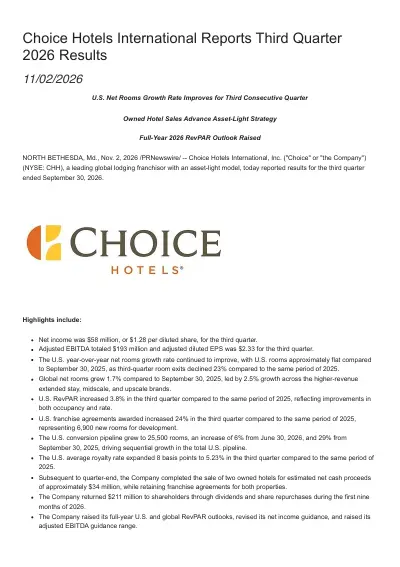
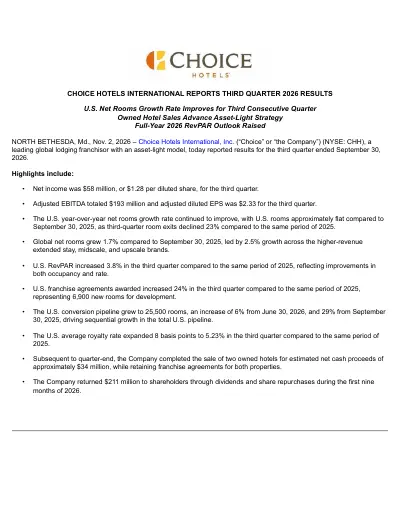
Our US net rooms year-over-year growth rate improved for the third consecutive quarter and is now flat. Together with continued international expansion, global net rooms increased 1.7% year-over-year.
As anticipated, we expect a more meaningful acceleration in US net rooms growth in the fourth quarter to approximately 1% year-over-year. US RevPAR increased 3.8% year-over-year, ahead of our expectations and a clear step-up from the second quarter, driven primarily by higher occupancy, with rate growth also accelerating.
We see further opportunity to improve rate performance over time as we advance our revenue management initiatives to optimize pricing. Demand growth was led by business travel, while leisure trends improved as the quarter progressed, reflecting the resilience of the value-minded travelers we serve.
World Cup demand contributed about 40 basis points to quarterly RevPAR growth. We also continue to benefit from infrastructure-related demand, including data center development.
Approximately 30% of our US hotels are located within 10 miles of a major data center, and those hotels delivered more than 400 basis points higher RevPAR growth than the rest of our system during the quarter. Importantly, our relative RevPAR performance also improved sequentially, an early indication that our commercial initiatives are helping us capture a greater share of demand.
The gap with the industry is narrowing, and we see further opportunity to improve our relative rate performance. Demand strength continued into October, with US RevPAR up approximately 7% year-over-year for the month, supported by gains in both occupancy and rate.
On that basis, we are raising our full year RevPAR and adjusted EBITDA outlooks. While we are encouraged by the acceleration in our core top-line performance, we recognize that higher in-year operating expenses have limited the full year benefit flowing through to earnings.
We expect expense growth to step down in 2027, allowing more of our revenue growth to translate into earnings. Scott will walk through the details.
Finally, on capital allocation, our historical hotel development programs are nearing completion. Capital recycling is underway, and we now expect significantly lower net capital outlays going forward.
Turning to US net rooms growth, we are focused on retaining and adding the right hotels to our portfolio. We are making steady progress in retaining hotels.
We're engaging franchisees earlier in the renewal process, with clearer accountability across our development and retention teams. Our focus is on improving retention while maintaining the quality and long-term economics of our franchise system.
As a result of this disciplined approach, approximately two-thirds of rooms exiting our system came from hotels ranking in the bottom quartile for guest satisfaction. These exiting hotels generated approximately 25% less royalty revenue per hotel than the system average.
US room openings increased 17% year-to-date, despite declining in the third quarter against strong prior year comparisons. We expect strong growth in US room openings for the full year, supported by our historical year-end opening patterns, with roughly one-third of annual US room openings typically occurring in the fourth quarter.
Conversions remain an important advantage for Choice. We've reduced the cost of joining our system and tailored property improvement requirements to focus on what matters most to guests, making conversions faster and more attractive to owners.
Of the US conversion rooms opened year-to-date, approximately two-thirds opened within just three months of signing. We're also seeing strong development activity that supports future rooms growth.
US franchise agreements increased 24% year-over-year in the quarter, and our US conversion pipeline grew 29% year-over-year and represents over one-third of total pipeline rooms. Together, improving retention and continued development activity are strengthening the foundation for sustained US net rooms growth.
Stronger franchisee economics are fundamental to sustaining rooms growth. When owners are more profitable, they are better positioned to reinvest in their hotels, renew their franchise agreements, and grow with us.
Over time, that translates to more durable earnings and stronger free cash flow for Choice. Over the past two months, I've met directly with more than 900 franchisees across the US and Canada.
I've come away energized by the positive tone of these conversations and the alignment I'm hearing around our shared priorities. To help franchisees grow revenue, our biggest opportunity is capturing a greater share of demand from the value-minded travelers we serve.
We're beginning to see encouraging results from our commercial investments, reflected in improving relative RevPAR performance. Choice Privileges is a good example.
Since the relaunch earlier this year, new members who have stayed with us generated 12% more revenue per member than comparable new members last year. The program grew 7% to 78 million members, while Choice Privileges members' share of revenue increased by more than 140 basis points year-over-year during the quarter.
We recently added point sharing to give members more flexibility in how they use their rewards. Choice Business Direct is also expanding our reach among small and medium-sized businesses, with approximately 75% of enrolled businesses new to Choice.
Since its launch in May, revenue from existing customers who adopted the platform has increased 25% year-over-year, contributing to growth in our broader small and medium-sized business segment, where revenue increased 18% year-over-year in the third quarter. Our AI-enabled easy-bid platform is helping owners win more group business, improving RFP win rates by 210 basis points and supporting 27% year-over-year growth in group revenue during the quarter.
We're also adapting our digital content strategy as travelers increasingly use AI-powered search tools. Our investments in richer, more relevant hotel content are helping improve discoverability across these platforms.
While still a very small share of overall website traffic, visits to choicehotels.com originating directly from large language models increased more than tenfold year-over-year in the third quarter. To help franchisees lower costs, we are focused on making our hotels more affordable to build, convert, and operate.
Building on the prototype and procurement savings we discussed last quarter, we've reduced reputation management fees by approximately 30% through our AI-enabled smart response tool. We've also introduced targeted fee incentives for hotels that achieve strong guest satisfaction and operating performance.
In addition, we're improving distribution economics to generate additional savings for franchisees and expanding the pilot of Charlie, our AI teammate within the property management system, to simplify routine tasks. Together, these initiatives strengthen the value we deliver to franchisees, supporting stronger retention, future development, and sustainable, capital-efficient rooms growth.
Our third priority is returning to our asset-light franchising roots. Our hotel development investments helped establish and grow Cambria and Everhome Suites.
With our own development programs winding down, we're reinforcing our focus on franchise-led growth and beginning to unlock capital from our owned hotel portfolio. We've already begun that process.
Since quarter-end, we've sold two owned hotels while retaining franchise agreements for both, preserving recurring franchise revenue. Returning to our asset-light roots also means being disciplined about where we invest for growth.
Harvest Hosts is one example. It's an asset-light subscription platform with recurring revenue that expands our reach into complementary outdoor travel, serving customers whose travel preferences align closely with those of Choice's value-minded guests.
Harvest Hosts has approximately 300,000 subscribers. Based on our consumer insights, we estimate that approximately 2 million Choice Privileges members participated in RV travel over the past year, highlighting a significant opportunity to expand Harvest Hosts' reach.
We underwrote the acquisition based on Harvest Hosts' standalone economics, with potential benefits from Choice's loyalty and commercial capabilities representing upside. Harvest Hosts will continue operating independently under its existing leadership, complementing our core hotel franchising business and expanding our opportunities for asset-light growth.
The value-minded travelers we serve continue to demonstrate resilience, supporting travel demand across our system. Looking ahead to 2027, we see opportunities to build on this progress through continued US net rooms and RevPAR growth, supported by our strengthening commercial capabilities and the operational changes we've made across the business.
I also want to thank our associates and franchisees for their continued commitment to Choice and the guests we serve. We are confident in our ability to translate this operating progress into stronger financial performance, more consistent results, and sustainable long-term value for our shareholders.
With that, I'll turn the call over to Scott.
Scott Oaksmith
Thanks, Dom, and congratulations again. I look forward to working closely with you as we execute on our priorities and drive stronger performance.
Good morning, everyone. This morning, I'll cover our third quarter financial results, the key drivers of our performance, and our updated full year outlook.
Third quarter adjusted EBITDA was approximately $193 million, up 1% year-over-year. Revenues, excluding reimbursable revenue from franchised and managed properties, increased 3% year-over-year to $285 million.
Adjusted diluted earnings per share increased approximately 11% year-over-year to $2.33, benefiting from higher franchise and management fees and share repurchases. As we highlighted last quarter, our third quarter 2025 results included elevated liquidated damages revenues, which declined approximately $6.2 million year-over-year, consistent with our improving franchisee retention.
Excluding liquidated damages from both the current and prior year quarters, adjusted EBITDA and revenue each grew approximately 5%. Underlying performance benefited from higher US royalties, driven by stronger RevPAR and royalty rate expansion, along with growth in franchisee programs and services revenues, and higher international revenues.
These benefits were partially offset by higher adjusted SG&A expenses, which I'll discuss shortly. Turning to RevPAR, global RevPAR increased 3.9% year-over-year in the third quarter on a currency-neutral basis.
As Dom discussed, US RevPAR increased 3.8% year-over-year, driven by a 160 basis point increase in occupancy and a 1% growth in rate. Performance was strongest in the West South Central and Midwest regions.
International RevPAR increased 3.7% year-over-year on a currency-neutral basis, with growth across all regions led by a nearly 9% increase in the Caribbean and Latin America. Turning to net rooms growth, global net rooms increased 1.7% year-over-year, reflecting continued international expansion.
In the US, net rooms were approximately flat year-over-year, with room exits declining 23% and gross room openings declining 8% against strong prior year comparisons. Importantly, US room openings increased 17% year-to-date.
As Dom discussed, we continue to expect stronger fourth quarter openings, with conversions expected to represent approximately 90% of our 2026 US room openings. Extended stay remains a key growth driver, delivering 13 consecutive quarters of double-digit rooms growth and representing more than 40% of our US pipeline.
We also recently opened our 600th extended stay hotel, marking another important milestone in the expansion of our portfolio. Beyond extended stay, we are seeing encouraging development activity across our core transient brands.
US franchise agreements awarded for our midscale and economy transient brands increased 10% year-over-year, while the pipeline for these brands expanded approximately 2% sequentially. Additional detail on our US net rooms trends is included in today's supplemental materials.
International net rooms increased 7.3% year-over-year, reflecting growth across EMEA, Asia Pacific, and the Americas. In Canada, net rooms increased 5.1% year-over-year, supported by our transition to a direct franchising model, which is increasing its earnings contribution and creating opportunities for future growth.
Our global pipeline also expanded sequentially, supporting future rooms growth across the system. Along with rooms growth and RevPAR, royalty rate expansion remains an important driver of our organic franchise revenue growth.
During the third quarter, our US average royalty rate increased 8 basis points year-over-year to 5.23%, reflecting a continued mix shift towards higher royalty brands and contractual rate increases, supported by the stronger franchisee value proposition Dom discussed. Beyond royalties, our franchisee programs and partnerships businesses leverage the scale of our system to generate additional fee-based revenue while strengthening franchisee economics.
Partnership services and fees decreased 2% to $28.3 million in the quarter, primarily reflecting the timing of certain revenues. We expect low to mid-single digit growth in this business for the full year.
We're also seeing growth across our franchisee technology solutions, driven by increased adoption of our revenue management tools and higher fee revenue from our cloud-based property management system. Adjusted SG&A increased approximately 5% year-over-year during the quarter, primarily reflecting higher accounts receivable reserves, certain one-time investments in strategic initiatives, and higher international operating expenses.
Separately during the quarter, we terminated an agreement involving an option to acquire a European hospitality business operating primarily under a lease-based model. The termination resulted in a one-time charge of approximately $24 million, which impacted reported net income, but is excluded from our adjusted results.
The termination eliminates any further funding obligations under the agreement. The decision reflects our disciplined approach to capital allocation and our focus on directing capital towards opportunities aligned with our asset-light franchising strategy.
Turning to capital allocation, our transition back to a more asset-light franchising model continues to progress. Year-to-date, net capital outlays for hotel development declined 56% year-over-year to $36 million, as we completed our own Cambria development program and continued winding down our remaining Everhome investments.
We now expect full year 2026 net capital outlays for hotel development-related activities to be approximately $20 million, compared with $103 million in 2025. We expect development capital outlays across our owned hotels and joint ventures to decline substantially from the approximately $70 to $75 million projected for 2026, with only minimal funding needs expected after the first half of 2027.
We've also begun recycling capital. Subsequent to quarter-end, we completed the sale of two owned hotels, generating estimated net cash proceeds of approximately $34 million, while retaining franchise agreements for both properties.
We expect an additional hotel disposition in or before the first quarter of 2027, subject to customary closing conditions. Additional modeling information on these initial dispositions is included in our supplemental materials.
As Dom noted, we are positioning Choice to generate more proceeds from asset sales than we invest in development by 2027, as our remaining commitments decline and dispositions progress. Our initial focus is on Cambria, given its more established operating history, while allowing our recently opened Everhome hotels time to mature before pursuing dispositions.
We are taking a disciplined, asset-by-asset approach to maximizing value while preserving long-term franchise relationships. Transaction timing and economics will vary based on individual property performance, operating maturity, and market conditions.
Separately on October 1st, we completed the acquisition of Harvest Hosts for approximately $130 million in cash and revolver borrowings. For the 12 months ended September 30th, Harvest Hosts generated approximately $33 million in revenue and approximately $11 million in adjusted EBITDA.
We will begin consolidating Harvest Hosts' results in the fourth quarter and provide additional modeling context with our 2027 guidance in February. We expect Harvest Hosts to support growth without requiring significant incremental capital investment.
Our capital allocation framework remains unchanged. As we transition back to a more asset-light model, we will continue to prioritize attractive return investments that support long-term growth, maintain a stable dividend, and return excess capital to shareholders through share repurchases.
Turning to the balance sheet, we ended the quarter with total liquidity of $928 million and a net leverage of 3.2 times adjusted EBITDA, within our targeted range of 3 to 4 times. Our quarter-end cash balance reflects borrowings made in advance of the October 1st Harvest Hosts acquisition.
Following the acquisition, net leverage remains within our targeted range. In August, we completed a $500 million term loan refinancing, lowering our borrowing spread and increasing available capacity under our revolving credit facility.
During the first nine months of the year, we generated $122 million of operating cash flow, compared to $185 million in the prior year period. The year-over-year decline primarily reflected the contract termination payment, higher franchise agreement acquisition costs associated with increased year-to-date US openings, and higher marketing and reservation system reimbursable expenses.
For the full year, we expect a net marketing and reservation system reimbursable deficit of approximately $135 million, reflecting elevated investment in franchisee-facing and guest delivery capabilities. As a reminder, these programs are structured to operate at a breakeven over time, and we expect the deficit to begin narrowing in 2027.
Through September 30th, we returned $211 million to shareholders, including $172 million through share repurchases and $39 million through dividends. We now expect repurchases of approximately $200 million of shares for the full year.
Based on our third quarter performance and the underlying operating trends we've discussed today, we are raising our full year US and global RevPAR outlooks and our adjusted EBITDA guidance, while narrowing our adjusted EPS range. We now expect full year 2026 adjusted EBITDA of $641 million to $651 million, raising the midpoint by $3.5 million.
Our updated outlook reflects stronger global RevPAR expectations and higher US royalty rate expansion, partially offset by higher adjusted SG&A. The fourth quarter contribution to adjusted EBITDA from Harvest Hosts, net of the impact of our recent hotel dispositions, is expected to be approximately $1 million.
We are narrowing our full year adjusted diluted earnings per share guidance to $6.92 to $7.07. The updated range reflects higher expected adjusted EBITDA, offset by higher interest expense and lower expected equity in earnings of affiliates.
We now expect full year US RevPAR growth of 1.5% to 2.5%, and global RevPAR growth of 1.5% to 2.5%, reflecting stronger underlying operating trends and continued commercial execution. Based on the midpoint of our updated full year outlook, we expect fourth quarter US RevPAR growth to be higher than the third quarter, supported by the momentum we've seen into October.
We estimate the full year benefit of the FIFA World Cup at approximately 30 basis points. We now expect US average royalty rate expansion of approximately 9 basis points for the full year, incorporating tougher comparisons in the fourth quarter.
We continue to expect approximately 1.5% global net rooms growth for the full year, supported by international expansion and a more meaningful acceleration in US net rooms growth in the fourth quarter. In the US, we expect net rooms growth of approximately 1% by year-end, supported by improving year-over-year retention, seasonally stronger fourth quarter conversion openings, and more favorable year-over-year comparisons.
We expect strong year-over-year growth in the US room openings for the full year, and continue to anticipate an approximately 250 basis point improvement in the US net exit rate compared with last year. Excluding Harvest Hosts, we now expect full year adjusted SG&A to increase approximately 9% year-over-year, compared with our prior expectation of mid-single digit growth.
This reflects increased spending on certain strategic initiatives and AI-enabled capabilities, along with higher accounts receivable reserves. We do not expect the same level of spending on these initiatives next year and anticipate adjusted SG&A growth, excluding Harvest Hosts, moderating to the low to mid-single digits in 2027.
With development capital requirements expected to decline substantially in 2027, capital recycling underway, and the reimbursable deficit expected to begin narrowing, we see an opportunity to strengthen free cash flow generation over time. Overall, our third quarter performance reinforces our confidence in the progress we're making against our operating priorities.
We're focused on translating these improvements into consistent results and sustainable long-term shareholder value. With that, Dom and I are happy to take your questions.
Operator?
Operator
Thank you. We will now begin the question and answer session.
If you would like to ask a question, please press *1 to raise your hand. To withdraw your question, press *1 again.
We ask that you pick up your handset when asking a question to allow for optimum sound quality. If you are muted locally, please remember to unmute your device.
Please stand by while we compile the Q&A roster. Your first question comes from the line of Lizzie Dove with Goldman Sachs.
Lizzie, your line is open. Please go ahead.
Lizzie Dove
Morning. Thanks for taking the question.
I wanted to ask about US rooms growth. Obviously some progress there and it's a big acceleration implied in Q4.
Could you talk more about your confidence of that? I know you talked about some seasonality there, but also just more broadly what you're seeing in, particularly the conversion environment, given it's such a big driver for you, both in terms of Q4 and just longer term, given we've heard some kind of mixed commentary across the space this quarter.
Dom Dragisich
Absolutely. Thanks, Lizzie.
I'll take that one. As I had mentioned obviously in the prepared remarks, the net rooms growth is certainly my number one operating priority for the company.
Obviously, we've seen very strong quarter-over-quarter improvements in that net rooms growth figure, three consecutive quarters of improvements. When you take a step back, though, I think what's even better is that you are seeing strong results across all three component parts, right?
Where you have openings are up 17% year-to-date, exits are down 44% year-to-date, development agreements are up 36% year-to-date. That's really a good setup going forward, especially when you take a look at those development agreements.
When you take a look at the mix, it gives me even more confidence, right? Because we are still growing in that midscale plus category, but at the same time, we're seeing a little bit of a both-and.
I mentioned this last quarter, consistent progress, I think, leads to confidence, and we're sitting in a very confident spot heading into Q4. We mentioned historically about one-third of our annual openings typically occur in Q4.
Conversions are actually opening even more quickly. When you take a look at that side of the business with 90% of our openings this year really being conversions and just where you're seeing that conversion pipeline, we have a really good visibility heading into Q4.
Feel great about that 1%, frankly. Then when you just take a look at just the conversion-led model to your question around the sustainability and the setup for 2027, the conversion-led model that we have, it is a differentiator.
We think that this is absolutely momentum that's going to be sustainable as we head into 2027, feeling really good about the setup and feeling very good about the top operating priority for the year.
Lizzie Dove
Great. Then one follow-up, slightly different topic, but the relative RevPAR performance has obviously been a big focus for you guys.
We saw a little bit of sequential improvement. With these kind of commercial initiatives that you're working on, could you give us some color of just how the kind of phasing of that and how long you think those kind of take to kind of bear more fruit when it comes to the relative performance versus STR?
Dom Dragisich
Sure. Obviously, we're in the early innings of some of these commercial investments.
We talked about the $60 million or so spent last year into this year, which is also driving that marketing and reservation system fund deficit. Obviously, we've leaned in on the commercial side, but certainly encouraged by the RevPAR improvement and the progress that you saw.
You saw a pretty dramatic step-up from Q2 into Q3. We did narrow the gap, to your point.
Obviously, not where we want to necessarily be just on a relative basis, but we're seeing that gap continuing to narrow quarter-over-quarter again, much like the net rooms growth metric. Part of the gap was geography, customer mix.
We're underindexed urban, event-driven, that type of business. Again, the most important thing is that we have to be focused on what we can control and the execution.
You mentioned the commercial tools. We are encouraged most importantly that what we're seeing is an occupancy-led recovery.
When you think about those commercial capabilities, we have the easy-bid tool, we relaunched the loyalty program. I think the biggest game changer for us on the rate side of the house is going to be Rays, which is our rate management tool, brings together pricing, inventory, channel management all together in one place.
That's going to be rolled out this quarter. You're going to continue to see the benefits of that, obviously, as the ramp occurs heading into 2027.
When you take a look at the business side of the equation, we're already starting to see the results of those commercial investments. I think the most important opportunity that we have in front of us today is on this Rays platform, because it really is rate where we have the ability to drive additional performance.
You're going to see that probably showing up more in Q1, Q2 of next year, but again, I think the setup is there for a really strong 2027.
Lizzie Dove
Thank you.
Dom Dragisich
Thank you.
Operator
Your next question comes from the line of David Katz with Jefferies. David, your line is open.
Please go ahead.
David Katz
Hi, good morning. Appreciate all the detail.
I wonder if you could give us just a little more insight into what's available to be sold on the owned side, right? Help us gather an inventory and you're not going to guide us to a specific number, but notionally what's available to be sold.
I imagine you have some estimates that maybe you can qualitatively give us a little insight. Thanks.
Scott Oaksmith
Thanks, David. I'll take that one.
As we highlighted in our supplemental materials, we do have several hotels that are on the owned side that'd be able to sell. We own 17 hotels when you adjust for the two that we've sold in the fourth quarter.
Those are really the pool that we're focused on today. When you think about the total amount of capital related to that, we're really going to be focused more on the Cambrias today.
Those are more mature assets that we can move to sell those. Then as the Everhomes ramp up and are ready for disposition, those will come in the second half of that.
Today post-sale, we've got 11, excuse me, nine Cambrias left. We still have two Radissons left, and five Everhomes that we are ready to sell.
We're focused on the Cambrias. We've had some success, some early ones that we've sold here in the second, excuse me, the fourth quarter.
I have one more under contract that should close end of the quarter, beginning of next year, and continue to work through market by market of selling those. When you look at kind of the capital that's outstanding on that, as we've talked about in the past, really what we have is about $455 million coming into the quarter of owned assets available for sale.
That'll be reduced by about the $38 million of the assets that we talked about. That's kind of the pool we're working on today, about $330 million of that's Cambria.
David Katz
Perfect. Thank you.
Dom Dragisich
Thank you.
Operator
Your next question comes from the line of Dan Politzer with JP Morgan. Dan, your line is open.
Please go ahead.
Dan Politzer
Hey, good morning, everyone, and thanks for the question. I wanted to talk a little bit about free cash flow and the conversion in the quarter and how you think about that kind of evolving over time, especially to the extent you're starting to recycle more capital into 2027, any kind of way to also think about your kind of willingness to return capital to shareholders as that capital recycling ramps up?
Thanks.
Dom Dragisich
Sure. Let me hit it at a high level and then I'll hand it over to Scott for the details on just capital allocation and what not.
I think when you take a step back, we absolutely see a meaningful opportunity to really strengthen free cash flow generation in 2027. A lot of that is really what we talked about: returning to that asset-light franchising roots, a much more efficient capital model.
I see three primary drivers of that, right? Which is, first and foremost, it's the development capital requirements that are coming down significantly.
We talked about the fact that we are completing the owned hotel development, minimal funding needs now with only one hotel under construction through first half of 2027. We are seeing capital recycling.
We sold those two hotels. We expect that additional disposition in early 2027 and obviously going to continue to look for more dispositions.
Very importantly, I think, has really been the drag on the marketing and reservation system deficit in 2026. I talked about a lot of that is because of the commercial investments that we made, a lot of that in the first quarter of the year was softer RevPAR environment.
When you take a look at that, our ability to flex that as we head into 2027, and really the revenue makeup, obviously what gives me the most optimism to return to free cash flow improvements in 2027, it's the top line. You're seeing all three of our key revenue levers inflect with regards to net rooms growth, RevPAR, royalty rates continue to expand.
We think that that growth on the top line is very much sustainable heading into 2027. Those are all going to be tailwinds for us.
As it pertains to the actual conversion, I'll let Scott hit on that one.
Scott Oaksmith
Yeah. We see a meaningful opportunity to improve the conversion.
We're moving beyond a period of that elevated investment, now that we've achieved our strategic objectives. The capital intensity of the business should decline materially here going forward.
We talked about the development outlays being down 56% year-over-year and down 80% for the full year. As we look at our capital allocation hierarchy, first and foremost, we always want to invest in the organic growth of the business.
As we get back to more of our asset-light roots here, we don't expect a material amount of capital needed to grow on an asset-light basis. Really provides us the opportunity to return that excess capital to shareholders.
We still remain well within our targeted leverage levels. As we've talked about this year, we did give, for the first time, guidance on share repurchases now that we have more visibility into our cash flows, given the step-down in the capital outlays for self-development.
We expect that to continue and really to prioritize shareholder returns as we go forward.
Dan Politzer
Got it. Thanks.
Just to clarify, for the free cash flow conversion this year, any parameters to which to think about that, and then maybe going forward if we can get back to that 50 to 60% type range?
Scott Oaksmith
Yeah. Going forward, where you'll see the meaningful step-down, as Dom mentioned, is clearly on the marketing and reservation reimbursables.
We are completing a more heavy investment in that this year, we expect that to step down materially next year. To get us back over the next couple of years to that 55, 60% free cash flow conversion where we've been historically.
Dan Politzer
Got it. Thank you so much.
Dom Dragisich
Thank you.
Operator
Your next question comes from the line of Michael Bellisario with Baird. Michael, your line is open.
Please go ahead.
Michael Bellisario
Thank you. Good morning, everyone.
Dom, on M&A, should we think about real estate sale proceeds being used to fund more asset-light M&A like Harvest Hosts, or are those kind of separate buckets? Then maybe just also remind us of your view on sort of just appetite for a couple buckets: larger-scale M&A, sort of the more traditional hotel brand M&A, and then adjacent businesses like the Harvest Hosts deal?
Thanks.
Dom Dragisich
Absolutely. The Harvest Hosts deal was certainly opportunistic.
I would tell you that what Scott said is spot-on with regards to we're prioritizing organic growth first and foremost. Obviously, if there's smaller tuck-ins that are net beneficial both to our owners and our shareholders, we'll obviously consider that.
I think Harvest Hosts certainly fell in that bucket. We also think our stock is cheap right now, frankly.
I think, to Scott's point, there's a reason why we gave share repurchase guidance this year. It's the first time in my 10 years since I've been here that we provided share repurchase guidance.
We're trading at a historically low multiple, and we're seeing a lot of great inflection in the business itself. It's not to say that we wouldn't do something that's a little bit more tuck-in in nature, probably immaterial.
You mentioned Harvest Hosts, and I think broadly speaking, that was an acquisition that was very much aligned with the asset-light growth strategy, right? It was subscription-based, recurring fee model.
It expanded our reach into an outdoor travel segment that we actually were underpenetrated in. The reality is we underwrote this on a standalone basis.
It was an attractive return even without the overlap. Obviously, we think that there's tremendous overlap with the 2 million customers that we talked about on the call, 300,000 subscribers.
Even keeping this business as a standalone, we think that it's a really strong return. Then when you consider the CP overlap and what not, we think it's certainly more beneficial for our franchisees, as it pertains to other demand-driven opportunities for them in the future.
It could open up additional opportunities for them. The reality is we want to keep this thing as a separate business unit.
It doesn't distract from the core strategy. Most importantly, I think, as it pertains to that financial return for our investors as well.
I think it passes the litmus test both for the franchisees as well as our investors.
Michael Bellisario
Got it. Then just one follow-up on this termination payment.
Was this for a legacy deal, or is that something that sort of came and went in the last plus or minus three months?
Dom Dragisich
It was an opportunity for us. We actually had an option to purchase the business that eventually migrated to an obligation.
As I shared, we are very much focused on asset-light growth. This was a group, they were growing, they were supposed to continue growing through a franchise and managed operation, but their growth increasingly became lease-based.
While they were very healthy leases and it was a company with great growth potential, it just didn't align with the asset-light growth plans. We were not willing to take on additional lease exposure.
We weren't willing to put that capital at risk, to speak. The reality is we just made the decision to terminate the arrangement rather than pursue a transaction that no longer really aligned with those strategic priorities as a company.
Scott Oaksmith
Michael, just to answer your question, yeah, it was a legacy. We had this relationship going back four or five years now.
Got it.
Michael Bellisario
That's helpful. Thank you.
Dom Dragisich
Thank you.
Operator
Your next question comes from the line of Shaun Kelley with Bank of America. Shaun, your line is open.
Please go ahead.
Shaun Kelley
Thank you very much for taking my question. Congrats, Dom, on the permanent announcement here.
Just wondering if we could walk through a little bit of just the owned and leased bridge for next year, right? I think you guys gave a little bit of the comments around Harvest Hosts.
Scott, if you could just help us understand, one, where exactly is Harvest Hosts going to show up in the P&L? Then, two, net of sales and it sounds like with the third one coming here, directionally can you give us some sense on just how much O&L headwind to expect next year as that line item starts to kind of shift down both in revenues and more importantly on EBITDA?
Thanks.
Scott Oaksmith
Sure, no problem, Shaun. When you think about Harvest Hosts, most likely just given the size of it, we'll probably include it in our other revenue line item, and it will also flow through in the SG&A.
It's a pretty simple business. It's a subscription-based where the members spend annual subscriptions that range from $99 to about $180, and then primarily the cost are technology and customer acquisition.
Most likely, we're still working through those disclosures, but that's where that'll show up. When you think about the owned assets, the three assets that we are selling, they generate roughly about $12 million.
Excuse me, the ones that were sold were about $12 million in revenue and about $2 million for a full year in EBITDA. The one that's scheduled to be sold here at the end of the year is another $6 million and about $1 million in EBITDA.
Total revenues somewhere between $18 and $19 million with an EBITDA impact of about $3 million.
Shaun Kelley
Perfect. Thanks so much.
Operator
Your next question comes from the line of Stephen Grambling with Morgan Stanley. Stephen, your line is open.
Please go ahead.
Stephen Grambling
Hi, thank you. You mentioned in the intro remarks some improved distribution costs for owners.
Can you just elaborate on what you're seeing there, and perhaps remind us where your distribution mix is right now and how that may be changing, or what tools you're leveraging to do that?
Dom Dragisich
Yeah. I think distribution costs are obviously one big component.
Broadly speaking, unit economics for our owners and just the entire ecosystem is critical here. We talked a lot about some of the things last quarter with regards to reducing certain fees, piloting insurance program, FF&E costs, etc.
When you take a look at just the distribution costs, this comes down to just the improvements that we're seeing in the new loyalty program in particular. You saw about 200 basis points of loyalty increase, the loyalty contribution last quarter.
You're seeing that sustain into Q3. Overall, what we've talked about historically is proprietary is about 60% of our distribution into our owners.
The goal there is obviously continuing to increase that proprietary channel contribution to really protect our owner profitability. Broadly, we're continuing to lean in as it pertains to AI and really positioning Choice for the shift that you're seeing on the distribution side.
We have made choicehotels.com accessible to AI agents, which really allows them to search, compare rates, complete bookings. Early innings in terms of the ability to talk about how the distribution landscape is going to change as it pertains to the cost, but the reality is we think what's sitting in front of us right now gives us an opportunity to wedge traffic away from those OTAs and ultimately increase that 60% going forward.
Stephen Grambling
Thank you.
Dom Dragisich
Thank you.
Operator
Your next question comes from the line of Patrick Scholes with Truist. Patrick, your line is open.
Please go ahead.
Patrick Scholes
Thank you. Good morning, everyone.
As we think about earnings growth for next year, would you be so kind to just give us a refresher on some of the sensitivities, specifically, one point of RevPAR growth equals how much EBITDA? Same thing for net rooms growth, and then the royalty rate?
I checked on the website for any presentation, I didn't see any updates on those. Thank you.
Dom Dragisich
No problem, Patrick. Let me hit it at a high level.
As you think about just the building blocks as we head into 2027, obviously not going to give 2027 guidance, we're working through the planning process as we speak, but the building blocks to consider, first and foremost, it's on that operating side. The three core levers, we're entering 2027 with improving US rooms growth, stronger RevPAR trends, and the effective royalty rate.
Every 1% on both net rooms growth in the US and RevPAR is about $5 million each, and then one basis point of effective royalty rate is another million dollars. Again, we feel very good about the fact that you're seeing that momentum, and you see the opportunity on the rate side specifically as it pertains to RevPAR.
You also see sustainable growth, obviously, with international and our platform businesses as well. Then when you layer in obviously expenses, we think that there's going to be a meaningful step-down in SG&A to that low to mid-single digits.
You'll likely see, obviously a little bit more information as we enter 2027 here and we provide official guidance in February, but those are really the building blocks at the highest level, Patrick.
Patrick Scholes
Thank you for that update. All set.
Dom Dragisich
Thank you.
Operator
Your next question comes from the line of Robin Farley with UBS. Robin, your line is open.
Please go ahead. A reminder, if you are muted locally, to please unmute your device.
Dom Dragisich
Can you hear us, Robin?
Operator
Your next question comes from the line--oh, hi, Robin.
Robin Farley
Can you hear me okay?
Dom Dragisich
We can hear you, Robin. Now we can.
Robin Farley
Great. I was not muted on my end for any of that, but okay.
Thanks. The question I wanted to ask is going back to Q4 and the sort of acceleration in the domestic unit growth that you're talking about, it sounds like you're saying it's mostly going to come from the removal rate being lower.
I guess how do we think about that long term? If you get to a point of growth because of sort of a reduction in removals or a normalization of removals, what can we conclude about sort of next year and the year after in terms of domestic units?
Is it kind of back to maybe not necessarily growing if the growth here is really just coming from lower removals, or just how to think about that beyond just Q4? Thanks.
Dom Dragisich
Yeah. I think broadly it's a both-and.
I think we're going to see continued strength in terms of openings. I think, obviously we're up 17% year-to-date.
I think that that sort of trend can carry us into Q4. Frankly, just with the volume that you see in Q4 historically, obviously we're anticipating a really strong openings quarter coming up here.
Now, I think on the removal rate, what you're seeing broadly speaking is our exit rate is improving about 250 basis points, and we could actually see a slightly higher improvement than that, really returning back to our historical retention rates. We're feeling good about that side of the equation as well.
I do think it's what you're seeing right now, Q4 into Q1 of next year is absolutely sustainable. Obviously, the conversion-led model is an important advantage in this environment.
We have shorter development timelines. We have lower upfront investment costs, lower FF&E and conversion costs broadly speaking.
What we've talked about publicly is the goal is to eventually get back to that 2 to 4% net unit growth, or net rooms growth. Even in a new construction environment that is muted, you're seeing kind of 50 basis points or less of supply growth, we think that we can get to that 2% even with a conversion-driven approach, with 90% of our openings coming from conversions.
I think you're going to need to see some tailwinds from a new construction perspective to get to that higher end in the long term, but broadly speaking, we feel very good about 1% plus for this year, obviously continuing to build on that as we enter 2027. The ultimate goal is to get to that 2 to 4%.
Scott Oaksmith
As we move forward, Robin, our 2027 planning is still underway, but we would absolutely expect to see both an increase in openings year-over-year as well as reduced terminations. I think you can really look at our pipeline, see the success we've had, particularly in the US on the conversion pipeline, which is up 29% year-over-year and 6% sequentially over June 30th.
We're seeing a lot of momentum there. We're seeing our franchise agreement executions up.
They were up almost 25% in the quarter. We're seeing momentum on both sides.
It won't be just a retention-led growth going forward, but that's certainly a big piece of it and something we're focused on getting back to where we have been historically.
Robin Farley
Great. No, super helpful.
Thank you. Just one other number, and you've thrown out lots of data, I'm sorry if I missed this, but did you say what percent of real things are over what percent of your pipeline is using key money, just when you're talking about, kind of reducing what you've spent on new units or what you spent to get that unit growth?
What percent of your projects are using key money pipeline now, and what do you think that goes next year?
Scott Oaksmith
We haven't given out specifically the percentages, but I will say that we have seen an increased use of key money across the industry over the last couple of years. We are at more elevated than we have been historically.
Where we're encouraged is that we haven't seen the amount of key money needed per deal increase over the last 12 months or so. We've seen that crest, and in some brands come down a little bit.
I think that's really a reflection of the value proposition and what we're offering owners that we don't need to continue to offer key money to affiliate with the system. We're encouraged that it's cresting, and we do believe that over the next couple of years, we do think that will come down as an industry, particularly as the new construction environment improves, but certainly has been elevated over the last two to three years.
Dom Dragisich
Robin. I think the bottom line there is just when you take a look at just the cumulative increase in key money, a lot of that has to do with the stronger development activity, the stronger net rooms growth that we've seen.
Every deal continues to be evaluated on that long-term franchise revenue, the returns, we do IRR paybacks, etc. I think the most important thing that Scott said there is you're actually seeing the average incentive per deal come down through September or stay approximately the same.
Again, we're encouraged that we're doing all the right things there, and that we're actually seeing the progress on the top line as it pertains to the openings.
Robin Farley
Great. Thank you.
Dom Dragisich
Thank you.
Operator
Your next question comes from the line of Trey Bowers with Wells Fargo. Trey, your line is open.
Please go ahead.
Trey Bowers
Hey, guys. Thanks for the question.
I guess first just to put a finer point on that, I think the last time you gave us a key money update, it was around $120 to $130 million this year. Is that still the expectation?
It sounds like maybe you think that kind of flattens out or declines in the years to come, or is the expectation that's kind of the run rate from here? Thanks.
Scott Oaksmith
We did give that guidance. We expect to be towards the upper end of that guidance, but generally still holds.
In terms of the go forward, as Dom and I both mentioned, that we have seen the amount per deal hold, but we do expect an increase in openings here as we move forward. Really any increase in key money going forward will be more a reflection of either the mix of moving up higher up in the chain scales or the absolute number of openings for the key money to increase, but generally I think kind of this year's level, slightly elevated for more openings is a good modeling assumption.
Then
Trey Bowers
if I could just get a follow-up in. It sounds like you guys are placing the kind of revenue and EBITDA of these owned assets about $6 million and a million.
Is the expectation from here we continue to see a kind of $17 million per property and 17 times that property's EBITDA? Those seem like pretty great numbers.
I guess the last point of that, my quick math says that's around $130,000 per key for a Cambria. Any kind of further detail around the individual asset sales would be amazing.
Thanks.
Scott Oaksmith
Sure, Trey. It really varies.
We have product in many different markets, some of them in more secondary markets and some in urban, top 50 RevPAR markets. It's going to vary by asset.
The Columbia hotel sold at about 11 times multiple of its EBITDA. The numbers are skewed a little bit by the Radisson RED we had in downtown Minneapolis that was not a contributor to EBITDA.
The hotel was really struggling in that market as the whole market has been. That has pushed up the numbers a little bit.
I would say most of these assets will probably trade around an 8% cap rate.
Trey Bowers
Great. Thanks for the questions, guys.
Dom Dragisich
Thank you.
Operator
Your next question comes from the line of Brandt Montour with Barclays. Brandt, your line is open.
Please go ahead.
Brandt Montour
Great. Thanks for the question.
I first want to hit on the termination progress and just sort of the year-over-year cumulative year-to-date termination decline. I want to understand a little bit more about what's driving that.
I'm assuming you would not say that there's been a wholesale relaxation of brand standards, but in terms of maybe franchise agreement acquisition costs or key money, is there any money being applied to retaining some of those deals? If not one of the first two buckets, what is it that you would describe as driving that progress?
Dom Dragisich
I think a lot of it had to do with the investments that we made in 2025 that are starting to come to fruition. It was an area that we were laser-focused on.
I mentioned the fact that this was my top operating priority. If you think about just the investments that we made from a people, process, and systems perspective, really assigning accountability across the development lifecycle, both on the opening side as well as on the retention side, we enabled our field teams with better systems, better processes, etc.
We got ahead of expirations. I think in a lot of cases, if you look back to 2025 and previously, we were stubbing our own toes, to speak, and we were fighting with one arm behind our back as it pertained to not having this information at our disposal.
I think we also had a pretty significant set of expirations based on a lot of the Comfort cleanup that we had previously done, which was back in 2013, 2014. When you look at it from a timing perspective, there were a lot of windows and expirations.
We took an opportunity last year to really exit the lowest performers. When you take a look at approximately two-thirds of our room exits last year and into this year are coming from the bottom quartile for guest satisfaction.
Those are the types of things that we were looking at is really making sure that we were holding onto the best products possible. This year, we've seen that subside quite a bit.
I think we're really executing on what we're talking about kind of both-and, because we have a right to win obviously in that economy and lower midscale as well. I think the absolute worst is behind us, and I expect the trends that you're seeing this year to continue well into 2027 and beyond.
Brandt Montour
Thanks for that. Then on the comment you made about AI, the tenfold increase in web traffic coming from AI, I know that's still small, but if you kind of look at just sort of the month-over-month trend line and maybe take it out to next year, what could that be as a percentage of total mix by next year, or sort of at some point next year?
Just to give us some sort of sense, big picture, of where that is.
Dom Dragisich
It's a little too early to tell, to be honest with you. Visits did increase tenfold, but to put in perspective, when you think about direct visits, that's about 1% of our volume.
I know that 50%, with all the research we've done, 50% of research starts with an AI tool at this point or they look at what's available in that particular market, but still very much in the infancy phases, I would say. I do think at the end of the day, like I said, the most important thing is making choicehotels.com accessible.
A perfect example of this is you can complete the entire booking process right now through Muse, including secure payment. Really what we've been focused on is really building on the foundation to have kind of common shopping, booking, loyalty service to really connect directly with these emerging platforms, so that it doesn't require customer integration or an installation by a guest.
Again, it's the common infrastructure that we're building. Obviously, this is an opportunity, like I said earlier in the Q&A session, I think it's an opportunity to increase that 60% proprietary channel contribution.
Again, at 1% of your volume coming through LLMs today, I'm not going to opine on whether or not that grows to 10% or 20% next year.
Brandt Montour
Great. Thanks, everyone.
Dom Dragisich
Thank you.
Operator
Your next question comes from the line of Meredith Jensen with HSBC. Meredith, your line is open.
Please go ahead.
Meredith Jensen
Good morning. I was hoping you might speak a little bit about international growth, excluding Canada, and particularly as you were mentioning some of the SG&A was related to international, and I'm wondering if that's sort of to build infrastructure there for development, and how we should think about that going forward in sort of a mix between direct and master franchise.
Thank you.
Dom Dragisich
Sure. Thank you.
International obviously is going to continue to be part of our growth strategy going forward. What we talked about last quarter and we've talked about this historically as well, we're focused on the Americas first and foremost, right?
When you take a look at where direct franchising is a common practice, those are the markets that we're laser-focused on, specifically in the Americas. There was a reason why we consolidated the ownership structure in Canada.
Canada has been a really nice tailwind for us this year. When you take a look at international holistically, revenue, we look at on a GRR basis, revenue was up a little over 7% in Q3.
It's up about 8% year-to-date. RevPAR internationally, 4% currency-neutral, to speak.
Rooms are up 7%. When all is said and done, EBITDA is still on track to be about $50 million, a little over $50 million this year, and we expect to see kind of that mid-single digits growth going forward.
As it pertains to direct versus MFA, you want to hit on some of that mix, Scott?
Scott Oaksmith
Sure. Yeah.
In direct versus MFA, we're about 45% of our rooms now are on the direct side, and about 55% are MFAs. That's been a material improvement, particularly with the acquisition of the Canadian joint venture last year.
Moving in the right direction, making sure that's more revenue-intensive. Really focused on the direct markets where we think we can compete and has a more robust franchising environment.
In terms of your question around SG&A, really the growth in SG&A has been around the acquisition of Canada. We did buy that in July 1st of last year.
We've now lapped the SG&A growth there. Just some small investments as we introduced our 22 brands up in the Canadian region versus the eight that the original JV had, but I think the great news is with over 370 hotels in Canada, we already have scale, and so there shouldn't be a lot of SG&A needed to accelerate growth up there.
Meredith Jensen
Super clear. Last, very quickly, just for modeling purposes, you noted on partnership services that there were some timing issues there, and so it would be sort of doubled up in the fourth quarter to reach sort of a target of low, I think, to mid-single digits, something like that.
Is that kind of the pace we should think about going forward? I know there was a lot of procurement opportunity there, I didn't know if that might be something we could look forward to higher growth in future years.
That's it. Thanks.
Scott Oaksmith
I do think there's an opportunity to grow that in a more accelerated fashion going forward. We did have some timing of revenues that pushed this quarter into next quarter, and we're now projecting low to mid-single digit.
I think going forward, we're probably in the more mid-single digit increase as a base. As we continue to unlock more opportunities, both in procurement and through monetizing the millions of customers that come through our hotels going forward, there's an opportunity to grow that even faster.
I'd say more long term, that mid-single digits is a good modeling assumption.
Meredith Jensen
Awesome. Thanks so much.
Dom Dragisich
Thank you.
Operator
Your final question comes from the line of Alex Brignall with Rothschild and Co. Alex, your line is open.
Please go ahead.
Alex Brignall
Thank you so much. Just one question on RevPAR.
I'm kind of less interested in forward expectations because the visibility is so low, but obviously in the last few weeks and months, the gap between sort of high-end RevPAR and the lower chain scale RevPAR in the US has closed dramatically. I wonder if you could just help us to put some reasoning behind that, just have a better understanding.
Thank you.
Dom Dragisich
Sure. Thank you.
I'll hit that one, and I think a lot of it has to do with just broader macro demand trends and what not, and I think simply put, the environment has become more constructive, right? Especially with our consumer.
The growth, I think it's showing up in the growth. The growth is accelerating, right?
7% was our RevPAR in October. We're optimistic that Q4 is going to be stronger than Q3 was, and I think a lot of this has to do with the fact that we're just more optimistic about the midscale consumer.
Employment is holding up even at the lower end, you had stronger job reports, wage growth, deposit levels are holding up, consumer spending is holding up. Yes, I think you're seeing some of that K-shape that we've been referring to here over the course of the last couple months.
I think the most important trend that we're seeing is consumers still continue to prioritize travel, right? When you take a look on the leisure side, we're seeing the resilience there.
It's showing up in the occupancy. Then on the business side, a lot of that is really project-based, workforce-related demand remaining resilient.
Again, we're sitting in what I would classify right now as a little bit of a sweet spot in terms of where the demand drivers are coming from. When you take a look at the broader macro, obviously, a nice setup for us.
We're going to continue to focus on what we can control. This goes back to commercial investments, midweek, etc.
Again, I would say that those were the top reasons as to why you're seeing RevPAR, especially in our segments, bounce back.
Alex Brignall
Thank you so much.
Dom Dragisich
Thank you.
Operator
There are no further questions at this time. I will now turn the call back to Dom Dragisich for closing remarks.
Dom Dragisich
Thank you, operator, and thanks, everyone, for joining us this morning. We look forward to speaking with you again in February when we report our fourth quarter results.
Have a great day.
Operator
This concludes today's call. Thank you for attending.
You may now disconnect.