Coherus Oncology, Inc.
Q3 FY2026 · Earnings Call TranscriptNovember 9, 2026
Operator
Please be advised that today's conference is being recorded. I would now like to turn the conference over to your speaker today, Carrie Graham.
Please go ahead.
Carrie Graham
Thank you, Heidi. Welcome to Coherus' third quarter 2026 earnings conference call.
Joining me today are Denny Lanfear, Chief Executive Officer of Coherus; Dr. Rosh Dias, Chief Medical Officer; Dr.
Theresa LaVallee, Chief Scientific and Development Officer; Sameer Goregaoker, Chief Commercial Officer; and Bryan McMichael, Chief Financial Officer. Before we get started, I would like to remind you that today's call includes forward-looking statements regarding Coherus' current expectations about future events.
Actual results may vary significantly, and we undertake no duty to update or revise any forward-looking statements. Please see the press release that we issued today and our quarterly form on Form 10-Q for more information on risks and uncertainties.
Now I'll turn the call over to Denny.
Denny Lanfear
Thank you, Carrie, and good afternoon, everyone. Thank you for joining us on our third quarter 2026 earnings call.
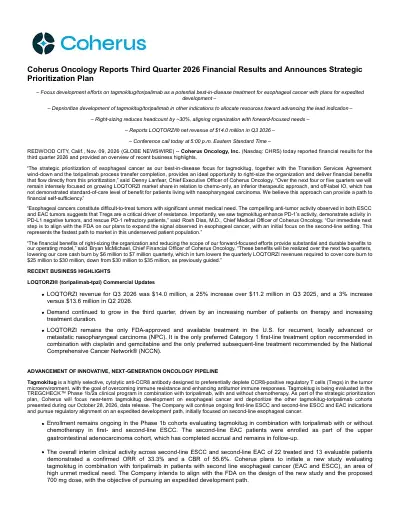
As we have spent the last few years transforming Coherus from a biosimilars company into an innovative oncology company focused on overcoming immune resistance in cancer. We've made substantial progress in reducing our debt, lowering our operating expenses, establishing Loqtorzi in the market, and advancing our clinical pipeline.
We've conducted key clinical trials and developed sufficient data to set future development direction for our tagmokitug program and select the go-forward dose. Today, I will discuss three strategic alternatives designed to make Coherus a financially self-sustaining, innovative oncology company with best-in-class and first-in-class products by the end of 2027.
First, the strategic prioritization of esophageal cancer as our focus for best-in-disease with tagmokitug. Second, the structural and financial benefits that flow directly from this prioritization.
Then finally, our emphasis on driving Loqtorzi revenues over the next four or five quarters to a level where they can fully support the company's core cash burn. When we launched tagmokitug clinical program, it was with the clear expectation that we would select the most promising area for continued development.
This is exactly what we have done. As we reported on October 28th, over the last two years, we have explored a wide range of mucosal system cancers, from head and neck to esophageal, gastric, colorectal, across various lines of therapy to understand where Treg depletion might best be advanced as combination therapy.
The emerging data from this very systematic clinical investigation demonstrated that esophageal cancer comprises a best-in-disease opportunity across first- and second-lines of therapy. Accordingly, going forward, we will sharply focusing our tagmokitug development efforts there, as this provides a substantial number of benefits.
First, providing a treatment alternative to patients confronting a particularly difficult cancer with poor prognosis. Second, our integrated approach across first- and second-line therapy will seek FDA support for rapid, efficient, and affordable development path, leading to accelerated approval.
Third, this enables ex-U.S. partnering.
Our encouraging interim data in combination with toripalimab and our development efforts focus now enables partnering discussions for ex-U.S. rights.
Toripalimab is approved in Europe and other regions for the treatment of ESCC, irrespective of PD-L1 status, and is being widely adopted in those markets. Esophageal cancer is the sixth in terms of annual cancer deaths globally, where over 400,000 patients are impacted annually, particularly in Asian countries.
Our objectives for ex-U.S. partnering include: one, use of these upfront payments to offset clinical trial expenses and support the accelerated approval approaches; secondly, partner funding for ex-U.S.
registration trials in their territories, significantly lowering the portion of overall costs that Coherus would need to incur; and third, leveraging the global regulatory constructs, such as FDA's Project Orbis, for harmonizing approvals across regions to the benefit of all parties. With data and clinical direction in hand, we are now engaging a financial advisor to conduct the tagmokitug partnering process, particularly with companies in countries with a high incidence of esophageal cancer.
We'll keep you informed on our progress. Now, let me address the structural and financial benefits derived from our strategic prioritization of esophageal cancer.
Over the last two, three years, we have pursued a broad development program across several cohorts, indications, more than 120 patients, to identify the most promising indication of interest and the go-forward dose. These objectives have now been both met, with the dose, the indication both identified for FDA discussions over 2027.
At the same time, and somewhat fortuitously, two other concurrent events provide rightsizing and cost reduction opportunities for us. First, our process transfer of toripalimab from China to the U.S.
is now complete as of Q3 2026, and the action date for the FDA for the drug product portion of the application is November 30th. You may recall the drug substance has already been approved earlier this year.
This allows us to reduce the ongoing costs associated with this transfer and approval, which increased the burn over the last two years. Second, our transition services agreement with the acquirer of Udenyca, Intas/Accord, is now pretty much wound down, allowing us to further reduce our footprint across the company.
These TSA efforts were very labor-intensive for us and artificially inflated our cash burn and were confusing for investors. The confluence of these three events—strategic prioritization, winding down the TSA, and the imminent manufacturing transfer approval—allows us an ideal opportunity to align and rightsize our organization, consistent with the reduced scope of our efforts.
Accordingly, we are announcing today that we are implementing projected 30% headcount reduction and attendant expense reductions. Our CFO, Bryan McMichael, will elaborate more on this in just a moment.
Let me give you just one key metric so you can understand the benefits in context. These rightsizing and prioritizing reductions amount to $6 to $7 million a quarter, which reduces the quarterly Loqtorzi revenues required to support the core burn from a previously guided $30 to $35 million a quarter down to $25 to $30 million a quarter.
This positions us to more readily establish a sustainable operating model, allowing us to continue investing in our high-value clinical opportunities with greater financial independence. Next, let me address commercial and revenues.
Sameer will provide more data directly, but I'll just summarize here a few of the key growth drivers. While we continue to make steady progress in penetrating the NPC market, our current share is approximately only 20% to 22%.
This means that too many patients are still receiving inferior therapy, and this represents a key growth opportunity for us. Also, the relatively low market share results in quarter-to-quarter volatility and lumpiness when one of the regions gets a disproportionate number of patient fluctuations, such as discontinuations.
This has to be addressed by increasing market share and penetration to damp out this. There is substantial opportunity remaining, with about 30% of the patients continuing to receive chemotherapy alone and not benefiting from the Loqtorzi six-year survival of 64.8 months versus 33.7 months with chemotherapy alone.
Over the next year, we'll need to dramatically reduce that 30% share by focusing on identifying these patients and reaching their providers who can then prescribe Loqtorzi in combination with chemo per our label. Given the compelling survival data, this objective appears reasonably within reach over the next 12 months.
We also plan to address the 40% of the patients who are being treated with off-label immunotherapies that lack clinical evidence of efficacy. This share is steadily going down, but faster progress is needed here also.
Physician reach and education are key here, HCPs know that we have superior data versus chemotherapy alone in our standard of care. Progress has been made here over the last three quarters, and Sameer is going to tell you about that and our strategies to reach these physicians.
Finally, our payer strategy is starting to bear fruit, as the step edits in place have proven very effective in modifying old prescribing behavior. They make physicians pay attention, this is a successful strategy we are extending in 2027.
With that, I'll now turn the call over to Rosh Dias, MD, our Chief Medical Officer. Rosh?
Rosh Dias
Thank you, Denny. Today, I'm going to talk to you about why we have selected esophageal cancer for future development as a best-in-disease approach.
We intend to pursue a second-line esophageal cancer study with both histologies, esophageal squamous cell and esophageal adenocarcinoma, as reported from our Treg-Check 102 program, due to, firstly, the strength of the signal; secondly, the high unmet medical need, particularly in the second-line setting where chemo alone is the current standard of care; and thirdly, the opportunity for a fast path-to-market strategy leveraging FDA designations and development constructs. Let me start by addressing the second-line esophageal data and our plans.
In this setting, we demonstrated activity in both squamous and adeno histologies at the go-forward dose of 700 mg tagmokitug with toripalimab. This includes nine evaluable second-line esophageal cancer patients, three adenocarcinomas and six squamous cell carcinomas.
The overall response rate data were very promising, as we saw three confirmed PRs plus one unconfirmed PR, that is, a 33.3% confirmed ORR and a 44.4% unconfirmed plus confirmed ORR. This activity exceeded the chemo-only benchmark of around 10% ORR in this area of high unmet medical need.
Additionally, the clinical benefit rate was 55.6%, with two patients remaining on treatment for over five months and two additional patients on treatment that have not as yet had their first tumor scan assessment. Importantly, this was a randomized study across the two doses, with 22 patients treated to date.
For the 300 mg tagmo dose in combination with Tori, there were no responses, and all patients progressed by four months. This demonstrates two key findings: one, these data show that toripalimab in this second-line setting has limited activity, thereby establishing contribution of effect; second, it gives confidence in the tagmo go-forward dose of 700 mg as it exhibits clear dose-dependent activity.
Very importantly, both in terms of response and duration, activity was observed both in patients who were PD-1 refractory and also patients and tumors that are PD-L1 low or negative, meaning that tagmo-Tori doublet both rescued PD-1 resistance and also demonstrated activity in cold or PD-L1 low or negative tumors. These data, irrespective of histology, inform next steps and provide the opportunity to progress our next study in second-line ESCC and second-line EAC, a similar approach to that taken in the pembrolizumab Phase 3 KEYNOTE-181 study.
Our study will investigate the tagmo-Tori doublet versus chemotherapy. Our immediate next step is to meet with the FDA to align on two topics: first, the recommended Phase 2 dose to ensure we have satisfied the requirements of Project Optimus; and second, the second-line esophageal cancer study design and any potential for this data from this next study to support expedited development, including accelerated approval.
Let me now review for you again the first-line setting interim data. In our first-line ESCC study, a safety cohort with target enrollment of 12 patients with 700 mg of tagmo in combination with Tori and cisplatin/5-FU, we demonstrated an overall response rate of 89% and 100% ORR in PD-L1 positive patients, including one complete response, that is, eight out of nine of the efficacy evaluable patient population, importantly, with activity irrespective of PD-L1 status.
The duration is also notable, with two patients demonstrating activity for close to eight months. The safety profile was manageable and acceptable.
Whilst four of the 10 safety evaluable patients discontinued due to AEs, this rate was not dissimilar to that seen in the CheckMate 648 study, and 50% of the discontinuations were due to cisplatin-related renal toxicity, which we plan to mitigate by swapping out cisplatin for oxaliplatin for the future study. In terms of the unmet medical need in first-line ESCC, there are three FDA-approved PD-1 chemo combinations for first-line disease, all with a limitation to PD-L1 positive patients only, with ORRs ranging from 44% to 59% in PD-L1 positive populations.
Of course, with the usual caveats for cross-trial comparisons, the fact that activity with the tagmo-Tori chemo combination was seen irrespective of PD-L1 status and equates to 100% in PD-L1 positive evaluable patients speaks to the potential to improve on the current standard of care. The current SOC in PD-L1 positive disease typically provides a median PFS of around seven months, and whilst durability is not as yet mature in this cohort, we look forward to continued follow-up for PFS.
These impressive first-line data provide us additional confidence in the Treg mechanism across esophageal cancers. We intend to address the first-line ESCC opportunity after we progress the second-line as part of our integrated development strategy and commitment to the disease.
In summary, these data confirming tagmo clinical activity, in addition to the established strong pharmacology previously communicated, support continued advancement, and this focus on second-line disease in these esophageal histologies represents an area of clear unmet medical need where a chemo-free option would be well-appreciated for patients. With that, I'll hand over to Sameer.
Sameer?
Sameer Goregaoker
Thank you, Rosh. Third quarter net sales were $14 million, representing 3% quarter-over-quarter growth and 25% year-over-year growth.
While sequential growth fell short of our 10% to 15% target due to slower new patient starts in a few territories, underlying drivers of long-term growth remain stable. Nationally, growth in accounts purchasing Loqtorzi for the first time was in line with the second quarter.
Patient discontinuation rates were also consistent with prior quarters, and duration of treatment continued to increase gradually. Based on a detailed assessment, we believe demand fundamentals remain strong and that localized patient flows in select territories tempered growth this quarter.
Our long-term goal is to achieve a dominant market share in the NPC space by displacing suboptimal chemotherapy-only and off-label I-Os. We have made significant investments to achieve these objectives.
Due to the rare nature of NPC and patient flow dynamics, these efforts will take time. That being said, recent market research revealed positive leading indicators of demand and strong physician sentiment.
We surveyed both academic and community oncologists to assess their perceptions of Loqtorzi and to help inform our view of future demand. The results were encouraging.
75% of surveyed oncologists now view Loqtorzi as the standard of care in NPC, compared with fewer than 35% who hold a similar view for off-label I-Os. This represents a significant favorable shift in opinion toward Loqtorzi since the last survey in early 2026.
We believe this shift is driven by our focused promotional efforts on the Loqtorzi superiority story. In addition, 57% of oncologists are now aware of our six-year overall survival data.
Recall that this data demonstrated a near doubling of survival with Loqtorzi plus chemotherapy versus chemotherapy alone. We are pleased to have achieved this level of awareness within three quarters of the data being available.
To convert these favorable physician perceptions into accelerating demand, we are focused on three priorities: First, our field team remains focused on using claims-based alerts to identify physicians who use chemotherapy alone. About a third of eligible patients still receive chemotherapy alone, and our educational efforts are geared towards minimizing the use of this suboptimal treatment.
Second, we're now collaborating with large clinical organizations to identify patients who are not receiving Loqtorzi per the label and per the NCCN guidelines. We're then working to educate physicians within these partnered organizations on the superior survival benefits of Loqtorzi.
Third, we are partnering with major national and regional payers to establish a preference for Loqtorzi in eligible NPC patients. Where these payer partnerships are already in place, our share of addressable patients is approximately double the national average.
We are now expanding these payer partnerships with the goal of covering a majority of U.S. covered lives.
We previously guided that we would achieve a $15 million quarter in 2026, and we expect to achieve that guidance in Q4. Longer term, we remain on track to reach peak market share by 2028, consistent with our prior projections.
I'll now pass the call to Bryan McMichael, our Chief Financial Officer.
Bryan McMichael
Thanks, Sameer. I will start off today by discussing Coherus' liquidity, plans for managing cash burn, and the advantages of the organizational rightsizing we announced today, including cost reductions and expected savings.
At the end of Q3 2026, we had $83.6 million in cash, cash equivalents, and investments, which is down $21.7 million from $105.3 million at the end of Q2. This change reflects an expected reduction in cash burn.
The use of cash in operations for Q3 was $34 million, which is a 43% decline from the quarterly average in the first half of 2026. As we signaled on the last earnings call, the slowdown in cash burn was primarily due to a significant reduction in cash being used to pay down TSA payables and accrued liabilities associated with the divested biosimilar business.
As announced previously, during Q3, we paid off our $38.7 million term loan using the proceeds of a new $55 million term loan that closed during the quarter. This refinancing contributed a net $11.5 million in cash to the balance sheet.
As Denny outlined, the strategic prioritization will yield significant benefits to further reduce burn. Once implemented, we expect a sustainable reduction in recurring costs of $6 to $7 million per quarter on average, and expect to achieve most of this rate of savings within two quarters.
These savings will come primarily from an approximately 30% reduction in headcount from about 140 to 100 FTEs, which will take place this month. While these reductions will come from across the organization, we are preserving substantially all the commercial organization as we prioritize driving the growth of Loqtorzi sales.
Consistent with our strategic prioritization, we plan to achieve savings by deprioritizing certain tagmokitug indications. Once successfully executed, these actions would help to extend cash runway and reduce ongoing core costs, which comprise all the non-cash costs of the business other than development costs.
This lowers the quarterly Loqtorzi revenues required to cover these core costs from $30 to $35 million, as we previously guided, to $25 to $30 million per quarter. Coherus recently received the revenue report in connection with the Udenyca divestiture.
Only a modest audit adjustment would be required to reach the earnout threshold for the first $37.5 million milestone, as the reported net sales came very close to meeting the threshold in the first earnout period. As permitted under the purchase agreement, we are exercising our audit rights and other contractual rights, and we will thoroughly review the reported results.
As a reminder, we will get the report on the second $37.5 million milestone after Q1 2027. Without considering the potential benefit of the cost reductions, the payment of the milestone, or proceeds from ex-U.S.
deals, our cash runway is less than 12 months from the date of the 10-Q we filed today. As such, that quarterly report included going concern disclosures to reflect this.
On the expense side, we had another strong quarter reducing costs versus the same quarter in the previous year. As covered by Sameer, Loqtorzi revenues were $14 million, up 3% from the prior quarter.
While we remain optimistic about the future growth trajectory of Loqtorzi, the lumpiness experienced this quarter was greater than we anticipated, we're revising the range of our revenue outlook for the year to $54 to $57 million. Turning to expenses, R&D expense from continuing operations for Q3 2026 was $22.6 million, down from $27.3 million in the third quarter of the prior year.
The decreases were primarily due to reduced headcount, lower infrastructure costs, and lower clinical trial and R&D manufacturing costs. SG&A expense from continuing operations was $21.2 million in the third quarter, which is down from $24.9 million in Q3 2025.
The decreases were primarily due to lower headcount, decreased operating costs resulting from Coherus completely exiting the biosimilar business in 2025. For the full year 2026, we reiterate the expectation that combined opex will be between $170 and $175 million.
With that, I hand the call back over to Denny.
Denny Lanfear
Thank you, Bryan. Let me summarize, first with respect to our molecule tagmokitug, and then I'll review the strategic plan for you.
We've now shown we have the right drug at the right target in the right disease to advance development in esophageal cancer. These results exceed benchmarks in first-line, expanding on current chemo-I-O options, and in second-line address the high unmet need with the chemo-free option.
Esophageal cancer is the sixth most fatal cancer worldwide, and in the U.S., approximately 18,000 cases will be diagnosed each year, and 16,000 people will die of the disease. Our immediate next steps are, first, to follow up with discussions of interested parties, both in the U.S.
and ex-U.S. We're initiating these discussions.
Secondly, align with the FDA on dose, trials, and development strategy and options for expedited development. Now regarding the strategic prioritization, as Bryan described, we're rightsizing the organization to align with our sharpened focus, thereby reducing costs.
We're going to drive the commercial sales towards core burn breakeven as quickly as possible in 2027. We will pursue non-dilutive funding options, including ex-U.S.
partnering transactions. Operator, we're ready for the questions.
Operator
Thank you. We will now begin the question-and-answer session.
As a reminder, if you wish to ask a question, you will need to press star one one on your telephone and wait for your name to be announced. To withdraw your question, please press star one one again.
Your first question comes from Paul Jeng from Guggenheim. Please go ahead.
Your line is open.
Paul Jeng
Oh, great. Thanks very much.
Appreciate all the detail on the call today. For tagmo, can you expand a little on how you're thinking about the potential regulatory path in the second-line setting?
Is this a trial perhaps where you could use PFS or even ORR as an interim for accelerated approval within a Phase 3? How strong is the precedent for combining esophageal squamous cell carcinoma with EAC in this setting?
Thanks.
Denny Lanfear
Thank you. Thank you, Paul.
I'll let Dr. LaVallee, our Chief Development and Regulatory Officer, address that.
Theresa?
Theresa LaVallee
Hi, Paul. Thanks.
Yes, there is a clear path, and it's commonly done. Many of the pembro studies included both histologies.
The FDA recognizes esophageal cancer with two histologies as a disease, there is clear precedent, with KEYNOTE-181 being the most noteworthy and most similar. Secondly, the FDA has shown, even with the recent approval with origami 4, accelerated approval last week, that ORR/BICR with durability is an endpoint that could be discussed.
That is what we plan to go with a plan to them showing a randomized study against chemotherapy, which is the only available agent for these patients, particularly in the PD-1 refractory or PD-L1 low patient population, and discuss the accelerated approval based on that, and then what the confirmatory study would look like, either as a seamless study or a stand-alone second study.
Denny Lanfear
Thank you, Paul. Did you have a follow-up question?
Paul Jeng
Yes, one quick follow-up. Obviously you had very compelling data in the frontline setting as well.
Just curious on how you're thinking about the gating factor for initiating a frontline study. Is that something you could do in parallel with the second-line study, perhaps staggered somewhat, or would that really be contingent on having a positive outcome in the second-line setting first?
Denny Lanfear
Great question. Theresa?
Theresa LaVallee
They definitely could go forward at the same time, and FDA would be enthusiastic about that because they like to see a commitment to the disease, and with their push with Project FrontRunner to move things earlier. Obviously, we've prioritized second-line given the complexity of contribution of effect in the first-line and the size and length of the study in the first-line, but given the activity that toripalimab has established in that disease and our objective of moving immunotherapy into earlier line settings, we'll continue to explore ways to develop and get more data in that disease type.
Paul Jeng
Okay. Thank you very much.
Denny Lanfear
Thank you, Paul.
Operator
Thank you. Your next question comes from Jay Olson from Oppenheimer.
Please go ahead. Your line is open.
Oh,
Jay Olson
hey. Congrats on the new sharpened focus, and thanks for taking the question.
Maybe just to follow up on the frontline opportunity, recognizing that you're prioritizing second-line ESCC, you did have eight of nine confirmed responses in the frontline, and I think I heard you say that you would continue building that data set. Can you just talk about what level of evidence would be required to preserve that frontline opportunity and push forward there?
Then if I could ask one follow-up financial question, from the current $14 million quarterly base for Loqtorzi, what are some of the commercial pushes and pulls that could give you the leverage that you need to get to the new $25 to $30 million quarterly Loqtorzi revenue threshold? Thank you.
Denny Lanfear
Thanks, Jay. I'll let Dr.
LaVallee take the question regarding frontline and your keen observation that was eight out of nine responding patients, quite impressive response rate. Theresa, why don't you do that, and then Sameer will follow up with the $14 million.
Go ahead.
Theresa LaVallee
For the first-line, I think we need three things to have a further conversation with FDA, the first being finish the enrollment, and ORR, I know we all enjoy that early readout, but I remind people all the time that durability and CBR and PFS are important. We're pleased to see it trending in the right direction, but going to FDA with a frontline study with ORR only would not lead to the most productive of conversations.
Having 22 patients in the second-line study and having randomized data really enables a productive and robust discussion about advancing development, particularly in an expedited fashion. We obviously wouldn't take advantage of the opportunity in a meeting to discuss opportunities in first-line to get their thinking while we get more data there and durability.
Denny Lanfear
Thanks, Jay. We'll have Sameer address the issue of moving up from the $14 million and the pushes and pulls, as you put it, to move it up, at least past the $15 million that we are projecting for next quarter.
Sameer?
Sameer Goregaoker
Thank you, Jay, for the question. Obviously, our immediate goal is to exceed $15 million for the guidance, but more importantly, longer term, we want to maximize the opportunity.
As Denny mentioned, we have a lot of upside here for the brand. If there's too much chemotherapy alone going on, about 30% of patients are getting chemotherapy alone, and too much Keytruda and off-label I-Os going on.
What are we doing about it, right? We have a significant, strong physician support to help us drive Loqtorzi utilization.
What's getting in the way is a typical rare disease dynamics and patient flows, which are relatively slow. Then the other thing that's getting in the way is just habit.
There's too many physicians who agree to use Loqtorzi, but six months later when the patient shows up, they don't remember to use Loqtorzi. What we're doing about it is twofold: our representatives are driving it from the bottom up, educating physicians; the other thing we're also doing is two main initiatives: we're working directly with large clinical organizations and large academic centers, and working from the top down to identify patients, put them on Loqtorzi.
Second thing we're doing is partnering with payer organizations to put preference in payers for Loqtorzi for utilization for label. When we put those two steps in place, we believe that we can accelerate demand in the coming quarters.
Denny Lanfear
I would just add, Jay, that our market share is about 22%, 20% to 22%. There's ample opportunity to grow.
We definitely have to encroach on the 30% for the chemo-only patients, but also there's 40% of other I-O which we have to pursue. We believe growth will come from the step-throughs.
To the other point, though, that Sameer just made, it's very important in the community that they convert those chemo-only patients to chemo plus Loqtorzi, those patients get the full benefits of the six-year survival. We have found that they're very receptive to that when we talk to them about it.
Jay Olson
Super helpful. Thank you.
Operator
Thank you. We will take our next question.
Your question comes from Mike Nedelcovych from TD Cowen. Please go ahead.
Your line is open.
Michael Nedelcovych
Hi. Thanks for the questions.
I have two. My first is on tagmokitug, and specifically the combination with pasritamig.
Were any patients dosed with that combination, and if not, will it be deprioritized before it starts? I ask—
Denny Lanfear
Hey, Mike, hold on to that. Let me get to that one first, and then I'll have Rosh take care of that, and then we'll go for your second question.
Go ahead, Rosh. Sure,
Michael Nedelcovych
sure.
Bryan McMichael
Hey, Mike. Good to speak to you.
For the pasri study, actually, we've initiated the study already, there are a couple of sites that have initiated, they're in screening already, so that is a priority that we are continuing. The important point here is that this is in conjunction with the T-cell engager, so that's, again, we've talked about the fact that it's first-in-disease, first in combination with the T-cell engager, yes, we're progressing that.
Denny Lanfear
Just on that point, Mike, I think it's very interesting. Dr.
LaVallee may have additional comments on the tumor microenvironment remodeling and some of the other things we've seen, and how that might apply to other TCE undertakings. Theresa, do you want to comment?
Theresa LaVallee
Yes, the data that we've shared on the Treg-Check program has shown removing the immune suppressor cells, bringing the CD8s in, and really potentiating an immune response. I am particularly enthusiastic about a T-cell engager combination, given that the challenge for the magnitude of benefit of those agents has been a lack of T cells and the Tregs being present.
We are incredibly excited about that. We were excited to see on Saturday that J&J presented combination data with pasri and their PSMA-CD28 showing really nice safety and an ability to potentiate the PSA response.
We have our benchmarks, and we look forward to a few days in this combination dosing patients.
Denny Lanfear
Theresa, how does that bode for other similar TCE studies if the safety is borne out with pasritamig in prostate?
Theresa LaVallee
I think I'll be very, very busy with looking at all the options.
Denny Lanfear
Mike, did you have a follow-on question?
Michael Nedelcovych
Awesome. No, that answers it.
We'll look forward to hopefully seeing some data from that cohort at some point in the future. My other question actually relates to casdozokitug.
I guess I was just curious if you could clarify. I assume it's not being deprioritized per se, presumably you're waiting for the HCC data before making a go/no-go decision.
If that's right, can you share with us what is the benchmark in your mind to support continued investment behind casdozo?
Denny Lanfear
I can handle the first part of that, and I'll let Dr. Dias handle the second part.
No, no, no. Casdozokitug has not been deprioritized.
It's maturing nicely. I think that we've recently said, I think, that it has shown, I think, very strong dose-response differentiation.
It's that the response is maturing, and so we'll probably have some additional insights on how that's going and have more to say about that sometime in Q1, early part of the year. It just is taking time for it to develop a bit.
When you have a situation where less than half the patients have a sufficient number of scans, you just have to wait. With respect to the benchmarks, I'll let Dr.
Dias talk about that. Rosh?
Rosh Dias
Mike. I'll just mention two points.
I'll reiterate that what we're seeing, what we are seeing so far is dose-dependent activity, right, with casdozo. The second point is that this data does take a little bit of time to mature.
You'll recall that from our prior study, casdozo-atezo-bev, the first data set that we reported an ORR of 27%, which over time went up to 38%, and also there was zero CRs in the initial cut, which went up to five CRs in the final cut. We do anticipate that similar pattern with the current study.
I think if we see an initial ORR that matches our prior data, we'd be happy because the important point is that we have to see this data mature and deepen and increase with time. I think that's what we were looking for at a minimum in our initial study.
Of course, the safety profile that's consistent, which is which was very consistent with just the atezo-bev alone previously.
Michael Nedelcovych
Great.
Denny Lanfear
Thanks, Mike.
Operator
Thank you. We will take our next question.
Your question comes from Charles Wallace from H.C. Wainwright.
Please go ahead. Your line is open.
Charles Wallace
Hi. Thanks for taking my question.
This is Charles on for RK. I guess, maybe for me, what specifically makes the second-line esophageal cancer setting the fastest pathway to market?
When do you expect to have the meeting with the FDA, and at this point, what have you discussed with the FDA on this program? Thanks.
Denny Lanfear
All great questions, Charles. Dr.
LaVallee, could you address those two issues, the why second-line the fastest and where we are with the FDA?
Theresa LaVallee
It's clear that second-line esophageal cancer is a high unmet medical need. Reading the most recent approval in second-line ESCC with tislelizumab, and if you read the FDA comments on their approval, they discuss how underserved these patients are repeatedly.
One of the criticisms in that approval package was that they had not tested in PD-1 refractory diseases, and given that PD-1 was established, that this would be limited availability to any patient in the U.S. Given the unmet medical need, it's still going to get approved.
Just in reading their writings of their perspective of this disease, in second-line EAC, there's really nothing approved. These patients have chemotherapy as an option.
They're clearly very sick. As we saw in our study, the overall survival in this patient population is about eight months.
In terms of following up on a compelling signal where we've shown contribution of effect, we have 22 patients in the randomized study with an ORR, and importantly, several patients with stable disease out about eight months on treatment. That enables a conversation, as well as the powering of a study for what we would need to see in a randomized study to really go forward with the FDA on regulatory approaches.
That makes it streamlined, fast. We know the drugs, we can talk about contribution of effect.
We've had a Type B meeting with FDA to align on our Project Optimus randomized cohorts that we just presented. The next two meetings that my team is working on immediately and plans to meet with the FDA early in 2027 are get the recommended Phase 2 dose buttoned up, and the second meeting is a Type B meeting to discuss development in esophageal cancer.
Denny Lanfear
Activity in both histologies, squamous and adeno, patients that are progressing very rapidly, unmet need with no real therapy other than chemotherapy, and our ability really to positively impact these patients' lives.
Theresa LaVallee
One more thing that I just want to add, because there's a lot of chatter about applicability to U.S. medical practice.
We have U.S. patients in the study, and U.S.
patients that are part of the benefiting patients. I think that really sets us up with meeting many of the FDA's requests for how to go forward in the disease.
Denny Lanfear
Thank you, Charles.
Charles Wallace
Great. Thank you for taking my questions.
Operator
Thank you. Once again, if you wish to ask a question, please press star one one on your telephone.
We will take our next question. The question is from Brian Cheng from J.P.
Morgan. Please go ahead.
Your line is open.
Brian Cheng
Hey, guys. Thanks for taking our questions this afternoon.
Just building on the previous question here, as we think about the expedited development path in second-line ESCC for tagmo and Tori, how should we think about the potential setup of a study? I know that Theresa, you talked about KEYNOTE-181 as comparable here.
Is that a fair comp to think about accelerated trial here, and also any color on what kind of response metric and also the size of the study that you'll need? Thank you.
Denny Lanfear
Hey, Brian. Thanks.
Theresa, do you want to take that for Brian?
Theresa LaVallee
The next study we're looking at is a randomized study against chemotherapy. With both histologies, looking across PD-L1 subtypes, and that's what we would want to refine with them as a Phase 2 study with an opportunity for accelerated approval on a BICR ORR, blinded independent central review ORR, with a duration of six months.
Currently, chemotherapy is at 10%, and the six months, like we said, the median OS is around eight months, six months is a pretty healthy look. I think doubling that to tripling that would be adequate, but those will be the conversations we'll have, I'll be able to answer specifically following an FDA discussion.
Denny Lanfear
Theresa, for Brian's benefit, when do you think we'll have those discussions? When do you think the package will go in, and when do you think we'll get something to say?
Theresa LaVallee
We're actively working on it with trying to have the meeting in the first quarter. Clearly, submitting at the end of this year, early next year, 60-day clock, it tells you March time frame is what we're looking at.
In terms of KEYNOTE-181, I just want to point out a couple of things: that's a Phase 3. KEYNOTE-590, the first-line esophageal study, also combined histologies, not unheard of.
But 181 did fail in the PD-L1 below 10 and also failed in the EAC histology. We're not looking to repeat that study; we're looking to go beyond that study and also treat patients who have progressed on frontline immunotherapy.
It has been commonly done and accepted by FDA in multiple lines of treatment.
Denny Lanfear
Thank you, Brian.
Brian Cheng
Thanks for the color.
Operator
Thank you. There seems to be no further questions.
I will hand back for closing remarks.
Denny Lanfear
Thank you, Heidi. Thank you all for joining us today on our Q3 call.
We will be at Guggenheim tomorrow, and we'll see you there, and we'll also see you in Jefferies in London. Thank you.
Operator
This concludes today's conference call. Thank you for participating.
You may now disconnect.